Japan HVAC and Fan Motor Market Size & Growth Rate
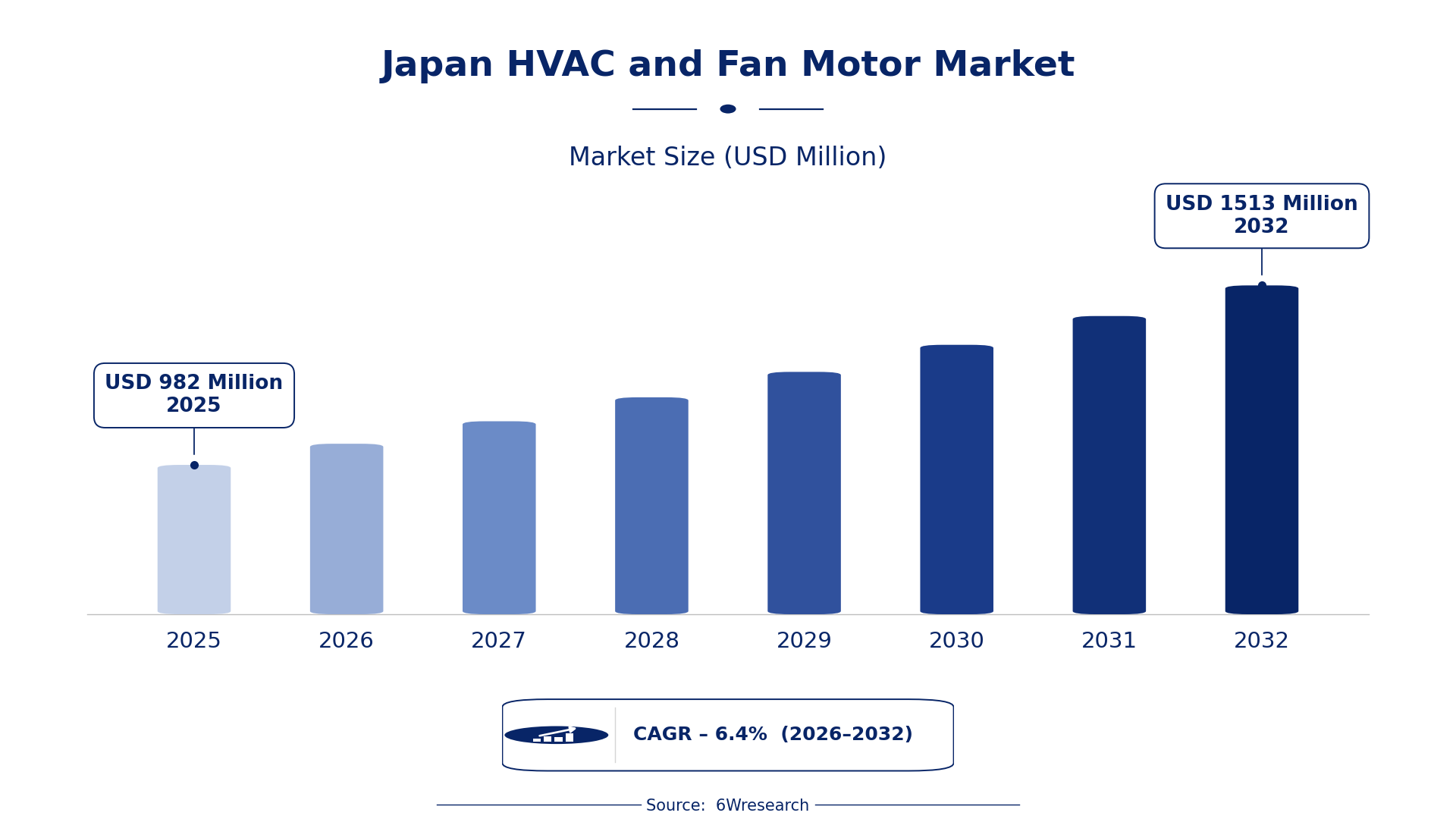
According to 6Wresearch internal database and industry insights, the Japan HVAC and Fan Motor Market was valued at USD 982 Million in 2025 and is projected to reach USD 1,513 Million by 2032, growing at a CAGR of approximately 6.4% during 2026–2032.
Japan HVAC and Fan Motor Market Highlights
| Report Metric | Details |
| Report Name | Japan HVAC and Fan Motor Market (2026-2032) |
| Market Size 2025 | USD 982 Million |
| Market Size 2032 | USD 1,513 Million |
| Absolute Growth 2025–2032 | USD 531 Million |
| CAGR 2026–2032 | 6.4% |
| Peak Annual Growth | 7.3% in 2028 |
| Forecast Period | 2026–2032 |
| Historical Data | 2022–2025 |
| Base Year | 2025 |
| Leading Motor Type, 2025 | PSC Motors (39% share) |
| Leading Speed Type, 2025 | Single Speed (37% share) |
| Leading Distribution Channel, 2025 | Motor Distributors (36% share) |
| Leading End User, 2025 | Split AC Manufacturers (36% share) |
| Fastest-Growing Motor Type | ECM Motors (8.8% CAGR) |
| Fastest-Growing Speed Type | Variable Speed (9.0% CAGR) |
| Fastest-Growing Distribution Channel | OEM HVAC Suppliers (8.3% CAGR) |
| Fastest-Growing End User | Commercial HVAC Units (8.1% CAGR) |
| Growing Sector | HVAC manufacturing |
| Key End Users | Split AC Manufacturers, Commercial HVAC Units, OEM HVAC Suppliers, Motor Distributors |
Japan HVAC and Fan Motor Market Year-wise Growth Rate and Key Drivers (2022–2032)
This graph illustrates the annual growth rates of the market from 2022 to 2032, highlighting a steady upward trajectory and projected market expansion over the forecast period.
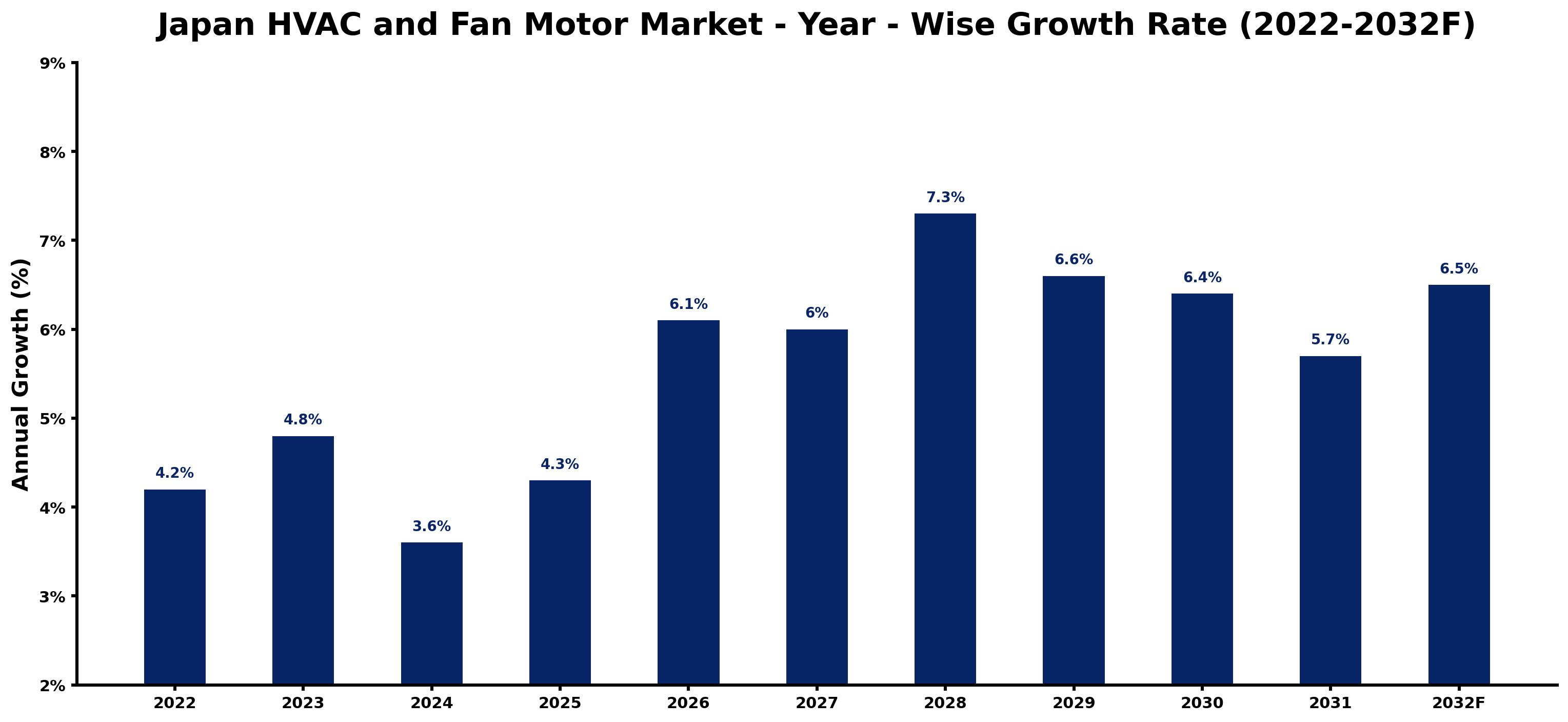
The table below sets out the estimated growth rate for each year and the main factor behind it.
| Year | Estimated Annual Growth (%) | Market Rationale |
| 2022 | 4.2 | The market experienced steady growth due to ongoing demand from domestic users. |
| 2023 | 4.8 | Growth accelerated as energy-efficient technologies gained traction among HVAC manufacturers. |
| 2024 | 3.6 | The market saw a slowdown as energy regulations began to impact purchasing decisions. |
| 2025 | 4.3 | Demand increased as manufacturers adopted high-efficiency motors to comply with standards. |
| 2026 | 6.1 | Growth is expected to continue as variable speed motors become more popular in residential applications. |
| 2027 | 6.0 | A slight slowdown is projected as competition intensifies among motor suppliers. |
| 2028 | 7.3 | The market is expected to peak with strong demand for advanced motor technologies in HVAC systems. |
| 2029 | 6.6 | Growth is projected to slow as the market adjusts to new energy consumption regulations. |
| 2030 | 6.4 | A further slowdown is anticipated as buyers focus on cost-effective solutions. |
| 2031 | 5.7 | The market will continue to grow, albeit at a slower pace due to market saturation. |
| 2032 | 6.5 | Demand is expected to rise again as innovation in energy-efficient technologies continues. |
Note: Market size estimations and growth projections presented in this report are based on 6Wresearch's proprietary forecasting methodology, utilizing the latest available industry data, government publications, and primary research inputs.
Japan HVAC and Fan Motor Market Synopsis
HVAC and fan motors are electrical devices that convert electrical energy into mechanical energy for heating, ventilation, and air conditioning systems. The Japan HVAC and Fan Motor Market is projected to reach 3.5 million units by 2025, driven by the need for energy-efficient solutions and government initiatives promoting advanced technologies. The population of approximately 126 million supports this growth, alongside investments in energy-saving upgrades and compliance with standards such as JIS B 8616. The focus on reducing carbon emissions in HVAC systems further fuels demand, creating a vibrant market environment.
Market Dynamics Impact Analysis (2026–2032)
| Factor | Type | Impact | Primary Segment Affected |
| Increasing adoption of energy-efficient motors | Driver | High | ECM Motors |
| Growing demand for variable speed motors in residential HVAC systems | Driver | High | Variable Speed |
| Rising focus on energy regulations and standards compliance | Opportunity | High | High-Efficiency |
| Expansion of HVAC manufacturing in major industrial regions | Opportunity | Medium | Commercial HVAC Units |
| Competition among suppliers affecting pricing strategies | Restraint | High | Motor Distributors |
| Challenges in sourcing advanced motor technologies | Restraint | Medium | OEM HVAC Suppliers |
| High costs associated with energy-efficient upgrades | Challenge | High | Split AC Manufacturers |
| Regulatory compliance costs impacting smaller manufacturers | Challenge | Medium | HVAC OEM Integrators |
Evaluation of Drivers in Japan HVAC and Fan Motor Market (2026–2032)
The following drivers explain most of the expected growth.
| Drivers | Primary Segment Affected | Why It Matters (Evidence) |
| Increased energy efficiency in HVAC systems | ECM Motors | Energy-efficient motors are promoted under the GX Promotion Act, resulting in higher sales. |
| Growing preference for variable speed technology | Variable Speed | Variable speed motors are increasingly adopted in residential HVAC systems, enhancing comfort levels. |
| Government initiatives supporting energy-saving technologies | High-Efficiency | The Ministry of the Environment promotes energy-saving technologies, which drives demand for compliant products. |
| Expansion of HVAC manufacturing capabilities in Tokyo and Osaka | Commercial HVAC Units | Tokyo and Osaka are major industrial regions, boosting demand for HVAC components. |
| Rising consumer awareness of energy consumption | Split AC Manufacturers | The average energy consumption in HVAC systems accounts for 30% of total building energy use. |
In 2023, energy-efficient motors are projected to account for a substantial portion of the HVAC market, supported by Japan's population of approximately 126 million, which contributes to the demand for advanced technologies. The emphasis on reducing carbon emissions in HVAC systems shapes purchasing decisions, particularly among manufacturers of commercial HVAC units. By 2025, high-efficiency motors are expected to represent 40% of the market, reflecting the shift towards more sustainable solutions.
Evaluation of Restraints in Japan HVAC and Fan Motor Market
The following restraints limit how fast demand can grow.
| Market Restraint | Primary Segment Affected | Why It Matters (Evidence) |
| Intense competition leading to price pressures | Motor Distributors | Competition among suppliers affects pricing strategies, causing profit margins to shrink. |
| Difficulty in sourcing advanced motor technologies | OEM HVAC Suppliers | Challenges in sourcing advanced technologies can delay product development and market entry. |
| High costs associated with energy-efficient upgrades | Split AC Manufacturers | Upgrading to energy-efficient systems incurs high costs, which can deter purchasing decisions. |
| Regulatory compliance costs for smaller manufacturers | HVAC OEM Integrators | Compliance with energy regulations can strain resources for smaller manufacturers. |
| Market saturation affecting growth potential | Commercial HVAC Units | As the market matures, growth potential diminishes, leading to cautious investment. |
Japan HVAC and Fan Motor Market Challenges
Producers encounter a skills shortage, as the HVAC industry employs over 200,000 workers but struggles to attract new talent, resulting in project delays. Rising material costs, particularly for copper and steel, have led to price increases of up to 15% for HVAC systems, which strains budgets for contractors. Compliance with the JIS B 8616 standard requires additional testing and certification, extending project timelines by several weeks for contractors. Supply chain disruptions for advanced motor technologies create shortages, delaying installations for producers in key industrial areas like Tokyo and Osaka.
Trends in the Japan HVAC and Fan Motor Market
Buyers and suppliers in the Japan HVAC and Fan Motor Market are adjusting to the following trends.
- Transition to Energy-Efficient Motors: The HVAC market is transitioning towards energy-efficient motors, influenced by government initiatives. By 2025, high-efficiency motors are expected to account for 40% of the market, prompting manufacturers to invest in advanced technologies.
- Rise of Variable Speed Technology: Variable speed motors are becoming standard in residential HVAC systems, promoting energy savings and comfort. This trend is reflected in the increasing demand for these motors, projected to grow at a CAGR of 9.0%.
- Focus on Sustainable HVAC Solutions: The push for sustainability is influencing HVAC manufacturers to adopt greener technologies. Initiatives from the Ministry of the Environment are encouraging investments in energy-saving solutions, impacting purchasing decisions across the sector.
- Growth of High-Efficiency Motors in Commercial Applications: Commercial HVAC units are increasingly utilising high-efficiency motors due to rising energy costs. This trend is expected to continue as businesses seek to reduce operational expenses and comply with energy regulations.
Investment Opportunities in the Japan HVAC and Fan Motor Market
The following areas offer the clearest openings for investors and suppliers in the Japan HVAC and Fan Motor Market.
- Growing Demand for Energy-Efficient Upgrades: With a projected value of 1 trillion yen, the HVAC market presents opportunities for suppliers of energy-efficient motors. Split AC Manufacturers are increasingly investing in these technologies to meet regulatory standards.
- Expansion of HVAC Manufacturing in Major Regions: Tokyo and Osaka serve as key industrial hubs for HVAC manufacturing, presenting substantial investment potential. Collaborating with local manufacturers can facilitate market entry and distribution.
- Investment in High-Efficiency Motor Technologies: The demand for high-efficiency motors is set to rise, offering opportunities for suppliers to innovate. OEM HVAC Suppliers are seeking advanced solutions to meet energy regulations.
- Growing Market for Variable Speed Motors: The increasing adoption of variable speed motors presents a lucrative opportunity for suppliers. Partnering with HVAC OEM Integrators can facilitate access to this expanding market.
Government Initiatives in the Japan HVAC and Fan Motor Market
The GX Promotion Act (2023) introduces a framework to support energy efficiency initiatives in HVAC systems, enhancing the existing Act on the Rational Use of Energy (1979). This new measure obliges large energy users to improve energy efficiency, ensuring compliance with modern standards and promoting the adoption of advanced technologies.
Buyers, particularly Split AC Manufacturers, benefit from the subsidy program launched in 2023 for energy-efficient HVAC upgrades. This program encourages investment in high-efficiency motors, helping manufacturers reduce operational costs while complying with energy regulations.
Future Insight of the Japan HVAC and Fan Motor Market
Energy-efficient motors will drive demand by 2032, supported by government subsidies for HVAC upgrades. The introduction of new energy-saving standards will motivate investments in modern systems, aligning with the goal of a 20% reduction in energy consumption by 2030. The HVAC market will shift towards high-efficiency motors, expected to account for 40% of the market, offering improved performance and lower operational costs. Innovations in HVAC technologies will receive backing from industry associations, benefiting both suppliers and end users.
Market Segmentation Analysis
Japan HVAC and Fan Motor Market report covers a detailed analysis of the following market segments:
By Motor Type – PSC Motors Lead, ECM Motors Expected to Grow Fastest
According to Saurav Kr Singh, Senior Research Analyst at 6Wresearch, PSC Motors held 39% of the Japan HVAC and Fan Motor Market by motor type in 2025. PSC Motors dominate the market due to their widespread use in HVAC applications, valued for their simplicity and cost-effectiveness. This type of motor is commonly found in various HVAC systems, making it a preferred choice among manufacturers. Over 2026–2032, ECM Motors are expected to post the fastest growth, at a CAGR of 8.8%. ECM Motors are gaining traction as they are increasingly adopted for energy-efficient HVAC systems, driven by government initiatives promoting energy savings. The push for advanced motor technologies has led to a notable rise in their usage in recent years. Suppliers should focus on developing energy-efficient motor technologies to meet rising demand.
By Speed Type – Single Speed Leads, Variable Speed Expected to Grow Fastest
Single Speed took 37% of speed type revenue in 2025, more than any other category. Single Speed motors hold the largest share as they are the standard choice for traditional HVAC applications, ensuring reliability across various systems. Their extensive use in both residential and commercial buildings exemplifies their established presence in the market. Variable Speed is set to record the highest CAGR in this split, 9.0% over 2026–2032. Variable Speed motors are rapidly gaining popularity due to their ability to provide energy savings and enhanced comfort in HVAC systems. The government's initiatives promoting energy-efficient technologies further drive the demand for these motors, indicating a strong growth trajectory. Suppliers should prioritise Variable Speed motors to meet the increasing demand for energy-efficient solutions.
By Distribution Channel – Motor Distributors Lead, OEM HVAC Suppliers Expected to Grow Fastest
Motor Distributors accounted for 36% of the market by distribution channel in 2025. Motor Distributors dominate the market by providing HVAC motors to a wide range of sectors, serving as a crucial link between manufacturers and end-users. Their established networks ensure a consistent supply chain that meets the diverse needs of the HVAC industry. OEM HVAC Suppliers are projected to grow fastest, at a CAGR of 8.3% during 2026–2032. OEM HVAC Suppliers are witnessing significant growth as they serve as the main source for manufacturers, addressing the rising demand for integrated HVAC solutions. Their close partnerships with manufacturers enable them to swiftly respond to changing market trends and requirements. Suppliers need to strengthen partnerships with OEMs to leverage the growing market opportunities.
By End User – Split AC Manufacturers Lead, Commercial HVAC Units Expected to Grow Fastest
In 2025, Split AC Manufacturers led the end user split with a 36% share. Split AC Manufacturers are the largest end users of HVAC motors, reflecting their dominance in the residential cooling market. Their consistent demand for motors ensures a stable market for motor suppliers. The quickest growth will come from Commercial HVAC Units, forecast to expand at a CAGR of 8.1% between 2026 and 2032. Commercial HVAC Units are driving the fastest growth in motor demand due to the increasing need for efficient climate control in commercial spaces. The expansion of commercial infrastructure is contributing to this surge. Suppliers should target commercial applications to capitalise on the growing demand for HVAC solutions.
Key Attractiveness of the Report
- 10 Years of Market Numbers
- Historical Data Starting from 2022 to 2025
- Base Year 2025
- Forecast Data until 2032
- Key Performance Indicators Impacting the Market
- Major Upcoming Developments and Projects
Key Highlights of the Report:
- Japan HVAC and Fan Motor Market Outlook
- Market Size of Japan HVAC and Fan Motor Market, 2025
- Forecast of Japan HVAC and Fan Motor Market, 2032
- Historical Data and Forecast of Japan HVAC and Fan Motor Revenues & Volume for the Period 2022-2032F
- Japan HVAC and Fan Motor Market Trend Evolution
- Japan HVAC and Fan Motor Market Drivers and Challenges
- Japan HVAC and Fan Motor Price Trends
- Japan HVAC and Fan Motor Porter's Five Forces
- Japan HVAC and Fan Motor Industry Life Cycle
- Historical Data and Forecast of Japan HVAC and Fan Motor Market Revenues & Volume By Motor Type for the Period 2022-2032F
- Historical Data and Forecast of Japan HVAC and Fan Motor Market Revenues & Volume By PSC Motors for the Period 2022-2032F
- Historical Data and Forecast of Japan HVAC and Fan Motor Market Revenues & Volume By ECM Motors for the Period 2022-2032F
- Historical Data and Forecast of Japan HVAC and Fan Motor Market Revenues & Volume By Shaded Pole Motors for the Period 2022-2032F
- Historical Data and Forecast of Japan HVAC and Fan Motor Market Revenues & Volume By Brushless DC Motors for the Period 2022-2032F
- Historical Data and Forecast of Japan HVAC and Fan Motor Market Revenues & Volume By Speed Type for the Period 2022-2032F
- Historical Data and Forecast of Japan HVAC and Fan Motor Market Revenues & Volume By Single Speed for the Period 2022-2032F
- Historical Data and Forecast of Japan HVAC and Fan Motor Market Revenues & Volume By Variable Speed for the Period 2022-2032F
- Historical Data and Forecast of Japan HVAC and Fan Motor Market Revenues & Volume By Compact for the Period 2022-2032F
- Historical Data and Forecast of Japan HVAC and Fan Motor Market Revenues & Volume By High-Efficiency for the Period 2022-2032F
- Historical Data and Forecast of Japan HVAC and Fan Motor Market Revenues & Volume By Distribution Channel for the Period 2022-2032F
- Historical Data and Forecast of Japan HVAC and Fan Motor Market Revenues & Volume By Motor Distributors for the Period 2022-2032F
- Historical Data and Forecast of Japan HVAC and Fan Motor Market Revenues & Volume By OEM HVAC Suppliers for the Period 2022-2032F
- Historical Data and Forecast of Japan HVAC and Fan Motor Market Revenues & Volume By Online Vendors for the Period 2022-2032F
- Historical Data and Forecast of Japan HVAC and Fan Motor Market Revenues & Volume By HVAC OEM Integrators for the Period 2022-2032F
- Historical Data and Forecast of Japan HVAC and Fan Motor Market Revenues & Volume By End User for the Period 2022-2032F
- Historical Data and Forecast of Japan HVAC and Fan Motor Market Revenues & Volume By Split AC Manufacturers for the Period 2022-2032F
- Historical Data and Forecast of Japan HVAC and Fan Motor Market Revenues & Volume By Commercial HVAC Units for the Period 2022-2032F
- Historical Data and Forecast of Japan HVAC and Fan Motor Market Revenues & Volume By Residential Fans for the Period 2022-2032F
- Historical Data and Forecast of Japan HVAC and Fan Motor Market Revenues & Volume By Industrial Ventilation for the Period 2022-2032F
- Japan HVAC and Fan Motor Import Export Trade Statistics
- Market Opportunity Assessment By Motor Type
- Market Opportunity Assessment By Speed Type
- Market Opportunity Assessment By Distribution Channel
- Market Opportunity Assessment By End User
- Japan HVAC and Fan Motor Top Companies Market Share
- Japan HVAC and Fan Motor Competitive Benchmarking By Technical and Operational Parameters
- Japan HVAC and Fan Motor Company Profiles
- Japan HVAC and Fan Motor Key Strategic Recommendations
Market Covered
The study includes the following segmentation.
By Motor Type
- PSC Motors
- ECM Motors
- Shaded Pole Motors
- Brushless DC Motors
By Speed Type
- Single Speed
- Variable Speed
- Compact
- High-Efficiency
By Distribution Channel
- Motor Distributors
- OEM HVAC Suppliers
- Online Vendors
- HVAC OEM Integrators
By End User
- Split AC Manufacturers
- Commercial HVAC Units
- Residential Fans
- Industrial Ventilation































