Japan HVAC Damper Controller Market Size & Growth Rate
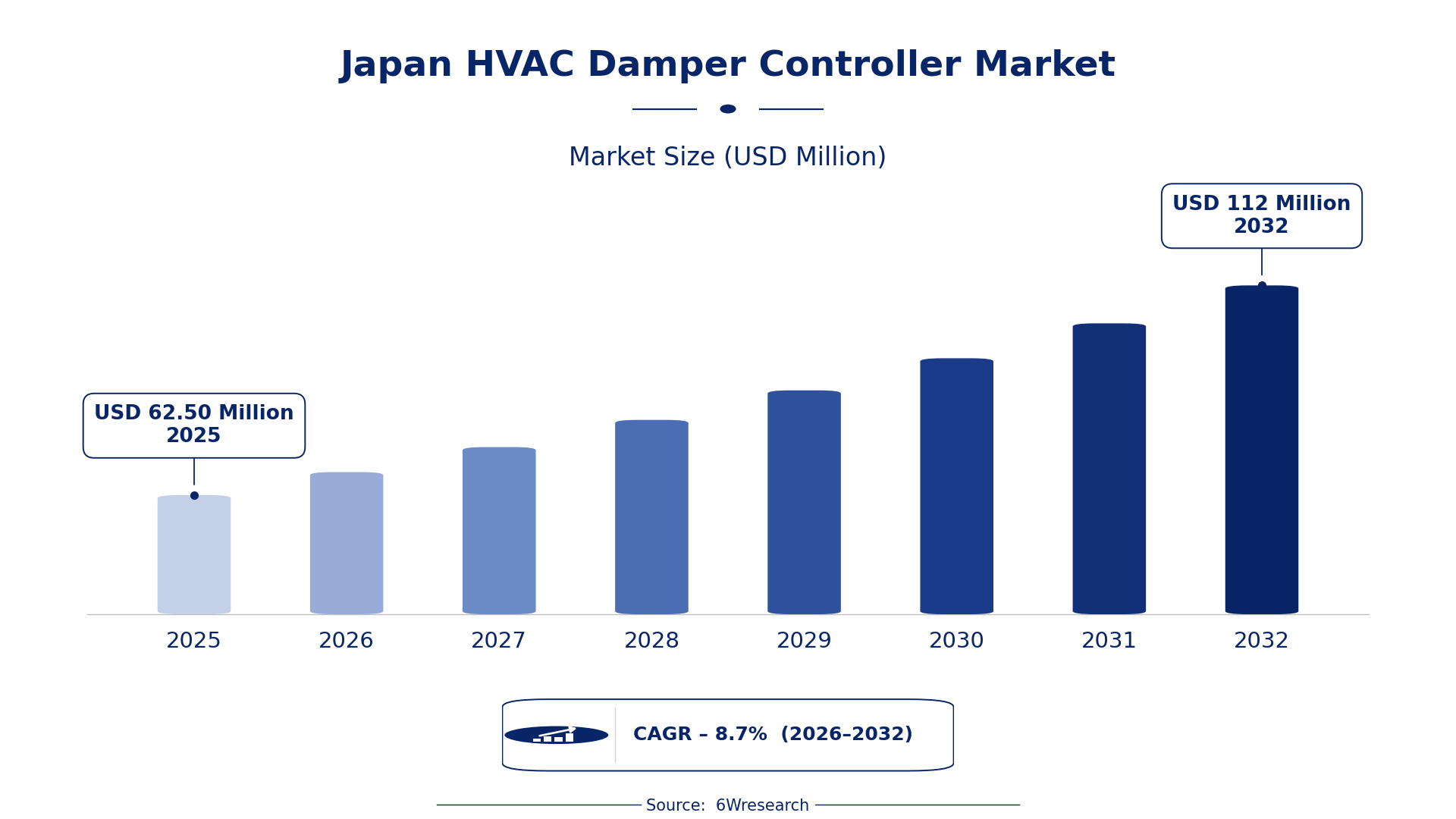
According to 6Wresearch internal database and industry insights, the Japan HVAC Damper Controller Market was valued at USD 62.50 Million in 2025 and is projected to reach USD 112 Million by 2032, growing at a CAGR of approximately 8.7% during 2026–2032.
Japan HVAC Damper Controller Market Highlights
| Report Metric | Details |
| Report Name | Japan HVAC Damper Controller Market (2026-2032) |
| Market Size 2025 | USD 62.50 Million |
| Market Size 2032 | USD 112 Million |
| Absolute Growth 2025–2032 | USD 49.50 Million |
| CAGR 2026–2032 | 8.7% |
| Peak Annual Growth | 11.2% in 2032 |
| Forecast Period | 2026–2032 |
| Historical Data | 2022–2025 |
| Base Year | 2025 |
| Leading Controller Type, 2025 | Smart IoT Controllers (55% share) |
| Leading Control Mechanism, 2025 | App/Cloud-Based (51% share) |
| Leading Distribution Channel, 2025 | HVAC Distributors (44% share) |
| Leading End User, 2025 | Smart Buildings (52% share) |
| Fastest-Growing Control Mechanism | Electric Actuation (12.2% CAGR) |
| Fastest-Growing Distribution Channel | Online Platforms (11.7% CAGR) |
| Fastest-Growing End User | Modern Homes (11.8% CAGR) |
| Growing Sector | smart buildings |
| Key End Users | construction sector, HVAC distributors, smart building developers, urban homeowners |
Japan HVAC Damper Controller Market Year-wise Growth Rate and Key Drivers (2022–2032)
This graph illustrates the annual growth rates of the market from 2022 to 2032, highlighting a steady upward trajectory and projected market expansion over the forecast period.
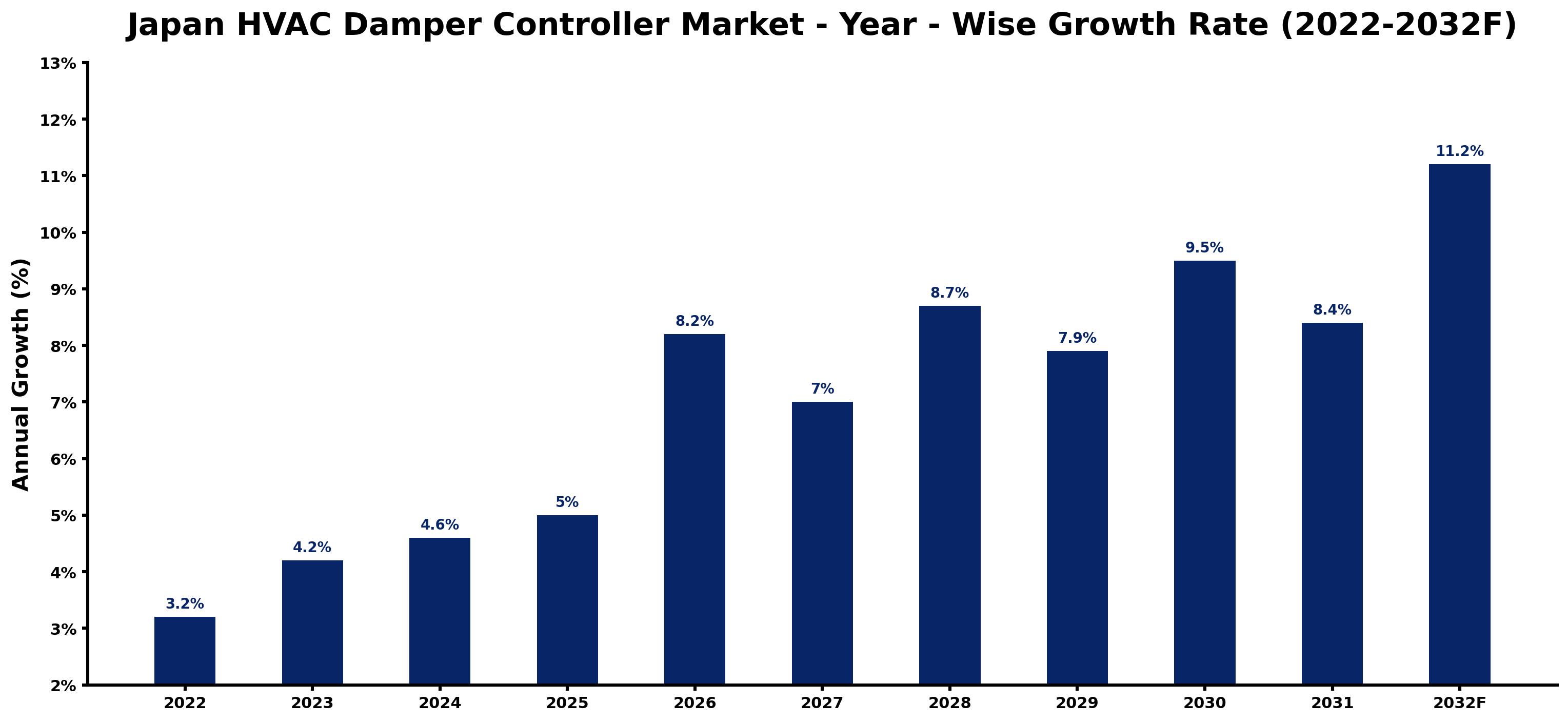
Each row of the following table gives one year's estimated growth and the event or demand shift that explains it.
| Year | Estimated Annual Growth (%) | Market Rationale |
| 2022 | 3.2 | The market experienced steady growth as urbanisation continued to rise. |
| 2023 | 4.2 | Demand increased due to heightened awareness of energy efficiency in buildings. |
| 2024 | 4.6 | Growth accelerated as more smart buildings were constructed in urban areas. |
| 2025 | 5.0 | The market peaked as the adoption of advanced HVAC technologies surged. |
| 2026 | 8.2 | Investment in smart building technologies is expected to drive growth. |
| 2027 | 7.0 | The growth rate is projected to slow as the market begins to stabilise after rapid expansion. |
| 2028 | 8.7 | Demand is expected to rise again as more consumers adopt energy-efficient solutions. |
| 2029 | 7.9 | The market is projected to experience a slowdown as competition intensifies among suppliers. |
| 2030 | 9.5 | Growth is expected to pick up due to rising energy consumption reduction targets. |
| 2031 | 8.4 | The growth rate is projected to moderate as market saturation begins to occur. |
| 2032 | 11.2 | The market is expected to peak as smart building initiatives gain traction. |
Note: Market size estimations and growth projections presented in this report are based on 6Wresearch's proprietary forecasting methodology, utilizing the latest available industry data, government publications, and primary research inputs.
Japan HVAC Damper Controller Market Synopsis
HVAC Damper Controllers are crucial devices that regulate airflow in heating, ventilation, and air conditioning systems, improving indoor comfort and air quality. The Japan HVAC Damper Controller Market is expanding, driven by the increasing prevalence of smart buildings, expected to rise by 20% by 2025, and the Building Energy Efficiency Act, which mandates energy standards for new constructions. With a market value exceeding 1 trillion yen annually, demand arises from urbanisation and the need for advanced climate control solutions.
Market Dynamics Impact Analysis (2026–2032)
| Factor | Type | Impact | Primary Segment Affected |
| Growing adoption of smart building technologies | Driver | High | Smart IoT Controllers |
| Rising energy efficiency standards | Driver | High | Electric Actuation |
| Expansion of the construction sector in urban areas | Opportunity | High | HVAC Distributors |
| Increasing demand for energy-efficient HVAC solutions | Opportunity | High | Smart IoT Controllers |
| Limited awareness of advanced HVAC technologies | Restraint | Medium | Motorized Damper Control |
| High initial investment costs for smart systems | Restraint | Medium | Smart IoT Controllers |
| Competition from alternative energy-efficient solutions | Challenge | High | Electric Actuation |
| Supply chain disruptions affecting component availability | Challenge | Medium | HVAC Distributors |
Evaluation of Drivers in Japan HVAC Damper Controller Market (2026–2032)
The main growth drivers and the segments they affect most are set out below.
| Drivers | Primary Segment Affected | Why It Matters (Evidence) |
| Increased urbanisation leading to more smart buildings | Smart IoT Controllers | The Tokyo metropolitan area accounts for approximately 30% of HVAC demand, driving purchases of smart solutions. |
| Government initiatives promoting energy efficiency | Electric Actuation | The Ministry of the Environment aims to reduce energy consumption in buildings by 30% by 2030, boosting demand. |
| Rising consumer awareness of indoor air quality | Motorized Damper Control | As the population of Japan approaches 125 million, more buyers seek advanced controls for better air quality. |
| Technological advancements in HVAC systems | App/Cloud-Based | The number of smart homes is projected to reach 10 million by 2025, increasing demand for remote management solutions. |
| Growing construction sector requiring modern HVAC solutions | HVAC Distributors | The HVAC market in Japan is valued at over 1 trillion yen annually, creating opportunities for distributors. |
Spending rises because Japan's population of approximately 125 million creates strong demand for improved indoor air quality. The target to reduce energy consumption in buildings by 30% by 2030 encourages investment in energy-efficient HVAC solutions. As smart homes are projected to reach 10 million by 2025, buyers increasingly seek advanced controls. The HVAC market in Japan is valued at over 1 trillion yen annually, stimulating growth in the construction sector. Urban areas, with a high concentration of smart buildings, drive purchases of advanced solutions.
Evaluation of Restraints in Japan HVAC Damper Controller Market
These are the pressures that could keep growth below its potential.
| Market Restraint | Primary Segment Affected | Why It Matters (Evidence) |
| Limited consumer awareness of advanced HVAC technologies | Motorized Damper Control | Many buyers are unaware of the benefits of modern systems, limiting adoption rates and market growth. |
| High initial investment costs for smart HVAC systems | Smart IoT Controllers | The upfront costs deter some buyers from upgrading to more efficient technologies, affecting overall market penetration. |
| Competition from alternative energy-efficient solutions | Electric Actuation | Buyers may opt for other energy-efficient systems, limiting market growth for HVAC controllers and reducing supplier sales. |
| Supply chain disruptions affecting component availability | HVAC Distributors | Delays in component supply can lead to project delays, impacting distributor sales and overall market performance. |
| Regulatory compliance challenges for manufacturers | App/Cloud-Based | Producers must navigate complex regulations, increasing operational costs and affecting pricing strategies. |
Japan HVAC Damper Controller Market Challenges
Contractors in urban areas face intense competition, with the Tokyo metropolitan area accounting for about 30% of HVAC demand, pushing prices down and squeezing margins for builders. Supply chain disruptions lead to fluctuating material costs, resulting in delays and increased expenses for suppliers. Adherence to the JIS B 8621 standard imposes additional financial burdens on producers, as they must invest in upgrades to meet efficiency requirements. A lack of skilled workers in the HVAC sector hampers contractors' ability to meet growing demand, causing project delays and potential revenue losses for companies.
Trends in the Japan HVAC Damper Controller Market
Buyers and suppliers in the Japan HVAC Damper Controller Market are adjusting to the following trends.
- Shift to Smart IoT Controllers: A notable shift towards Smart IoT Controllers is underway, reflecting the demand for energy-efficient solutions. By 2025, smart buildings are expected to increase by 20%, prompting suppliers to adapt their offerings accordingly.
- Transition from Manual to Automated Systems: The year 2023 marked a transition as the Building Energy Efficiency Act promoted automated HVAC systems. This shift encourages buyers to invest in technologies that improve energy management and efficiency.
- Emergence of App/Cloud-Based Solutions: App/Cloud-Based HVAC controls are gaining traction, with a market share of 51% in 2025. This trend reflects the growing need for remote management capabilities in modern buildings.
- Prioritisation of Energy Efficiency Standards: The Building Energy Efficiency Act, amended in 2022, prioritises energy efficiency in new buildings. This regulation drives demand for HVAC systems that meet stringent energy standards.
Investment Opportunities in the Japan HVAC Damper Controller Market
Several openings in the Japan HVAC Damper Controller Market merit attention from investors.
- Urban Areas: Rapid growth in urban areas presents opportunities, with the Tokyo metropolitan area accounting for approximately 30% of HVAC demand. Suppliers can target this market by offering advanced HVAC solutions that meet local needs.
- Smart Building Developers: Developers of smart buildings are increasingly seeking energy-efficient HVAC solutions. With smart buildings projected to rise by 20% by 2025, suppliers can meet this demand by providing effective technologies that support energy management.
- Energy-Efficient HVAC Systems: The need for energy-efficient HVAC systems is growing as the Ministry of the Environment targets a 30% reduction in energy consumption by 2030. Suppliers can invest in technologies that align with these goals to capture market share.
- Joint Ventures with Local Distributors: Forming joint ventures with HVAC Distributors can facilitate market entry. Collaborating with established players can help new suppliers navigate the competitive environment and reach a broader customer base.
Government Initiatives in the Japan HVAC Damper Controller Market
The Electrical Appliance and Material Safety Act, established in 1961, regulates the safety of electrical appliances in Japan. The Building Energy Efficiency Act, amended in 2022, mandates that all new buildings meet energy efficiency standards starting April 2025. These regulations ensure that HVAC systems comply with safety and efficiency requirements, benefiting both producers and buyers.
The GX Promotion Act provides a framework for energy-efficient building practices. The Ministry of the Environment oversees initiatives that promote compliance with energy standards, ensuring that buyers can access certified HVAC solutions. In 2023, the government allocated funding for 500 projects aimed at improving building energy efficiency.
Future Insight of the Japan HVAC Damper Controller Market
Investment in energy-efficient technologies will expand significantly by 2032, as government programmes promote sustainable building practices. Demand for HVAC systems will increase as the number of smart homes rises, with projections indicating 10 million smart homes by 2025. The Ministry of the Environment's target to reduce energy consumption in buildings by 30% by 2030 will lead to the development of advanced HVAC solutions. Urban areas will increasingly adopt sophisticated HVAC systems, improving indoor air quality and comfort for occupants.
Market Segmentation Analysis
Japan HVAC Damper Controller Market report covers a detailed analysis of the following market segments:
By Controller Type – Smart IoT Controllers Lead and Record the Fastest Growth
According to Saurav Kr Singh, Senior Research Analyst at 6Wresearch, Smart IoT Controllers held 55% of the Japan HVAC Damper Controller Market by controller type in 2025. Smart IoT Controllers dominate the market due to their effectiveness in energy management, particularly in smart buildings. Their ability to integrate with advanced systems makes them a preferred choice among urban developers, aligning with the growing trend towards energy efficiency. The same category are also set to grow fastest, at a CAGR of 9.8% during 2026–2032. The continued adoption of Smart IoT Controllers in smart buildings ensures their growth rate remains strong. As energy management becomes increasingly critical, these controllers will likely see an expanded role in new construction projects. Suppliers should focus on developing advanced features for Smart IoT Controllers to meet rising demand.
By Control Mechanism – App/Cloud-Based Leads, Electric Actuation Expected to Grow Fastest
With 51% of control mechanism revenue in 2025, App/Cloud-Based was the largest category. App/Cloud-Based control mechanisms hold the largest share as they enable remote management of HVAC systems, appealing to urban users seeking convenience. This trend aligns with the increasing implementation of energy-efficient technologies in smart buildings across Japan. Electric Actuation is projected to grow fastest, at a CAGR of 12.2% during 2026–2032. Electric Actuation is experiencing rapid growth as it plays a vital role in automating HVAC systems, which significantly improves operational efficiency. The ongoing shift towards automation in facilities ensures this segment will attract considerable investment and development. Suppliers should prioritise advancements in both App/Cloud-Based and Electric Actuation technologies to cater to the rising demand for efficiency in HVAC systems.
By Distribution Channel – HVAC Distributors Lead, Online Platforms Expected to Grow Fastest
HVAC Distributors took 44% of distribution channel revenue in 2025, more than any other category. HVAC Distributors dominate the distribution channel as they are crucial for supplying components to the construction sector, which is vital for meeting HVAC demand. Their established networks and logistics capabilities facilitate timely delivery to various projects throughout Japan. Online Platforms are set to record the highest CAGR in this split, 11.7% over 2026–2032. Online Platforms are swiftly gaining popularity due to their convenience, allowing customers to easily purchase HVAC components. This transition to digital channels indicates a shift in consumer preferences within the market. Suppliers must strengthen their online presence to effectively connect with the growing segment of buyers who favour digital purchasing methods.
By End User – Smart Buildings Lead, Modern Homes Expected to Grow Fastest
In 2025, Smart Buildings led the end user split with a 52% share. Smart Buildings account for the largest share of end users as they are increasingly prevalent in urban areas, driven by the need for energy-efficient solutions. The integration of HVAC systems in these buildings is essential for ensuring comfort and air quality. The quickest growth will come from Modern Homes, forecast to expand at a CAGR of 11.8% between 2026 and 2032. Modern Homes are emerging as the fastest-growing segment, reflecting the rising adoption of smart home technologies and consumer interest in energy efficiency. This trend is expected to persist as homeowners increasingly seek to upgrade their HVAC systems. Suppliers should tailor their offerings to meet the unique requirements of modern homes to take advantage of this expanding market.
Key Attractiveness of the Report
- 10 Years of Market Numbers
- Historical Data Starting from 2022 to 2025
- Base Year 2025
- Forecast Data until 2032
- Key Performance Indicators Impacting the Market
- Major Upcoming Developments and Projects
Key Highlights of the Report:
- Japan HVAC Damper Controller Market Outlook
- Market Size of Japan HVAC Damper Controller Market, 2025
- Forecast of Japan HVAC Damper Controller Market, 2032
- Historical Data and Forecast of Japan HVAC Damper Controller Revenues & Volume for the Period 2022-2032F
- Japan HVAC Damper Controller Market Trend Evolution
- Japan HVAC Damper Controller Market Drivers and Challenges
- Japan HVAC Damper Controller Price Trends
- Japan HVAC Damper Controller Porter's Five Forces
- Japan HVAC Damper Controller Industry Life Cycle
- Historical Data and Forecast of Japan HVAC Damper Controller Market Revenues & Volume By Controller Type for the Period 2022-2032F
- Historical Data and Forecast of Japan HVAC Damper Controller Market Revenues & Volume By Manual Damper Control for the Period 2022-2032F
- Historical Data and Forecast of Japan HVAC Damper Controller Market Revenues & Volume By Motorized Damper Control for the Period 2022-2032F
- Historical Data and Forecast of Japan HVAC Damper Controller Market Revenues & Volume By Pneumatic Controller for the Period 2022-2032F
- Historical Data and Forecast of Japan HVAC Damper Controller Market Revenues & Volume By Smart IoT Controllers for the Period 2022-2032F
- Historical Data and Forecast of Japan HVAC Damper Controller Market Revenues & Volume By Control Mechanism for the Period 2022-2032F
- Historical Data and Forecast of Japan HVAC Damper Controller Market Revenues & Volume By Mechanical Lever for the Period 2022-2032F
- Historical Data and Forecast of Japan HVAC Damper Controller Market Revenues & Volume By Electric Actuation for the Period 2022-2032F
- Historical Data and Forecast of Japan HVAC Damper Controller Market Revenues & Volume By Pressure-Driven for the Period 2022-2032F
- Historical Data and Forecast of Japan HVAC Damper Controller Market Revenues & Volume By App/Cloud-Based for the Period 2022-2032F
- Historical Data and Forecast of Japan HVAC Damper Controller Market Revenues & Volume By Distribution Channel for the Period 2022-2032F
- Historical Data and Forecast of Japan HVAC Damper Controller Market Revenues & Volume By HVAC Distributors for the Period 2022-2032F
- Historical Data and Forecast of Japan HVAC Damper Controller Market Revenues & Volume By OEM Suppliers for the Period 2022-2032F
- Historical Data and Forecast of Japan HVAC Damper Controller Market Revenues & Volume By Industrial Retailers for the Period 2022-2032F
- Historical Data and Forecast of Japan HVAC Damper Controller Market Revenues & Volume By Online Platforms for the Period 2022-2032F
- Historical Data and Forecast of Japan HVAC Damper Controller Market Revenues & Volume By End User for the Period 2022-2032F
- Historical Data and Forecast of Japan HVAC Damper Controller Market Revenues & Volume By Small Commercial Units for the Period 2022-2032F
- Historical Data and Forecast of Japan HVAC Damper Controller Market Revenues & Volume By Smart Buildings for the Period 2022-2032F
- Historical Data and Forecast of Japan HVAC Damper Controller Market Revenues & Volume By Manufacturing Plants for the Period 2022-2032F
- Historical Data and Forecast of Japan HVAC Damper Controller Market Revenues & Volume By Modern Homes for the Period 2022-2032F
- Japan HVAC Damper Controller Import Export Trade Statistics
- Market Opportunity Assessment By Controller Type
- Market Opportunity Assessment By Control Mechanism
- Market Opportunity Assessment By Distribution Channel
- Market Opportunity Assessment By End User
- Japan HVAC Damper Controller Top Companies Market Share
- Japan HVAC Damper Controller Competitive Benchmarking By Technical and Operational Parameters
- Japan HVAC Damper Controller Company Profiles
- Japan HVAC Damper Controller Key Strategic Recommendations
Market Covered
This report examines the market across the segments below.
By Controller Type
- Manual Damper Control
- Motorized Damper Control
- Pneumatic Controller
- Smart IoT Controllers
By Control Mechanism
- Mechanical Lever
- Electric Actuation
- Pressure-Driven
- App/Cloud-Based
By Distribution Channel
- HVAC Distributors
- OEM Suppliers
- Industrial Retailers
- Online Platforms
By End User
- Small Commercial Units
- Smart Buildings
- Manufacturing Plants
- Modern Homes































