Japan HVAC Dehumidification Market Size & Growth Rate
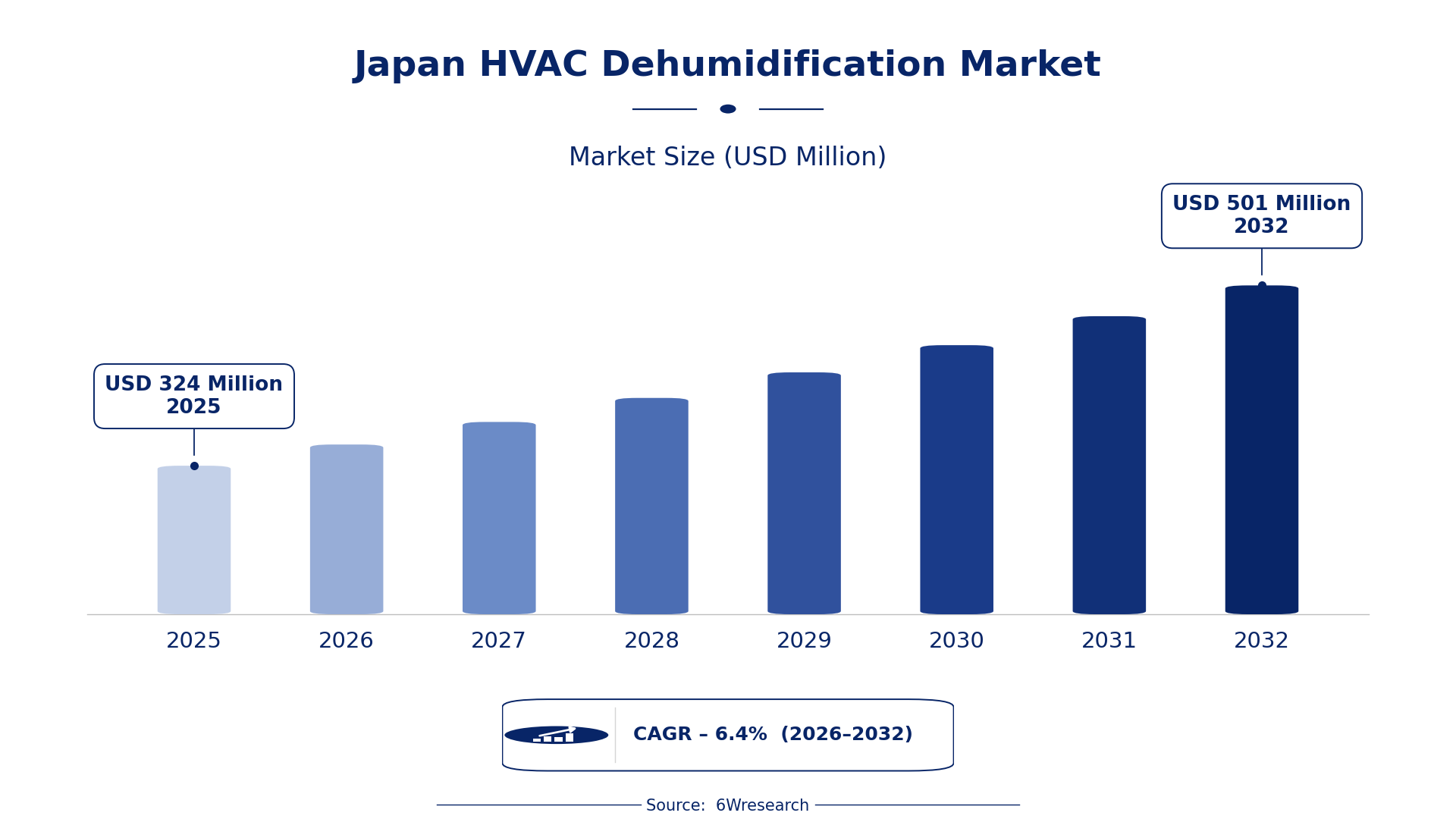
According to 6Wresearch internal database and industry insights, the Japan HVAC Dehumidification Market was valued at USD 324 Million in 2025 and is projected to reach USD 501 Million by 2032, growing at a CAGR of approximately 6.4% during 2026–2032.
Japan HVAC Dehumidification Market Highlights
| Report Metric | Details |
| Report Name | Japan HVAC Dehumidification Market (2026-2032) |
| Market Size 2025 | USD 324 Million |
| Market Size 2032 | USD 501 Million |
| Absolute Growth 2025–2032 | USD 177 Million |
| CAGR 2026–2032 | 6.4% |
| Peak Annual Growth | 7.4% in 2032 |
| Forecast Period | 2026–2032 |
| Historical Data | 2022–2025 |
| Base Year | 2025 |
| Leading System Type, 2025 | Refrigerant Dehumidifier (52% share) |
| Leading Technology Used, 2025 | Coil Condensation (49% share) |
| Leading Distribution Channel, 2025 | Appliance Retailers (53% share) |
| Leading End User, 2025 | Residential Buildings (52% share) |
| Fastest-Growing System Type | Desiccant Dehumidifier (9.5% CAGR) |
| Fastest-Growing Technology Used | Silica Gel/Wheel (9.6% CAGR) |
| Fastest-Growing Distribution Channel | HVAC Equipment Vendors (8.6% CAGR) |
| Fastest-Growing End User | Warehouses (8.5% CAGR) |
| Growing Sector | Residential Buildings |
| Key End Users | Residential users, commercial sectors, warehouses, HVAC equipment vendors |
Japan HVAC Dehumidification Market Year-wise Growth Rate and Key Drivers (2022–2032)
This graph illustrates the annual growth rates of the market from 2022 to 2032, highlighting a steady upward trajectory and projected market expansion over the forecast period.
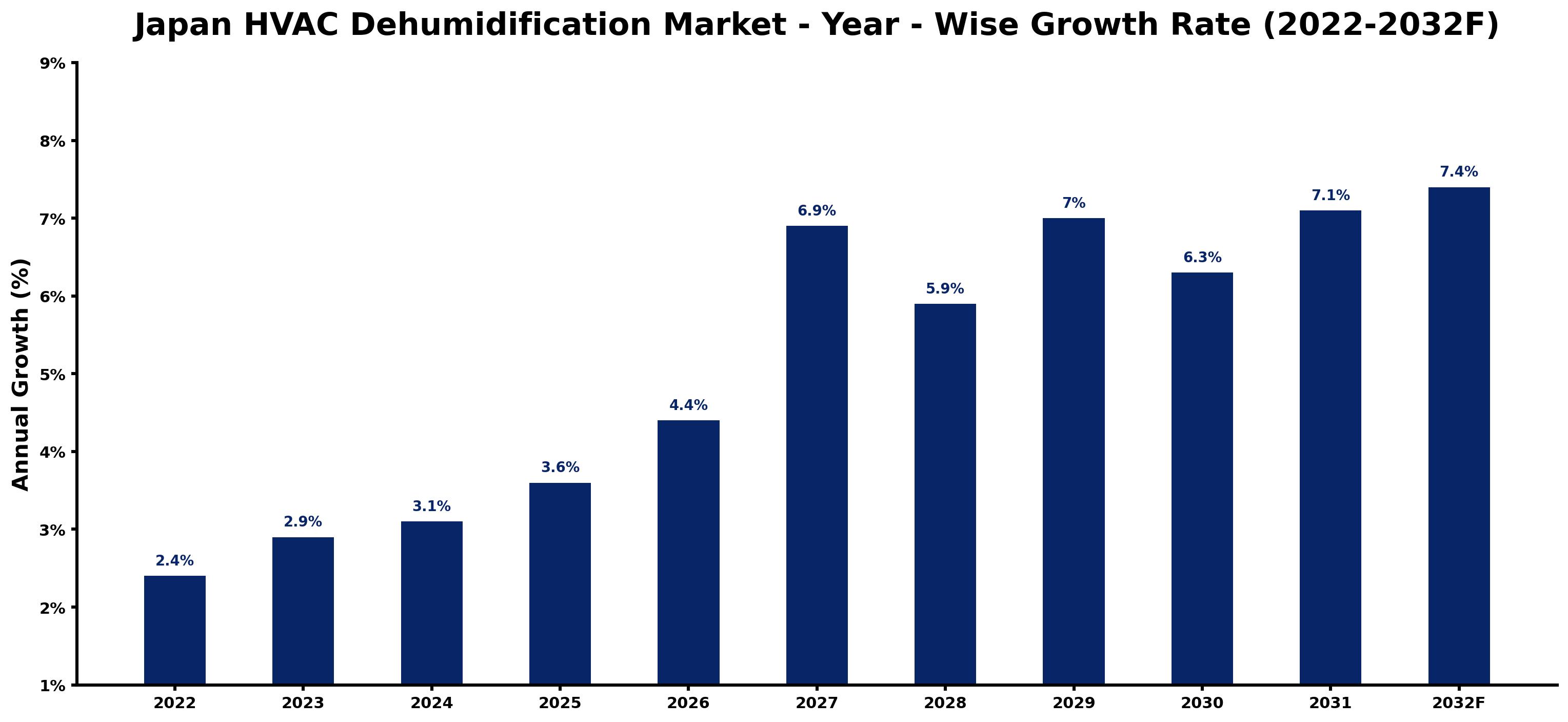
The table below sets out the estimated growth rate for each year and the main factor behind it.
| Year | Estimated Annual Growth (%) | Market Rationale |
| 2022 | 2.4 | The market experienced stable growth as residential demand for dehumidifiers rose. |
| 2023 | 2.9 | Higher humidity levels during summer months led to increased sales of HVAC dehumidifiers. |
| 2024 | 3.1 | The Tokyo 2020 Olympics spurred upgrades in HVAC systems, boosting market performance. |
| 2025 | 3.6 | Awareness of energy efficiency standards drove demand for advanced dehumidifiers. |
| 2026 | 4.4 | Investment in energy-efficient systems is projected to boost market growth. |
| 2027 | 6.9 | The introduction of new technologies is likely to attract more buyers in the market. |
| 2028 | 5.9 | A slight slowdown in growth is expected as the market adjusts to new standards. |
| 2029 | 7.0 | The ongoing trend towards smart home technologies will stimulate demand further. |
| 2030 | 6.3 | Market growth is anticipated to moderate as competition among suppliers intensifies. |
| 2031 | 7.1 | Rising construction activities will contribute to a surge in HVAC dehumidifier sales. |
| 2032 | 7.4 | The market is expected to peak as energy efficiency regulations become stricter. |
Note: Market size estimations and growth projections presented in this report are based on 6Wresearch's proprietary forecasting methodology, utilizing the latest available industry data, government publications, and primary research inputs.
Japan HVAC Dehumidification Market Synopsis
HVAC dehumidification systems control indoor humidity using refrigerant or desiccant technologies, essential for maintaining comfort and preserving materials. The Japan HVAC Dehumidification Market is expanding due to rising humidity levels, especially in urban areas like Tokyo, where average summer humidity can reach 80%. Demand is primarily driven by residential buildings, which account for 40% of usage, and commercial sectors requiring effective humidity control. The government's focus on energy efficiency and sustainability further fuels market growth, creating opportunities for suppliers and manufacturers.
Market Dynamics Impact Analysis (2026–2032)
| Factor | Type | Impact | Primary Segment Affected |
| Increasing residential construction activities | Driver | High | Refrigerant Dehumidifier |
| Growing awareness of energy-efficient systems | Driver | High | Desiccant Dehumidifier |
| Investment in smart home technologies | Opportunity | Medium | Smart Dehumidifiers |
| Expansion of commercial facilities requiring humidity control | Opportunity | High | Commercial Spaces |
| High initial costs of advanced systems | Restraint | High | Hybrid Systems |
| Limited awareness of energy-efficient options among consumers | Restraint | Medium | Refrigerant Dehumidifier |
| Compliance with stringent energy regulations | Challenge | High | Desiccant Dehumidifier |
| Supply chain disruptions affecting component availability | Challenge | Medium | HVAC Equipment Vendors |
Evaluation of Drivers in Japan HVAC Dehumidification Market (2026–2032)
The table below links each growth driver to the segment it affects and the evidence for it.
| Drivers | Primary Segment Affected | Why It Matters (Evidence) |
| Rising humidity levels in urban areas | Refrigerant Dehumidifier | The average humidity level in Tokyo reaches 80%, increasing demand for effective humidity control solutions. |
| Government incentives for energy-efficient systems | Desiccant Dehumidifier | Subsidies for energy-efficient HVAC upgrades encourage consumers to invest in advanced dehumidifiers. |
| Increased focus on indoor air quality | Smart Dehumidifiers | Growing health awareness drives demand for systems that monitor and control humidity effectively. |
| Expansion of commercial spaces and warehouses | Commercial Spaces | Approximately 50% of commercial buildings use HVAC systems, creating strong demand for dehumidification. |
| Technological advancements in HVAC systems | Hybrid Systems | Innovations in hybrid systems attract buyers seeking versatile humidity control solutions. |
Several shifts outside the market lift sales. The average humidity level in Tokyo reaches 80%, compelling residential buyers to invest in dehumidifiers for comfort. Incentives for energy-efficient systems encourage consumers to purchase advanced technologies, while the focus on indoor air quality drives demand for smart dehumidifiers. The expansion of commercial spaces, with around 50% of buildings using HVAC systems, stimulates purchases for humidity control. Innovations in hybrid systems attract buyers seeking versatile solutions, contributing to overall market growth.
Evaluation of Restraints in Japan HVAC Dehumidification Market
The following restraints limit how fast demand can grow.
| Market Restraint | Primary Segment Affected | Why It Matters (Evidence) |
| High initial costs of advanced dehumidifiers | Hybrid Systems | The upfront investment required for advanced systems deters potential buyers from making purchases. |
| Limited consumer awareness of energy-efficient options | Refrigerant Dehumidifier | Many consumers lack knowledge about the benefits of energy-efficient dehumidifiers, hindering market growth. |
| Challenges in compliance with energy regulations | Desiccant Dehumidifier | Stricter energy regulations impose additional costs on manufacturers, affecting pricing and availability. |
| Supply chain disruptions for HVAC components | HVAC Equipment Vendors | Ongoing supply chain issues delay production and increase costs, impacting overall market supply. |
| Competition from alternative humidity control solutions | Smart Dehumidifiers | Emerging technologies may divert consumer interest away from traditional dehumidifiers. |
Japan HVAC Dehumidification Market Challenges
High humidity levels in Tokyo can reach 80% during summer, forcing buyers to spend an additional 20% on energy for cooling and dehumidification. Supply chain disruptions hinder the availability of critical components like compressors, delaying production timelines for manufacturers and increasing costs by 15% for suppliers. A shortage of skilled workers in HVAC technology restricts contractors' ability to implement advanced systems, resulting in project delays and higher labour costs. Compliance with standards such as ISO 16890 for air filters complicates operations for producers, raising operational costs by 10% as they adapt to regulatory demands.
Trends in the Japan HVAC Dehumidification Market
The trends below show where the Japan HVAC Dehumidification Market is heading.
- Growth in Demand for Smart Dehumidifiers: The trend towards smart home technology is reflected in the increasing adoption of smart dehumidifiers, projected to grow by 15% annually until 2030. This shift is supported by consumer demand for integrated systems that automatically monitor humidity levels.
- Rise of Desiccant Dehumidifiers in Food Storage: Desiccant dehumidifiers are becoming more popular, especially in food storage facilities, due to their effectiveness in low-temperature environments. This trend is underscored by a projected CAGR of 9.5% for desiccant systems between 2026 and 2032.
- Surge in Commercial HVAC Solutions in Osaka: The Osaka region is experiencing heightened demand for commercial HVAC solutions, driven by increased construction activities. Approximately 50% of commercial buildings in Japan utilise HVAC systems, reflecting this growth.
- Implementation of Stricter Energy Efficiency Standards: The Building Energy Efficiency Act, amended in 2022, mandates higher energy standards for new buildings starting April 2025. This regulation is expected to drive demand for energy-efficient HVAC dehumidification systems.
Investment Opportunities in the Japan HVAC Dehumidification Market
Where to invest in the Japan HVAC Dehumidification Market: the main openings are set out below.
- Investment in Energy-Efficient HVAC Systems: The Japanese government aims to reduce energy consumption in buildings by 20% by 2030, creating opportunities for suppliers of energy-efficient HVAC systems. Collaborating with HVAC Equipment Vendors can facilitate market entry.
- Boom in Residential Construction: With residential buildings accounting for 40% of dehumidifier usage, suppliers can target this sector for growth. The current boom in residential construction presents a timely opportunity for investment in HVAC solutions.
- Increased Focus on Indoor Air Quality: As awareness of indoor air quality rises, there is a growing demand for advanced dehumidifiers. Suppliers can enter this market by partnering with residential builders and promoting the benefits of humidity control.
- Expansion of Commercial Spaces: The increasing number of commercial facilities requiring humidity control creates a notable opportunity for suppliers. Targeting the Osaka region, known for its high demand for commercial HVAC solutions, can yield substantial returns.
Government Initiatives in the Japan HVAC Dehumidification Market
The Building Energy Efficiency Act, amended in 2022, mandates all new buildings to meet stringent energy standards starting April 2025. This legislation compels manufacturers to develop HVAC dehumidification systems that comply with these regulations, ensuring improved energy efficiency for buyers.
Government subsidies for energy-efficient HVAC upgrades are available as of 2023, promoting the adoption of advanced dehumidification systems. The Ministry of the Environment oversees these subsidies, which aim to encourage consumers to invest in energy-efficient technologies.
Future Insight of the Japan HVAC Dehumidification Market
The HVAC market in Japan will invest 500 billion JPY in R&D by 2025, creating demand for energy-efficient technologies. By 2032, smart dehumidifiers will see a 15% annual increase in adoption, reflecting the shift towards automated solutions. Government initiatives aiming to cut energy consumption in buildings by 20% by 2030 will compel suppliers to innovate and enhance their offerings. Standards like JIS B 8616 will ensure improved quality and efficiency in dehumidification systems, benefiting buyers seeking reliable products and suppliers striving to meet high market expectations.
Market Segmentation Analysis
Japan HVAC Dehumidification Market report covers a detailed analysis of the following market segments:
By System Type – Refrigerant Dehumidifier Leads, Desiccant Dehumidifier Expected to Grow Fastest
According to Saurav Kr Singh, Senior Research Analyst at 6Wresearch, in 2025, Refrigerant Dehumidifier led the system type split with a 52% share. Refrigerant dehumidifiers dominate the market because they are extensively used in both residential and commercial settings. Their effectiveness in managing humidity is crucial in areas like Tokyo, where summer humidity levels can reach 80%. Desiccant Dehumidifier is set to record the highest CAGR in this split, 9.5% over 2026–2032. Desiccant dehumidifiers are experiencing rapid growth due to their efficiency in low-temperature environments, making them particularly suitable for food storage facilities. As the focus on material preservation increases, demand for these systems is expected to rise significantly. Suppliers must enhance their offerings of desiccant systems to align with the growing demand in specialised applications.
By Technology Used – Coil Condensation Leads, Silica Gel/Wheel Expected to Grow Fastest
Coil Condensation accounted for 49% of the market by technology used in 2025. Coil condensation technology is the leading method in HVAC systems, known for its reliability and efficiency in maintaining optimal humidity levels. Its widespread application across various sectors ensures a strong installed base in both residential and commercial environments. Over 2026–2032, Silica Gel/Wheel is expected to post the fastest growth, at a CAGR of 9.6%. Silica gel/wheel technology is growing quickly as it is increasingly used in specialised applications that require precise humidity control. This trend reflects a shift towards more advanced technologies tailored for niche markets. Buyers should explore advanced technologies that offer enhanced performance for specific humidity control requirements.
By Distribution Channel – Appliance Retailers Lead, HVAC Equipment Vendors Expected to Grow Fastest
With 53% of distribution channel revenue in 2025, Appliance Retailers was the largest category. Appliance retailers are the leading distribution channel for residential units, offering consumers easy access to dehumidifiers for home use. Their strong presence in local markets ensures that these products are readily available to meet consumer demands effectively. HVAC Equipment Vendors are projected to grow fastest, at a CAGR of 8.6% during 2026–2032. HVAC equipment vendors are experiencing the fastest growth as they respond to the rising demand for commercial installations, especially in urban areas. This trend highlights a shift towards more integrated solutions for larger-scale humidity control requirements. Suppliers should focus on building partnerships with HVAC equipment vendors to better cater to the commercial sector.
By End User – Residential Buildings Lead, Warehouses Expected to Grow Fastest
Residential Buildings held 52% of the Japan HVAC Dehumidification Market by end user in 2025. Residential buildings account for the largest share of dehumidifier usage, driven by the need for comfort and humidity control in homes. This segment's prominence is underscored by the average lifespan of dehumidifiers, which is around 10 years, indicating a stable installed base. The quickest growth will come from Warehouses, forecast to expand at a CAGR of 8.5% between 2026 and 2032. Warehouses are emerging as the fastest-growing end user segment due to their critical need for humidity management to preserve materials. The increasing focus on material preservation in logistics and storage is propelling this growth. Suppliers should consider developing targeted marketing strategies for the warehouse sector to capitalise on this growing demand.
Key Attractiveness of the Report
- 10 Years of Market Numbers
- Historical Data Starting from 2022 to 2025
- Base Year 2025
- Forecast Data until 2032
- Key Performance Indicators Impacting the Market
- Major Upcoming Developments and Projects
Key Highlights of the Report:
- Japan HVAC Dehumidification Market Outlook
- Market Size of Japan HVAC Dehumidification Market, 2025
- Forecast of Japan HVAC Dehumidification Market, 2032
- Historical Data and Forecast of Japan HVAC Dehumidification Revenues & Volume for the Period 2022-2032F
- Japan HVAC Dehumidification Market Trend Evolution
- Japan HVAC Dehumidification Market Drivers and Challenges
- Japan HVAC Dehumidification Price Trends
- Japan HVAC Dehumidification Porter's Five Forces
- Japan HVAC Dehumidification Industry Life Cycle
- Historical Data and Forecast of Japan HVAC Dehumidification Market Revenues & Volume By System Type for the Period 2022-2032F
- Historical Data and Forecast of Japan HVAC Dehumidification Market Revenues & Volume By Refrigerant Dehumidifier for the Period 2022-2032F
- Historical Data and Forecast of Japan HVAC Dehumidification Market Revenues & Volume By Desiccant Dehumidifier for the Period 2022-2032F
- Historical Data and Forecast of Japan HVAC Dehumidification Market Revenues & Volume By Hybrid Systems for the Period 2022-2032F
- Historical Data and Forecast of Japan HVAC Dehumidification Market Revenues & Volume By Smart Dehumidifiers for the Period 2022-2032F
- Historical Data and Forecast of Japan HVAC Dehumidification Market Revenues & Volume By Technology Used for the Period 2022-2032F
- Historical Data and Forecast of Japan HVAC Dehumidification Market Revenues & Volume By Coil Condensation for the Period 2022-2032F
- Historical Data and Forecast of Japan HVAC Dehumidification Market Revenues & Volume By Silica Gel/Wheel for the Period 2022-2032F
- Historical Data and Forecast of Japan HVAC Dehumidification Market Revenues & Volume By Combined Tech for the Period 2022-2032F
- Historical Data and Forecast of Japan HVAC Dehumidification Market Revenues & Volume By Sensor-Based for the Period 2022-2032F
- Historical Data and Forecast of Japan HVAC Dehumidification Market Revenues & Volume By Distribution Channel for the Period 2022-2032F
- Historical Data and Forecast of Japan HVAC Dehumidification Market Revenues & Volume By Appliance Retailers for the Period 2022-2032F
- Historical Data and Forecast of Japan HVAC Dehumidification Market Revenues & Volume By HVAC Equipment Vendors for the Period 2022-2032F
- Historical Data and Forecast of Japan HVAC Dehumidification Market Revenues & Volume By OEMs for the Period 2022-2032F
- Historical Data and Forecast of Japan HVAC Dehumidification Market Revenues & Volume By Online Electronics Stores for the Period 2022-2032F
- Historical Data and Forecast of Japan HVAC Dehumidification Market Revenues & Volume By End User for the Period 2022-2032F
- Historical Data and Forecast of Japan HVAC Dehumidification Market Revenues & Volume By Residential Buildings for the Period 2022-2032F
- Historical Data and Forecast of Japan HVAC Dehumidification Market Revenues & Volume By Warehouses for the Period 2022-2032F
- Historical Data and Forecast of Japan HVAC Dehumidification Market Revenues & Volume By Commercial Spaces for the Period 2022-2032F
- Historical Data and Forecast of Japan HVAC Dehumidification Market Revenues & Volume By Hotels & Offices for the Period 2022-2032F
- Japan HVAC Dehumidification Import Export Trade Statistics
- Market Opportunity Assessment By System Type
- Market Opportunity Assessment By Technology Used
- Market Opportunity Assessment By Distribution Channel
- Market Opportunity Assessment By End User
- Japan HVAC Dehumidification Top Companies Market Share
- Japan HVAC Dehumidification Competitive Benchmarking By Technical and Operational Parameters
- Japan HVAC Dehumidification Company Profiles
- Japan HVAC Dehumidification Key Strategic Recommendations
Market Covered
The following segment groups are covered in the report.
By System Type
- Refrigerant Dehumidifier
- Desiccant Dehumidifier
- Hybrid Systems
- Smart Dehumidifiers
By Technology Used
- Coil Condensation
- Silica Gel/Wheel
- Combined Tech
- Sensor-Based
By Distribution Channel
- Appliance Retailers
- HVAC Equipment Vendors
- OEMs
- Online Electronics Stores
By End User
- Residential Buildings
- Warehouses
- Commercial Spaces
- Hotels & Offices































