Japan HVAC Ducting Market Size & Growth Rate
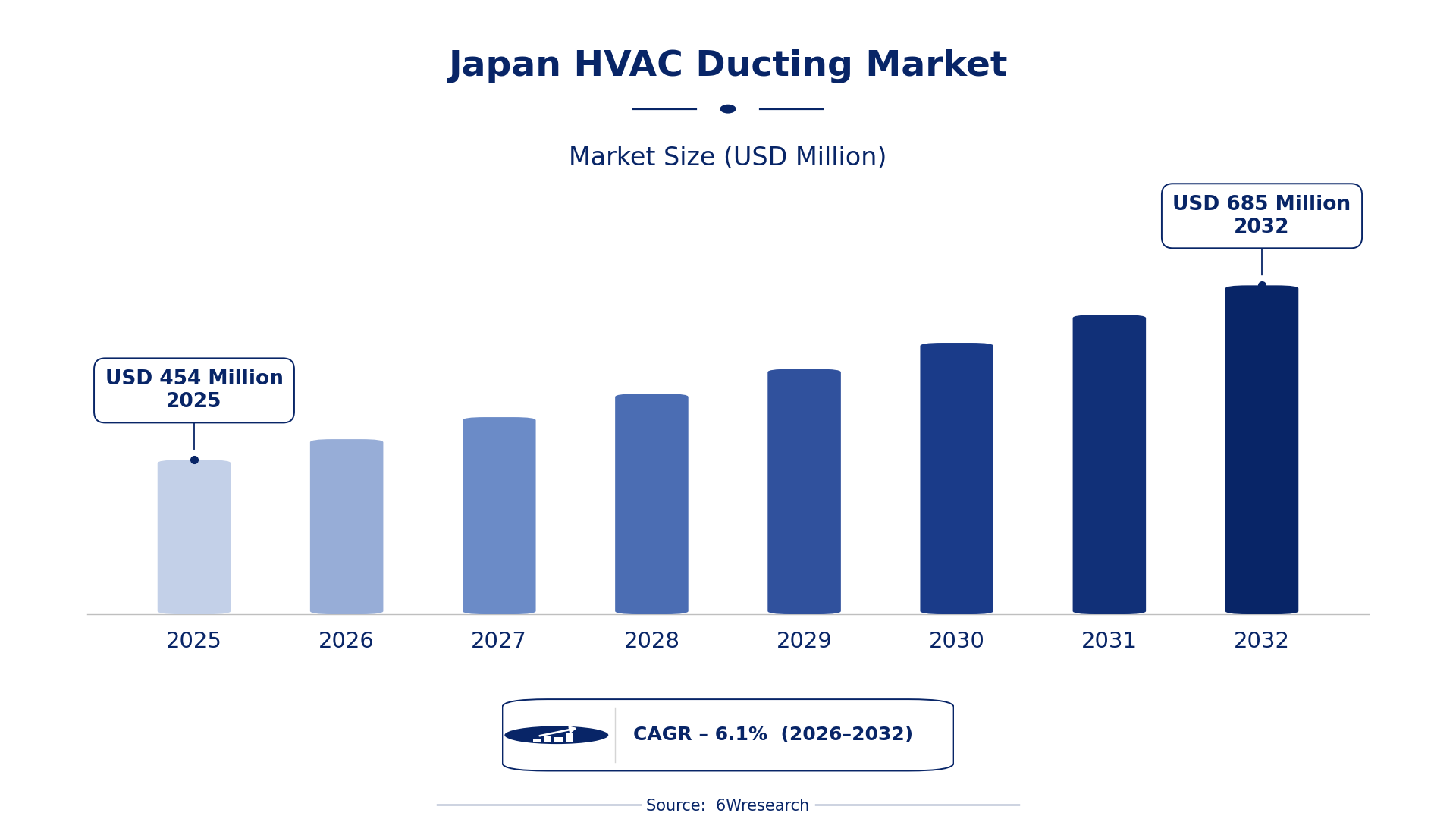
According to 6Wresearch internal database and industry insights, the Japan HVAC Ducting Market was valued at USD 454 Million in 2025 and is projected to reach USD 685 Million by 2032, growing at a CAGR of approximately 6.1% during 2026–2032.
Japan HVAC Ducting Market Highlights
| Report Metric | Details |
| Report Name | Japan HVAC Ducting Market (2026-2032) |
| Market Size 2025 | USD 454 Million |
| Market Size 2032 | USD 685 Million |
| Absolute Growth 2025–2032 | USD 231 Million |
| CAGR 2026–2032 | 6.1% |
| Peak Annual Growth | 6.9% in 2032 |
| Forecast Period | 2026–2032 |
| Historical Data | 2022–2025 |
| Base Year | 2025 |
| Leading Duct Type, 2025 | Flexible Ducts (38% share) |
| Leading Material Type, 2025 | PVC / Aluminum (44% share) |
| Leading Distribution Channel, 2025 | HVAC Suppliers (35% share) |
| Leading End User, 2025 | Residential Buildings (46% share) |
| Fastest-Growing Duct Type | Rigid Ducts (8.5% CAGR) |
| Fastest-Growing Material Type | Galvanized Steel (8.6% CAGR) |
| Fastest-Growing Distribution Channel | Industrial Distributors (7.9% CAGR) |
| Fastest-Growing End User | Commercial Facilities (7.8% CAGR) |
| Growing Sector | Residential Buildings |
| Key End Users | Residential Buildings, Commercial Facilities, Industrial Units |
Japan HVAC Ducting Market Year-wise Growth Rate and Key Drivers (2022–2032)
This graph illustrates the annual growth rates of the market from 2022 to 2032, highlighting a steady upward trajectory and projected market expansion over the forecast period.
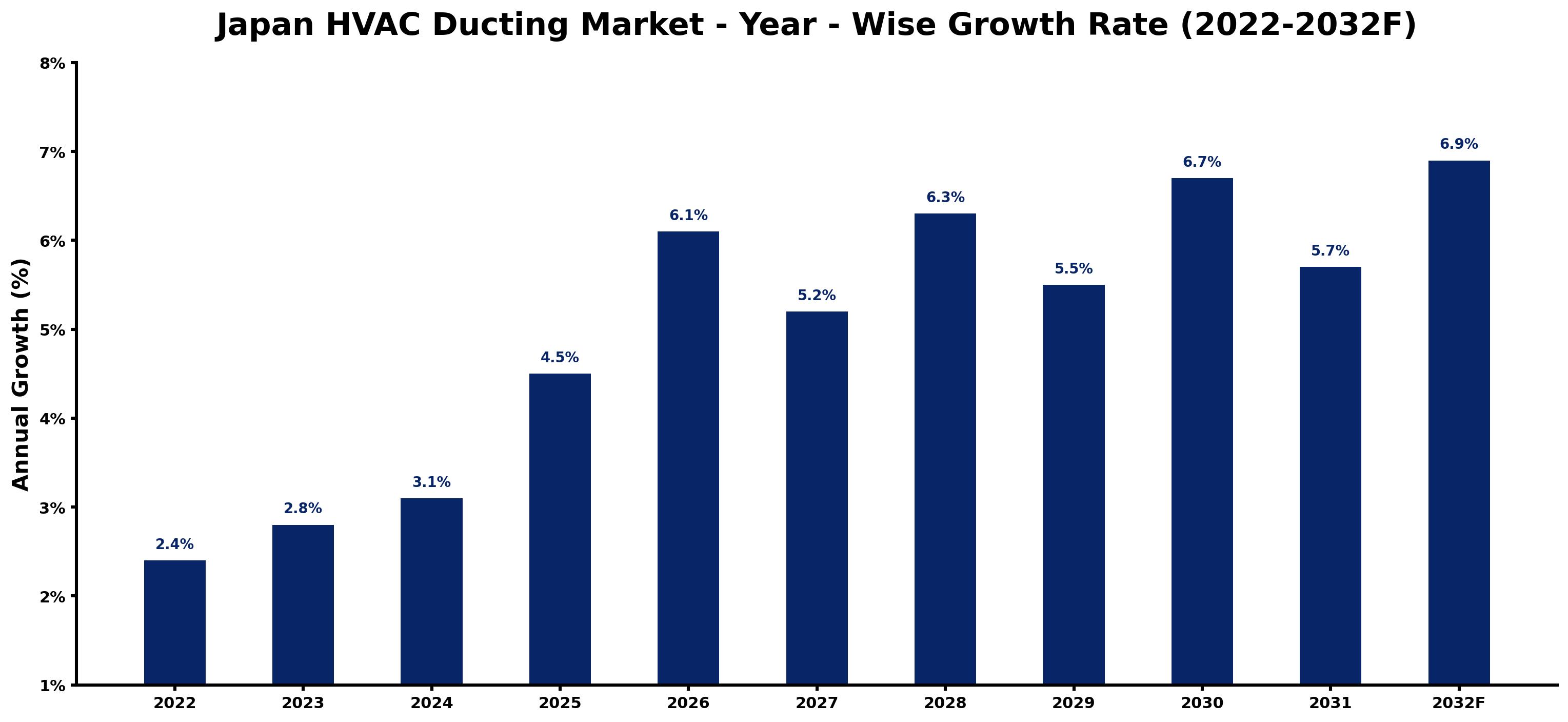
The yearly estimates that follow link every growth rate to its principal driver, so readers can see why the pace changed in each period.
| Year | Estimated Annual Growth (%) | Market Rationale |
| 2022 | 2.4 | The market experienced steady demand from residential buildings and commercial facilities. |
| 2023 | 2.8 | Growth accelerated due to increased urbanisation and energy efficiency awareness. |
| 2024 | 3.1 | Demand continued to rise as more buildings adopted modern HVAC systems. |
| 2025 | 4.5 | The peak growth was driven by significant investments in energy-efficient technologies. |
| 2026 | 6.1 | A surge in construction projects boosted the market's expansion. |
| 2027 | 5.2 | Growth slowed as the market began to stabilise after rapid expansion. |
| 2028 | 6.3 | Renewed interest in energy-efficient solutions spurred demand again. |
| 2029 | 5.5 | Market growth decelerated slightly as projects reached completion. |
| 2030 | 6.7 | Increased focus on sustainability led to a resurgence in demand. |
| 2031 | 5.7 | The market continued to grow, albeit at a slower pace than previous years. |
| 2032 | 6.9 | Final growth acceleration was driven by new energy regulations and standards. |
Note: Market size estimations and growth projections presented in this report are based on 6Wresearch's proprietary forecasting methodology, utilizing the latest available industry data, government publications, and primary research inputs.
Japan HVAC Ducting Market Synopsis
HVAC ducting is essential for distributing heating, ventilation, and air conditioning in buildings, made from materials such as galvanized steel and aluminum. The Japan HVAC Ducting Market is growing due to rising demand from urban areas, with over 1,000 residential buildings supported annually. Key drivers include government initiatives promoting energy efficiency and increased online sales, which have surged by 30% recently, indicating a shift in purchasing behaviour.
Market Dynamics Impact Analysis (2026–2032)
| Factor | Type | Impact | Primary Segment Affected |
| Rising urbanisation in Tokyo and Osaka | Driver | High | Residential Buildings |
| Government initiatives promoting energy efficiency | Driver | High | Commercial Facilities |
| Increased demand for flexible ducting solutions | Opportunity | Medium | Flexible Ducts |
| Growth in online sales channels for HVAC products | Opportunity | Medium | Online Duct Vendors |
| High costs associated with material sourcing | Restraint | High | Galvanized Steel |
| Limited availability of skilled labour in HVAC installation | Restraint | Medium | Rigid Ducts |
| Rising competition from imported products | Challenge | High | PVC / Aluminum |
| Fluctuating raw material prices affecting profitability | Challenge | Medium | Flexible Ducts |
Evaluation of Drivers in Japan HVAC Ducting Market (2026–2032)
The factors lifting demand, and the evidence behind each, are summarised below.
| Drivers | Primary Segment Affected | Why It Matters (Evidence) |
| Growing construction projects in urban areas | Residential Buildings | Over 1,000 residential buildings are supported annually, increasing ducting demand. |
| Government energy efficiency initiatives | Commercial Facilities | Energy-efficient HVAC systems are promoted, driving purchases and installations. |
| Preference for flexible ducting in retrofitting | Flexible Ducts | Flexible ducts are preferred for retrofitting existing buildings, facilitating installation. |
| Increase in online sales of HVAC products | Online Duct Vendors | Online sales have increased significantly, reflecting changing purchasing habits. |
| High demand for durable materials like galvanized steel | Galvanized Steel | Galvanized steel ducts are commonly used, ensuring longevity and strength in systems. |
Several shifts outside the market lift sales. The construction boom in urban areas, particularly in Tokyo and Osaka, supports a growing number of new residential buildings annually, driving demand for HVAC ducting. The push for energy-efficient systems reflects a shift in consumer preference towards sustainability, with many buyers seeking modern solutions. Recent trends indicate a significant rise in online sales, which allows for easier access to products and wider market reach. The preference for flexible ducting in retrofitting projects improves installation efficiency, leading to increased demand for this product type.
Evaluation of Restraints in Japan HVAC Ducting Market
These restraints slow adoption and weigh on supplier margins.
| Market Restraint | Primary Segment Affected | Why It Matters (Evidence) |
| High costs associated with sourcing materials | Galvanized Steel | Sourcing galvanized steel incurs high costs, impacting overall project budgets. |
| Limited skilled labour availability for installation | Rigid Ducts | A shortage of skilled workers delays installation timelines, affecting project schedules. |
| Increasing competition from imported HVAC products | PVC / Aluminum | Imported products often undercut local prices, challenging domestic manufacturers. |
| Fluctuating prices of raw materials | Flexible Ducts | Volatile raw material prices create uncertainty in budgeting for projects. |
| Regulatory compliance costs for manufacturers | Fabric Ducts | Compliance with standards like ISO 9001 increases operational costs for manufacturers. |
Japan HVAC Ducting Market Challenges
A key obstacle in the HVAC ducting market is regulatory compliance, as strict standards slow down project approvals and lead to delays for contractors. Rising material costs, with galvanized steel increasing by 15% this year, strain budgets for builders and inflate project expenses. A shortage of skilled technicians limits installation capabilities, forcing contractors to postpone projects and potentially resulting in revenue losses. Technological advancements require ongoing training, yet many workers lack access to updated resources, which restricts productivity for HVAC producers and impacts overall market efficiency.
Trends in the Japan HVAC Ducting Market
Below are the shifts with the largest effect on the Japan HVAC Ducting Market.
- Shift towards Energy-Efficient HVAC Systems: The HVAC market is increasingly focusing on energy efficiency, driven by government initiatives. In 2023, a government initiative aimed to reduce energy consumption in buildings, encouraging the adoption of modern systems.
- Increase in Online Sales Channels: Online sales of HVAC ducting have surged by 30% in recent years, particularly among residential buyers. This shift allows for easier access to products and wider market reach.
- Growing Use of Flexible Ducts in Retrofitting: Flexible ducts are becoming more popular for retrofitting existing buildings, improving installation flexibility. This trend is particularly evident in urban regions where space is constrained.
- Rising Adoption of Fabric Ducts in Gyms: Fabric ducts are increasingly used in gymnasiums for their aesthetic appeal and acoustic benefits. This trend reflects a growing preference for visually pleasing and functional air distribution solutions.
Investment Opportunities in the Japan HVAC Ducting Market
The following areas offer the clearest openings for investors and suppliers in the Japan HVAC Ducting Market.
- Partnering with Local Distributors: Entering joint ventures with local distributors can facilitate market entry. The HVAC Suppliers category, which holds a 35% share, represents a significant opportunity for collaboration.
- Investing in Energy-Efficient Solutions: With government initiatives promoting energy efficiency, investing in compliant products is timely. The residential sector, a major buyer group, is increasingly seeking energy-efficient HVAC solutions.
- Expanding Online Sales Platforms: Online duct vendors are seeing increased demand, with a 30% rise in sales. Focusing on e-commerce can capture a growing segment of tech-savvy consumers.
- Meeting ISO 9001 Standards: Manufacturers can gain a competitive edge by adhering to ISO 9001 standards, which are increasingly demanded by buyers. This compliance can enhance product credibility and marketability.
Government Initiatives in the Japan HVAC Ducting Market
The Economic Security Promotion Act of 2022 supports supply-chain resilience for critical HVAC materials. This measure ensures that manufacturers can maintain a steady supply of essential components, reducing disruptions and improving production capabilities. Additionally, the Green Growth Strategy aims for carbon neutrality by 2050, promoting energy-efficient HVAC systems and encouraging investments in sustainable technologies.
The Ministry of the Environment oversees the implementation of regulations related to energy efficiency in HVAC systems. This agency approves projects that align with national energy-saving goals, providing funding for initiatives that improve system efficiency and support manufacturers in upgrading their offerings.
Future Insight of the Japan HVAC Ducting Market
New energy-efficient building projects will emerge by 2032, aligning with government initiatives aimed at reducing energy consumption. Advanced ducting technologies will streamline installation processes and improve system performance. The population of Japan, approximately 125 million, will drive demand for tailored HVAC solutions in urban areas. By 2030, online sales of HVAC ducting are projected to increase by 30%, indicating a shift towards digital purchasing channels.
Market Segmentation Analysis
Japan HVAC Ducting Market report covers a detailed analysis of the following market segments:
By Duct Type – Flexible Ducts Lead, Rigid Ducts Expected to Grow Fastest
According to Saurav Kr Singh, Senior Research Analyst at 6Wresearch, Flexible Ducts took 38% of duct type revenue in 2025, more than any other category. Flexible ducts hold the largest share due to their ease of installation and adaptability in confined spaces, making them ideal for residential applications. Their prevalent use in urban areas like Tokyo underscores their critical role in fulfilling HVAC demands. Over 2026–2032, Rigid Ducts are expected to post the fastest growth, at a CAGR of 8.5%. Rigid ducts are growing quickly because they provide efficient airflow and durability, essential for new commercial projects. The heightened focus on energy efficiency in construction is further propelling their uptake. Suppliers should highlight the benefits of rigid ducts to capitalise on this growing market segment.
By Material Type – PVC / Aluminum Leads, Galvanized Steel Expected to Grow Fastest
With 44% of material type revenue in 2025, PVC / Aluminum was the largest category. PVC and aluminium are the leading materials used in HVAC ducting because they are lightweight and resistant to corrosion, making them suitable for various applications. Their widespread use in residential buildings contributes to their dominant market share. Galvanized Steel is set to record the highest CAGR in this split, 8.6% over 2026–2032. Galvanized steel is growing quickly due to its strength and longevity, which are critical for new installations in commercial facilities. The push for more durable HVAC solutions is driving this trend. Buyers may benefit from considering galvanized steel options for long-term reliability and performance.
By Distribution Channel – HVAC Suppliers Lead, Industrial Distributors Expected to Grow Fastest
HVAC Suppliers held 35% of the Japan HVAC Ducting Market by distribution channel in 2025. HVAC suppliers dominate the market as they serve as the main source for HVAC ducting, providing a wide array of products that meet various needs. Their established relationships with contractors and builders across key regions solidify their leading status. The quickest growth will come from Industrial Distributors, forecast to expand at a CAGR of 7.9% between 2026 and 2032. Industrial distributors are seeing the fastest growth by supplying HVAC products to multiple sectors, including construction and manufacturing. The rising demand for HVAC solutions across diverse industries is a key factor in this expansion. Suppliers ought to strengthen partnerships with industrial distributors to enhance their market reach.
By End User – Residential Buildings Lead, Commercial Facilities Expected to Grow Fastest
The largest end user category in 2025 was Residential Buildings, at 46% of revenue. Residential buildings represent the largest end-user segment for HVAC systems, driven by the need for climate control and air quality in homes. The high number of residential constructions annually in Japan supports this leading position. Commercial Facilities are projected to grow fastest, at a CAGR of 7.8% during 2026–2032. Commercial facilities are experiencing the fastest growth due to rising demand for efficient HVAC systems in office buildings and retail spaces. The trend towards energy-efficient solutions in commercial construction is a key factor. Suppliers should tailor their offerings to meet the specific needs of commercial facilities to capture this growing market.
Key Attractiveness of the Report
- 10 Years of Market Numbers
- Historical Data Starting from 2022 to 2025
- Base Year 2025
- Forecast Data until 2032
- Key Performance Indicators Impacting the Market
- Major Upcoming Developments and Projects
Key Highlights of the Report:
- Japan HVAC Ducting Market Outlook
- Market Size of Japan HVAC Ducting Market, 2025
- Forecast of Japan HVAC Ducting Market, 2032
- Historical Data and Forecast of Japan HVAC Ducting Revenues & Volume for the Period 2022-2032F
- Japan HVAC Ducting Market Trend Evolution
- Japan HVAC Ducting Market Drivers and Challenges
- Japan HVAC Ducting Price Trends
- Japan HVAC Ducting Porter's Five Forces
- Japan HVAC Ducting Industry Life Cycle
- Historical Data and Forecast of Japan HVAC Ducting Market Revenues & Volume By Duct Type for the Period 2022-2032F
- Historical Data and Forecast of Japan HVAC Ducting Market Revenues & Volume By Flexible Ducts for the Period 2022-2032F
- Historical Data and Forecast of Japan HVAC Ducting Market Revenues & Volume By Rigid Ducts for the Period 2022-2032F
- Historical Data and Forecast of Japan HVAC Ducting Market Revenues & Volume By Fabric Ducts for the Period 2022-2032F
- Historical Data and Forecast of Japan HVAC Ducting Market Revenues & Volume By Spiral Ducts for the Period 2022-2032F
- Historical Data and Forecast of Japan HVAC Ducting Market Revenues & Volume By Material Type for the Period 2022-2032F
- Historical Data and Forecast of Japan HVAC Ducting Market Revenues & Volume By PVC / Aluminum for the Period 2022-2032F
- Historical Data and Forecast of Japan HVAC Ducting Market Revenues & Volume By Galvanized Steel for the Period 2022-2032F
- Historical Data and Forecast of Japan HVAC Ducting Market Revenues & Volume By Woven Materials for the Period 2022-2032F
- Historical Data and Forecast of Japan HVAC Ducting Market Revenues & Volume By Stainless Steel for the Period 2022-2032F
- Historical Data and Forecast of Japan HVAC Ducting Market Revenues & Volume By Distribution Channel for the Period 2022-2032F
- Historical Data and Forecast of Japan HVAC Ducting Market Revenues & Volume By HVAC Suppliers for the Period 2022-2032F
- Historical Data and Forecast of Japan HVAC Ducting Market Revenues & Volume By Industrial Distributors for the Period 2022-2032F
- Historical Data and Forecast of Japan HVAC Ducting Market Revenues & Volume By Online Duct Vendors for the Period 2022-2032F
- Historical Data and Forecast of Japan HVAC Ducting Market Revenues & Volume By OEM Distribution for the Period 2022-2032F
- Historical Data and Forecast of Japan HVAC Ducting Market Revenues & Volume By End User for the Period 2022-2032F
- Historical Data and Forecast of Japan HVAC Ducting Market Revenues & Volume By Residential Buildings for the Period 2022-2032F
- Historical Data and Forecast of Japan HVAC Ducting Market Revenues & Volume By Commercial Facilities for the Period 2022-2032F
- Historical Data and Forecast of Japan HVAC Ducting Market Revenues & Volume By Gymnasiums for the Period 2022-2032F
- Historical Data and Forecast of Japan HVAC Ducting Market Revenues & Volume By Industrial Units for the Period 2022-2032F
- Japan HVAC Ducting Import Export Trade Statistics
- Market Opportunity Assessment By Duct Type
- Market Opportunity Assessment By Material Type
- Market Opportunity Assessment By Distribution Channel
- Market Opportunity Assessment By End User
- Japan HVAC Ducting Top Companies Market Share
- Japan HVAC Ducting Competitive Benchmarking By Technical and Operational Parameters
- Japan HVAC Ducting Company Profiles
- Japan HVAC Ducting Key Strategic Recommendations
Market Covered
Coverage by segment is as follows.
By Duct Type
- Flexible Ducts
- Rigid Ducts
- Fabric Ducts
- Spiral Ducts
By Material Type
- PVC / Aluminum
- Galvanized Steel
- Woven Materials
- Stainless Steel
By Distribution Channel
- HVAC Suppliers
- Industrial Distributors
- Online Duct Vendors
- OEM Distribution
By End User
- Residential Buildings
- Commercial Facilities
- Gymnasiums
- Industrial Units































