Japan HVAC Fan Drive Market Size & Growth Rate
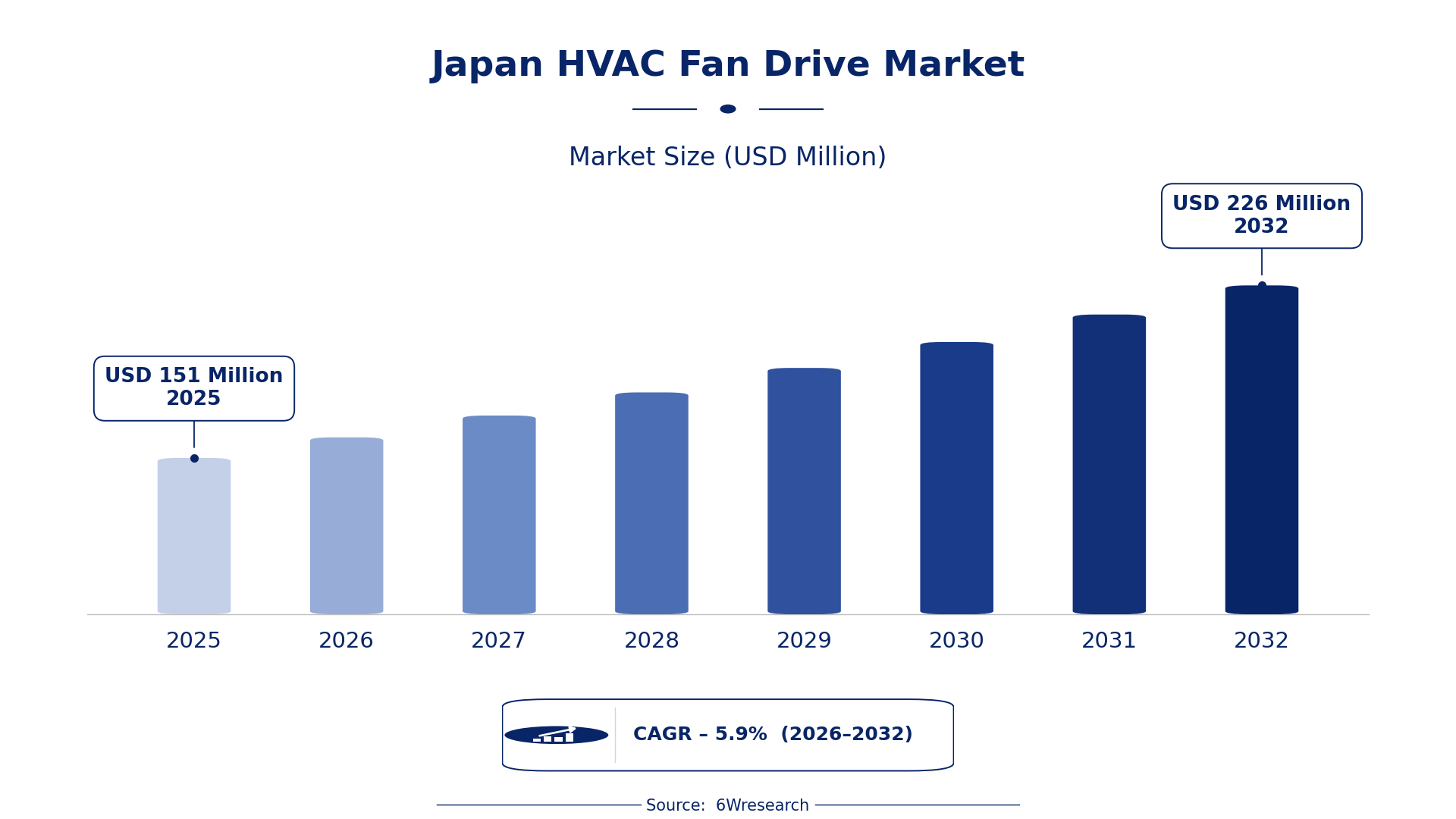
According to 6Wresearch internal database and industry insights, the Japan HVAC Fan Drive Market was valued at USD 151 Million in 2025 and is projected to reach USD 226 Million by 2032, growing at a CAGR of approximately 5.9% during 2026–2032.
Japan HVAC Fan Drive Market Highlights
| Report Metric | Details |
| Report Name | Japan HVAC Fan Drive Market (2026-2032) |
| Market Size 2025 | USD 151 Million |
| Market Size 2032 | USD 226 Million |
| Absolute Growth 2025–2032 | USD 75 Million |
| CAGR 2026–2032 | 5.9% |
| Peak Annual Growth | 7.2% in 2032 |
| Forecast Period | 2026–2032 |
| Historical Data | 2022–2025 |
| Base Year | 2025 |
| Leading Drive Type, 2025 | Belt Drive Fans (33% share) |
| Leading Motor Configuration, 2025 | Single/Multi Speed (38% share) |
| Leading Distribution Channel, 2025 | HVAC Part Suppliers (40% share) |
| Leading End User, 2025 | Commercial HVAC Systems (38% share) |
| Fastest-Growing Drive Type | Direct Drive Fans (8.3% CAGR) |
| Fastest-Growing Motor Configuration | Fixed Speed (8.0% CAGR) |
| Fastest-Growing Distribution Channel | OEM Distributors (7.8% CAGR) |
| Fastest-Growing End User | Residential Buildings (8.1% CAGR) |
| Growing Sector | Residential HVAC Systems |
| Key End Users | Commercial developers, residential builders, HVAC part suppliers |
Japan HVAC Fan Drive Market Year-wise Growth Rate and Key Drivers (2022–2032)
This graph illustrates the annual growth rates of the market from 2022 to 2032, highlighting a steady upward trajectory and projected market expansion over the forecast period.
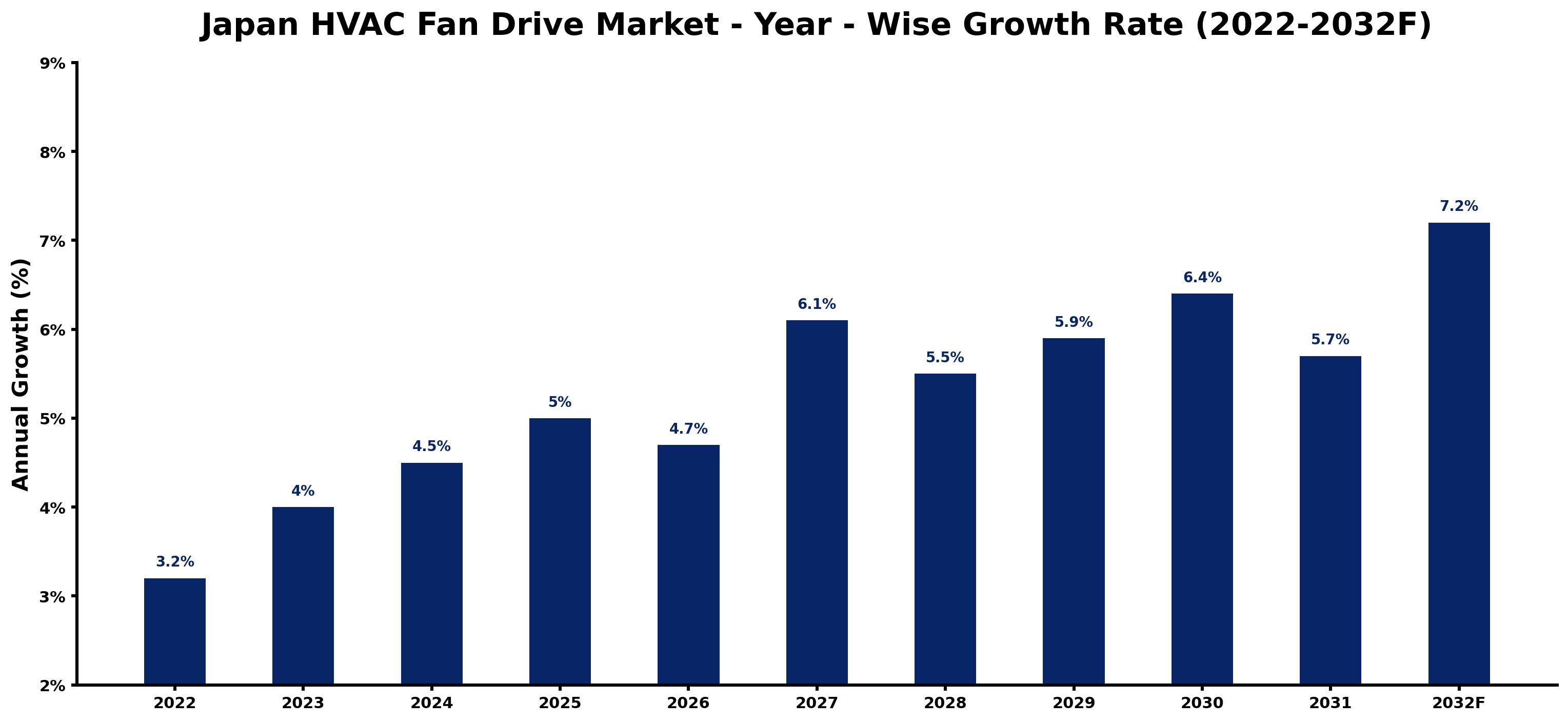
Each row of the following table gives one year's estimated growth and the event or demand shift that explains it.
| Year | Estimated Annual Growth (%) | Market Rationale |
| 2022 | 3.2 | Demand was stable as the HVAC market maintained its operational capacity. |
| 2023 | 4.0 | Growth accelerated due to increased investments in energy-efficient technologies. |
| 2024 | 4.5 | The market continued to expand as construction projects boosted HVAC system installations. |
| 2025 | 5.0 | Demand peaked as commercial developments surged, driving HVAC system upgrades. |
| 2026 | 4.7 | Growth slowed slightly as market adjustments occurred after the peak. |
| 2027 | 6.1 | A rebound in demand followed as energy efficiency became a priority. |
| 2028 | 5.5 | The market experienced moderate growth as new regulations encouraged upgrades. |
| 2029 | 5.9 | Demand increased again as smart HVAC systems gained popularity in urban areas. |
| 2030 | 6.4 | Growth continued as more residential buildings adopted energy-efficient solutions. |
| 2031 | 5.7 | The market saw a slight slowdown as competition intensified among suppliers. |
| 2032 | 7.2 | A strong surge in demand is anticipated as sustainability initiatives gain traction. |
Note: Market size estimations and growth projections presented in this report are based on 6Wresearch's proprietary forecasting methodology, utilizing the latest available industry data, government publications, and primary research inputs.
Japan HVAC Fan Drive Market Synopsis
HVAC Fan Drives manage fan operations in heating, ventilation, and air conditioning systems, utilising electric motors for efficiency. In Japan, the HVAC market is valued at approximately 1.5 trillion JPY, driven by strong demand from commercial and residential sectors. The push for energy-efficient systems, supported by the Energy Conservation Law, along with the increasing adoption of smart technologies in new residential buildings, are key growth factors, creating opportunities for suppliers and manufacturers in this evolving market.
Market Dynamics Impact Analysis (2026–2032)
| Factor | Type | Impact | Primary Segment Affected |
| Growing focus on energy efficiency in HVAC systems | Driver | High | Variable Speed Drives |
| Increase in construction projects leading to higher HVAC installations | Driver | High | Commercial HVAC Systems |
| Rising demand for smart HVAC technologies | Opportunity | High | Smart HVAC Systems |
| Need for system upgrades in aging residential buildings | Opportunity | High | Residential Buildings |
| High costs associated with advanced HVAC technologies | Restraint | Medium | HVAC Part Suppliers |
| Limited awareness of energy-efficient options among consumers | Restraint | Medium | Residential Buildings |
| Competition from alternative cooling and heating solutions | Challenge | High | Commercial HVAC Systems |
| Supply chain disruptions affecting component availability | Challenge | Medium | OEM Distributors |
Evaluation of Drivers in Japan HVAC Fan Drive Market (2026–2032)
These are the developments adding the most demand over the forecast period.
| Drivers | Primary Segment Affected | Why It Matters (Evidence) |
| Increased investment in energy-efficient HVAC technologies | Variable Speed Drives | This investment drives demand as commercial buildings seek to reduce operational costs and comply with regulations. |
| Surge in construction projects in urban areas | Commercial HVAC Systems | New developments in Tokyo and Osaka create a need for advanced HVAC systems. |
| Growing adoption of smart technologies in residential buildings | Smart HVAC Systems | Over 30% of new residential buildings incorporated smart HVAC systems in 2022, reflecting rising consumer demand. |
| Government incentives for energy efficiency upgrades | HVAC Part Suppliers | The allocation of 5 billion JPY for energy efficiency programs encourages system maintenance and upgrades. |
| Rising awareness of environmental sustainability | Residential Buildings | Consumers increasingly prefer energy-efficient solutions to reduce carbon footprints and energy bills. |
The strongest pull on demand comes from increased investment in energy-efficient HVAC technologies, which is vital as commercial buildings seek to lower operational costs. A surge in construction projects in urban areas has led to a rise in the installation of advanced HVAC systems. The growing adoption of smart technologies in residential buildings is clear, with over 30% of new constructions incorporating these systems in 2022. Increased awareness of environmental sustainability drives residential buyers to prefer energy-efficient solutions, creating a dynamic market environment.
Evaluation of Restraints in Japan HVAC Fan Drive Market
The table below lists the restraints and the evidence behind each.
| Market Restraint | Primary Segment Affected | Why It Matters (Evidence) |
| High costs associated with advanced HVAC technologies | HVAC Part Suppliers | These costs deter some buyers from upgrading to energy-efficient systems, limiting market growth. |
| Limited awareness of energy-efficient options among consumers | Residential Buildings | This lack of knowledge results in slower adoption rates for modern HVAC solutions. |
| Regulatory compliance costs for new installations | Commercial HVAC Systems | Meeting the Building Energy Efficiency Act requirements can increase initial investment for buyers. |
| Supply chain disruptions affecting component availability | OEM Distributors | These disruptions can delay project timelines and increase costs for HVAC installations. |
| Competition from alternative cooling and heating solutions | Commercial HVAC Systems | Emerging technologies may divert investments away from traditional HVAC systems. |
Japan HVAC Fan Drive Market Challenges
Natural disasters often disrupt component availability, delaying production schedules for HVAC fan drives and increasing lead times for producers. Technological challenges arise for importers, as many existing systems do not comply with JIS standards, leading to compliance costs that can exceed 100 million JPY. Distributors face fierce competition, resulting in price wars that can shrink profit margins by 20%, jeopardising the viability of smaller firms. Buyers encounter rising operational expenses due to increasing energy costs, which can elevate their HVAC-related expenditures by 15%, compelling them to reassess their system choices.
Trends in the Japan HVAC Fan Drive Market
The shifts below are changing how Japan HVAC Fan Drive Market products are bought and supplied.
- Shift to Smart HVAC Systems: Residential buyers are increasingly adopting smart HVAC systems, with over 30% of new buildings incorporating these technologies in 2022. This trend reflects a growing preference for energy efficiency and automation.
- Transition to Variable Speed Drives in Commercial Buildings: Variable speed drives are becoming standard in commercial HVAC systems as businesses aim to improve energy efficiency. In 2023, their adoption rate increased across major urban areas.
- Emergence of Energy Efficiency Standards: The Building Energy Efficiency Act, effective from April 2025, mandates energy standards for new buildings. This regulation is driving demand for compliant HVAC systems, influencing purchasing decisions.
- Growing Preference for Local Suppliers: Local HVAC part suppliers are gaining traction as buyers seek reliable sources for energy-efficient components. In 2023, 40% of HVAC parts were sourced locally, reflecting a shift in procurement strategies.
Investment Opportunities in the Japan HVAC Fan Drive Market
Several openings in the Japan HVAC Fan Drive Market merit attention from investors.
- Investment in Energy-Efficient HVAC Systems: The demand for energy-efficient HVAC systems is rising, with the government allocating 5 billion JPY for related programs. HVAC part suppliers can capitalise on this trend by offering advanced solutions.
- Expansion of Smart HVAC Technologies: As over 30% of new residential buildings adopted smart systems in 2022, suppliers can invest in developing advanced smart HVAC solutions to meet growing consumer demand.
- Focus on Urban Development Projects: With ongoing construction in Tokyo and Osaka, there is an opportunity for HVAC suppliers to engage with commercial developers and provide tailored solutions.
- Partnerships with Local Distributors: Collaborating with local HVAC distributors can facilitate market entry, especially in regions where demand for energy-efficient systems is increasing.
Government Initiatives in the Japan HVAC Fan Drive Market
The Building Energy Efficiency Act, amended in 2022, is important for buyers as it mandates that all new buildings meet energy standards starting April 2025. This law encourages the adoption of energy-efficient HVAC systems, prompting buyers to invest in compliant technologies to avoid penalties.
The Ministry of the Environment oversees energy efficiency initiatives. It approves funding for programs aimed at promoting smart HVAC technologies, ensuring that buyers have access to the latest advancements and financial support for upgrades.
Future Insight of the Japan HVAC Fan Drive Market
By 2032, buyers will increasingly adopt smart HVAC technologies, driven by government support for energy efficiency initiatives. The integration of advanced control systems will enhance system performance and reduce energy consumption significantly. With 5 billion JPY allocated for energy efficiency programs, suppliers must align their offerings with new standards. As over 30% of new buildings incorporate these technologies, demand for innovative HVAC fan drives will surge, providing producers with opportunities to diversify and expand their product portfolios.
Market Segmentation Analysis
Japan HVAC Fan Drive Market report covers a detailed analysis of the following market segments:
By Drive Type – Belt Drive Fans Lead, Direct Drive Fans Expected to Grow Fastest
According to Saurav Kr Singh, Senior Research Analyst at 6Wresearch, Belt Drive Fans took 33% of drive type revenue in 2025, more than any other category. Belt Drive Fans dominate the market as they are crucial for large systems that necessitate adjustable airflow, particularly in commercial HVAC settings. Facilities in urban areas like Osaka frequently utilise these fans to effectively handle varying operational requirements. Direct Drive Fans are set to record the highest CAGR in this split, 8.3% over 2026–2032. Direct Drive Fans are experiencing rapid growth due to their rising adoption in modern HVAC systems, which prioritise energy efficiency. The increasing trend of new residential buildings incorporating smart HVAC technologies will further accelerate the demand for Direct Drive Fans. Suppliers must focus on enhancing their offerings of Direct Drive Fans to capitalise on the growing market demand.
By Motor Configuration – Single/Multi Speed Leads, Fixed Speed Expected to Grow Fastest
In 2025, Single/Multi Speed led the motor configuration split with a 38% share. Single/Multi Speed configurations dominate the market as they are extensively used in a variety of HVAC systems, accommodating different operational requirements. Their widespread application in urban centres like Tokyo highlights their critical role in both commercial and residential settings. The quickest growth will come from Fixed Speed, forecast to expand at a CAGR of 8.0% between 2026 and 2032. Fixed Speed motors are experiencing rapid growth as they offer a cost-effective solution for new installations, particularly in budget-sensitive projects. As energy efficiency initiatives expand, interest in Fixed Speed motors is likely to rise. Buyers should consider Fixed Speed options for their affordability in new HVAC projects.
By Distribution Channel – HVAC Part Suppliers Lead, OEM Distributors Expected to Grow Fastest
The largest distribution channel category in 2025 was HVAC Part Suppliers, at 40% of revenue. HVAC Part Suppliers lead the market as they are critical for system maintenance and upgrades, ensuring the longevity of HVAC systems in commercial settings. Their established networks in major cities facilitate easy access to essential components for ongoing projects. Over 2026–2032, OEM Distributors are expected to post the fastest growth, at a CAGR of 7.8%. OEM Distributors are the fastest-growing channel, primarily serving as the main source for new installations in the expanding residential sector. With government initiatives promoting energy-efficient systems, the reliance on OEMs for new projects is expected to surge. Suppliers should strengthen partnerships with OEM Distributors to capitalise on the increasing demand for new installations.
By End User – Commercial HVAC Systems Lead, Residential Buildings Expected to Grow Fastest
Commercial HVAC Systems accounted for 38% of the market by end user in 2025. Commercial HVAC Systems represent the largest share as they are extensively employed in urban developments, where effective climate control is essential. The ongoing construction boom in cities such as Tokyo reinforces this segment's dominant position. Residential Buildings are projected to grow fastest, at a CAGR of 8.1% during 2026–2032. Residential Buildings are the fastest-growing segment driven by the rising integration of energy-efficient HVAC systems in new housing projects. The government's support for smart HVAC technologies will significantly boost this sector's expansion. Suppliers should adapt their strategies to cater to the increasing demands of the residential building market.
Key Attractiveness of the Report
- 10 Years of Market Numbers
- Historical Data Starting from 2022 to 2025
- Base Year 2025
- Forecast Data until 2032
- Key Performance Indicators Impacting the Market
- Major Upcoming Developments and Projects
Key Highlights of the Report:
- Japan HVAC Fan Drive Market Outlook
- Market Size of Japan HVAC Fan Drive Market, 2025
- Forecast of Japan HVAC Fan Drive Market, 2032
- Historical Data and Forecast of Japan HVAC Fan Drive Revenues & Volume for the Period 2022-2032F
- Japan HVAC Fan Drive Market Trend Evolution
- Japan HVAC Fan Drive Market Drivers and Challenges
- Japan HVAC Fan Drive Price Trends
- Japan HVAC Fan Drive Porter's Five Forces
- Japan HVAC Fan Drive Industry Life Cycle
- Historical Data and Forecast of Japan HVAC Fan Drive Market Revenues & Volume By Drive Type for the Period 2022-2032F
- Historical Data and Forecast of Japan HVAC Fan Drive Market Revenues & Volume By Belt Drive Fans for the Period 2022-2032F
- Historical Data and Forecast of Japan HVAC Fan Drive Market Revenues & Volume By Direct Drive Fans for the Period 2022-2032F
- Historical Data and Forecast of Japan HVAC Fan Drive Market Revenues & Volume By Variable Speed Drives for the Period 2022-2032F
- Historical Data and Forecast of Japan HVAC Fan Drive Market Revenues & Volume By Clutch-Based Fans for the Period 2022-2032F
- Historical Data and Forecast of Japan HVAC Fan Drive Market Revenues & Volume By Motor Configuration for the Period 2022-2032F
- Historical Data and Forecast of Japan HVAC Fan Drive Market Revenues & Volume By Single/Multi Speed for the Period 2022-2032F
- Historical Data and Forecast of Japan HVAC Fan Drive Market Revenues & Volume By Fixed Speed for the Period 2022-2032F
- Historical Data and Forecast of Japan HVAC Fan Drive Market Revenues & Volume By ECM / BLDC Motors for the Period 2022-2032F
- Historical Data and Forecast of Japan HVAC Fan Drive Market Revenues & Volume By Electromagnetic for the Period 2022-2032F
- Historical Data and Forecast of Japan HVAC Fan Drive Market Revenues & Volume By Distribution Channel for the Period 2022-2032F
- Historical Data and Forecast of Japan HVAC Fan Drive Market Revenues & Volume By HVAC Part Suppliers for the Period 2022-2032F
- Historical Data and Forecast of Japan HVAC Fan Drive Market Revenues & Volume By OEM Distributors for the Period 2022-2032F
- Historical Data and Forecast of Japan HVAC Fan Drive Market Revenues & Volume By Online B2B Platforms for the Period 2022-2032F
- Historical Data and Forecast of Japan HVAC Fan Drive Market Revenues & Volume By Auto HVAC Vendors for the Period 2022-2032F
- Historical Data and Forecast of Japan HVAC Fan Drive Market Revenues & Volume By End User for the Period 2022-2032F
- Historical Data and Forecast of Japan HVAC Fan Drive Market Revenues & Volume By Commercial HVAC Systems for the Period 2022-2032F
- Historical Data and Forecast of Japan HVAC Fan Drive Market Revenues & Volume By Residential Buildings for the Period 2022-2032F
- Historical Data and Forecast of Japan HVAC Fan Drive Market Revenues & Volume By Smart HVAC Systems for the Period 2022-2032F
- Historical Data and Forecast of Japan HVAC Fan Drive Market Revenues & Volume By Vehicle HVAC Systems for the Period 2022-2032F
- Japan HVAC Fan Drive Import Export Trade Statistics
- Market Opportunity Assessment By Drive Type
- Market Opportunity Assessment By Motor Configuration
- Market Opportunity Assessment By Distribution Channel
- Market Opportunity Assessment By End User
- Japan HVAC Fan Drive Top Companies Market Share
- Japan HVAC Fan Drive Competitive Benchmarking By Technical and Operational Parameters
- Japan HVAC Fan Drive Company Profiles
- Japan HVAC Fan Drive Key Strategic Recommendations
Market Covered
Coverage by segment is as follows.
By Drive Type
- Belt Drive Fans
- Direct Drive Fans
- Variable Speed Drives
- Clutch-Based Fans
By Motor Configuration
- Single/Multi Speed
- Fixed Speed
- ECM / BLDC Motors
- Electromagnetic
By Distribution Channel
- HVAC Part Suppliers
- OEM Distributors
- Online B2B Platforms
- Auto HVAC Vendors
By End User
- Commercial HVAC Systems
- Residential Buildings
- Smart HVAC Systems
- Vehicle HVAC Systems































