Japan HVAC Filtration System Market Size & Growth Rate
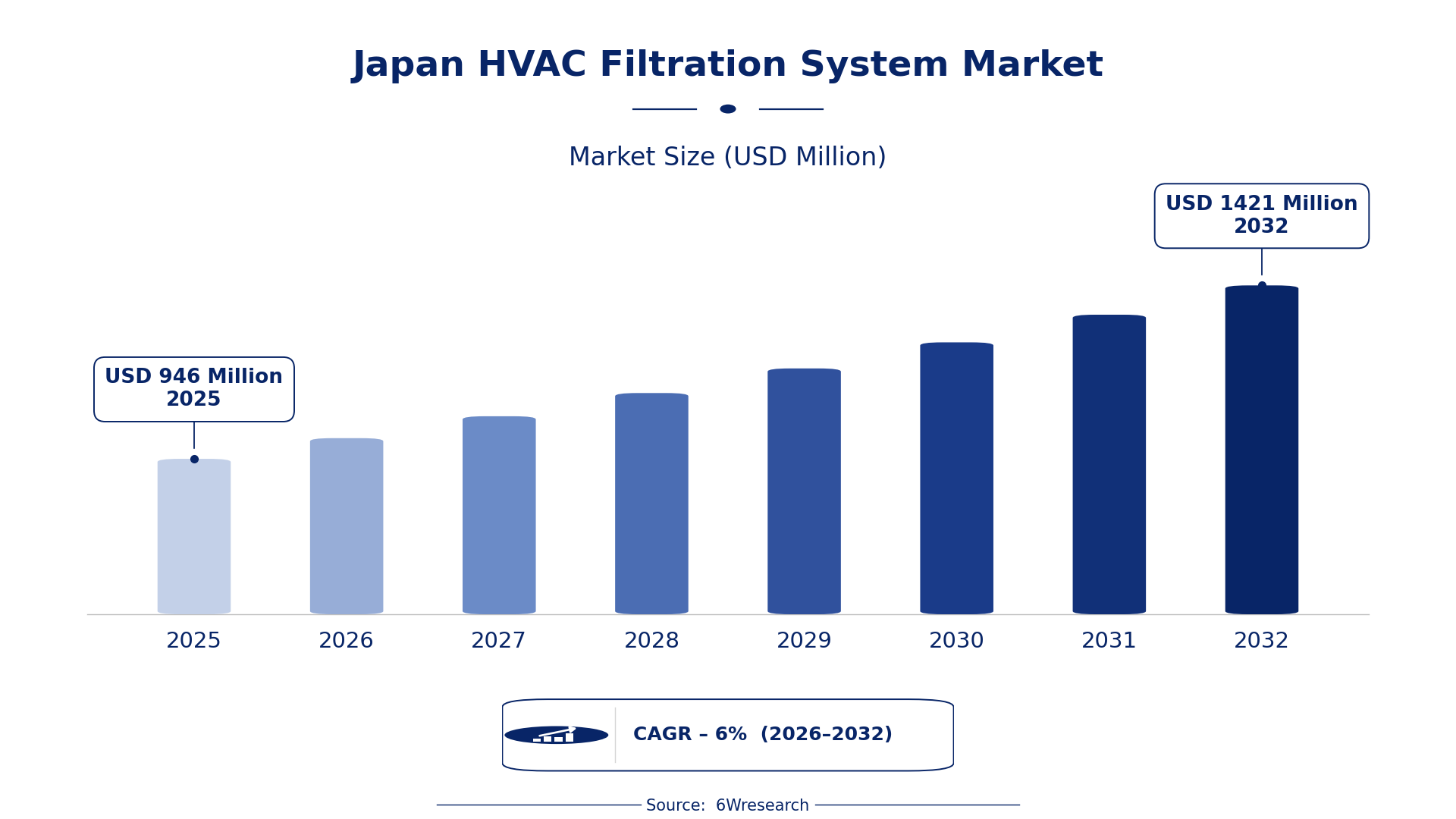
According to 6Wresearch internal database and industry insights, the Japan HVAC Filtration System Market was valued at USD 946 Million in 2025 and is projected to reach USD 1,421 Million by 2032, growing at a CAGR of approximately 6% during 2026–2032.
Japan HVAC Filtration System Market Highlights
| Report Metric | Details |
| Report Name | Japan HVAC Filtration System Market (2026-2032) |
| Market Size 2025 | USD 946 Million |
| Market Size 2032 | USD 1,421 Million |
| Absolute Growth 2025–2032 | USD 475 Million |
| CAGR 2026–2032 | 6% |
| Peak Annual Growth | 6.7% in 2026 |
| Forecast Period | 2026–2032 |
| Historical Data | 2022–2025 |
| Base Year | 2025 |
| Leading System Type, 2025 | Central Air Systems (41% share) |
| Leading Application Type, 2025 | Full-Building (41% share) |
| Leading Distribution Channel, 2025 | HVAC Integrators (40% share) |
| Leading End User, 2025 | Malls & Airports (41% share) |
| Fastest-Growing System Type | Portable Filtration (8.6% CAGR) |
| Fastest-Growing Application Type | Room-Based (8.0% CAGR) |
| Fastest-Growing Distribution Channel | Retail Electronics (7.8% CAGR) |
| Fastest-Growing End User | Homes & Offices (7.9% CAGR) |
| Growing Sector | commercial HVAC systems |
| Key End Users | hospitals, commercial buildings, residential homes, manufacturing plants |
Japan HVAC Filtration System Market Year-wise Growth Rate and Key Drivers (2022–2032)
This graph illustrates the annual growth rates of the market from 2022 to 2032, highlighting a steady upward trajectory and projected market expansion over the forecast period.
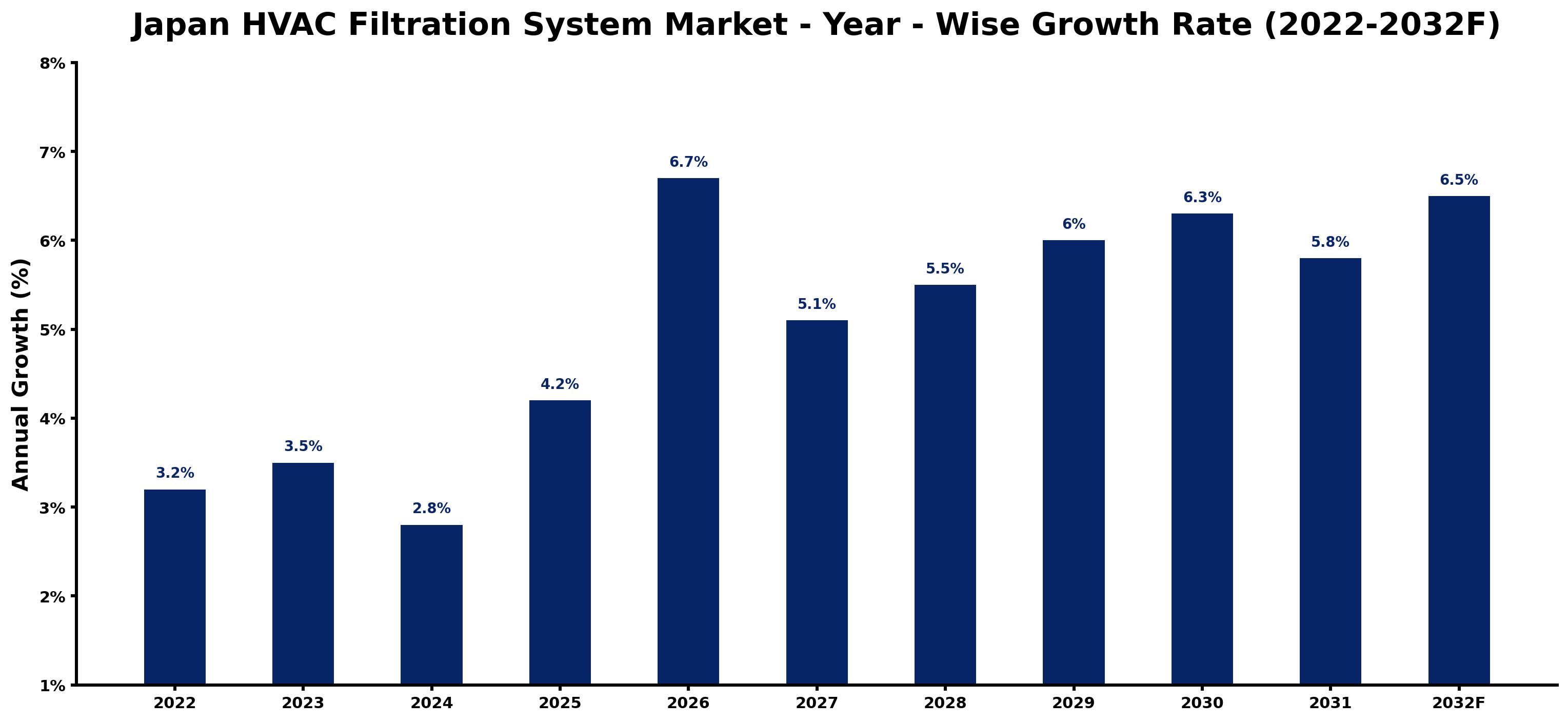
The following figures match every annual growth estimate with the main market development of that year, giving the reasoning behind each rise or slowdown.
| Year | Estimated Annual Growth (%) | Market Rationale |
| 2022 | 3.2 | The market showed steady growth, supported by ongoing construction projects and rising awareness of air quality. |
| 2023 | 3.5 | Demand increased as consumers sought better indoor air quality solutions amid urbanisation trends. |
| 2024 | 2.8 | Growth slowed slightly due to market saturation in some segments, yet demand remained positive. |
| 2025 | 4.2 | The market accelerated as investments surged following the Tokyo 2020 Olympics infrastructure upgrades. |
| 2026 | 6.7 | Peak growth is expected as energy efficiency standards prompt widespread adoption of advanced filtration systems. |
| 2027 | 5.1 | A slight slowdown in growth is projected as the market begins to stabilise after rapid expansion. |
| 2028 | 5.5 | Demand is expected to rise again as new commercial buildings increasingly incorporate advanced HVAC systems. |
| 2029 | 6.0 | Growth will continue as urban areas expand, driving the need for improved air quality solutions. |
| 2030 | 6.3 | The market is expected to maintain momentum with ongoing government initiatives aimed at energy efficiency. |
| 2031 | 5.8 | A slowdown in growth is anticipated as the market adjusts to previous high rates of expansion. |
| 2032 | 6.5 | Growth is projected to pick up again as technological advancements in filtration systems become more prevalent. |
Note: Market size estimations and growth projections presented in this report are based on 6Wresearch's proprietary forecasting methodology, utilizing the latest available industry data, government publications, and primary research inputs.
Japan HVAC Filtration System Market Synopsis
HVAC filtration systems are critical technologies that enhance indoor air quality by filtering pollutants and particulates. Constructed from materials like fiberglass and activated carbon, they cater to residential, commercial, and industrial needs. The Japan HVAC Filtration System Market is growing due to urbanisation, heightened health awareness, and government initiatives promoting energy-efficient systems. The Tokyo metropolitan area serves as a central hub for installations, while the 2023 government programme aimed at improving indoor air quality in public buildings is further stimulating demand.
Market Dynamics Impact Analysis (2026–2032)
| Factor | Type | Impact | Primary Segment Affected |
| Rising health awareness among consumers | Driver | High | Room-Based |
| Increased urbanisation leading to higher demand for air quality solutions | Driver | High | Full-Building |
| Growing need for energy-efficient systems in commercial buildings | Opportunity | High | Central Air Systems |
| Expansion of online sales channels for HVAC products | Opportunity | Medium | Online HVAC Vendors |
| High initial investment costs for advanced systems | Restraint | High | Modular Systems |
| Limited awareness of filtration options among consumers | Restraint | Medium | Portable Filtration |
| Competition from low-cost alternatives affecting premium brands | Challenge | High | Industrial Air Systems |
| Technological advancements requiring ongoing investment | Challenge | Medium | High Volume Filters |
Evaluation of Drivers in Japan HVAC Filtration System Market (2026–2032)
The table below links each growth driver to the segment it affects and the evidence for it.
| Drivers | Primary Segment Affected | Why It Matters (Evidence) |
| Increased health concerns | Room-Based | The need for cleaner air in homes drives demand for room-based systems, with urban areas showing a 15% rise in sales. |
| Government energy efficiency initiatives | Full-Building | Policies promoting energy-efficient HVAC systems boost demand in commercial buildings, particularly in the Tokyo metropolitan area, where installations are expected to rise by 20%. |
| Growing construction of commercial buildings | Central Air Systems | New projects are increasingly adopting central air systems, with a projected 20% increase in installations by 2025. |
| Rising disposable incomes | Portable Filtration | Higher disposable incomes lead to greater investment in portable filtration units, particularly in urban households, which are seeing a 15% increase in demand. |
| Technological advancements in filtration materials | High Volume Filters | Innovations in filter technology improve performance, driving demand in manufacturing plants to meet safety regulations. |
Buyers are adding capacity as health concerns rise, with urban areas showing a 15% increase in sales of room-based systems. Energy efficiency efforts are driving demand for full-building systems, particularly in the Tokyo metropolitan area, where installations are projected to increase by 20%. The construction boom in commercial buildings boosts demand for central air systems, which are essential for maintaining air quality. Rising disposable incomes lead to greater investments in portable filtration units, especially in urban households that are increasingly prioritising air quality.
Evaluation of Restraints in Japan HVAC Filtration System Market
These restraints slow adoption and weigh on supplier margins.
| Market Restraint | Primary Segment Affected | Why It Matters (Evidence) |
| High initial investment costs for advanced systems | Modular Systems | The cost of advanced modular systems can deter buyers, particularly in smaller commercial projects where budgets are tight. |
| Limited consumer awareness about filtration options | Portable Filtration | Many consumers lack knowledge about the benefits of portable filtration, which slows adoption rates in urban homes. |
| Competition from low-cost alternatives | Industrial Air Systems | Low-cost filtration options undermine premium brands, affecting sales and market share in the industrial sector. |
| Technological advancements requiring ongoing investment | High Volume Filters | Suppliers face pressure to continuously invest in technology, impacting profitability and pricing strategies. |
| Regulatory compliance costs for manufacturers | Central Air Systems | Manufacturers must invest in compliance with stringent regulations, raising operational costs. |
Japan HVAC Filtration System Market Challenges
High costs for HVAC filtration systems impede producers' investment in innovation, as material prices have surged by 20% over the past year. Supply chain disruptions in Japan have led to filter shortages, causing installation delays for buyers of up to three months. Compliance with strict regulations from the Ministry of Health, Labour and Welfare requires high-efficiency filters in hospitals, increasing costs for suppliers by 15%. A shortage of skilled technicians in the HVAC sector restricts producers' workforce capacity, resulting in longer wait times for system installations and maintenance services for buyers.
Trends in the Japan HVAC Filtration System Market
Four trends stand out in the Japan HVAC Filtration System Market.
- Shift towards Energy-Efficient Systems: In 2023, a government programme was initiated to enhance indoor air quality in public buildings, promoting energy-efficient HVAC systems. This initiative is anticipated to boost demand for advanced filtration technologies.
- Rise in Online Sales Channels: Online sales of HVAC systems have risen by 15% in the past year, reflecting a change in consumer purchasing behaviour. This trend is transforming how buyers access filtration products, making them more accessible.
- Growing Popularity of Portable Filtration Units: Portable filtration units are gaining traction in urban homes due to space limitations. Urban households are showing a marked increase in demand for these systems.
- Expansion of Modular Systems in New Constructions: The demand for modular systems is increasing in the construction of new commercial buildings, driven by the need for flexible HVAC solutions. This segment is expected to experience substantial growth over the next five years.
Investment Opportunities in the Japan HVAC Filtration System Market
Where to invest in the Japan HVAC Filtration System Market: the main openings are set out below.
- Gap in Energy-Efficient HVAC Solutions: With a target of reducing energy consumption in commercial buildings by 20% by 2030, there is a rising need for energy-efficient HVAC solutions. Engineering firms are pivotal in this market, enabling entry through partnerships.
- Need for Advanced Filtration in Hospitals: Hospitals require high-efficiency filters to meet health regulations, presenting a significant opportunity for suppliers. Collaborating with healthcare facilities can improve market penetration, especially as compliance becomes more rigorous.
- Urban Expansion Driving Demand for Air Quality Solutions: As urban areas grow, the demand for air quality solutions is on the rise. Targeting the Kansai region, recognised for its industrial base, offers a prime opportunity for HVAC suppliers, with projected market growth of 10%.
- Investment in Smart HVAC Technologies: The HVAC market is shifting towards smart technologies, with anticipated growth in demand for smart systems. Partnering with technology firms can ease entry into this expanding segment, expected to grow by 15%.
Government Initiatives in the Japan HVAC Filtration System Market
The Building Energy Efficiency Act, amended in 2022, requires that all new buildings comply with energy standards from April 2025, influencing HVAC system designs and promoting the adoption of energy-efficient technologies. This legislation creates a market for advanced filtration systems, benefiting both producers and buyers.
The Ministry of the Environment manages funding initiatives to encourage energy-efficient HVAC systems. This agency supports projects aimed at improving indoor air quality, approving over 50 projects annually, which benefits both producers and buyers in the HVAC market.
Future Insight of the Japan HVAC Filtration System Market
Government initiatives focused on improving indoor air quality will drive demand for advanced HVAC filtration technologies by 2032. Energy efficiency standards will compel suppliers to develop more sustainable solutions, aligning with the goal to reduce energy consumption in commercial buildings by 20% by 2030. The rise of modular systems in new construction projects will provide buyers with flexible and efficient options. As the HVAC market evolves, digital sales channels will become essential for suppliers to effectively connect with a wider customer base.
Market Segmentation Analysis
Japan HVAC Filtration System Market report covers a detailed analysis of the following market segments:
By System Type – Central Air Systems Lead, Portable Filtration Expected to Grow Fastest
According to Saurav Kr Singh, Senior Research Analyst at 6Wresearch, the largest system type category in 2025 was Central Air Systems, at 41% of revenue. Central air systems are essential for maintaining indoor air quality in commercial buildings, particularly in urban centres like Tokyo. Their widespread use in large facilities ensures they hold the largest share of the market. Over 2026–2032, Portable Filtration is expected to post the fastest growth, at a CAGR of 8.6%. The increasing demand for portable filtration units is primarily due to space constraints in urban homes, where traditional systems are impractical. This trend is particularly pronounced in densely populated areas, indicating a shift towards more adaptable solutions. Suppliers should prioritise the development of portable filtration options to meet the growing demand in urban residential markets.
By Application Type – Full-Building Leads, Room-Based Expected to Grow Fastest
Full-Building held 41% of the Japan HVAC Filtration System Market by application type in 2025. Full-building applications play a crucial role in maintaining air quality across extensive commercial spaces, making them essential in the HVAC sector. Their leading position is reinforced by the ongoing construction of large facilities that demand comprehensive HVAC solutions. The quickest growth will come from Room-Based, forecast to expand at a CAGR of 8.0% between 2026 and 2032. Room-based systems are rapidly becoming popular in residential settings, as consumers increasingly recognise the importance of indoor air quality in smaller living spaces. This trend is likely to continue, further widening the gap between full-building and room-based applications. Suppliers should focus on developing room-based solutions to meet the growing consumer demand for improved air quality in homes.
By Distribution Channel – HVAC Integrators Lead, Retail Electronics Expected to Grow Fastest
HVAC Integrators took 40% of distribution channel revenue in 2025, more than any other category. HVAC integrators are integral to the installation process, offering expertise that ensures the effective performance of HVAC systems across diverse environments. Their strong relationships with commercial clients solidify their leading role in the distribution channel. Retail Electronics is set to record the highest CAGR in this split, 7.8% over 2026–2032. Retail electronics outlets are witnessing rapid growth as they provide consumers with direct access to filtration products, reflecting the increasing demand for home air quality solutions. This trend indicates a shift in consumer preferences towards more accessible purchasing options. Suppliers should consider collaborating with retail electronics to improve product visibility and reach a wider audience.
By End User – Malls & Airports Lead, Homes & Offices Expected to Grow Fastest
Malls & Airports accounted for 41% of the market by end user in 2025. Malls and airports require effective air quality control, making advanced HVAC filtration systems vital for ensuring safety in high-traffic public areas. The strict regulations governing air quality in these environments further strengthen this segment's leadership. Homes & Offices are projected to grow fastest, at a CAGR of 7.9% during 2026–2032. Homes and offices are emerging as significant markets for residential units, with a growing awareness of indoor air quality driving demand for effective filtration solutions. This focus on healthier living environments is expected to accelerate the growth of this segment. Suppliers must tailor their products to meet the specific needs of residential customers as this segment continues to grow.
Key Attractiveness of the Report
- 10 Years of Market Numbers
- Historical Data Starting from 2022 to 2025
- Base Year 2025
- Forecast Data until 2032
- Key Performance Indicators Impacting the Market
- Major Upcoming Developments and Projects
Key Highlights of the Report:
- Japan HVAC Filtration System Market Outlook
- Market Size of Japan HVAC Filtration System Market, 2025
- Forecast of Japan HVAC Filtration System Market, 2032
- Historical Data and Forecast of Japan HVAC Filtration System Revenues & Volume for the Period 2022-2032F
- Japan HVAC Filtration System Market Trend Evolution
- Japan HVAC Filtration System Market Drivers and Challenges
- Japan HVAC Filtration System Price Trends
- Japan HVAC Filtration System Porter's Five Forces
- Japan HVAC Filtration System Industry Life Cycle
- Historical Data and Forecast of Japan HVAC Filtration System Market Revenues & Volume By System Type for the Period 2022-2032F
- Historical Data and Forecast of Japan HVAC Filtration System Market Revenues & Volume By Central Air Systems for the Period 2022-2032F
- Historical Data and Forecast of Japan HVAC Filtration System Market Revenues & Volume By Portable Filtration for the Period 2022-2032F
- Historical Data and Forecast of Japan HVAC Filtration System Market Revenues & Volume By Modular Systems for the Period 2022-2032F
- Historical Data and Forecast of Japan HVAC Filtration System Market Revenues & Volume By Industrial Air Systems for the Period 2022-2032F
- Historical Data and Forecast of Japan HVAC Filtration System Market Revenues & Volume By Application Type for the Period 2022-2032F
- Historical Data and Forecast of Japan HVAC Filtration System Market Revenues & Volume By Full-Building for the Period 2022-2032F
- Historical Data and Forecast of Japan HVAC Filtration System Market Revenues & Volume By Room-Based for the Period 2022-2032F
- Historical Data and Forecast of Japan HVAC Filtration System Market Revenues & Volume By Plug-in Units for the Period 2022-2032F
- Historical Data and Forecast of Japan HVAC Filtration System Market Revenues & Volume By High Volume Filters for the Period 2022-2032F
- Historical Data and Forecast of Japan HVAC Filtration System Market Revenues & Volume By Distribution Channel for the Period 2022-2032F
- Historical Data and Forecast of Japan HVAC Filtration System Market Revenues & Volume By HVAC Integrators for the Period 2022-2032F
- Historical Data and Forecast of Japan HVAC Filtration System Market Revenues & Volume By Retail Electronics for the Period 2022-2032F
- Historical Data and Forecast of Japan HVAC Filtration System Market Revenues & Volume By Online HVAC Vendors for the Period 2022-2032F
- Historical Data and Forecast of Japan HVAC Filtration System Market Revenues & Volume By Engineering Firms for the Period 2022-2032F
- Historical Data and Forecast of Japan HVAC Filtration System Market Revenues & Volume By End User for the Period 2022-2032F
- Historical Data and Forecast of Japan HVAC Filtration System Market Revenues & Volume By Malls & Airports for the Period 2022-2032F
- Historical Data and Forecast of Japan HVAC Filtration System Market Revenues & Volume By Homes & Offices for the Period 2022-2032F
- Historical Data and Forecast of Japan HVAC Filtration System Market Revenues & Volume By Hospitals for the Period 2022-2032F
- Historical Data and Forecast of Japan HVAC Filtration System Market Revenues & Volume By Manufacturing Plants for the Period 2022-2032F
- Japan HVAC Filtration System Import Export Trade Statistics
- Market Opportunity Assessment By System Type
- Market Opportunity Assessment By Application Type
- Market Opportunity Assessment By Distribution Channel
- Market Opportunity Assessment By End User
- Japan HVAC Filtration System Top Companies Market Share
- Japan HVAC Filtration System Competitive Benchmarking By Technical and Operational Parameters
- Japan HVAC Filtration System Company Profiles
- Japan HVAC Filtration System Key Strategic Recommendations
Market Covered
Coverage by segment is as follows.
By System Type
- Central Air Systems
- Portable Filtration
- Modular Systems
- Industrial Air Systems
By Application Type
- Full-Building
- Room-Based
- Plug-in Units
- High Volume Filters
By Distribution Channel
- HVAC Integrators
- Retail Electronics
- Online HVAC Vendors
- Engineering Firms
By End User
- Malls & Airports
- Homes & Offices
- Hospitals
- Manufacturing Plants































