Japan HVAC Heat Exchanger Market Size & Growth Rate
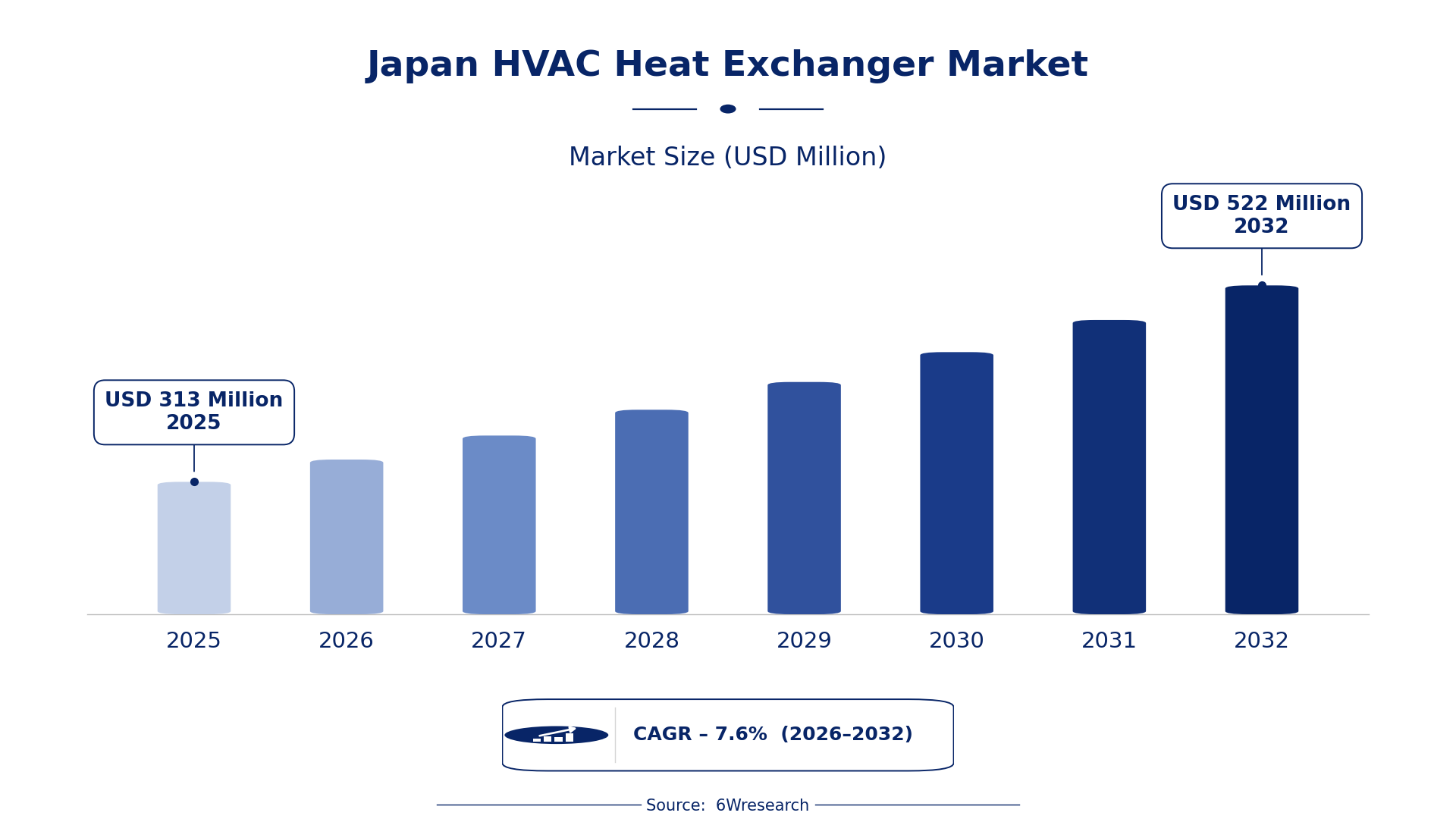
According to 6Wresearch internal database and industry insights, the Japan HVAC Heat Exchanger Market was valued at USD 313 Million in 2025 and is projected to reach USD 522 Million by 2032, growing at a CAGR of approximately 7.6% during 2026–2032.
Japan HVAC Heat Exchanger Market Highlights
| Report Metric | Details |
| Report Name | Japan HVAC Heat Exchanger Market (2026-2032) |
| Market Size 2025 | USD 313 Million |
| Market Size 2032 | USD 522 Million |
| Absolute Growth 2025–2032 | USD 209 Million |
| CAGR 2026–2032 | 7.6% |
| Peak Annual Growth | 8.6% in 2029 |
| Forecast Period | 2026–2032 |
| Historical Data | 2022–2025 |
| Base Year | 2025 |
| Leading Type, 2025 | Plate Heat Exchangers (47% share) |
| Leading Material Type, 2025 | Stainless Steel (50% share) |
| Leading Distribution Channel, 2025 | OEM Distributors (39% share) |
| Leading End User, 2025 | Commercial HVAC Systems (41% share) |
| Fastest-Growing Type | Shell & Tube (10.8% CAGR) |
| Fastest-Growing Material Type | Copper Alloy (10.7% CAGR) |
| Fastest-Growing Distribution Channel | Industrial Suppliers (10.1% CAGR) |
| Fastest-Growing End User | Power Plants (9.8% CAGR) |
| Growing Sector | Commercial HVAC Systems |
| Key End Users | Commercial buildings, power plants, industrial suppliers, HVAC component vendors |
Japan HVAC Heat Exchanger Market Year-wise Growth Rate and Key Drivers (2022–2032)
This graph illustrates the annual growth rates of the market from 2022 to 2032, highlighting a steady upward trajectory and projected market expansion over the forecast period.
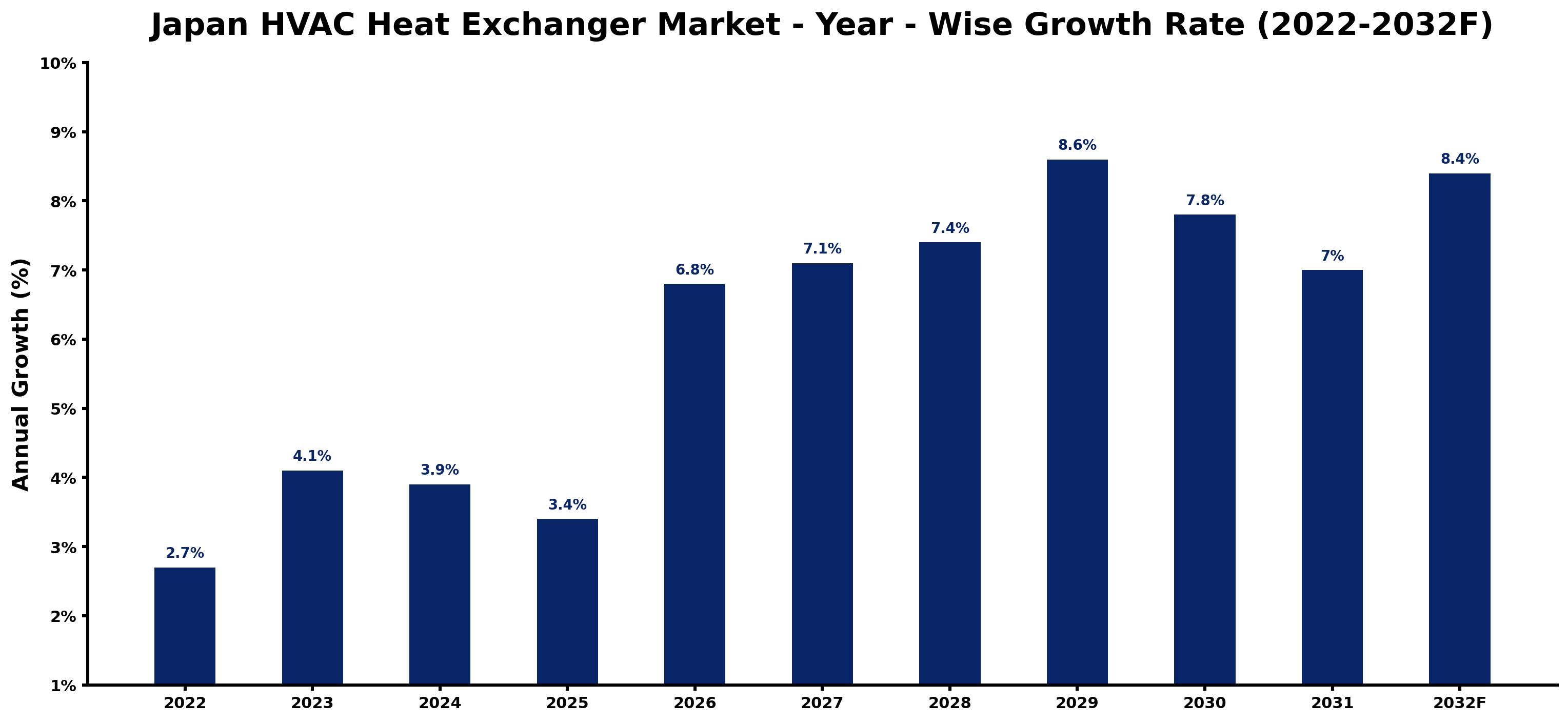
For each year, the table pairs the estimated growth rate with the leading influence on demand, showing how the drivers changed across the period.
| Year | Estimated Annual Growth (%) | Market Rationale |
| 2022 | 2.7 | The market experienced moderate growth due to stable demand from commercial buildings. |
| 2023 | 4.1 | Growth accelerated as the Tokyo metropolitan area adopted more HVAC technologies. |
| 2024 | 3.9 | Growth slowed as energy efficiency standards began to impact purchasing decisions. |
| 2025 | 3.4 | Demand continued to grow but at a slower pace as market saturation occurred. |
| 2026 | 6.8 | Investment in energy-efficient technologies is anticipated to drive a resurgence in demand. |
| 2027 | 7.1 | Increased activity is expected as commercial HVAC systems expand. |
| 2028 | 7.4 | Higher summer temperatures will boost demand for cooling solutions. |
| 2029 | 8.6 | Peak growth will be driven by heightened investment in energy-efficient HVAC systems. |
| 2030 | 7.8 | Demand growth is projected to slow as market maturity begins to set in. |
| 2031 | 7.0 | The market is likely to continue growing but at a reduced rate due to saturation. |
| 2032 | 8.4 | A renewed focus on sustainability will drive increased purchases. |
Note: Market size estimations and growth projections presented in this report are based on 6Wresearch's proprietary forecasting methodology, utilizing the latest available industry data, government publications, and primary research inputs.
Japan HVAC Heat Exchanger Market Synopsis
HVAC heat exchangers are devices that transfer heat between fluids, commonly used in heating, cooling, and refrigeration applications. The Japan HVAC Heat Exchanger Market is expanding, supported by over 100 million square meters of commercial building space requiring HVAC systems and a strong emphasis on energy efficiency. The Tokyo metropolitan area is a key hub for technology adoption, while government initiatives aim to reduce energy consumption by 20% by 2030, stimulating further demand.
Market Dynamics Impact Analysis (2026–2032)
| Factor | Type | Impact | Primary Segment Affected |
| Increasing energy efficiency regulations | Driver | High | Commercial HVAC Systems |
| Rising temperatures leading to higher cooling demand | Driver | High | Air Cooled |
| Growing investment in energy-efficient HVAC technologies | Opportunity | High | Finned Tube |
| Expansion of commercial building space requiring HVAC systems | Opportunity | High | Commercial Buildings |
| High initial costs of energy-efficient systems | Restraint | Medium | Stainless Steel |
| Market saturation in urban areas limiting growth potential | Restraint | Medium | Shell & Tube |
| Supply chain disruptions affecting material availability | Challenge | High | Copper Alloy |
| Technological advancements requiring continuous investment | Challenge | Medium | HVAC Component Vendors |
Evaluation of Drivers in Japan HVAC Heat Exchanger Market (2026–2032)
The main growth drivers and the segments they affect most are set out below.
| Drivers | Primary Segment Affected | Why It Matters (Evidence) |
| Investment in energy-efficient HVAC technologies | Finned Tube | This investment unlocks demand as consumers seek to reduce energy costs, with a projected energy consumption reduction of 20% by 2030. |
| Rising temperatures during summer months | Air Cooled | Increased temperatures, which can reach 35°C in Tokyo, lead to higher demand for cooling solutions in commercial buildings. |
| Expansion of commercial building space | Commercial HVAC Systems | With over 100 million square meters of commercial space, there is a consistent demand for HVAC systems to maintain comfortable environments. |
| Government initiatives promoting energy efficiency | Stainless Steel | The Ministry of the Environment's program to improve HVAC efficiency drives demand for durable and efficient heat exchangers. |
| Technological advancements in HVAC systems | Shell & Tube | Innovation in HVAC technology encourages manufacturers to adopt advanced heat exchangers, improving system performance. |
Demand is primarily driven by investment in energy-efficient HVAC technologies, projected to reduce energy consumption by 20% by 2030. Rising temperatures in urban areas increase the need for cooling solutions, especially during summer months when averages can reach 35°C. The expansion of commercial building space, exceeding 100 million square meters, consistently fuels the need for HVAC systems.
Evaluation of Restraints in Japan HVAC Heat Exchanger Market
The following restraints limit how fast demand can grow.
| Market Restraint | Primary Segment Affected | Why It Matters (Evidence) |
| High initial costs of energy-efficient systems | Stainless Steel | The upfront investment required for energy-efficient HVAC systems can deter buyers, particularly in cost-sensitive sectors. |
| Market saturation in urban areas | Shell & Tube | As urban areas become saturated with HVAC solutions, growth potential diminishes, limiting new purchases. |
| Supply chain disruptions affecting material availability | Copper Alloy | Ongoing supply chain issues can delay production and increase costs, impacting availability for manufacturers. |
| Technological advancements requiring continuous investment | HVAC Component Vendors | The need for ongoing investment in new technologies can strain budgets and slow down procurement processes. |
| Regulatory compliance costs for HVAC systems | Air Cooled | Compliance with stringent energy efficiency regulations can increase operational costs for buyers. |
Japan HVAC Heat Exchanger Market Challenges
Contractors in Japan's HVAC market face rising costs as stainless steel prices surged by 15% in the past year, straining their budgets. Regulatory requirements from the Ministry of the Environment compel manufacturers to invest in new technologies, delaying project timelines by up to six months. Supply chain disruptions have extended lead times for essential components, causing installation delays for contractors. The demand for energy-efficient solutions has intensified competition, resulting in unpredictable price fluctuations that complicate procurement for buyers, particularly in the commercial sector.
Trends in the Japan HVAC Heat Exchanger Market
The trends below show where the Japan HVAC Heat Exchanger Market is heading.
- Shift from Traditional to Energy-Efficient HVAC Systems: Since 2023, the market has seen a shift towards energy-efficient HVAC systems, prompted by rising energy costs. The government's initiative aims for a 20% reduction in energy consumption by 2030, leading buyers to invest in modern solutions.
- Transition from Metal to Composite Materials: In 2026, HVAC manufacturers began adopting composite materials for heat exchangers, improving performance while reducing weight. This shift is evidenced by a 10% increase in demand for composite heat exchangers in commercial applications.
- Emergence of Smart HVAC Technologies: Starting in 2025, smart HVAC technologies have gained traction, allowing for better energy management. The integration of IoT in HVAC systems is expected to increase efficiency by 15%, attracting tech-savvy buyers.
- Prioritisation of Sustainability in HVAC Design: Since 2022, sustainability has become a focal point in HVAC design, with buyers increasingly demanding eco-friendly solutions. The market for green HVAC technologies is anticipated to grow by 12% annually.
Investment Opportunities in the Japan HVAC Heat Exchanger Market
Several openings in the Japan HVAC Heat Exchanger Market merit attention from investors.
- Energy-efficient HVAC systems: With the government aiming for a 20% reduction in energy consumption by 2030, there is an opportunity to supply energy-efficient HVAC systems to commercial buildings, particularly in urban areas like Tokyo.
- Advanced heat exchanger technologies: The rising demand for innovative heat exchangers presents an opportunity for suppliers to collaborate with HVAC component vendors, particularly in regions focused on energy efficiency.
- Sustainable HVAC solutions: The emphasis on sustainability creates a gap for suppliers of eco-friendly HVAC products, especially in commercial sectors prioritising green technologies.
- Smart HVAC integration: The growing trend towards smart HVAC technologies offers opportunities for partnerships with technology providers, aiming to enhance energy management in commercial buildings.
Government Initiatives in the Japan HVAC Heat Exchanger Market
The Economic Security Promotion Act, enacted in 2022, strengthens supply-chain resilience for critical products, including HVAC heat exchangers. This legislation requires manufacturers to enhance their production capabilities and invest in advanced technologies, thus improving overall quality and reliability. Additionally, the Energy Conservation Law mandates energy efficiency standards, compelling producers to adopt more sustainable practices in HVAC systems, which aligns with the government's goal of reducing energy consumption by 20% by 2030.
Buyers benefit from the PRTR Law, which mandates reporting on chemical substances, ensuring that HVAC systems comply with safety and environmental standards. The Ministry of the Environment oversees this regulation, providing guidelines that help manufacturers and buyers navigate compliance. This framework encourages the use of safer materials in HVAC heat exchangers, enhancing market confidence and promoting environmentally friendly practices among commercial HVAC systems.
Future Insight of the Japan HVAC Heat Exchanger Market
By 2032, buyers in Japan's HVAC market will experience enhanced operational efficiency as new energy standards are adopted. The Ministry of the Environment's programme will drive the integration of advanced HVAC technologies, promoting innovative heat exchanger designs. As the Tokyo metropolitan area leads in technology adoption, operational costs will decrease for users. With the annual energy consumption for HVAC systems estimated at 40 terawatt-hours, the shift towards energy-efficient models will create new opportunities for suppliers.
Market Segmentation Analysis
Japan HVAC Heat Exchanger Market report covers a detailed analysis of the following market segments:
By Type – Plate Heat Exchangers Lead, Shell & Tube Expected to Grow Fastest
According to Saurav Kr Singh, Senior Research Analyst at 6Wresearch, with 47% of type revenue in 2025, Plate Heat Exchangers was the largest category. Plate Heat Exchangers dominate the market as they are crucial for efficient heat transfer in HVAC systems, particularly in commercial buildings. Their widespread adoption in the Tokyo metropolitan area underscores their importance in fulfilling the HVAC requirements of this densely populated region. The quickest growth will come from Shell & Tube, forecast to expand at a CAGR of 10.8% between 2026 and 2032. Shell & Tube heat exchangers are experiencing rapid growth due to the rising demand for energy-efficient solutions in industrial applications. The government's initiatives to enhance energy efficiency in HVAC systems further drive this segment's expansion. Suppliers must focus on increasing the availability of Shell & Tube heat exchangers to capitalise on the growing industrial sector.
By Material Type – Stainless Steel Leads, Copper Alloy Expected to Grow Fastest
Stainless Steel held 50% of the Japan HVAC Heat Exchanger Market by material type in 2025. Stainless Steel leads the market owing to its durability and resistance to corrosion, making it the preferred choice for long-term use in HVAC applications. Its widespread acceptance among manufacturers is reflected in the high standards established by ISO 9001. Over 2026–2032, Copper Alloy is expected to post the fastest growth, at a CAGR of 10.7%. Copper Alloy is experiencing the fastest growth due to its excellent thermal conductivity, which is becoming increasingly important in high-efficiency HVAC systems. The tightening of energy efficiency regulations is expected to further increase this demand. Buyers should invest in Copper Alloy heat exchangers to align with future efficiency standards and optimise operational costs.
By Distribution Channel – OEM Distributors Lead, Industrial Suppliers Expected to Grow Fastest
The largest distribution channel category in 2025 was OEM Distributors, at 39% of revenue. OEM Distributors lead the market as they supply essential components directly to manufacturers, ensuring a steady flow of products for HVAC systems. Their established networks facilitate quick access to high-quality heat exchangers across Japan. Industrial Suppliers are set to record the highest CAGR in this split, 10.1% over 2026–2032. Industrial Suppliers are growing rapidly as they cater to various industries that require HVAC solutions, reflecting the increasing demand for tailored products. This trend is supported by the expansion of industrial applications in the region. Suppliers must strengthen partnerships with Industrial Suppliers to effectively reach diverse end-user segments.
By End User – Commercial HVAC Systems Lead, Power Plants Expected to Grow Fastest
Commercial HVAC Systems took 41% of end user revenue in 2025, more than any other category. Commercial HVAC Systems dominate the market as they are the primary application for heat exchangers within Japan's vast commercial building space. The demand stemming from over 100 million square meters of commercial space underscores their significance in the industry. Power Plants are projected to grow fastest, at a CAGR of 9.8% during 2026–2032. Power Plants are the fastest-growing end-user segment, driven by the need for efficient cooling and heating processes to adhere to energy regulations. The government's commitment to energy conservation is likely to further boost this segment's growth. Suppliers should focus on Power Plants to meet the increasing demand for efficient heat exchange solutions in energy production.
Key Attractiveness of the Report
- 10 Years of Market Numbers
- Historical Data Starting from 2022 to 2025
- Base Year 2025
- Forecast Data until 2032
- Key Performance Indicators Impacting the Market
- Major Upcoming Developments and Projects
Key Highlights of the Report:
- Japan HVAC Heat Exchanger Market Outlook
- Market Size of Japan HVAC Heat Exchanger Market, 2025
- Forecast of Japan HVAC Heat Exchanger Market, 2032
- Historical Data and Forecast of Japan HVAC Heat Exchanger Revenues & Volume for the Period 2022-2032F
- Japan HVAC Heat Exchanger Market Trend Evolution
- Japan HVAC Heat Exchanger Market Drivers and Challenges
- Japan HVAC Heat Exchanger Price Trends
- Japan HVAC Heat Exchanger Porter's Five Forces
- Japan HVAC Heat Exchanger Industry Life Cycle
- Historical Data and Forecast of Japan HVAC Heat Exchanger Market Revenues & Volume By Type for the Period 2022-2032F
- Historical Data and Forecast of Japan HVAC Heat Exchanger Market Revenues & Volume By Plate Heat Exchangers for the Period 2022-2032F
- Historical Data and Forecast of Japan HVAC Heat Exchanger Market Revenues & Volume By Shell & Tube for the Period 2022-2032F
- Historical Data and Forecast of Japan HVAC Heat Exchanger Market Revenues & Volume By Air Cooled for the Period 2022-2032F
- Historical Data and Forecast of Japan HVAC Heat Exchanger Market Revenues & Volume By Finned Tube for the Period 2022-2032F
- Historical Data and Forecast of Japan HVAC Heat Exchanger Market Revenues & Volume By Material Type for the Period 2022-2032F
- Historical Data and Forecast of Japan HVAC Heat Exchanger Market Revenues & Volume By Stainless Steel for the Period 2022-2032F
- Historical Data and Forecast of Japan HVAC Heat Exchanger Market Revenues & Volume By Copper Alloy for the Period 2022-2032F
- Historical Data and Forecast of Japan HVAC Heat Exchanger Market Revenues & Volume By Aluminum Fins for the Period 2022-2032F
- Historical Data and Forecast of Japan HVAC Heat Exchanger Market Revenues & Volume By Galvanized Steel for the Period 2022-2032F
- Historical Data and Forecast of Japan HVAC Heat Exchanger Market Revenues & Volume By Distribution Channel for the Period 2022-2032F
- Historical Data and Forecast of Japan HVAC Heat Exchanger Market Revenues & Volume By OEM Distributors for the Period 2022-2032F
- Historical Data and Forecast of Japan HVAC Heat Exchanger Market Revenues & Volume By Industrial Suppliers for the Period 2022-2032F
- Historical Data and Forecast of Japan HVAC Heat Exchanger Market Revenues & Volume By HVAC Component Vendors for the Period 2022-2032F
- Historical Data and Forecast of Japan HVAC Heat Exchanger Market Revenues & Volume By Online Distributors for the Period 2022-2032F
- Historical Data and Forecast of Japan HVAC Heat Exchanger Market Revenues & Volume By End User for the Period 2022-2032F
- Historical Data and Forecast of Japan HVAC Heat Exchanger Market Revenues & Volume By Commercial HVAC Systems for the Period 2022-2032F
- Historical Data and Forecast of Japan HVAC Heat Exchanger Market Revenues & Volume By Power Plants for the Period 2022-2032F
- Historical Data and Forecast of Japan HVAC Heat Exchanger Market Revenues & Volume By Commercial Buildings for the Period 2022-2032F
- Historical Data and Forecast of Japan HVAC Heat Exchanger Market Revenues & Volume By Refrigeration Units for the Period 2022-2032F
- Japan HVAC Heat Exchanger Import Export Trade Statistics
- Market Opportunity Assessment By Type
- Market Opportunity Assessment By Material Type
- Market Opportunity Assessment By Distribution Channel
- Market Opportunity Assessment By End User
- Japan HVAC Heat Exchanger Top Companies Market Share
- Japan HVAC Heat Exchanger Competitive Benchmarking By Technical and Operational Parameters
- Japan HVAC Heat Exchanger Company Profiles
- Japan HVAC Heat Exchanger Key Strategic Recommendations
Market Covered
The following segment groups are covered in the report.
By Type
- Plate Heat Exchangers
- Shell & Tube
- Air Cooled
- Finned Tube
By Material Type
- Stainless Steel
- Copper Alloy
- Aluminum Fins
- Galvanized Steel
By Distribution Channel
- OEM Distributors
- Industrial Suppliers
- HVAC Component Vendors
- Online Distributors
By End User
- Commercial HVAC Systems
- Power Plants
- Commercial Buildings
- Refrigeration Units































