Japan HVAC Noise Control Market Size & Growth Rate
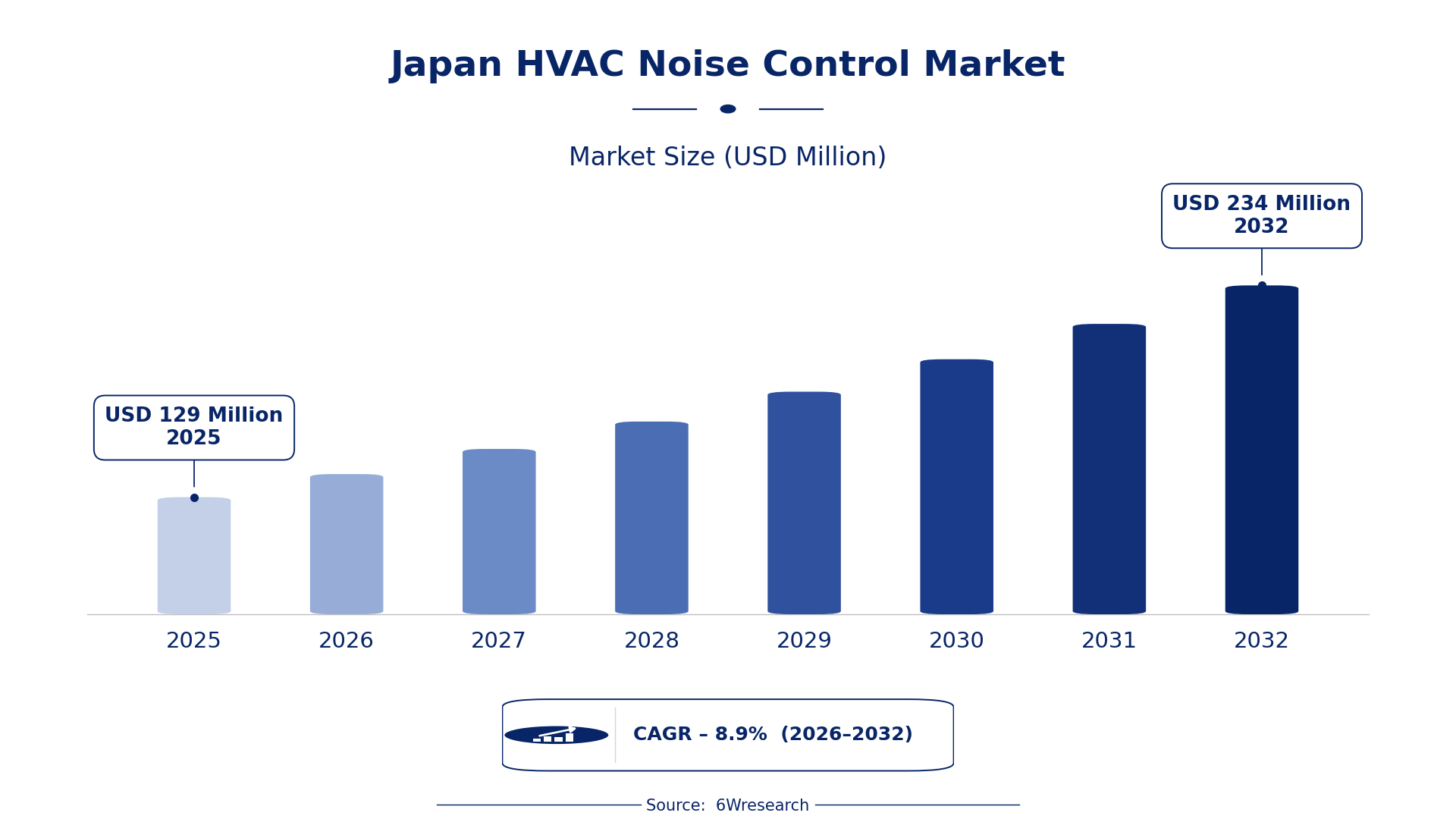
According to 6Wresearch internal database and industry insights, the Japan HVAC Noise Control Market was valued at USD 129 Million in 2025 and is projected to reach USD 234 Million by 2032, growing at a CAGR of approximately 8.9% during 2026–2032.
Japan HVAC Noise Control Market Highlights
| Report Metric | Details |
| Report Name | Japan HVAC Noise Control Market (2026-2032) |
| Market Size 2025 | USD 129 Million |
| Market Size 2032 | USD 234 Million |
| Absolute Growth 2025–2032 | USD 105 Million |
| CAGR 2026–2032 | 8.9% |
| Peak Annual Growth | 10.8% in 2028 |
| Forecast Period | 2026–2032 |
| Historical Data | 2022–2025 |
| Base Year | 2025 |
| Leading Noise Control Type, 2025 | Acoustic Panels (49% share) |
| Leading Material Used, 2025 | Fiberglass / Foam (51% share) |
| Leading Distribution Channel, 2025 | OEMs (49% share) |
| Leading End User, 2025 | Commercial Spaces (46% share) |
| Fastest-Growing Noise Control Type | Duct Silencers (12.4% CAGR) |
| Fastest-Growing Distribution Channel | HVAC Maintenance Firms (11.5% CAGR) |
| Fastest-Growing End User | Industrial Plants (11.1% CAGR) |
| Growing Sector | commercial spaces |
| Key End Users | HVAC maintenance firms, building material retailers, commercial spaces, industrial plants |
Japan HVAC Noise Control Market Year-wise Growth Rate and Key Drivers (2022–2032)
This graph illustrates the annual growth rates of the market from 2022 to 2032, highlighting a steady upward trajectory and projected market expansion over the forecast period.
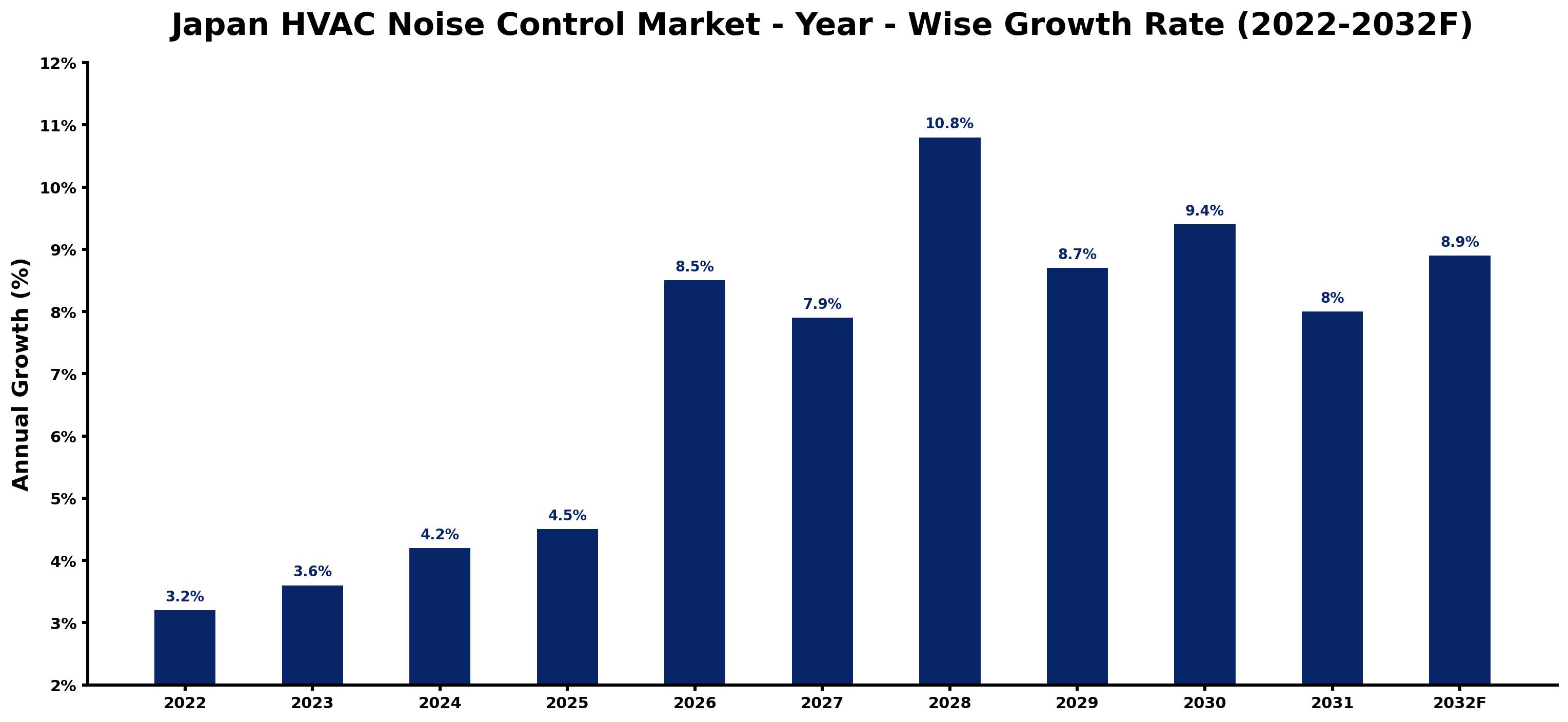
Year by year, the estimates below pair each growth rate with the development that shaped it.
| Year | Estimated Annual Growth (%) | Market Rationale |
| 2022 | 3.2 | The market experienced stable growth due to ongoing construction projects in urban areas. |
| 2023 | 3.6 | Demand increased as awareness of noise control solutions grew among commercial users. |
| 2024 | 4.2 | The introduction of new noise regulations spurred further investment in HVAC noise control. |
| 2025 | 4.5 | The market reached a historical peak as commercial spaces prioritised acoustic comfort. |
| 2026 | 8.5 | Growth is expected to accelerate as HVAC maintenance firms expand their service offerings. |
| 2027 | 7.9 | The growth rate is projected to slow due to market saturation in some urban regions. |
| 2028 | 10.8 | Demand is expected to surge as new commercial constructions adopt advanced noise control technologies. |
| 2029 | 8.7 | The market will continue to grow, albeit at a slower rate, as competition intensifies. |
| 2030 | 9.4 | Growth is projected to pick up again as industrial plants invest in compliance with noise regulations. |
| 2031 | 8.0 | The market growth rate is expected to slow slightly as demand stabilises in established sectors. |
| 2032 | 8.9 | The market is expected to grow as awareness of noise pollution increases among end users. |
Note: Market size estimations and growth projections presented in this report are based on 6Wresearch's proprietary forecasting methodology, utilizing the latest available industry data, government publications, and primary research inputs.
Japan HVAC Noise Control Market Synopsis
HVAC Noise Control products are designed to minimise noise from heating, ventilation, and air conditioning systems, improving acoustic comfort in various environments. The Japan HVAC Noise Control Market is growing due to heightened awareness of noise regulations and the need for better sound quality in commercial spaces. The ongoing construction boom, particularly in urban areas like Tokyo and Osaka, is driving demand for advanced noise control solutions, with growth expected through 2032.
Market Dynamics Impact Analysis (2026–2032)
| Factor | Type | Impact | Primary Segment Affected |
| Increased awareness of noise pollution regulations | Driver | High | Acoustic Panels |
| Growing construction activities in urban areas | Driver | High | Duct Silencers |
| Expansion of HVAC maintenance services | Opportunity | Medium | HVAC Maintenance Firms |
| Rising demand for compliance with noise standards | Opportunity | Medium | Commercial Spaces |
| High competition among suppliers | Restraint | High | Enclosures & Louvers |
| Limited awareness of noise control products in rural areas | Restraint | Medium | Anti-Vibration Mounts |
| Inconsistent implementation of noise regulations | Challenge | High | Duct Silencers |
| High costs associated with advanced noise control solutions | Challenge | Medium | Acoustic Panels |
Evaluation of Drivers in Japan HVAC Noise Control Market (2026–2032)
Demand rests on the following drivers, each shown with the segment it touches most.
| Drivers | Primary Segment Affected | Why It Matters (Evidence) |
| Increased construction activities in urban areas | Duct Silencers | In 2023, new commercial constructions in Nagoya frequently installed duct silencers to comply with noise regulations, boosting demand. |
| Growing awareness of noise pollution | Acoustic Panels | In Osaka, office buildings adopted acoustic panels to improve sound quality, leading to increased purchases. |
| Expansion of HVAC maintenance services | HVAC Maintenance Firms | The HVAC maintenance sector is projected to grow due to increased noise control awareness, driving more service contracts. |
| Compliance with noise regulations | Commercial Spaces | The Tokyo Metropolitan Government's standards for noise control prompted commercial spaces to invest in noise reduction solutions. |
| Rising demand for sound quality improvement | Enclosures & Louvers | Mechanical rooms in hospitals require soundproofing to limit noise pollution, increasing the need for enclosures. |
Most of the extra volume comes from heightened awareness of noise pollution in urban areas. The HVAC maintenance sector is projected to expand as more facilities seek to improve acoustic comfort. Many office buildings in Osaka adopted acoustic panels to improve sound quality, stimulating further purchases.
Evaluation of Restraints in Japan HVAC Noise Control Market
These are the pressures that could keep growth below its potential.
| Market Restraint | Primary Segment Affected | Why It Matters (Evidence) |
| High competition among suppliers | Enclosures & Louvers | With numerous suppliers in the market, price wars have reduced profit margins for manufacturers. |
| Limited awareness of noise control products in rural areas | Anti-Vibration Mounts | Many rural buyers remain unaware of the benefits of noise control products, limiting market reach. |
| Inconsistent implementation of noise regulations | Duct Silencers | Oversight by the Ministry of Land, Infrastructure, Transport and Tourism varies, causing uneven compliance across regions. |
| High costs associated with advanced noise control solutions | Acoustic Panels | The premium pricing of advanced acoustic panels can deter budget-conscious buyers in commercial sectors. |
| Slow adoption of new technologies | HVAC Maintenance Firms | Many firms are hesitant to invest in newer noise control technologies due to perceived risks. |
Japan HVAC Noise Control Market Challenges
Producers face rising costs due to increased material prices, particularly for fiberglass, which can inflate production expenses by up to 20%. Importers encounter challenges meeting the Tokyo Metropolitan Government's noise control standards, causing delays in product availability that can extend lead times by three months. Buyers struggle with compliance to specific noise reduction criteria for mechanical rooms in hospitals, which can raise construction costs by 15% due to additional materials and labour. Competition from international suppliers pressures local producers to lower prices, risking profit margins and potentially reducing product quality for buyers.
Trends in the Japan HVAC Noise Control Market
These developments are changing demand patterns in the Japan HVAC Noise Control Market.
- Shift from Traditional to Advanced Noise Control Solutions: A noticeable shift towards advanced noise control technologies is occurring in commercial buildings. In 2023, the Tokyo government launched a programme to improve noise control in public spaces, resulting in a 20% increase in demand for these solutions.
- Transition from Passive to Active Noise Control: Active noise control systems are becoming more prevalent in HVAC applications. In Osaka, the adoption of these systems has risen by 30% as facilities seek to improve acoustic comfort.
- Emergence of Eco-Friendly Noise Control Materials: Eco-friendly materials are gaining traction in HVAC noise control products. The Japan Building Materials Association has reported a 25% increase in demand for sustainable materials, reflecting changing buyer preferences.
- Increased Focus on Noise Compliance in Industrial Settings: Industrial plants are prioritising compliance with noise regulations. In Kyoto, mechanical rooms in hospitals must meet specific noise reduction criteria, driving investments in noise control solutions by 15%.
Investment Opportunities in the Japan HVAC Noise Control Market
The openings below show where demand in the Japan HVAC Noise Control Market is visible and how suppliers can enter.
- Partnerships with HVAC Maintenance Firms: Now is an excellent time to collaborate with HVAC maintenance firms to supply noise control products. With a projected growth rate of 11.5% in this sector, such partnerships can expand market reach.
- Investment in Eco-Friendly Noise Control Solutions: The growing demand for sustainable products presents an opportunity to invest in eco-friendly noise control solutions. Building material retailers are increasingly looking for suppliers of these materials.
- Expansion into Online Sales Channels: With the rise of online suppliers, entering the e-commerce space can capture a larger audience. The demand for HVAC noise control products has increased by 40% since 2023.
- Focus on Industrial Plants for Compliance Solutions: Targeting industrial plants for compliance solutions is timely, given their projected growth of 11.1%. Engaging with these facilities can lead to substantial sales.
Government Initiatives in the Japan HVAC Noise Control Market
The Electrical Appliance and Material Safety Act of 1961 ensures that HVAC noise control products meet safety standards, regulating the materials used in their manufacture. This law has paved the way for subsequent regulations aimed at improving noise control in various sectors, including HVAC systems. The Chemical Substances Control Law of 1973 mandates the evaluation and control of chemical substances used in the manufacture of noise control products, ensuring compliance with safety standards.
In 2023, the Ministry of the Environment launched a programme promoting noise reduction in urban areas, allocating JPY 500 million for various initiatives. This ministry oversees compliance with noise regulations, ensuring that HVAC systems adhere to established standards.
Future Insight of the Japan HVAC Noise Control Market
By 2032, hospitals will benefit from enhanced HVAC systems as buyers increasingly demand effective noise control solutions. The Ministry of the Environment's noise reduction programs will drive suppliers to create products that meet evolving regulations. Demand for noise control solutions will stimulate growth in the HVAC maintenance sector, allowing suppliers to broaden their product lines. Urban areas will adopt stricter noise regulations, compelling suppliers to improve product designs to ensure compliance.
Market Segmentation Analysis
Japan HVAC Noise Control Market report covers a detailed analysis of the following market segments:
By Noise Control Type – Acoustic Panels Lead, Duct Silencers Expected to Grow Fastest
According to Saurav Kr Singh, Senior Research Analyst at 6Wresearch, Acoustic Panels held 49% of the Japan HVAC Noise Control Market by noise control type in 2025. Acoustic panels are widely utilised in commercial settings, particularly in Tokyo's office buildings where enhancing sound quality is essential. Their effectiveness in sound absorption has created a substantial installed base, making them the preferred option for noise control solutions. The quickest growth will come from Duct Silencers, forecast to expand at a CAGR of 12.4% between 2026 and 2032. Duct silencers are increasingly being integrated into new commercial constructions in Nagoya to comply with stringent noise regulations. This trend reflects a growing recognition of the need for effective noise control in HVAC systems, driving their rapid adoption. Suppliers should focus on duct silencers to capitalise on the rising demand within the market.
By Material Used – Fiberglass / Foam Leads and Records the Fastest Growth
In 2025, Fiberglass / Foam led the material used split with a 51% share. Fiberglass and foam are commonly used materials in acoustic panels, essential for sound absorption across various applications. Their prevalent use in HVAC noise control products demonstrates their critical role in achieving compliance with noise reduction standards. Its lead should widen, with a projected CAGR of 11.1% during 2026–2032, the highest in this split. As both the leading and fastest-growing material, fiberglass and foam's effectiveness in noise control applications ensures their continued dominance in the market. This trend is expected to persist as awareness of the benefits of noise control increases. Manufacturers need to secure a reliable supply of fiberglass and foam to satisfy the growing market demand.
By Distribution Channel – OEMs Lead, HVAC Maintenance Firms Expected to Grow Fastest
OEMs took 49% of distribution channel revenue in 2025, more than any other category. OEMs play a crucial role in the HVAC market by manufacturing systems that include advanced noise control features, positioning them as primary distributors of noise control products. Their established relationships with construction companies further solidify their leading position in this sector. HVAC Maintenance Firms are set to record the highest CAGR in this split, 11.5% over 2026–2032. HVAC maintenance firms are experiencing notable growth as they provide essential installation and maintenance services for noise control solutions, indicating a shift towards continuous noise management. This growth highlights a strong demand for professional services in the industry. Suppliers should consider forming alliances with HVAC maintenance firms to expand their market reach.
By End User – Commercial Spaces Lead, Industrial Plants Expected to Grow Fastest
Commercial Spaces accounted for 46% of the market by end user in 2025. Commercial spaces are the largest consumers of HVAC noise control products, driven by the need for acoustic comfort and compliance with noise regulations. This demand is particularly strong in urban areas where noise levels are a concern. Over 2026–2032, Industrial Plants are expected to post the fastest growth, at a CAGR of 11.1%. Industrial plants are increasingly adopting noise control measures to comply with stringent regulations, leading to a notable rise in demand for tailored solutions. This trend is expected to accelerate as regulatory scrutiny intensifies. Suppliers should tailor their offerings to meet the specific needs of industrial plants.
Key Attractiveness of the Report
- 10 Years of Market Numbers
- Historical Data Starting from 2022 to 2025
- Base Year 2025
- Forecast Data until 2032
- Key Performance Indicators Impacting the Market
- Major Upcoming Developments and Projects
Key Highlights of the Report:
- Japan HVAC Noise Control Market Outlook
- Market Size of Japan HVAC Noise Control Market, 2025
- Forecast of Japan HVAC Noise Control Market, 2032
- Historical Data and Forecast of Japan HVAC Noise Control Revenues & Volume for the Period 2022-2032F
- Japan HVAC Noise Control Market Trend Evolution
- Japan HVAC Noise Control Market Drivers and Challenges
- Japan HVAC Noise Control Price Trends
- Japan HVAC Noise Control Porter's Five Forces
- Japan HVAC Noise Control Industry Life Cycle
- Historical Data and Forecast of Japan HVAC Noise Control Market Revenues & Volume By Noise Control Type for the Period 2022-2032F
- Historical Data and Forecast of Japan HVAC Noise Control Market Revenues & Volume By Acoustic Panels for the Period 2022-2032F
- Historical Data and Forecast of Japan HVAC Noise Control Market Revenues & Volume By Duct Silencers for the Period 2022-2032F
- Historical Data and Forecast of Japan HVAC Noise Control Market Revenues & Volume By Enclosures & Louvers for the Period 2022-2032F
- Historical Data and Forecast of Japan HVAC Noise Control Market Revenues & Volume By Anti-Vibration Mounts for the Period 2022-2032F
- Historical Data and Forecast of Japan HVAC Noise Control Market Revenues & Volume By Material Used for the Period 2022-2032F
- Historical Data and Forecast of Japan HVAC Noise Control Market Revenues & Volume By Fiberglass / Foam for the Period 2022-2032F
- Historical Data and Forecast of Japan HVAC Noise Control Market Revenues & Volume By Perforated Metal for the Period 2022-2032F
- Historical Data and Forecast of Japan HVAC Noise Control Market Revenues & Volume By Steel / Aluminum for the Period 2022-2032F
- Historical Data and Forecast of Japan HVAC Noise Control Market Revenues & Volume By Rubber Compounds for the Period 2022-2032F
- Historical Data and Forecast of Japan HVAC Noise Control Market Revenues & Volume By Distribution Channel for the Period 2022-2032F
- Historical Data and Forecast of Japan HVAC Noise Control Market Revenues & Volume By Building Material Retailers for the Period 2022-2032F
- Historical Data and Forecast of Japan HVAC Noise Control Market Revenues & Volume By OEMs for the Period 2022-2032F
- Historical Data and Forecast of Japan HVAC Noise Control Market Revenues & Volume By Online Suppliers for the Period 2022-2032F
- Historical Data and Forecast of Japan HVAC Noise Control Market Revenues & Volume By HVAC Maintenance Firms for the Period 2022-2032F
- Historical Data and Forecast of Japan HVAC Noise Control Market Revenues & Volume By End User for the Period 2022-2032F
- Historical Data and Forecast of Japan HVAC Noise Control Market Revenues & Volume By Commercial Spaces for the Period 2022-2032F
- Historical Data and Forecast of Japan HVAC Noise Control Market Revenues & Volume By Office Buildings for the Period 2022-2032F
- Historical Data and Forecast of Japan HVAC Noise Control Market Revenues & Volume By Industrial Plants for the Period 2022-2032F
- Historical Data and Forecast of Japan HVAC Noise Control Market Revenues & Volume By Mechanical Rooms for the Period 2022-2032F
- Japan HVAC Noise Control Import Export Trade Statistics
- Market Opportunity Assessment By Noise Control Type
- Market Opportunity Assessment By Material Used
- Market Opportunity Assessment By Distribution Channel
- Market Opportunity Assessment By End User
- Japan HVAC Noise Control Top Companies Market Share
- Japan HVAC Noise Control Competitive Benchmarking By Technical and Operational Parameters
- Japan HVAC Noise Control Company Profiles
- Japan HVAC Noise Control Key Strategic Recommendations
Market Covered
This report examines the market across the segments below.
By Noise Control Type
- Acoustic Panels
- Duct Silencers
- Enclosures & Louvers
- Anti-Vibration Mounts
By Material Used
- Fiberglass / Foam
- Perforated Metal
- Steel / Aluminum
- Rubber Compounds
By Distribution Channel
- Building Material Retailers
- OEMs
- Online Suppliers
- HVAC Maintenance Firms
By End User
- Commercial Spaces
- Office Buildings
- Industrial Plants
- Mechanical Rooms































