Japan HVAC & Refrigeration Service Market Size & Growth Rate
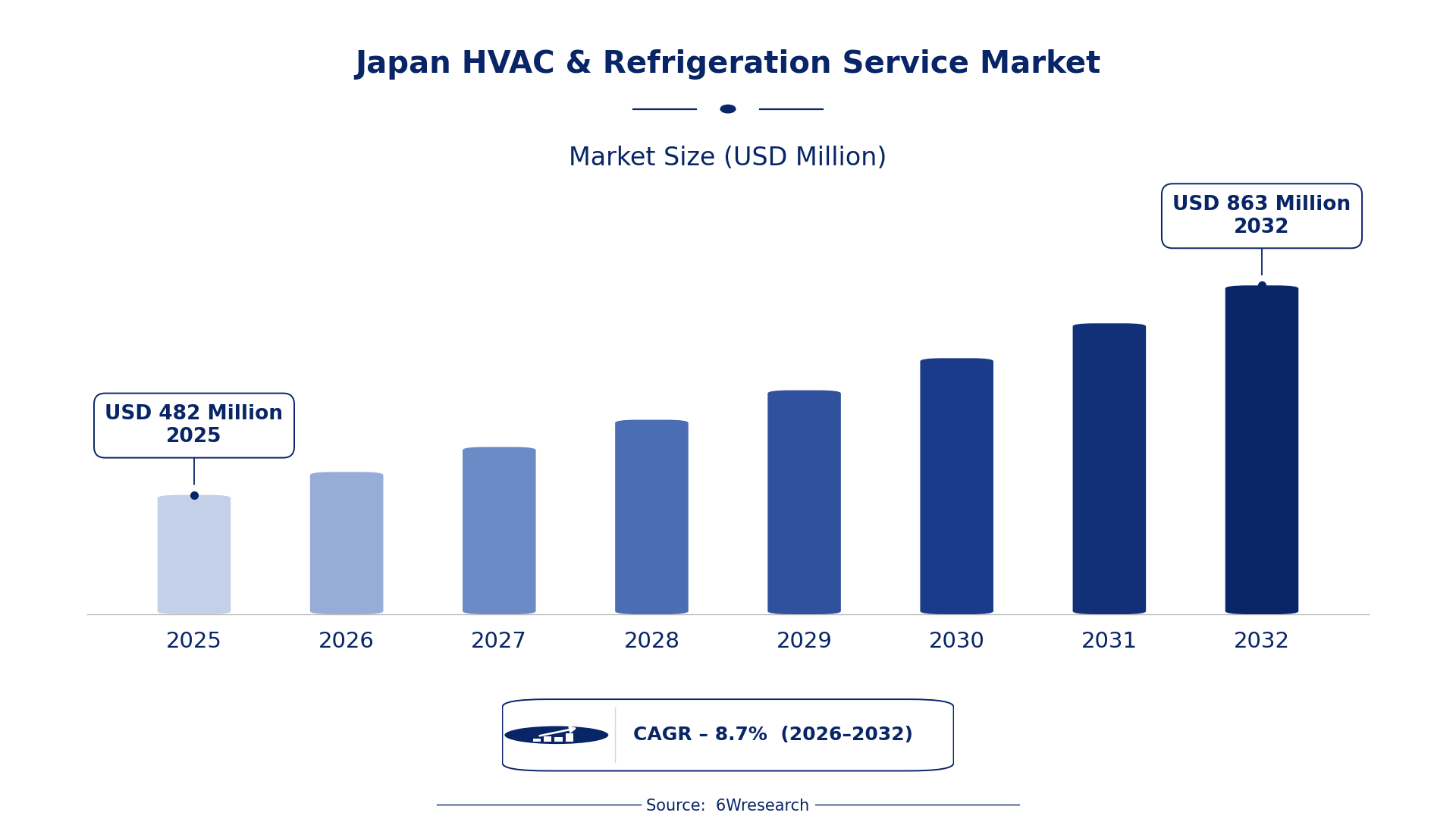
According to 6Wresearch internal database and industry insights, the Japan HVAC & Refrigeration Service Market was valued at USD 482 Million in 2025 and is projected to reach USD 863 Million by 2032, growing at a CAGR of approximately 8.7% during 2026–2032.
Japan HVAC & Refrigeration Service Market Highlights
| Report Metric | Details |
| Report Name | Japan HVAC & Refrigeration Service Market (2026-2032) |
| Market Size 2025 | USD 482 Million |
| Market Size 2032 | USD 863 Million |
| Absolute Growth 2025–2032 | USD 381 Million |
| CAGR 2026–2032 | 8.7% |
| Peak Annual Growth | 9.8% in 2028 |
| Forecast Period | 2026–2032 |
| Historical Data | 2022–2025 |
| Base Year | 2025 |
| Leading Service Type, 2025 | Maintenance Services (44% share) |
| Leading System Type, 2025 | Residential HVAC (39% share) |
| Leading Distribution Channel, 2025 | Direct Contracts (46% share) |
| Leading End User, 2025 | Homeowners (45% share) |
| Fastest-Growing Service Type | Repair Services (11.4% CAGR) |
| Fastest-Growing System Type | Commercial Systems (12.4% CAGR) |
| Fastest-Growing Distribution Channel | Local Service Providers (10.5% CAGR) |
| Fastest-Growing End User | Retail Chains (11.0% CAGR) |
| Growing Sector | Residential HVAC |
| Key End Users | Homeowners, Retail Chains, Factories & Warehouses, Corporate Offices |
Japan HVAC & Refrigeration Service Market Year-wise Growth Rate and Key Drivers (2022–2032)
This graph illustrates the annual growth rates of the market from 2022 to 2032, highlighting a steady upward trajectory and projected market expansion over the forecast period.
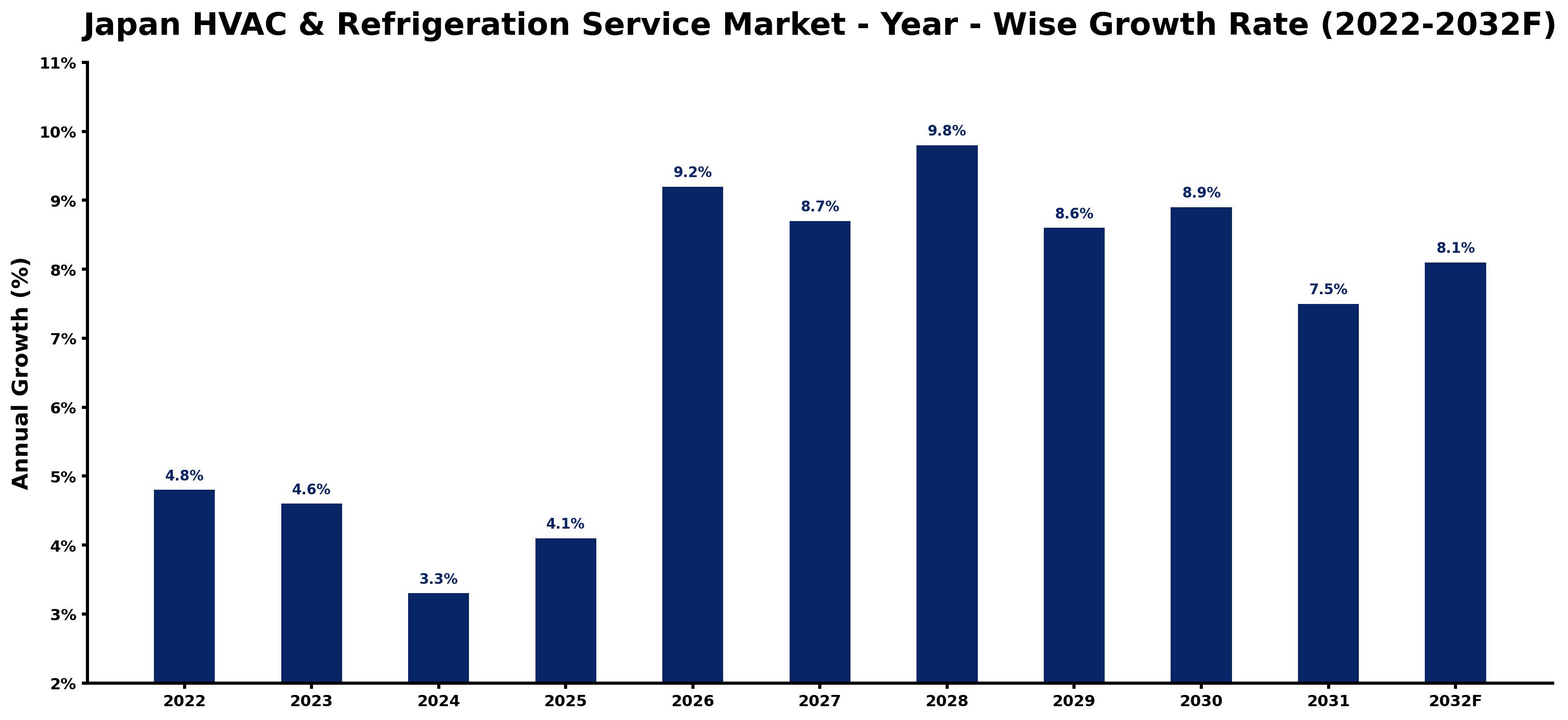
The table below sets out the estimated growth rate for each year and the main factor behind it.
| Year | Estimated Annual Growth (%) | Market Rationale |
| 2022 | 4.8 | The market experienced solid growth, driven by increased demand for HVAC services across various sectors. |
| 2023 | 4.6 | Growth slowed slightly due to market saturation in major urban areas, although demand remained strong. |
| 2024 | 3.3 | A further slowdown occurred as the market adjusted to previous high growth rates, yet demand persisted. |
| 2025 | 4.1 | Growth accelerated again as homeowners sought upgrades to energy-efficient systems amid rising energy costs. |
| 2026 | 9.2 | Demand is expected to surge as commercial systems expand, driven by new construction projects and renovations. |
| 2027 | 8.7 | The growth rate is projected to slow as the market stabilises, but demand for repair services remains strong. |
| 2028 | 9.8 | Peak growth is anticipated due to heightened interest in smart HVAC technologies and energy efficiency. |
| 2029 | 8.6 | A slight slowdown is expected as the market adjusts to the previous year's peak growth. |
| 2030 | 8.9 | Growth is projected to resume as energy efficiency initiatives gain traction among commercial users and homeowners. |
| 2031 | 7.5 | The market is expected to experience a slowdown as growth stabilises, yet demand for maintenance services continues. |
| 2032 | 8.1 | Growth is projected to pick up again as new energy regulations prompt upgrades in HVAC systems. |
Note: Market size estimations and growth projections presented in this report are based on 6Wresearch's proprietary forecasting methodology, utilizing the latest available industry data, government publications, and primary research inputs.
Japan HVAC & Refrigeration Service Market Synopsis
HVAC & Refrigeration Service in Japan involves maintenance, repair, installation, and upgrades of HVAC systems, which are essential for energy efficiency and comfort. The Japan HVAC & Refrigeration Service Market is expanding due to rising demand from homeowners and businesses, particularly in the Tokyo metropolitan area, which accounts for over 30% of installations. Energy efficiency initiatives, such as the government's subsidy program for energy-efficient upgrades, stimulate market growth, leading to a projected value of 863 million USD by 2032.
Market Dynamics Impact Analysis (2026–2032)
| Factor | Type | Impact | Primary Segment Affected |
| Increased focus on energy-efficient systems | Driver | High | Maintenance Services |
| Rising construction activities in urban areas | Driver | High | Installation Services |
| Growing demand for energy-efficient upgrades | Opportunity | High | Upgrade/Retrofit |
| Expansion of smart HVAC technologies | Opportunity | High | Smart HVAC |
| Shortage of skilled technicians | Restraint | High | Repair Services |
| High installation costs for advanced systems | Restraint | Medium | Installation Services |
| Competition from alternative energy solutions | Challenge | Medium | Commercial Systems |
| Regulatory compliance costs for energy efficiency | Challenge | High | Residential HVAC |
Evaluation of Drivers in Japan HVAC & Refrigeration Service Market (2026–2032)
The table below links each growth driver to the segment it affects and the evidence for it.
| Drivers | Primary Segment Affected | Why It Matters (Evidence) |
| Rising energy costs | Residential HVAC | Homeowners are investing in HVAC services to improve energy efficiency, with over 70% of residential buildings using HVAC systems. |
| Increased urbanisation | Installation Services | The average lifespan of HVAC systems in Japan is about 15-20 years, necessitating regular upgrades. |
| Government energy efficiency initiatives | Maintenance Services | The Ministry of the Environment aims to reduce energy consumption by 30% by 2030 through efficient HVAC systems. |
| Technological advancements in HVAC systems | Smart HVAC | Commercial buildings in Japan are increasingly adopting smart HVAC technologies. |
| Rising awareness of indoor air quality | Repair Services | Increased focus on health and safety drives demand for regular HVAC repairs and maintenance to ensure system functionality. |
Spending rises because over 70% of residential buildings utilise HVAC systems, prompting homeowners to invest in maintenance for energy efficiency. The Tokyo metropolitan area, accounting for over 30% of installations, fuels demand for installation services as urbanisation increases. Anticipated growth in smart HVAC technologies propels requests for advanced installations and repairs. Growing awareness of indoor air quality leads to increased spending on repair services to ensure system functionality and safety.
Evaluation of Restraints in Japan HVAC & Refrigeration Service Market
The following restraints limit how fast demand can grow.
| Market Restraint | Primary Segment Affected | Why It Matters (Evidence) |
| Shortage of skilled technicians | Repair Services | The estimated 100,000 HVAC service technicians in Japan are insufficient to meet growing demand, causing delays in service. |
| High costs of advanced HVAC systems | Installation Services | The average installation cost for residential HVAC systems is around 500,000 yen, limiting affordability for some homeowners. |
| Competition from alternative energy solutions | Commercial Systems | The rise of alternative energy sources may divert investments away from traditional HVAC services, impacting growth opportunities. |
| Regulatory compliance costs | Residential HVAC | Compliance with energy efficiency regulations increases operational costs for service providers, affecting pricing for consumers. |
| Market saturation in urban areas | Maintenance Services | In major cities, the high penetration of HVAC systems leads to intense competition and price pressures. |
Japan HVAC & Refrigeration Service Market Challenges
Homeowners face an installation cost of approximately 500,000 yen for residential HVAC systems, which can strain budgets when seeking energy-efficient options. Local service providers struggle with a shortage of skilled technicians, as the workforce is capped at around 100,000, leading to delays in repairs and maintenance for residential users. Compliance with ISO 14001 standards imposes additional operational costs on service providers, reducing their competitiveness in the market. Increased demand for energy-efficient solutions, driven by government initiatives, pressures buyers to invest more upfront, complicating their financial planning.
Trends in the Japan HVAC & Refrigeration Service Market
Four trends stand out in the Japan HVAC & Refrigeration Service Market.
- Shift towards Smart HVAC Systems: Beginning in 2023, the adoption of smart HVAC technologies is transforming the market. With commercial buildings increasingly integrating these systems, demand for smart HVAC services is projected to rise, reflecting a growing trend towards energy management.
- Transition to Energy-Efficient Solutions: The government's subsidy program for energy-efficient HVAC upgrades has accelerated the shift towards energy-efficient systems. This initiative aims to reduce energy consumption by 30% by 2030, driving demand for upgrades and retrofits.
- Emergence of Local Service Providers: Local service providers are gaining prominence in the HVAC market, capturing a 60% share of the residential segment. This shift reflects a growing preference for community-level services that offer tailored solutions.
- Increased Focus on Indoor Air Quality: In 2024, heightened awareness of indoor air quality led to a surge in demand for HVAC maintenance and repair services. This trend is expected to continue as consumers prioritise health and safety.
Investment Opportunities in the Japan HVAC & Refrigeration Service Market
The opportunities below stand out in the Japan HVAC & Refrigeration Service Market for new entrants and existing suppliers.
- Residential Buildings in Tokyo: Tokyo, with over 30% of HVAC installations, presents a prime opportunity for service providers to expand offerings, particularly in energy-efficient upgrades, as the market value is around 1 trillion yen.
- Forming Partnerships with Local Service Providers: Now is an ideal time to collaborate with local service providers, who dominate the residential market. This can improve service delivery and broaden market reach.
- Investing in Smart HVAC Service Offerings: Investing in smart HVAC systems is timely, given the expected 15% annual growth from 2023 to 2028. Targeting commercial buildings can yield substantial returns as they adopt these technologies.
- Opportunities in Energy Efficiency Upgrades: The government's push for energy-efficient HVAC systems creates opportunities for service providers to offer upgrades. Engaging with homeowners in urban areas can lead to increased service contracts.
Government Initiatives in the Japan HVAC & Refrigeration Service Market
The GX Promotion Act, introduced in 2023, establishes a framework for promoting energy-efficient HVAC systems, building on previous laws like the Green Growth Strategy. This act mandates compliance with new energy standards, compelling producers to invest in efficient technologies. The Japanese government aims to reduce energy consumption by 30% by 2030, which will require HVAC service providers to adapt their offerings accordingly.
The subsidy programme for energy-efficient HVAC upgrades launched in 2023 provides financial support for homeowners. Administered by the Ministry of the Environment, this initiative makes energy-efficient solutions more accessible and encourages widespread adoption.
Future Insight of the Japan HVAC & Refrigeration Service Market
The introduction of advanced energy-efficient building designs will reshape the HVAC market by 2032, leading to greater adoption of modern systems. The market will see a surge in smart HVAC technologies, improving energy efficiency and user comfort. The government's subsidy programme for energy-efficient upgrades will incentivise suppliers to innovate and align their offerings with sustainability goals. By 2025, the HVAC service market is projected to grow at an annual rate of 5%, indicating robust demand for skilled technicians and advanced solutions.
Market Segmentation Analysis
Japan HVAC & Refrigeration Service Market report covers a detailed analysis of the following market segments:
By Service Type – Maintenance Services Lead, Repair Services Expected to Grow Fastest
According to Saurav Kr Singh, Senior Research Analyst at 6Wresearch, Maintenance Services accounted for 44% of the market by service type in 2025. Maintenance services hold the largest share due to their critical role in ensuring HVAC system longevity and efficiency, particularly in residential buildings where over 70% utilise these systems. This ongoing need for maintenance underscores its importance in enhancing system performance and energy efficiency. Over 2026–2032, Repair Services are expected to post the fastest growth, at a CAGR of 11.4%. Repair services are experiencing rapid growth as the necessity for system functionality and safety becomes increasingly apparent, supported by the presence of approximately 100,000 HVAC service technicians in 2022. This trend reflects a heightened demand for prompt repair solutions to ensure operational reliability. Suppliers should focus on expanding their maintenance and repair service offerings to align with the growing market demand.
By System Type – Residential HVAC Leads, Commercial Systems Expected to Grow Fastest
With 39% of system type revenue in 2025, Residential HVAC was the largest category. Residential HVAC systems dominate the market as they are the primary choice for comfort in homes, with over 70% of residential buildings equipped with such systems. This widespread adoption highlights the essential role of HVAC in maintaining indoor climate control for homeowners. Commercial Systems are set to record the highest CAGR in this split, 12.4% over 2026–2032. Commercial systems are poised for rapid growth as businesses increasingly recognise the importance of effective climate control for operational success. The rising adoption of HVAC in commercial buildings emphasises the sector's critical role in ensuring customer comfort and operational efficiency. Buyers in the commercial sector should prioritise investing in advanced HVAC solutions to enhance their operational performance.
By Distribution Channel – Direct Contracts Lead, Local Service Providers Expected to Grow Fastest
In 2025, Direct Contracts led the distribution channel split with a 46% share. Direct contracts are prevalent in the market as they are commonly used for large projects, where clients seek comprehensive service agreements. This distribution method is particularly favoured by institutional clients requiring extensive HVAC installations and ongoing maintenance services. Local Service Providers are projected to grow fastest, at a CAGR of 10.5% during 2026–2032. Local service providers are witnessing the fastest growth as they play a crucial role in delivering community-level services, which are increasingly valued for their responsiveness and local expertise. The demand for personalised service is propelling this trend forward. Suppliers should strengthen partnerships with local service providers to improve market penetration.
By End User – Homeowners Lead, Retail Chains Expected to Grow Fastest
Homeowners took 45% of end user revenue in 2025, more than any other category. Homeowners represent the largest end-user group as they are the primary consumers of HVAC services, driven by the need for comfort and energy efficiency in residential spaces. Their significant presence in the market highlights the importance of tailored services for individual households. The quickest growth will come from Retail Chains, forecast to expand at a CAGR of 11.0% between 2026 and 2032. Retail chains are the fastest-growing end-user segment as they require efficient HVAC solutions to ensure customer comfort and maintain an inviting shopping environment. The increasing focus on customer experience in retail is driving this growth. Suppliers should tailor their offerings to meet the specific needs of retail chains to capitalise on this growth opportunity.
Key Attractiveness of the Report
- 10 Years of Market Numbers
- Historical Data Starting from 2022 to 2025
- Base Year 2025
- Forecast Data until 2032
- Key Performance Indicators Impacting the Market
- Major Upcoming Developments and Projects
Key Highlights of the Report:
- Japan HVAC & Refrigeration Service Market Outlook
- Market Size of Japan HVAC & Refrigeration Service Market, 2025
- Forecast of Japan HVAC & Refrigeration Service Market, 2032
- Historical Data and Forecast of Japan HVAC & Refrigeration Service Revenues & Volume for the Period 2022-2032F
- Japan HVAC & Refrigeration Service Market Trend Evolution
- Japan HVAC & Refrigeration Service Market Drivers and Challenges
- Japan HVAC & Refrigeration Service Price Trends
- Japan HVAC & Refrigeration Service Porter's Five Forces
- Japan HVAC & Refrigeration Service Industry Life Cycle
- Historical Data and Forecast of Japan HVAC & Refrigeration Service Market Revenues & Volume By Service Type for the Period 2022-2032F
- Historical Data and Forecast of Japan HVAC & Refrigeration Service Market Revenues & Volume By Maintenance Services for the Period 2022-2032F
- Historical Data and Forecast of Japan HVAC & Refrigeration Service Market Revenues & Volume By Repair Services for the Period 2022-2032F
- Historical Data and Forecast of Japan HVAC & Refrigeration Service Market Revenues & Volume By Installation Services for the Period 2022-2032F
- Historical Data and Forecast of Japan HVAC & Refrigeration Service Market Revenues & Volume By Upgrade/Retrofit for the Period 2022-2032F
- Historical Data and Forecast of Japan HVAC & Refrigeration Service Market Revenues & Volume By System Type for the Period 2022-2032F
- Historical Data and Forecast of Japan HVAC & Refrigeration Service Market Revenues & Volume By Residential HVAC for the Period 2022-2032F
- Historical Data and Forecast of Japan HVAC & Refrigeration Service Market Revenues & Volume By Commercial Systems for the Period 2022-2032F
- Historical Data and Forecast of Japan HVAC & Refrigeration Service Market Revenues & Volume By Industrial Cooling for the Period 2022-2032F
- Historical Data and Forecast of Japan HVAC & Refrigeration Service Market Revenues & Volume By Smart HVAC for the Period 2022-2032F
- Historical Data and Forecast of Japan HVAC & Refrigeration Service Market Revenues & Volume By Distribution Channel for the Period 2022-2032F
- Historical Data and Forecast of Japan HVAC & Refrigeration Service Market Revenues & Volume By Direct Contracts for the Period 2022-2032F
- Historical Data and Forecast of Japan HVAC & Refrigeration Service Market Revenues & Volume By Local Service Providers for the Period 2022-2032F
- Historical Data and Forecast of Japan HVAC & Refrigeration Service Market Revenues & Volume By HVAC Contractors for the Period 2022-2032F
- Historical Data and Forecast of Japan HVAC & Refrigeration Service Market Revenues & Volume By Energy Solution Providers for the Period 2022-2032F
- Historical Data and Forecast of Japan HVAC & Refrigeration Service Market Revenues & Volume By End User for the Period 2022-2032F
- Historical Data and Forecast of Japan HVAC & Refrigeration Service Market Revenues & Volume By Homeowners for the Period 2022-2032F
- Historical Data and Forecast of Japan HVAC & Refrigeration Service Market Revenues & Volume By Retail Chains for the Period 2022-2032F
- Historical Data and Forecast of Japan HVAC & Refrigeration Service Market Revenues & Volume By Factories & Warehouses for the Period 2022-2032F
- Historical Data and Forecast of Japan HVAC & Refrigeration Service Market Revenues & Volume By Corporate Offices for the Period 2022-2032F
- Japan HVAC & Refrigeration Service Import Export Trade Statistics
- Market Opportunity Assessment By Service Type
- Market Opportunity Assessment By System Type
- Market Opportunity Assessment By Distribution Channel
- Market Opportunity Assessment By End User
- Japan HVAC & Refrigeration Service Top Companies Market Share
- Japan HVAC & Refrigeration Service Competitive Benchmarking By Technical and Operational Parameters
- Japan HVAC & Refrigeration Service Company Profiles
- Japan HVAC & Refrigeration Service Key Strategic Recommendations
Market Covered
The following segment groups are covered in the report.
By Service Type
- Maintenance Services
- Repair Services
- Installation Services
- Upgrade/Retrofit
By System Type
- Residential HVAC
- Commercial Systems
- Industrial Cooling
- Smart HVAC
By Distribution Channel
- Direct Contracts
- Local Service Providers
- HVAC Contractors
- Energy Solution Providers
By End User
- Homeowners
- Retail Chains
- Factories & Warehouses
- Corporate Offices































