Japan HVAC Sensor System Market Size & Growth Rate
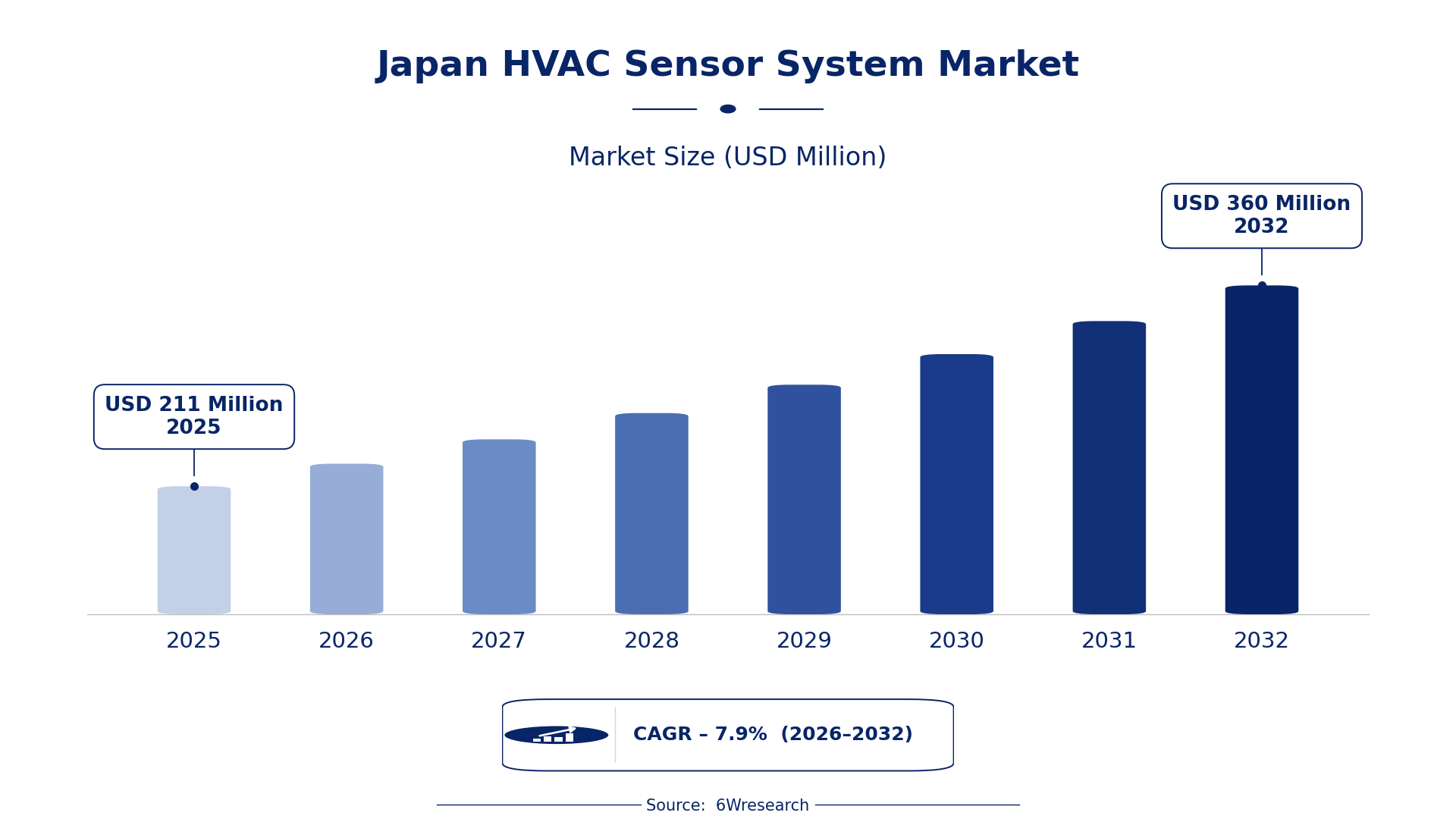
According to 6Wresearch internal database and industry insights, the Japan HVAC Sensor System Market was valued at USD 211 Million in 2025 and is projected to reach USD 360 Million by 2032, growing at a CAGR of approximately 7.9% during 2026–2032.
Japan HVAC Sensor System Market Highlights
| Report Metric | Details |
| Report Name | Japan HVAC Sensor System Market (2026-2032) |
| Market Size 2025 | USD 211 Million |
| Market Size 2032 | USD 360 Million |
| Absolute Growth 2025–2032 | USD 149 Million |
| CAGR 2026–2032 | 7.9% |
| Peak Annual Growth | 8.8% in 2032 |
| Forecast Period | 2026–2032 |
| Historical Data | 2022–2025 |
| Base Year | 2025 |
| Leading Sensor System Type, 2025 | Smart Sensor Network (41% share) |
| Leading Parameter Measured, 2025 | IAQ & Airflow (48% share) |
| Leading Distribution Channel, 2025 | IoT System Providers (35% share) |
| Leading End User, 2025 | Smart Building Systems (53% share) |
| Fastest-Growing Sensor System Type | Wireless Sensor Kits (12.3% CAGR) |
| Fastest-Growing Distribution Channel | OEM Integrators (10.6% CAGR) |
| Fastest-Growing End User | Offices & Malls (10.5% CAGR) |
| Growing Sector | Offices & Malls |
| Key End Users | Smart Building Systems, Offices & Malls, Industrial Plants, Facility Managers |
Japan HVAC Sensor System Market Year-wise Growth Rate and Key Drivers (2022–2032)
This graph illustrates the annual growth rates of the market from 2022 to 2032, highlighting a steady upward trajectory and projected market expansion over the forecast period.
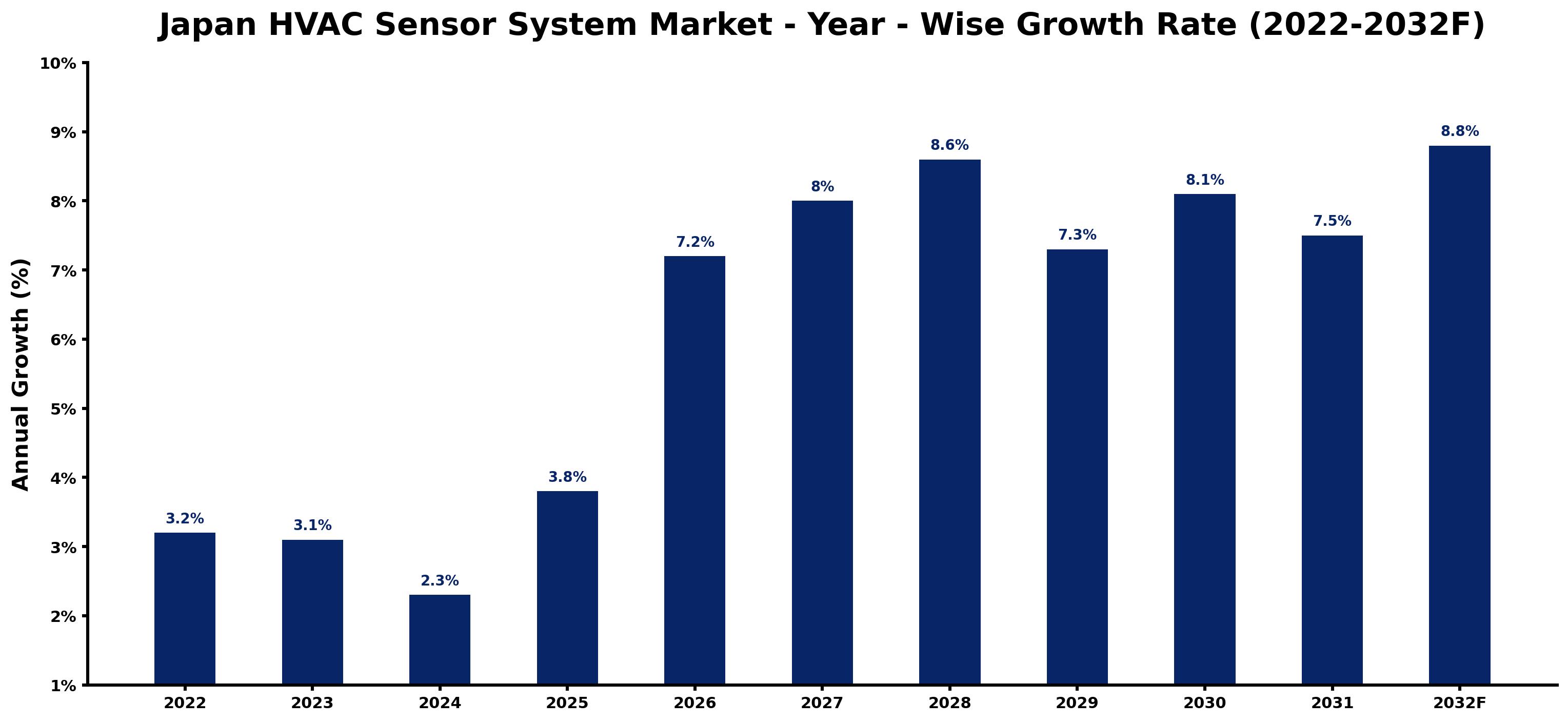
Each row of the following table gives one year's estimated growth and the event or demand shift that explains it.
| Year | Estimated Annual Growth (%) | Market Rationale |
| 2022 | 3.2 | The market experienced steady growth, driven by ongoing investments in HVAC technologies. |
| 2023 | 3.1 | Growth slowed slightly due to market adjustments and evolving consumer preferences. |
| 2024 | 2.3 | The market continued to grow, albeit at a slower pace, as energy efficiency remained a priority. |
| 2025 | 3.8 | Demand surged as more smart buildings were constructed, increasing HVAC system adoption. |
| 2026 | 7.2 | The market is likely to grow faster as IoT integration becomes more prevalent. |
| 2027 | 8.0 | Growth is expected to remain strong as energy efficiency regulations tighten. |
| 2028 | 8.6 | The market is anticipated to expand further with increased focus on indoor air quality. |
| 2029 | 7.3 | Growth is expected to slow slightly as market saturation begins to set in. |
| 2030 | 8.1 | Demand is projected to rise again as new technologies emerge in HVAC systems. |
| 2031 | 7.5 | Growth is expected to moderate as competition increases among suppliers. |
| 2032 | 8.8 | The market is projected to peak due to heightened investment in smart technologies. |
Note: Market size estimations and growth projections presented in this report are based on 6Wresearch's proprietary forecasting methodology, utilizing the latest available industry data, government publications, and primary research inputs.
Japan HVAC Sensor System Market Synopsis
HVAC Sensor Systems are advanced technologies designed to monitor and control heating, ventilation, and air conditioning systems, ensuring optimal indoor climate conditions. Demand is further supported by the Ministry of the Environment's 'Cool Choice' initiative, which promotes energy-efficient HVAC systems, alongside the anticipated growth of IoT-enabled HVAC systems, expected to exceed 1 million by 2025.
Market Dynamics Impact Analysis (2026–2032)
| Factor | Type | Impact | Primary Segment Affected |
| The rise in smart building construction is boosting demand for HVAC Sensor Systems. | Driver | High | Smart Sensor Network |
| The increasing focus on energy efficiency is propelling the adoption of advanced HVAC technologies. | Driver | High | IAQ & Airflow |
| The growing number of smart buildings creates a significant market opportunity for sensor systems. | Opportunity | High | Smart Building Systems |
| The Japanese government's investment in smart building technology development opens new avenues for suppliers. | Opportunity | High | Facility Managers |
| The high cost of advanced HVAC technologies can limit accessibility for smaller facilities. | Restraint | Medium | Wired Sensor System |
| Market saturation in urban areas may slow growth as demand stabilises. | Restraint | Medium | Wireless Sensor Kits |
| Shortages in skilled technicians can delay installation and maintenance of HVAC systems. | Challenge | High | Remote Monitoring |
| Increased competition among suppliers may lead to price wars, affecting profitability. | Challenge | High | Multi-Sensor Modules |
Evaluation of Drivers in Japan HVAC Sensor System Market (2026–2032)
The following drivers explain most of the expected growth.
| Drivers | Primary Segment Affected | Why It Matters (Evidence) |
| Increased construction of smart buildings drives demand for advanced HVAC technologies. | Smart Sensor Network | Tokyo accounts for 30% of Japan's HVAC installations, boosting sensor system orders. |
| Growing awareness of indoor air quality enhances the need for monitoring systems. | IAQ & Airflow | The average temperature in Tokyo during summer peaks at 35°C, increasing HVAC demand. |
| Investment in energy-efficient technologies is rising among facility managers. | HVAC Controllers | The Japanese government allocated 10 billion JPY for smart building technology development in 2023. |
| The integration of IoT in HVAC systems is transforming operational capabilities. | Remote Monitoring | The number of IoT-enabled HVAC systems in Japan is expected to exceed 1 million by 2025. |
| Regulatory standards are pushing facilities to adopt advanced HVAC solutions. | Wired Sensor System | ISO 50001 is widely adopted for energy management in HVAC systems. |
Behind the steady rise in orders sits a marked increase in smart building construction, with Tokyo accounting for 30% of HVAC installations. The average summer temperature in Tokyo, peaking at 35°C, drives demand for effective HVAC solutions. The number of IoT-enabled HVAC systems is anticipated to exceed 1 million by 2025, improving operational capabilities.
Evaluation of Restraints in Japan HVAC Sensor System Market
Below are the constraints most often cited by buyers and suppliers, with the segment each affects.
| Market Restraint | Primary Segment Affected | Why It Matters (Evidence) |
| High costs associated with advanced HVAC technologies limit market penetration. | Wired Sensor System | The average investment in HVAC systems can be substantial, deterring smaller facilities. |
| Market saturation in urban areas may lead to slower growth rates. | Wireless Sensor Kits | With many buildings already equipped, new installations are declining in densely populated regions. |
| Shortages of skilled technicians can hinder system installation and maintenance. | Remote Monitoring | The demand for qualified personnel in HVAC sectors often exceeds supply, delaying projects. |
| Increased competition may lead to aggressive pricing strategies among suppliers. | Multi-Sensor Modules | Price wars can affect profitability, particularly for smaller suppliers trying to enter the market. |
| Regulatory compliance costs can burden smaller facilities. | IAQ & Airflow | Meeting standards like ISO 50001 requires substantial investment in technology and training. |
Japan HVAC Sensor System Market Challenges
Rising operational costs present challenges for buyers as Japan's national minimum wage increased to JPY 1,055 per hour, elevating installation expenses for HVAC systems. Intense competition arises since Tokyo accounts for 30% of HVAC installations, resulting in price wars that erode margins for local suppliers. Supply chain disruptions occur due to reliance on imported electronic components, leading to delays that inflate costs for producers. A shortage of skilled technicians persists, limiting service quality and response times for clinics and commercial buildings, ultimately impacting customer satisfaction and operational efficiency.
Trends in the Japan HVAC Sensor System Market
The trends below show where the Japan HVAC Sensor System Market is heading.
- Shift from Traditional to Smart Building Systems: Facility managers are increasingly adopting smart building systems, with around 5,000 smart buildings currently in Japan. This shift improves energy efficiency and operational control, reflecting a growing trend in urban development.
- Transition from Wired to Wireless Sensor Systems: The HVAC sector is moving towards more flexible wireless sensor systems, allowing for easier installations. This trend is illustrated by the rapid growth of wireless sensor kits, projected to grow at a CAGR of 12.3%.
- Emergence of IoT-Enabled HVAC Solutions: The integration of IoT technologies in HVAC systems is gaining traction, with over 1 million IoT-enabled systems expected by 2025. This trend is reshaping how facilities manage energy consumption and indoor air quality.
- Prioritisation of Indoor Air Quality Monitoring: Indoor air quality monitoring is becoming a priority for many building managers, driven by health concerns. The IAQ & Airflow segment, leading the market with a 48% share, reflects this growing focus.
Investment Opportunities in the Japan HVAC Sensor System Market
Where to invest in the Japan HVAC Sensor System Market: the main openings are set out below.
- Growing Demand for Smart Building Technologies: With Japan's HVAC market projected to reach 1.2 trillion JPY by 2025, there is a notable opportunity for suppliers of smart building technologies. Facility managers are keen to invest in solutions that improve efficiency.
- Investment in Energy-Efficient HVAC Solutions: The Japanese government's 10 billion JPY allocation for smart building technology development presents a timely opportunity for suppliers. Collaborating with local partners can facilitate market entry.
- Expansion of IoT-Enabled HVAC Systems: As the number of IoT-enabled HVAC systems is expected to exceed 1 million by 2025, suppliers can focus on advanced sensor technologies. Engaging with IoT system providers can enhance market presence.
- Increasing Focus on Indoor Air Quality: The rising awareness of indoor air quality creates an opportunity for manufacturers of monitoring systems. Targeting commercial buildings in urban areas can yield notable returns.
Government Initiatives in the Japan HVAC Sensor System Market
The Semiconductor and Digital Industry Strategy initiated in June 2021 supports domestic semiconductor manufacturing, essential for HVAC sensor production. This strategy promotes the development of advanced technologies, ensuring a steady supply chain for HVAC components, with a focus on innovation and investment of 10 billion JPY for smart building technology development in 2023.
Facility managers are utilising the Economic Security Promotion Act of 2022, which supports supply-chain resilience for critical products. This act helps them secure reliable HVAC systems and components, ensuring operational efficiency in their buildings.
Future Insight of the Japan HVAC Sensor System Market
Technological advancements will reshape demand for HVAC systems, with expectations that over 1 million IoT-enabled units will be operational by 2025. The government's investment of 10 billion JPY in smart building technology will drive innovation and improve energy efficiency. Adoption of energy management standards like ISO 50001 will become more prevalent, encouraging compliance among facilities. The push for reduced greenhouse gas emissions will motivate buyers to prioritise energy-efficient HVAC systems, aligning with environmental goals set by local authorities.
Market Segmentation Analysis
Japan HVAC Sensor System Market report covers a detailed analysis of the following market segments:
By Sensor System Type – Smart Sensor Network Leads, Wireless Sensor Kits Expected to Grow Fastest
According to Saurav Kr Singh, Senior Research Analyst at 6Wresearch, Smart Sensor Network accounted for 41% of the market by sensor system type in 2025. Smart Sensor Networks are essential for real-time monitoring and control of HVAC systems, making them indispensable in the 5,000 smart buildings across Japan. Their ability to improve energy efficiency and indoor climate management solidifies their leading position in the market. Over 2026–2032, Wireless Sensor Kits are expected to post the fastest growth, at a CAGR of 12.3%. Wireless Sensor Kits are experiencing rapid growth due to their flexibility in installation across various environments. The push for adaptable solutions in smart building technology, supported by a 10 billion JPY investment in 2023, is driving this segment's expansion. Suppliers should focus on developing flexible sensor technologies to align with the increasing demand for versatile HVAC installations.
By Parameter Measured – IAQ & Airflow Leads and Records the Fastest Growth
The largest parameter measured category in 2025 was IAQ & Airflow, at 48% of revenue. IAQ & Airflow sensors hold the largest share as they are critical for maintaining healthy indoor environments, a priority for many facilities. This focus is underscored by the adoption of standards like ISO 50001 for energy management in HVAC systems. The same category is also set to grow fastest, at a CAGR of 9.2% during 2026–2032. The growth of IAQ & Airflow sensors is propelled by the rising awareness of indoor air quality's impact on health, particularly in urban areas like Tokyo. The increasing average summer temperature, peaking at 35°C, further drives the need for effective airflow management. Buyers will increasingly seek advanced solutions that ensure optimal indoor air quality alongside energy efficiency.
By Distribution Channel – IoT System Providers Lead, OEM Integrators Expected to Grow Fastest
In 2025, IoT System Providers led the distribution channel split with a 35% share. IoT System Providers lead the market by facilitating the integration of sensors into advanced HVAC systems. Their role is crucial in enhancing the functionality of smart buildings, which are becoming more prevalent in Japan. OEM Integrators are projected to grow fastest, at a CAGR of 10.6% during 2026–2032. OEM Integrators are growing quickly as they incorporate sensors into comprehensive HVAC solutions, addressing the rising demand for integrated systems. The trend towards smart building technologies is further accelerating their market growth. Suppliers need to establish strong partnerships with OEM Integrators to enhance market access and effectively meet customer needs.
By End User – Smart Building Systems Lead, Offices & Malls Expected to Grow Fastest
Smart Building Systems took 53% of end user revenue in 2025, more than any other category. Smart Building Systems represent the largest user group, utilising sensors to improve automation and efficiency in HVAC operations. Their widespread adoption in urban areas, where energy efficiency is critical, reinforces their dominant position in the market. The quickest growth will come from Offices & Malls, forecast to expand at a CAGR of 10.5% between 2026 and 2032. Offices & Malls are the fastest-growing end users, driven by their substantial HVAC needs and a strong focus on energy efficiency in commercial spaces. The ongoing investment in smart technologies in these sectors is propelling their rapid growth. Suppliers should tailor their offerings to meet the specific requirements of commercial users, particularly within the smart building sector.
Key Attractiveness of the Report
- 10 Years of Market Numbers
- Historical Data Starting from 2022 to 2025
- Base Year 2025
- Forecast Data until 2032
- Key Performance Indicators Impacting the Market
- Major Upcoming Developments and Projects
Key Highlights of the Report:
- Japan HVAC Sensor System Market Outlook
- Market Size of Japan HVAC Sensor System Market, 2025
- Forecast of Japan HVAC Sensor System Market, 2032
- Historical Data and Forecast of Japan HVAC Sensor System Revenues & Volume for the Period 2022-2032F
- Japan HVAC Sensor System Market Trend Evolution
- Japan HVAC Sensor System Market Drivers and Challenges
- Japan HVAC Sensor System Price Trends
- Japan HVAC Sensor System Porter's Five Forces
- Japan HVAC Sensor System Industry Life Cycle
- Historical Data and Forecast of Japan HVAC Sensor System Market Revenues & Volume By Sensor System Type for the Period 2022-2032F
- Historical Data and Forecast of Japan HVAC Sensor System Market Revenues & Volume By Smart Sensor Network for the Period 2022-2032F
- Historical Data and Forecast of Japan HVAC Sensor System Market Revenues & Volume By Multi-Sensor Modules for the Period 2022-2032F
- Historical Data and Forecast of Japan HVAC Sensor System Market Revenues & Volume By Wired Sensor System for the Period 2022-2032F
- Historical Data and Forecast of Japan HVAC Sensor System Market Revenues & Volume By Wireless Sensor Kits for the Period 2022-2032F
- Historical Data and Forecast of Japan HVAC Sensor System Market Revenues & Volume By Parameter Measured for the Period 2022-2032F
- Historical Data and Forecast of Japan HVAC Sensor System Market Revenues & Volume By IAQ & Airflow for the Period 2022-2032F
- Historical Data and Forecast of Japan HVAC Sensor System Market Revenues & Volume By Temp, Humidity, CO2 for the Period 2022-2032F
- Historical Data and Forecast of Japan HVAC Sensor System Market Revenues & Volume By HVAC Controllers for the Period 2022-2032F
- Historical Data and Forecast of Japan HVAC Sensor System Market Revenues & Volume By Remote Monitoring for the Period 2022-2032F
- Historical Data and Forecast of Japan HVAC Sensor System Market Revenues & Volume By Distribution Channel for the Period 2022-2032F
- Historical Data and Forecast of Japan HVAC Sensor System Market Revenues & Volume By IoT System Providers for the Period 2022-2032F
- Historical Data and Forecast of Japan HVAC Sensor System Market Revenues & Volume By OEM Integrators for the Period 2022-2032F
- Historical Data and Forecast of Japan HVAC Sensor System Market Revenues & Volume By Component Distributors for the Period 2022-2032F
- Historical Data and Forecast of Japan HVAC Sensor System Market Revenues & Volume By Online B2B Portals for the Period 2022-2032F
- Historical Data and Forecast of Japan HVAC Sensor System Market Revenues & Volume By End User for the Period 2022-2032F
- Historical Data and Forecast of Japan HVAC Sensor System Market Revenues & Volume By Smart Building Systems for the Period 2022-2032F
- Historical Data and Forecast of Japan HVAC Sensor System Market Revenues & Volume By Offices & Malls for the Period 2022-2032F
- Historical Data and Forecast of Japan HVAC Sensor System Market Revenues & Volume By Industrial Plants for the Period 2022-2032F
- Historical Data and Forecast of Japan HVAC Sensor System Market Revenues & Volume By Facility Managers for the Period 2022-2032F
- Japan HVAC Sensor System Import Export Trade Statistics
- Market Opportunity Assessment By Sensor System Type
- Market Opportunity Assessment By Parameter Measured
- Market Opportunity Assessment By Distribution Channel
- Market Opportunity Assessment By End User
- Japan HVAC Sensor System Top Companies Market Share
- Japan HVAC Sensor System Competitive Benchmarking By Technical and Operational Parameters
- Japan HVAC Sensor System Company Profiles
- Japan HVAC Sensor System Key Strategic Recommendations
Market Covered
Coverage by segment is as follows.
By Sensor System Type
- Smart Sensor Network
- Multi-Sensor Modules
- Wired Sensor System
- Wireless Sensor Kits
By Parameter Measured
- IAQ & Airflow
- Temp
- Humidity
- CO2
- HVAC Controllers
- Remote Monitoring
By Distribution Channel
- IoT System Providers
- OEM Integrators
- Component Distributors
- Online B2B Portals
By End User
- Smart Building Systems
- Offices & Malls
- Industrial Plants
- Facility Managers































