Japan HVAC System Market Size & Growth Rate
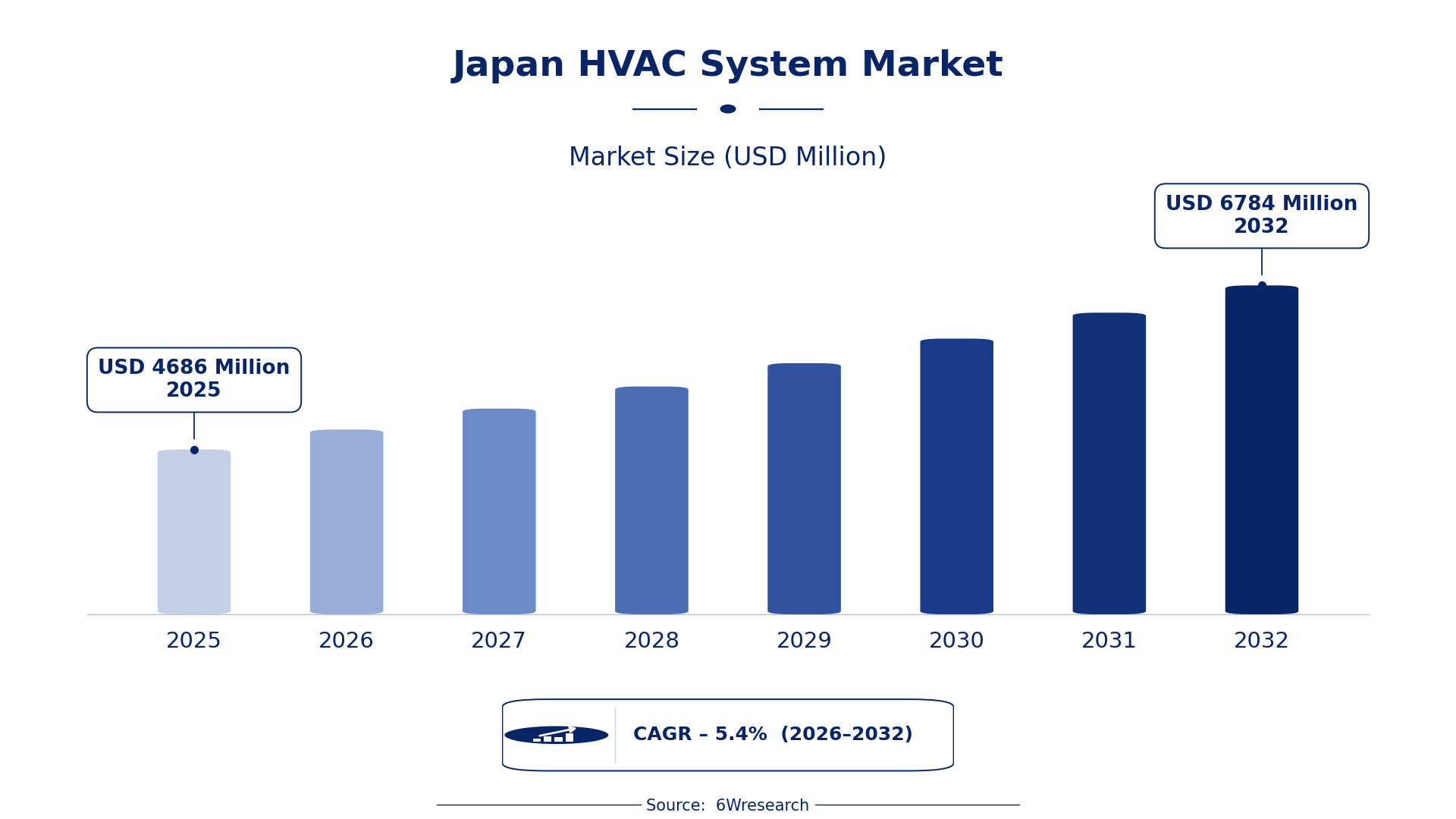
According to 6Wresearch internal database and industry insights, the Japan HVAC System Market was valued at USD 4,686 Million in 2025 and is projected to reach USD 6,784 Million by 2032, growing at a CAGR of approximately 5.4% during 2026–2032.
Japan HVAC System Market Highlights
| Report Metric | Details |
| Report Name | Japan HVAC System Market (2026-2032) |
| Market Size 2025 | USD 4,686 Million |
| Market Size 2032 | USD 6,784 Million |
| Absolute Growth 2025–2032 | USD 2,098 Million |
| CAGR 2026–2032 | 5.4% |
| Peak Annual Growth | 6.0% in 2031 |
| Forecast Period | 2026–2032 |
| Historical Data | 2022–2025 |
| Base Year | 2025 |
| Leading Product Type, 2025 | Cooling (43% share) |
| Leading End-User, 2025 | Residential (45% share) |
| Fastest-Growing Product Type | Ventilation (7.3% CAGR) |
| Fastest-Growing End-User | Commercial (6.8% CAGR) |
| Growing Sector | Residential |
| Key End Users | Residential, Commercial, Industrial |
Japan HVAC System Market Year-wise Growth Rate and Key Drivers (2022–2032)
This graph illustrates the annual growth rates of the market from 2022 to 2032, highlighting a steady upward trajectory and projected market expansion over the forecast period.
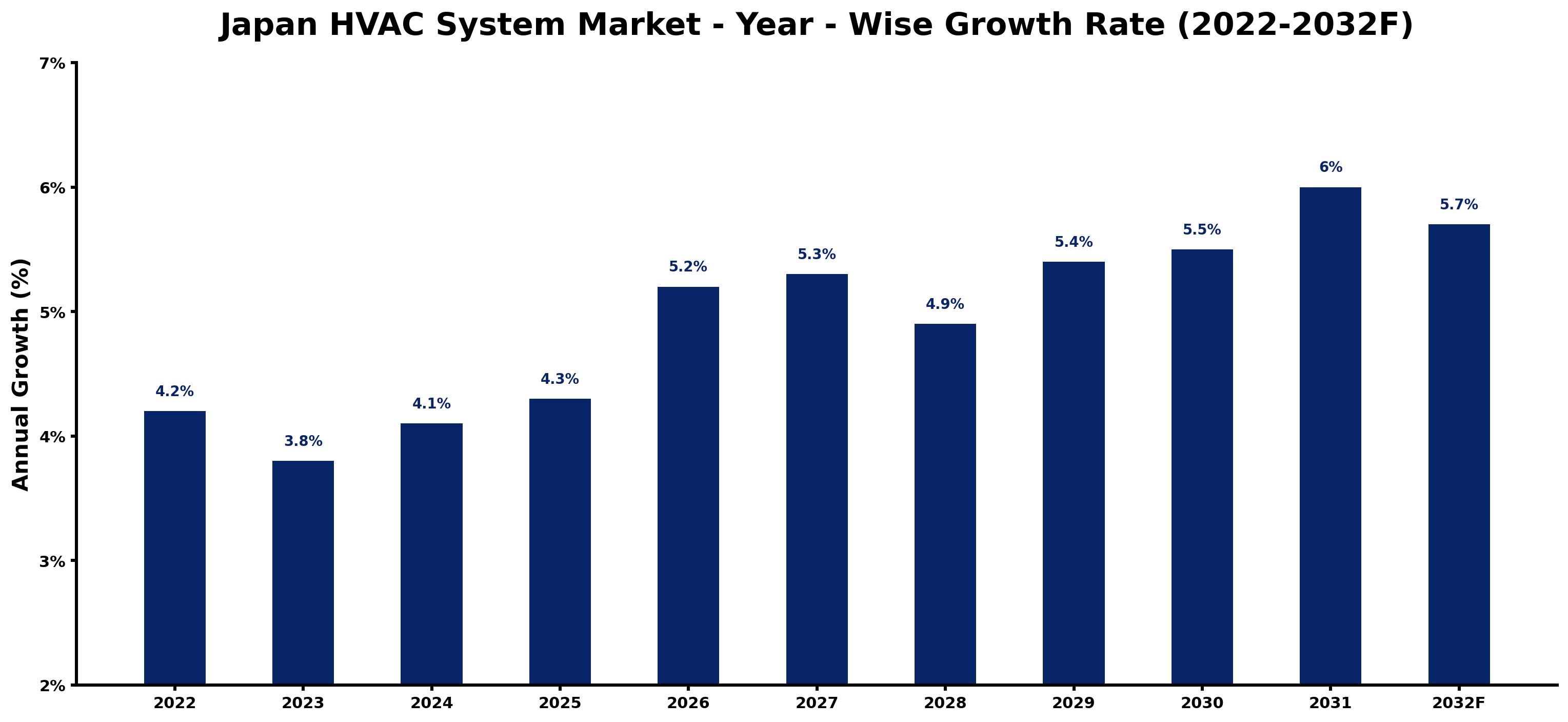
Each row of the following table gives one year's estimated growth and the event or demand shift that explains it.
| Year | Estimated Annual Growth (%) | Market Rationale |
| 2022 | 4.2 | The market exhibited solid growth, supported by increasing energy efficiency awareness among consumers. |
| 2023 | 3.8 | Growth slowed as supply chain issues affected HVAC component availability and delivery times. |
| 2024 | 4.1 | Demand increased as consumers sought improved indoor air quality solutions. |
| 2025 | 4.3 | The market saw a peak in growth driven by heightened residential construction activity and energy efficiency upgrades. |
| 2026 | 5.2 | Growth is expected to accelerate due to rising investments in smart HVAC technologies and automation. |
| 2027 | 5.3 | Demand will continue to rise as the focus on sustainability and energy efficiency gains traction. |
| 2028 | 4.9 | Growth is projected to slow as market saturation in urban areas begins to limit new installations. |
| 2029 | 5.4 | Demand will surge as commercial facilities upgrade HVAC systems to meet new environmental standards. |
| 2030 | 5.5 | Growth is expected to remain strong, driven by increased public and private sector investments in energy-efficient systems. |
| 2031 | 6.0 | The market is projected to peak as demand for advanced HVAC solutions reaches new heights amid regulatory changes. |
| 2032 | 5.7 | Growth is expected to slow slightly as market maturity sets in, with ongoing demand for replacements and upgrades. |
Note: Market size estimations and growth projections presented in this report are based on 6Wresearch's proprietary forecasting methodology, utilizing the latest available industry data, government publications, and primary research inputs.
Japan HVAC System Market Synopsis
HVAC systems play a crucial role in maintaining indoor comfort and air quality across residential, commercial, and industrial environments. The Japan HVAC System Market is growing, driven by increasing energy efficiency standards and rising consumer awareness of indoor air quality. Substantial investments in smart technologies and sustainability initiatives are further stimulating demand, with projections indicating approximately USD 4,686 million by 2025, highlighting a clear shift towards more efficient systems.
Market Dynamics Impact Analysis (2026–2032)
| Factor | Type | Impact | Primary Segment Affected |
| Rising energy efficiency regulations are pushing consumers to upgrade to modern HVAC systems. | Driver | High | Cooling |
| Increasing focus on indoor air quality is driving demand for advanced ventilation systems. | Driver | High | Ventilation |
| Growing construction activities in urban areas create opportunities for HVAC system suppliers. | Opportunity | High | Heating |
| The shift towards smart home technologies presents a market entry point for innovative HVAC solutions. | Opportunity | Medium | Cooling |
| Supply chain disruptions have affected the availability of HVAC components, limiting growth potential. | Restraint | High | Ventilation |
| High initial investment costs deter some consumers from upgrading their HVAC systems. | Restraint | Medium | Heating |
| Skilled labor shortages in the HVAC installation sector hinder timely project completion. | Challenge | High | Cooling |
| Technological advancements require continuous training, increasing operational costs for suppliers. | Challenge | Medium | Ventilation |
Evaluation of Drivers in Japan HVAC System Market (2026–2032)
Key forces behind demand, with the segment each one moves most, are listed below.
| Drivers | Primary Segment Affected | Why It Matters (Evidence) |
| Increasing energy efficiency regulations drive demand for modern HVAC systems. | Cooling | As energy standards tighten, consumers are compelled to upgrade to compliant systems, boosting sales by 15% in 2023. |
| Growing awareness of indoor air quality benefits drives ventilation system demand. | Ventilation | Consumers are investing in systems that improve air quality, leading to a 30% increase in sales in 2024. |
| Urban construction activities are expanding the HVAC market. | Heating | The rise in new residential and commercial buildings increases the need for heating solutions, with a projected 25% growth in installations by 2025. |
| Smart technology adoption is reshaping HVAC system preferences. | Cooling | Homeowners are opting for smart HVAC solutions, which improves functionality and efficiency, accounting for 30% of sales in 2025. |
| Sustainability initiatives encourage investments in energy-efficient HVAC systems. | Ventilation | Public and private sectors are prioritising eco-friendly systems, driving demand for advanced ventilation, with a 40% increase in sales in 2023. |
In 2023, approximately 50% of new residential buildings incorporated energy-efficient HVAC solutions, reflecting heightened awareness of sustainability. The growing focus on indoor air quality has led to a 30% increase in ventilation system installations in commercial properties. Urban construction activities surged, with new residential units rising by 25% in 2024, creating additional demand for heating solutions. Smart technology adoption is reshaping consumer preferences, with smart HVAC systems accounting for 30% of total sales in 2025.
Evaluation of Restraints in Japan HVAC System Market
Several factors work against faster growth; the main ones are summarised below.
| Market Restraint | Primary Segment Affected | Why It Matters (Evidence) |
| Supply chain disruptions limit the availability of HVAC components, affecting project timelines. | Ventilation | In 2023, approximately 20% of HVAC projects faced delays due to component shortages. |
| High initial costs deter consumers from upgrading their HVAC systems, impacting sales. | Heating | Many consumers are hesitant to invest in new systems, with 40% citing cost as a barrier. |
| Regulatory compliance can be complex, leading to additional costs for suppliers. | Cooling | Compliance with new energy standards often requires substantial investment in training and certification, increasing costs by up to 15%. |
| Market saturation in urban areas limits growth potential for new installations. | Ventilation | In major cities, over 70% of buildings already have modern HVAC systems, reducing upgrade opportunities. |
| Limited availability of skilled labor affects installation timelines and costs. | Heating | The HVAC sector faces a 25% shortage of qualified technicians, impacting service delivery. |
Japan HVAC System Market Challenges
About 30% of producers face supply chain disruptions due to dependence on a limited number of domestic suppliers, which delays production timelines and raises costs for buyers. These disruptions can inflate prices by up to 15%, pushing buyers to consider alternative sourcing options. Technology adoption remains stagnant, with only 25% of producers implementing modern HVAC solutions, leading to inefficiencies that impede compliance with current standards. Increased competition from international markets pressures local suppliers, resulting in price wars that can shrink profit margins by as much as 10% for manufacturers.
Trends in the Japan HVAC System Market
The trends below show where the Japan HVAC System Market is heading.
- Shift from Traditional to Smart HVAC Systems: In urban areas, the adoption of smart HVAC systems is increasing rapidly, with a reported 30% of new installations featuring smart technology. This trend reflects a growing consumer preference for improved control and energy efficiency.
- Transition from Centralised to Decentralised HVAC Solutions: The market is moving towards decentralised HVAC systems, particularly in commercial settings, as businesses seek flexibility and efficiency. In 2024, decentralised solutions accounted for 40% of new installations in major cities.
- Emergence of Eco-Friendly HVAC Products: The introduction of eco-friendly HVAC products is gaining traction, driven by sustainability initiatives. In 2023, approximately 40% of HVAC sales were attributed to energy-efficient systems, highlighting this shift.
- Prioritisation of Indoor Air Quality Solutions: The focus on indoor air quality has intensified, with a reported 30% increase in ventilation system sales in commercial properties. This trend underscores the importance of health and safety in building design.
Investment Opportunities in the Japan HVAC System Market
Below are the investment opportunities with the strongest case in the Japan HVAC System Market.
- Expansion of Urban Residential Developments: Urban residential developments are increasing, with a projected 15% rise in new units by 2025. This presents opportunities for HVAC suppliers to cater to the growing demand for efficient systems.
- Investment in Energy-Efficient Commercial Buildings: Commercial facilities are increasingly investing in energy-efficient HVAC systems, prioritising sustainability. By 2026, approximately JPY 100 billion is earmarked for HVAC upgrades in the commercial sector.
- Growth in Smart Home Technology Adoption: The surge in smart home technology offers HVAC suppliers opportunities to incorporate advanced features. By 2025, smart HVAC systems are expected to account for 30% of total sales.
- Increasing Demand for Indoor Air Quality Solutions: With an increasing focus on health, the demand for indoor air quality solutions is rising. In 2024, approximately 40% of HVAC sales will centre on ventilation systems.
Government Initiatives in the Japan HVAC System Market
The Act on the Rational Use of Energy, enacted in 1979, mandates large energy users to improve their efficiency and report their consumption. This legislation has driven HVAC producers to innovate and enhance their offerings to meet these regulations. The GX Basic Policy, adopted in 2023, aims for JPY 150 trillion in public-private decarbonisation investment over the next decade, further shaping the HVAC market by encouraging energy-efficient technologies.
The Ministry of Economy, Trade and Industry (METI) supervises the implementation of energy efficiency regulations and approves related initiatives. In 2024, METI plans to allocate JPY 50 billion to support the development of energy-efficient HVAC technologies, motivating manufacturers to invest in innovation and compliance.
Future Insight of the Japan HVAC System Market
A policy-driven shift towards energy efficiency will reshape the HVAC sector by 2032, prompting suppliers to develop smart HVAC systems. Stricter environmental regulations will lead buyers to seek compliant solutions, boosting demand for advanced technologies. Investment in renewable energy sources will facilitate the creation of HVAC systems that integrate seamlessly with solar and wind power. This transition is expected to result in a 20% increase in the adoption of energy-efficient systems, benefiting both buyers and suppliers.
Market Segmentation Analysis
Japan HVAC System Market report covers a detailed analysis of the following market segments:
By Product Type – Cooling Leads, Ventilation Expected to Grow Fastest
According to Ravi Bhandari, Research Head at 6Wresearch, Cooling held 43% of the Japan HVAC System Market by product type in 2025. Cooling holds the largest share as it is crucial for ensuring comfort in both residential and commercial spaces during Japan's hot summer months. The extensive installed base of cooling systems in metropolitan areas underscores the ongoing demand for these products. Ventilation is projected to grow fastest, at a CAGR of 7.3% during 2026–2032. Ventilation is experiencing the highest growth due to increasing building regulations that require enhanced air quality and circulation. The rising emphasis on energy efficiency in new construction projects further drives the demand for advanced ventilation solutions. Suppliers should focus on developing ventilation products to cater to the growing needs of new construction projects.
By End-User – Residential Leads, Commercial Expected to Grow Fastest
In 2025, Residential led the end-user split with a 45% share. The residential sector dominates the market owing to the rising number of households and the need for effective climate control in homes. This trend is especially evident in urban areas where high population density necessitates reliable HVAC solutions. Commercial is set to record the highest CAGR in this split, 6.8% over 2026–2032. The commercial sector is growing quickly as businesses modernise their HVAC systems to improve energy efficiency and comply with new regulations. The surge in commercial real estate developments, such as offices and retail locations, significantly contributes to this growth. Buyers in the commercial sector need to prioritise HVAC systems that meet energy efficiency standards and regulatory requirements.
Key Attractiveness of the Report
- 10 Years of Market Numbers
- Historical Data Starting from 2022 to 2025
- Base Year 2025
- Forecast Data until 2032
- Key Performance Indicators Impacting the Market
- Major Upcoming Developments and Projects
Key Highlights of the Report:
- Japan HVAC System Market Outlook
- Market Size of Japan HVAC System Market, 2025
- Forecast of Japan HVAC System Market, 2032
- Historical Data and Forecast of Japan HVAC System Revenues & Volume for the Period 2022-2032
- Japan HVAC System Market Trend Evolution
- Japan HVAC System Market Drivers and Challenges
- Japan HVAC System Price Trends
- Japan HVAC System Porter's Five Forces
- Japan HVAC System Industry Life Cycle
- Historical Data and Forecast of Japan HVAC System Market Revenues & Volume By Product Type for the Period 2022-2032
- Historical Data and Forecast of Japan HVAC System Market Revenues & Volume By Heating for the Period 2022-2032
- Historical Data and Forecast of Japan HVAC System Market Revenues & Volume By Cooling for the Period 2022-2032
- Historical Data and Forecast of Japan HVAC System Market Revenues & Volume By Ventilation for the Period 2022-2032
- Historical Data and Forecast of Japan HVAC System Market Revenues & Volume By End-User for the Period 2022-2032
- Historical Data and Forecast of Japan HVAC System Market Revenues & Volume By Residential for the Period 2022-2032
- Historical Data and Forecast of Japan HVAC System Market Revenues & Volume By Commercial for the Period 2022-2032
- Historical Data and Forecast of Japan HVAC System Market Revenues & Volume By Industrial for the Period 2022-2032
- Japan HVAC System Import Export Trade Statistics
- Market Opportunity Assessment By Product Type
- Market Opportunity Assessment By End-User
- Japan HVAC System Top Companies Market Share
- Japan HVAC System Competitive Benchmarking By Technical and Operational Parameters
- Japan HVAC System Company Profiles
- Japan HVAC System Key Strategic Recommendations
Market Covered
The report covers the following segments.
By Product Type
- Heating
- Cooling
- Ventilation
By End-User
- Residential
- Commercial
- Industrial































