Japan Hybrid Power Unit Market Size & Growth Rate
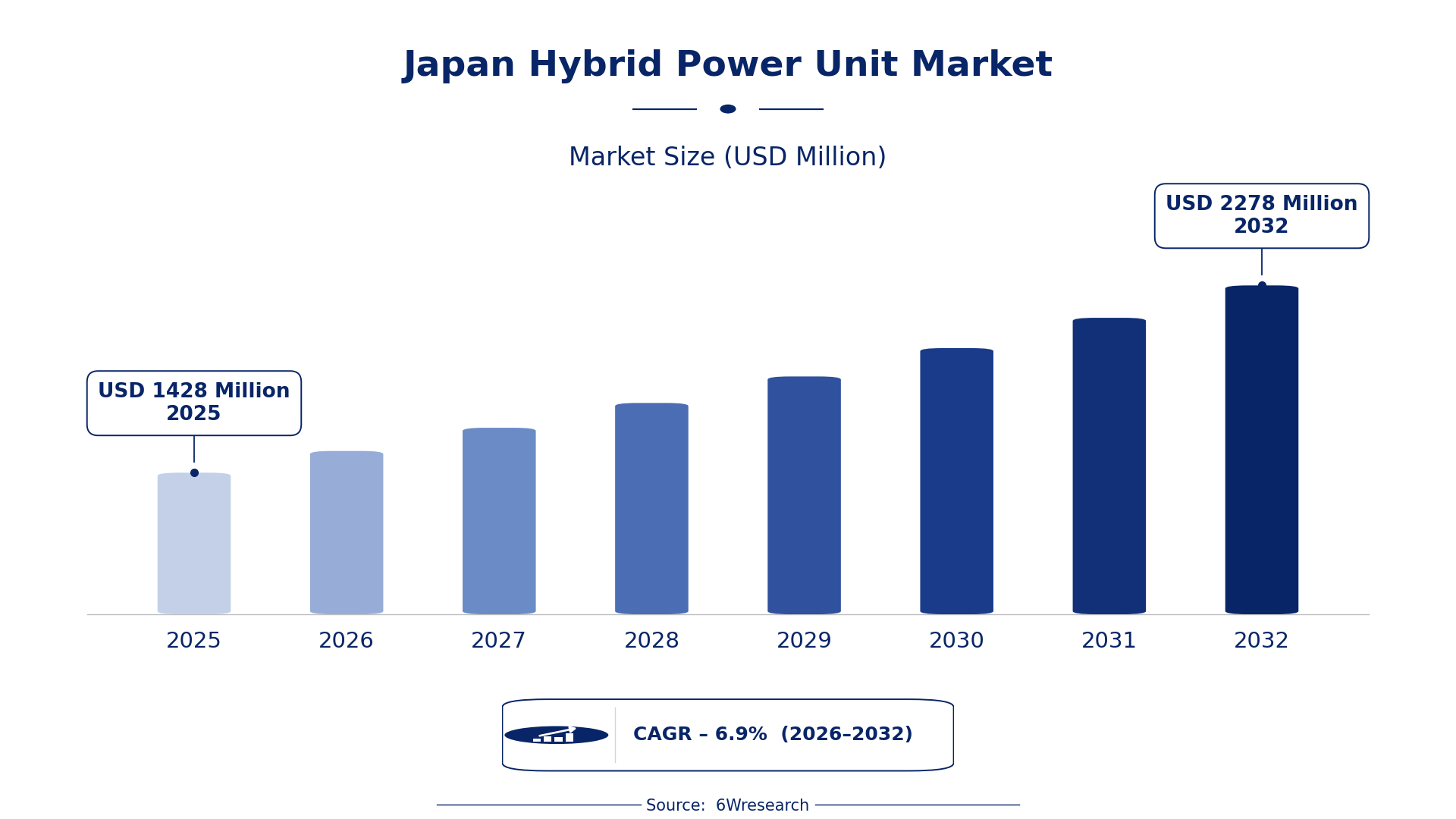
According to 6Wresearch internal database and industry insights, the Japan Hybrid Power Unit Market was valued at USD 1,428 Million in 2025 and is projected to reach USD 2,278 Million by 2032, growing at a CAGR of approximately 6.9% during 2026–2032.
Japan Hybrid Power Unit Market Highlights
| Report Metric | Details |
| Report Name | Japan Hybrid Power Unit Market (2026-2032) |
| Market Size 2025 | USD 1,428 Million |
| Market Size 2032 | USD 2,278 Million |
| Absolute Growth 2025–2032 | USD 850 Million |
| CAGR 2026–2032 | 6.9% |
| Peak Annual Growth | 8.1% in 2031 |
| Forecast Period | 2026–2032 |
| Historical Data | 2022–2025 |
| Base Year | 2025 |
| Leading Power Unit Type, 2025 | Portable Hybrid Units (38% share) |
| Leading Energy Source, 2025 | Diesel + Battery (40% share) |
| Leading Distribution Channel, 2025 | Equipment Dealers (35% share) |
| Leading End User, 2025 | Construction Industry (38% share) |
| Fastest-Growing Power Unit Type | Grid-Connected Hybrid (10.5% CAGR) |
| Fastest-Growing Energy Source | Solar + Grid (10.2% CAGR) |
| Fastest-Growing Distribution Channel | Power Integrators (9.1% CAGR) |
| Fastest-Growing End User | Commercial Facilities (9.0% CAGR) |
| Growing Sector | Construction Industry |
| Key End Users | Construction Industry, Military Camps, Commercial Facilities, Mining Sites |
Japan Hybrid Power Unit Market Year-wise Growth Rate and Key Drivers (2022–2032)
This graph illustrates the annual growth rates of the market from 2022 to 2032, highlighting a steady upward trajectory and projected market expansion over the forecast period.
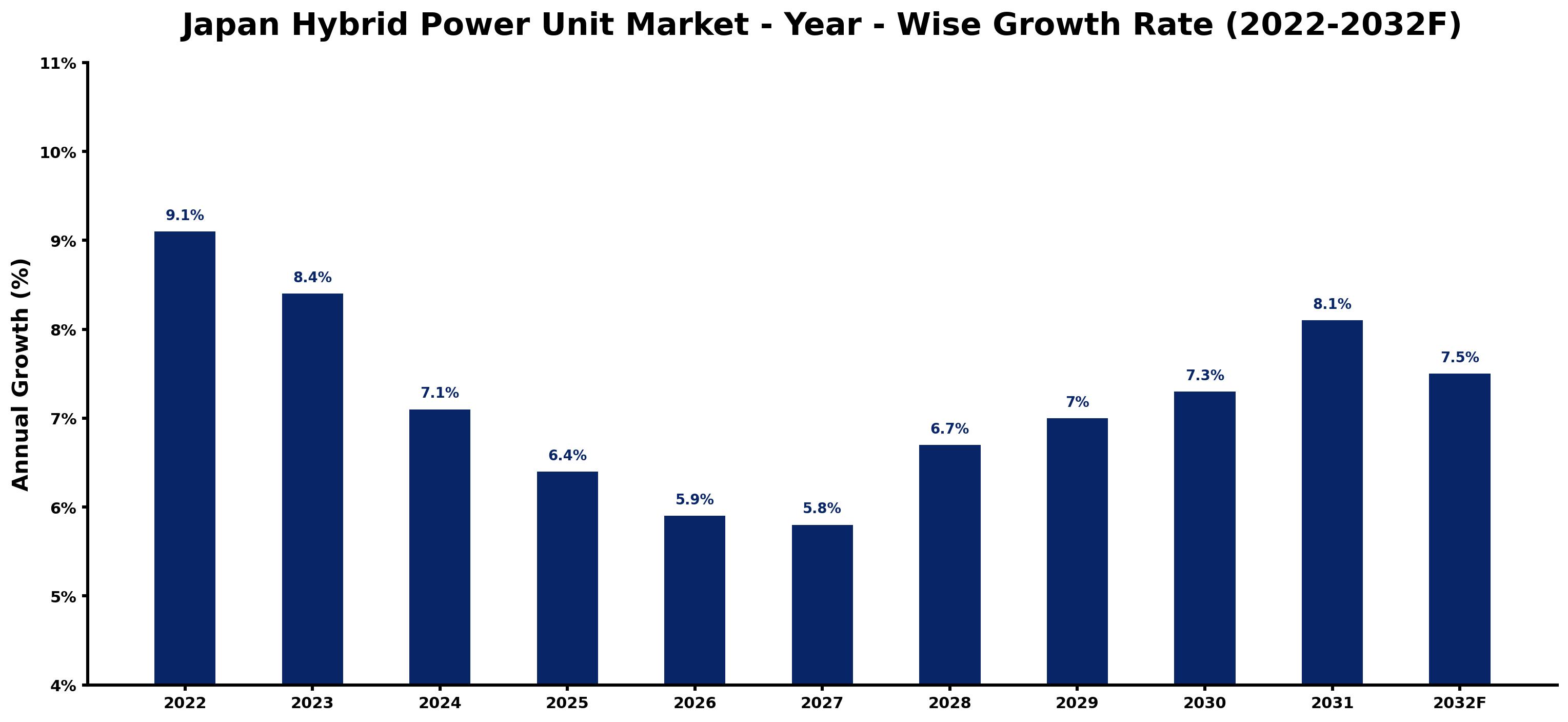
Each row of the following table gives one year's estimated growth and the event or demand shift that explains it.
| Year | Estimated Annual Growth (%) | Market Rationale |
| 2022 | 9.1 | Demand surged due to increased construction activity and military investments. |
| 2023 | 8.4 | Growth slowed as the market adjusted to previous high levels of demand. |
| 2024 | 7.1 | Investments in renewable energy projects supported market expansion and stability. |
| 2025 | 6.4 | The market experienced a slowdown as demand stabilised after rapid growth. |
| 2026 | 5.9 | Growth is expected to decelerate as the market matures and competition increases. |
| 2027 | 5.8 | Demand is projected to remain steady but show signs of further slowing in growth. |
| 2028 | 6.7 | A resurgence in construction projects will lead to a faster growth rate this year. |
| 2029 | 7.0 | Increased adoption of hybrid solutions in commercial facilities is expected to boost demand. |
| 2030 | 7.3 | Growth will accelerate as more sectors adopt hybrid power units for efficiency. |
| 2031 | 8.1 | The market is projected to peak with heightened investments in hybrid technologies. |
| 2032 | 7.5 | Demand growth is expected to slow again as the market approaches saturation. |
Note: Market size estimations and growth projections presented in this report are based on 6Wresearch's proprietary forecasting methodology, utilizing the latest available industry data, government publications, and primary research inputs.
Japan Hybrid Power Unit Market Synopsis
Hybrid Power Units integrate multiple energy sources, providing reliable power solutions for various applications. Their construction involves combining renewable energy sources with traditional generators to improve efficiency. The Japan Hybrid Power Unit Market is expanding due to strong demand from the construction industry, which accounted for 30% of total demand in 2022, alongside military investments aimed at enhancing operational capabilities. Government initiatives, such as the GX Basic Policy, support the transition to renewable energy, further driving market growth.
Market Dynamics Impact Analysis (2026–2032)
| Factor | Type | Impact | Primary Segment Affected |
| Government initiatives promoting renewable energy investments are increasing demand for hybrid power units. | Driver | High | Portable Hybrid Units |
| The construction industry's growing reliance on hybrid power for site operations boosts market demand. | Driver | High | Construction Industry |
| The increasing need for off-grid power solutions presents significant opportunities for hybrid power units. | Opportunity | High | Remote Power Units |
| The rising adoption of hybrid systems in commercial facilities creates new market prospects. | Opportunity | High | Grid-Connected Hybrid |
| High initial investment costs can deter potential buyers from adopting hybrid solutions. | Restraint | Medium | Portable Hybrid Units |
| Limited awareness of hybrid power unit benefits can restrict market growth in certain sectors. | Restraint | Medium | Containerized Systems |
| Supply chain disruptions can delay the availability of components for hybrid systems. | Challenge | High | Grid-Connected Hybrid |
| Competition from alternative energy solutions may hinder hybrid unit market penetration. | Challenge | Medium | Diesel + Battery |
Evaluation of Drivers in Japan Hybrid Power Unit Market (2026–2032)
Below are the drivers that matter most for revenue growth, with supporting evidence.
| Drivers | Primary Segment Affected | Why It Matters (Evidence) |
| Increased construction activity drives demand for hybrid power units on job sites. | Portable Hybrid Units | In 2022, the construction industry accounted for 30% of hybrid power unit demand. |
| Military investments in hybrid solutions improve operational efficiency and power reliability. | Military Camps | The military sector is investing in hybrid power solutions for operational efficiency. |
| Government policies promoting renewable energy adoption stimulate hybrid unit sales. | Grid-Connected Hybrid | Japan targets a 46% cut in greenhouse-gas emissions from fiscal 2013 levels by fiscal 2030. |
| Growing awareness of energy efficiency benefits encourages hybrid system integration. | Commercial Facilities | Hybrid systems are being integrated into commercial facilities to reduce energy costs. |
| Rural electrification initiatives increase demand for remote power solutions. | Remote Power Units | Remote power units are essential in rural areas with limited grid access. |
What keeps demand rising is the increasing construction activity, which accounted for 30% of hybrid power unit demand in 2022, leading to higher purchases of portable hybrid units. Military investments in hybrid solutions are improving operational efficiency, with substantial funding directed towards these technologies. The focus on rural electrification is also increasing the need for remote power units, supporting overall market growth.
Evaluation of Restraints in Japan Hybrid Power Unit Market
The main factors holding the market back are set out below.
| Market Restraint | Primary Segment Affected | Why It Matters (Evidence) |
| High initial investment costs deter potential buyers from adopting hybrid solutions. | Portable Hybrid Units | The average lifespan of a hybrid power unit is around 15 years, resulting in higher upfront costs. |
| Limited awareness of hybrid power unit benefits restricts market growth in certain sectors. | Containerized Systems | Many potential users remain unaware of the advantages of hybrid systems, limiting adoption. |
| Supply chain disruptions delay the availability of components for hybrid systems. | Grid-Connected Hybrid | Recent global supply chain issues have impacted the timely delivery of critical parts, affecting projects. |
| Competition from alternative energy solutions may hinder hybrid unit market penetration. | Diesel + Battery | Alternative energy sources are often perceived as more cost-effective by some buyers, limiting hybrid adoption. |
| Regulatory hurdles can complicate the deployment of hybrid power units. | Remote Power Units | Compliance with various energy regulations can slow down project approvals, delaying market entry. |
Japan Hybrid Power Unit Market Challenges
Intense competition exists as numerous producers enter the hybrid power unit market, compelling them to reduce prices and squeezing profit margins. Importers face supply chain disruptions due to reliance on specific components, leading to project delays that can increase costs for buyers by 15%. Regulatory compliance with the JIS C 8612 standard incurs significant financial burdens on smaller companies, necessitating substantial investments in hybrid power systems. A shortage of skilled workers in advanced hybrid technologies hampers production efficiency, resulting in longer lead times and higher operational costs for suppliers.
Trends in the Japan Hybrid Power Unit Market
Four trends stand out in the Japan Hybrid Power Unit Market.
- Increase in Containerized Systems Adoption: Containerized systems are gaining popularity due to their mobility and ease of deployment. In 2022, the installed base of hybrid power units in Japan reached 5,000 units, with containerized solutions becoming a preferred choice for temporary power needs.
- Expansion of Military Hybrid Power Solutions: The military sector is increasingly investing in hybrid power solutions for operational efficiency. In 2023, the Ministry of Defense announced plans to explore hybrid technologies for military applications, reflecting a growing trend in defence energy strategies.
- Rising Demand for Remote Power Units: Remote power units are essential in rural areas with limited grid access. The increasing focus on rural electrification drives demand for these units, as they provide reliable power solutions where traditional infrastructure is lacking.
- Shift to Renewable Energy Sources: In 2023, Japan's government set a target to increase renewable energy usage to 50% by 2030. This shift drives demand for hybrid power units that integrate renewable sources, improving energy efficiency in various sectors.
Investment Opportunities in the Japan Hybrid Power Unit Market
Investors looking at the Japan Hybrid Power Unit Market should consider the following areas.
- Timing for Renewable Energy Projects: With the government targeting JPY 150 trillion in decarbonisation investment over 10 years, there is an opportunity to supply hybrid power units to support these initiatives, particularly in the construction industry.
- Supply of Portable Hybrid Units: The growing need for temporary power solutions in disaster response operations presents a unique opportunity to supply portable hybrid units, especially in regions prone to natural disasters, like the Tokyo region.
- Gap in Energy Efficiency Solutions: The Tokyo Electric Power Company promotes hybrid systems for energy efficiency, creating an opportunity for suppliers to invest in grid-connected hybrid solutions that cater to urban energy needs.
- Investment in Military Hybrid Technologies: The military's focus on improving operational efficiency opens a window for suppliers to provide advanced hybrid solutions, particularly as the Ministry of Defense explores innovative technologies.
Government Initiatives in the Japan Hybrid Power Unit Market
The GX Promotion Act, adopted in 2023, strengthens the legal framework for promoting hybrid power units, building on the Act on the Rational Use of Energy from 1979. This newer measure requires large energy users to enhance their energy efficiency, thus increasing demand for hybrid solutions that meet these standards.
In 2023, the Japanese government announced a budget of ¥10 billion for renewable energy projects, administered by the Ministry of the Environment. This funding supports the deployment of hybrid power units, enabling buyers to access financial assistance for integrating renewable technologies.
Future Insight of the Japan Hybrid Power Unit Market
The upcoming renewable energy projects will drive demand for hybrid power units, particularly in remote areas with limited grid access. By 2032, Japan's decarbonisation investment is projected to reach JPY 150 trillion, stimulating growth in the hybrid power unit market. The military sector's focus on operational efficiency will further elevate the demand for advanced hybrid solutions. As the government aims for 50% renewable energy usage by 2030, suppliers will need to innovate to meet these targets and remain competitive.
Market Segmentation Analysis
Japan Hybrid Power Unit Market report covers a detailed analysis of the following market segments:
By Power Unit Type – Portable Hybrid Units Lead, Grid-Connected Hybrid Expected to Grow Fastest
According to Saurav Kr Singh, Senior Research Analyst at 6Wresearch, the largest power unit type category in 2025 was Portable Hybrid Units, at 38% of revenue. Portable hybrid units dominate the market as they are ideal for temporary power supply in remote locations, particularly in construction projects. Their widespread adoption in the Tokyo region highlights their essential role in meeting urgent energy needs. Over 2026–2032, Grid-Connected Hybrid is expected to post the fastest growth, at a CAGR of 10.5%. Grid-connected hybrid units are experiencing rapid growth because they efficiently integrate with existing grid systems, enhancing overall energy management. This trend is especially evident in urban areas where energy efficiency is becoming increasingly critical. Suppliers should focus on enhancing grid-connected unit offerings to meet the growing demand for efficient energy solutions.
By Energy Source – Diesel + Battery Leads, Solar + Grid Expected to Grow Fastest
With 40% of energy source revenue in 2025, Diesel + Battery was the largest category. The diesel and battery combination holds the largest market share as it is commonly employed for backup power solutions across various sectors. Its reliability in providing consistent energy makes it a preferred choice among users in construction and military applications. Solar + Grid is set to record the highest CAGR in this split, 10.2% over 2026–2032. Solar and grid integration is gaining traction due to its appeal as a sustainable energy solution, particularly in commercial facilities. The push for renewable energy adoption, supported by government initiatives, is driving this segment's growth. Buyers are increasingly looking for hybrid solutions that incorporate renewable energy sources to align with sustainability goals.
By Distribution Channel – Equipment Dealers Lead, Power Integrators Expected to Grow Fastest
In 2025, Equipment Dealers led the distribution channel split with a 35% share. Equipment dealers are the primary source for purchasing hybrid power units, ensuring access to a broad customer base across various sectors. Their established networks and expertise are crucial for effectively distributing units in industries such as construction and military. The quickest growth will come from Power Integrators, forecast to expand at a CAGR of 9.1% between 2026 and 2032. Power integrators are quickly gaining popularity by providing tailored solutions that address the specific energy needs of end users. Their role is becoming more significant as the demand for customised hybrid systems increases. Suppliers could gain an advantage by partnering with power integrators to enhance their market reach and better fulfil customer requirements.
By End User – Construction Industry Leads, Commercial Facilities Expected to Grow Fastest
Construction Industry accounted for 38% of the market by end user in 2025. The construction industry is the leading end user of hybrid power units, accounting for a substantial portion of demand due to its need for reliable site power. The high volume of ongoing construction projects, particularly in urban areas, drives this segment's growth. Commercial Facilities are projected to grow fastest, at a CAGR of 9.0% during 2026–2032. Commercial facilities are adopting hybrid power solutions at an accelerated pace as they seek to reduce energy costs and improve efficiency. This trend is supported by government incentives aimed at promoting energy efficiency in commercial operations. Suppliers should target commercial facilities as a growing market segment to capitalise on the increasing focus on energy savings.
Key Attractiveness of the Report
- 10 Years of Market Numbers
- Historical Data Starting from 2022 to 2025
- Base Year 2025
- Forecast Data until 2032
- Key Performance Indicators Impacting the Market
- Major Upcoming Developments and Projects
Key Highlights of the Report:
- Japan Hybrid Power Unit Market Outlook
- Market Size of Japan Hybrid Power Unit Market, 2025
- Forecast of Japan Hybrid Power Unit Market, 2032
- Historical Data and Forecast of Japan Hybrid Power Unit Revenues & Volume for the Period 2022-2032F
- Japan Hybrid Power Unit Market Trend Evolution
- Japan Hybrid Power Unit Market Drivers and Challenges
- Japan Hybrid Power Unit Price Trends
- Japan Hybrid Power Unit Porter's Five Forces
- Japan Hybrid Power Unit Industry Life Cycle
- Historical Data and Forecast of Japan Hybrid Power Unit Market Revenues & Volume By Power Unit Type for the Period 2022-2032F
- Historical Data and Forecast of Japan Hybrid Power Unit Market Revenues & Volume By Portable Hybrid Units for the Period 2022-2032F
- Historical Data and Forecast of Japan Hybrid Power Unit Market Revenues & Volume By Grid-Connected Hybrid for the Period 2022-2032F
- Historical Data and Forecast of Japan Hybrid Power Unit Market Revenues & Volume By Remote Power Units for the Period 2022-2032F
- Historical Data and Forecast of Japan Hybrid Power Unit Market Revenues & Volume By Containerized Systems for the Period 2022-2032F
- Historical Data and Forecast of Japan Hybrid Power Unit Market Revenues & Volume By Energy Source for the Period 2022-2032F
- Historical Data and Forecast of Japan Hybrid Power Unit Market Revenues & Volume By Diesel + Battery for the Period 2022-2032F
- Historical Data and Forecast of Japan Hybrid Power Unit Market Revenues & Volume By Solar + Grid for the Period 2022-2032F
- Historical Data and Forecast of Japan Hybrid Power Unit Market Revenues & Volume By Wind + Diesel for the Period 2022-2032F
- Historical Data and Forecast of Japan Hybrid Power Unit Market Revenues & Volume By Modular Hybrid for the Period 2022-2032F
- Historical Data and Forecast of Japan Hybrid Power Unit Market Revenues & Volume By Distribution Channel for the Period 2022-2032F
- Historical Data and Forecast of Japan Hybrid Power Unit Market Revenues & Volume By Equipment Dealers for the Period 2022-2032F
- Historical Data and Forecast of Japan Hybrid Power Unit Market Revenues & Volume By Power Integrators for the Period 2022-2032F
- Historical Data and Forecast of Japan Hybrid Power Unit Market Revenues & Volume By Online Energy Distributors for the Period 2022-2032F
- Historical Data and Forecast of Japan Hybrid Power Unit Market Revenues & Volume By OEM Power Suppliers for the Period 2022-2032F
- Historical Data and Forecast of Japan Hybrid Power Unit Market Revenues & Volume By End User for the Period 2022-2032F
- Historical Data and Forecast of Japan Hybrid Power Unit Market Revenues & Volume By Construction Industry for the Period 2022-2032F
- Historical Data and Forecast of Japan Hybrid Power Unit Market Revenues & Volume By Commercial Facilities for the Period 2022-2032F
- Historical Data and Forecast of Japan Hybrid Power Unit Market Revenues & Volume By Military Camps for the Period 2022-2032F
- Historical Data and Forecast of Japan Hybrid Power Unit Market Revenues & Volume By Mining Sites for the Period 2022-2032F
- Japan Hybrid Power Unit Import Export Trade Statistics
- Market Opportunity Assessment By Power Unit Type
- Market Opportunity Assessment By Energy Source
- Market Opportunity Assessment By Distribution Channel
- Market Opportunity Assessment By End User
- Japan Hybrid Power Unit Top Companies Market Share
- Japan Hybrid Power Unit Competitive Benchmarking By Technical and Operational Parameters
- Japan Hybrid Power Unit Company Profiles
- Japan Hybrid Power Unit Key Strategic Recommendations
Market Covered
Coverage by segment is as follows.
By Power Unit Type
- Portable Hybrid Units
- Grid-Connected Hybrid
- Remote Power Units
- Containerized Systems
By Energy Source
- Diesel + Battery
- Solar + Grid
- Wind + Diesel
- Modular Hybrid
By Distribution Channel
- Equipment Dealers
- Power Integrators
- Online Energy Distributors
- OEM Power Suppliers
By End User
- Construction Industry
- Commercial Facilities
- Military Camps
- Mining Sites































