Japan Hybrid Reality Devices Market Size & Growth Rate
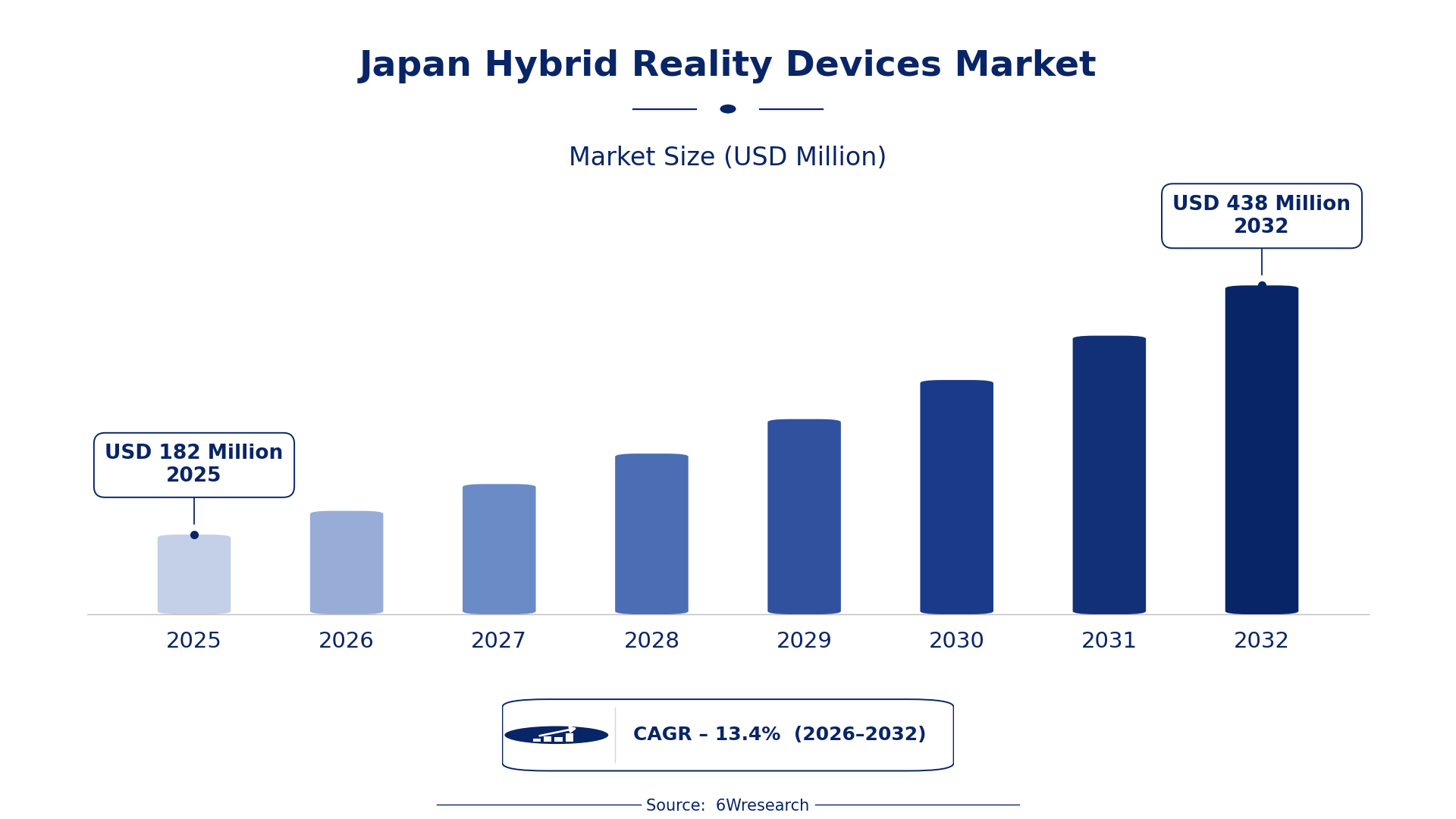
According to 6Wresearch internal database and industry insights, the Japan Hybrid Reality Devices Market was valued at USD 182 Million in 2025 and is projected to reach USD 438 Million by 2032, growing at a CAGR of approximately 13.4% during 2026–2032.
Japan Hybrid Reality Devices Market Highlights
| Report Metric | Details |
| Report Name | Japan Hybrid Reality Devices Market (2026-2032) |
| Market Size 2025 | USD 182 Million |
| Market Size 2032 | USD 438 Million |
| Absolute Growth 2025–2032 | USD 256 Million |
| CAGR 2026–2032 | 13.4% |
| Peak Annual Growth | 16.4% in 2029 |
| Forecast Period | 2026–2032 |
| Historical Data | 2022–2025 |
| Base Year | 2025 |
| Leading Device Type, 2025 | Mixed Reality Headsets (45% share) |
| Leading Platform Type, 2025 | Standalone (42% share) |
| Leading Distribution Channel, 2025 | Tech Retailers (43% share) |
| Leading End User, 2025 | Gamers & Developers (45% share) |
| Fastest-Growing Device Type | AR/VR Hybrid Glasses (20.0% CAGR) |
| Fastest-Growing Distribution Channel | Online Electronics Stores (18.3% CAGR) |
| Fastest-Growing End User | Training Institutions (18.0% CAGR) |
| Growing Sector | education |
| Key End Users | gamers, training institutions, design labs, educational platforms |
Japan Hybrid Reality Devices Market Year-wise Growth Rate and Key Drivers (2022–2032)
This graph illustrates the annual growth rates of the market from 2022 to 2032, highlighting a steady upward trajectory and projected market expansion over the forecast period.
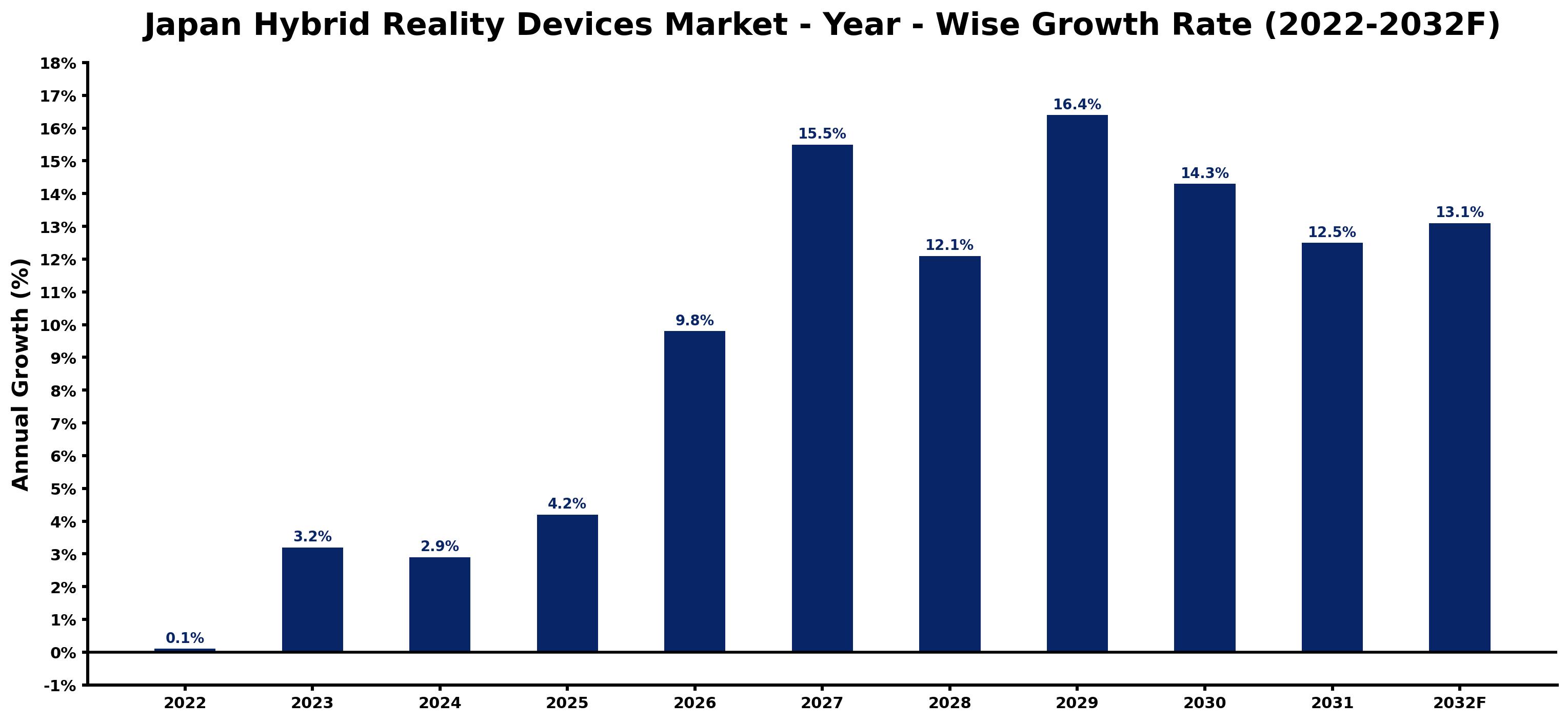
The yearly estimates that follow link every growth rate to its principal driver, so readers can see why the pace changed in each period.
| Year | Estimated Annual Growth (%) | Market Rationale |
| 2022 | 0.1 | The market showed minimal growth due to limited consumer awareness and adoption. |
| 2023 | 3.2 | Increased interest in gaming and educational applications spurred demand for devices. |
| 2024 | 2.9 | Growth slowed as market saturation began to affect new purchases. |
| 2025 | 4.2 | The introduction of new models and features revitalised consumer interest. |
| 2026 | 9.8 | A surge in educational initiatives incorporating AR/VR technologies is expected to boost sales. |
| 2027 | 15.5 | Demand is projected to rise sharply as more institutions adopt hybrid reality devices. |
| 2028 | 12.1 | Growth is expected to moderate as competition intensifies among manufacturers. |
| 2029 | 16.4 | The market is projected to peak with high demand from gaming and enterprise sectors. |
| 2030 | 14.3 | A slight slowdown is expected as market maturity begins to set in. |
| 2031 | 12.5 | Growth is projected to continue slowing as the market stabilises at a higher level. |
| 2032 | 13.1 | Increased investment in hybrid reality technologies is expected to sustain demand. |
Note: Market size estimations and growth projections presented in this report are based on 6Wresearch's proprietary forecasting methodology, utilizing the latest available industry data, government publications, and primary research inputs.
Japan Hybrid Reality Devices Market Synopsis
Hybrid Reality Devices integrate augmented and virtual reality technologies to create immersive experiences for gaming, training, and design applications. The Japan Hybrid Reality Devices Market is expanding due to rising consumer interest, particularly among gamers and educational institutions. The Tokyo region is a key hub for technology innovation, with initiatives from the Ministry of Education aiming to incorporate AR/VR in classrooms by 2025. The gaming market, valued at approximately $20 billion in 2023, is driving demand for these devices, with growth anticipated in the coming years.
Market Dynamics Impact Analysis (2026–2032)
| Factor | Type | Impact | Primary Segment Affected |
| Growing interest in immersive gaming experiences | Driver | High | Gamers & Developers |
| Increased adoption of AR/VR in educational settings | Driver | High | Training Institutions |
| Rising demand for training simulations in various industries | Opportunity | High | Enterprise Use |
| Expansion of online sales channels for hybrid reality devices | Opportunity | Medium | Online Electronics Stores |
| High competition among manufacturers leading to price wars | Restraint | High | Mixed Reality Headsets |
| Limited consumer awareness about hybrid reality applications | Restraint | Medium | AR/VR Hybrid Glasses |
| High initial costs for advanced hybrid reality devices | Challenge | High | Standalone |
| Need for compliance with evolving technology standards | Challenge | Medium | Tethered |
Evaluation of Drivers in Japan Hybrid Reality Devices Market (2026–2032)
Key forces behind demand, with the segment each one moves most, are listed below.
| Drivers | Primary Segment Affected | Why It Matters (Evidence) |
| Rising number of gamers in Japan | Gamers & Developers | In 2023, over 60 million gamers in Japan increased demand for immersive gaming experiences. |
| Educational initiatives incorporating AR/VR | Training Institutions | The Ministry of Education aims to integrate AR/VR in classrooms by 2025, boosting device adoption. |
| Demand for training simulations in enterprises | Enterprise Use | Many companies are utilising hybrid reality for training, with over 1,000 institutions adopting these technologies. |
| Growth of online electronics sales channels | Online Electronics Stores | In 2023, over 200 online stores offered hybrid reality devices, making them more accessible to consumers. |
| Technological advancements in AR/VR devices | AR/VR Hybrid Glasses | The JIS X 0123 standard promotes interoperability, improving user experience and driving sales. |
Purchasing is picking up as the number of gamers in Japan reached over 60 million in 2023, driving demand for immersive gaming experiences. Over 1,000 training institutions are utilising hybrid reality for simulations, improving training effectiveness. The growth of online electronics stores, which numbered over 200 in 2023, has made these devices more accessible. Technological advancements governed by the JIS X 0123 standard are improving device interoperability, leading to increased consumer interest.
Evaluation of Restraints in Japan Hybrid Reality Devices Market
These restraints slow adoption and weigh on supplier margins.
| Market Restraint | Primary Segment Affected | Why It Matters (Evidence) |
| High competition among manufacturers | Mixed Reality Headsets | Intense competition has led to price wars, affecting profit margins for manufacturers. |
| Limited consumer awareness about hybrid reality applications | AR/VR Hybrid Glasses | Many potential users lack understanding of the benefits, hindering market growth. |
| High initial costs for advanced hybrid reality devices | Standalone | The premium pricing of advanced models restricts access for budget-conscious consumers. |
| Need for compliance with evolving technology standards | Tethered | Manufacturers face challenges in meeting new standards, which delays product launches. |
| Market saturation affecting new purchases | Immersive Viewers | As the market matures, fewer consumers are willing to invest in new devices. |
Japan Hybrid Reality Devices Market Challenges
In 2023, Japan had about 8,100 hospitals struggling to adopt hybrid reality devices due to high costs, which limits access for healthcare buyers. Production delays arise as manufacturers depend on imported components, affecting supply chains and prolonging device availability. Retail prices for hybrid reality devices can exceed JPY 100,000, making them unaffordable for many potential buyers, especially in education and training sectors. A shortage of skilled developers in AR/VR technology hampers producers' ability to innovate, resulting in fewer competitive products available in the market.
Trends in the Japan Hybrid Reality Devices Market
The following changes are redrawing the Japan Hybrid Reality Devices Market.
- Shift towards Educational Integration of AR/VR: The Ministry of Education's initiative to incorporate AR/VR in classrooms by 2025 is reshaping educational practices. This shift is projected to increase demand for hybrid reality devices, with a rise in adoption rates expected.
- Transition from Standalone to Tethered Devices: Standalone devices are becoming more popular, with a 42% market share in 2025. This shift reflects consumer preference for portability and ease of use, driving manufacturers to innovate in this segment.
- Emergence of Online Sales Channels: The rise of online electronics stores, with over 200 in 2023, is changing how consumers purchase hybrid reality devices. This trend is making devices more accessible, particularly to younger audiences.
- Increase in Training Applications: The number of training institutions using hybrid reality technology is estimated at over 1,000 nationwide. This growth highlights the increasing recognition of hybrid reality's effectiveness in professional training.
Investment Opportunities in the Japan Hybrid Reality Devices Market
The openings below show where demand in the Japan Hybrid Reality Devices Market is visible and how suppliers can enter.
- Timing for Educational Investments: With the Ministry of Education's initiative to integrate AR/VR by 2025, there is an opportunity to supply educational institutions with hybrid reality devices, improving learning experiences and increasing adoption rates.
- Entry through Partnerships with Training Institutions: Training institutions are increasingly adopting hybrid reality technologies, creating opportunities for partnerships to supply devices and software, particularly in urban areas like Tokyo, which is a hub for educational innovation.
- Growing Demand from Gamers: The gaming market, valued at approximately $20 billion in 2023, presents a prime opportunity to supply innovative hybrid reality devices tailored for immersive gaming experiences, appealing to a large consumer base.
- Investment in Online Distribution Channels: The expansion of online electronics stores offers a timely opportunity to invest in digital marketing strategies and partnerships to reach a broader consumer base, capitalising on the growing trend of online shopping.
Government Initiatives in the Japan Hybrid Reality Devices Market
The PMD Act regulates the approval, manufacture, and quality of hybrid reality devices, ensuring that producers meet safety and performance standards. This law protects consumers and encourages manufacturers to invest in quality assurance and compliance processes. Additionally, the Industrial Standardization Act governs the interoperability of devices, promoting consistency and reliability in the market, which is important for user satisfaction.
Training institutions utilise funding from the New Growth Strategy 2023 to develop their AR/VR capabilities. This funding supports the acquisition of hybrid reality devices and the development of training programs, enabling institutions to provide advanced educational experiences and improve learning outcomes.
Future Insight of the Japan Hybrid Reality Devices Market
The launch of initiatives to incorporate AR/VR in classrooms by 2025 will stimulate demand for hybrid reality devices in educational institutions. By 2032, the number of design and simulation labs is expected to increase significantly, improving prototyping capabilities for various industries. Government funding for AR/VR research will drive technological advancements, benefiting suppliers and buyers. With a growing focus on technology innovation in the Tokyo region, new opportunities will emerge across multiple sectors.
Market Segmentation Analysis
Japan Hybrid Reality Devices Market report covers a detailed analysis of the following market segments:
By Device Type – Mixed Reality Headsets Lead, AR/VR Hybrid Glasses Expected to Grow Fastest
According to Saurav Kr Singh, Senior Research Analyst at 6Wresearch, Mixed Reality Headsets held 45% of the Japan Hybrid Reality Devices Market by device type in 2025. Mixed Reality Headsets hold the largest share due to their widespread application in immersive gaming and simulations, appealing to users across various demographics. Their prominent role in events like the Tokyo Game Show 2023 highlights their significance in the gaming community. AR/VR Hybrid Glasses are projected to grow fastest, at a CAGR of 20.0% during 2026–2032. AR/VR Hybrid Glasses are rapidly gaining traction as they improve user interaction in diverse applications, particularly in educational settings. The government's push to integrate AR/VR technologies in classrooms is accelerating the growth of this segment. Suppliers should prioritise the development of AR/VR Hybrid Glasses to align with the increasing demand in educational and interactive sectors.
By Platform Type – Standalone Leads and Records the Fastest Growth
The largest platform type category in 2025 was Standalone, at 42% of revenue. Standalone devices lead the market as they offer portability and ease of use, appealing to a broad range of consumers. Their convenience makes them particularly popular among casual users and gamers who seek hassle-free experiences. Standalone is also forecast to expand faster than any other category, at a CAGR of 15.8% over 2026–2032. The Standalone platform is also the fastest-growing due to its increasing adoption across various user demographics, including gamers and educational institutions. As more users seek flexible and accessible solutions, the demand for Standalone devices will continue to rise. Suppliers must prioritise the development of Standalone devices to capture the expanding market and meet user preferences.
By Distribution Channel – Tech Retailers Lead, Online Electronics Stores Expected to Grow Fastest
In 2025, Tech Retailers led the distribution channel split with a 43% share. Tech Retailers hold the largest share in distribution as they provide a wide variety of hybrid reality devices and knowledgeable assistance to customers. Their established presence in urban areas, particularly in Tokyo, ensures that consumers can easily access the latest products and technologies. The quickest growth will come from Online Electronics Stores, forecast to expand at a CAGR of 18.3% between 2026 and 2032. Online Electronics Stores are rapidly expanding as a preferred purchasing option, primarily due to the increasing trend towards e-commerce and the convenience it offers. In 2023, over 200 such stores were operational in Japan, catering to the growing demand for hybrid reality devices. This trend indicates that suppliers must enhance their online presence to effectively reach and engage the expanding consumer base in the digital marketplace.
By End User – Gamers & Developers Lead, Training Institutions Expected to Grow Fastest
Gamers & Developers accounted for 45% of the market by end user in 2025. Gamers & Developers represent the largest user base for hybrid reality devices, utilising them extensively for immersive gaming experiences. The gaming market in Japan, valued at approximately $20 billion in 2023, highlights the substantial demand from this segment. Training Institutions are set to record the highest CAGR in this split, 18.0% over 2026–2032. Training Institutions are the fastest-growing end user segment as they increasingly incorporate hybrid reality technology for educational purposes. The government's support for AR/VR in education is driving this trend, leading to a surge in adoption among training facilities. Suppliers should target training institutions to capitalise on the growing demand for hybrid reality devices in educational settings.
Key Attractiveness of the Report
- 10 Years of Market Numbers
- Historical Data Starting from 2022 to 2025
- Base Year 2025
- Forecast Data until 2032
- Key Performance Indicators Impacting the Market
- Major Upcoming Developments and Projects
Key Highlights of the Report:
- Japan Hybrid Reality Devices Market Outlook
- Market Size of Japan Hybrid Reality Devices Market, 2025
- Forecast of Japan Hybrid Reality Devices Market, 2032
- Historical Data and Forecast of Japan Hybrid Reality Devices Revenues & Volume for the Period 2022-2032F
- Japan Hybrid Reality Devices Market Trend Evolution
- Japan Hybrid Reality Devices Market Drivers and Challenges
- Japan Hybrid Reality Devices Price Trends
- Japan Hybrid Reality Devices Porter's Five Forces
- Japan Hybrid Reality Devices Industry Life Cycle
- Historical Data and Forecast of Japan Hybrid Reality Devices Market Revenues & Volume By Device Type for the Period 2022-2032F
- Historical Data and Forecast of Japan Hybrid Reality Devices Market Revenues & Volume By Mixed Reality Headsets for the Period 2022-2032F
- Historical Data and Forecast of Japan Hybrid Reality Devices Market Revenues & Volume By AR/VR Hybrid Glasses for the Period 2022-2032F
- Historical Data and Forecast of Japan Hybrid Reality Devices Market Revenues & Volume By MR Smart Glasses for the Period 2022-2032F
- Historical Data and Forecast of Japan Hybrid Reality Devices Market Revenues & Volume By Immersive Viewers for the Period 2022-2032F
- Historical Data and Forecast of Japan Hybrid Reality Devices Market Revenues & Volume By Platform Type for the Period 2022-2032F
- Historical Data and Forecast of Japan Hybrid Reality Devices Market Revenues & Volume By Tethered for the Period 2022-2032F
- Historical Data and Forecast of Japan Hybrid Reality Devices Market Revenues & Volume By Standalone for the Period 2022-2032F
- Historical Data and Forecast of Japan Hybrid Reality Devices Market Revenues & Volume By Enterprise Use for the Period 2022-2032F
- Historical Data and Forecast of Japan Hybrid Reality Devices Market Revenues & Volume By Mobile Supported for the Period 2022-2032F
- Historical Data and Forecast of Japan Hybrid Reality Devices Market Revenues & Volume By Distribution Channel for the Period 2022-2032F
- Historical Data and Forecast of Japan Hybrid Reality Devices Market Revenues & Volume By Tech Retailers for the Period 2022-2032F
- Historical Data and Forecast of Japan Hybrid Reality Devices Market Revenues & Volume By Online Electronics Stores for the Period 2022-2032F
- Historical Data and Forecast of Japan Hybrid Reality Devices Market Revenues & Volume By OEM & SaaS Providers for the Period 2022-2032F
- Historical Data and Forecast of Japan Hybrid Reality Devices Market Revenues & Volume By Online Gaming Platforms for the Period 2022-2032F
- Historical Data and Forecast of Japan Hybrid Reality Devices Market Revenues & Volume By End User for the Period 2022-2032F
- Historical Data and Forecast of Japan Hybrid Reality Devices Market Revenues & Volume By Gamers & Developers for the Period 2022-2032F
- Historical Data and Forecast of Japan Hybrid Reality Devices Market Revenues & Volume By Training Institutions for the Period 2022-2032F
- Historical Data and Forecast of Japan Hybrid Reality Devices Market Revenues & Volume By Design & Simulation Labs for the Period 2022-2032F
- Historical Data and Forecast of Japan Hybrid Reality Devices Market Revenues & Volume By EdTech Platforms for the Period 2022-2032F
- Japan Hybrid Reality Devices Import Export Trade Statistics
- Market Opportunity Assessment By Device Type
- Market Opportunity Assessment By Platform Type
- Market Opportunity Assessment By Distribution Channel
- Market Opportunity Assessment By End User
- Japan Hybrid Reality Devices Top Companies Market Share
- Japan Hybrid Reality Devices Competitive Benchmarking By Technical and Operational Parameters
- Japan Hybrid Reality Devices Company Profiles
- Japan Hybrid Reality Devices Key Strategic Recommendations
Market Covered
This report examines the market across the segments below.
By Device Type
- Mixed Reality Headsets
- AR/VR Hybrid Glasses
- MR Smart Glasses
- Immersive Viewers
By Platform Type
- Tethered
- Standalone
- Enterprise Use
- Mobile Supported
By Distribution Channel
- Tech Retailers
- Online Electronics Stores
- OEM & SaaS Providers
- Online Gaming Platforms
By End User
- Gamers & Developers
- Training Institutions
- Design & Simulation Labs
- EdTech Platforms































