Japan Hydraulic Components Market Size & Growth Rate
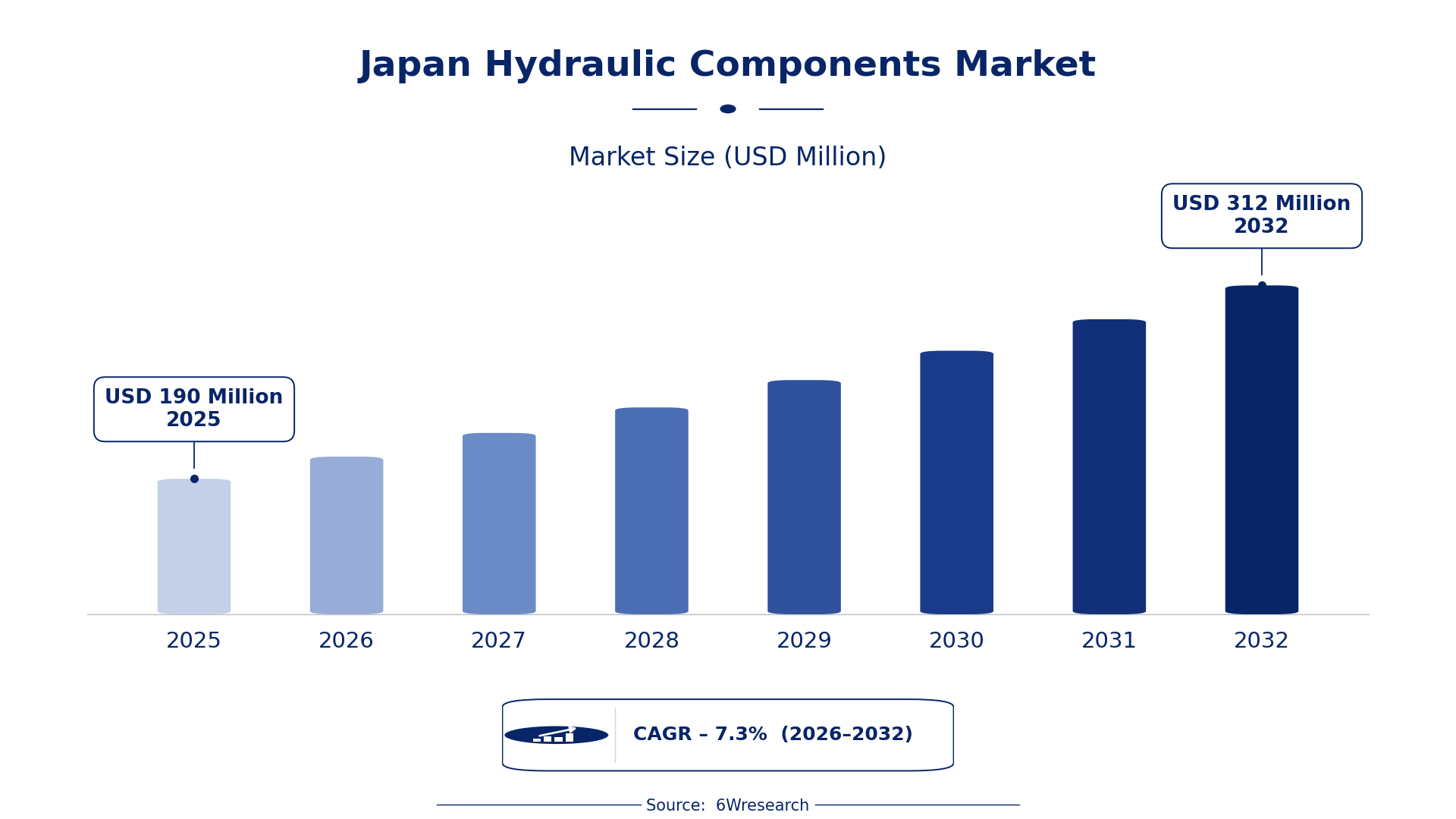
According to 6Wresearch internal database and industry insights, the Japan Hydraulic Components Market was valued at USD 190 Million in 2025 and is projected to reach USD 312 Million by 2032, growing at a CAGR of approximately 7.3% during 2026–2032.
Japan Hydraulic Components Market Highlights
| Report Metric | Details |
| Report Name | Japan Hydraulic Components Market (2026-2032) |
| Market Size 2025 | USD 190 Million |
| Market Size 2032 | USD 312 Million |
| Absolute Growth 2025–2032 | USD 122 Million |
| CAGR 2026–2032 | 7.3% |
| Peak Annual Growth | 8.1% in 2029 |
| Forecast Period | 2026–2032 |
| Historical Data | 2022–2025 |
| Base Year | 2025 |
| Leading Component Type, 2025 | Hydraulic Pumps (38% share) |
| Leading Material Type, 2025 | Cast Iron / Steel (44% share) |
| Leading Distribution Channel, 2025 | OEM Equipment Dealers (51% share) |
| Leading End User, 2025 | Industrial Machinery (51% share) |
| Fastest-Growing Component Type | Hydraulic Cylinders (9.8% CAGR) |
| Fastest-Growing Material Type | Alloy Steel (10.1% CAGR) |
| Fastest-Growing Distribution Channel | Online B2B Portals (9.0% CAGR) |
| Fastest-Growing End User | Construction Equipment (9.4% CAGR) |
| Growing Sector | Construction Equipment |
| Key End Users | Industrial Machinery, Construction Equipment, Agricultural Equipment |
Japan Hydraulic Components Market Year-wise Growth Rate and Key Drivers (2022–2032)
This graph illustrates the annual growth rates of the market from 2022 to 2032, highlighting a steady upward trajectory and projected market expansion over the forecast period.
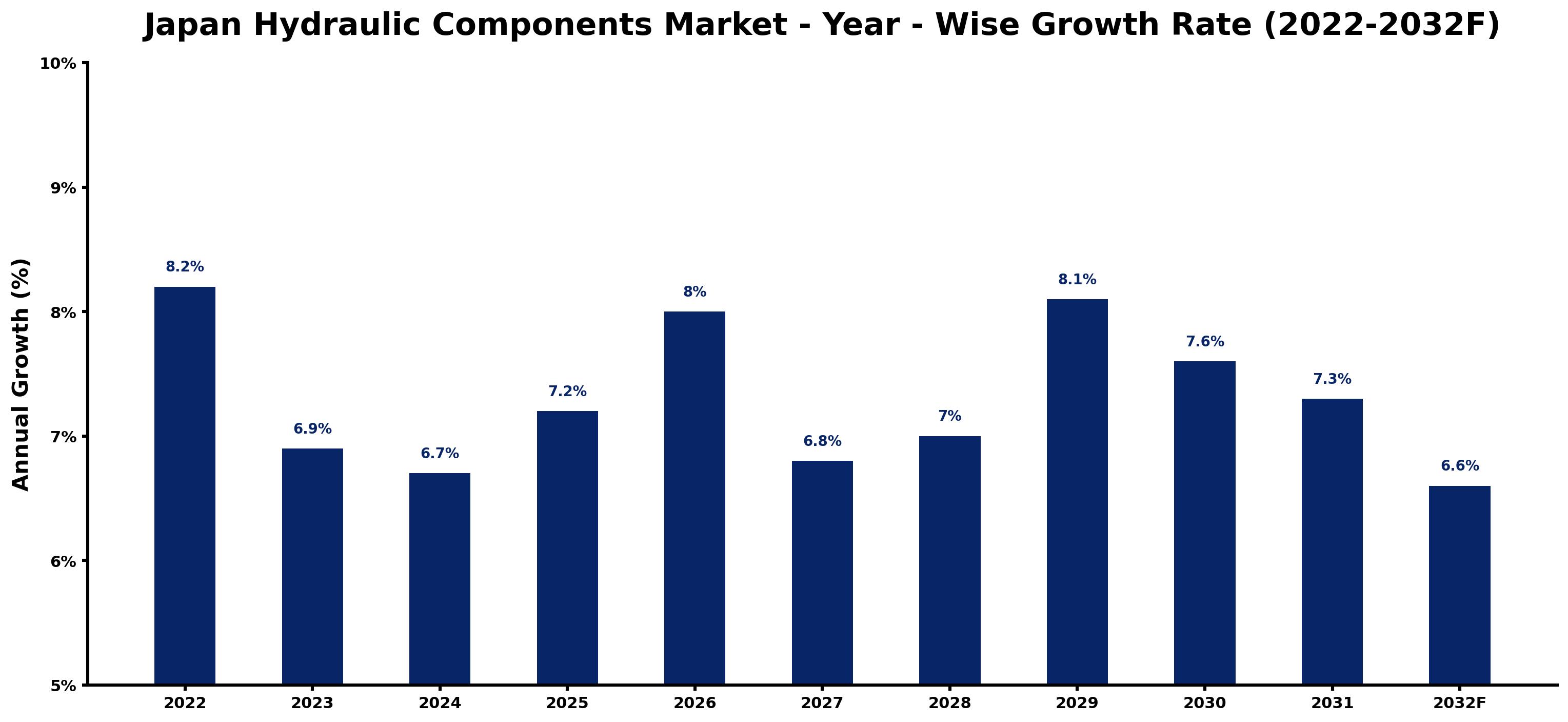
The following figures match every annual growth estimate with the main market development of that year, giving the reasoning behind each rise or slowdown.
| Year | Estimated Annual Growth (%) | Market Rationale |
| 2022 | 8.2 | The market experienced strong demand from the construction sector, driving growth. |
| 2023 | 6.9 | Growth slowed due to a temporary dip in infrastructure projects and machinery orders. |
| 2024 | 6.7 | Demand continued to slow as manufacturers adjusted to market conditions and inventory levels. |
| 2025 | 7.2 | An increase in infrastructure spending led to a rebound in hydraulic component orders. |
| 2026 | 8.0 | Renewed interest will emerge as construction projects ramp up across the country. |
| 2027 | 6.8 | Growth will slow as manufacturers face challenges in sourcing materials and components. |
| 2028 | 7.0 | A rise in industrial activity will boost demand for hydraulic systems and components. |
| 2029 | 8.1 | The market will peak as automation trends drive investments in hydraulic technologies. |
| 2030 | 7.6 | Growth will slow as market saturation in certain sectors begins to take effect. |
| 2031 | 7.3 | Demand will remain steady, but growth rates will normalise as the market matures. |
| 2032 | 6.6 | The market is expected to stabilise as new technologies are adopted in hydraulic systems. |
Note: Market size estimations and growth projections presented in this report are based on 6Wresearch's proprietary forecasting methodology, utilizing the latest available industry data, government publications, and primary research inputs.
Japan Hydraulic Components Market Synopsis
Hydraulic components are mechanical devices that use pressurised fluid to transmit power, primarily made from materials like steel and rubber. The Japan Hydraulic Components Market is growing, driven by the construction equipment sector, which is expected to expand due to increased infrastructure projects. The adoption of hydraulic systems in agriculture, with over 1 million tractors in operation, fuels demand. Investment in innovation and adherence to standards like JIS B 8360 support market expansion. The hydraulic valve market is also expanding due to advancements in automation technologies, indicating a promising future for hydraulic components.
Market Dynamics Impact Analysis (2026–2032)
| Factor | Type | Impact | Primary Segment Affected |
| Rising construction projects in the Kanto region drive demand for hydraulic components. | Driver | High | Hydraulic Pumps |
| Increased automation in industrial machinery enhances the need for hydraulic systems. | Driver | High | Hydraulic Cylinders |
| Growing agricultural sector adoption of hydraulic technology presents opportunities. | Opportunity | High | Hydraulic Hoses |
| The shift towards online procurement channels opens new market avenues. | Opportunity | Medium | Online B2B Portals |
| Material sourcing challenges can limit production capacity for manufacturers. | Restraint | High | Hydraulic Valves |
| Compliance with stringent safety standards may increase operational costs. | Restraint | Medium | Hydraulic Pumps |
| High costs of advanced hydraulic technologies can deter smaller manufacturers. | Challenge | High | Hydraulic Cylinders |
| Competition from alternative power transmission technologies may impact market share. | Challenge | Medium | Hydraulic Hoses |
Evaluation of Drivers in Japan Hydraulic Components Market (2026–2032)
The following drivers explain most of the expected growth.
| Drivers | Primary Segment Affected | Why It Matters (Evidence) |
| Increased infrastructure spending fuels demand for hydraulic pumps. | Hydraulic Pumps | The construction equipment sector is valued at approximately ¥4 trillion, driving orders for hydraulic pumps. |
| Growing automation in industrial machinery increases hydraulic cylinder usage. | Hydraulic Cylinders | The total installed base of hydraulic pumps exceeds 2 million units, boosting cylinder demand. |
| Adoption of hydraulic systems in agriculture increases hose requirements. | Hydraulic Hoses | Japan's agricultural sector has over 1 million tractors, necessitating more hydraulic hoses. |
| Rising industrial activity drives demand for hydraulic valves. | Hydraulic Valves | The growth in industrial machinery usage leads to higher orders for hydraulic valves. |
| Expansion of online B2B portals improves distribution efficiency. | Online B2B Portals | The shift to digital procurement channels is gaining traction among manufacturers, increasing order volume. |
Behind the steady rise in orders sits the construction sector, projected to grow due to increased infrastructure projects valued at approximately ¥4 trillion. The agricultural sector also drives demand, with over 1 million tractors in use, boosting the need for hydraulic hoses. The total installed base of hydraulic pumps exceeds 2 million units, leading to increased orders for hydraulic cylinders. The expansion of online B2B portals is improving distribution efficiency, allowing manufacturers to reach a broader audience. As automation trends continue, the demand for hydraulic valves in industrial machinery is expected to rise, further supporting market growth.
Evaluation of Restraints in Japan Hydraulic Components Market
The main factors holding the market back are set out below.
| Market Restraint | Primary Segment Affected | Why It Matters (Evidence) |
| Material sourcing challenges limit production capacity for hydraulic valves. | Hydraulic Valves | Manufacturers face difficulties in obtaining high-quality materials, impacting output and leading to a 15% increase in costs. |
| Compliance with JIS B 8360 standards increases operational costs for producers. | Hydraulic Pumps | Meeting stringent safety and quality standards requires considerable investment, raising production expenses by 10%. |
| High costs of advanced hydraulic technologies deter smaller manufacturers. | Hydraulic Cylinders | Smaller firms struggle to invest in new technologies, limiting competitiveness and market presence. |
| Competition from alternative power transmission technologies may impact market share. | Hydraulic Hoses | Emerging technologies present viable alternatives, challenging traditional hydraulic systems and market position. |
| Economic fluctuations can affect overall construction activity and hydraulic component demand. | Hydraulic Pumps | Economic downturns lead to reduced infrastructure spending, impacting orders and overall market stability. |
Japan Hydraulic Components Market Challenges
A critical obstacle in the hydraulic components market is the shortage of skilled labour, driven by an ageing workforce and insufficient training programmes, which delays production timelines for manufacturers. Rising raw material costs, particularly for steel and rubber, have increased by 15%, straining budgets for suppliers and forcing them to adjust pricing strategies. Supply chain disruptions, exacerbated by global events, lead to extended lead times for components, causing significant project delays for importers. Intense competition from international markets compels local producers to lower prices, jeopardising product quality and profitability for them.
Trends in the Japan Hydraulic Components Market
The following changes are redrawing the Japan Hydraulic Components Market.
- Shift towards Automation in Construction Equipment: The construction equipment sector is increasingly adopting automation technologies, improving efficiency. In 2023, this shift has led to a notable increase in demand for hydraulic components in automated machinery, with a 15% rise in orders.
- Growing Preference for Online Procurement Channels: Manufacturers are increasingly shifting to online B2B portals for procurement. This trend has seen a rise in orders through digital channels, reflecting changing buyer behaviours, with a 20% increase in online transactions.
- Increased Adoption of Hydraulic Systems in Agriculture: The agricultural sector is modernising with hydraulic systems, particularly in tractors. Over 1 million tractors are now equipped with advanced hydraulic technologies, improving operational efficiency and increasing demand by 12%.
- Emergence of New Safety Standards for Hydraulic Systems: The introduction of the ISO 4413 standard in 2023 has reshaped product design in the hydraulic sector. Compliance with these standards is now mandatory for all manufacturers, affecting over 500 companies.
Investment Opportunities in the Japan Hydraulic Components Market
Where to invest in the Japan Hydraulic Components Market: the main openings are set out below.
- Partnerships with Local Manufacturers: Establishing joint ventures with local manufacturers can facilitate market entry. The construction sector, a major consumer, is projected to grow, offering substantial opportunities with an expected 10% increase in demand.
- Investment in Agricultural Equipment: The agricultural sector is increasingly adopting hydraulic technologies, creating demand. Investing in hydraulic components for tractors can yield high returns as modernization continues, with a projected 15% growth in orders.
- Expansion into Online B2B Portals: Investing in online distribution channels can tap into the growing digital procurement trend. The construction equipment sector is a key buyer group that is shifting towards online purchasing, with a 25% increase in online orders.
- Supply of Advanced Hydraulic Technologies: There is a rising demand for advanced hydraulic systems in industrial applications. Focusing on innovation and technology can attract buyers from the industrial machinery sector, with a projected 20% increase in technology adoption.
Government Initiatives in the Japan Hydraulic Components Market
The Water Supply Act of 1957 sets standards for drinking-water quality and supply, influencing manufacturers to ensure compliance in their hydraulic components. The Building Energy Efficiency Act, amended in 2022, mandates energy standards for new buildings, indirectly impacting hydraulic systems used in construction, requiring significant investments from producers.
In 2023, the Japanese government allocated ¥10 billion for infrastructure development projects requiring hydraulic equipment. The Ministry of Economy, Trade and Industry oversees funding programs that support innovation in hydraulic technologies, facilitating advancements in the industry and benefiting local manufacturers.
Future Insight of the Japan Hydraulic Components Market
Buyers in the construction sector will see a shift towards advanced automation technologies by 2032, enhancing operational efficiency and reducing costs. The Japanese government's funding for infrastructure projects will drive demand for hydraulic components, benefiting suppliers significantly. New guidelines from the Japan Society of Mechanical Engineers will elevate quality and safety standards in hydraulic systems. Increased emphasis on efficiency will prompt buyers in agriculture to adopt modern hydraulic solutions, particularly as over 1 million tractors are already in use.
Market Segmentation Analysis
Japan Hydraulic Components Market report covers a detailed analysis of the following market segments:
By Component Type – Hydraulic Pumps Lead, Hydraulic Cylinders Expected to Grow Fastest
According to Saurav Kr Singh, Senior Research Analyst at 6Wresearch, the largest component type category in 2025 was Hydraulic Pumps, at 38% of revenue. Hydraulic pumps dominate the market due to their essential role in generating flow and pressure for hydraulic systems, widely used in construction and industrial machinery. Their critical application in infrastructure projects, especially in the Kanto region, solidifies their leading position. Over 2026–2032, Hydraulic Cylinders are expected to post the fastest growth, at a CAGR of 9.8%. Hydraulic cylinders are growing rapidly as they convert hydraulic energy into mechanical force, vital for lifting and pushing in construction applications. The increasing emphasis on efficient machinery in urban development projects will further accelerate this segment's growth. Suppliers should focus on increasing the availability of hydraulic cylinders to meet the rising demand in construction and industrial sectors.
By Material Type – Cast Iron / Steel Leads, Alloy Steel Expected to Grow Fastest
Cast Iron / Steel took 44% of material type revenue in 2025, more than any other category. Cast iron and steel are the primary materials for hydraulic components, prized for their durability and strength required for reliable performance in challenging environments. Their widespread application in manufacturing, particularly in construction equipment, reinforces their market leadership. The quickest growth will come from Alloy Steel, forecast to expand at a CAGR of 10.1% between 2026 and 2032. Alloy steel is experiencing significant growth due to its enhanced strength and wear resistance, making it ideal for high-performance applications in hydraulic systems. This trend is driven by the rising demand for robust materials in advanced machinery. Buyers should prioritise suppliers that provide alloy steel options to improve the durability and efficiency of their hydraulic components.
By Distribution Channel – OEM Equipment Dealers Lead, Online B2B Portals Expected to Grow Fastest
OEM Equipment Dealers held 51% of the Japan Hydraulic Components Market by distribution channel in 2025. OEM equipment dealers serve as the main distribution channel for hydraulic components, ensuring manufacturers have direct access to crucial parts for their machinery. Their established relationships with manufacturers create a reliable supply chain for high-demand hydraulic products. Online B2B Portals are projected to grow fastest, at a CAGR of 9.0% during 2026–2032. Online B2B portals are rapidly emerging as a popular procurement channel, offering convenience and accessibility for sourcing hydraulic components. This trend mirrors the broader shift towards digitalisation in the supply chain, aligning with modern purchasing behaviours. Suppliers need to enhance their online presence to connect with the growing number of buyers who prefer digital procurement methods.
By End User – Industrial Machinery Leads, Construction Equipment Expected to Grow Fastest
In 2025, Industrial Machinery led the end user split with a 51% share. Industrial machinery is the largest end-user category for hydraulic components, utilising them extensively for various operational functions. The high volume of machinery in manufacturing sectors drives consistent demand for these components. Construction Equipment is set to record the highest CAGR in this split, 9.4% over 2026–2032. The construction equipment sector is rapidly expanding as it heavily relies on hydraulic components for machinery like excavators, driven by increasing infrastructure projects. This growth positions construction as a key area for future investment in hydraulic technologies. Suppliers must align their strategies to cater to the increasing needs of the construction sector, ensuring they meet the demand for hydraulic components.
Key Attractiveness of the Report
- 10 Years of Market Numbers
- Historical Data Starting from 2022 to 2025
- Base Year 2025
- Forecast Data until 2032
- Key Performance Indicators Impacting the Market
- Major Upcoming Developments and Projects
Key Highlights of the Report:
- Japan Hydraulic Components Market Outlook
- Market Size of Japan Hydraulic Components Market, 2025
- Forecast of Japan Hydraulic Components Market, 2032
- Historical Data and Forecast of Japan Hydraulic Components Revenues & Volume for the Period 2022-2032F
- Japan Hydraulic Components Market Trend Evolution
- Japan Hydraulic Components Market Drivers and Challenges
- Japan Hydraulic Components Price Trends
- Japan Hydraulic Components Porter's Five Forces
- Japan Hydraulic Components Industry Life Cycle
- Historical Data and Forecast of Japan Hydraulic Components Market Revenues & Volume By Component Type for the Period 2022-2032F
- Historical Data and Forecast of Japan Hydraulic Components Market Revenues & Volume By Hydraulic Pumps for the Period 2022-2032F
- Historical Data and Forecast of Japan Hydraulic Components Market Revenues & Volume By Hydraulic Cylinders for the Period 2022-2032F
- Historical Data and Forecast of Japan Hydraulic Components Market Revenues & Volume By Hydraulic Valves for the Period 2022-2032F
- Historical Data and Forecast of Japan Hydraulic Components Market Revenues & Volume By Hydraulic Hoses for the Period 2022-2032F
- Historical Data and Forecast of Japan Hydraulic Components Market Revenues & Volume By Material Type for the Period 2022-2032F
- Historical Data and Forecast of Japan Hydraulic Components Market Revenues & Volume By Cast Iron / Steel for the Period 2022-2032F
- Historical Data and Forecast of Japan Hydraulic Components Market Revenues & Volume By Alloy Steel for the Period 2022-2032F
- Historical Data and Forecast of Japan Hydraulic Components Market Revenues & Volume By Brass / Bronze for the Period 2022-2032F
- Historical Data and Forecast of Japan Hydraulic Components Market Revenues & Volume By Reinforced Rubber for the Period 2022-2032F
- Historical Data and Forecast of Japan Hydraulic Components Market Revenues & Volume By Distribution Channel for the Period 2022-2032F
- Historical Data and Forecast of Japan Hydraulic Components Market Revenues & Volume By OEM Equipment Dealers for the Period 2022-2032F
- Historical Data and Forecast of Japan Hydraulic Components Market Revenues & Volume By Online B2B Portals for the Period 2022-2032F
- Historical Data and Forecast of Japan Hydraulic Components Market Revenues & Volume By Engineering Suppliers for the Period 2022-2032F
- Historical Data and Forecast of Japan Hydraulic Components Market Revenues & Volume By MRO Distributors for the Period 2022-2032F
- Historical Data and Forecast of Japan Hydraulic Components Market Revenues & Volume By End User for the Period 2022-2032F
- Historical Data and Forecast of Japan Hydraulic Components Market Revenues & Volume By Industrial Machinery for the Period 2022-2032F
- Historical Data and Forecast of Japan Hydraulic Components Market Revenues & Volume By Construction Equipment for the Period 2022-2032F
- Historical Data and Forecast of Japan Hydraulic Components Market Revenues & Volume By Mobile Equipment for the Period 2022-2032F
- Historical Data and Forecast of Japan Hydraulic Components Market Revenues & Volume By Agricultural Equipment for the Period 2022-2032F
- Japan Hydraulic Components Import Export Trade Statistics
- Market Opportunity Assessment By Component Type
- Market Opportunity Assessment By Material Type
- Market Opportunity Assessment By Distribution Channel
- Market Opportunity Assessment By End User
- Japan Hydraulic Components Top Companies Market Share
- Japan Hydraulic Components Competitive Benchmarking By Technical and Operational Parameters
- Japan Hydraulic Components Company Profiles
- Japan Hydraulic Components Key Strategic Recommendations
Market Covered
The study includes the following segmentation.
By Component Type
- Hydraulic Pumps
- Hydraulic Cylinders
- Hydraulic Valves
- Hydraulic Hoses
By Material Type
- Cast Iron / Steel
- Alloy Steel
- Brass / Bronze
- Reinforced Rubber
By Distribution Channel
- OEM Equipment Dealers
- Online B2B Portals
- Engineering Suppliers
- MRO Distributors
By End User
- Industrial Machinery
- Construction Equipment
- Mobile Equipment
- Agricultural Equipment































