Japan Hydraulic Lift Market Size & Growth Rate
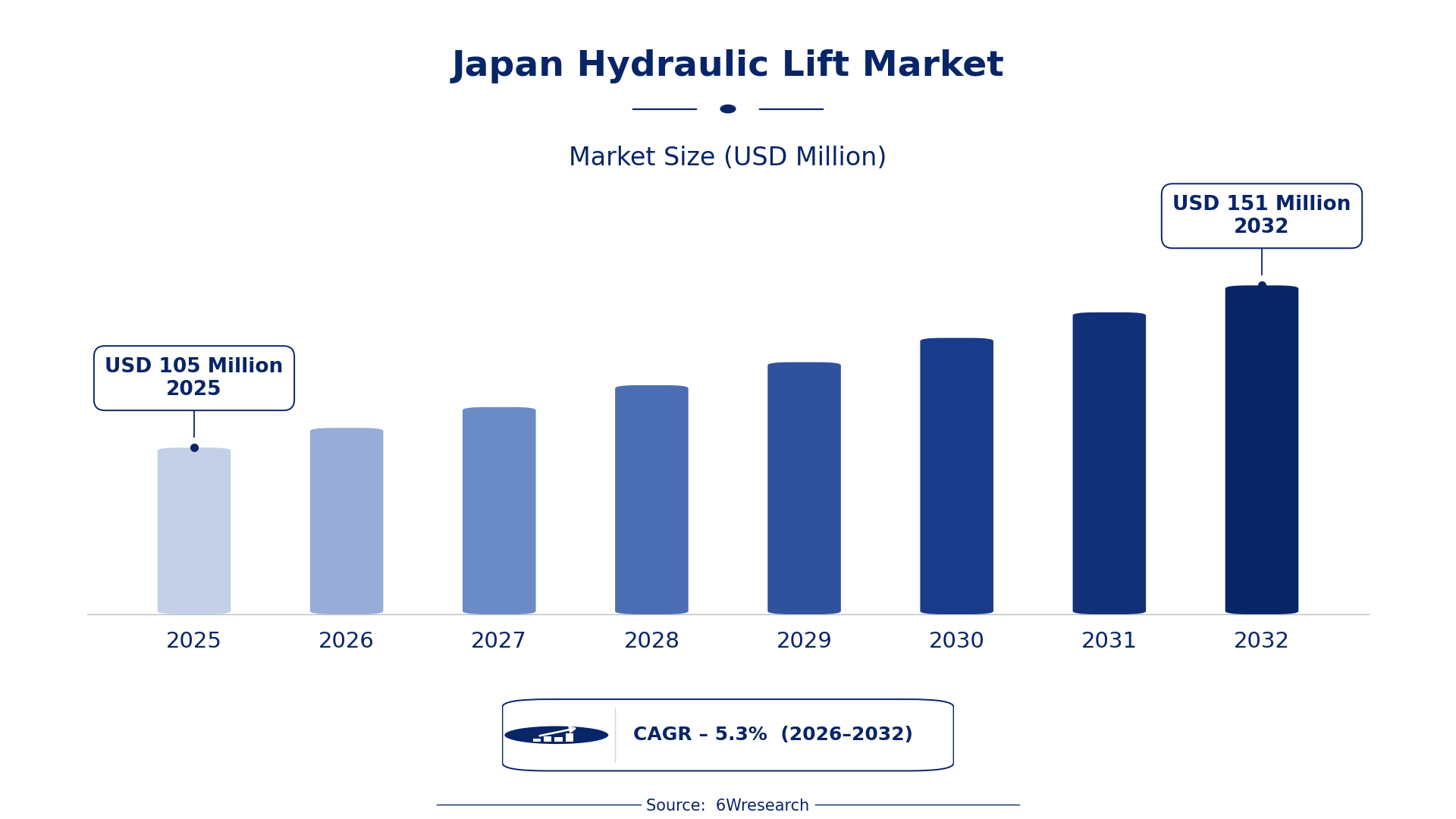
According to 6Wresearch internal database and industry insights, the Japan Hydraulic Lift Market was valued at USD 105 Million in 2025 and is projected to reach USD 151 Million by 2032, growing at a CAGR of approximately 5.3% during 2026–2032.
Japan Hydraulic Lift Market Highlights
| Report Metric | Details |
| Report Name | Japan Hydraulic Lift Market (2026-2032) |
| Market Size 2025 | USD 105 Million |
| Market Size 2032 | USD 151 Million |
| Absolute Growth 2025–2032 | USD 46 Million |
| CAGR 2026–2032 | 5.3% |
| Peak Annual Growth | 7.0% in 2026 |
| Forecast Period | 2026–2032 |
| Historical Data | 2022–2025 |
| Base Year | 2025 |
| Leading Lift Type, 2025 | Scissor Lifts (49% share) |
| Leading Power Source, 2025 | Electric-Hydraulic (50% share) |
| Leading Distribution Channel, 2025 | Industrial Suppliers (37% share) |
| Leading End User, 2025 | Automotive Garages (44% share) |
| Fastest-Growing Power Source | Hydraulic Pump (7.2% CAGR) |
| Fastest-Growing Distribution Channel | OEM Equipment Dealers (6.6% CAGR) |
| Fastest-Growing End User | Logistics Centers (6.5% CAGR) |
| Growing Sector | automotive |
| Key End Users | automotive garages, manufacturing plants, logistics centers, vehicle service shops |
Japan Hydraulic Lift Market Year-wise Growth Rate and Key Drivers (2022–2032)
This graph illustrates the annual growth rates of the market from 2022 to 2032, highlighting a steady upward trajectory and projected market expansion over the forecast period.
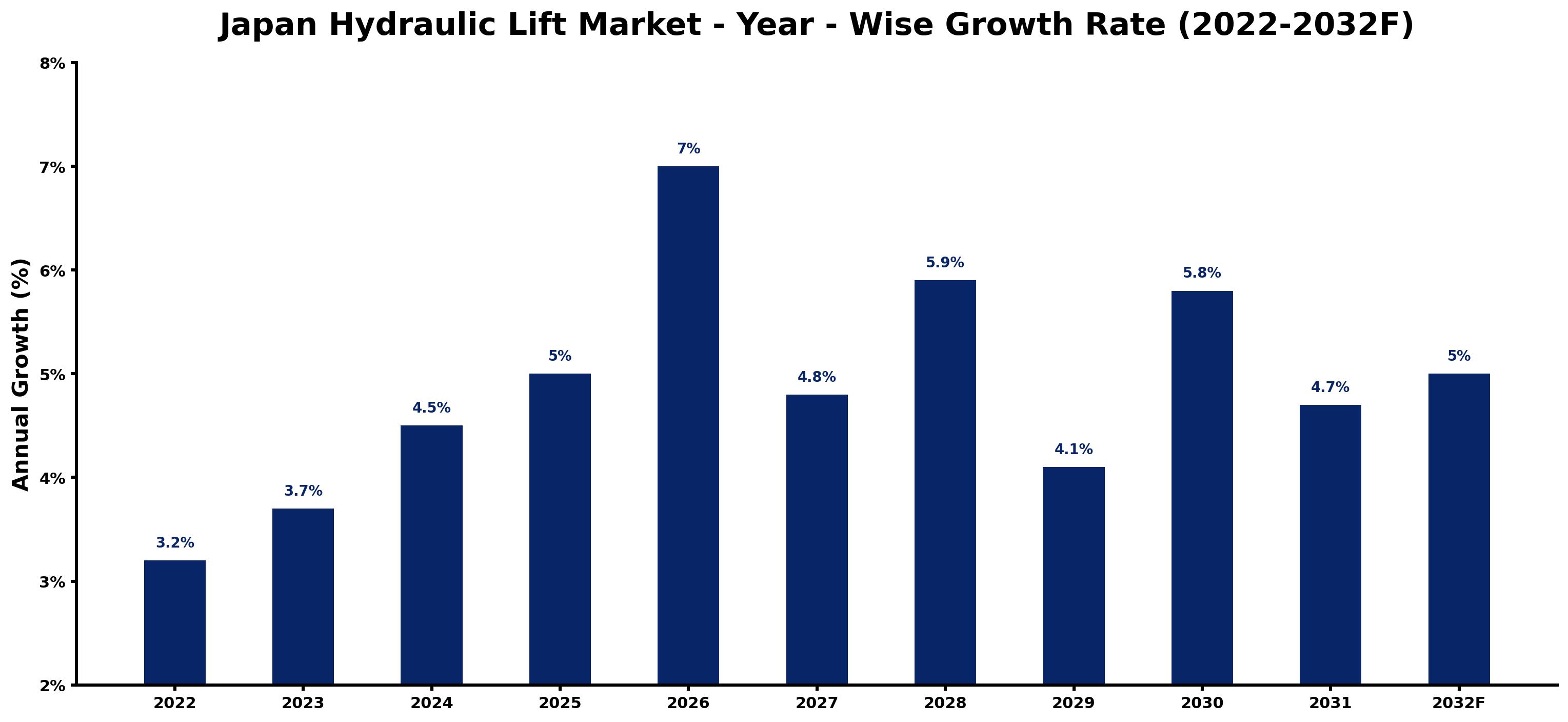
The yearly estimates that follow link every growth rate to its principal driver, so readers can see why the pace changed in each period.
| Year | Estimated Annual Growth (%) | Market Rationale |
| 2022 | 3.2 | The market experienced steady demand from automotive garages and manufacturing plants. |
| 2023 | 3.7 | Growth was driven by increased installations in logistics centers and automotive service facilities. |
| 2024 | 4.5 | Demand continued to rise due to ongoing modernization in the automotive sector. |
| 2025 | 5.0 | The market reached a peak growth rate, reflecting strong investments in hydraulic lift technology. |
| 2026 | 7.0 | A surge in new installations is anticipated, particularly in urban vehicle service shops. |
| 2027 | 4.8 | Growth is projected to slow slightly as the market adjusts to previous high demand levels. |
| 2028 | 5.9 | Increased construction activities will contribute to a rebound in hydraulic lift installations. |
| 2029 | 4.1 | The market is expected to see another slowdown as demand stabilises after rapid growth. |
| 2030 | 5.8 | A resurgence in automotive production will boost hydraulic lift demand across sectors. |
| 2031 | 4.7 | The market is projected to continue growing, albeit at a slower pace, as installations normalise. |
| 2032 | 5.0 | Demand is expected to remain stable, supported by ongoing investments in logistics. |
Note: Market size estimations and growth projections presented in this report are based on 6Wresearch's proprietary forecasting methodology, utilizing the latest available industry data, government publications, and primary research inputs.
Japan Hydraulic Lift Market Synopsis
Hydraulic lifts are mechanical devices that utilise hydraulic power for raising and lowering loads, predominantly made from steel. They serve vital roles in automotive garages, manufacturing, and logistics centers. The Japan Hydraulic Lift Market is expanding, driven by the automotive sector's $100 billion value and the increasing demand for efficient material handling in manufacturing. The Tokyo region accounts for 30% of the demand, while new subsidy programs for lift modernization are anticipated to further boost installations.
Market Dynamics Impact Analysis (2026–2032)
| Factor | Type | Impact | Primary Segment Affected |
| Growing automotive sector | Driver | High | Automotive Garages |
| Increased construction activity | Driver | High | Scissor Lifts |
| Modernization initiatives | Opportunity | High | Vehicle Service Shops |
| Rising demand for efficient logistics | Opportunity | High | Logistics Centers |
| High installation costs | Restraint | Medium | Four-Post Lifts |
| Limited awareness of safety standards | Restraint | Medium | Electric-Hydraulic |
| Competition from alternative lifting solutions | Challenge | High | In-Ground Lifts |
| Supply chain disruptions affecting components | Challenge | High | Hydraulic Pump |
Evaluation of Drivers in Japan Hydraulic Lift Market (2026–2032)
The main growth drivers and the segments they affect most are set out below.
| Drivers | Primary Segment Affected | Why It Matters (Evidence) |
| Increased automotive production | Automotive Garages | The automotive industry, valued at $100 billion, drives demand for hydraulic lifts in service and maintenance. |
| Growing construction projects | Scissor Lifts | Construction activities are boosting demand for efficient lifting solutions, with over 200,000 lifts installed in 2022. |
| Modernization of logistics operations | Logistics Centers | Logistics centers utilise hydraulic lifts extensively, improving loading and unloading processes across the sector, with over 5,000 centers nationwide. |
| Preference for electric-hydraulic systems | Electric-Hydraulic | Electric-hydraulic lifts account for 70% of new installations due to their efficiency and ease of use. |
| Safety regulations and standards | Four-Post Lifts | Compliance with JIS B 8362 standards encourages upgrades and installations of safer hydraulic lifts. |
Volumes grow on the back of increased automotive production, with the industry valued at $100 billion driving demand for hydraulic lifts in garages. Growing construction projects contribute to the rising popularity of scissor lifts, with over 200,000 installations in 2022. The modernization of logistics operations is clear, as logistics centers increasingly utilise hydraulic lifts, improving loading and unloading processes across the sector. The preference for electric-hydraulic systems is evident, as they represent 70% of new installations, reflecting their efficiency. Compliance with safety standards is prompting upgrades, further boosting demand for four-post lifts.
Evaluation of Restraints in Japan Hydraulic Lift Market
These restraints slow adoption and weigh on supplier margins.
| Market Restraint | Primary Segment Affected | Why It Matters (Evidence) |
| High installation costs | Four-Post Lifts | The average cost of hydraulic lifts ranges from $5,000 to $15,000, limiting some buyers. |
| Limited awareness of safety standards | Electric-Hydraulic | Many buyers are unaware of JIS B 8362, affecting their purchasing decisions. |
| Emerging technologies present alternatives | In-Ground Lifts | New lifting technologies are impacting demand for traditional hydraulic lifts, with modern options gaining traction. |
| Supply chain disruptions affecting components | Hydraulic Pump | Disruptions in the supply chain for hydraulic components delay installations and repairs. |
| Market saturation in urban areas | Scissor Lifts | High competition in urban regions leads to slower growth in new installations. |
Japan Hydraulic Lift Market Challenges
Slow technology adoption hampers efficiency in lift operations. Many manufacturers in Japan still rely on outdated systems, which can delay installations by up to three months for buyers. Intense competition from alternative lifting solutions pressures margins, forcing suppliers to lower prices and impacting profitability. Supply chain disruptions, particularly in sourcing hydraulic components, can extend lead times, affecting production schedules for manufacturers. Rising raw material costs, averaging 15% increases annually, strain budgets for logistics centres that depend on hydraulic lifts for daily operations.
Trends in the Japan Hydraulic Lift Market
Below are the shifts with the largest effect on the Japan Hydraulic Lift Market.
- Shift towards Electric-Hydraulic Systems: The preference for electric-hydraulic lifts is increasing due to their efficiency, with 70% of new installations opting for this type. This trend reflects the industry's move towards more sustainable and cost-effective solutions.
- Increased Use of Scissor Lifts in Construction: Scissor lifts are becoming more common in construction projects, with their versatility meeting diverse lifting needs. In 2023, their usage rose significantly, driven by ongoing construction activities, with installations exceeding 200,000 lifts.
- Growing Demand for Safety Compliance: The Japan Lift Association's promotion of safety standards is influencing market practices. As a result, more buyers are prioritising compliance with safety regulations, enhancing overall operational safety in over 5,000 logistics centres.
- Expansion of Logistics Centers: The number of logistics centres utilising hydraulic lifts is increasing, with significant growth driven by the need for efficient loading and unloading processes, with over 5,000 centres nationwide.
Investment Opportunities in the Japan Hydraulic Lift Market
Below are the investment opportunities with the strongest case in the Japan Hydraulic Lift Market.
- Partnerships with OEM Equipment Dealers: Forming partnerships with OEM equipment dealers can facilitate access to hydraulic lift technologies, particularly in urban areas where demand is high, with the market valued at $105 million.
- Investment in Modernization Programs: The recent subsidy program for lift modernisation presents an opportunity to invest in upgrading existing equipment, particularly in automotive garages, improving operational efficiency and safety compliance.
- Expansion into Logistics Centers: The increasing number of logistics centres creates a demand for hydraulic lifts. Investing in tailored solutions for these facilities can capture significant market share, with over 5,000 centres requiring efficient systems.
- Focus on Safety Compliance Solutions: As safety regulations become more stringent, providing compliance solutions can meet the needs of buyers looking to adhere to JIS B 8362 standards, ensuring safer operations.
Government Initiatives in the Japan Hydraulic Lift Market
The Building Energy Efficiency Act, amended in 2022, mandates that new buildings comply with energy-efficient designs from April 2025. This law impacts hydraulic lift producers by necessitating adherence to these standards, influencing lift specifications and installations. The act aims to reduce energy consumption in new constructions by 20% by 2030, affecting the design and operation of hydraulic lifts.
The Ministry of Economy, Trade and Industry oversees safety regulations for hydraulic lifts, promoting compliance through various initiatives. It funds safety inspections and certifications, ensuring that producers meet necessary standards for market entry, with a target of approving 1,000 inspections annually.
Future Insight of the Japan Hydraulic Lift Market
Manufacturers and logistics centres will increasingly modernise their lift systems by 2032, influenced by new safety regulations and subsidy programmes. The shift towards electric-hydraulic lifts will dominate new installations, reflecting a preference for energy-efficient solutions. By 2032, 200,000 hydraulic lifts are projected to be installed, indicating strong demand from the automotive sector and logistics expansion. New safety standards will further elevate market expectations, ensuring that buyers seek reliable and efficient lifting solutions.
Market Segmentation Analysis
Japan Hydraulic Lift Market report covers a detailed analysis of the following market segments:
By Lift Type – Scissor Lifts Lead and Record the Fastest Growth
According to Saurav Kr Singh, Senior Research Analyst at 6Wresearch, Scissor Lifts accounted for 49% of the market by lift type in 2025. Scissor lifts dominate the market due to their vital function in construction, effectively lifting both personnel and materials. Their widespread use in various construction projects across Japan highlights their significance in the hydraulic lift sector. Its lead should widen, with a projected CAGR of 7.1% during 2026–2032, the highest in this split. The rapid growth of scissor lifts is attributed to a boom in construction activities, where their efficiency and safety features are increasingly recognised. As construction demand continues to rise, scissor lifts will remain a preferred choice for lifting solutions. Suppliers should ensure a robust supply of scissor lifts to meet the increasing demands of the construction industry.
By Power Source – Electric-Hydraulic Leads, Hydraulic Pump Expected to Grow Fastest
Electric-Hydraulic held 50% of the Japan Hydraulic Lift Market by power source in 2025. Electric-hydraulic systems hold the largest share due to their efficiency and ease of operation, making them the preferred choice for many installations. This preference is reflected in the high percentage of new installations utilising electric-hydraulic lifts, indicating strong user confidence. Hydraulic Pump is projected to grow fastest, at a CAGR of 7.2% during 2026–2032. The hydraulic pump segment is experiencing rapid growth as it is an essential component for the operation of hydraulic lifts, particularly in heavy-duty applications. As industries increasingly rely on advanced hydraulic systems, the demand for high-performance hydraulic pumps is set to rise. Buyers should consider investing in advanced hydraulic pump technologies to ensure optimal lift performance.
By Distribution Channel – Industrial Suppliers Lead, OEM Equipment Dealers Expected to Grow Fastest
The largest distribution channel category in 2025 was Industrial Suppliers, at 37% of revenue. Industrial suppliers lead the distribution channel as they are the main source for hydraulic lift components, providing a wide array of essential products for diverse applications. Their established reputation and extensive networks make them a reliable option for customers seeking quality hydraulic lift solutions. OEM Equipment Dealers are set to record the highest CAGR in this split, 6.6% over 2026–2032. OEM equipment dealers are witnessing rapid growth as they incorporate hydraulic lifts into larger equipment packages, catering to a variety of sectors. This trend is driven by the rising demand for integrated machinery solutions that include hydraulic lifts, enhancing their market visibility. Suppliers must enhance partnerships with OEM dealers to expand their market presence and reach a broader customer base.
By End User – Automotive Garages Lead, Logistics Centers Expected to Grow Fastest
In 2025, Automotive Garages led the end user split with a 44% share. Automotive garages represent the largest user group of hydraulic lifts, relying on them extensively for vehicle maintenance and repair operations. With over 1,500 garages in Japan, their ongoing need for hydraulic lifts solidifies their leading position in the market. The quickest growth will come from Logistics Centers, forecast to expand at a CAGR of 6.5% between 2026 and 2032. Logistics centers are increasingly utilising hydraulic lifts to improve efficiency in loading and unloading processes, reflecting a growing trend towards automation in the logistics field. As the logistics industry expands, the demand for hydraulic lifts in these centres is expected to increase significantly. Suppliers should target logistics centres as a key emerging segment for hydraulic lift solutions.
Key Attractiveness of the Report
- 10 Years of Market Numbers
- Historical Data Starting from 2022 to 2025
- Base Year 2025
- Forecast Data until 2032
- Key Performance Indicators Impacting the Market
- Major Upcoming Developments and Projects
Key Highlights of the Report:
- Japan Hydraulic Lift Market Outlook
- Market Size of Japan Hydraulic Lift Market, 2025
- Forecast of Japan Hydraulic Lift Market, 2032
- Historical Data and Forecast of Japan Hydraulic Lift Revenues & Volume for the Period 2022-2032F
- Japan Hydraulic Lift Market Trend Evolution
- Japan Hydraulic Lift Market Drivers and Challenges
- Japan Hydraulic Lift Price Trends
- Japan Hydraulic Lift Porter's Five Forces
- Japan Hydraulic Lift Industry Life Cycle
- Historical Data and Forecast of Japan Hydraulic Lift Market Revenues & Volume By Lift Type for the Period 2022-2032F
- Historical Data and Forecast of Japan Hydraulic Lift Market Revenues & Volume By Scissor Lifts for the Period 2022-2032F
- Historical Data and Forecast of Japan Hydraulic Lift Market Revenues & Volume By Two-Post Lifts for the Period 2022-2032F
- Historical Data and Forecast of Japan Hydraulic Lift Market Revenues & Volume By Four-Post Lifts for the Period 2022-2032F
- Historical Data and Forecast of Japan Hydraulic Lift Market Revenues & Volume By In-Ground Lifts for the Period 2022-2032F
- Historical Data and Forecast of Japan Hydraulic Lift Market Revenues & Volume By Power Source for the Period 2022-2032F
- Historical Data and Forecast of Japan Hydraulic Lift Market Revenues & Volume By Electric-Hydraulic for the Period 2022-2032F
- Historical Data and Forecast of Japan Hydraulic Lift Market Revenues & Volume By Hydraulic Pump for the Period 2022-2032F
- Historical Data and Forecast of Japan Hydraulic Lift Market Revenues & Volume By High-Capacity Pump for the Period 2022-2032F
- Historical Data and Forecast of Japan Hydraulic Lift Market Revenues & Volume By Compact Hydraulic for the Period 2022-2032F
- Historical Data and Forecast of Japan Hydraulic Lift Market Revenues & Volume By Distribution Channel for the Period 2022-2032F
- Historical Data and Forecast of Japan Hydraulic Lift Market Revenues & Volume By Industrial Suppliers for the Period 2022-2032F
- Historical Data and Forecast of Japan Hydraulic Lift Market Revenues & Volume By OEM Equipment Dealers for the Period 2022-2032F
- Historical Data and Forecast of Japan Hydraulic Lift Market Revenues & Volume By Online B2B Platforms for the Period 2022-2032F
- Historical Data and Forecast of Japan Hydraulic Lift Market Revenues & Volume By Construction Suppliers for the Period 2022-2032F
- Historical Data and Forecast of Japan Hydraulic Lift Market Revenues & Volume By End User for the Period 2022-2032F
- Historical Data and Forecast of Japan Hydraulic Lift Market Revenues & Volume By Manufacturing Plants for the Period 2022-2032F
- Historical Data and Forecast of Japan Hydraulic Lift Market Revenues & Volume By Automotive Garages for the Period 2022-2032F
- Historical Data and Forecast of Japan Hydraulic Lift Market Revenues & Volume By Logistics Centers for the Period 2022-2032F
- Historical Data and Forecast of Japan Hydraulic Lift Market Revenues & Volume By Vehicle Service Shops for the Period 2022-2032F
- Japan Hydraulic Lift Import Export Trade Statistics
- Market Opportunity Assessment By Lift Type
- Market Opportunity Assessment By Power Source
- Market Opportunity Assessment By Distribution Channel
- Market Opportunity Assessment By End User
- Japan Hydraulic Lift Top Companies Market Share
- Japan Hydraulic Lift Competitive Benchmarking By Technical and Operational Parameters
- Japan Hydraulic Lift Company Profiles
- Japan Hydraulic Lift Key Strategic Recommendations
Market Covered
The study includes the following segmentation.
By Lift Type
- Scissor Lifts
- Two-Post Lifts
- Four-Post Lifts
- In-Ground Lifts
By Power Source
- Electric-Hydraulic
- Hydraulic Pump
- High-Capacity Pump
- Compact Hydraulic
By Distribution Channel
- Industrial Suppliers
- OEM Equipment Dealers
- Online B2B Platforms
- Construction Suppliers
By End User
- Manufacturing Plants
- Automotive Garages
- Logistics Centers
- Vehicle Service Shops































