Japan Hydrophobic and Superhydrophobic Materials Market Size & Growth Rate
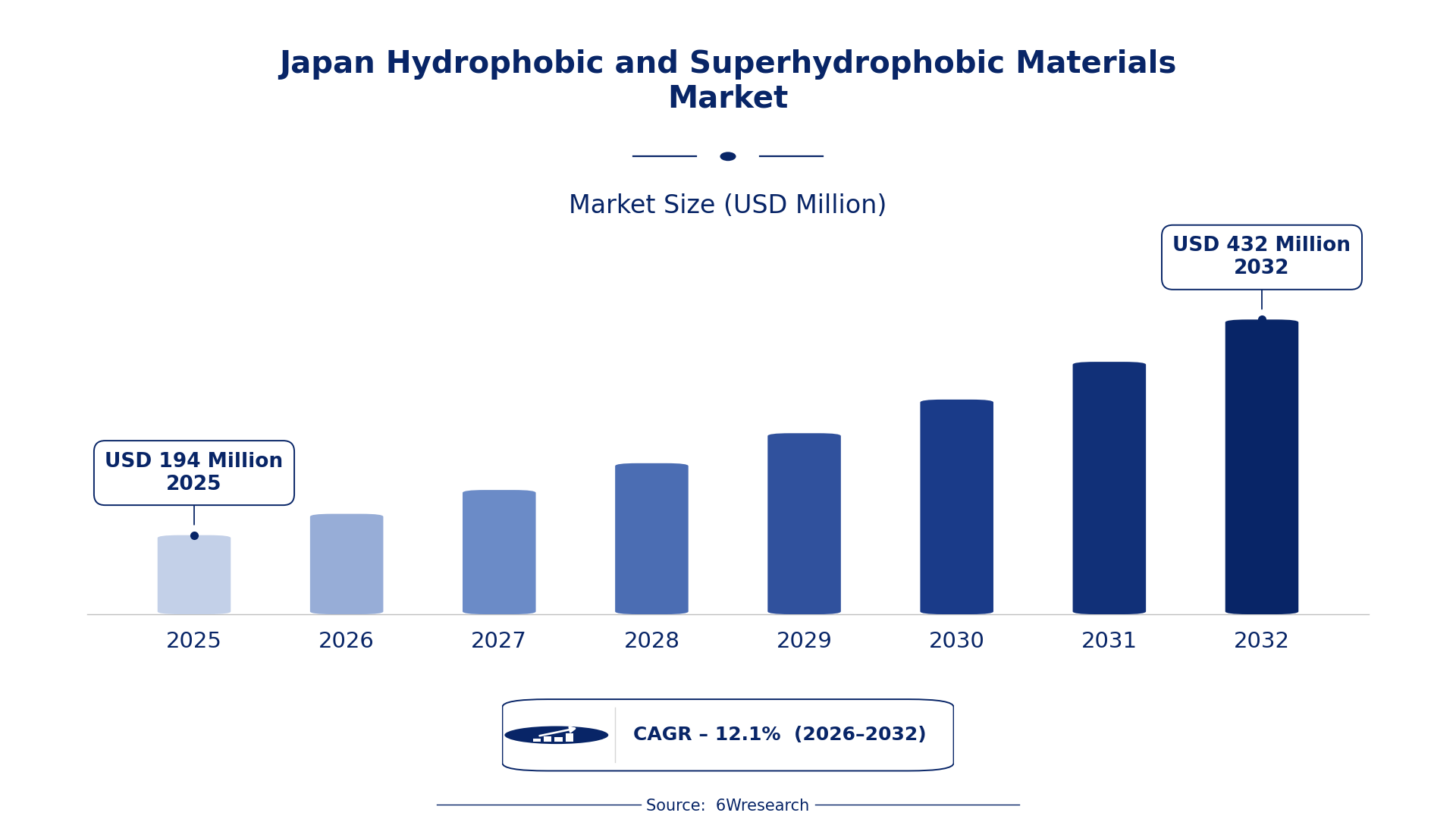
According to 6Wresearch internal database and industry insights, the Japan Hydrophobic and Superhydrophobic Materials Market was valued at USD 194 Million in 2025 and is projected to reach USD 432 Million by 2032, growing at a CAGR of approximately 12.1% during 2026–2032.
Japan Hydrophobic and Superhydrophobic Materials Market Highlights
| Report Metric | Details |
| Report Name | Japan Hydrophobic and Superhydrophobic Materials Market (2026-2032) |
| Market Size 2025 | USD 194 Million |
| Market Size 2032 | USD 432 Million |
| Absolute Growth 2025–2032 | USD 238 Million |
| CAGR 2026–2032 | 12.1% |
| Peak Annual Growth | 13.7% in 2027 |
| Forecast Period | 2026–2032 |
| Historical Data | 2022–2025 |
| Base Year | 2025 |
| Leading Product, 2025 | Anti-corrosion (49% share) |
| Leading End user, 2025 | Steel & Metal (49% share) |
| Fastest-Growing Product | Anti-wetting (16.3% CAGR) |
| Fastest-Growing End user | Building & Construction (15.9% CAGR) |
| Growing Sector | Building & Construction |
| Key End Users | Steel & Metal, Building & Construction, Automotive, Textile & Fabric |
Japan Hydrophobic and Superhydrophobic Materials Market Year-wise Growth Rate and Key Drivers (2022–2032)
This graph illustrates the annual growth rates of the market from 2022 to 2032, highlighting a steady upward trajectory and projected market expansion over the forecast period.
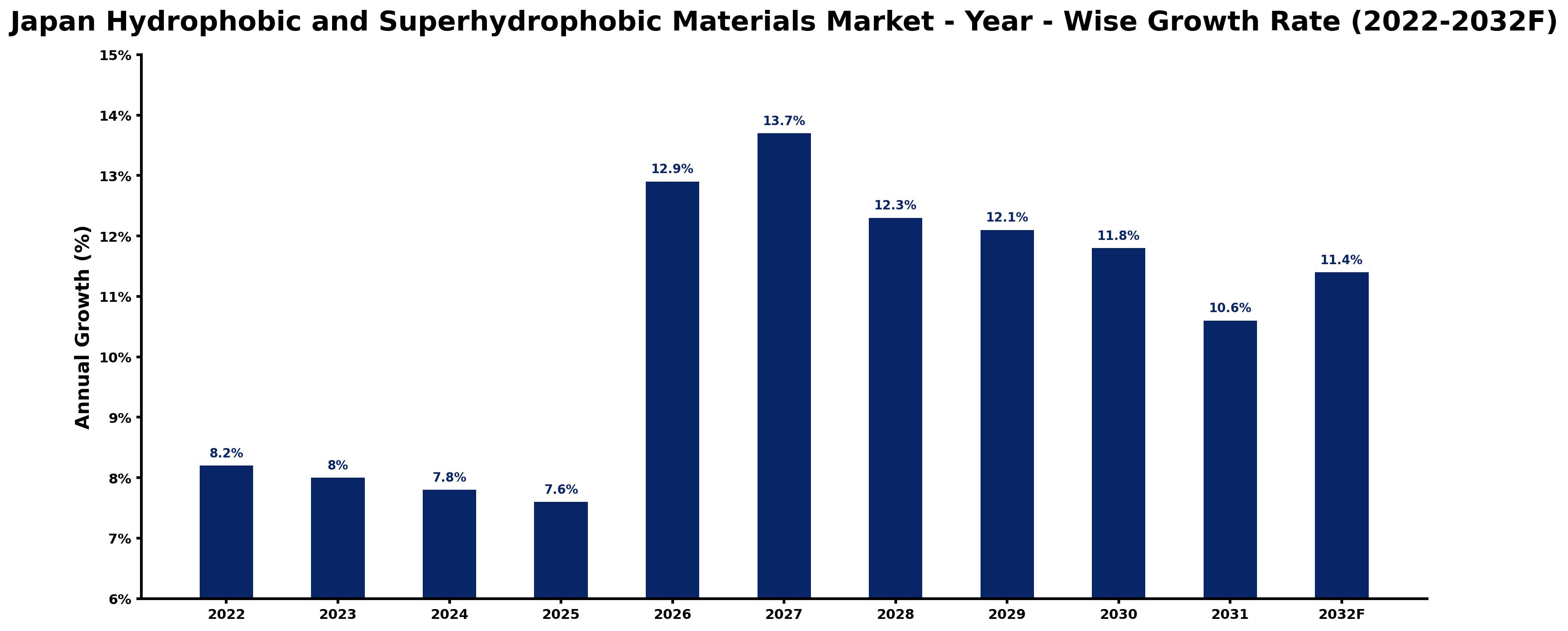
The following figures match every annual growth estimate with the main market development of that year, giving the reasoning behind each rise or slowdown.
| Year | Estimated Annual Growth (%) | Market Rationale |
| 2022 | 8.2 | The market exhibited strong growth, driven by rising applications in anti-corrosion coatings. |
| 2023 | 8.0 | Growth slowed slightly due to market saturation in some segments, yet demand remained steady. |
| 2024 | 7.8 | The market continued to experience a slowdown as competition intensified among suppliers. |
| 2025 | 7.6 | Demand growth slowed further as some end-user industries faced challenges in scaling operations. |
| 2026 | 12.9 | Growth is expected to accelerate as investments in sustainable materials gain traction across industries. |
| 2027 | 13.7 | The market is projected to peak due to heightened demand for anti-corrosion solutions in the steel sector. |
| 2028 | 12.3 | Growth is anticipated to slow as the market begins to stabilise after the previous peak in demand. |
| 2029 | 12.1 | A slight slowdown is expected as the market adjusts to new supply chain conditions. |
| 2030 | 11.8 | Demand growth will continue to slow as market maturity sets in across several applications. |
| 2031 | 10.6 | The market is projected to experience further deceleration as competition increases among existing players. |
| 2032 | 11.4 | Growth is expected to pick up again as new applications for hydrophobic materials emerge. |
Note: Market size estimations and growth projections presented in this report are based on 6Wresearch's proprietary forecasting methodology, utilizing the latest available industry data, government publications, and primary research inputs.
Japan Hydrophobic and Superhydrophobic Materials Market Synopsis
Hydrophobic and superhydrophobic materials are advanced coatings that repel water and other liquids, produced through chemical processes that create micro- and nano-scale textures. The ongoing push for sustainable materials and substantial investments in urban infrastructure projects further fuel market expansion.
Market Dynamics Impact Analysis (2026–2032)
| Factor | Type | Impact | Primary Segment Affected |
| Increasing demand for anti-corrosion solutions in the steel sector | Driver | High | Anti-corrosion |
| Growing adoption of self-cleaning surfaces in urban infrastructure | Driver | High | Self-cleaning |
| Rising demand for anti-wetting materials in electronics manufacturing | Opportunity | High | Anti-wetting |
| Expansion of the building and construction sector in urban areas | Opportunity | High | Building & Construction |
| Regulatory compliance costs for chemical substances | Restraint | Medium | Anti-corrosion |
| Market saturation in certain applications limiting growth potential | Restraint | Medium | Self-cleaning |
| Intense competition among suppliers affecting pricing strategies | Challenge | High | Anti-wetting |
| Dependence on specific industries for demand stability | Challenge | Medium | Steel & Metal |
Evaluation of Drivers in Japan Hydrophobic and Superhydrophobic Materials Market (2026–2032)
The main growth drivers and the segments they affect most are set out below.
| Drivers | Primary Segment Affected | Why It Matters (Evidence) |
| Increasing demand for anti-corrosion solutions | Anti-corrosion | This demand is driven by the need to protect metal surfaces, with the anti-corrosion coatings market valued at 150 billion JPY in 2023, prompting manufacturers to invest in hydrophobic materials. |
| Growth in urban infrastructure projects | Self-cleaning | The adoption of self-cleaning materials is rising in urban areas, particularly in the Tokyo metropolitan region, where maintenance efficiency is crucial, leading to increased purchases. |
| Expansion of electronics manufacturing | Anti-wetting | The anti-wetting market is growing due to rising applications in electronics, reflecting a shift in buyer preferences towards hydrophobic materials that prevent liquid adhesion. |
| Sustainability initiatives in construction | Building & Construction | Investments in sustainable building practices are driving the adoption of hydrophobic coatings, as seen in the Green Building Initiative, which encourages the use of eco-friendly materials. |
| Technological advancements in coating applications | Anti-icing | Innovations in anti-icing technologies are being explored for specific applications, enhancing the functionality of hydrophobic materials in cold climates. |
The strongest pull on demand comes from the steel and metal industry, which accounted for 49% of the market share in 2025. The ongoing push for anti-corrosion solutions is clear as Japan's anti-corrosion coatings market reached 150 billion JPY in 2023. Urban infrastructure projects are increasingly utilising self-cleaning materials, promoting easier maintenance and improving aesthetic appeal. The anti-wetting market is expanding due to rising applications in electronics manufacturing, reflecting a shift in buyer preferences. Investments in sustainable building practices are driving the adoption of hydrophobic coatings, further stimulating demand in the construction sector.
Evaluation of Restraints in Japan Hydrophobic and Superhydrophobic Materials Market
These are the pressures that could keep growth below its potential.
| Market Restraint | Primary Segment Affected | Why It Matters (Evidence) |
| Regulatory compliance costs for chemical substances | Anti-corrosion | The PRTR Law requires businesses to report chemical releases, increasing operational costs for manufacturers. |
| Market saturation in certain applications limiting growth potential | Self-cleaning | As self-cleaning materials gain popularity, competition intensifies, resulting in price pressures and reduced margins. |
| Dependence on specific industries for demand stability | Steel & Metal | Fluctuations in the steel sector can impact demand for hydrophobic materials, creating uncertainty. |
| High production costs associated with advanced coatings | Anti-wetting | The Chemical Substances Control Law imposes strict regulations, raising production costs for manufacturers. |
| Limited awareness of hydrophobic materials in niche markets | Others | Niche applications struggle to gain traction, resulting in low overall demand for hydrophobic coatings. |
Japan Hydrophobic and Superhydrophobic Materials Market Challenges
Competition from lower-priced alternatives limits market potential for producers, as many find it difficult to maintain premium pricing for cost-conscious buyers. Supply chain disruptions, particularly from natural disasters, can delay raw material availability for producers, resulting in extended lead times that impact construction firms. Inconsistent quality from suppliers creates challenges for textile buyers, leading to increased rework costs that can reach up to 20% of project budgets. Rising production costs, driven by stringent environmental regulations, inflate expenses for end users, making hydrophobic coatings less attractive compared to traditional options.
Trends in the Japan Hydrophobic and Superhydrophobic Materials Market
The following changes are redrawing the Japan Hydrophobic and Superhydrophobic Materials Market.
- Shift towards Sustainable Building Practices: The construction sector is prioritising sustainable materials, with public and private investments targeting 150 trillion JPY over ten years. This trend opens new opportunities for suppliers of hydrophobic coatings.
- Growing Adoption of Self-Cleaning Technologies: Urban infrastructure projects are increasingly utilising self-cleaning materials for maintenance efficiency. In Osaka, these materials are becoming standard, reflecting a shift in buyer preferences towards low-maintenance solutions.
- Transition from Traditional to Advanced Coatings: The market is transitioning from conventional coatings to advanced hydrophobic materials, driven by technological innovations. ISO 10665 is now a standard for testing these materials, ensuring quality and safety.
- Emergence of Anti-Wetting Solutions in Electronics: The electronics manufacturing sector is increasingly adopting anti-wetting materials, improving product durability. This trend is expected to grow significantly, driven by demand for high-performance components.
Investment Opportunities in the Japan Hydrophobic and Superhydrophobic Materials Market
Below are the investment opportunities with the strongest case in the Japan Hydrophobic and Superhydrophobic Materials Market.
- Investment in Anti-Corrosion Solutions: With Japan's anti-corrosion coatings market valued at 150 billion JPY, there is a gap for suppliers to invest in innovative solutions. Steel manufacturers are seeking advanced coatings to enhance product durability.
- Expansion in Self-Cleaning Materials: Urban infrastructure projects in cities like Osaka present opportunities for suppliers of self-cleaning materials. Collaborating with local construction firms can facilitate market entry and growth.
- Growth in Electronics Manufacturing: The increasing need for anti-wetting materials in electronics manufacturing creates a gap for suppliers. Establishing partnerships with electronics producers can help capture this emerging market.
- Focus on Sustainable Building Practices: The ongoing push for sustainable materials in construction offers opportunities for suppliers of hydrophobic coatings. Engaging with builders and developers can enhance market presence.
Government Initiatives in the Japan Hydrophobic and Superhydrophobic Materials Market
The Chemical Substances Control Law (1973) requires manufacturers to evaluate and control chemical substances, ensuring safety and compliance in hydrophobic material production. This law affects producers by mandating rigorous testing and reporting, which can increase operational costs but enhances product safety for buyers.
The Advanced Coating Technology Program, launched in 2022 with a budget of JPY 10 billion, aims to promote innovation in coating technologies. Managed by the Ministry of Economy, Trade and Industry, this program supports research and development, benefiting both producers and buyers by facilitating access to advanced hydrophobic materials.
Future Insight of the Japan Hydrophobic and Superhydrophobic Materials Market
The Advanced Coating Technology Program will promote the adoption of hydrophobic materials in urban infrastructure projects by 2032, improving maintenance efficiency. The textile industry will see a surge in anti-wetting applications as demand in electronics manufacturing grows. By 2030, public and private investments of JPY 150 trillion will support the shift towards sustainable coatings, aligning with Japan's greenhouse gas reduction targets. New testing standards, such as ISO 10665, will enhance quality assurance in hydrophobic material applications, benefiting both suppliers and end users.
Market Segmentation Analysis
Japan Hydrophobic and Superhydrophobic Materials Market report covers a detailed analysis of the following market segments:
By Product – Anti-corrosion Leads, Anti-wetting Expected to Grow Fastest
According to Ravi Bhandari, Research Head at 6Wresearch, Anti-corrosion accounted for 49% of the market by product in 2025. The anti-corrosion segment holds the largest share due to its essential role in protecting metal surfaces from rust and degradation, particularly within Japan's thriving steel and metal industry. The 150 billion JPY valuation of the anti-corrosion coatings market in 2023 highlights its critical importance. The quickest growth will come from Anti-wetting, forecast to expand at a CAGR of 16.3% between 2026 and 2032. The anti-wetting segment is experiencing rapid growth, driven by increasing demand in electronics manufacturing for surfaces that prevent liquid adhesion and staining. This growth is supported by advancements in technology and the complexity of modern electronic devices. Suppliers should focus on expanding their offerings in the anti-wetting segment to capitalise on the growing market opportunities.
By End user – Steel & Metal Leads, Building & Construction Expected to Grow Fastest
Steel & Metal took 49% of end user revenue in 2025, more than any other category. The steel and metal industry is the primary end user of hydrophobic materials, as these coatings are crucial for enhancing the durability and lifespan of products. This strong demand is a result of Japan's extensive industrial framework that heavily relies on these protective technologies. Building & Construction is projected to grow fastest, at a CAGR of 15.9% during 2026–2032. The building and construction sector is the fastest-growing end user, driven by the increasing use of protective coatings and aesthetic improvements in urban infrastructure projects. Urbanisation trends in areas like the Tokyo metropolitan region further fuel this demand. Buyers in the building and construction sector should prioritise the acquisition of hydrophobic materials to meet project requirements and sustainability goals.
Key Attractiveness of the Report
- 10 Years of Market Numbers
- Historical Data Starting from 2022 to 2025
- Base Year 2025
- Forecast Data until 2032
- Key Performance Indicators Impacting the Market
- Major Upcoming Developments and Projects
Key Highlights of the Report:
- Japan Hydrophobic and Superhydrophobic Materials Market Outlook
- Market Size of Japan Hydrophobic and Superhydrophobic Materials Market, 2025
- Forecast of Japan Hydrophobic and Superhydrophobic Materials Market, 2032
- Historical Data and Forecast of Japan Hydrophobic and Superhydrophobic Materials Revenues & Volume for the Period 2022-2032
- Japan Hydrophobic and Superhydrophobic Materials Market Trend Evolution
- Japan Hydrophobic and Superhydrophobic Materials Market Drivers and Challenges
- Japan Hydrophobic and Superhydrophobic Materials Price Trends
- Japan Hydrophobic and Superhydrophobic Materials Porter's Five Forces
- Japan Hydrophobic and Superhydrophobic Materials Industry Life Cycle
- Historical Data and Forecast of Japan Hydrophobic and Superhydrophobic Materials Market Revenues & Volume By Product for the Period 2022-2032
- Historical Data and Forecast of Japan Hydrophobic and Superhydrophobic Materials Market Revenues & Volume By Anti-corrosion for the Period 2022-2032
- Historical Data and Forecast of Japan Hydrophobic and Superhydrophobic Materials Market Revenues & Volume By Anti-wetting for the Period 2022-2032
- Historical Data and Forecast of Japan Hydrophobic and Superhydrophobic Materials Market Revenues & Volume By Anti-icing for the Period 2022-2032
- Historical Data and Forecast of Japan Hydrophobic and Superhydrophobic Materials Market Revenues & Volume By Self-cleaning for the Period 2022-2032
- Historical Data and Forecast of Japan Hydrophobic and Superhydrophobic Materials Market Revenues & Volume By End user for the Period 2022-2032
- Historical Data and Forecast of Japan Hydrophobic and Superhydrophobic Materials Market Revenues & Volume By Steel & Metal for the Period 2022-2032
- Historical Data and Forecast of Japan Hydrophobic and Superhydrophobic Materials Market Revenues & Volume By Building & Construction for the Period 2022-2032
- Historical Data and Forecast of Japan Hydrophobic and Superhydrophobic Materials Market Revenues & Volume By Automotive for the Period 2022-2032
- Historical Data and Forecast of Japan Hydrophobic and Superhydrophobic Materials Market Revenues & Volume By Textile & Fabric for the Period 2022-2032
- Historical Data and Forecast of Japan Hydrophobic and Superhydrophobic Materials Market Revenues & Volume By Others for the Period 2022-2032
- Japan Hydrophobic and Superhydrophobic Materials Import Export Trade Statistics
- Market Opportunity Assessment By Product
- Market Opportunity Assessment By End user
- Japan Hydrophobic and Superhydrophobic Materials Top Companies Market Share
- Japan Hydrophobic and Superhydrophobic Materials Competitive Benchmarking By Technical and Operational Parameters
- Japan Hydrophobic and Superhydrophobic Materials Company Profiles
- Japan Hydrophobic and Superhydrophobic Materials Key Strategic Recommendations
Market Covered
The study includes the following segmentation.
By Product
- Anti-corrosion
- Anti-wetting
- Anti-icing
- Self-cleaning
By End user
- Steel & Metal
- Building & Construction
- Automotive
- Textile & Fabric
- Others






































