Japan Hydroponics Nutrients Market Size & Growth Rate
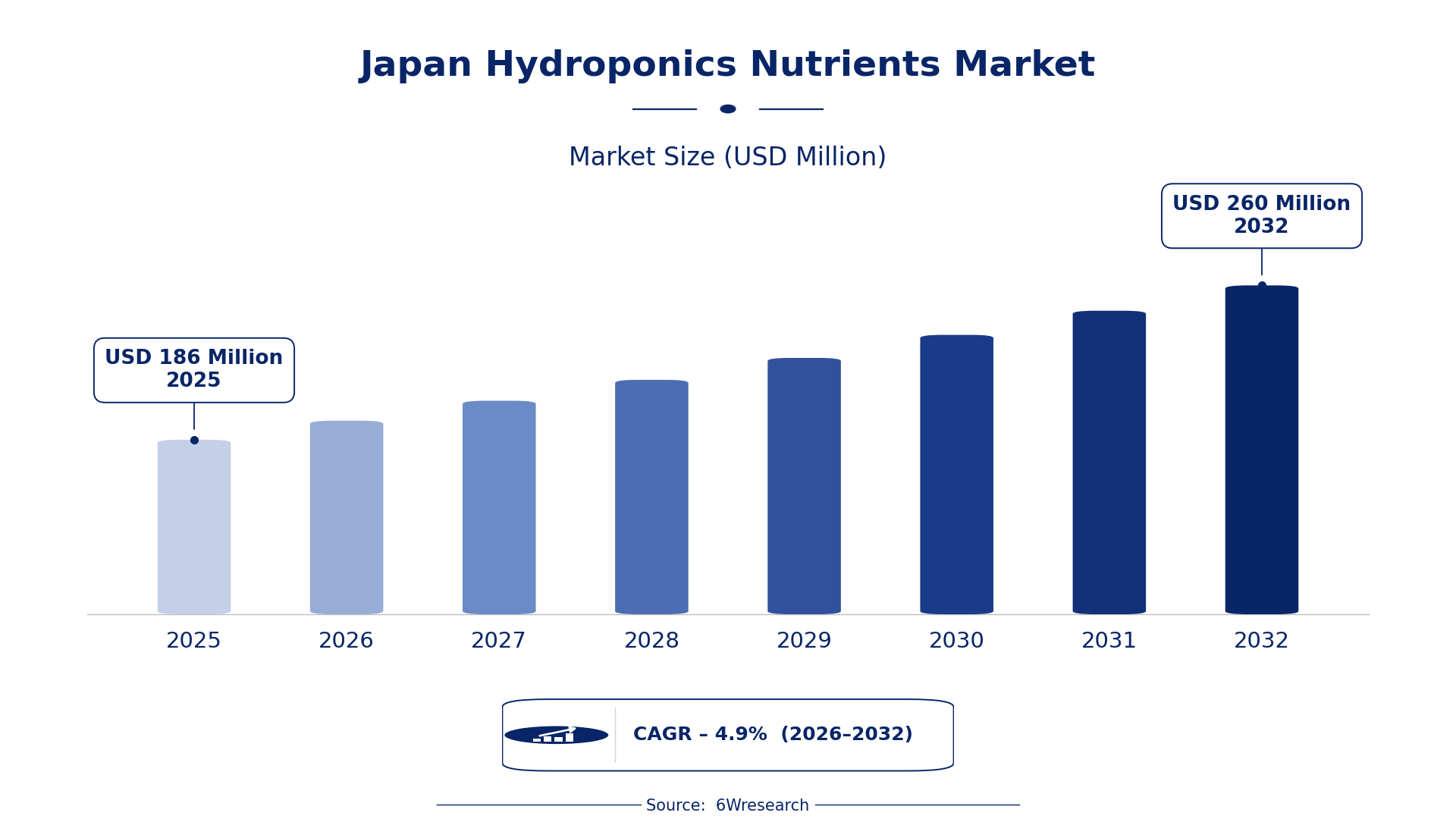
According to 6Wresearch internal database and industry insights, the Japan Hydroponics Nutrients Market was valued at USD 186 Million in 2025 and is projected to reach USD 260 Million by 2032, growing at a CAGR of approximately 4.9% during 2026–2032.
Japan Hydroponics Nutrients Market Highlights
| Report Metric | Details |
| Report Name | Japan Hydroponics Nutrients Market (2026-2032) |
| Market Size 2025 | USD 186 Million |
| Market Size 2032 | USD 260 Million |
| Absolute Growth 2025–2032 | USD 74 Million |
| CAGR 2026–2032 | 4.9% |
| Peak Annual Growth | 6.0% in 2030 |
| Forecast Period | 2026–2032 |
| Historical Data | 2022–2025 |
| Base Year | 2025 |
| Leading Product Type, 2025 | Liquid Nutrients (55% share) |
| Leading Nutrient Type, 2025 | Macro & Micro (43% share) |
| Leading Application Area, 2025 | Commercial Hydroponics (56% share) |
| Leading Distribution Channel, 2025 | Agro Retailers (45% share) |
| Leading End User, 2025 | Commercial Growers (46% share) |
| Fastest-Growing Product Type | Powder Nutrients (7.2% CAGR) |
| Fastest-Growing Nutrient Type | Mineral-Based (7.3% CAGR) |
| Fastest-Growing Application Area | Vertical Farming (6.2% CAGR) |
| Fastest-Growing Distribution Channel | Online Stores (6.5% CAGR) |
| Fastest-Growing End User | Urban Farmers (6.6% CAGR) |
| Growing Sector | Vertical Farming |
| Key End Users | Commercial Hydroponics, Vertical Farming, Greenhouses |
Japan Hydroponics Nutrients Market Year-wise Growth Rate and Key Drivers (2022–2032)
This graph illustrates the annual growth rates of the market from 2022 to 2032, highlighting a steady upward trajectory and projected market expansion over the forecast period.
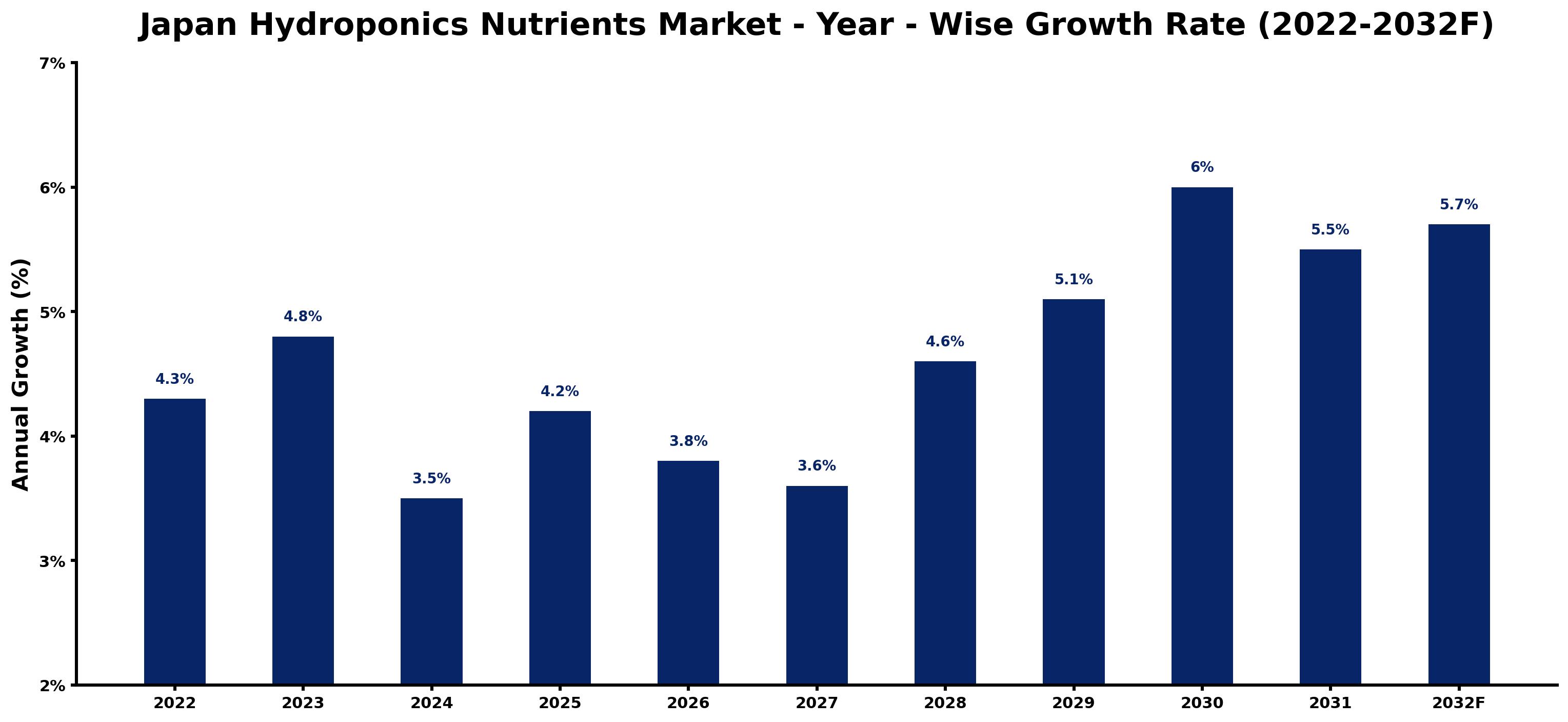
Below, each year's estimated growth is shown next to the factor that most influenced it.
| Year | Estimated Annual Growth (%) | Market Rationale |
| 2022 | 4.3 | The market experienced steady growth due to increasing interest in urban agriculture. |
| 2023 | 4.8 | Growth accelerated as urban farmers adopted hydroponics nutrients for better yields. |
| 2024 | 3.5 | A slowdown occurred as market expansion faced temporary challenges in supply chains. |
| 2025 | 4.2 | Growth rebounded as commercial growers increased their investments in hydroponics systems. |
| 2026 | 3.8 | Market growth is expected to decelerate as competition intensifies among suppliers. |
| 2027 | 3.6 | A continued slowdown is projected as the hydroponics sector matures. |
| 2028 | 4.6 | Growth is expected to pick up as vertical farming projects gain investment. |
| 2029 | 5.1 | Demand will surge as urban farmers seek efficient nutrient solutions for their crops. |
| 2030 | 6.0 | The market is anticipated to peak with investments in hydroponics technology and infrastructure. |
| 2031 | 5.5 | Growth is expected to slow slightly as the market stabilises after reaching a peak. |
| 2032 | 5.7 | Demand is expected to rise again as sustainability trends gain traction. |
Note: Market size estimations and growth projections presented in this report are based on 6Wresearch's proprietary forecasting methodology, utilizing the latest available industry data, government publications, and primary research inputs.
Japan Hydroponics Nutrients Market Synopsis
Hydroponics nutrients are specialised fertilisers tailored for soilless farming systems, crucial for promoting plant growth in commercial hydroponics, vertical farming, and greenhouses. The Japan Hydroponics Nutrients Market is expanding due to rising demand from commercial growers and urban farmers, alongside increased investment in vertical farming projects. In 2023, 30% of urban farmers reported using these nutrients, reflecting a shift towards modern agricultural practices. The market is poised for robust growth, driven by the need for efficient nutrient solutions.
Market Dynamics Impact Analysis (2026–2032)
| Factor | Type | Impact | Primary Segment Affected |
| Growing interest in sustainable agriculture practices | Driver | High | Organic Nutrients |
| Expansion of vertical farming projects | Driver | High | Vertical Farming |
| Increasing urban population driving demand for local food sources | Opportunity | High | Commercial Hydroponics |
| Rising consumer preference for organic produce | Opportunity | Medium | Organic Nutrients |
| High initial investment costs for hydroponics systems | Restraint | High | Commercial Hydroponics |
| Limited awareness of hydroponics benefits among traditional farmers | Restraint | Medium | Urban Farmers |
| Fluctuating raw material prices impacting nutrient production | Challenge | High | Liquid Nutrients |
| Regulatory compliance costs for nutrient formulations | Challenge | Medium | Powder Nutrients |
Evaluation of Drivers in Japan Hydroponics Nutrients Market (2026–2032)
The following drivers explain most of the expected growth.
| Drivers | Primary Segment Affected | Why It Matters (Evidence) |
| Increased urban farming initiatives | Organic Nutrients | The Ministry of Agriculture, Forestry and Fisheries promotes urban agriculture, leading to a 30% increase in urban farmers using hydroponics nutrients. |
| Investment in vertical farming technology | Vertical Farming | Vertical farming projects in Japan increased by 20% since 2021, driving demand for efficient nutrient solutions. |
| Growing consumer demand for local produce | Commercial Hydroponics | Over 70% of commercial growers in Japan rely on hydroponics nutrients to meet local food demand. |
| Rising interest in sustainable farming methods | Organic Nutrients | Organic nutrients accounted for 15% of total hydroponics nutrient sales in 2022, reflecting a shift towards sustainable practices. |
| Technological advancements in nutrient delivery systems | Liquid Nutrients | Innovations in nutrient solutions have improved yield by 30%, attracting more commercial growers. |
Investment in vertical farming technology has surged, evidenced by a 20% increase in vertical farming projects since 2021, driving demand for effective nutrient solutions. A majority of commercial growers in Japan rely on hydroponics nutrients to meet the demand for local produce. The growing interest in sustainable practices has led to organic nutrients accounting for 15% of total sales in 2022, indicating a shift towards eco-friendly methods. Technological advancements in nutrient delivery systems have improved yield by 30%, attracting more growers to invest in hydroponics.
Evaluation of Restraints in Japan Hydroponics Nutrients Market
The following restraints limit how fast demand can grow.
| Market Restraint | Primary Segment Affected | Why It Matters (Evidence) |
| High sourcing costs for specific formulations | Urban Farmers | Urban farmers face challenges in accessing affordable nutrient solutions, which impacts their operational efficiency. |
| Intense competition from imported products | Liquid Nutrients | Local suppliers struggle with price undercutting, affecting profit margins and overall market presence. |
| Limited technological adoption | Commercial Growers | Over 30% of commercial growers do not utilize advanced nutrient management systems, resulting in lower yields. |
| Skills gaps among urban farmers | Urban Farmers | Only 15% of urban farmers report having formal training, hindering effective nutrient application and growth potential. |
| Regulatory compliance costs | Liquid Nutrients | Producers must invest in meeting standards like JIS 1001, which increases their operational costs. |
Japan Hydroponics Nutrients Market Challenges
Urban farmers in Japan face intense competition from imported hydroponics nutrients, forcing local suppliers to reduce prices and squeeze profit margins. High sourcing costs for specific formulations delay planting schedules for these growers, leading to a 15% decrease in potential yields. Technology adoption is uneven, with over 30% of commercial growers lacking advanced nutrient management systems, which results in lower productivity. Skills gaps remain significant, as only 15% of urban farmers have received formal training in hydroponics, restricting their ability to utilise nutrients effectively and stunting growth potential.
Trends in the Japan Hydroponics Nutrients Market
Buyers and suppliers in the Japan Hydroponics Nutrients Market are adjusting to the following trends.
- Shift towards Sustainable Practices: Urban farmers are increasingly adopting organic nutrients, with organic formulations accounting for 15% of total sales in 2022. This trend reflects a growing consumer preference for eco-friendly produce.
- Growth in Vertical Farming: Vertical farming projects in Japan have increased by 20% since 2021, driven by urban agriculture initiatives. This expansion highlights the need for efficient nutrient solutions in urban settings.
- Rise of Online Sales Channels: Online sales of hydroponics nutrients grew by 25% in 2023, as urban farmers seek convenience in sourcing products. This trend indicates a shift in purchasing behaviour among growers.
- Increased Demand from Commercial Growers: The number of commercial hydroponics farms in Japan surpassed 500 in 2023, reflecting a growing interest in soilless farming systems. This growth drives demand for specialised nutrient solutions.
Investment Opportunities in the Japan Hydroponics Nutrients Market
Several openings in the Japan Hydroponics Nutrients Market merit attention from investors.
- Investment in Organic Nutrients: With organic nutrients accounting for 15% of total sales in 2022, there is a growing opportunity to supply eco-friendly formulations to urban farmers seeking sustainable practices.
- Expansion of Vertical Farming: The vertical farming sector is projected to grow by 20%, creating demand for efficient nutrient solutions. Suppliers can enter this market by partnering with urban agriculture initiatives.
- Development of Online Distribution Channels: As online sales of hydroponics nutrients grew by 25% in 2023, suppliers can invest in e-commerce platforms to reach a broader audience of urban farmers.
- Support for Commercial Growers: With over 500 commercial hydroponics farms in Japan, there is an opportunity to provide tailored nutrient solutions that boost productivity and yield for these growers.
Government Initiatives in the Japan Hydroponics Nutrients Market
The Economic Security Promotion Act of 2022 supports supply-chain resilience for critical products, including hydroponics nutrients, ensuring producers can maintain consistent quality and availability. Additionally, the JIS 1001 standard governs nutrient formulations, requiring compliance from manufacturers to ensure product safety and effectiveness.
In 2023, the Ministry of Agriculture, Forestry and Fisheries allocated USD 1 million to support urban agriculture initiatives, improving the availability of hydroponics nutrients. The Japan Hydroponics Association plays a key role in funding research and development, promoting innovation in nutrient solutions.
Future Insight of the Japan Hydroponics Nutrients Market
By 2032, urban agriculture will expand significantly due to policy-driven initiatives aimed at boosting local food production. New nutrient formulations will emerge as the JIS 1001 standard evolves to meet sustainability goals. Online sales channels will continue to thrive, driven by a 25% growth in 2023, broadening access for various buyers. Increased research and development support from industry associations will spur advancements in hydroponics nutrient solutions, improving efficiency and effectiveness.
Market Segmentation Analysis
Japan Hydroponics Nutrients Market report covers a detailed analysis of the following market segments:
By Product Type – Liquid Nutrients Lead, Powder Nutrients Expected to Grow Fastest
According to Vasu Joshi, Associate Consultant at 6Wresearch, with 55% of product type revenue in 2025, Liquid Nutrients was the largest category. Liquid nutrients hold the largest share as they are essential for nutrient delivery in hydroponics systems, directly supporting plant growth. This is highlighted by the fact that over 70% of commercial growers in Japan utilise liquid formulations for their operations. Over 2026–2032, Powder Nutrients are expected to post the fastest growth, at a CAGR of 7.2%. Powder nutrients are gaining traction as growers increasingly seek formulations that can be customised for specific needs. The growing interest in tailored nutrient solutions is driving this segment's rapid expansion. Suppliers should focus on enhancing their liquid nutrient range while also catering to the rising demand for powder formulations.
By Nutrient Type – Macro & Micro Leads, Mineral-Based Expected to Grow Fastest
Macro & Micro accounted for 43% of the market by nutrient type in 2025. Macro and micro nutrients dominate the market due to their critical role in ensuring plant health within hydroponic systems. A substantial proportion of commercial growers rely on these nutrients to achieve optimal crop yields and growth rates. Mineral-Based is projected to grow fastest, at a CAGR of 7.3% during 2026–2032. Mineral-based nutrients are witnessing accelerated growth as they effectively supply essential elements required for robust plant development. This trend towards mineral solutions indicates a shift towards more efficient nutrient delivery methods. Suppliers must ensure a robust inventory of macro and micro nutrients while adapting to the increasing demand for mineral-based products.
By Application Area – Commercial Hydroponics Lead, Vertical Farming Expected to Grow Fastest
In 2025, Commercial Hydroponics led the application area split with a 56% share. Commercial hydroponics is the leading application area, accounting for a substantial share of hydroponics nutrient usage among growers. This segment's prominence is supported by the extensive number of commercial farms operating in Japan. The quickest growth will come from Vertical Farming, forecast to expand at a CAGR of 6.2% between 2026 and 2032. Vertical farming is rapidly expanding, driven by urban agriculture initiatives and the need for efficient nutrient solutions in limited spaces. The 20% increase in vertical farming projects since 2021 highlights this segment's growth potential. Suppliers should prioritise their offerings for commercial hydroponics while also exploring opportunities within the vertical farming sector.
By Distribution Channel – Agro Retailers Lead, Online Stores Expected to Grow Fastest
Agro Retailers took 45% of distribution channel revenue in 2025, more than any other category. Agro retailers are the primary distribution channel for hydroponics nutrients, effectively connecting suppliers with growers. Their established networks and strong relationships with commercial growers facilitate consistent sales and product availability across the market. Online Stores are set to record the highest CAGR in this split, 6.5% over 2026–2032. Online stores are rapidly gaining popularity as consumers prefer the convenience of purchasing hydroponics nutrients digitally. The 25% growth in online sales in 2023 underscores the shift towards e-commerce in this sector. Suppliers should strengthen their online presence to capture the growing customer base that prefers digital purchasing options.
By End User – Commercial Growers Lead, Urban Farmers Expected to Grow Fastest
Commercial Growers held 46% of the Japan Hydroponics Nutrients Market by end user in 2025. Commercial growers represent the largest end-user segment, extensively utilising hydroponics nutrients to maximise crop yields. Their established practices and operational scale significantly influence this segment's leading position in the market. Over 2026–2032, Urban Farmers are expected to post the fastest growth, at a CAGR of 6.6%. Urban farmers are emerging as a fast-growing segment, driven by increasing urban agriculture initiatives and the need for efficient nutrient solutions in limited spaces. This trend is evident in the rising adoption of hydroponics among urban growers. Suppliers should tailor their product offerings to meet the unique needs of urban farmers while maintaining strong relationships with commercial growers.
Key Attractiveness of the Report
- 10 Years of Market Numbers
- Historical Data Starting from 2022 to 2025
- Base Year 2025
- Forecast Data until 2032
- Key Performance Indicators Impacting the Market
- Major Upcoming Developments and Projects
Key Highlights of the Report:
- Japan Hydroponics Nutrients Market Outlook
- Market Size of Japan Hydroponics Nutrients Market, 2025
- Forecast of Japan Hydroponics Nutrients Market, 2032
- Historical Data and Forecast of Japan Hydroponics Nutrients Market Revenues & Volume for the Period 2022-2032F
- Japan Hydroponics Nutrients Market Trend Evolution
- Japan Hydroponics Nutrients Market Drivers and Challenges
- Japan Hydroponics Nutrients Market Price Trends
- Japan Hydroponics Nutrients Market Porter's Five Forces
- Japan Hydroponics Nutrients Market Industry Life Cycle
- Historical Data and Forecast of Japan Hydroponics Nutrients Market Revenues & Volume By Product Type for the Period 2022-2032F
- Historical Data and Forecast of Japan Hydroponics Nutrients Market Revenues & Volume By Liquid Nutrients for the Period 2022-2032F
- Historical Data and Forecast of Japan Hydroponics Nutrients Market Revenues & Volume By Powder Nutrients for the Period 2022-2032F
- Historical Data and Forecast of Japan Hydroponics Nutrients Market Revenues & Volume By Organic Nutrients for the Period 2022-2032F
- Historical Data and Forecast of Japan Hydroponics Nutrients Market Revenues & Volume By Nutrient Type for the Period 2022-2032F
- Historical Data and Forecast of Japan Hydroponics Nutrients Market Revenues & Volume By Macro & Micro for the Period 2022-2032F
- Historical Data and Forecast of Japan Hydroponics Nutrients Market Revenues & Volume By Mineral-Based for the Period 2022-2032F
- Historical Data and Forecast of Japan Hydroponics Nutrients Market Revenues & Volume By Bio-Based for the Period 2022-2032F
- Historical Data and Forecast of Japan Hydroponics Nutrients Market Revenues & Volume By Application Area for the Period 2022-2032F
- Historical Data and Forecast of Japan Hydroponics Nutrients Market Revenues & Volume By Commercial Hydroponics for the Period 2022-2032F
- Historical Data and Forecast of Japan Hydroponics Nutrients Market Revenues & Volume By Vertical Farming for the Period 2022-2032F
- Historical Data and Forecast of Japan Hydroponics Nutrients Market Revenues & Volume By Greenhouses for the Period 2022-2032F
- Historical Data and Forecast of Japan Hydroponics Nutrients Market Revenues & Volume By Distribution Channel for the Period 2022-2032F
- Historical Data and Forecast of Japan Hydroponics Nutrients Market Revenues & Volume By Agro Retailers for the Period 2022-2032F
- Historical Data and Forecast of Japan Hydroponics Nutrients Market Revenues & Volume By Online Stores for the Period 2022-2032F
- Historical Data and Forecast of Japan Hydroponics Nutrients Market Revenues & Volume By Direct-to-Farm for the Period 2022-2032F
- Historical Data and Forecast of Japan Hydroponics Nutrients Market Revenues & Volume By End User for the Period 2022-2032F
- Historical Data and Forecast of Japan Hydroponics Nutrients Market Revenues & Volume By Commercial Growers for the Period 2022-2032F
- Historical Data and Forecast of Japan Hydroponics Nutrients Market Revenues & Volume By Urban Farmers for the Period 2022-2032F
- Historical Data and Forecast of Japan Hydroponics Nutrients Market Revenues & Volume By Organic Producers for the Period 2022-2032F
- Japan Hydroponics Nutrients Market Import Export Trade Statistics
- Market Opportunity Assessment By Product Type
- Market Opportunity Assessment By Nutrient Type
- Market Opportunity Assessment By Application Area
- Market Opportunity Assessment By Distribution Channel
- Market Opportunity Assessment By End User
- Japan Hydroponics Nutrients Market Top Companies Market Share
- Japan Hydroponics Nutrients Market Competitive Benchmarking By Technical and Operational Parameters
- Japan Hydroponics Nutrients Market Company Profiles
- Japan Hydroponics Nutrients Market Key Strategic Recommendations
Market Covered
The following segment groups are covered in the report.
By Product Type
- Liquid Nutrients
- Powder Nutrients
- Organic Nutrients
By Nutrient Type
- Macro & Micro
- Mineral-Based
- Bio-Based
By Application Area
- Commercial Hydroponics
- Vertical Farming
- Greenhouses
By Distribution Channel
- Agro Retailers
- Online Stores
- Direct-to-Farm
By End User
- Commercial Growers
- Urban Farmers
- Organic Producers






































