Japan Industrial Air Heaters Market Size & Growth Rate
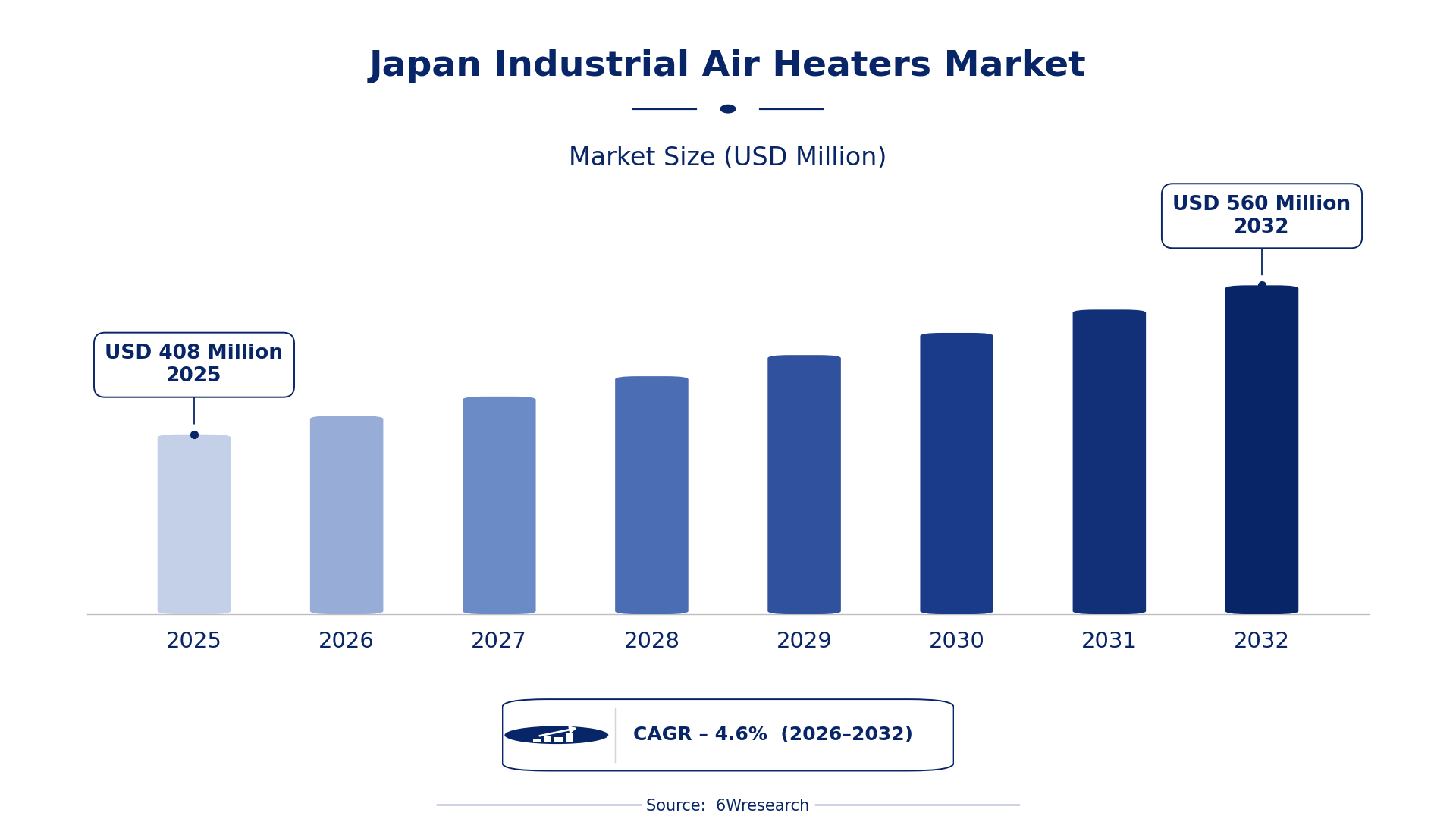
According to 6Wresearch internal database and industry insights, the Japan Industrial Air Heaters Market was valued at USD 408 Million in 2025 and is projected to reach USD 560 Million by 2032, growing at a CAGR of approximately 4.6% during 2026–2032.
Japan Industrial Air Heaters Market Highlights
| Report Metric | Details |
| Report Name | Japan Industrial Air Heaters Market (2026-2032) |
| Market Size 2025 | USD 408 Million |
| Market Size 2032 | USD 560 Million |
| Absolute Growth 2025–2032 | USD 152 Million |
| CAGR 2026–2032 | 4.6% |
| Peak Annual Growth | 6.3% in 2032 |
| Forecast Period | 2026–2032 |
| Historical Data | 2022–2025 |
| Base Year | 2025 |
| Leading Fuel Type, 2025 | Electric Powered (43% share) |
| Leading Technology, 2025 | Direct Fired (54% share) |
| Leading Capacity, 2025 | 10-15 KW (36% share) |
| Leading Application, 2025 | Air & Gas Heating (31% share) |
| Leading Material Type, 2025 | Steel (56% share) |
| Fastest-Growing Technology | Indirect Fired (6.3% CAGR) |
| Fastest-Growing Capacity | 15-20 KW (5.8% CAGR) |
| Fastest-Growing Application | Chemical Reactor (6.5% CAGR) |
| Fastest-Growing Material Type | Aluminum (6.4% CAGR) |
| Growing Sector | Industrial Heating |
| Key End Users | Manufacturers, Construction Firms, Medical Facilities, Chemical Processors |
Japan Industrial Air Heaters Market Year-wise Growth Rate and Key Drivers (2022–2032)
This graph illustrates the annual growth rates of the market from 2022 to 2032, highlighting a steady upward trajectory and projected market expansion over the forecast period.
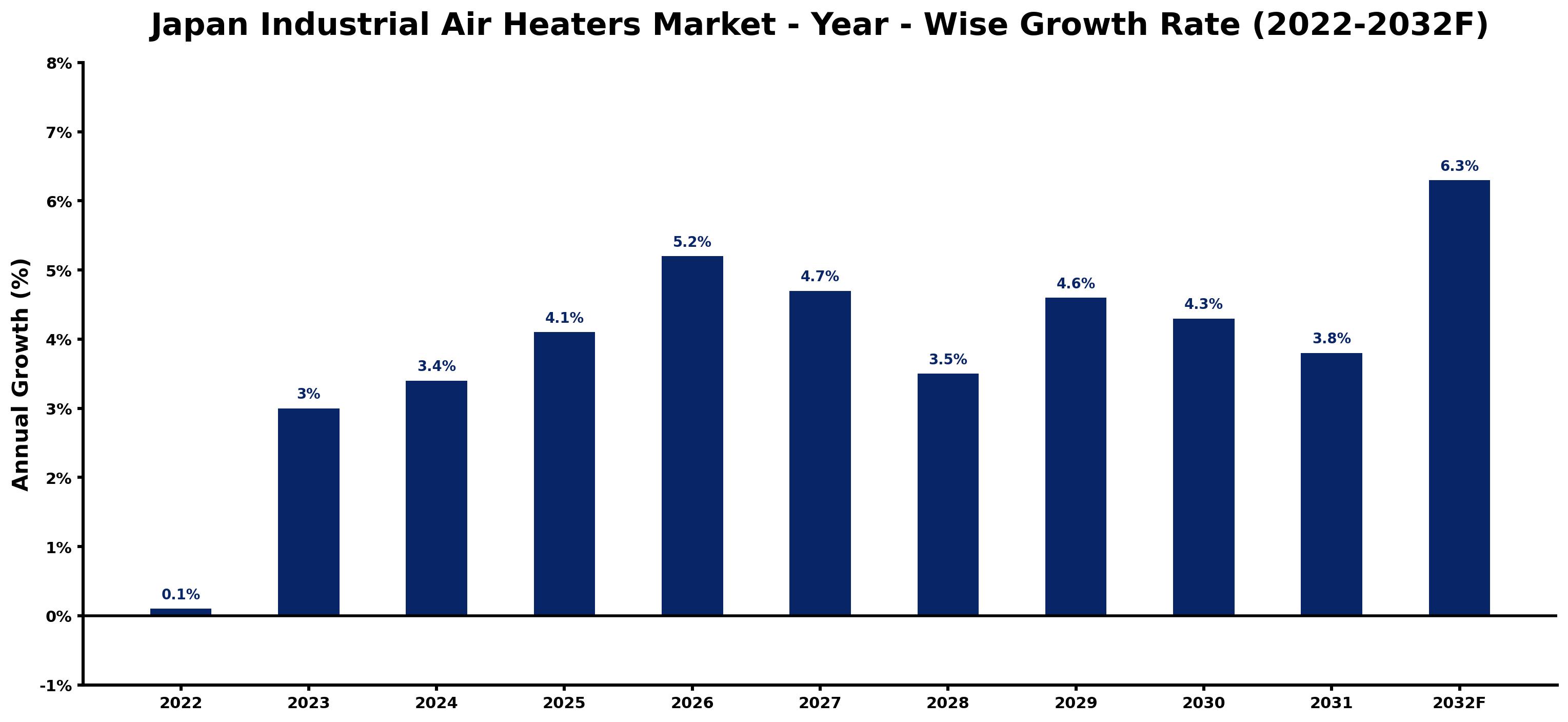
Each row of the following table gives one year's estimated growth and the event or demand shift that explains it.
| Year | Estimated Annual Growth (%) | Market Rationale |
| 2022 | 0.1 | The market experienced minimal growth due to ongoing recovery from previous economic disruptions. |
| 2023 | 3.0 | Demand increased as industrial facilities began to adopt more energy-efficient heating solutions. |
| 2024 | 3.4 | Growth continued as manufacturers focused on upgrading their heating systems for better efficiency. |
| 2025 | 4.1 | The market reached a peak growth rate as investments in industrial heating technologies surged. |
| 2026 | 5.2 | Demand is expected to rise further as companies seek to comply with new energy efficiency standards. |
| 2027 | 4.7 | Growth will slow slightly as market saturation begins to affect new installations. |
| 2028 | 3.5 | The market is projected to continue growing, albeit at a slower pace, as energy conservation measures take hold. |
| 2029 | 4.6 | Demand is expected to accelerate again as more facilities switch to electric-powered heating systems. |
| 2030 | 4.3 | Growth will moderate as the market adjusts to the increasing presence of electric heating solutions. |
| 2031 | 3.8 | The market is projected to see further slowdown as competition intensifies among heating technology providers. |
| 2032 | 6.3 | A resurgence in demand is expected as industrial facilities ramp up investments in advanced heating technologies. |
Note: Market size estimations and growth projections presented in this report are based on 6Wresearch's proprietary forecasting methodology, utilizing the latest available industry data, government publications, and primary research inputs.
Japan Industrial Air Heaters Market Synopsis
Industrial air heaters are essential devices for heating air in various industrial applications, made from materials like steel and aluminum. They serve critical functions in air and gas heating, chemical reactors, and medical packaging. The Japan Industrial Air Heaters Market is expanding, driven by rising demand for energy-efficient solutions, particularly electric-powered heaters, which accounted for 40% of new installations in 2023. The government's commitment to decarbonisation and energy efficiency is stimulating investment in modern heating technologies, targeting JPY 150 trillion over the next decade.
Market Dynamics Impact Analysis (2026–2032)
| Factor | Type | Impact | Primary Segment Affected |
| Growing adoption of electric-powered heaters | Driver | High | Electric Powered |
| Increase in manufacturing activity in regions like Tohoku | Driver | High | Air & Gas Heating |
| Investment in energy-efficient technologies | Opportunity | High | Electric Powered |
| Rising demand for efficient heating solutions in the Tokyo region | Opportunity | High | Air & Gas Heating |
| High initial costs of advanced heating systems | Restraint | Medium | Electric Powered |
| Limited availability of skilled technicians for installation | Restraint | Medium | Direct Fired |
| Compliance with stringent energy efficiency regulations | Challenge | High | Electric Powered |
| Fluctuating raw material costs affecting production | Challenge | High | Steel |
Evaluation of Drivers in Japan Industrial Air Heaters Market (2026–2032)
Demand rests on the following drivers, each shown with the segment it touches most.
| Drivers | Primary Segment Affected | Why It Matters (Evidence) |
| Increased adoption of electric-powered heaters | Electric Powered | In 2023, 25% of industrial facilities adopted electric-powered heaters for their efficiency. |
| Growth in manufacturing activity in Tohoku | Air & Gas Heating | The Tohoku region has seen a rise in demand for air heaters due to increased manufacturing activity. |
| Government incentives for energy-efficient technologies | Electric Powered | Japan targets JPY 150 trillion in decarbonisation investment over 10 years. |
| Rising energy costs prompting efficiency upgrades | Direct Fired | The average industrial facility in Japan uses 50% less energy due to modern heating technologies. |
| Focus on compliance with energy conservation laws | Electric Powered | The 2022 Energy Conservation Law mandates efficiency standards for industrial heating systems. |
The strongest pull on demand comes from the increasing adoption of electric-powered heaters, with 25% of industrial facilities utilising them for their efficiency. Heightened manufacturing activity in the Tohoku region has driven demand for air heaters, resulting in a notable increase in installations. Incentives targeting JPY 150 trillion in decarbonisation investments stimulate the market. This combination of factors propels growth in the Japan Industrial Air Heaters Market.
Evaluation of Restraints in Japan Industrial Air Heaters Market
These restraints slow adoption and weigh on supplier margins.
| Market Restraint | Primary Segment Affected | Why It Matters (Evidence) |
| High initial costs of advanced heating systems | Electric Powered | The installation of electric-powered heaters often requires substantial upfront investment, deterring some buyers. |
| Limited availability of skilled technicians for installation | Direct Fired | A shortage of qualified technicians can delay installations and increase operational costs for manufacturers. |
| Compliance with stringent energy efficiency regulations | Electric Powered | Meeting the requirements of the Industrial Safety and Health Act can be challenging for some facilities. |
| Fluctuating raw material costs affecting production | Steel | Volatility in steel prices can impact the production costs of industrial air heaters. |
| Market saturation in certain regions | Air & Gas Heating | In mature markets, demand growth may slow as most facilities have upgraded their heating systems. |
Japan Industrial Air Heaters Market Challenges
Increased adoption of electric-powered heaters has created challenges for producers, as they must invest in new technology to comply with efficiency standards. This requirement arises from Japan's 2022 Energy Conservation Law, necessitating capital for upgrades that can consume up to 20% of manufacturers' annual budgets. Buyers face rising costs due to competition for these advanced systems, inflating prices by as much as 30% in the Tokyo region. Limited availability of skilled technicians complicates matters for producers, delaying installations and maintenance, which can extend project timelines by several months for industrial facilities.
Trends in the Japan Industrial Air Heaters Market
Several trends are reshaping the Japan Industrial Air Heaters Market; the most important are set out below.
- Shift towards Electric-Powered Heating Solutions: The trend towards electric-powered heating solutions began gaining momentum in 2023, as energy efficiency demands rose. In 2023, 40% of new installations were electric-powered systems, indicating a shift in preference among industrial users.
- Transition from Direct Fired to Indirect Fired Technologies: Since 2023, there has been a noticeable transition from direct fired to indirect fired technologies in industrial heating. This shift is reflected in the growing adoption of indirect systems, which are projected to grow at a CAGR of 6.3%.
- Emergence of Energy Efficiency Standards: The introduction of the 2022 Energy Conservation Law has prompted a focus on energy efficiency standards. Facilities are now prioritising compliance, leading to increased investments in modern heating technologies that meet these standards.
- Increased Demand for Heating in the Tohoku Region: The Tohoku region has experienced a surge in industrial activity since 2023, driving up the demand for air heaters. This region accounted for a significant portion of the market growth, reflecting the overall industrial expansion.
Investment Opportunities in the Japan Industrial Air Heaters Market
The openings below show where demand in the Japan Industrial Air Heaters Market is visible and how suppliers can enter.
- Investment in Electric-Powered Heating Technologies: With the government's push for energy efficiency, now is the time to invest in electric-powered heating technologies. The industrial sector is increasingly seeking efficient solutions, particularly in the Tokyo region, where demand is strong.
- Supply of Indirect Fired Heating Systems: The growing preference for indirect fired systems presents an opportunity to supply advanced technologies. Manufacturers in the Tohoku region are looking for efficient heating solutions that meet new energy standards.
- Development of Energy-Efficient Heating Solutions: The current focus on energy conservation creates an opportunity for developing efficient heating solutions. Industrial facilities across Japan are actively seeking suppliers who can provide compliant and effective systems.
- Expansion of Maintenance Services for Industrial Heaters: As the market matures, there is a growing need for maintenance services for industrial heaters. Facilities in the Tokyo region require reliable service providers to ensure optimal performance of their heating systems.
Government Initiatives in the Japan Industrial Air Heaters Market
The Industrial Safety and Health Act, enacted in 1972, mandates that employers ensure safety standards for machinery and hazardous substances. This law compels manufacturers of industrial air heaters to adhere to strict safety protocols, impacting their operational practices. The Act on the Rational Use of Energy, established in 1979, requires large energy users to report their energy consumption and improve efficiency, further influencing the design and production of heating systems.
The Ministry of Economy, Trade and Industry oversees compliance with energy efficiency regulations and funds initiatives aimed at promoting energy-efficient technologies. The agency supports projects that align with the GX Basic Policy, which targets JPY 150 trillion in decarbonisation investments over the next decade. This funding is vital for manufacturers looking to innovate and upgrade their heating solutions.
Future Insight of the Japan Industrial Air Heaters Market
Japan's policy-driven shift towards decarbonisation will accelerate the transition to electric-powered heating systems, prompting suppliers to innovate and adapt their offerings. By 2032, the market will likely see a surge in advanced technologies, with 40% of new installations projected to be electric-powered. The government's planned investment of JPY 150 trillion in decarbonisation will stimulate demand for energy-efficient solutions, benefiting both buyers and suppliers. Training programmes will also develop a skilled workforce, ensuring adequate support for this evolving market.
Market Segmentation Analysis
Japan Industrial Air Heaters Market report covers a detailed analysis of the following market segments:
By Fuel Type – Electric Powered Leads and Records the Fastest Growth
According to Sachin Kumar Rai, Senior Research Analyst at 6Wresearch, Electric Powered accounted for 43% of the market by fuel type in 2025. Electric powered heaters dominate the market due to their efficiency and precision in temperature control, making them ideal for facilities with specific heating needs. In 2023, 25% of industrial facilities opted for electric-powered heaters, reflecting a strong preference among users. Its lead should widen, with a projected CAGR of 6.8% during 2026–2032, the highest in this split. The continuous push for energy efficiency and Japan's commitment to decarbonisation have accelerated the adoption of electric-powered heaters. With 40% of new installations in 2023 being electric-powered, this trend is expected to strengthen further. Suppliers should focus on electric-powered solutions to align with market demands and regulatory trends.
By Technology – Direct Fired Leads, Indirect Fired Expected to Grow Fastest
In 2025, Direct Fired led the technology split with a 54% share. Direct fired heaters are the leading technology as they provide immediate heating, essential for many industrial processes. Their efficiency in delivering heat quickly makes them a preferred choice in various applications. Indirect Fired is projected to grow fastest, at a CAGR of 6.3% during 2026–2032. The indirect fired technology is gaining traction as it allows for separation of exhaust gases from heated air, catering to specific industrial requirements. Increased awareness of environmental standards is driving this growth. Buyers should consider the benefits of indirect fired systems for applications requiring stringent emissions control.
By Capacity – 10-15 KW Leads, 15-20 KW Expected to Grow Fastest
With 36% of capacity revenue in 2025, 10-15 KW was the largest category. The 10-15 KW capacity heaters are essential for larger facilities, providing consistent heating for operations that require reliable performance. Their widespread use in high-demand environments underpins their leading position in the market. 15-20 KW is set to record the highest CAGR in this split, 5.8% over 2026–2032. The 15-20 KW capacity heaters are gaining traction as industries expand and require more powerful heating solutions. This trend is driven by the increasing demand from larger industrial applications that need enhanced heating capabilities. Suppliers should focus on developing higher capacity heaters to meet the growing needs of industrial clients.
By Application – Air & Gas Heating Leads, Chemical Reactor Expected to Grow Fastest
Air & Gas Heating held 31% of the Japan Industrial Air Heaters Market by application in 2025. Air and gas heating is the primary application for industrial air heaters, serving a wide range of industries such as manufacturing and processing. This broad applicability reinforces its dominant market position. The quickest growth will come from Chemical Reactor, forecast to expand at a CAGR of 6.5% between 2026 and 2032. The chemical reactor application is witnessing rapid growth, as it is vital for maintaining precise reaction temperatures in various processes. The expansion of this sector is significantly boosting the demand for specialised heating solutions. Suppliers should target the chemical sector to capitalise on the increasing need for accurate heating technologies.
By Material Type – Steel Leads, Aluminum Expected to Grow Fastest
The largest material type category in 2025 was Steel, at 56% of revenue. Steel is the predominant material used in industrial air heaters due to its durability and strength, making it suitable for demanding environments. This preference is reflected in the majority of installations across various industrial applications. Over 2026–2032, Aluminum is expected to post the fastest growth, at a CAGR of 6.4%. Aluminum is gaining popularity for its lightweight properties, making it ideal for applications where reducing weight is crucial. As industries strive for greater efficiency, the demand for aluminum-based heaters is expected to rise. Suppliers should explore expanding their material offerings to include lightweight options like aluminum to attract a broader customer base.
Key Attractiveness of the Report
- 10 Years of Market Numbers
- Historical Data Starting from 2022 to 2025
- Base Year 2025
- Forecast Data until 2032
- Key Performance Indicators Impacting the Market
- Major Upcoming Developments and Projects
Key Highlights of the Report:
- Japan Industrial Air Heaters Market Outlook
- Market Size of Japan Industrial Air Heaters Market, 2025
- Forecast of Japan Industrial Air Heaters Market, 2032
- Historical Data and Forecast of Japan Industrial Air Heaters Revenues & Volume for the Period 2022-2032
- Japan Industrial Air Heaters Market Trend Evolution
- Japan Industrial Air Heaters Market Drivers and Challenges
- Japan Industrial Air Heaters Price Trends
- Japan Industrial Air Heaters Porter's Five Forces
- Japan Industrial Air Heaters Industry Life Cycle
- Historical Data and Forecast of Japan Industrial Air Heaters Market Revenues & Volume By Fuel Type for the Period 2022-2032
- Historical Data and Forecast of Japan Industrial Air Heaters Market Revenues & Volume By Gasoline Powered for the Period 2022-2032
- Historical Data and Forecast of Japan Industrial Air Heaters Market Revenues & Volume By Diesel Powered for the Period 2022-2032
- Historical Data and Forecast of Japan Industrial Air Heaters Market Revenues & Volume By Natural Fuel Powered for the Period 2022-2032
- Historical Data and Forecast of Japan Industrial Air Heaters Market Revenues & Volume By Electric Powered for the Period 2022-2032
- Historical Data and Forecast of Japan Industrial Air Heaters Market Revenues & Volume By Technology for the Period 2022-2032
- Historical Data and Forecast of Japan Industrial Air Heaters Market Revenues & Volume By Direct Fired for the Period 2022-2032
- Historical Data and Forecast of Japan Industrial Air Heaters Market Revenues & Volume By Indirect Fired for the Period 2022-2032
- Historical Data and Forecast of Japan Industrial Air Heaters Market Revenues & Volume By Capacity for the Period 2022-2032
- Historical Data and Forecast of Japan Industrial Air Heaters Market Revenues & Volume By Less than 1 KW for the Period 2022-2032
- Historical Data and Forecast of Japan Industrial Air Heaters Market Revenues & Volume By 1-5 KW for the Period 2022-2032
- Historical Data and Forecast of Japan Industrial Air Heaters Market Revenues & Volume By 5-10 KW for the Period 2022-2032
- Historical Data and Forecast of Japan Industrial Air Heaters Market Revenues & Volume By 10-15 KW for the Period 2022-2032
- Historical Data and Forecast of Japan Industrial Air Heaters Market Revenues & Volume By 15-20 KW for the Period 2022-2032
- Historical Data and Forecast of Japan Industrial Air Heaters Market Revenues & Volume By More than 20 KW for the Period 2022-2032
- Historical Data and Forecast of Japan Industrial Air Heaters Market Revenues & Volume By Application for the Period 2022-2032
- Historical Data and Forecast of Japan Industrial Air Heaters Market Revenues & Volume By Air & Gas Heating for the Period 2022-2032
- Historical Data and Forecast of Japan Industrial Air Heaters Market Revenues & Volume By Chemical Reactor for the Period 2022-2032
- Historical Data and Forecast of Japan Industrial Air Heaters Market Revenues & Volume By Lube & Fuel Oil Heating for the Period 2022-2032
- Historical Data and Forecast of Japan Industrial Air Heaters Market Revenues & Volume By Water ?? Glycol Heating for the Period 2022-2032
- Historical Data and Forecast of Japan Industrial Air Heaters Market Revenues & Volume By Medical Packaging Application for the Period 2022-2032
- Historical Data and Forecast of Japan Industrial Air Heaters Market Revenues & Volume By Material Type for the Period 2022-2032
- Historical Data and Forecast of Japan Industrial Air Heaters Market Revenues & Volume By Steel for the Period 2022-2032
- Historical Data and Forecast of Japan Industrial Air Heaters Market Revenues & Volume By Aluminum for the Period 2022-2032
- Historical Data and Forecast of Japan Industrial Air Heaters Market Revenues & Volume By Alloy Material for the Period 2022-2032
- Historical Data and Forecast of Japan Industrial Air Heaters Market Revenues & Volume By End Use for the Period 2022-2032
- Historical Data and Forecast of Japan Industrial Air Heaters Market Revenues & Volume By General Manufacturing for the Period 2022-2032
- Historical Data and Forecast of Japan Industrial Air Heaters Market Revenues & Volume By Food & Beverages for the Period 2022-2032
- Historical Data and Forecast of Japan Industrial Air Heaters Market Revenues & Volume By Medical & Pharmaceuticals for the Period 2022-2032
- Japan Industrial Air Heaters Import Export Trade Statistics
- Market Opportunity Assessment By Fuel Type
- Market Opportunity Assessment By Technology
- Market Opportunity Assessment By Capacity
- Market Opportunity Assessment By Application
- Market Opportunity Assessment By Material Type
- Market Opportunity Assessment By End Use
- Japan Industrial Air Heaters Top Companies Market Share
- Japan Industrial Air Heaters Competitive Benchmarking By Technical and Operational Parameters
- Japan Industrial Air Heaters Company Profiles
- Japan Industrial Air Heaters Key Strategic Recommendations
Market Covered
The study includes the following segmentation.
By Fuel Type
- Gasoline Powered
- Diesel Powered
- Natural Fuel Powered
- Electric Powered
By Technology
- Direct Fired
- Indirect Fired
By Capacity
- Less than 1 KW
- 1-5 KW
- 5-10 KW
- 10-15 KW
- 15-20 KW
- More than 20 KW
By Application
- Air & Gas Heating
- Chemical Reactor
- Lube & Fuel Oil Heating
- Water “ Glycol Heating
- Medical Packaging Application
By Material Type
- Steel
- Aluminum
- Alloy Material






































