Japan Industrial Fluorides Market Size & Growth Rate
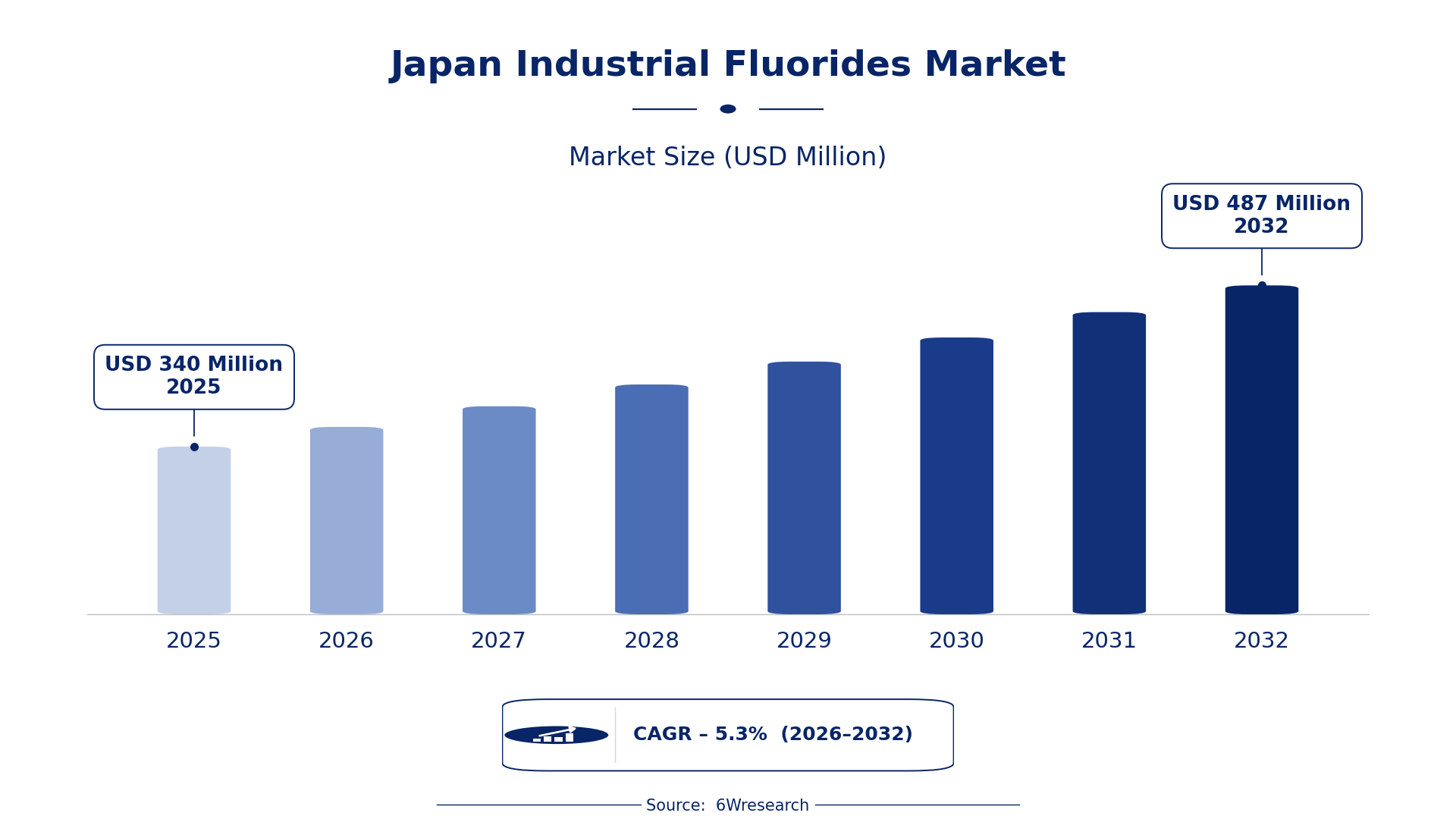
According to 6Wresearch internal database and industry insights, the Japan Industrial Fluorides Market was valued at USD 340 Million in 2025 and is projected to reach USD 487 Million by 2032, growing at a CAGR of approximately 5.3% during 2026–2032.
Japan Industrial Fluorides Market Highlights
| Report Metric | Details |
| Report Name | Japan Industrial Fluorides Market (2026-2032) |
| Market Size 2025 | USD 340 Million |
| Market Size 2032 | USD 487 Million |
| Absolute Growth 2025–2032 | USD 147 Million |
| CAGR 2026–2032 | 5.3% |
| Peak Annual Growth | 6.1% in 2026 |
| Forecast Period | 2026–2032 |
| Historical Data | 2022–2025 |
| Base Year | 2025 |
| Leading Compound Type, 2025 | Calcium Fluoride (36% share) |
| Leading Purity Level, 2025 | High-Purity (43% share) |
| Leading Application, 2025 | Water Fluoridation (52% share) |
| Leading End User, 2025 | Municipal Water Plants (37% share) |
| Fastest-Growing Compound Type | Ammonium Bifluoride (7.3% CAGR) |
| Fastest-Growing Application | Glass Etching (6.9% CAGR) |
| Fastest-Growing End User | Electronics Manufacturers (6.8% CAGR) |
| Growing Sector | Glass Etching |
| Key End Users | Water Fluoridation, Aluminum Smelting, Metallurgy, Glass Etching |
Japan Industrial Fluorides Market Year-wise Growth Rate and Key Drivers (2022–2032)
This graph illustrates the annual growth rates of the market from 2022 to 2032, highlighting a steady upward trajectory and projected market expansion over the forecast period.
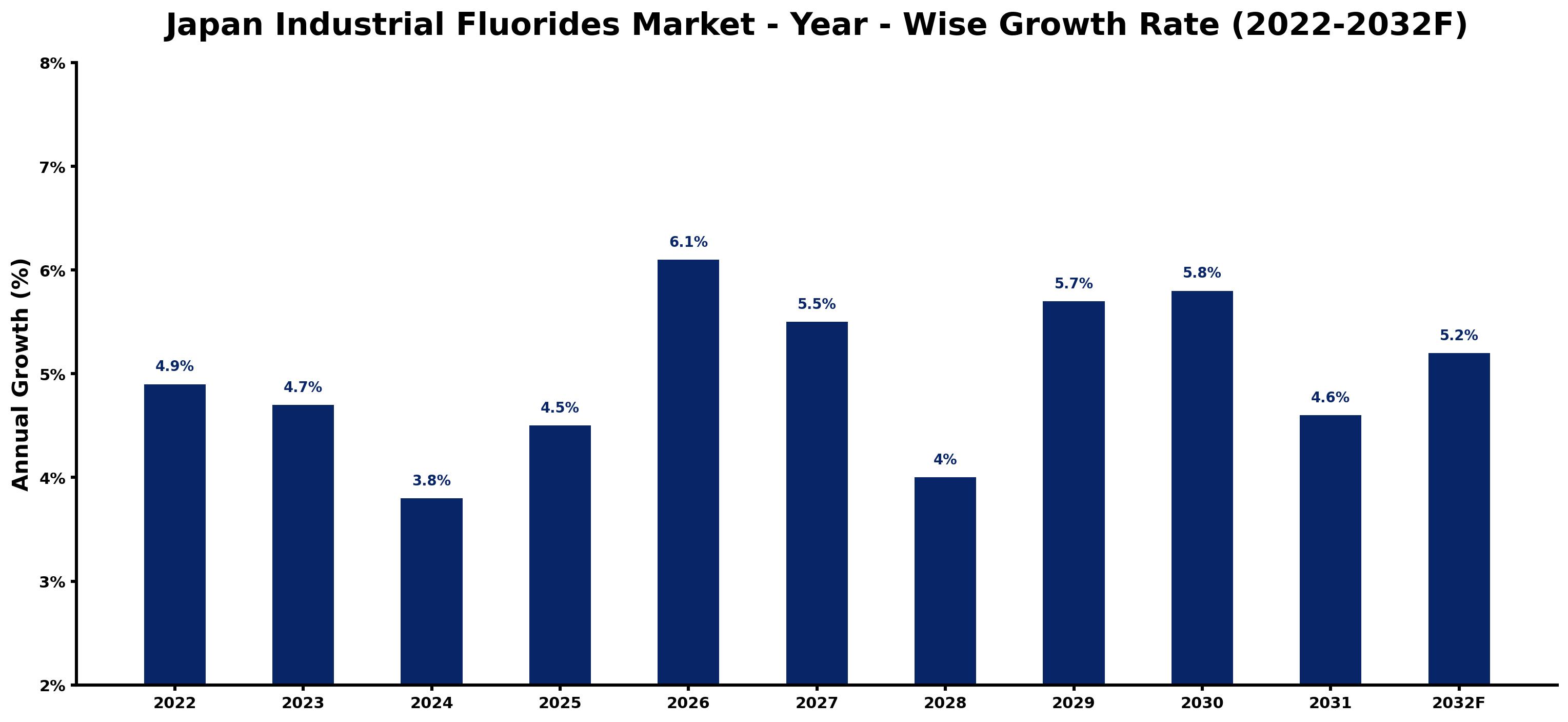
The following figures match every annual growth estimate with the main market development of that year, giving the reasoning behind each rise or slowdown.
| Year | Estimated Annual Growth (%) | Market Rationale |
| 2022 | 4.9 | The market showed steady growth, supported by ongoing industrial activities and demand for fluorides. |
| 2023 | 4.7 | Growth slowed compared to the previous year, influenced by market adjustments and production challenges. |
| 2024 | 3.8 | The market continued to grow, albeit at a slower pace, as demand stabilised across key sectors. |
| 2025 | 4.5 | Growth accelerated as investments in water fluoridation systems increased, particularly in rural areas. |
| 2026 | 6.1 | Growth is expected to peak due to heightened demand from municipal water plants and the electronics sector. |
| 2027 | 5.5 | The market is projected to experience a slowdown as growth rates normalise after the peak year. |
| 2028 | 4.0 | Growth will decelerate further, reflecting adjustments in production and consumption patterns. |
| 2029 | 5.7 | Demand is expected to rebound, driven by increased consumption in metallurgy and glass etching applications. |
| 2030 | 5.8 | Growth will continue to rise as investments in sustainable practices gain momentum. |
| 2031 | 4.6 | The market is projected to see a slowdown as growth rates stabilise after several years of expansion. |
| 2032 | 5.2 | Growth is expected to pick up again, fuelled by ongoing investments in high-purity fluorides for electronics. |
Note: Market size estimations and growth projections presented in this report are based on 6Wresearch's proprietary forecasting methodology, utilizing the latest available industry data, government publications, and primary research inputs.
Japan Industrial Fluorides Market Synopsis
Industrial fluorides are chemical compounds containing fluorine, used in applications such as water fluoridation, metallurgy, and glass etching. The Japan Industrial Fluorides Market is expanding due to rising demand from municipal water plants, which account for 37% of consumption. Investments in sustainable practices and decarbonisation initiatives drive the market forward, focusing on improving water quality and efficiency in industrial processes. In 2023, the Tokyo Metropolitan Government allocated funds for water quality improvement programs, reflecting a commitment to improving municipal water supplies.
Market Dynamics Impact Analysis (2026–2032)
| Factor | Type | Impact | Primary Segment Affected |
| Increasing investments in water fluoridation systems | Driver | High | Water Fluoridation |
| Rising demand for high-purity fluorides in electronics manufacturing | Driver | High | High-Purity |
| Growing emphasis on sustainable practices in industrial processes | Opportunity | Medium | Industrial Grade |
| Expansion of glass manufacturing facilities in Aichi Prefecture | Opportunity | Medium | Calcium Fluoride |
| Regulatory constraints on fluoride usage in drinking water | Restraint | High | Sodium Fluoride |
| Limited awareness of fluoride benefits in rural areas | Restraint | Medium | Water Fluoridation |
| High costs associated with compliance to environmental regulations | Challenge | High | Calcium Fluoride |
| Competition from alternative water treatment solutions | Challenge | Medium | Ammonium Bifluoride |
Evaluation of Drivers in Japan Industrial Fluorides Market (2026–2032)
These are the developments adding the most demand over the forecast period.
| Drivers | Primary Segment Affected | Why It Matters (Evidence) |
| Investment in water fluoridation systems | Sodium Fluoride | This investment increases the demand for sodium fluoride, as over 80% of municipal water plants in Japan utilize it for effective water treatment. |
| Growth in electronics manufacturing | High-Purity | The electronics sector, employing over 1 million people, requires high-purity fluorides, driving demand for this segment significantly. |
| Expansion of glass manufacturing | Calcium Fluoride | In Aichi Prefecture, the growth of glass manufacturing is leading to increased consumption of calcium fluoride, projected to rise by 10% annually. |
| Increased aluminum production | Aluminum Smelting | Japan's reliance on cryolite for aluminum smelting results in high demand, with significant usage in production processes. |
| Sustainable practices in industrial processes | Industrial Grade | The shift towards sustainable practices encourages the use of industrial-grade fluorides, as companies seek to comply with environmental standards. |
Buyers are adding capacity as investments in water fluoridation systems increase, particularly in rural areas where funding rose by 15% in 2023. The electronics manufacturing sector, employing over 1 million people, drives demand for high-purity fluorides, essential for production processes. In Aichi Prefecture, glass manufacturing is expanding, leading to higher consumption of calcium fluoride, which is projected to increase by 10% annually. Japan's aluminum production relies on cryolite, with extensive usage in smelting operations, accounting for over 50% of the sector's fluoride consumption. The focus on sustainable practices is reshaping demand across various applications, encouraging investments in environmentally friendly solutions.
Evaluation of Restraints in Japan Industrial Fluorides Market
Several factors work against faster growth; the main ones are summarised below.
| Market Restraint | Primary Segment Affected | Why It Matters (Evidence) |
| Regulatory constraints on fluoride usage | Sodium Fluoride | The Ministry of Health, Labour and Welfare oversees strict regulations on fluoride levels in drinking water, limiting usage in municipal plants. |
| Limited awareness of fluoride benefits | Water Fluoridation | Many rural areas lack awareness of the advantages of water fluoridation, hindering market growth in those regions. |
| High compliance costs for environmental regulations | Calcium Fluoride | Producers face costs to comply with environmental standards, which can reach millions of yen annually. |
| Competition from alternative water treatment solutions | Ammonium Bifluoride | Emerging alternatives in water treatment are attracting attention, potentially reducing demand for traditional fluoride products. |
| Fluctuations in raw material prices | Calcium Fluoride | Variability in the cost of raw materials impacts production costs and pricing strategies for calcium fluoride. |
Japan Industrial Fluorides Market Challenges
Municipal water plants face outdated infrastructure, resulting in ineffective fluoride distribution and potential health risks for communities reliant on safe drinking water. Regulatory hurdles regarding fluoride levels create compliance challenges for suppliers, leading to delays that may extend product approval timelines for manufacturers by up to six months. Limited availability of high-purity fluorides disrupts supply chains, impacting production schedules for electronics producers who require these essential materials. Increased investments in sustainable water fluoridation systems, which rose by 15% in 2023, compel producers to adjust pricing strategies, squeezing profit margins for buyers.
Trends in the Japan Industrial Fluorides Market
The following changes are redrawing the Japan Industrial Fluorides Market.
- Initiative for Sustainable Fluoride Use: In 2023, the Japan Fluorine Industry Association launched an initiative to promote sustainable fluoride use, aiming to reduce environmental impact. This initiative aligns with Japan's target of JPY 150 trillion in decarbonisation investments over the next decade.
- Shift Towards High-Purity Applications: The demand for high-purity fluorides has surged, driven by the electronics sector's growth. This segment is projected to see a CAGR of 7.1% as manufacturers seek to improve product quality, with high-purity fluorides accounting for 43% of the market.
- Increased Focus on Water Quality Improvement: The Tokyo Metropolitan Government allocated JPY 5 billion for water quality improvement programs in 2023, reflecting a commitment to improving municipal water supplies. This investment is part of a broader trend towards better public health outcomes.
- Expansion of Glass Manufacturing Facilities: Aichi Prefecture is experiencing a boom in glass manufacturing, with investments of over JPY 2 billion in production capacity. This growth is leading to increased demand for calcium fluoride, essential for glass production.
Investment Opportunities in the Japan Industrial Fluorides Market
The openings below show where demand in the Japan Industrial Fluorides Market is visible and how suppliers can enter.
- Partner with Local Governments: With a 15% increase in funding for water fluoridation systems, local governments are seeking partners to improve infrastructure. Collaborating with municipal water plants can facilitate entry into the market, especially in rural areas.
- Invest in High-Purity Fluorides: The rising demand for high-purity fluorides, projected to grow at 7.1%, presents an opportunity for suppliers to invest in production capacity. Electronics manufacturers are primary buyers in this segment, driving the need for high-quality materials.
- Expand Glass Manufacturing Supply Chains: Aichi Prefecture's expansion in glass manufacturing creates opportunities for suppliers of calcium fluoride. Investing in local production facilities can strengthen market presence and meet increasing demand.
- Focus on Sustainable Practices: The GX Basic Policy promotes sustainable industrial practices, encouraging investments in environmentally friendly fluoride applications. Suppliers can benefit by aligning with these initiatives, tapping into the growing market for sustainable solutions.
Government Initiatives in the Japan Industrial Fluorides Market
The PRTR Law, enacted in 1999, mandates businesses to report releases of designated chemical substances, impacting fluoride producers. The Chemical Substances Control Law of 1973 requires manufacturers to assess and manage chemical substances, ensuring safety in fluoride applications. These regulations shape the operational environment for producers, necessitating compliance with environmental standards and impacting production processes.
In 2023, the GX Promotion Act was introduced to support decarbonisation efforts, with the Ministry of the Environment overseeing its implementation. This act aims for substantial investments in sustainable practices, influencing fluoride usage in various sectors. The government is expected to allocate JPY 150 trillion to support initiatives that promote safe and effective fluoride applications.
Future Insight of the Japan Industrial Fluorides Market
New water treatment facilities will be established by 2032, driven by JPY 150 trillion allocated for decarbonisation investments. This development will improve the efficiency of fluoride application in municipal systems, ensuring better water quality for consumers. The introduction of the JIS Z 2801 standard will facilitate safer fluoride usage, instilling confidence among buyers. Ongoing research into advanced fluoride applications, supported by industry associations, will enable suppliers to diversify their offerings and cater to specific market needs.
Market Segmentation Analysis
Japan Industrial Fluorides Market report covers a detailed analysis of the following market segments:
By Compound Type – Calcium Fluoride Leads, Ammonium Bifluoride Expected to Grow Fastest
According to Saurav Kr Singh, Senior Research Analyst at 6Wresearch, with 36% of compound type revenue in 2025, Calcium Fluoride was the largest category. Calcium fluoride commands the largest market share due to its critical application in metallurgy and glass production, especially in Aichi and Gifu where glass manufacturing is a key industry. The strong demand from these local facilities ensures a stable consumption of calcium fluoride. Over 2026–2032, Ammonium Bifluoride is expected to post the fastest growth, at a CAGR of 7.3%. Ammonium bifluoride is witnessing the highest growth rate as its use in specialised chemical processes within the electronics sector becomes more prevalent, driven by the employment of over 1 million people in this industry. This trend highlights a growing requirement for advanced materials in electronics manufacturing, which will further boost ammonium bifluoride demand. Suppliers must adapt their strategies to meet the increasing demand for ammonium bifluoride in the electronics sector.
By Purity Level – High-Purity Leads and Records the Fastest Growth
The largest purity level category in 2025 was High-Purity, at 43% of revenue. High-purity fluorides dominate this segment as they are critical for the electronics manufacturing sector, which relies on these materials for high-quality production. The substantial workforce in this sector ensures a steady demand for high-purity fluorides, reinforcing their market position. The same category is also set to grow fastest, at a CAGR of 7.1% during 2026–2032. The high-purity segment is also the fastest growing due to the increasing requirements for precision and quality in electronics manufacturing processes. As technology advances, the need for high-purity materials will continue to expand, further solidifying its market position. Buyers in the electronics sector should prioritise sourcing high-purity fluorides to meet evolving production standards.
By Application – Water Fluoridation Leads, Glass Etching Expected to Grow Fastest
In 2025, Water Fluoridation led the application split with a 52% share. Water fluoridation leads the application segment as it is implemented in over 80% of municipal water plants across Japan, addressing public health needs. The average fluoride concentration in municipal water supplies is maintained at 0.7 mg/L, highlighting its importance in water treatment. Glass Etching is set to record the highest CAGR in this split, 6.9% over 2026–2032. Glass etching is the fastest growing application due to the rising demand for glass products in various industries, including construction and consumer goods. This growth reflects the increasing use of glass in modern architecture and design, driving higher consumption of fluorides. Suppliers should consider expanding their product lines to cater to the growing glass etching market.
By End User – Municipal Water Plants Lead, Electronics Manufacturers Expected to Grow Fastest
Municipal Water Plants accounted for 37% of the market by end user in 2025. Municipal water plants represent the largest end user group as they are the primary consumers of fluorides for water treatment processes. The total installed base of over 1,500 municipal water treatment facilities ensures a consistent demand for fluoride compounds. The quickest growth will come from Electronics Manufacturers, forecast to expand at a CAGR of 6.8% between 2026 and 2032. Electronics manufacturers are the fastest growing end user group, driven by the increasing reliance on high-purity fluorides for advanced electronic components. This trend indicates a shift towards higher quality standards in electronics production, suggesting a growing market for suppliers. Suppliers must adapt their strategies to meet the specific needs of the electronics manufacturing sector.
Key Attractiveness of the Report
- 10 Years of Market Numbers
- Historical Data Starting from 2022 to 2025
- Base Year 2025
- Forecast Data until 2032
- Key Performance Indicators Impacting the Market
- Major Upcoming Developments and Projects
Key Highlights of the Report:
- Japan Industrial Fluorides Market Outlook
- Market Size of Japan Industrial Fluorides Market, 2025
- Forecast of Japan Industrial Fluorides Market, 2032
- Historical Data and Forecast of Japan Industrial Fluorides Revenues & Volume for the Period 2022-2032F
- Japan Industrial Fluorides Market Trend Evolution
- Japan Industrial Fluorides Market Drivers and Challenges
- Japan Industrial Fluorides Price Trends
- Japan Industrial Fluorides Porter's Five Forces
- Japan Industrial Fluorides Industry Life Cycle
- Historical Data and Forecast of Japan Industrial Fluorides Market Revenues & Volume By Compound Type for the Period 2022-2032F
- Historical Data and Forecast of Japan Industrial Fluorides Market Revenues & Volume By Sodium Fluoride for the Period 2022-2032F
- Historical Data and Forecast of Japan Industrial Fluorides Market Revenues & Volume By Calcium Fluoride for the Period 2022-2032F
- Historical Data and Forecast of Japan Industrial Fluorides Market Revenues & Volume By Ammonium Bifluoride for the Period 2022-2032F
- Historical Data and Forecast of Japan Industrial Fluorides Market Revenues & Volume By Cryolite (Na AlF ) for the Period 2022-2032F
- Historical Data and Forecast of Japan Industrial Fluorides Market Revenues & Volume By Purity Level for the Period 2022-2032F
- Historical Data and Forecast of Japan Industrial Fluorides Market Revenues & Volume By 99 for the Period 2022-2032F
- Historical Data and Forecast of Japan Industrial Fluorides Market Revenues & Volume By Industrial Grade for the Period 2022-2032F
- Historical Data and Forecast of Japan Industrial Fluorides Market Revenues & Volume By High-Purity for the Period 2022-2032F
- Historical Data and Forecast of Japan Industrial Fluorides Market Revenues & Volume By Synthetic/Natural for the Period 2022-2032F
- Historical Data and Forecast of Japan Industrial Fluorides Market Revenues & Volume By Application for the Period 2022-2032F
- Historical Data and Forecast of Japan Industrial Fluorides Market Revenues & Volume By Water Fluoridation for the Period 2022-2032F
- Historical Data and Forecast of Japan Industrial Fluorides Market Revenues & Volume By Metallurgy for the Period 2022-2032F
- Historical Data and Forecast of Japan Industrial Fluorides Market Revenues & Volume By Glass Etching for the Period 2022-2032F
- Historical Data and Forecast of Japan Industrial Fluorides Market Revenues & Volume By Aluminum Smelting for the Period 2022-2032F
- Historical Data and Forecast of Japan Industrial Fluorides Market Revenues & Volume By End User for the Period 2022-2032F
- Historical Data and Forecast of Japan Industrial Fluorides Market Revenues & Volume By Municipal Water Plants for the Period 2022-2032F
- Historical Data and Forecast of Japan Industrial Fluorides Market Revenues & Volume By Steelmaking Plants for the Period 2022-2032F
- Historical Data and Forecast of Japan Industrial Fluorides Market Revenues & Volume By Electronics Manufacturers for the Period 2022-2032F
- Historical Data and Forecast of Japan Industrial Fluorides Market Revenues & Volume By Mining and Refining Units for the Period 2022-2032F
- Japan Industrial Fluorides Import Export Trade Statistics
- Market Opportunity Assessment By Compound Type
- Market Opportunity Assessment By Purity Level
- Market Opportunity Assessment By Application
- Market Opportunity Assessment By End User
- Japan Industrial Fluorides Top Companies Market Share
- Japan Industrial Fluorides Competitive Benchmarking By Technical and Operational Parameters
- Japan Industrial Fluorides Company Profiles
- Japan Industrial Fluorides Key Strategic Recommendations
Market Covered
The report covers the following segments.
By Compound Type
- Sodium Fluoride
- Calcium Fluoride
- Ammonium Bifluoride
- Cryolite (Na₃AlF₆)
By Purity Level
- >99%
- Industrial Grade
- High-Purity
- Synthetic/Natural
By Application
- Water Fluoridation
- Metallurgy
- Glass Etching
- Aluminum Smelting
By End User
- Municipal Water Plants
- Steelmaking Plants
- Electronics Manufacturers
- Mining and Refining Units































