Japan Industrial Gas Production Market Size & Growth Rate
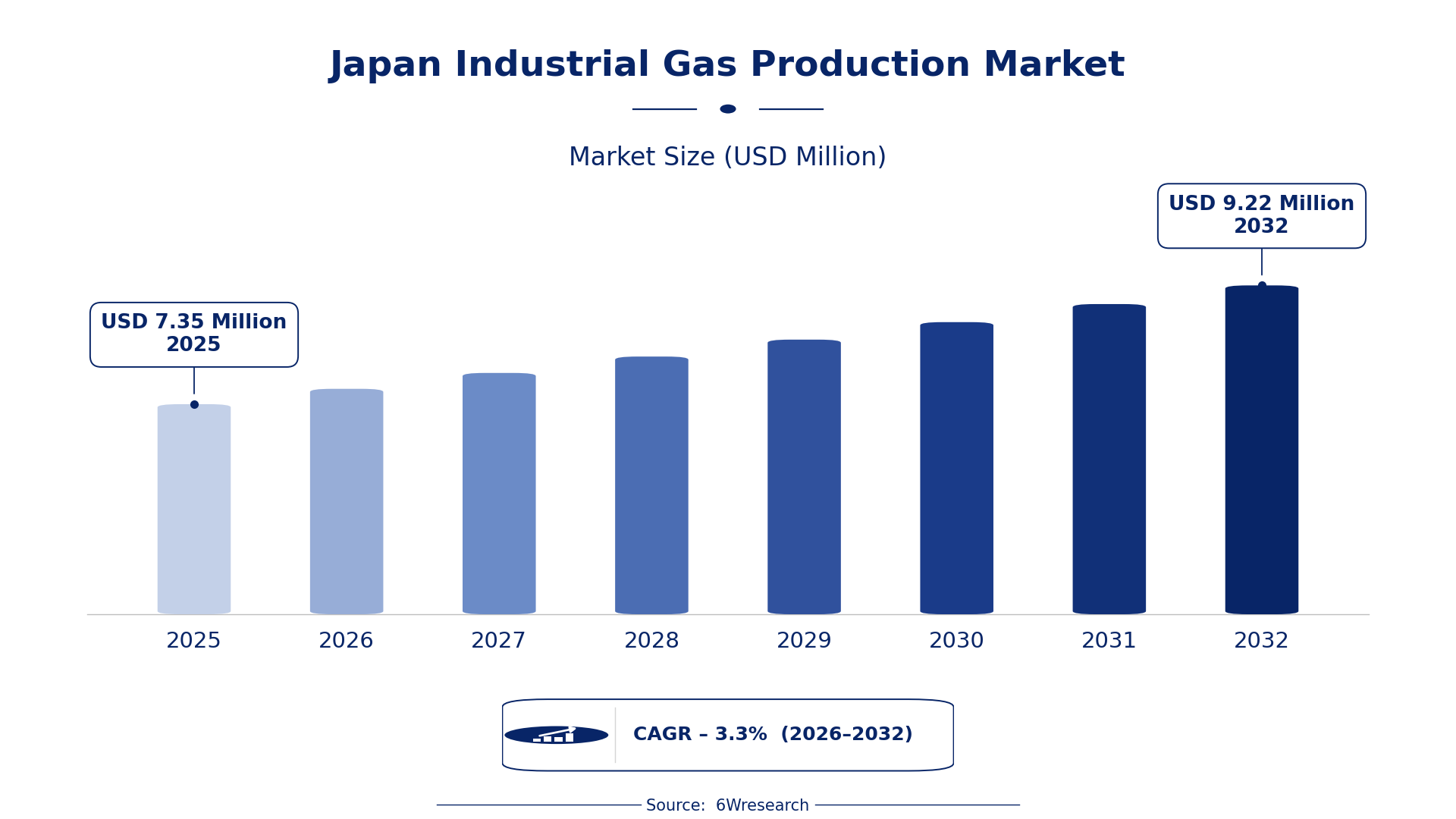
According to 6Wresearch internal database and industry insights, the Japan Industrial Gas Production Market was valued at USD 7.35 Million in 2025 and is projected to reach USD 9.22 Million by 2032, growing at a CAGR of approximately 3.3% during 2026–2032.
Japan Industrial Gas Production Market Highlights
| Report Metric | Details |
| Report Name | Japan Industrial Gas Production Market (2026-2032) |
| Market Size 2025 | USD 7.35 Million |
| Market Size 2032 | USD 9.22 Million |
| Absolute Growth 2025–2032 | USD 1.87 Million |
| CAGR 2026–2032 | 3.3% |
| Peak Annual Growth | 3.9% in 2026 |
| Forecast Period | 2026–2032 |
| Historical Data | 2022–2025 |
| Base Year | 2025 |
| Leading Gas Type, 2025 | Oxygen (41% share) |
| Leading Production Method, 2025 | Cryogenic Distillation (42% share) |
| Leading Storage Format, 2025 | Liquid / Cylinder (41% share) |
| Leading End User, 2025 | Steel & Welding Industry (38% share) |
| Fastest-Growing Gas Type | Hydrogen (4.7% CAGR) |
| Fastest-Growing Production Method | Electrolysis / Reforming (4.8% CAGR) |
| Fastest-Growing Storage Format | Pressurized / Gas Banks (4.9% CAGR) |
| Fastest-Growing End User | Energy & Fuel Applications (4.5% CAGR) |
| Growing Sector | Energy & Fuel Applications |
| Key End Users | Steel & Welding Industry, Electronics Industry, Beverage Industry, Energy Sector |
Japan Industrial Gas Production Market Year-wise Growth Rate and Key Drivers (2022–2032)
This graph illustrates the annual growth rates of the market from 2022 to 2032, highlighting a steady upward trajectory and projected market expansion over the forecast period.
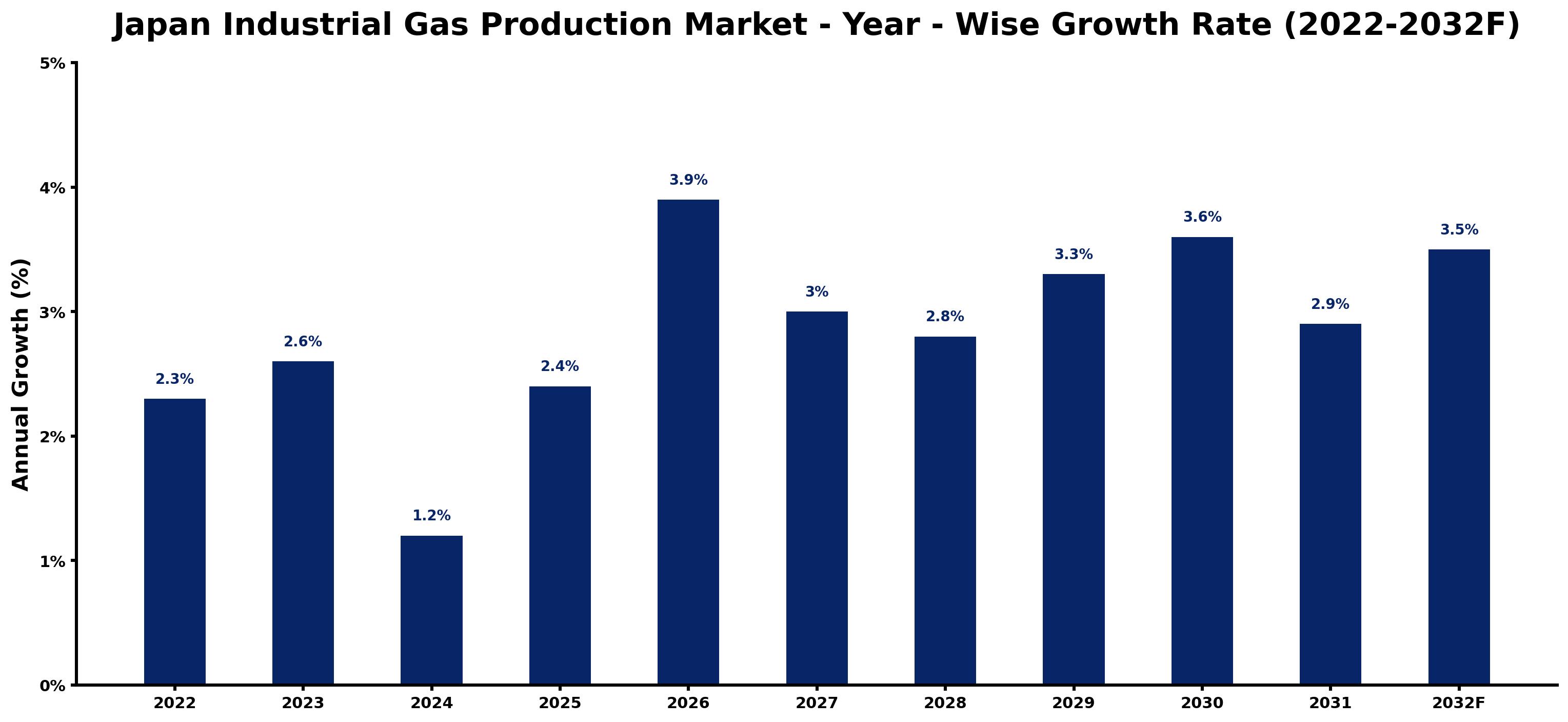
Each row of the following table gives one year's estimated growth and the event or demand shift that explains it.
| Year | Estimated Annual Growth (%) | Market Rationale |
| 2022 | 2.3 | The market experienced moderate growth due to steady industrial activity. |
| 2023 | 2.6 | Growth accelerated as demand from the steel industry increased. |
| 2024 | 1.2 | Growth slowed as energy prices affected production costs in various sectors. |
| 2025 | 2.4 | Demand rebounded as investments in hydrogen infrastructure gained traction. |
| 2026 | 3.9 | The peak growth year saw heightened activity in the energy sector. |
| 2027 | 3.0 | Growth slowed as the market stabilises after the peak in 2026. |
| 2028 | 2.8 | Demand continued to grow, albeit at a slower pace than previous years. |
| 2029 | 3.3 | Increased investments in green technologies spurred faster growth again. |
| 2030 | 3.6 | Growth remained strong as hydrogen adoption in energy applications expanded. |
| 2031 | 2.9 | The market saw a slowdown as demand stabilised across key sectors. |
| 2032 | 3.5 | Growth picked up due to rising investments in industrial gas technologies. |
Note: Market size estimations and growth projections presented in this report are based on 6Wresearch's proprietary forecasting methodology, utilizing the latest available industry data, government publications, and primary research inputs.
Japan Industrial Gas Production Market Synopsis
Industrial gas production involves creating gases such as oxygen, hydrogen, and nitrogen through methods like cryogenic distillation and electrolysis. The Japan Industrial Gas Production Market is growing due to rising demand from the steel industry, which accounted for 40% of consumption in 2022. Investments in hydrogen infrastructure, supported by government initiatives targeting JPY 150 trillion in decarbonisation over ten years, further fuel this growth. The energy sector's shift towards hydrogen as a clean fuel source also contributes to the market's expansion, promising a dynamic future.
Market Dynamics Impact Analysis (2026–2032)
| Factor | Type | Impact | Primary Segment Affected |
| Rising demand from the steel industry drives consumption of industrial gases. | Driver | High | Oxygen |
| Investment in hydrogen infrastructure enhances production capabilities. | Driver | High | Hydrogen |
| Growing beverage industry increases demand for CO2 in carbonation. | Opportunity | High | Carbon Dioxide |
| Expansion of hydrogen fueling stations supports the hydrogen market. | Opportunity | High | Hydrogen |
| High production costs limit profitability for some producers. | Restraint | Medium | Nitrogen |
| Regulatory compliance can increase operational burdens on producers. | Restraint | Medium | Oxygen |
| Technological advancements may outpace some producers' capabilities. | Challenge | High | Hydrogen |
| Competition from alternative energy sources poses risks to market share. | Challenge | High | Energy & Fuel Applications |
Evaluation of Drivers in Japan Industrial Gas Production Market (2026–2032)
Below are the drivers that matter most for revenue growth, with supporting evidence.
| Drivers | Primary Segment Affected | Why It Matters (Evidence) |
| Increased steel production leads to higher oxygen consumption. | Oxygen | Japan produced approximately 2 million tons of oxygen in 2022, primarily for steel manufacturing. |
| Hydrogen demand rises due to its use in fuel cells and refining processes. | Hydrogen | Japan has over 100 hydrogen fueling stations as of 2023, driving adoption in various sectors. |
| Growing nitrogen needs in food preservation boost production. | Nitrogen | The electronics industry is a key user of nitrogen for manufacturing processes, increasing demand. |
| Carbon dioxide demand increases with the beverage industry's growth. | Carbon Dioxide | Japan's beverage industry uses 1.5 million tons of CO2 annually for carbonation, raising overall consumption. |
| Technological advancements in production methods improve efficiency. | Cryogenic Distillation | New technologies are widely adopted in nitrogen production in Japan, enhancing output. |
Volumes grow on the back of rising steel production, which accounted for 40% of industrial gas consumption in 2022. The electronics sector's demand for nitrogen further drives growth, as it is essential for semiconductor manufacturing. The beverage industry utilizes 1.5 million tons of CO2 annually for carbonation, increasing overall gas consumption. The establishment of over 100 hydrogen fueling stations in Japan supports the hydrogen market, while advancements in production technologies improve nitrogen production efficiency. Investments in hydrogen infrastructure are expected to further boost demand across various sectors.
Evaluation of Restraints in Japan Industrial Gas Production Market
Below are the constraints most often cited by buyers and suppliers, with the segment each affects.
| Market Restraint | Primary Segment Affected | Why It Matters (Evidence) |
| High production costs limit profitability for nitrogen producers. | Nitrogen | Production costs have risen due to fluctuating energy prices, impacting profitability. |
| Regulatory compliance increases operational burdens on oxygen producers. | Oxygen | Producers must adhere to the Industrial Safety and Health Act, which raises operational costs by 10%. |
| Limited technological capabilities hinder some producers' competitiveness in hydrogen. | Hydrogen | Some producers struggle to keep pace with rapid technological advancements, affecting their market position. |
| Market saturation in certain regions restricts growth opportunities for CO2. | Carbon Dioxide | Major consumption regions like Tokyo and Osaka face increased competition, limiting expansion prospects. |
| Dependence on traditional energy sources slows transition to cleaner technologies. | Energy & Fuel Applications | Some sectors remain reliant on fossil fuels, delaying hydrogen adoption and hindering growth. |
Japan Industrial Gas Production Market Challenges
Skills shortages in advanced production techniques hinder output quality, delaying deliveries for producers and raising costs by 15%. Buyers in the steel industry face increasing prices as they account for 40% of industrial gas consumption, straining their budgets. Supply chain disruptions arise from inadequate hydrogen fueling stations, leading to service delays for energy sector clients. Heightened competition from new entrants adopting advanced technologies compels established suppliers to invest significantly in upgrades, diverting resources and slowing growth for existing players.
Trends in the Japan Industrial Gas Production Market
Four trends stand out in the Japan Industrial Gas Production Market.
- Shift in Steel Industry Practices: The steel industry is increasingly adopting hydrogen as a reducing agent, with government initiatives promoting this transition. This shift began in 2023, aiming to reduce carbon emissions by 46% by 2030.
- Emergence of Hydrogen as a Key Energy Source: The Hydrogen Society Promotion Act, enacted in 2024, promotes low-carbon hydrogen supply chains. This initiative is expected to drive hydrogen production and infrastructure development considerably.
- Transition to Advanced Production Technologies: The adoption of new production technologies in nitrogen production is on the rise, with a projected efficiency increase of 4.9% by 2032. This trend is reshaping production methods across the industry.
- Expansion of Beverage Industry Demand: Japan's beverage industry is projected to grow, leading to increased CO2 demand. This trend is evidenced by the consumption of 1.5 million tons of CO2 annually for carbonation.
Investment Opportunities in the Japan Industrial Gas Production Market
The following opportunities in the Japan Industrial Gas Production Market pair current demand with a clear way in.
- Investment in Hydrogen Infrastructure: There is an opportunity to invest in hydrogen infrastructure development, with the government allocating $1 billion through 2025. Collaborating with local governments can facilitate entry into this expanding market.
- Supply of Advanced Production Technologies: The demand for advanced production technologies presents an opportunity for suppliers. The steel and electronics industries are seeking efficient solutions to improve production capabilities.
- Expansion in Beverage CO2 Supply: The beverage industry's growth creates an opportunity to supply CO2. With a projected increase in demand, suppliers can target the beverage sector for expansion.
- Development of Onsite Gas Production Facilities: Investing in liquid onsite plants is timely, given the rising demand for immediate gas supply. Targeting industrial hubs like Tokyo can enhance market presence.
Government Initiatives in the Japan Industrial Gas Production Market
The Hydrogen Society Promotion Act, enacted in 2024, supports low-carbon hydrogen supply chains with price-gap support. This measure builds on the GX Promotion Act of 2023, which established a legal framework for decarbonisation efforts. Together, these laws aim to facilitate investments in hydrogen technologies and infrastructure, promoting sustainable energy practices across Japan.
Buyers in the hydrogen sector benefit from the Ministry of the Environment's initiatives, which promote hydrogen as part of the national energy strategy. The government has allocated $1 billion for hydrogen infrastructure development through 2025, enabling buyers to access funding for projects that improve hydrogen production and distribution.
Future Insight of the Japan Industrial Gas Production Market
By 2032, the steel industry will adopt green hydrogen technologies, driven by government support for decarbonisation. Local governments will launch energy efficiency programmes, reducing operational costs for buyers. Suppliers will need to comply with evolving standards like ISO 9001 and JIS B 8240 to maintain product quality and safety. Japan's beverage industry will see CO2 consumption rise to 1.5 million tons annually, presenting new opportunities for producers.
Market Segmentation Analysis
Japan Industrial Gas Production Market report covers a detailed analysis of the following market segments:
By Gas Type – Oxygen Leads, Hydrogen Expected to Grow Fastest
According to Saurav Kr Singh, Senior Research Analyst at 6Wresearch, in 2025, Oxygen led the gas type split with a 41% share. Oxygen holds the largest share because it is crucial for steel production, which accounts for 40% of industrial gas consumption in Japan. Additionally, its application in medical settings further strengthens its demand across multiple sectors. Over 2026–2032, Hydrogen is expected to post the fastest growth, at a CAGR of 4.7%. Hydrogen is experiencing rapid growth as Japan's energy sector shifts towards hydrogen solutions, with government initiatives promoting its use and a $1 billion investment in infrastructure planned through 2025. This trend will likely continue as the number of hydrogen fueling stations expands, enhancing accessibility. Suppliers should focus on increasing hydrogen production capabilities to meet the growing demand from the energy sector.
By Production Method – Cryogenic Distillation Leads, Electrolysis / Reforming Expected to Grow Fastest
Cryogenic Distillation accounted for 42% of the market by production method in 2025. Cryogenic Distillation is the leading method for producing oxygen and nitrogen, vital for industries such as steel manufacturing. Its established efficiency and reliability make it the method of choice among producers in Japan. Electrolysis / Reforming is set to record the highest CAGR in this split, 4.8% over 2026–2032. Electrolysis and Reforming are gaining prominence as they align with Japan's decarbonisation objectives, particularly for hydrogen production. The government's commitment to developing hydrogen infrastructure is likely to accelerate the adoption of these methods. Suppliers should invest in electrolysis technology to seize opportunities in the expanding hydrogen market.
By Storage Format – Liquid / Cylinder Leads, Pressurized / Gas Banks Expected to Grow Fastest
Liquid / Cylinder held 41% of the Japan Industrial Gas Production Market by storage format in 2025. Liquid and Cylinder storage formats are widely used for the transport and storage of industrial gases, making them the most prevalent choice among users. Their versatility and efficiency in handling various gases contribute to their leading position. Pressurized / Gas Banks are projected to grow fastest, at a CAGR of 4.9% during 2026–2032. Pressurised Gas Banks are emerging as the fastest-growing storage solution due to their suitability for large-scale applications, particularly in the energy sector. The increasing demand for hydrogen storage solutions is propelling this growth. Suppliers must consider expanding their offerings in pressurised gas storage to meet the evolving needs of large-scale applications.
By End User – Steel & Welding Industry Leads, Energy & Fuel Applications Expected to Grow Fastest
The largest end user category in 2025 was Steel & Welding Industry, at 38% of revenue. The Steel and Welding Industry leads in industrial gas consumption due to its significant reliance on gases for production processes. This sector's major share underscores its vital importance within Japan's industrial landscape. The quickest growth will come from Energy & Fuel Applications, forecast to expand at a CAGR of 4.5% between 2026 and 2032. Energy and Fuel Applications are growing swiftly as Japan transitions towards hydrogen as a primary energy source, with national policies encouraging its adoption. This shift is expected to greatly increase the demand for industrial gases in this sector. Suppliers must adapt their strategies to cater to the rising needs of the energy sector, particularly in hydrogen applications.
Key Attractiveness of the Report
- 10 Years of Market Numbers
- Historical Data Starting from 2022 to 2025
- Base Year 2025
- Forecast Data until 2032
- Key Performance Indicators Impacting the Market
- Major Upcoming Developments and Projects
Key Highlights of the Report:
- Japan Industrial Gas Production Market Outlook
- Market Size of Japan Industrial Gas Production Market, 2025
- Forecast of Japan Industrial Gas Production Market, 2032
- Historical Data and Forecast of Japan Industrial Gas Production Revenues & Volume for the Period 2022-2032F
- Japan Industrial Gas Production Market Trend Evolution
- Japan Industrial Gas Production Market Drivers and Challenges
- Japan Industrial Gas Production Price Trends
- Japan Industrial Gas Production Porter's Five Forces
- Japan Industrial Gas Production Industry Life Cycle
- Historical Data and Forecast of Japan Industrial Gas Production Market Revenues & Volume By Gas Type for the Period 2022-2032F
- Historical Data and Forecast of Japan Industrial Gas Production Market Revenues & Volume By Oxygen for the Period 2022-2032F
- Historical Data and Forecast of Japan Industrial Gas Production Market Revenues & Volume By Hydrogen for the Period 2022-2032F
- Historical Data and Forecast of Japan Industrial Gas Production Market Revenues & Volume By Nitrogen for the Period 2022-2032F
- Historical Data and Forecast of Japan Industrial Gas Production Market Revenues & Volume By Carbon Dioxide for the Period 2022-2032F
- Historical Data and Forecast of Japan Industrial Gas Production Market Revenues & Volume By Production Method for the Period 2022-2032F
- Historical Data and Forecast of Japan Industrial Gas Production Market Revenues & Volume By Cryogenic Distillation for the Period 2022-2032F
- Historical Data and Forecast of Japan Industrial Gas Production Market Revenues & Volume By Electrolysis / Reforming for the Period 2022-2032F
- Historical Data and Forecast of Japan Industrial Gas Production Market Revenues & Volume By Pressure Swing Adsorption for the Period 2022-2032F
- Historical Data and Forecast of Japan Industrial Gas Production Market Revenues & Volume By Captured/Byproduct for the Period 2022-2032F
- Historical Data and Forecast of Japan Industrial Gas Production Market Revenues & Volume By Storage Format for the Period 2022-2032F
- Historical Data and Forecast of Japan Industrial Gas Production Market Revenues & Volume By Liquid / Cylinder for the Period 2022-2032F
- Historical Data and Forecast of Japan Industrial Gas Production Market Revenues & Volume By Pressurized / Gas Banks for the Period 2022-2032F
- Historical Data and Forecast of Japan Industrial Gas Production Market Revenues & Volume By Liquid / Onsite Plants for the Period 2022-2032F
- Historical Data and Forecast of Japan Industrial Gas Production Market Revenues & Volume By Cylinders/Tankers for the Period 2022-2032F
- Historical Data and Forecast of Japan Industrial Gas Production Market Revenues & Volume By End User for the Period 2022-2032F
- Historical Data and Forecast of Japan Industrial Gas Production Market Revenues & Volume By Steel & Welding Industry for the Period 2022-2032F
- Historical Data and Forecast of Japan Industrial Gas Production Market Revenues & Volume By Energy & Fuel Applications for the Period 2022-2032F
- Historical Data and Forecast of Japan Industrial Gas Production Market Revenues & Volume By Electronics & Inerting Use for the Period 2022-2032F
- Historical Data and Forecast of Japan Industrial Gas Production Market Revenues & Volume By Beverage & Fire Control for the Period 2022-2032F
- Japan Industrial Gas Production Import Export Trade Statistics
- Market Opportunity Assessment By Gas Type
- Market Opportunity Assessment By Production Method
- Market Opportunity Assessment By Storage Format
- Market Opportunity Assessment By End User
- Japan Industrial Gas Production Top Companies Market Share
- Japan Industrial Gas Production Competitive Benchmarking By Technical and Operational Parameters
- Japan Industrial Gas Production Company Profiles
- Japan Industrial Gas Production Key Strategic Recommendations
Market Covered
Segments analysed in this report are listed below.
By Gas Type
- Oxygen
- Hydrogen
- Nitrogen
- Carbon Dioxide
By Production Method
- Cryogenic Distillation
- Electrolysis / Reforming
- Pressure Swing Adsorption
- Captured/Byproduct
By Storage Format
- Liquid / Cylinder
- Pressurized / Gas Banks
- Liquid / Onsite Plants
- Cylinders/Tankers
By End User
- Steel & Welding Industry
- Energy & Fuel Applications
- Electronics & Inerting Use
- Beverage & Fire Control































