Japan Industrial Heat Exchangers Market Size & Growth Rate
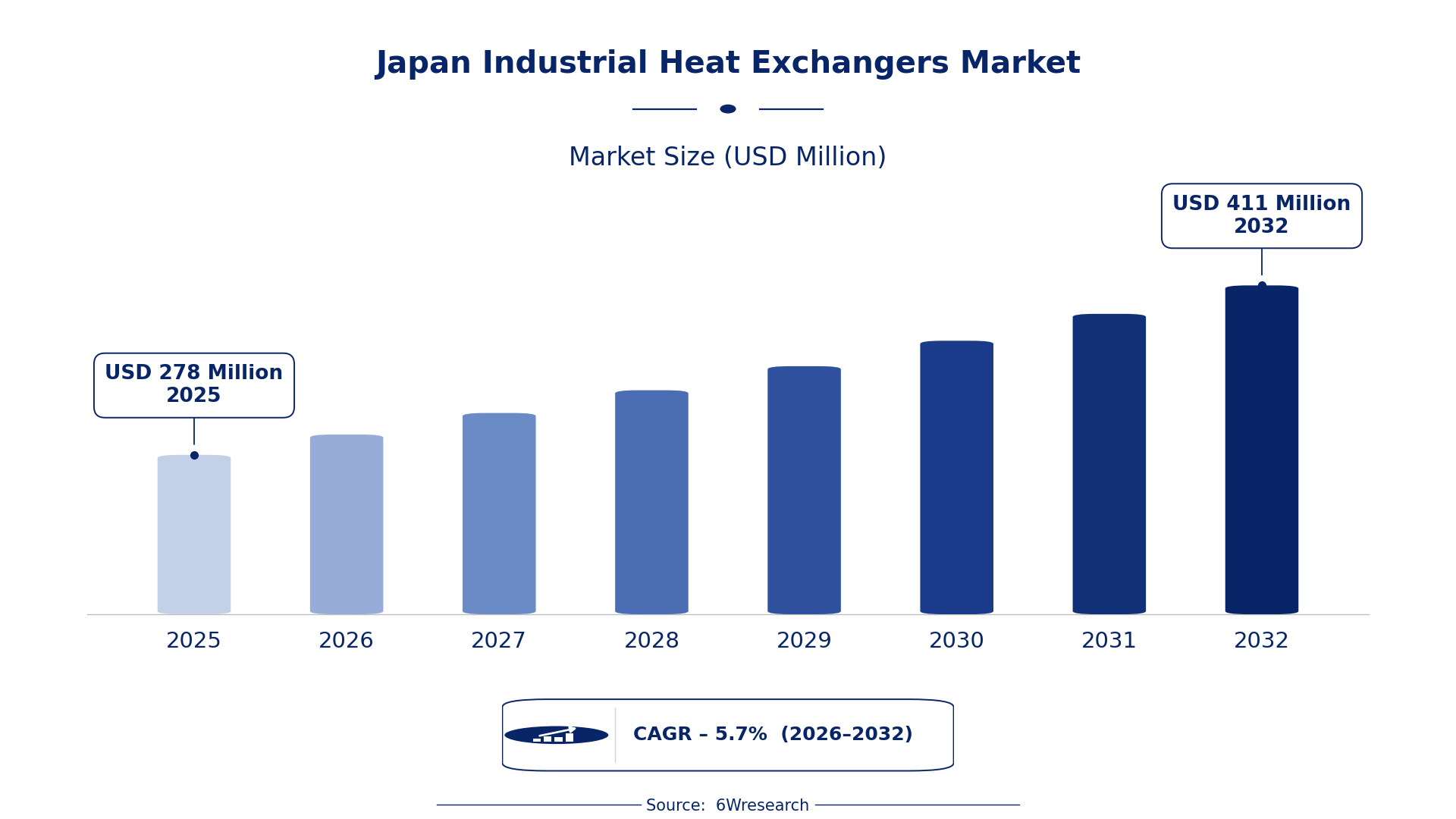
According to 6Wresearch internal database and industry insights, the Japan Industrial Heat Exchangers Market was valued at USD 278 Million in 2025 and is projected to reach USD 411 Million by 2032, growing at a CAGR of approximately 5.7% during 2026–2032.
Japan Industrial Heat Exchangers Market Highlights
| Report Metric | Details |
| Report Name | Japan Industrial Heat Exchangers Market (2026-2032) |
| Market Size 2025 | USD 278 Million |
| Market Size 2032 | USD 411 Million |
| Absolute Growth 2025–2032 | USD 133 Million |
| CAGR 2026–2032 | 5.7% |
| Peak Annual Growth | 6.5% in 2028 |
| Forecast Period | 2026–2032 |
| Historical Data | 2022–2025 |
| Base Year | 2025 |
| Leading Exchanger Type, 2025 | Shell and Tube (48% share) |
| Leading Heat Transfer Mechanism, 2025 | Conduction (44% share) |
| Leading Configuration, 2025 | Horizontal/Vertical (44% share) |
| Leading End User, 2025 | Petrochemical Refineries (39% share) |
| Fastest-Growing Exchanger Type | Plate Heat Exchangers (8.2% CAGR) |
| Fastest-Growing Heat Transfer Mechanism | Surface Contact (7.4% CAGR) |
| Fastest-Growing Configuration | Gasketed/Brazed (7.7% CAGR) |
| Fastest-Growing End User | Food Processing Plants (7.5% CAGR) |
| Growing Sector | Food Processing Plants |
| Key End Users | Petrochemical Refineries, Food Processing Plants, Power Plants, HVAC & Refrigeration |
Japan Industrial Heat Exchangers Market Year-wise Growth Rate and Key Drivers (2022–2032)
This graph illustrates the annual growth rates of the market from 2022 to 2032, highlighting a steady upward trajectory and projected market expansion over the forecast period.
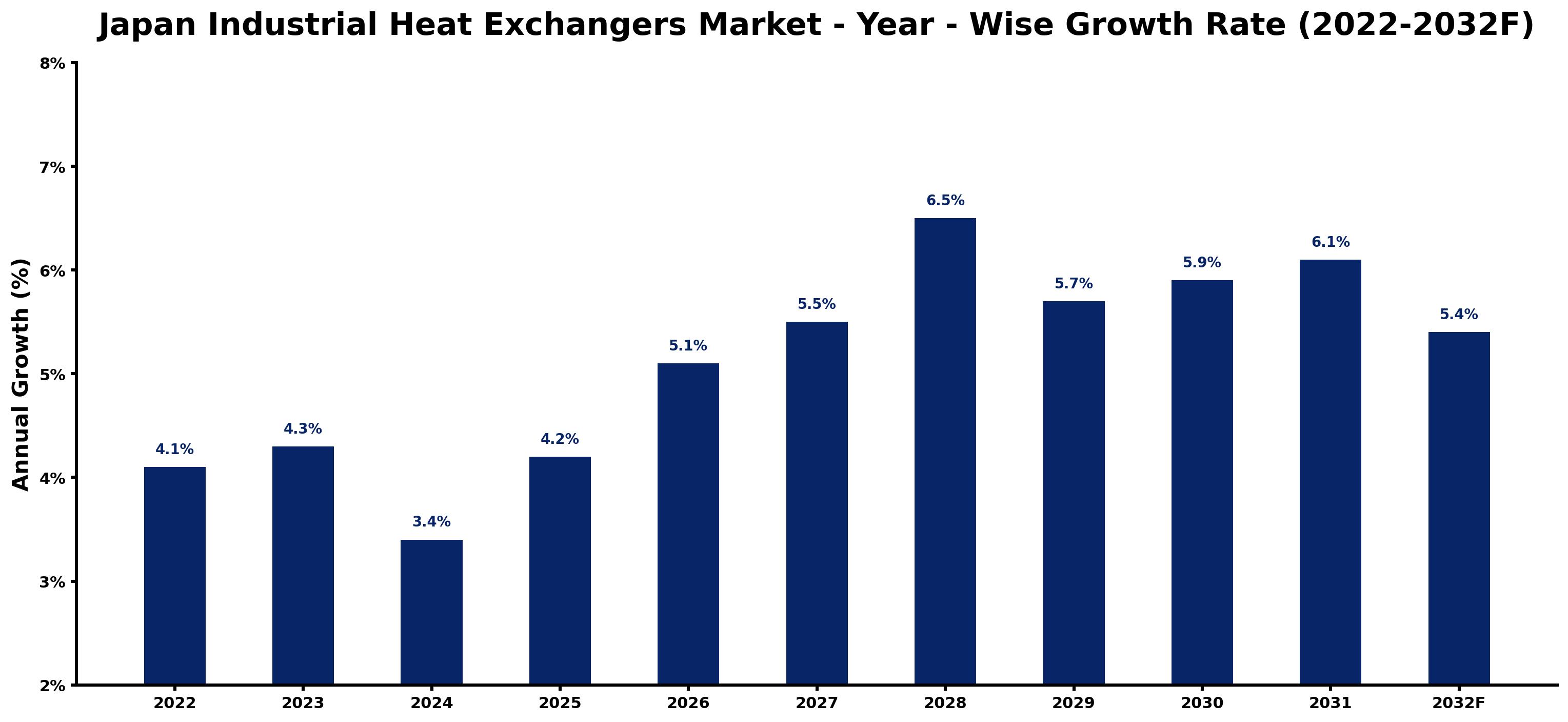
Below, each year's estimated growth is shown next to the factor that most influenced it.
| Year | Estimated Annual Growth (%) | Market Rationale |
| 2022 | 4.1 | The market displayed steady activity with ongoing industrial operations driving demand. |
| 2023 | 4.3 | Growth accelerated as industrial sectors increased investments in energy efficiency technologies. |
| 2024 | 3.4 | A slowdown occurred as some sectors faced temporary project delays and budget adjustments. |
| 2025 | 4.2 | Demand rebounded as industries sought to upgrade aging infrastructure and improve efficiency. |
| 2026 | 5.1 | Growth is expected to resume as energy efficiency programs gain traction across various sectors. |
| 2027 | 5.5 | Investments in decarbonisation initiatives are projected to further boost market demand. |
| 2028 | 6.5 | The market is expected to peak as extensive upgrades in industrial facilities drive purchases. |
| 2029 | 5.7 | A slight slowdown is anticipated as some projects reach completion and demand stabilises. |
| 2030 | 5.9 | Growth will pick up again as new energy regulations prompt further investments. |
| 2031 | 6.1 | Demand is expected to continue rising with increasing focus on sustainability in industrial processes. |
| 2032 | 5.4 | The market is projected to experience a slowdown as growth stabilises following peak investments. |
Note: Market size estimations and growth projections presented in this report are based on 6Wresearch's proprietary forecasting methodology, utilizing the latest available industry data, government publications, and primary research inputs.
Japan Industrial Heat Exchangers Market Synopsis
Industrial heat exchangers transfer heat between fluids and are essential in cooling, heating, and condensing processes across various industries. The Japan Industrial Heat Exchangers Market is growing due to investments in energy efficiency, driven by over 1,200 petrochemical refineries and a food processing sector valued at approximately 10 trillion JPY. The ongoing push for decarbonisation, supported by Japan's GX Basic Policy, will further stimulate demand for these devices, particularly in power generation and HVAC applications.
Market Dynamics Impact Analysis (2026–2032)
| Factor | Type | Impact | Primary Segment Affected |
| Increasing investments in energy efficiency programmes | Driver | High | Shell and Tube |
| Rising demand from the food processing sector | Driver | High | Plate Heat Exchangers |
| Growing need for efficient cooling solutions | Opportunity | High | Air Cooled Heat Exchangers |
| Expansion of petrochemical facilities | Opportunity | High | Condensers and Evaporators |
| High initial costs of advanced systems | Restraint | Medium | Shell and Tube |
| Limited awareness of energy-efficient technologies | Restraint | Medium | Plate Heat Exchangers |
| Competition from alternative cooling technologies | Challenge | Medium | Air Cooled Heat Exchangers |
| Regulatory compliance challenges for manufacturers | Challenge | Medium | Condensers and Evaporators |
Evaluation of Drivers in Japan Industrial Heat Exchangers Market (2026–2032)
These are the developments adding the most demand over the forecast period.
| Drivers | Primary Segment Affected | Why It Matters (Evidence) |
| Investment in energy efficiency initiatives | Shell and Tube | Japan has invested 500 billion JPY in energy efficiency programs, prompting manufacturers to upgrade their heat exchangers. |
| Demand from food processing plants | Plate Heat Exchangers | The food processing sector, valued at approximately 10 trillion JPY, drives the need for efficient heat transfer solutions. |
| Electricity generation requirements | Air Cooled Heat Exchangers | Power plants generating over 1,000 TWh of electricity annually require advanced cooling solutions to improve efficiency. |
| Regulatory pressure for decarbonisation | Condensers and Evaporators | Japan targets a 46% reduction in greenhouse gas emissions by 2030, increasing demand for efficient heat exchangers. |
| Technological advancements in heat exchanger design | Shell and Tube | Innovations in heat exchanger technology improve performance, attracting investments from various industrial sectors. |
The food processing sector drives demand for heat exchangers, particularly in facilities requiring precise temperature control. Additionally, ongoing advancements in heat exchanger designs attract investments from various sectors, as manufacturers seek to optimise operations and reduce energy consumption.
Evaluation of Restraints in Japan Industrial Heat Exchangers Market
The key brakes on demand, and where they bite hardest, are shown below.
| Market Restraint | Primary Segment Affected | Why It Matters (Evidence) |
| High initial costs for advanced heat exchangers | Shell and Tube | The substantial investment required for advanced systems can deter some manufacturers from upgrading. |
| Limited awareness of energy-efficient technologies | Plate Heat Exchangers | Many potential buyers lack knowledge about the benefits of energy-efficient heat exchangers, hindering adoption. |
| Competition from alternative cooling technologies | Air Cooled Heat Exchangers | Emerging technologies may offer lower-cost solutions, impacting demand for traditional heat exchangers. |
| Regulatory compliance challenges for manufacturers | Condensers and Evaporators | Manufacturers face difficulties in meeting stringent regulations, which can delay product development. |
| Supply chain disruptions affecting material availability | Shell and Tube | Ongoing global supply chain issues can lead to delays in production and increased costs. |
Japan Industrial Heat Exchangers Market Challenges
A shortage of skilled technicians hampers production efficiency, as fewer qualified workers enter the industrial sector, leading to longer lead times for suppliers. Escalating raw material costs, driven by global supply chain pressures, raise production expenses for manufacturers, potentially increasing prices for buyers in the food processing sector by up to 15%. Rapid technological advancements require frequent upgrades for producers, disrupting supply chains for power plants that depend on effective heat transfer solutions. Stringent regulations like JIS B 8350 impose compliance costs on manufacturers, causing delays in deliveries for hospitals needing efficient exchangers for their systems.
Trends in the Japan Industrial Heat Exchangers Market
The shifts below are changing how Japan Industrial Heat Exchangers Market products are bought and supplied.
- Shift towards Energy-Efficient Designs: The Tokyo metropolitan area is experiencing a shift towards energy-efficient heat exchanger designs, prompted by regulatory pressures. In 2023, the government announced a subsidy program for upgrading industrial heat exchangers, improving efficiency across sectors.
- Increase in Decarbonisation Investments: Japan's GX Basic Policy, adopted in 2023, targets about JPY 150 trillion of public and private decarbonisation investment over 10 years. This funding is projected to boost demand for advanced heat exchangers in various industries.
- Growing Adoption of Plate Heat Exchangers: Plate heat exchangers are increasingly preferred for their compact designs and high heat transfer rates. With an expected CAGR of 8.2% from 2026 to 2032, this trend reflects the industry's focus on space efficiency.
- Expansion of Petrochemical Facilities: The expansion of petrochemical refineries across Japan is driving demand for industrial heat exchangers. With over 1,200 refineries in operation, the need for efficient heat exchange solutions continues to rise.
Investment Opportunities in the Japan Industrial Heat Exchangers Market
The following areas offer the clearest openings for investors and suppliers in the Japan Industrial Heat Exchangers Market.
- Supply of Advanced Heat Exchangers: The demand for advanced heat exchangers is increasing, particularly in the petrochemical sector, which requires efficient solutions. With over 1,200 refineries, suppliers can target this market segment effectively.
- Investment in Energy Efficiency Solutions: The food processing sector presents a significant opportunity, valued at approximately 10 trillion JPY. Suppliers can enter this market by offering energy-efficient heat exchangers tailored to industry needs.
- Development of Innovative Cooling Technologies: With the HVAC market growing rapidly, there is a need for innovative cooling solutions. Suppliers can capitalise on this trend by developing advanced heat exchangers.
- Focus on Sustainability Initiatives: The Japanese government's commitment to achieving net zero by 2050 creates opportunities for heat exchanger suppliers. Engaging with local partners can facilitate entry into this expanding market.
Government Initiatives in the Japan Industrial Heat Exchangers Market
The GX Promotion Act (2023) establishes a legal framework for decarbonisation efforts, building on earlier laws like the Act on the Rational Use of Energy (1979) and the Industrial Safety and Health Act (1972). This new act promotes investment in energy-efficient technologies and practices, ensuring compliance with environmental standards, which directly impacts industrial heat exchanger manufacturers and their buyers.
The Ministry of the Environment oversees the implementation of energy efficiency programs, providing funding for projects that upgrade industrial heat exchangers. This support helps manufacturers meet regulatory requirements while improving operational performance, benefiting buyers across various sectors.
Future Insight of the Japan Industrial Heat Exchangers Market
The launch of new energy efficiency initiatives will drive the adoption of advanced industrial heat exchanger technologies by 2032, enhancing operational performance. The HVAC market, projected to reach 4 trillion JPY by 2025, will significantly increase demand for efficient exchangers in urban centres, particularly Tokyo. With 150 trillion JPY earmarked for decarbonisation investments, suppliers will experience a surge in orders for sustainable solutions. Ongoing efforts to achieve ISO 9001 certification will elevate quality standards, ensuring buyers access more reliable and efficient products.
Market Segmentation Analysis
Japan Industrial Heat Exchangers Market report covers a detailed analysis of the following market segments:
By Exchanger Type – Shell and Tube Leads, Plate Heat Exchangers Expected to Grow Fastest
According to Saurav Kr Singh, Senior Research Analyst at 6Wresearch, Shell and Tube accounted for 48% of the market by exchanger type in 2025. Shell and Tube heat exchangers dominate the market due to their widespread use in over 1,200 petrochemical refineries across Japan, which rely on their efficiency for large-scale operations. Their robust design and reliability make them the preferred choice for critical industrial applications. Plate Heat Exchangers are set to record the highest CAGR in this split, 8.2% over 2026–2032. Plate Heat Exchangers are rapidly gaining popularity as industries increasingly seek compact designs that deliver high heat transfer rates, especially in the food processing sector valued at approximately 10 trillion JPY. This trend is propelled by the growing emphasis on energy efficiency and space optimisation in manufacturing processes. Suppliers should focus on developing compact and efficient Plate Heat Exchangers to meet the rising market demand.
By Heat Transfer Mechanism – Conduction Leads, Surface Contact Expected to Grow Fastest
Conduction took 44% of heat transfer mechanism revenue in 2025, more than any other category. Conduction is the primary heat transfer mechanism, fundamental to the operation of most industrial heat exchangers, ensuring effective heat transfer across various applications. Its essential role in sectors such as power generation and petrochemicals reinforces its leading position in the market. Surface Contact is projected to grow fastest, at a CAGR of 7.4% during 2026–2032. Surface Contact is witnessing rapid growth as it significantly enhances heat exchange efficiency in modern designs, particularly in compact systems. As industries prioritise performance improvements, the importance of this mechanism is set to increase. Buyers should invest in technologies that optimise surface contact to improve overall heat exchange efficiency.
By Configuration – Horizontal/Vertical Leads, Gasketed/Brazed Expected to Grow Fastest
In 2025, Horizontal/Vertical led the configuration split with a 44% share. Horizontal/Vertical configurations are favoured for their flexibility in installation and ability to optimise efficiency across diverse industrial applications. This adaptability is particularly crucial for meeting the specific requirements of sectors such as power generation and petrochemicals. Over 2026–2032, Gasketed/Brazed is expected to post the fastest growth, at a CAGR of 7.7%. Gasketed/Brazed configurations are experiencing the fastest growth due to their ease of maintenance and superior performance in compact environments. As operational efficiency becomes a priority, these configurations are likely to see increased adoption. Manufacturers should concentrate on developing more gasketed and brazed options to align with the evolving preferences of end users.
By End User – Petrochemical Refineries Lead, Food Processing Plants Expected to Grow Fastest
With 39% of end user revenue in 2025, Petrochemical Refineries was the largest category. Petrochemical Refineries are the largest consumers of industrial heat exchangers, extensively utilising them for process efficiency and energy conservation. Their operational scale necessitates reliable and efficient heat exchange solutions to maintain high productivity levels. The quickest growth will come from Food Processing Plants, forecast to expand at a CAGR of 7.5% between 2026 and 2032. Food Processing Plants are experiencing the fastest growth as they increasingly rely on advanced heat exchangers to ensure product quality and safety in their operations. The substantial market value of this sector significantly contributes to the rising demand for heat exchangers. Manufacturers should tailor their products to meet the specific needs of food processing plants to capitalise on this expanding market segment.
Key Attractiveness of the Report
- 10 Years of Market Numbers
- Historical Data Starting from 2022 to 2025
- Base Year 2025
- Forecast Data until 2032
- Key Performance Indicators Impacting the Market
- Major Upcoming Developments and Projects
Key Highlights of the Report:
- Japan Industrial Heat Exchangers Market Outlook
- Market Size of Japan Industrial Heat Exchangers Market, 2025
- Forecast of Japan Industrial Heat Exchangers Market, 2032
- Historical Data and Forecast of Japan Industrial Heat Exchangers Revenues & Volume for the Period 2022-2032F
- Japan Industrial Heat Exchangers Market Trend Evolution
- Japan Industrial Heat Exchangers Market Drivers and Challenges
- Japan Industrial Heat Exchangers Price Trends
- Japan Industrial Heat Exchangers Porter's Five Forces
- Japan Industrial Heat Exchangers Industry Life Cycle
- Historical Data and Forecast of Japan Industrial Heat Exchangers Market Revenues & Volume By Exchanger Type for the Period 2022-2032F
- Historical Data and Forecast of Japan Industrial Heat Exchangers Market Revenues & Volume By Shell and Tube for the Period 2022-2032F
- Historical Data and Forecast of Japan Industrial Heat Exchangers Market Revenues & Volume By Plate Heat Exchangers for the Period 2022-2032F
- Historical Data and Forecast of Japan Industrial Heat Exchangers Market Revenues & Volume By Air Cooled Heat Exchangers for the Period 2022-2032F
- Historical Data and Forecast of Japan Industrial Heat Exchangers Market Revenues & Volume By Condensers and Evaporators for the Period 2022-2032F
- Historical Data and Forecast of Japan Industrial Heat Exchangers Market Revenues & Volume By Heat Transfer Mechanism for the Period 2022-2032F
- Historical Data and Forecast of Japan Industrial Heat Exchangers Market Revenues & Volume By Conduction for the Period 2022-2032F
- Historical Data and Forecast of Japan Industrial Heat Exchangers Market Revenues & Volume By Surface Contact for the Period 2022-2032F
- Historical Data and Forecast of Japan Industrial Heat Exchangers Market Revenues & Volume By Air-Fin Cooling for the Period 2022-2032F
- Historical Data and Forecast of Japan Industrial Heat Exchangers Market Revenues & Volume By Phase Change for the Period 2022-2032F
- Historical Data and Forecast of Japan Industrial Heat Exchangers Market Revenues & Volume By Configuration for the Period 2022-2032F
- Historical Data and Forecast of Japan Industrial Heat Exchangers Market Revenues & Volume By Horizontal/Vertical for the Period 2022-2032F
- Historical Data and Forecast of Japan Industrial Heat Exchangers Market Revenues & Volume By Gasketed/Brazed for the Period 2022-2032F
- Historical Data and Forecast of Japan Industrial Heat Exchangers Market Revenues & Volume By Fan-Assisted for the Period 2022-2032F
- Historical Data and Forecast of Japan Industrial Heat Exchangers Market Revenues & Volume By Internal Circuits for the Period 2022-2032F
- Historical Data and Forecast of Japan Industrial Heat Exchangers Market Revenues & Volume By End User for the Period 2022-2032F
- Historical Data and Forecast of Japan Industrial Heat Exchangers Market Revenues & Volume By Petrochemical Refineries for the Period 2022-2032F
- Historical Data and Forecast of Japan Industrial Heat Exchangers Market Revenues & Volume By Food Processing Plants for the Period 2022-2032F
- Historical Data and Forecast of Japan Industrial Heat Exchangers Market Revenues & Volume By Power Plants for the Period 2022-2032F
- Historical Data and Forecast of Japan Industrial Heat Exchangers Market Revenues & Volume By HVAC & Refrigeration for the Period 2022-2032F
- Japan Industrial Heat Exchangers Import Export Trade Statistics
- Market Opportunity Assessment By Exchanger Type
- Market Opportunity Assessment By Heat Transfer Mechanism
- Market Opportunity Assessment By Configuration
- Market Opportunity Assessment By End User
- Japan Industrial Heat Exchangers Top Companies Market Share
- Japan Industrial Heat Exchangers Competitive Benchmarking By Technical and Operational Parameters
- Japan Industrial Heat Exchangers Company Profiles
- Japan Industrial Heat Exchangers Key Strategic Recommendations
Market Covered
The report covers the following segments.
By Exchanger Type
- Shell and Tube
- Plate Heat Exchangers
- Air Cooled Heat Exchangers
- Condensers and Evaporators
By Heat Transfer Mechanism
- Conduction
- Surface Contact
- Air-Fin Cooling
- Phase Change
By Configuration
- Horizontal/Vertical
- Gasketed/Brazed
- Fan-Assisted
- Internal Circuits
By End User
- Petrochemical Refineries
- Food Processing Plants
- Power Plants
- HVAC & Refrigeration































