Japan Industrial Heat Sink Market Size & Growth Rate
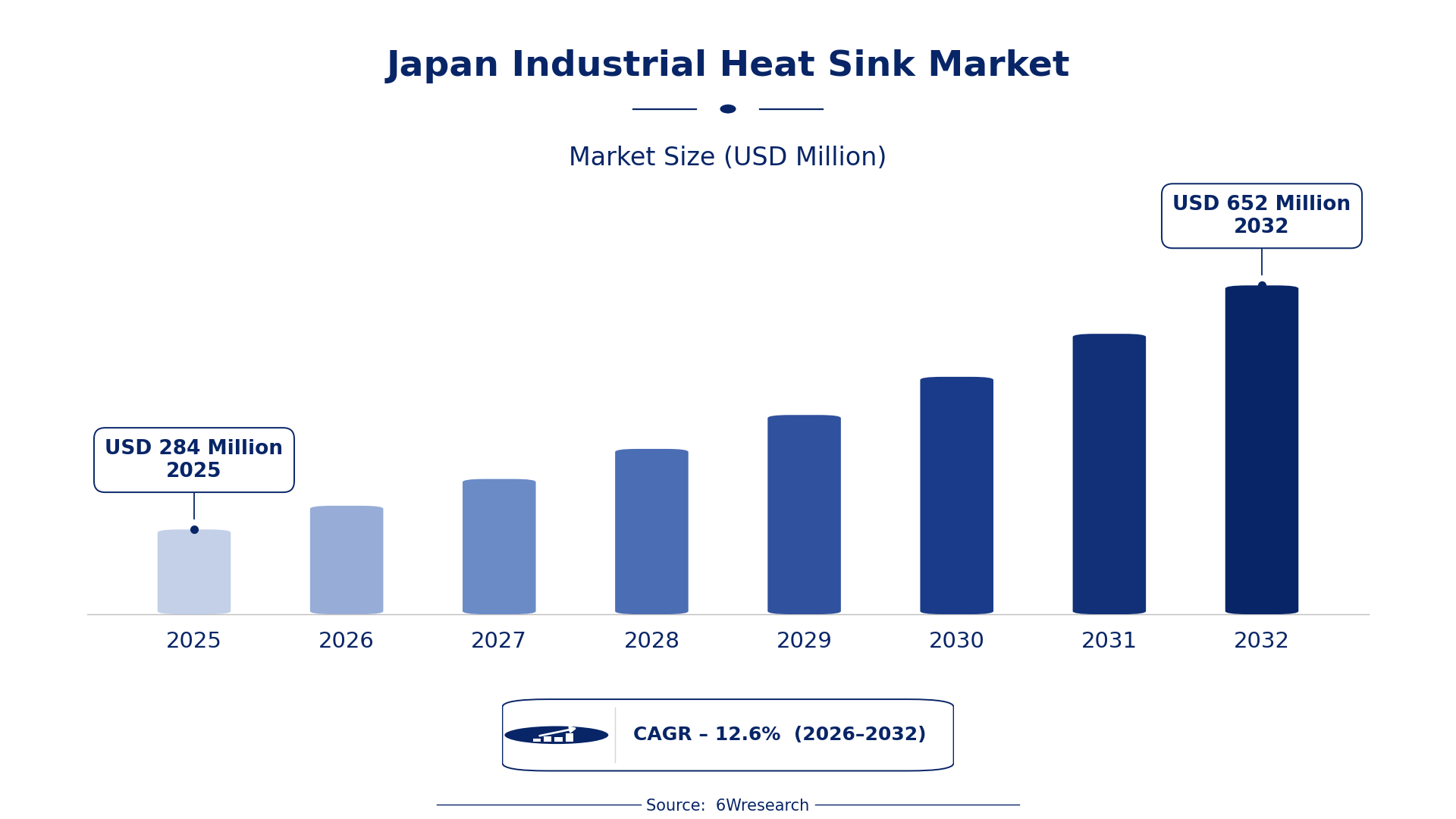
According to 6Wresearch internal database and industry insights, the Japan Industrial Heat Sink Market was valued at USD 284 Million in 2025 and is projected to reach USD 652 Million by 2032, growing at a CAGR of approximately 12.6% during 2026–2032.
Japan Industrial Heat Sink Market Highlights
| Report Metric | Details |
| Report Name | Japan Industrial Heat Sink Market (2026-2032) |
| Market Size 2025 | USD 284 Million |
| Market Size 2032 | USD 652 Million |
| Absolute Growth 2025–2032 | USD 368 Million |
| CAGR 2026–2032 | 12.6% |
| Peak Annual Growth | 13.7% in 2032 |
| Forecast Period | 2026–2032 |
| Historical Data | 2022–2025 |
| Base Year | 2025 |
| Leading Heat Sink Type, 2025 | Passive Heat Sinks (33% share) |
| Leading Material Type, 2025 | Aluminum (39% share) |
| Leading Cooling Method, 2025 | Natural Convection (38% share) |
| Leading End User, 2025 | Power Electronics (43% share) |
| Fastest-Growing Heat Sink Type | Active Heat Sinks (17.5% CAGR) |
| Fastest-Growing Material Type | Copper (18.1% CAGR) |
| Fastest-Growing Cooling Method | Forced Air Cooling (17.6% CAGR) |
| Fastest-Growing End User | Computing Servers (16.1% CAGR) |
| Growing Sector | automotive thermal management |
| Key End Users | electronics manufacturers, automotive producers, data center operators, LED lighting designers |
Japan Industrial Heat Sink Market Year-wise Growth Rate and Key Drivers (2022–2032)
This graph illustrates the annual growth rates of the market from 2022 to 2032, highlighting a steady upward trajectory and projected market expansion over the forecast period.
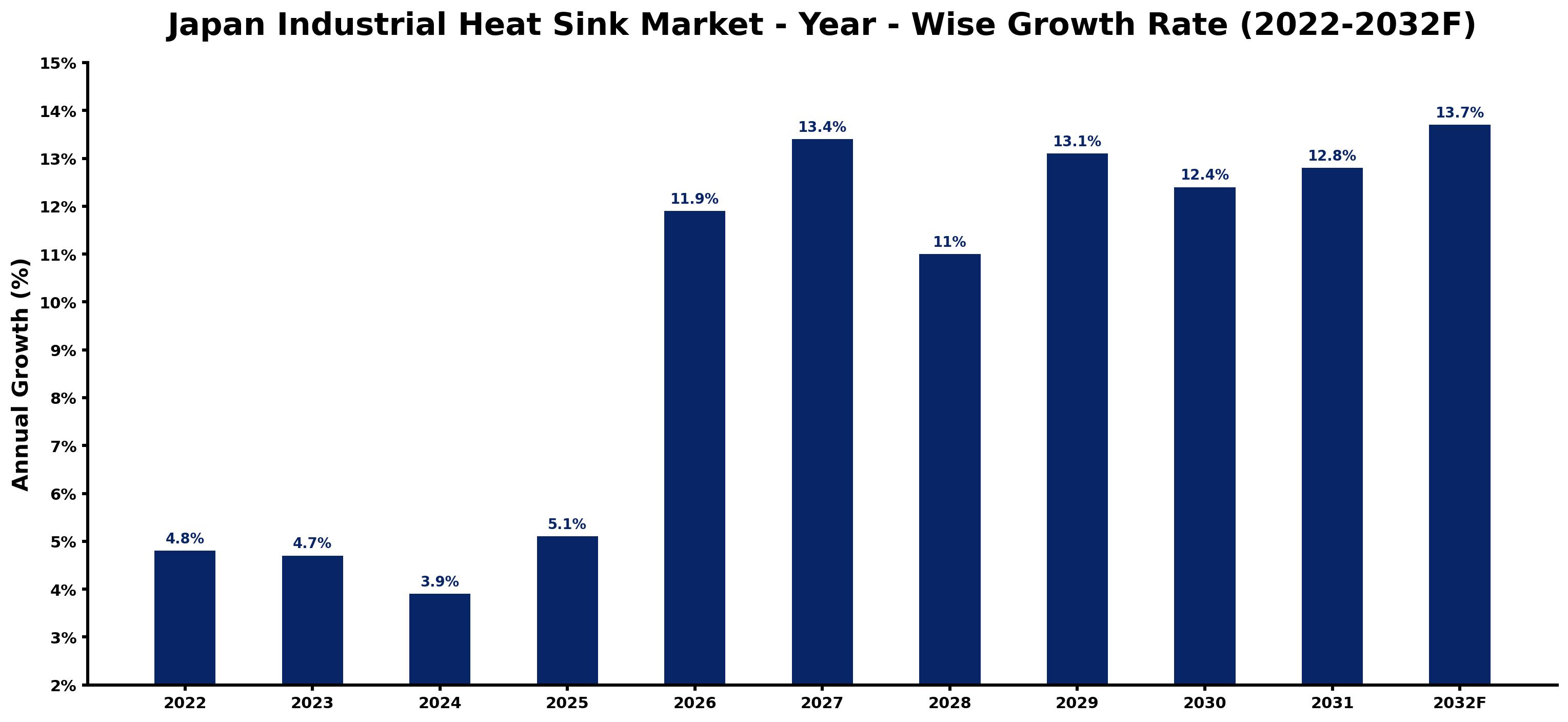
Year by year, the estimates below pair each growth rate with the development that shaped it.
| Year | Estimated Annual Growth (%) | Market Rationale |
| 2022 | 4.8 | Demand remained stable, supported by ongoing activity in the electronics sector. |
| 2023 | 4.7 | Growth slowed slightly as the market adjusted to previously high levels of demand. |
| 2024 | 3.9 | A further slowdown occurred as manufacturers focused on improving efficiency. |
| 2025 | 5.1 | Demand increased due to rising production in the automotive sector, driving heat sink needs. |
| 2026 | 11.9 | Investment in new technologies is expected to spur growth in heat sink applications. |
| 2027 | 13.4 | Demand is projected to surge as the automotive industry adopts advanced thermal management solutions. |
| 2028 | 11.0 | Growth is expected to slow as the market begins to stabilise after rapid expansion. |
| 2029 | 13.1 | Increased production of computing servers will drive renewed demand for heat sinks. |
| 2030 | 12.4 | A slight slowdown is projected as manufacturers adjust to market saturation. |
| 2031 | 12.8 | Demand is expected to rise again as new energy-efficient technologies are implemented. |
| 2032 | 13.7 | The market is projected to peak, driven by substantial investments in decarbonisation technologies. |
Note: Market size estimations and growth projections presented in this report are based on 6Wresearch's proprietary forecasting methodology, utilizing the latest available industry data, government publications, and primary research inputs.
Japan Industrial Heat Sink Market Synopsis
Industrial heat sinks are devices used to dissipate heat from electronic components, ensuring they operate within safe temperature ranges. The Japan Industrial Heat Sink Market is growing due to increasing demand from the electronics and automotive sectors, particularly in urban regions like Tokyo and Osaka. A strong focus on energy efficiency and advancements in thermal management technologies are propelling this growth, alongside substantial investments in decarbonisation initiatives, with JPY 150 trillion targeted over the next decade.
Market Dynamics Impact Analysis (2026–2032)
| Factor | Type | Impact | Primary Segment Affected |
| Growing investments in decarbonisation technologies | Driver | High | Active Heat Sinks |
| Rising production of electric vehicles | Driver | High | Power Electronics |
| Increased demand for energy-efficient cooling solutions | Opportunity | High | Passive Heat Sinks |
| Expansion of data centers requiring advanced thermal management | Opportunity | High | Computing Servers |
| High costs associated with advanced materials | Restraint | Medium | Copper |
| Limited adoption of liquid-cooled heat sinks in mainstream applications | Restraint | Medium | Liquid-Cooled Heat Sinks |
| Competition from alternative cooling technologies | Challenge | High | Fan-Assisted |
| Challenges in meeting stringent safety standards | Challenge | Medium | Passive Heat Sinks |
Evaluation of Drivers in Japan Industrial Heat Sink Market (2026–2032)
The main growth drivers and the segments they affect most are set out below.
| Drivers | Primary Segment Affected | Why It Matters (Evidence) |
| Investment in decarbonisation initiatives | Active Heat Sinks | Japan's GX Basic Policy targets JPY 150 trillion in decarbonisation investment, increasing demand for efficient cooling solutions. |
| Growth in electric vehicle production | Power Electronics | With over 4 million vehicles produced annually, the automotive sector drives heat sink demand for thermal management. |
| Technological advancements in thermal management | Passive Heat Sinks | New energy-efficient designs are being adopted, improving the performance of passive heat sinks. |
| Expansion of data centers | Computing Servers | Increased digitalisation leads to higher demand for efficient cooling solutions in data centers. |
| Rising energy efficiency standards | Copper | The JIS Z 2801 standard ensures high-quality materials, increasing the preference for copper in high-performance applications. |
Volumes grow on the back of substantial investments in decarbonisation technologies, particularly in the automotive sector, which produced over 4 million vehicles in 2022. Japan's target for a 46% reduction in greenhouse-gas emissions by 2030 aligns with the push for energy-efficient cooling solutions. Demand is further driven by the expansion of data centers, where increased digitalisation necessitates effective heat dissipation. The adoption of new energy-efficient designs improves the performance of passive heat sinks, while rising energy efficiency standards encourage the use of high-quality materials like copper in high-performance applications.
Evaluation of Restraints in Japan Industrial Heat Sink Market
These restraints slow adoption and weigh on supplier margins.
| Market Restraint | Primary Segment Affected | Why It Matters (Evidence) |
| High costs of advanced materials | Copper | The premium pricing of copper limits its widespread use in heat sinks, impacting overall market growth. |
| Limited market adoption of liquid-cooled solutions | Liquid-Cooled Heat Sinks | Specialised applications restrict the broader adoption of liquid-cooled heat sinks, limiting potential demand. |
| Competition from alternative cooling technologies | Fan-Assisted | Emerging technologies provide alternatives to traditional heat sinks, challenging market share. |
| Stringent safety standards for materials | Passive Heat Sinks | Compliance with safety regulations increases production costs and complexity for manufacturers. |
| Market saturation in certain segments | Active Heat Sinks | As the market matures, growth rates may slow due to saturation in established applications. |
Japan Industrial Heat Sink Market Challenges
Electronics buyers face intense competition, which can reduce profit margins by up to 15%. Suppliers must navigate stringent regulations, including compliance with the JIS Z 2801 standard, leading to product launch delays of several months for testing. Automotive buyers, producing over 4 million vehicles annually, grapple with fluctuating demand for industrial heat sinks, complicating inventory management. Rapid advancements in thermal management technology can quickly render existing products obsolete, forcing suppliers to allocate up to 20% of their budgets to R&D, straining their operational capacity.
Trends in the Japan Industrial Heat Sink Market
The trends below show where the Japan Industrial Heat Sink Market is heading.
- Adoption of Energy Efficiency Standards: The JIS Z 2801 standard is increasingly being adopted, ensuring quality and safety in heat sink materials. This trend reflects the growing emphasis on energy efficiency in electronics, driving demand for compliant products.
- Surge in Data Center Construction: Tokyo has experienced a surge in data center construction, with over 100 new facilities established in the past two years. This expansion drives demand for advanced thermal management solutions, particularly in computing servers.
- Shift to Active Cooling Solutions: The market is transitioning towards active cooling methods, with Active Heat Sinks projected to grow at a CAGR of 17.5% from 2026 to 2032. This change is driven by the need for improved cooling in high-performance applications.
- Growth of High-Power LED Systems: High-Power LED systems are increasingly used in urban lighting projects across Japan, with a projected increase of 20% in installations by 2025. This trend boosts demand for effective heat sinks to manage thermal output.
Investment Opportunities in the Japan Industrial Heat Sink Market
Investors looking at the Japan Industrial Heat Sink Market should consider the following areas.
- Demand for Energy-Efficient Cooling Solutions: With the market projected to reach USD 652 million by 2032, there is an opportunity for investment in energy-efficient cooling technologies. Collaborating with local manufacturers in the automotive sector could yield substantial returns.
- Partnerships in the Data Center Market: The expansion of data centers in Tokyo presents an opportunity for partnerships with facility operators. Establishing joint ventures can facilitate entry into this market, especially for advanced cooling solutions.
- Decarbonisation Investment Opportunities: Japan's commitment to a 46% reduction in greenhouse-gas emissions by 2030 creates a timely opportunity for suppliers of energy-efficient heat sinks. Engaging with public and private sectors can enhance market presence.
- Automotive Thermal Management Focus: The automotive sector's shift towards advanced thermal management technologies offers a prime opportunity. Targeting partnerships with automotive manufacturers can lead to successful market penetration.
Government Initiatives in the Japan Industrial Heat Sink Market
The Act on the Rational Use of Energy, established in 1979, mandates large energy users to enhance energy efficiency and report their consumption levels. This law compels manufacturers of industrial heat sinks to adopt energy-efficient designs, ensuring compliance with national standards and promoting innovation in product development.
In 2023, the GX Basic Policy aims for JPY 150 trillion in public-private decarbonisation investment over ten years. The Ministry of Economy, Trade and Industry (METI) oversees this initiative, promoting energy efficiency in electronics and influencing heat sink design.
Future Insight of the Japan Industrial Heat Sink Market
Emerging technologies will reshape demand for industrial heat sinks by 2032. The automotive sector's integration of advanced thermal management systems will lead to innovative designs in heat sinks. Urban lighting initiatives will escalate the need for efficient cooling solutions. Public and private investments targeting decarbonisation will drive the development of more effective heat dissipation products, enhancing market opportunities for suppliers.
Market Segmentation Analysis
Japan Industrial Heat Sink Market report covers a detailed analysis of the following market segments:
By Heat Sink Type – Passive Heat Sinks Lead, Active Heat Sinks Expected to Grow Fastest
According to Saurav Kr Singh, Senior Research Analyst at 6Wresearch, in 2025, Passive Heat Sinks led the heat sink type split with a 33% share. Passive heat sinks dominate the market due to their widespread application in cooling electronic components without the need for additional power. Their prevalence in consumer electronics, particularly in urban areas like Tokyo and Osaka, reinforces their leading position. Active Heat Sinks are projected to grow fastest, at a CAGR of 17.5% during 2026–2032. Active heat sinks are experiencing rapid growth as they are critical for high-performance applications that demand enhanced cooling capabilities. The surge in data centres across Japan is a key factor contributing to the increased adoption of this technology. Suppliers must prioritise the development of advanced active cooling solutions to meet the escalating demand in high-performance applications.
By Material Type – Aluminum Leads, Copper Expected to Grow Fastest
Aluminum held 39% of the Japan Industrial Heat Sink Market by material type in 2025. Aluminum is the leading material for industrial heat sinks, primarily because of its lightweight nature and cost-effectiveness, making it suitable for a variety of applications. This material is extensively used in the electronics sector, which is a major consumer in Japan. Copper is set to record the highest CAGR in this split, 18.1% over 2026–2032. Copper is growing at a fast rate due to its superior thermal conductivity, especially in high-performance computing applications. The increasing demand for efficient cooling solutions in advanced computing systems is propelling this segment. Buyers may benefit from exploring copper options for high-performance needs while suppliers should ensure a steady supply of both materials.
By Cooling Method – Natural Convection Leads, Forced Air Cooling Expected to Grow Fastest
Natural Convection took 38% of cooling method revenue in 2025, more than any other category. Natural convection is the leading cooling method, primarily utilised in passive designs that fulfil basic cooling needs. Its importance is highlighted in the cooling of consumer electronics, which are extensively used throughout Japan. Over 2026–2032, Forced Air Cooling is expected to post the fastest growth, at a CAGR of 17.6%. Forced air cooling is gaining momentum as it is vital for maintaining optimal temperatures in active cooling systems, particularly in data centres. The expansion of data centre infrastructure in Japan significantly drives the demand for this method. Suppliers should concentrate on enhancing forced air cooling technologies to address the increasing requirements of data centres.
By End User – Power Electronics Leads, Computing Servers Expected to Grow Fastest
With 43% of end user revenue in 2025, Power Electronics was the largest category. Power electronics represent the largest end user of heat sinks, as they require effective thermal management to ensure reliability and performance. The extensive use of power electronics in various industries in Japan solidifies this segment's dominance. The quickest growth will come from Computing Servers, forecast to expand at a CAGR of 16.1% between 2026 and 2032. Computing servers are the fastest-growing end user segment due to the critical need for maintaining optimal operating temperatures in high-performance environments. The surge in cloud computing services in Japan is a major driver of this growth. Suppliers need to align their product development with the increasing requirements of computing servers to capture market opportunities.
Key Attractiveness of the Report
- 10 Years of Market Numbers
- Historical Data Starting from 2022 to 2025
- Base Year 2025
- Forecast Data until 2032
- Key Performance Indicators Impacting the Market
- Major Upcoming Developments and Projects
Key Highlights of the Report:
- Japan Industrial Heat Sink Market Outlook
- Market Size of Japan Industrial Heat Sink Market, 2025
- Forecast of Japan Industrial Heat Sink Market, 2032
- Historical Data and Forecast of Japan Industrial Heat Sink Revenues & Volume for the Period 2022-2032F
- Japan Industrial Heat Sink Market Trend Evolution
- Japan Industrial Heat Sink Market Drivers and Challenges
- Japan Industrial Heat Sink Price Trends
- Japan Industrial Heat Sink Porter's Five Forces
- Japan Industrial Heat Sink Industry Life Cycle
- Historical Data and Forecast of Japan Industrial Heat Sink Market Revenues & Volume By Heat Sink Type for the Period 2022-2032F
- Historical Data and Forecast of Japan Industrial Heat Sink Market Revenues & Volume By Passive Heat Sinks for the Period 2022-2032F
- Historical Data and Forecast of Japan Industrial Heat Sink Market Revenues & Volume By Active Heat Sinks for the Period 2022-2032F
- Historical Data and Forecast of Japan Industrial Heat Sink Market Revenues & Volume By Liquid-Cooled Heat Sinks for the Period 2022-2032F
- Historical Data and Forecast of Japan Industrial Heat Sink Market Revenues & Volume By Folded Fin Heat Sinks for the Period 2022-2032F
- Historical Data and Forecast of Japan Industrial Heat Sink Market Revenues & Volume By Material Type for the Period 2022-2032F
- Historical Data and Forecast of Japan Industrial Heat Sink Market Revenues & Volume By Aluminum, Copper for the Period 2022-2032F
- Historical Data and Forecast of Japan Industrial Heat Sink Market Revenues & Volume By Fan-Assisted for the Period 2022-2032F
- Historical Data and Forecast of Japan Industrial Heat Sink Market Revenues & Volume By Copper Tubing for the Period 2022-2032F
- Historical Data and Forecast of Japan Industrial Heat Sink Market Revenues & Volume By Stamped/Fabricated for the Period 2022-2032F
- Historical Data and Forecast of Japan Industrial Heat Sink Market Revenues & Volume By Cooling Method for the Period 2022-2032F
- Historical Data and Forecast of Japan Industrial Heat Sink Market Revenues & Volume By Natural Convection for the Period 2022-2032F
- Historical Data and Forecast of Japan Industrial Heat Sink Market Revenues & Volume By Forced Air Cooling for the Period 2022-2032F
- Historical Data and Forecast of Japan Industrial Heat Sink Market Revenues & Volume By Pump Circulation for the Period 2022-2032F
- Historical Data and Forecast of Japan Industrial Heat Sink Market Revenues & Volume By Surface Area Expansion for the Period 2022-2032F
- Historical Data and Forecast of Japan Industrial Heat Sink Market Revenues & Volume By End User for the Period 2022-2032F
- Historical Data and Forecast of Japan Industrial Heat Sink Market Revenues & Volume By Power Electronics for the Period 2022-2032F
- Historical Data and Forecast of Japan Industrial Heat Sink Market Revenues & Volume By Computing Servers for the Period 2022-2032F
- Historical Data and Forecast of Japan Industrial Heat Sink Market Revenues & Volume By High-Power LED Systems for the Period 2022-2032F
- Historical Data and Forecast of Japan Industrial Heat Sink Market Revenues & Volume By Automotive Control Units for the Period 2022-2032F
- Japan Industrial Heat Sink Import Export Trade Statistics
- Market Opportunity Assessment By Heat Sink Type
- Market Opportunity Assessment By Material Type
- Market Opportunity Assessment By Cooling Method
- Market Opportunity Assessment By End User
- Japan Industrial Heat Sink Top Companies Market Share
- Japan Industrial Heat Sink Competitive Benchmarking By Technical and Operational Parameters
- Japan Industrial Heat Sink Company Profiles
- Japan Industrial Heat Sink Key Strategic Recommendations
Market Covered
Segments analysed in this report are listed below.
By Heat Sink Type
- Passive Heat Sinks
- Active Heat Sinks
- Liquid-Cooled Heat Sinks
- Folded Fin Heat Sinks
By Material Type
- Aluminum
- Copper
- Fan-Assisted
- Copper Tubing
- Stamped/Fabricated
By Cooling Method
- Natural Convection
- Forced Air Cooling
- Pump Circulation
- Surface Area Expansion
By End User
- Power Electronics
- Computing Servers
- High-Power LED Systems
- Automotive Control Units































