Japan Industrial Humidity Control Market Size & Growth Rate
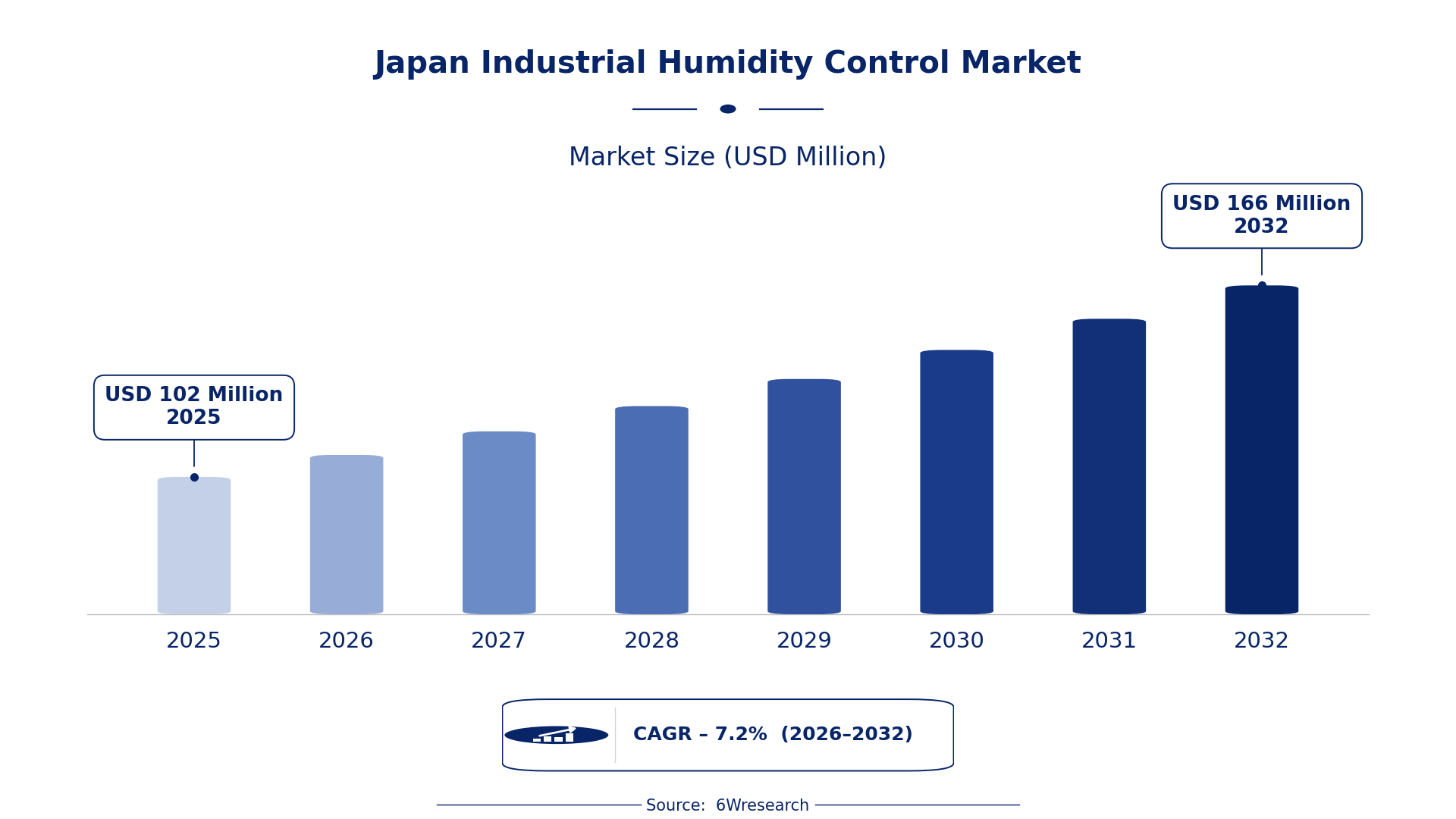
According to 6Wresearch internal database and industry insights, the Japan Industrial Humidity Control Market was valued at USD 102 Million in 2025 and is projected to reach USD 166 Million by 2032, growing at a CAGR of approximately 7.2% during 2026–2032.
Japan Industrial Humidity Control Market Highlights
| Report Metric | Details |
| Report Name | Japan Industrial Humidity Control Market (2026-2032) |
| Market Size 2025 | USD 102 Million |
| Market Size 2032 | USD 166 Million |
| Absolute Growth 2025–2032 | USD 64 Million |
| CAGR 2026–2032 | 7.2% |
| Peak Annual Growth | 8.1% in 2032 |
| Forecast Period | 2026–2032 |
| Historical Data | 2022–2025 |
| Base Year | 2025 |
| Leading System Type, 2025 | Dehumidifiers (37% share) |
| Leading Control Technology, 2025 | Refrigerant / Desiccant (50% share) |
| Leading Installation Type, 2025 | Portable / Ducted (38% share) |
| Leading End User, 2025 | Electronics Manufacturing (39% share) |
| Fastest-Growing System Type | Humidifiers (10.7% CAGR) |
| Fastest-Growing Control Technology | Ultrasonic / Steam-Based (11.0% CAGR) |
| Fastest-Growing Installation Type | Central / Console (10.6% CAGR) |
| Fastest-Growing End User | Data Centers (9.7% CAGR) |
| Growing Sector | Electronics Manufacturing |
| Key End Users | Electronics manufacturers, pharmaceutical plants, data centers, cleanroom operators |
Japan Industrial Humidity Control Market Year-wise Growth Rate and Key Drivers (2022–2032)
This graph illustrates the annual growth rates of the market from 2022 to 2032, highlighting a steady upward trajectory and projected market expansion over the forecast period.
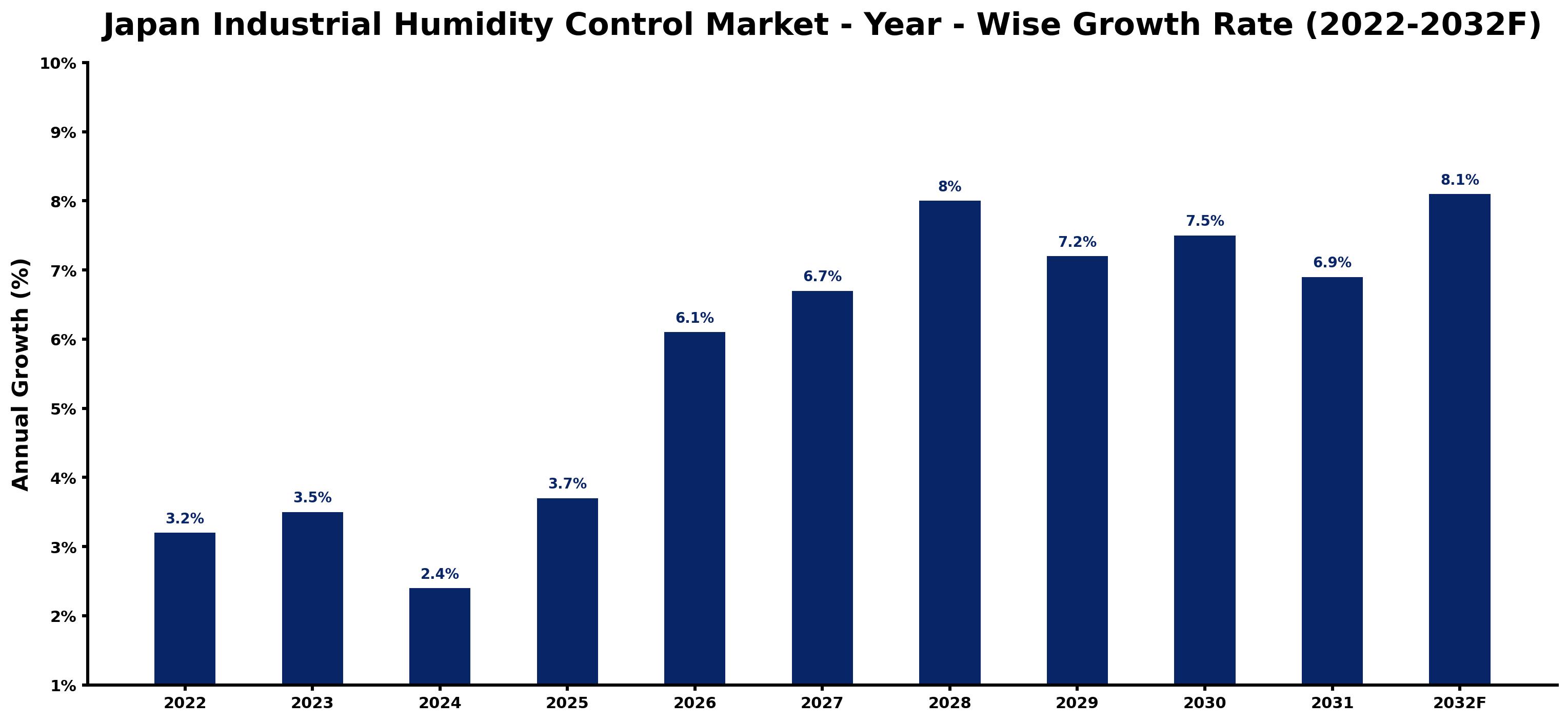
Year by year, the estimates below pair each growth rate with the development that shaped it.
| Year | Estimated Annual Growth (%) | Market Rationale |
| 2022 | 3.2 | The market showed steady growth, driven by demand from electronics manufacturing. |
| 2023 | 3.5 | Growth accelerated due to increased investments in data center infrastructure. |
| 2024 | 2.4 | Growth slowed as market adjustments occurred following rapid expansion in previous years. |
| 2025 | 3.7 | Demand surged again, supported by new guidelines for humidity control in cleanrooms. |
| 2026 | 6.1 | The market is expected to grow faster as more facilities adopt energy-efficient technologies. |
| 2027 | 6.7 | Continued investment in pharmaceutical plants is projected to support growth further. |
| 2028 | 8.0 | Growth is anticipated to peak as the demand for humidity control in data centers rises. |
| 2029 | 7.2 | A slight slowdown is expected as the market stabilises after peak growth years. |
| 2030 | 7.5 | Increased focus on energy efficiency is projected to drive demand once more. |
| 2031 | 6.9 | Growth is expected to slow as the market reaches a more mature phase. |
| 2032 | 8.1 | The market is projected to grow faster due to rising environmental regulations. |
Note: Market size estimations and growth projections presented in this report are based on 6Wresearch's proprietary forecasting methodology, utilizing the latest available industry data, government publications, and primary research inputs.
Japan Industrial Humidity Control Market Synopsis
Industrial humidity control encompasses technologies such as dehumidifiers and humidifiers, which are vital for maintaining optimal moisture levels in various environments. Key sectors include electronics manufacturing, data centers, and pharmaceutical plants, all of which require strict humidity standards. The Japan Industrial Humidity Control Market is expanding, driven by increased investments in facility upgrades, energy-efficient technologies, and adherence to new regulations, with the electronics manufacturing sector valued at approximately 10 trillion JPY. The average installed base of dehumidifiers in Japan is estimated at 1 million units, indicating a strong market presence.
Market Dynamics Impact Analysis (2026–2032)
| Factor | Type | Impact | Primary Segment Affected |
| Rising investments in data centers drive demand for humidity control solutions. | Driver | High | Data Centers |
| Increased focus on energy efficiency leads to higher adoption of advanced humidity control systems. | Driver | High | Integrated HVAC |
| Growing pharmaceutical investments create a need for stringent humidity management. | Opportunity | High | Pharmaceutical Plants |
| The shift towards energy-efficient technologies opens new market avenues for suppliers. | Opportunity | Medium | Portable / Ducted |
| High initial costs of advanced systems may deter small manufacturers from upgrading. | Restraint | High | Dehumidifiers |
| Limited awareness of humidity control benefits restricts market growth in certain sectors. | Restraint | Medium | Humidifiers |
| Competition from low-cost alternatives challenges established suppliers' market share. | Challenge | High | Hybrid Systems |
| Rapid technological advancements require continuous investment from suppliers. | Challenge | Medium | Sensor-Driven Controllers |
Evaluation of Drivers in Japan Industrial Humidity Control Market (2026–2032)
The table below links each growth driver to the segment it affects and the evidence for it.
| Drivers | Primary Segment Affected | Why It Matters (Evidence) |
| Increased investments in data centers drive demand for humidity control solutions. | Data Centers | Data centers require humidity levels between 45-55% for optimal performance, leading to higher purchases of humidity control systems. |
| Growing pharmaceutical investments create a need for stringent humidity management. | Pharmaceutical Plants | The pharmaceutical industry is expected to invest 500 billion JPY in facility upgrades by 2025, increasing demand for humidity control. |
| The shift towards energy-efficient technologies opens new market avenues for suppliers. | Integrated HVAC | Japan's target to reduce energy consumption in industrial facilities by 20% by 2030 supports the adoption of advanced systems. |
| Rising population drives demand for humidity control in various sectors. | Electronics Manufacturing | With a population of around 125 million, the need for quality electronics drives humidity control system purchases. |
| Increased focus on cleanroom standards enhances demand for humidity control solutions. | Cleanroom Operations | Pharmaceutical plants adhere to strict humidity standards, including ISO 14644, necessitating advanced humidity control technologies. |
What keeps demand rising is the increasing investments in data centers, which require humidity levels between 45-55% for optimal performance. The pharmaceutical industry is projected to invest 500 billion JPY in facility upgrades by 2025, creating a strong need for stringent humidity management. Japan's target to reduce energy consumption in industrial facilities by 20% by 2030 supports the adoption of advanced systems. With a population of around 125 million, the electronics manufacturing sector drives the demand for quality humidity control solutions. Compliance with strict cleanroom standards necessitates advanced humidity control technologies in pharmaceutical plants, particularly as the Cleanroom Technology Association of Japan updates guidelines.
Evaluation of Restraints in Japan Industrial Humidity Control Market
The key brakes on demand, and where they bite hardest, are shown below.
| Market Restraint | Primary Segment Affected | Why It Matters (Evidence) |
| High initial costs of advanced systems may deter small manufacturers from upgrading. | Dehumidifiers | The average installed base of dehumidifiers in Japan is estimated at 1 million units, with many small manufacturers unable to afford upgrades. |
| Limited awareness of humidity control benefits restricts market growth in certain sectors. | Humidifiers | Despite the critical need for humidity control, many manufacturers lack knowledge about the advantages of advanced systems. |
| Competition from low-cost alternatives challenges established suppliers' market share. | Hybrid Systems | As hybrid systems gain traction, established suppliers face pressure from cheaper, less efficient alternatives. |
| Regulatory compliance can increase operational costs for manufacturers. | Integrated HVAC | Compliance with the JIS Z 8701 standard adds to the operational costs for manufacturers, affecting their pricing strategies. |
| Slow adoption of IoT-enabled technologies limits market expansion. | IoT Enabled | While there is growing interest, the IoT-enabled humidity control segment is projected to grow significantly by 2026, limiting its market impact. |
Japan Industrial Humidity Control Market Challenges
Producers face high operational costs as Japan's national minimum wage reaches JPY 1,055 per hour, increasing expenses significantly. Supply chain disruptions arise from challenges in sourcing advanced materials, delaying humidity control system deliveries to critical sectors like electronics, which can lead to production halts. A shortage of skilled engineers limits suppliers' ability to innovate, extending product development timelines and reducing market competitiveness. Stringent regulations, such as the JIS Z 8701 standard, complicate technology adoption, causing compliance delays that can cost manufacturers valuable time and resources in a fast-paced market.
Trends in the Japan Industrial Humidity Control Market
Below are the shifts with the largest effect on the Japan Industrial Humidity Control Market.
- Shift from Traditional to Energy-Efficient Systems: In 2023, the Tokyo Metropolitan Government promoted energy-efficient humidity control technologies, resulting in a 30% increase in adoption rates among new installations.
- Emergence of IoT-Enabled Solutions: Data centers are increasingly adopting IoT-enabled humidity control systems, with projections indicating a 20% growth in this segment by 2026, allowing for real-time monitoring and adjustments.
- Focus on Cleanroom Standards: The Cleanroom Technology Association of Japan updated guidelines in 2023, mandating stricter humidity control measures, essential for maintaining sterile environments in pharmaceutical plants.
- Adoption of Hybrid Systems: Hybrid systems are increasingly adopted in high-tech manufacturing sectors in Japan, with a projected growth rate of 10.7% through 2032, reflecting the need for versatile solutions.
Investment Opportunities in the Japan Industrial Humidity Control Market
The following areas offer the clearest openings for investors and suppliers in the Japan Industrial Humidity Control Market.
- Investment in Energy-Efficient Technologies: With Japan targeting a 46% cut in greenhouse-gas emissions by 2030, there is a growing opportunity for suppliers of energy-efficient humidity control systems, particularly in the electronics manufacturing sector.
- Expansion in Pharmaceutical Facilities: The pharmaceutical industry is projected to invest 500 billion JPY in facility upgrades by 2025, creating opportunities for suppliers of advanced humidity control solutions through partnerships with local manufacturers.
- Rising Demand for Portable Solutions: The demand for portable humidity control solutions is increasing in small-scale manufacturing operations, driven by the need for flexibility. Suppliers can enter this market by collaborating with local distributors.
- Focus on Cleanroom Operations: As cleanroom standards tighten, there is a notable opportunity for suppliers to provide compliant humidity control solutions. Engaging with the Cleanroom Technology Association of Japan can enhance market access.
Government Initiatives in the Japan Industrial Humidity Control Market
The GX Promotion Act (2023) establishes a legal basis for the GX strategy, updating previous regulations like the Electrical Appliance and Material Safety Act (1961). This act mandates producers to adopt energy-efficient technologies, impacting the production of humidity control systems. The Industrial Safety and Health Act (1972) also sets employer duties for hazardous substances and machinery, ensuring that manufacturers adhere to safety standards in their operations.
In 2023, the government launched a subsidy program for energy-efficient HVAC systems, administered by the Ministry of the Environment. This program allocates JPY 30 billion to support manufacturers in upgrading their systems, thereby facilitating the adoption of advanced humidity control technologies.
Future Insight of the Japan Industrial Humidity Control Market
The rollout of advanced cleanroom facilities will reshape industrial humidity control by 2032, driven by government support for energy-efficient technologies. With JPY 150 trillion earmarked for decarbonisation investments, suppliers will be motivated to enhance their offerings. By 2026, the IoT-enabled segment is expected to expand, streamlining operations for buyers. Pharmaceutical plants are projected to invest 500 billion JPY in facility upgrades by 2025, aligning with new guidelines and ensuring compliance with strict humidity standards.
Market Segmentation Analysis
Japan Industrial Humidity Control Market report covers a detailed analysis of the following market segments:
By System Type – Dehumidifiers Lead, Humidifiers Expected to Grow Fastest
According to Saurav Kr Singh, Senior Research Analyst at 6Wresearch, Dehumidifiers accounted for 37% of the market by system type in 2025. Dehumidifiers hold the largest share in Japan due to their essential role in moisture control for manufacturing processes, particularly in the electronics manufacturing sector valued at approximately 10 trillion JPY. Their extensive installed base of around 1 million units reflects the critical need for humidity regulation across various industries. Humidifiers are projected to grow fastest, at a CAGR of 10.7% during 2026–2032. Humidifiers are witnessing rapid growth as they are vital for maintaining humidity levels in sensitive environments, especially in data centers that require specific humidity ranges for optimal performance. The increasing focus on precise humidity management in these facilities is driving this segment's expansion. This suggests that suppliers should prioritise the development and distribution of humidifiers to meet the growing market requirements.
By Control Technology – Refrigerant / Desiccant Leads, Ultrasonic / Steam-Based Expected to Grow Fastest
Refrigerant / Desiccant took 50% of control technology revenue in 2025, more than any other category. Refrigerant / Desiccant technologies dominate the market as they are commonly used in industrial settings for effective humidity control. Their established presence and reliability in various applications contribute to their leading share. The quickest growth will come from Ultrasonic / Steam-Based, forecast to expand at a CAGR of 11.0% between 2026 and 2032. Ultrasonic / Steam-Based technologies are growing quickly due to their niche applications in specific environments that require precise humidity management. As industries seek more efficient solutions, this segment is set to gain traction. Buyers may benefit from exploring Ultrasonic / Steam-Based options for specialised humidity control needs.
By Installation Type – Portable / Ducted Leads, Central / Console Expected to Grow Fastest
With 38% of installation type revenue in 2025, Portable / Ducted was the largest category. Portable / Ducted systems dominate the market in Japan because they offer flexible solutions adaptable to various installation scenarios across multiple sectors. Their ability to cater to both small-scale and larger operations enhances their appeal in diverse industrial applications. Central / Console is set to record the highest CAGR in this split, 10.6% over 2026–2032. Central / Console systems are growing swiftly as they are increasingly adopted in larger facilities that demand comprehensive humidity control solutions. This trend indicates a movement towards more integrated humidity management systems in expansive environments. Suppliers should focus on expanding their offerings in Central / Console systems to effectively address the needs of larger industrial clients.
By End User – Electronics Manufacturing Leads, Data Centers Expected to Grow Fastest
In 2025, Electronics Manufacturing led the end user split with a 39% share. Electronics Manufacturing is the largest end user of humidity control systems in Japan, as maintaining precise humidity levels is critical for product quality in this sector. The industry's substantial value of approximately 10 trillion JPY underscores its significance. Over 2026–2032, Data Centers are expected to post the fastest growth, at a CAGR of 9.7%. Data Centers are rapidly becoming the fastest-growing end user segment, driven by the essential need for reliable equipment performance in maintaining optimal humidity levels. The increasing number of data centers in Japan fuels this growth. Suppliers should prioritise the development of tailored solutions for Data Centers to capitalise on this expanding market.
Key Attractiveness of the Report
- 10 Years of Market Numbers
- Historical Data Starting from 2022 to 2025
- Base Year 2025
- Forecast Data until 2032
- Key Performance Indicators Impacting the Market
- Major Upcoming Developments and Projects
Key Highlights of the Report:
- Japan Industrial Humidity Control Market Outlook
- Market Size of Japan Industrial Humidity Control Market, 2025
- Forecast of Japan Industrial Humidity Control Market, 2032
- Historical Data and Forecast of Japan Industrial Humidity Control Revenues & Volume for the Period 2022-2032F
- Japan Industrial Humidity Control Market Trend Evolution
- Japan Industrial Humidity Control Market Drivers and Challenges
- Japan Industrial Humidity Control Price Trends
- Japan Industrial Humidity Control Porter's Five Forces
- Japan Industrial Humidity Control Industry Life Cycle
- Historical Data and Forecast of Japan Industrial Humidity Control Market Revenues & Volume By System Type for the Period 2022-2032F
- Historical Data and Forecast of Japan Industrial Humidity Control Market Revenues & Volume By Dehumidifiers for the Period 2022-2032F
- Historical Data and Forecast of Japan Industrial Humidity Control Market Revenues & Volume By Humidifiers for the Period 2022-2032F
- Historical Data and Forecast of Japan Industrial Humidity Control Market Revenues & Volume By Hybrid Systems for the Period 2022-2032F
- Historical Data and Forecast of Japan Industrial Humidity Control Market Revenues & Volume By Sensor-Driven Controllers for the Period 2022-2032F
- Historical Data and Forecast of Japan Industrial Humidity Control Market Revenues & Volume By Control Technology for the Period 2022-2032F
- Historical Data and Forecast of Japan Industrial Humidity Control Market Revenues & Volume By Refrigerant / Desiccant for the Period 2022-2032F
- Historical Data and Forecast of Japan Industrial Humidity Control Market Revenues & Volume By Ultrasonic / Steam-Based for the Period 2022-2032F
- Historical Data and Forecast of Japan Industrial Humidity Control Market Revenues & Volume By Integrated HVAC for the Period 2022-2032F
- Historical Data and Forecast of Japan Industrial Humidity Control Market Revenues & Volume By IoT Enabled for the Period 2022-2032F
- Historical Data and Forecast of Japan Industrial Humidity Control Market Revenues & Volume By Installation Type for the Period 2022-2032F
- Historical Data and Forecast of Japan Industrial Humidity Control Market Revenues & Volume By Portable / Ducted for the Period 2022-2032F
- Historical Data and Forecast of Japan Industrial Humidity Control Market Revenues & Volume By Central / Console for the Period 2022-2032F
- Historical Data and Forecast of Japan Industrial Humidity Control Market Revenues & Volume By In-Line for the Period 2022-2032F
- Historical Data and Forecast of Japan Industrial Humidity Control Market Revenues & Volume By Wall-Mount / Modular for the Period 2022-2032F
- Historical Data and Forecast of Japan Industrial Humidity Control Market Revenues & Volume By End User for the Period 2022-2032F
- Historical Data and Forecast of Japan Industrial Humidity Control Market Revenues & Volume By Electronics Manufacturing for the Period 2022-2032F
- Historical Data and Forecast of Japan Industrial Humidity Control Market Revenues & Volume By Data Centers for the Period 2022-2032F
- Historical Data and Forecast of Japan Industrial Humidity Control Market Revenues & Volume By Pharmaceutical Plants for the Period 2022-2032F
- Historical Data and Forecast of Japan Industrial Humidity Control Market Revenues & Volume By Cleanroom Operations for the Period 2022-2032F
- Japan Industrial Humidity Control Import Export Trade Statistics
- Market Opportunity Assessment By System Type
- Market Opportunity Assessment By Control Technology
- Market Opportunity Assessment By Installation Type
- Market Opportunity Assessment By End User
- Japan Industrial Humidity Control Top Companies Market Share
- Japan Industrial Humidity Control Competitive Benchmarking By Technical and Operational Parameters
- Japan Industrial Humidity Control Company Profiles
- Japan Industrial Humidity Control Key Strategic Recommendations
Market Covered
Segments analysed in this report are listed below.
By System Type
- Dehumidifiers
- Humidifiers
- Hybrid Systems
- Sensor-Driven Controllers
By Control Technology
- Refrigerant / Desiccant
- Ultrasonic / Steam-Based
- Integrated HVAC
- IoT Enabled
By Installation Type
- Portable / Ducted
- Central / Console
- In-Line
- Wall-Mount / Modular
By End User
- Electronics Manufacturing
- Data Centers
- Pharmaceutical Plants
- Cleanroom Operations































