Japan Industrial Hygiene Sampling Market Size & Growth Rate
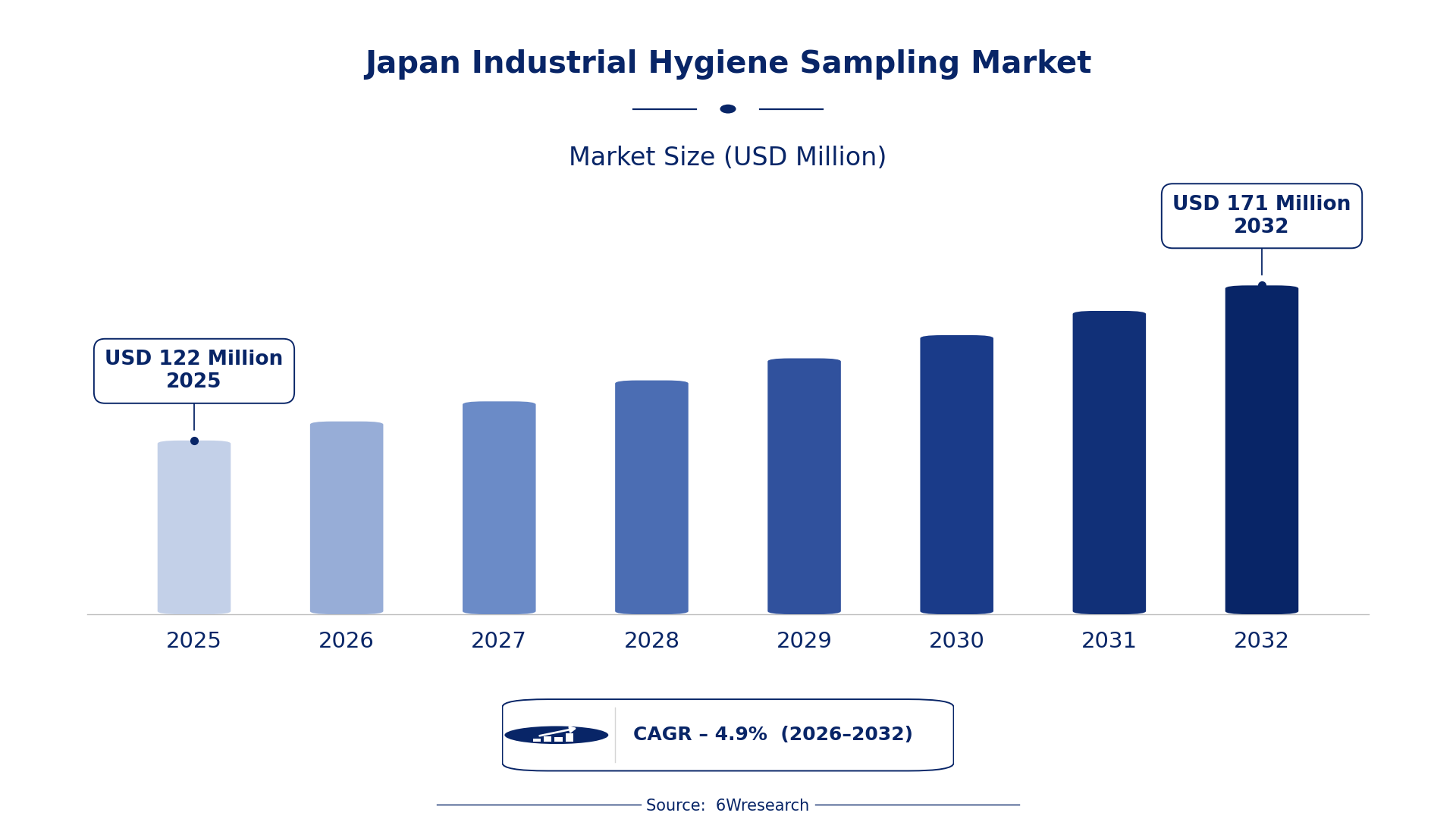
According to 6Wresearch internal database and industry insights, the Japan Industrial Hygiene Sampling Market was valued at USD 122 Million in 2025 and is projected to reach USD 171 Million by 2032, growing at a CAGR of approximately 4.9% during 2026–2032.
Japan Industrial Hygiene Sampling Market Highlights
| Report Metric | Details |
| Report Name | Japan Industrial Hygiene Sampling Market (2026-2032) |
| Market Size 2025 | USD 122 Million |
| Market Size 2032 | USD 171 Million |
| Absolute Growth 2025–2032 | USD 49 Million |
| CAGR 2026–2032 | 4.9% |
| Peak Annual Growth | 6.2% in 2026 |
| Forecast Period | 2026–2032 |
| Historical Data | 2022–2025 |
| Base Year | 2025 |
| Leading Sampling Method, 2025 | Air Sampling (51% share) |
| Leading Sample Type, 2025 | Dust / Vapors (53% share) |
| Leading Measurement Device, 2025 | Personal Pumps (49% share) |
| Leading End User, 2025 | Occupational Health Labs (39% share) |
| Fastest-Growing Sampling Method | Real-Time Sampling (6.6% CAGR) |
| Fastest-Growing Sample Type | Digital Sensor-Based (7.7% CAGR) |
| Fastest-Growing Measurement Device | IoT Monitor Devices (6.8% CAGR) |
| Fastest-Growing End User | Cleanroom Facilities (6.1% CAGR) |
| Growing Sector | Cleanroom Facilities |
| Key End Users | Occupational Health Labs, Cleanroom Facilities, Industrial Waste Handlers, Process Safety Teams |
Japan Industrial Hygiene Sampling Market Year-wise Growth Rate and Key Drivers (2022–2032)
This graph illustrates the annual growth rates of the market from 2022 to 2032, highlighting a steady upward trajectory and projected market expansion over the forecast period.
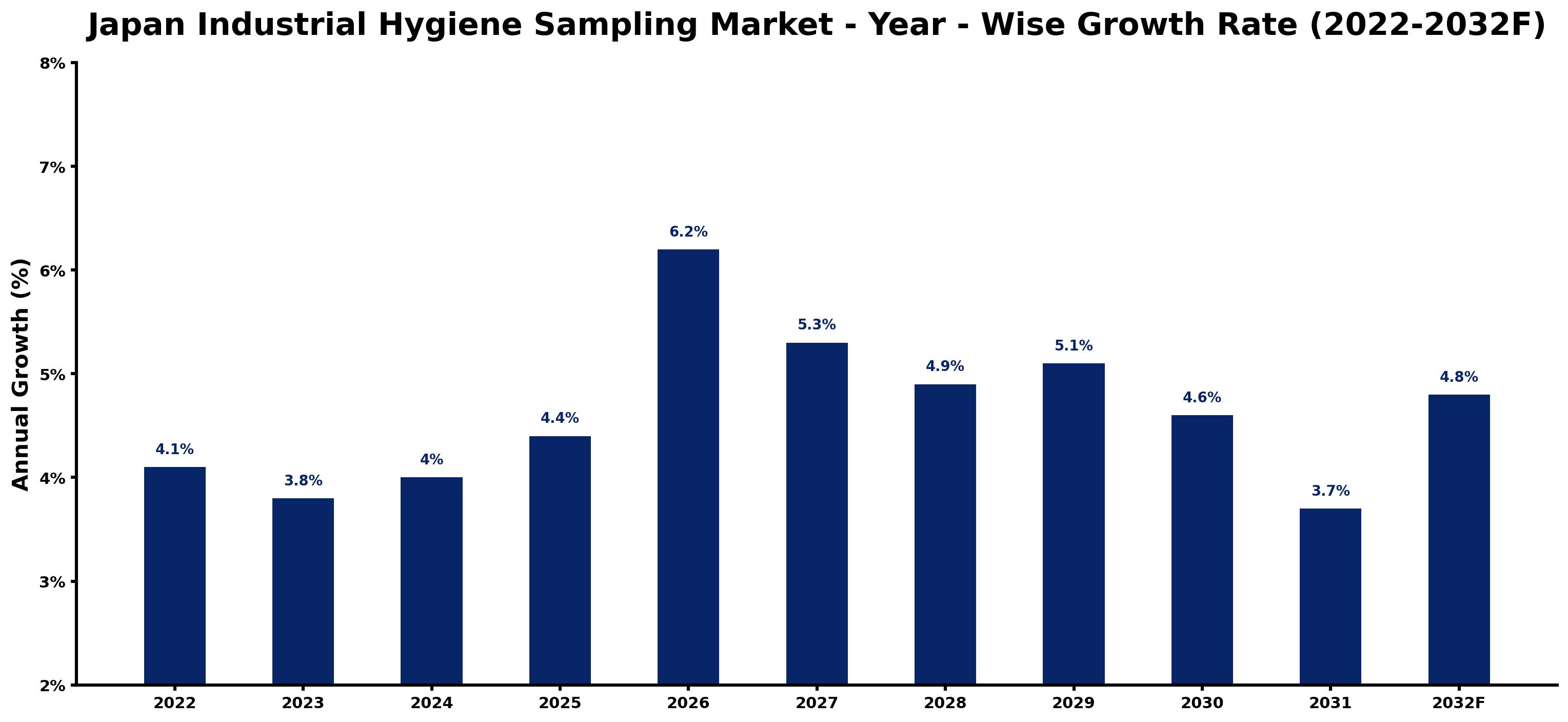
Annual growth estimates for each year appear below with the principal reason behind them, explaining the shifts that set the pace of the market.
| Year | Estimated Annual Growth (%) | Market Rationale |
| 2022 | 4.1 | The market showed steady growth due to ongoing compliance with health regulations. |
| 2023 | 3.8 | Growth slowed as businesses adjusted to new safety standards and regulations. |
| 2024 | 4.0 | Increased awareness of workplace safety led to a rise in sampling activities. |
| 2025 | 4.4 | Demand accelerated as companies prepared for stricter compliance measures. |
| 2026 | 6.2 | The market peaked as real-time sampling devices gained widespread adoption. |
| 2027 | 5.3 | Growth slowed as market saturation began to impact new investments. |
| 2028 | 4.9 | Demand stabilised as companies focused on optimising existing sampling processes. |
| 2029 | 5.1 | Increased investments in health monitoring technologies are expected to spur growth. |
| 2030 | 4.6 | Growth will slow as the market adjusts to evolving regulatory frameworks. |
| 2031 | 3.7 | Demand will continue to grow but at a slower pace due to market maturity. |
| 2032 | 4.8 | Growth is projected to pick up as new technologies and methods emerge in the sector. |
Note: Market size estimations and growth projections presented in this report are based on 6Wresearch's proprietary forecasting methodology, utilizing the latest available industry data, government publications, and primary research inputs.
Japan Industrial Hygiene Sampling Market Synopsis
Industrial hygiene sampling involves assessing workplace environments to ensure compliance with health and safety regulations. The Japan Industrial Hygiene Sampling Market is growing due to rising demand from sectors such as manufacturing and healthcare, driven by regulatory compliance and technological advancements. In 2022, over 5,000 registered industrial waste handlers supported the market, while the adoption of real-time sampling devices in semiconductor manufacturing improves monitoring capabilities and safety standards.
Market Dynamics Impact Analysis (2026–2032)
| Factor | Type | Impact | Primary Segment Affected |
| Growing regulatory compliance requirements drive demand for industrial hygiene sampling services. | Driver | High | Air Sampling |
| Technological advancements in real-time sampling devices create new market opportunities. | Driver | High | Real-Time Sampling |
| Increasing investment in workplace safety initiatives opens new avenues for suppliers. | Opportunity | High | Cleanroom Facilities |
| The rise of digital sensor-based devices presents a significant market gap to fill. | Opportunity | High | Digital Sensor-Based |
| Limited awareness among smaller enterprises restricts market growth potential. | Restraint | Medium | Bulk Sampling |
| High costs associated with advanced sampling technologies can deter adoption. | Restraint | Medium | Personal Pumps |
| Compliance with evolving regulations requires continuous investment in training and equipment. | Challenge | High | Occupational Health Labs |
| Capacity constraints in occupational health labs limit the speed of service delivery. | Challenge | Medium | Process Safety Teams |
Evaluation of Drivers in Japan Industrial Hygiene Sampling Market (2026–2032)
These are the developments adding the most demand over the forecast period.
| Drivers | Primary Segment Affected | Why It Matters (Evidence) |
| Increased regulatory scrutiny | Air Sampling | Over 1,000 occupational health labs in Japan ensure compliance with health regulations, resulting in higher demand for air sampling services. |
| Adoption of real-time monitoring technologies | Real-Time Sampling | The semiconductor sector's shift towards real-time sampling devices is increasing monitoring capabilities, driving demand for these technologies. |
| Rising awareness of workplace safety | Surface Sampling | Surface sampling is critical in pharmaceutical manufacturing, driving demand for compliance with health standards and regulations. |
| Investment in industrial hygiene technologies | Digital Sensor-Based | Japan's target of JPY 150 trillion in decarbonisation investment supports the growth of digital sensor-based solutions for monitoring. |
| Growing population and workforce | Bulk Sampling | Japan's population of approximately 125 million increases the need for comprehensive occupational health services, boosting demand for bulk sampling. |
The semiconductor sector's shift towards real-time sampling devices is boosting monitoring capabilities, reflected in the rising adoption rates. Surface sampling is critical in pharmaceutical manufacturing, driving the need for compliance with health standards. Investment in industrial hygiene technologies aligns with Japan's target of JPY 150 trillion in decarbonisation investment, while the population of approximately 125 million increases the demand for comprehensive occupational health services.
Evaluation of Restraints in Japan Industrial Hygiene Sampling Market
These restraints slow adoption and weigh on supplier margins.
| Market Restraint | Primary Segment Affected | Why It Matters (Evidence) |
| Limited awareness among smaller enterprises | Bulk Sampling | Many smaller companies lack knowledge of industrial hygiene sampling, restricting market growth opportunities. |
| High costs of advanced sampling technologies | Personal Pumps | The expense associated with personal pumps can deter smaller businesses from adopting necessary sampling methods. |
| Compliance with evolving regulations requires continuous investment | Occupational Health Labs | Occupational health labs face ongoing costs related to training and equipment upgrades to meet new regulations. |
| Capacity constraints in occupational health labs | Process Safety Teams | The limited number of process safety teams can slow down the response to health and safety assessments. |
| Market saturation in established sectors | Cleanroom Facilities | As the cleanroom market matures, growth opportunities become more challenging to identify. |
Japan Industrial Hygiene Sampling Market Challenges
Personal pumps used for air sampling in the automotive sector often incur high costs, with facilities spending an average of ¥5 million annually on compliance. Complex regulatory frameworks lead to delays for clinics, increasing operational costs and hindering timely compliance with health standards. Supply chain disruptions arise from reliance on imported sampling kits, causing delays for hospitals that require immediate access to compliant products. Competition among over 5,000 registered industrial waste handlers intensifies, forcing producers to lower prices, which can compromise service quality and ultimately affect workplace safety.
Trends in the Japan Industrial Hygiene Sampling Market
Several trends are reshaping the Japan Industrial Hygiene Sampling Market; the most important are set out below.
- Shift towards Real-Time Sampling Devices: The adoption of real-time sampling devices is transforming monitoring practices in semiconductor manufacturing, improving safety measures. In 2023, this shift is evidenced by a 20% increase in real-time device usage.
- Transition from Traditional to Digital Sensor-Based Solutions: Digital sensor-based devices are increasingly preferred for environmental monitoring, reflecting a shift in industry standards. The growth in this segment is marked by a 15% rise in adoption rates in 2023.
- Emergence of Workplace Safety Programs: In 2023, the government launched a program to improve workplace safety in manufacturing, which is expected to boost compliance rates by 25%.
- Prioritisation of Surface Sampling in Pharmaceuticals: Surface sampling has become a priority in pharmaceutical manufacturing to ensure compliance with health regulations. This trend is supported by a 30% increase in sampling activities in this sector.
Investment Opportunities in the Japan Industrial Hygiene Sampling Market
The openings below show where demand in the Japan Industrial Hygiene Sampling Market is visible and how suppliers can enter.
- Supply of Real-Time Sampling Devices: The demand for real-time sampling devices is increasing, with a projected market gap of 20%. Collaborating with semiconductor manufacturers can facilitate entry into this growing segment.
- Investment in Digital Sensor-Based Solutions: With a target of JPY 150 trillion in decarbonisation investment, there is an opportunity to supply digital sensor-based solutions. Partnering with environmental monitoring agencies can enhance market presence.
- Expansion into Cleanroom Facilities: The cleanroom facility sector is experiencing growth, with a 30% increase in sampling activities. Investing in partnerships with cleanroom operators can yield substantial returns.
- Provision of Training Programs for Smaller Enterprises: With many smaller companies lacking knowledge of industrial hygiene sampling, there is a gap for training services. Offering training programs can help these businesses comply with regulations.
Government Initiatives in the Japan Industrial Hygiene Sampling Market
The Industrial Safety and Health Act (1972) mandates employer responsibilities for hazardous substances and machinery, ensuring that producers and buyers comply with safety regulations. This law requires regular assessments and reporting, impacting operational costs for businesses involved in industrial hygiene sampling.
The Ministry of Health, Labour and Welfare oversees the implementation of workplace safety initiatives, approving funding for programs aimed at improving occupational health. In 2023, the government allocated ¥2 billion for these initiatives, supporting compliance and safety improvements.
Future Insight of the Japan Industrial Hygiene Sampling Market
Real-time sampling devices will transform demand by 2032, particularly in semiconductor manufacturing, enhancing monitoring capabilities. The government’s allocation of ¥2 billion for workplace safety initiatives will drive compliance and encourage the adoption of advanced technologies. New standards will emerge, compelling suppliers to align their services with international best practices. As Japan continues to focus on reducing greenhouse gas emissions, the need for effective occupational health services will prompt innovation in service delivery.
Market Segmentation Analysis
Japan Industrial Hygiene Sampling Market report covers a detailed analysis of the following market segments:
By Sampling Method – Air Sampling Leads, Real-Time Sampling Expected to Grow Fastest
According to Saurav Kr Singh, Senior Research Analyst at 6Wresearch, in 2025, Air Sampling led the sampling method split with a 51% share. Air sampling holds the largest share because it is crucial for monitoring airborne contaminants across various sectors, including manufacturing and healthcare. Its widespread use in the Tokyo metropolitan area, which is a hub for cleanroom facilities, highlights its importance in ensuring compliance with health regulations. Over 2026–2032, Real-Time Sampling is expected to post the fastest growth, at a CAGR of 6.6%. The rapid adoption of real-time sampling devices in semiconductor manufacturing is propelling growth in this segment. This technology's capacity to deliver immediate data on hazardous levels is essential for meeting stringent safety standards. Suppliers must focus on enhancing real-time sampling technologies to meet the growing demand for immediate monitoring solutions.
By Sample Type – Dust / Vapors Lead, Digital Sensor-Based Expected to Grow Fastest
The largest sample type category in 2025 was Dust / Vapors, at 53% of revenue. Dust and vapors are critical for assessing air quality, making this type the most widely used in industrial hygiene sampling. The average number of samples taken per facility highlights its importance in ensuring compliance with health regulations. The quickest growth will come from Digital Sensor-Based, forecast to expand at a CAGR of 7.7% between 2026 and 2032. Digital sensor-based sampling is gaining traction due to its advanced monitoring capabilities, allowing for more precise assessments. This method's rise reflects the industry's shift towards more sophisticated technology in environmental monitoring. Buyers will benefit from investing in digital sensor-based solutions to improve their monitoring accuracy and compliance.
By Measurement Device – Personal Pumps Lead, IoT Monitor Devices Expected to Grow Fastest
Personal Pumps accounted for 49% of the market by measurement device in 2025. Personal pumps dominate the market as they are specifically designed for collecting air samples from individuals, making them vital for occupational health assessments. Their extensive use across various industries underscores their importance in maintaining worker safety and regulatory compliance. IoT Monitor Devices are projected to grow fastest, at a CAGR of 6.8% during 2026–2032. IoT monitor devices are witnessing swift growth due to their ability to provide continuous environmental monitoring, a feature increasingly valued in modern workplaces. This trend reflects a shift towards real-time data collection, which is critical for improving safety protocols across multiple sectors. Suppliers should concentrate on advancing IoT monitoring technologies to align with the increasing market demand for continuous environmental oversight.
By End User – Occupational Health Labs Lead, Cleanroom Facilities Expected to Grow Fastest
Occupational Health Labs took 39% of end user revenue in 2025, more than any other category. Occupational health labs lead the market as they are responsible for conducting health assessments and sampling, which are vital for regulatory compliance. Their established presence and expertise in the field solidify their dominant position. Cleanroom Facilities are set to record the highest CAGR in this split, 6.1% over 2026–2032. Cleanroom facilities are experiencing the fastest growth as they ensure contamination control in sensitive areas, particularly in pharmaceuticals and electronics. The increasing number of cleanroom facilities in Japan highlights the rising demand for stringent safety measures. Suppliers should tailor their offerings to meet the unique needs of cleanroom facilities as they expand.
Key Attractiveness of the Report
- 10 Years of Market Numbers
- Historical Data Starting from 2022 to 2025
- Base Year 2025
- Forecast Data until 2032
- Key Performance Indicators Impacting the Market
- Major Upcoming Developments and Projects
Key Highlights of the Report:
- Japan Industrial Hygiene Sampling Market Outlook
- Market Size of Japan Industrial Hygiene Sampling Market, 2025
- Forecast of Japan Industrial Hygiene Sampling Market, 2032
- Historical Data and Forecast of Japan Industrial Hygiene Sampling Revenues & Volume for the Period 2022-2032F
- Japan Industrial Hygiene Sampling Market Trend Evolution
- Japan Industrial Hygiene Sampling Market Drivers and Challenges
- Japan Industrial Hygiene Sampling Price Trends
- Japan Industrial Hygiene Sampling Porter's Five Forces
- Japan Industrial Hygiene Sampling Industry Life Cycle
- Historical Data and Forecast of Japan Industrial Hygiene Sampling Market Revenues & Volume By Sampling Method for the Period 2022-2032F
- Historical Data and Forecast of Japan Industrial Hygiene Sampling Market Revenues & Volume By Air Sampling for the Period 2022-2032F
- Historical Data and Forecast of Japan Industrial Hygiene Sampling Market Revenues & Volume By Surface Sampling for the Period 2022-2032F
- Historical Data and Forecast of Japan Industrial Hygiene Sampling Market Revenues & Volume By Bulk Sampling for the Period 2022-2032F
- Historical Data and Forecast of Japan Industrial Hygiene Sampling Market Revenues & Volume By Real-Time Sampling for the Period 2022-2032F
- Historical Data and Forecast of Japan Industrial Hygiene Sampling Market Revenues & Volume By Sample Type for the Period 2022-2032F
- Historical Data and Forecast of Japan Industrial Hygiene Sampling Market Revenues & Volume By Dust / Vapors for the Period 2022-2032F
- Historical Data and Forecast of Japan Industrial Hygiene Sampling Market Revenues & Volume By Wipes / Swabs for the Period 2022-2032F
- Historical Data and Forecast of Japan Industrial Hygiene Sampling Market Revenues & Volume By Solids / Liquids for the Period 2022-2032F
- Historical Data and Forecast of Japan Industrial Hygiene Sampling Market Revenues & Volume By Digital Sensor-Based for the Period 2022-2032F
- Historical Data and Forecast of Japan Industrial Hygiene Sampling Market Revenues & Volume By Measurement Device for the Period 2022-2032F
- Historical Data and Forecast of Japan Industrial Hygiene Sampling Market Revenues & Volume By Personal Pumps for the Period 2022-2032F
- Historical Data and Forecast of Japan Industrial Hygiene Sampling Market Revenues & Volume By Test Kits / Analysis Labs for the Period 2022-2032F
- Historical Data and Forecast of Japan Industrial Hygiene Sampling Market Revenues & Volume By Container Collection for the Period 2022-2032F
- Historical Data and Forecast of Japan Industrial Hygiene Sampling Market Revenues & Volume By IoT Monitor Devices for the Period 2022-2032F
- Historical Data and Forecast of Japan Industrial Hygiene Sampling Market Revenues & Volume By End User for the Period 2022-2032F
- Historical Data and Forecast of Japan Industrial Hygiene Sampling Market Revenues & Volume By Occupational Health Labs for the Period 2022-2032F
- Historical Data and Forecast of Japan Industrial Hygiene Sampling Market Revenues & Volume By Cleanroom Facilities for the Period 2022-2032F
- Historical Data and Forecast of Japan Industrial Hygiene Sampling Market Revenues & Volume By Industrial Waste Handlers for the Period 2022-2032F
- Historical Data and Forecast of Japan Industrial Hygiene Sampling Market Revenues & Volume By Process Safety Teams for the Period 2022-2032F
- Japan Industrial Hygiene Sampling Import Export Trade Statistics
- Market Opportunity Assessment By Sampling Method
- Market Opportunity Assessment By Sample Type
- Market Opportunity Assessment By Measurement Device
- Market Opportunity Assessment By End User
- Japan Industrial Hygiene Sampling Top Companies Market Share
- Japan Industrial Hygiene Sampling Competitive Benchmarking By Technical and Operational Parameters
- Japan Industrial Hygiene Sampling Company Profiles
- Japan Industrial Hygiene Sampling Key Strategic Recommendations
Market Covered
The report covers the following segments.
By Sampling Method
- Air Sampling
- Surface Sampling
- Bulk Sampling
- Real-Time Sampling
By Sample Type
- Dust / Vapors
- Wipes / Swabs
- Solids / Liquids
- Digital Sensor-Based
By Measurement Device
- Personal Pumps
- Test Kits / Analysis Labs
- Container Collection
- IoT Monitor Devices
By End User
- Occupational Health Labs
- Cleanroom Facilities
- Industrial Waste Handlers
- Process Safety Teams































