Japan Industrial Inspection Market Size & Growth Rate
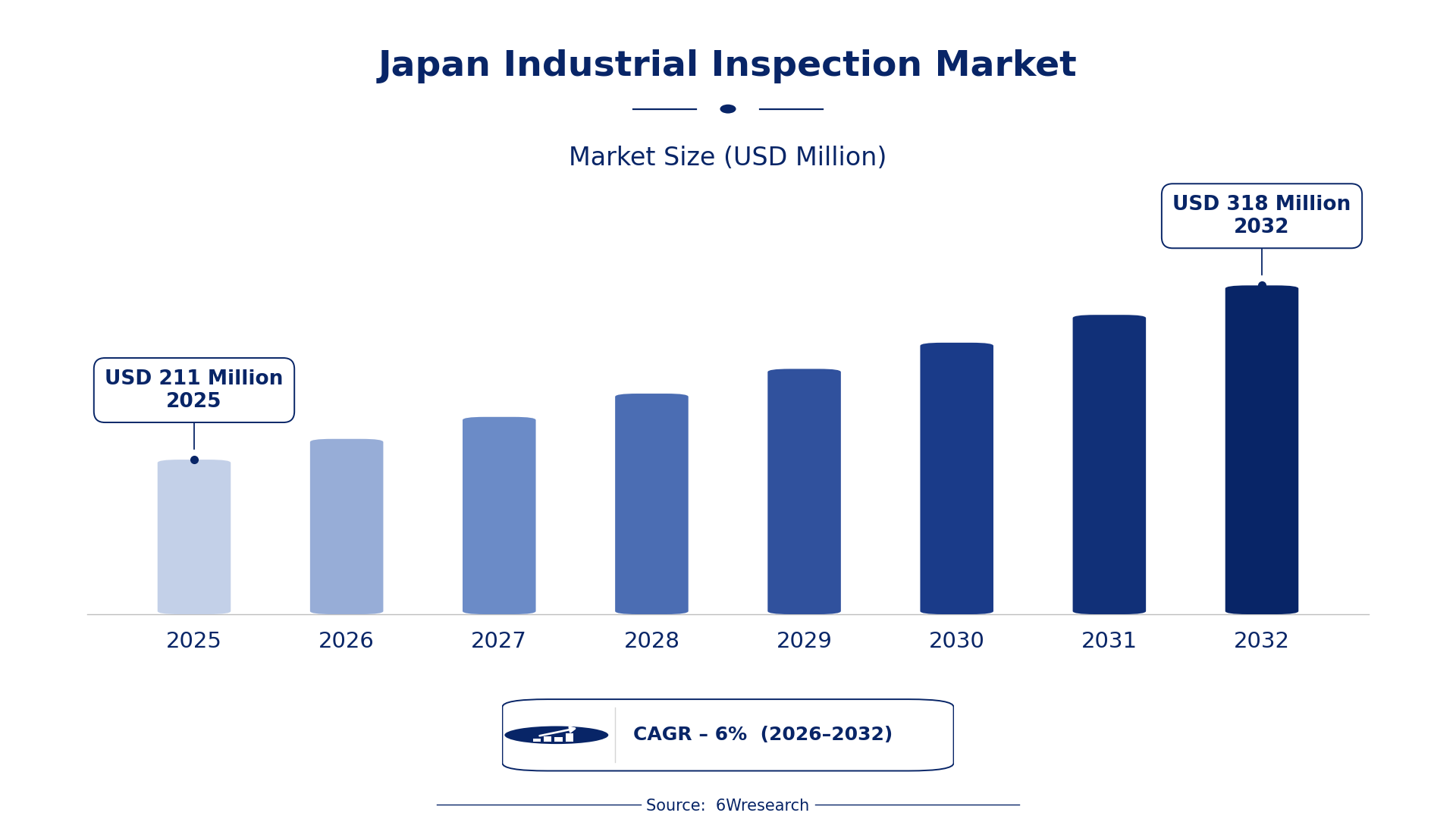
According to 6Wresearch internal database and industry insights, the Japan Industrial Inspection Market was valued at USD 211 Million in 2025 and is projected to reach USD 318 Million by 2032, growing at a CAGR of approximately 6% during 2026–2032.
Japan Industrial Inspection Market Highlights
| Report Metric | Details |
| Report Name | Japan Industrial Inspection Market (2026-2032) |
| Market Size 2025 | USD 211 Million |
| Market Size 2032 | USD 318 Million |
| Absolute Growth 2025–2032 | USD 107 Million |
| CAGR 2026–2032 | 6% |
| Peak Annual Growth | 6.7% in 2032 |
| Forecast Period | 2026–2032 |
| Historical Data | 2022–2025 |
| Base Year | 2025 |
| Leading Service Type, 2025 | Non-Destructive Testing (35% share) |
| Leading Inspection Type, 2025 | Visual (40% share) |
| Leading Automation Level, 2025 | Manual/Automated (43% share) |
| Leading End User, 2025 | Power Plants (46% share) |
| Fastest-Growing Service Type | Structural Inspection (8.5% CAGR) |
| Fastest-Growing Inspection Type | UT (9.0% CAGR) |
| Fastest-Growing Automation Level | Semi-Automated (8.3% CAGR) |
| Fastest-Growing End User | Construction Equipment (7.8% CAGR) |
| Growing Sector | Power Generation |
| Key End Users | Power Plants, Oil Refineries, Manufacturing Units, Construction Equipment |
Japan Industrial Inspection Market Year-wise Growth Rate and Key Drivers (2022–2032)
This graph illustrates the annual growth rates of the market from 2022 to 2032, highlighting a steady upward trajectory and projected market expansion over the forecast period.
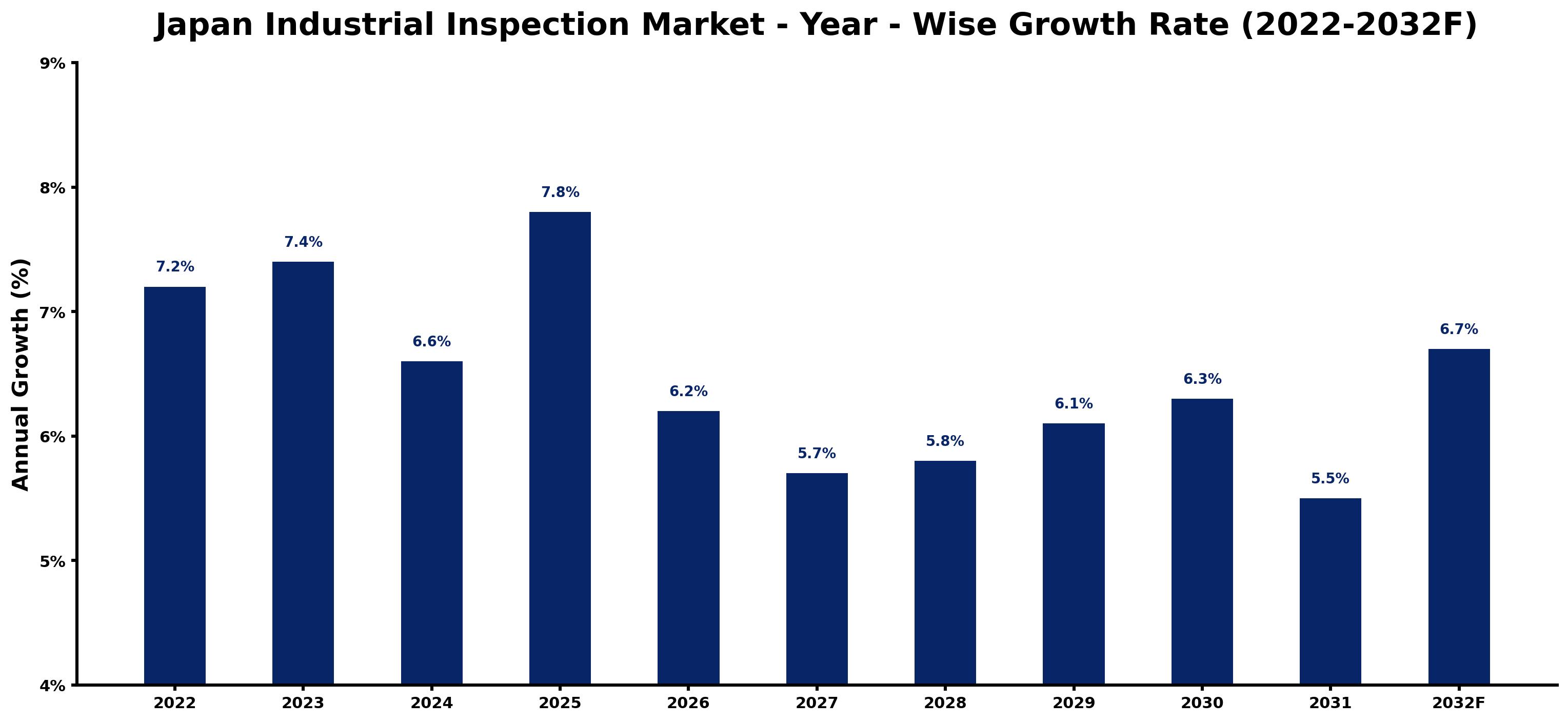
Year by year, the estimates below pair each growth rate with the development that shaped it.
| Year | Estimated Annual Growth (%) | Market Rationale |
| 2022 | 7.2 | The market experienced strong demand driven by stringent safety regulations and aging infrastructure. |
| 2023 | 7.4 | Growth continued as investments in inspection technologies increased across various sectors. |
| 2024 | 6.6 | The market showed slower growth due to a temporary reduction in industrial activity. |
| 2025 | 7.8 | Demand surged again as major infrastructure projects required extensive inspections. |
| 2026 | 6.2 | Growth is expected to slow as the market adjusts to previous peaks in investment. |
| 2027 | 5.7 | A further slowdown is projected as companies reassess their inspection budgets. |
| 2028 | 5.8 | The market is expected to rebound with renewed investments in safety technologies. |
| 2029 | 6.1 | Growth is projected to accelerate as new projects emerge in the energy sector. |
| 2030 | 6.3 | Demand will strengthen with ongoing efforts to improve industrial safety standards. |
| 2031 | 5.5 | The market is expected to face a slowdown as competition intensifies among service providers. |
| 2032 | 6.7 | Growth will peak as the adoption of smart inspection technologies gains momentum. |
Note: Market size estimations and growth projections presented in this report are based on 6Wresearch's proprietary forecasting methodology, utilizing the latest available industry data, government publications, and primary research inputs.
Japan Industrial Inspection Market Synopsis
Industrial inspection in Japan involves various techniques to ensure the integrity and safety of industrial assets, particularly through non-destructive testing methods. The Japan Industrial Inspection Market is expanding due to stringent safety regulations, a focus on maintenance in aging infrastructure, and investments in decarbonisation initiatives. With over 1,200 power plants requiring regular inspections and a target of JPY 150 trillion in decarbonisation investments, demand from sectors like power generation and oil refining is driving market growth.
Market Dynamics Impact Analysis (2026–2032)
| Factor | Type | Impact | Primary Segment Affected |
| Increased investment in decarbonisation technologies | Driver | High | Non-Destructive Testing |
| Growing demand for compliance with safety regulations | Driver | High | Structural Inspection |
| Need for enhanced safety protocols in aging infrastructure | Opportunity | High | Pipeline Inspection |
| Expansion of smart inspection technologies | Opportunity | Medium | Electrical System Inspection |
| High competition among inspection service providers | Restraint | Medium | Visual |
| Limited availability of skilled inspectors | Restraint | High | UT |
| Pressure to reduce costs while maintaining quality | Challenge | High | RT |
| Technological advancements outpacing current capabilities | Challenge | Medium | MT |
Evaluation of Drivers in Japan Industrial Inspection Market (2026–2032)
Key forces behind demand, with the segment each one moves most, are listed below.
| Drivers | Primary Segment Affected | Why It Matters (Evidence) |
| Investment in decarbonisation initiatives | Non-Destructive Testing | Japan targets JPY 150 trillion in decarbonisation investments over the next decade, increasing demand for compliance inspections in power generation. |
| Compliance with safety regulations | Structural Inspection | Structural inspections are mandated every five years for public buildings in Tokyo, driving service demand from construction firms. |
| Adoption of smart inspection technologies | Pipeline Inspection | The 2023 initiative to promote smart inspection technologies enhances operational safety, prompting oil refineries to invest in advanced inspection solutions. |
| Focus on operational efficiency | Visual | Manufacturing units in the Tokyo region are prioritising visual assessments to ensure equipment reliability, boosting demand for inspection services. |
| Aging infrastructure | Electrical System Inspection | With Japan's population of approximately 125 million, the need for regular inspections of aging electrical systems is increasing among industrial users. |
The introduction of smart inspection technologies in 2023 improves operational safety, prompting buyers to invest in advanced solutions. The focus on operational efficiency in manufacturing units in the Tokyo region also boosts the need for visual assessments.
Evaluation of Restraints in Japan Industrial Inspection Market
The key brakes on demand, and where they bite hardest, are shown below.
| Market Restraint | Primary Segment Affected | Why It Matters (Evidence) |
| High competition causing price pressures | Visual | Intense competition among service providers in the Tokyo region forces companies to lower prices, impacting profitability. |
| Shortage of skilled inspectors | UT | The limited availability of qualified personnel in Japan leads to delays in service delivery and increased operational costs. |
| Cost pressures affecting service quality | RT | Inspection service providers face pressure to reduce costs, which may compromise the quality of inspections. |
| Rapid technological changes in inspection methods | MT | Technological advancements may leave some providers unable to meet new standards, affecting their competitiveness. |
| Regulatory compliance costs | Electrical System Inspection | Meeting the requirements of the Industrial Safety and Health Act increases operational costs for inspection providers. |
Japan Industrial Inspection Market Challenges
Skills shortages in Japan's industrial inspection sector arise from an ageing workforce, resulting in project delays for buyers in manufacturing and energy. High operational costs are driven by advanced inspection technologies, which can inflate service prices by 30%, burdening budget-conscious clinics and plants. Intense competition among service providers leads to price undercutting, risking service quality and safety for end users. Stringent regulations mandate regular inspections for public buildings in Tokyo, causing delays that can extend project timelines by several weeks for contractors, impacting overall project delivery schedules.
Trends in the Japan Industrial Inspection Market
The following changes are redrawing the Japan Industrial Inspection Market.
- Shift towards Smart Inspection Technologies: In 2023, the introduction of smart inspection technologies transformed traditional methods. This shift aims to improve efficiency and accuracy in inspections, with the installed base of inspection equipment valued at over ¥200 billion.
- Increase in Non-Destructive Testing Adoption: Non-destructive testing is becoming the preferred method for safety evaluations, with standards governed by JIS Z 2343. This trend supports the integrity of industrial assets across sectors, including power generation.
- Growing Demand for Structural Inspections: The requirement for structural inspections every five years for public buildings in Tokyo is driving demand. This regulatory change ensures building integrity and safety, influencing inspection service providers.
- Expansion of Pipeline Safety Inspections: In 2023, a government program was launched to improve pipeline safety inspections. This initiative aims to prevent leaks and ensure compliance, increasing the need for inspection services in the oil and gas sector.
Investment Opportunities in the Japan Industrial Inspection Market
Investors looking at the Japan Industrial Inspection Market should consider the following areas.
- Supply of Smart Inspection Technologies: The demand for smart inspection technologies is growing, with the government promoting their use. Inspection service providers can form partnerships with technology firms to improve service offerings.
- Inspection Services for Power Plants: With over 1,200 power plants requiring regular inspections, there is a significant gap in service provision. Companies can target this sector by establishing local partnerships to meet demand.
- Expansion of Non-Destructive Testing Services: The increasing adoption of non-destructive testing presents an opportunity for service providers. Targeting sectors like manufacturing and construction can yield substantial returns.
- Investment in Training for Skilled Inspectors: The shortage of skilled inspectors creates an opportunity for training programs. Collaborating with educational institutions can help develop a qualified workforce to meet industry needs.
Government Initiatives in the Japan Industrial Inspection Market
The GX Promotion Act (2023) establishes a framework for decarbonisation efforts, complementing the Industrial Safety and Health Act (1972). This law mandates updated inspection protocols to ensure compliance with safety standards, particularly for hazardous substances and machinery.
The Japan Climate Transition Bonds scheme supports inspection service providers by funding training programs and approving new technologies to improve inspection processes. This initiative aids buyers in accessing advanced inspection solutions.
Future Insight of the Japan Industrial Inspection Market
By 2032, suppliers will adopt smart inspection technologies to streamline processes, significantly reducing operational costs. The introduction of new pipeline safety inspection programmes will elevate compliance standards, enhancing safety for end users. With over 1,200 power plants requiring regular assessments, the demand for reliable services will surge. The push for ISO 9001 certification among service providers will ensure consistent quality, allowing buyers to trust the reliability of inspections.
Market Segmentation Analysis
Japan Industrial Inspection Market report covers a detailed analysis of the following market segments:
By Service Type – Non-Destructive Testing Leads, Structural Inspection Expected to Grow Fastest
According to Saurav Kr Singh, Senior Research Analyst at 6Wresearch, Non-Destructive Testing accounted for 35% of the market by service type in 2025. Non-destructive testing holds the largest share due to its essential role in ensuring safety across various sectors. The need for regular inspections at over 1,200 power plants in Japan underscores the strong demand for these services. The quickest growth will come from Structural Inspection, forecast to expand at a CAGR of 8.5% between 2026 and 2032. Structural inspection is witnessing rapid growth as it is crucial for maintaining building integrity, particularly with regulations mandating inspections every five years for public buildings in Tokyo. This focus on infrastructure safety will likely sustain its growth trajectory. Suppliers must enhance their non-destructive testing offerings to address increasing regulatory demands.
By Inspection Type – Visual Leads, UT Expected to Grow Fastest
Visual took 40% of inspection type revenue in 2025, more than any other category. Visual inspection is the leading method as it serves as the common initial assessment approach used across multiple sectors. Its straightforward nature makes it a preferred choice for preliminary evaluations in various industrial applications. Over 2026–2032, UT is expected to post the fastest growth, at a CAGR of 9.0%. Ultrasonic testing is experiencing rapid growth due to its efficiency in thickness measurements, especially in sectors where material integrity is crucial. The heightened focus on safety compliance is expected to drive this segment further. Buyers should incorporate ultrasonic testing into their inspection routines to improve safety and compliance.
By Automation Level – Manual/Automated Leads, Semi-Automated Expected to Grow Fastest
With 43% of automation level revenue in 2025, Manual/Automated was the largest category. The manual/automated category holds the largest share, reflecting the current level of technology adoption within Japan's industrial inspection sector. This combination allows for both flexibility and efficiency in diverse inspection processes, meeting various client requirements. Semi-Automated is projected to grow fastest, at a CAGR of 8.3% during 2026–2032. Semi-automated inspection is the fastest-growing segment as it is increasingly implemented in advanced applications, balancing human oversight with technological efficiency. This trend is likely to persist as industries aim to optimise their inspection methodologies. Suppliers should focus on developing semi-automated solutions to keep pace with technological advancements in the market.
By End User – Power Plants Lead, Construction Equipment Expected to Grow Fastest
The largest end user category in 2025 was Power Plants, at 46% of revenue. Power plants represent the largest end-user segment, necessitating regular inspections to adhere to safety standards. The extensive installed base of power generation facilities in Japan highlights the critical need for dependable inspection services. Construction Equipment is set to record the highest CAGR in this split, 7.8% over 2026–2032. The construction equipment segment is rapidly expanding as safety and compliance become increasingly important in construction projects. This growth is driven by rising infrastructure development and heightened regulatory scrutiny in the construction industry. Suppliers should strategically target the construction equipment segment to leverage the increasing demand for safety inspections.
Key Attractiveness of the Report
- 10 Years of Market Numbers
- Historical Data Starting from 2022 to 2025
- Base Year 2025
- Forecast Data until 2032
- Key Performance Indicators Impacting the Market
- Major Upcoming Developments and Projects
Key Highlights of the Report:
- Japan Industrial Inspection Market Outlook
- Market Size of Japan Industrial Inspection Market, 2025
- Forecast of Japan Industrial Inspection Market, 2032
- Historical Data and Forecast of Japan Industrial Inspection Revenues & Volume for the Period 2022-2032F
- Japan Industrial Inspection Market Trend Evolution
- Japan Industrial Inspection Market Drivers and Challenges
- Japan Industrial Inspection Price Trends
- Japan Industrial Inspection Porter's Five Forces
- Japan Industrial Inspection Industry Life Cycle
- Historical Data and Forecast of Japan Industrial Inspection Market Revenues & Volume By Service Type for the Period 2022-2032F
- Historical Data and Forecast of Japan Industrial Inspection Market Revenues & Volume By Non-Destructive Testing for the Period 2022-2032F
- Historical Data and Forecast of Japan Industrial Inspection Market Revenues & Volume By Structural Inspection for the Period 2022-2032F
- Historical Data and Forecast of Japan Industrial Inspection Market Revenues & Volume By Pipeline Inspection for the Period 2022-2032F
- Historical Data and Forecast of Japan Industrial Inspection Market Revenues & Volume By Electrical System Inspection for the Period 2022-2032F
- Historical Data and Forecast of Japan Industrial Inspection Market Revenues & Volume By Inspection Type for the Period 2022-2032F
- Historical Data and Forecast of Japan Industrial Inspection Market Revenues & Volume By Visual, UT, RT, MT for the Period 2022-2032F
- Historical Data and Forecast of Japan Industrial Inspection Market Revenues & Volume By Static/Dynamic Load for the Period 2022-2032F
- Historical Data and Forecast of Japan Industrial Inspection Market Revenues & Volume By Internal/External for the Period 2022-2032F
- Historical Data and Forecast of Japan Industrial Inspection Market Revenues & Volume By Thermal/Continuity for the Period 2022-2032F
- Historical Data and Forecast of Japan Industrial Inspection Market Revenues & Volume By Automation Level for the Period 2022-2032F
- Historical Data and Forecast of Japan Industrial Inspection Market Revenues & Volume By Manual/Automated for the Period 2022-2032F
- Historical Data and Forecast of Japan Industrial Inspection Market Revenues & Volume By Semi-Automated for the Period 2022-2032F
- Historical Data and Forecast of Japan Industrial Inspection Market Revenues & Volume By Smart Pigging for the Period 2022-2032F
- Historical Data and Forecast of Japan Industrial Inspection Market Revenues & Volume By Handheld Devices for the Period 2022-2032F
- Historical Data and Forecast of Japan Industrial Inspection Market Revenues & Volume By End User for the Period 2022-2032F
- Historical Data and Forecast of Japan Industrial Inspection Market Revenues & Volume By Power Plants for the Period 2022-2032F
- Historical Data and Forecast of Japan Industrial Inspection Market Revenues & Volume By Construction Equipment for the Period 2022-2032F
- Historical Data and Forecast of Japan Industrial Inspection Market Revenues & Volume By Oil Refineries for the Period 2022-2032F
- Historical Data and Forecast of Japan Industrial Inspection Market Revenues & Volume By Manufacturing Units for the Period 2022-2032F
- Japan Industrial Inspection Import Export Trade Statistics
- Market Opportunity Assessment By Service Type
- Market Opportunity Assessment By Inspection Type
- Market Opportunity Assessment By Automation Level
- Market Opportunity Assessment By End User
- Japan Industrial Inspection Top Companies Market Share
- Japan Industrial Inspection Competitive Benchmarking By Technical and Operational Parameters
- Japan Industrial Inspection Company Profiles
- Japan Industrial Inspection Key Strategic Recommendations
Market Covered
This report examines the market across the segments below.
By Service Type
- Non-Destructive Testing
- Structural Inspection
- Pipeline Inspection
- Electrical System Inspection
By Inspection Type
- Visual
- UT
- RT
- MT
- Static/Dynamic Load
- Internal/External
- Thermal/Continuity
By Automation Level
- Manual/Automated
- Semi-Automated
- Smart Pigging
- Handheld Devices
By End User
- Power Plants
- Construction Equipment
- Oil Refineries
- Manufacturing Units































