Japan Industrial Integration Solutions Market Size & Growth Rate
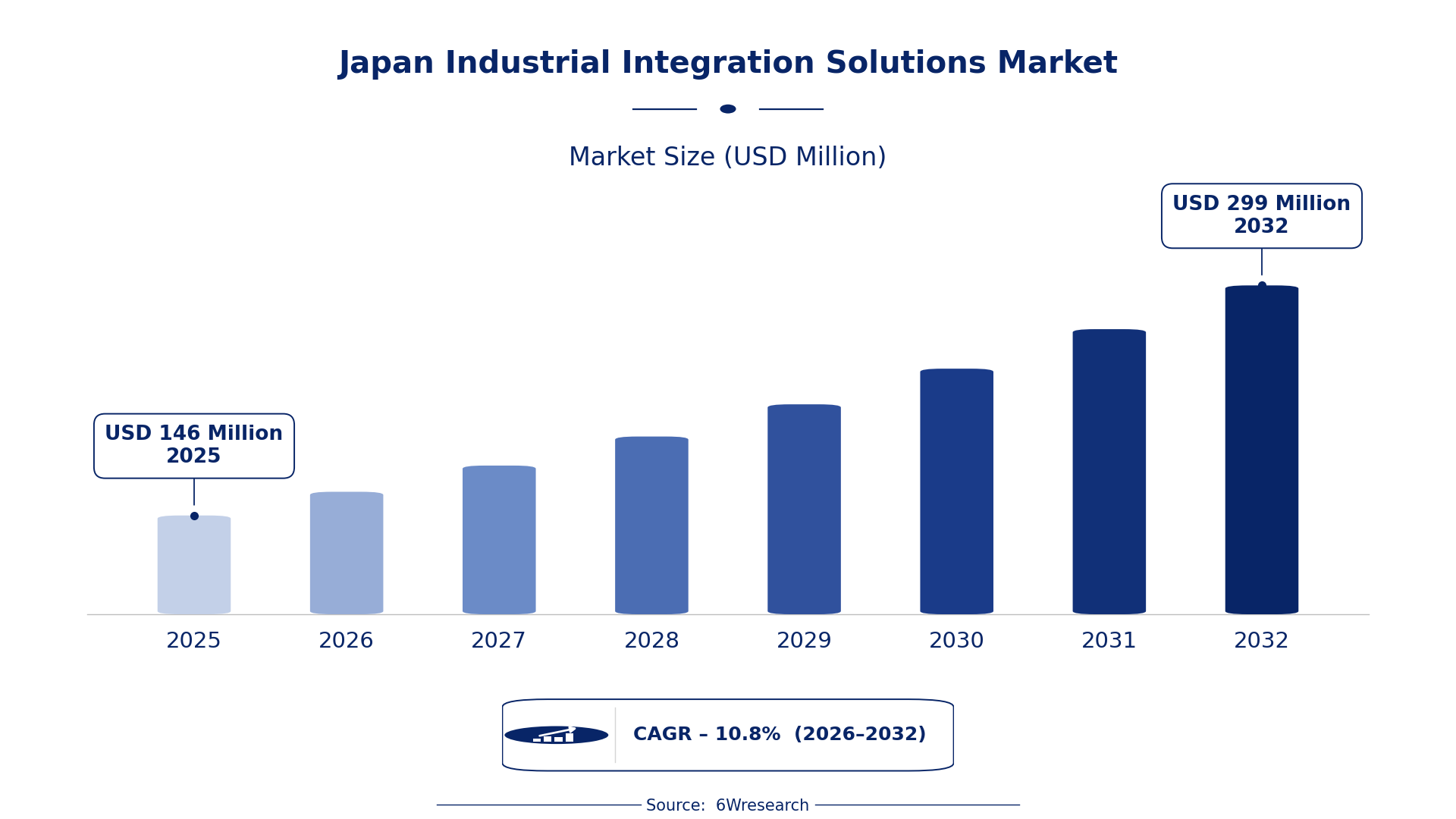
According to 6Wresearch internal database and industry insights, the Japan Industrial Integration Solutions Market was valued at USD 146 Million in 2025 and is projected to reach USD 299 Million by 2032, growing at a CAGR of approximately 10.8% during 2026–2032.
Japan Industrial Integration Solutions Market Highlights
| Report Metric | Details |
| Report Name | Japan Industrial Integration Solutions Market (2026-2032) |
| Market Size 2025 | USD 146 Million |
| Market Size 2032 | USD 299 Million |
| Absolute Growth 2025–2032 | USD 153 Million |
| CAGR 2026–2032 | 10.8% |
| Peak Annual Growth | 11.4% in 2032 |
| Forecast Period | 2026–2032 |
| Historical Data | 2022–2025 |
| Base Year | 2025 |
| Leading Solution Type, 2025 | MES-ERP Integration (38% share) |
| Leading Integration Level, 2025 | Factory-to-Enterprise (51% share) |
| Leading Interface Type, 2025 | API/Web Services (49% share) |
| Leading End User, 2025 | Smart Manufacturing (41% share) |
| Fastest-Growing Solution Type | IoT Gateway Solutions (15.8% CAGR) |
| Fastest-Growing Integration Level | Device-Level (14.0% CAGR) |
| Fastest-Growing Interface Type | Edge/Cloud (16.2% CAGR) |
| Fastest-Growing End User | Industrial IoT (14.4% CAGR) |
| Growing Sector | Smart Manufacturing |
| Key End Users | Automotive Plants, Utilities & Energy Firms, Industrial IoT, Smart Manufacturing |
Japan Industrial Integration Solutions Market Year-wise Growth Rate and Key Drivers (2022–2032)
This graph illustrates the annual growth rates of the market from 2022 to 2032, highlighting a steady upward trajectory and projected market expansion over the forecast period.
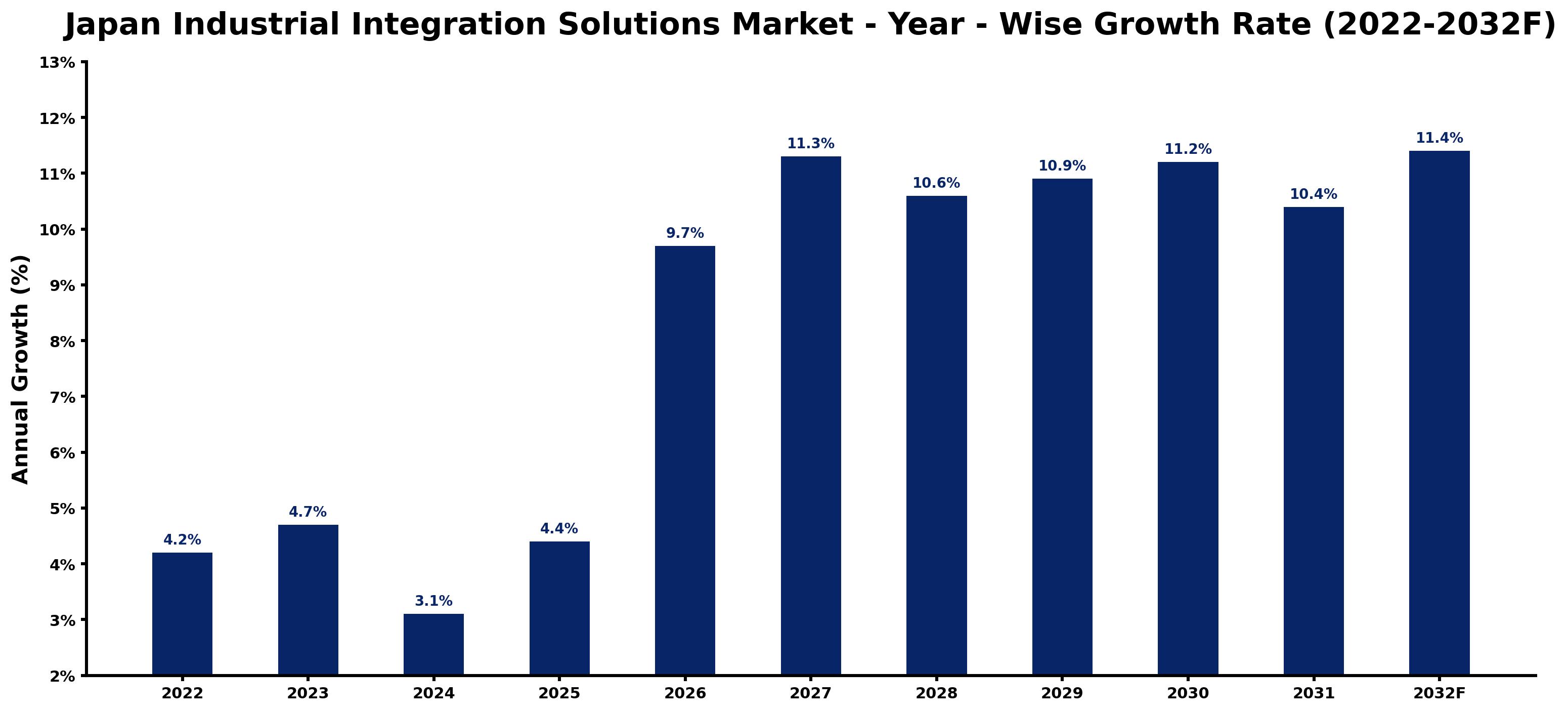
Annual growth estimates for each year appear below with the principal reason behind them, explaining the shifts that set the pace of the market.
| Year | Estimated Annual Growth (%) | Market Rationale |
| 2022 | 4.2 | The market exhibited steady growth, driven by increasing investments in automation technologies. |
| 2023 | 4.7 | Demand accelerated as manufacturers sought to improve operational efficiency through integration solutions. |
| 2024 | 3.1 | Growth slowed as companies adjusted to market conditions and focused on existing systems. |
| 2025 | 4.4 | A renewed interest in smart manufacturing initiatives led to faster growth in integration solutions. |
| 2026 | 9.7 | The market is expected to gain momentum as businesses invest in digital transformation projects. |
| 2027 | 11.3 | Demand is projected to rise sharply as the adoption of advanced technologies expands. |
| 2028 | 10.6 | Growth is anticipated to slow slightly as the market stabilises after rapid expansion. |
| 2029 | 10.9 | A resurgence in demand is expected as manufacturers seek to optimise processes further. |
| 2030 | 11.2 | Investment in automation technologies is projected to drive growth as companies modernise operations. |
| 2031 | 10.4 | Growth is expected to normalise as the market matures and competition increases. |
| 2032 | 11.4 | The market is set to peak as integration solutions become essential for operational efficiency. |
Note: Market size estimations and growth projections presented in this report are based on 6Wresearch's proprietary forecasting methodology, utilizing the latest available industry data, government publications, and primary research inputs.
Japan Industrial Integration Solutions Market Synopsis
Industrial Integration Solutions facilitate connections between various industrial systems, improving operational efficiency and enabling real-time data exchange. The Japan Industrial Integration Solutions Market is expanding due to the automotive industry's demand, which is the largest user of these solutions, and ongoing investments in automation technologies. With Japan's manufacturing sector contributing 20% to the national GDP, the emphasis on digital transformation and smart manufacturing initiatives is propelling further growth in this market.
Market Dynamics Impact Analysis (2026–2032)
| Factor | Type | Impact | Primary Segment Affected |
| Increasing demand for smart manufacturing solutions | Driver | High | Smart Manufacturing |
| Growth of the automotive industry as a key user | Driver | High | Automotive Plants |
| Expansion of IoT adoption in manufacturing | Opportunity | High | IoT Gateway Solutions |
| Government initiatives to promote digital transformation | Opportunity | High | Smart Manufacturing |
| High initial investment costs for integration solutions | Restraint | High | Factory-to-Enterprise |
| Lack of skilled workforce for implementation | Restraint | Medium | SCADA-PLC Integration |
| Competition from alternative automation technologies | Challenge | Medium | IoT Gateway Solutions |
| Supply chain disruptions affecting component availability | Challenge | High | Machine Data Connectors |
Evaluation of Drivers in Japan Industrial Integration Solutions Market (2026–2032)
Below are the drivers that matter most for revenue growth, with supporting evidence.
| Drivers | Primary Segment Affected | Why It Matters (Evidence) |
| Rising investments in automation technologies | Smart Manufacturing | The average investment in automation technology per plant is approximately ¥300 million, encouraging more manufacturers to adopt integration solutions. |
| Demand from the automotive sector | Automotive Plants | As the largest user of industrial integration solutions, the automotive industry drives purchases to improve manufacturing efficiency. |
| Government support for digital transformation | Factory-to-Enterprise | The government announced a budget of ¥500 billion for digital transformation projects, spurring investments in integration solutions. |
| Growth in the installed base of manufacturing execution systems | MES-ERP Integration | With over 10,000 units installed, the demand for integration solutions to connect these systems is increasing. |
| Adoption of Industry 4.0 technologies | Industrial IoT | The Japanese government aims to increase adoption of Industry 4.0 technologies by 2025, driving demand for integration solutions. |
Purchasing is picking up as the automotive industry invests heavily in industrial integration solutions, with approximately ¥300 million spent on automation technology per plant. The installed base of manufacturing execution systems exceeds 10,000 units, prompting manufacturers to seek integration for efficiency. Support for digital transformation fuels demand, with a budget of ¥500 billion allocated for related projects. The push for Industry 4.0 technologies by 2025 is expected to drive the integration of IoT solutions in manufacturing processes. This combination of factors is driving growth in the market as companies modernise their operations.
Evaluation of Restraints in Japan Industrial Integration Solutions Market
The main factors holding the market back are set out below.
| Market Restraint | Primary Segment Affected | Why It Matters (Evidence) |
| High initial investment costs for integration solutions | Factory-to-Enterprise | The average investment in automation technology per plant is approximately ¥300 million, which can deter smaller manufacturers. |
| Lack of skilled workforce for implementation | SCADA-PLC Integration | The need for specialised skills in integration solutions limits the ability of firms to fully implement these technologies. |
| Competition from alternative automation technologies | IoT Gateway Solutions | Emerging technologies may divert investments away from traditional integration solutions. |
| Supply chain disruptions affecting component availability | Machine Data Connectors | Ongoing supply chain issues can delay the procurement of necessary components for integration solutions. |
| Regulatory compliance costs | Smart Manufacturing | Adhering to standards like ISO 9001 incurs additional costs for manufacturers seeking integration solutions. |
Japan Industrial Integration Solutions Market Challenges
Manufacturers face skills shortages, as the ageing workforce lacks training in modern industrial integration solutions. This issue arises from a declining population and insufficient educational programmes, resulting in project delays and increased costs for manufacturers. Suppliers contend with outdated technology, as many cannot adopt the latest integration solutions, leading to higher operational expenses and longer delivery times. Regulatory compliance creates challenges, as evolving standards require continuous adjustments, imposing additional financial burdens on producers. Intense competition from international markets pressures local suppliers to innovate quickly, risking their market share if they fail to adapt.
Trends in the Japan Industrial Integration Solutions Market
Below are the shifts with the largest effect on the Japan Industrial Integration Solutions Market.
- Shift to Smart Manufacturing: Tokyo is increasingly adopting smart manufacturing practices, with the GX Basic Policy targeting JPY 150 trillion in decarbonisation investment. This initiative aims to improve operational efficiency and connectivity, resulting in a projected increase in demand for integration solutions.
- Transition from Traditional to IoT Solutions: The change towards IoT Gateway Solutions is significant, with a CAGR of 15.8% expected from 2026 to 2032. This shift reflects the need for manufacturers to connect devices for data analysis and operational improvements.
- Emergence of Edge Computing: The trend towards Edge/Cloud integration solutions is gaining traction, with a projected CAGR of 16.2% from 2026 to 2032. This change allows for more efficient data processing closer to the source, improving real-time decision-making.
- Increased Focus on Energy Efficiency: The push for energy-efficient technologies is prominent, especially with the GX Basic Policy targeting JPY 150 trillion in decarbonisation investment. This focus is driving demand for integration solutions that improve energy management.
Investment Opportunities in the Japan Industrial Integration Solutions Market
The following areas offer the clearest openings for investors and suppliers in the Japan Industrial Integration Solutions Market.
- Investment in IoT Solutions: With a projected increase in demand for IoT solutions, manufacturers should invest in IoT Gateway Solutions. The automotive sector, as a major user, presents an opportunity for suppliers.
- Expansion of Smart Manufacturing Initiatives: The GX Basic Policy creates a demand gap for integration solutions. Suppliers can enter this market by partnering with manufacturers in Tokyo and Aichi, where demand is high.
- Government Funding for Digital Transformation: The government’s ¥500 billion budget for digital transformation projects presents a prime opportunity for investment in integration solutions. Firms in the manufacturing sector should seek to align with these initiatives.
- Growth in Energy Management Solutions: As the GX Basic Policy promotes energy efficiency, there is a growing need for integration solutions that improve energy management. Utilities and energy firms should invest in these technologies to meet regulatory requirements.
Government Initiatives in the Japan Industrial Integration Solutions Market
The GX Promotion Act (2023) establishes the legal framework for promoting decarbonisation and energy efficiency in manufacturing. This act compels manufacturers to invest in energy-efficient technologies and report on their energy use, ensuring compliance with national targets for greenhouse gas emissions reduction.
The Ministry of Economy, Trade and Industry administers a ¥500 billion budget for digital transformation projects. This funding supports initiatives that improve operational efficiency and promote the adoption of smart manufacturing technologies.
Future Insight of the Japan Industrial Integration Solutions Market
By 2032, buyers will demand more automation technologies, driven by Japan's target of a 46% reduction in greenhouse-gas emissions by 2030. Investments of approximately JPY 150 trillion in decarbonisation will stimulate the market for energy-efficient technologies. The adoption of Industry 4.0 solutions will support operational efficiency across the manufacturing sector. As the installed base of manufacturing execution systems exceeds 10,000 units, real-time data exchange will become standard, facilitating better collaboration between buyers and suppliers.
Market Segmentation Analysis
Japan Industrial Integration Solutions Market report covers a detailed analysis of the following market segments:
By Solution Type – MES-ERP Integration Leads, IoT Gateway Solutions Expected to Grow Fastest
According to Saurav Kr Singh, Senior Research Analyst at 6Wresearch, the largest solution type category in 2025 was MES-ERP Integration, at 38% of revenue. MES-ERP Integration commands the largest share as it directly integrates manufacturing processes with enterprise resource planning, enhancing operational efficiency. The extensive installed base of over 10,000 manufacturing execution systems in Japan highlights its critical role for manufacturers in optimising workflows. The quickest growth will come from IoT Gateway Solutions, forecast to expand at a CAGR of 15.8% between 2026 and 2032. IoT Gateway Solutions are rapidly expanding due to the surge in demand for smart technologies, with the government backing digital transformation efforts through a ¥500 billion budget in 2023. This support is likely to accelerate the adoption of IoT solutions across various sectors. Suppliers should prioritise the development of IoT Gateway Solutions to align with the increasing demand for smart manufacturing.
By Integration Level – Factory-to-Enterprise Leads, Device-Level Expected to Grow Fastest
Factory-to-Enterprise held 51% of the Japan Industrial Integration Solutions Market by integration level in 2025. Factory-to-Enterprise integration holds the largest market share as it ensures seamless data flow from the factory floor to enterprise systems, crucial for effective decision-making. This integration is particularly vital for manufacturers in key industrial regions like Tokyo and Aichi, where operational efficiency is essential. Device-Level is projected to grow fastest, at a CAGR of 14.0% during 2026–2032. Device-Level integration is witnessing rapid growth as it connects individual devices to networks, facilitating improved data sharing. The push for adopting Industry 4.0 technologies by 2025 is a significant factor driving this trend in Japan. Buyers should consider investing in Device-Level solutions to enhance connectivity and data sharing capabilities.
By Interface Type – API/Web Services Lead, Edge/Cloud Expected to Grow Fastest
With 49% of interface type revenue in 2025, API/Web Services was the largest category. API/Web Services lead the market due to their role in enabling communication between applications over the internet, which is essential for contemporary industrial operations. Their extensive application across various sectors underscores their importance in facilitating integration. Edge/Cloud is set to record the highest CAGR in this split, 16.2% over 2026–2032. Edge/Cloud interfaces are quickly gaining popularity as they allow for data processing closer to the source, improving operational efficiency. This trend is closely tied to the increasing adoption of IoT solutions within the manufacturing sector. Suppliers must focus on developing Edge/Cloud solutions to meet the rising demand for efficient data processing in industrial applications.
By End User – Smart Manufacturing Leads, Industrial IoT Expected to Grow Fastest
Smart Manufacturing accounted for 41% of the market by end user in 2025. Smart Manufacturing is the dominant end user as it utilises technology to significantly improve manufacturing processes and operational efficiency. The automotive industry, being the largest consumer of industrial integration solutions, exemplifies the importance of this segment. Over 2026–2032, Industrial IoT is expected to post the fastest growth, at a CAGR of 14.4%. Industrial IoT is the fastest-growing end user as it connects industrial devices to the internet, enabling real-time data exchange and analysis. The heightened focus on smart technologies in manufacturing is propelling this rapid growth. Buyers should prioritise Industrial IoT solutions to maintain competitiveness in an increasingly data-driven market.
Key Attractiveness of the Report
- 10 Years of Market Numbers
- Historical Data Starting from 2022 to 2025
- Base Year 2025
- Forecast Data until 2032
- Key Performance Indicators Impacting the Market
- Major Upcoming Developments and Projects
Key Highlights of the Report:
- Japan Industrial Integration Solutions Market Outlook
- Market Size of Japan Industrial Integration Solutions Market, 2025
- Forecast of Japan Industrial Integration Solutions Market, 2032
- Historical Data and Forecast of Japan Industrial Integration Solutions Revenues & Volume for the Period 2022-2032F
- Japan Industrial Integration Solutions Market Trend Evolution
- Japan Industrial Integration Solutions Market Drivers and Challenges
- Japan Industrial Integration Solutions Price Trends
- Japan Industrial Integration Solutions Porter's Five Forces
- Japan Industrial Integration Solutions Industry Life Cycle
- Historical Data and Forecast of Japan Industrial Integration Solutions Market Revenues & Volume By Solution Type for the Period 2022-2032F
- Historical Data and Forecast of Japan Industrial Integration Solutions Market Revenues & Volume By MES-ERP Integration for the Period 2022-2032F
- Historical Data and Forecast of Japan Industrial Integration Solutions Market Revenues & Volume By IoT Gateway Solutions for the Period 2022-2032F
- Historical Data and Forecast of Japan Industrial Integration Solutions Market Revenues & Volume By SCADA-PLC Integration for the Period 2022-2032F
- Historical Data and Forecast of Japan Industrial Integration Solutions Market Revenues & Volume By Machine Data Connectors for the Period 2022-2032F
- Historical Data and Forecast of Japan Industrial Integration Solutions Market Revenues & Volume By Integration Level for the Period 2022-2032F
- Historical Data and Forecast of Japan Industrial Integration Solutions Market Revenues & Volume By Factory-to-Enterprise for the Period 2022-2032F
- Historical Data and Forecast of Japan Industrial Integration Solutions Market Revenues & Volume By Device-Level for the Period 2022-2032F
- Historical Data and Forecast of Japan Industrial Integration Solutions Market Revenues & Volume By Control Systems for the Period 2022-2032F
- Historical Data and Forecast of Japan Industrial Integration Solutions Market Revenues & Volume By Real-Time Sync for the Period 2022-2032F
- Historical Data and Forecast of Japan Industrial Integration Solutions Market Revenues & Volume By Interface Type for the Period 2022-2032F
- Historical Data and Forecast of Japan Industrial Integration Solutions Market Revenues & Volume By API/Web Services for the Period 2022-2032F
- Historical Data and Forecast of Japan Industrial Integration Solutions Market Revenues & Volume By Edge/Cloud for the Period 2022-2032F
- Historical Data and Forecast of Japan Industrial Integration Solutions Market Revenues & Volume By Modbus/OPC UA for the Period 2022-2032F
- Historical Data and Forecast of Japan Industrial Integration Solutions Market Revenues & Volume By Ethernet/IP for the Period 2022-2032F
- Historical Data and Forecast of Japan Industrial Integration Solutions Market Revenues & Volume By End User for the Period 2022-2032F
- Historical Data and Forecast of Japan Industrial Integration Solutions Market Revenues & Volume By Smart Manufacturing for the Period 2022-2032F
- Historical Data and Forecast of Japan Industrial Integration Solutions Market Revenues & Volume By Industrial IoT for the Period 2022-2032F
- Historical Data and Forecast of Japan Industrial Integration Solutions Market Revenues & Volume By Utilities & Energy Firms for the Period 2022-2032F
- Historical Data and Forecast of Japan Industrial Integration Solutions Market Revenues & Volume By Automotive Plants for the Period 2022-2032F
- Japan Industrial Integration Solutions Import Export Trade Statistics
- Market Opportunity Assessment By Solution Type
- Market Opportunity Assessment By Integration Level
- Market Opportunity Assessment By Interface Type
- Market Opportunity Assessment By End User
- Japan Industrial Integration Solutions Top Companies Market Share
- Japan Industrial Integration Solutions Competitive Benchmarking By Technical and Operational Parameters
- Japan Industrial Integration Solutions Company Profiles
- Japan Industrial Integration Solutions Key Strategic Recommendations
Market Covered
Segments analysed in this report are listed below.
By Solution Type
- MES-ERP Integration
- IoT Gateway Solutions
- SCADA-PLC Integration
- Machine Data Connectors
By Integration Level
- Factory-to-Enterprise
- Device-Level
- Control Systems
- Real-Time Sync
By Interface Type
- API/Web Services
- Edge/Cloud
- Modbus/OPC UA
- Ethernet/IP
By End User
- Smart Manufacturing
- Industrial IoT
- Utilities & Energy Firms
- Automotive Plants































