Japan Industrial IoT Connectivity Market Size & Growth Rate
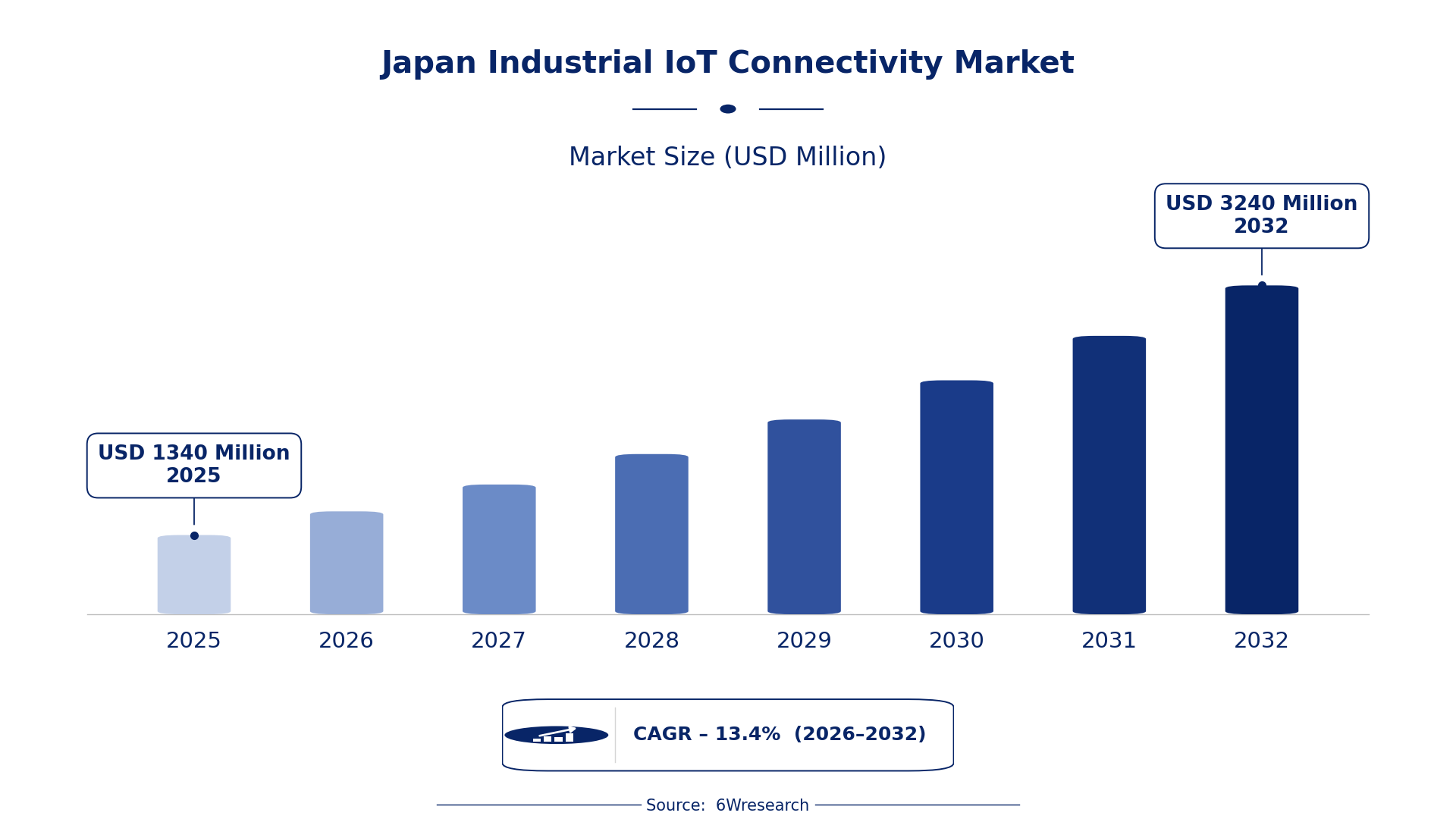
According to 6Wresearch internal database and industry insights, the Japan Industrial IoT Connectivity Market was valued at USD 1,340 Million in 2025 and is projected to reach USD 3,240 Million by 2032, growing at a CAGR of approximately 13.4% during 2026–2032.
Japan Industrial IoT Connectivity Market Highlights
| Report Metric | Details |
| Report Name | Japan Industrial IoT Connectivity Market (2026-2032) |
| Market Size 2025 | USD 1,340 Million |
| Market Size 2032 | USD 3,240 Million |
| Absolute Growth 2025–2032 | USD 1,900 Million |
| CAGR 2026–2032 | 13.4% |
| Peak Annual Growth | 14.5% in 2026 |
| Forecast Period | 2026–2032 |
| Historical Data | 2022–2025 |
| Base Year | 2025 |
| Leading Connectivity Type, 2025 | 5G Connectivity (40% share) |
| Leading Network Protocol, 2025 | High Bandwidth (51% share) |
| Leading Coverage Range, 2025 | Campus-Wide (46% share) |
| Leading End User, 2025 | Smart Factories (39% share) |
| Fastest-Growing Connectivity Type | LPWAN (LoRa/Sigfox) (18.9% CAGR) |
| Fastest-Growing Network Protocol | Low Latency (17.0% CAGR) |
| Fastest-Growing Coverage Range | Long Range (16.7% CAGR) |
| Fastest-Growing End User | Smart Agriculture (17.3% CAGR) |
| Growing Sector | Smart Agriculture |
| Key End Users | Smart Factories, Warehouse Automation, Smart Agriculture, Mining Sites |
Japan Industrial IoT Connectivity Market Year-wise Growth Rate and Key Drivers (2022–2032)
This graph illustrates the annual growth rates of the market from 2022 to 2032, highlighting a steady upward trajectory and projected market expansion over the forecast period.
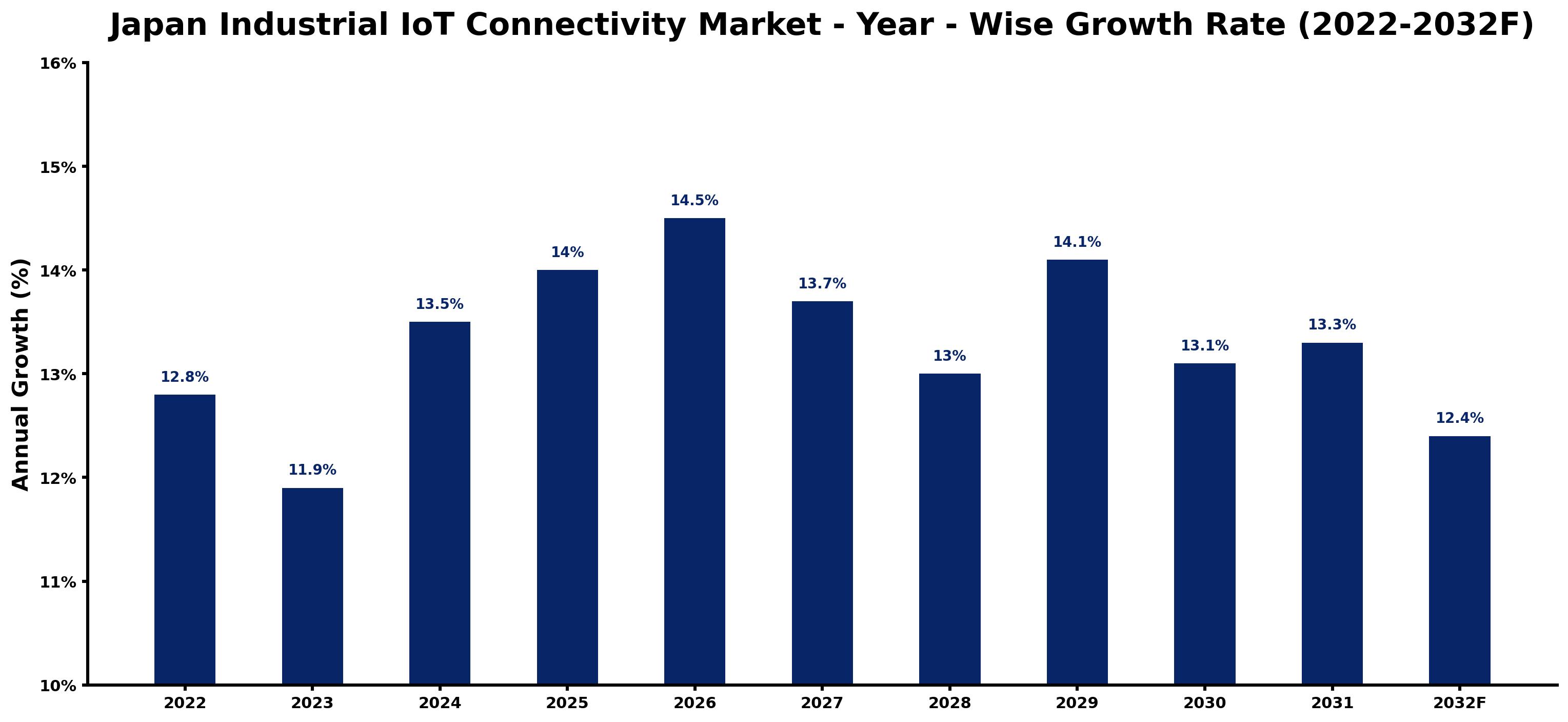
Year by year, the estimates below pair each growth rate with the development that shaped it.
| Year | Estimated Annual Growth (%) | Market Rationale |
| 2022 | 12.8 | The market showed strong activity with numerous IoT device deployments in industrial sectors. |
| 2023 | 11.9 | Growth slowed slightly due to market adjustments and increased competition in connectivity solutions. |
| 2024 | 13.5 | Demand accelerated as industries adopted IoT solutions to improve operational efficiency. |
| 2025 | 14.0 | Growth continued to rise as the government promoted IoT adoption in manufacturing. |
| 2026 | 14.5 | The market peaked with heightened investments in 5G and LPWAN technologies for industrial use. |
| 2027 | 13.7 | Growth slowed as the market began to stabilise after rapid expansions in previous years. |
| 2028 | 13.0 | Demand continued to moderate as industries consolidated their IoT investments and strategies. |
| 2029 | 14.1 | Growth picked up again as new applications for IoT connectivity emerged in various sectors. |
| 2030 | 13.1 | The market experienced a slowdown as companies focused on optimising existing IoT deployments. |
| 2031 | 13.3 | Growth resumed as advancements in technology and infrastructure attracted new investments. |
| 2032 | 12.4 | The market growth rate slowed again as saturation in certain segments began to occur. |
Note: Market size estimations and growth projections presented in this report are based on 6Wresearch's proprietary forecasting methodology, utilizing the latest available industry data, government publications, and primary research inputs.
Japan Industrial IoT Connectivity Market Synopsis
Industrial IoT Connectivity encompasses technologies that enable devices and machines to communicate over the internet, primarily through LPWAN, 5G, and Wi-Fi. The Japan Industrial IoT Connectivity Market is propelled by a dynamic industrial sector, particularly in manufacturing and smart agriculture. The Tokyo metropolitan area acts as a centre for smart factory implementations, while the government has allocated JPY 150 trillion for decarbonisation investments over the next decade, stimulating demand for IoT connectivity solutions.
Market Dynamics Impact Analysis (2026–2032)
| Factor | Type | Impact | Primary Segment Affected |
| Rising investments in smart factories and agriculture drive demand for IoT connectivity solutions. | Driver | High | Smart Factories |
| The increasing deployment of 5G networks enhances real-time data processing capabilities. | Driver | High | 5G Connectivity |
| The need for efficient logistics solutions creates opportunities for IoT in warehouse automation. | Opportunity | Medium | Warehouse Automation |
| Growing interest in sustainable practices fuels demand for smart agriculture technologies. | Opportunity | Medium | Smart Agriculture |
| High initial investment costs can deter smaller manufacturers from adopting IoT solutions. | Restraint | High | Smart Factories |
| Limited awareness of IoT benefits may slow adoption rates in traditional industries. | Restraint | Medium | Smart Factories |
| Competition among connectivity providers can lead to pricing pressures affecting profitability. | Challenge | High | 5G Connectivity |
| The rapid pace of technological change requires constant adaptation from suppliers. | Challenge | Medium | LPWAN (LoRa/Sigfox) |
Evaluation of Drivers in Japan Industrial IoT Connectivity Market (2026–2032)
The following drivers explain most of the expected growth.
| Drivers | Primary Segment Affected | Why It Matters (Evidence) |
| Increased investment in smart factories boosts productivity and efficiency. | Smart Factories | The GX Basic Policy aims for productivity improvements through IoT by 2025, driving demand for connectivity solutions. |
| Deployment of 5G networks enables real-time data processing for industrial applications. | 5G Connectivity | 5G networks are being rolled out in major industrial regions like Aichi, increasing demand for connectivity. |
| Adoption of IoT solutions in agriculture improves operational efficiency and monitoring. | Smart Agriculture | Japan's smart agriculture sector is projected to extensively adopt IoT solutions by 2025, boosting connectivity needs. |
| Private LTE networks offer secure and reliable connectivity for critical applications. | Private LTE Networks | The growing use of Private LTE in logistics ensures secure communication, driving connectivity demand. |
| Wi-Fi 6 adoption in factories supports high-capacity connectivity for dense environments. | Wi-Fi 6 Industrial | As of 2023, Wi-Fi 6 is being adopted in over 50% of new industrial installations, increasing connectivity requirements. |
What keeps demand rising is the investment in smart factories, with productivity targets driving the need for IoT solutions. The deployment of 5G networks in regions like Aichi enables real-time data processing, further increasing the need for connectivity technologies. In agriculture, the projected extensive adoption of IoT solutions by 2025 will improve operational efficiency, leading to increased purchases of connectivity technologies. The growing use of Private LTE networks in logistics ensures secure communication, while Wi-Fi 6 adoption in over 50% of new industrial installations supports high-capacity connectivity, driving further demand.
Evaluation of Restraints in Japan Industrial IoT Connectivity Market
The main factors holding the market back are set out below.
| Market Restraint | Primary Segment Affected | Why It Matters (Evidence) |
| High initial investment costs deter smaller manufacturers from adopting IoT solutions. | Smart Factories | The financial commitment required for IoT implementation can limit participation from smaller entities. |
| Limited awareness of IoT benefits may slow adoption rates in traditional industries. | Smart Factories | Many traditional manufacturers lack understanding of IoT advantages, hindering their adoption of new technologies. |
| Regulatory compliance costs can burden manufacturers looking to implement IoT solutions. | 5G Connectivity | Compliance with standards like JIS X 5071 increases operational costs for manufacturers adopting new technologies. |
| Integration challenges with existing systems may delay IoT implementation. | LPWAN (LoRa/Sigfox) | Legacy systems in industries can complicate the integration of new IoT connectivity solutions. |
| Market competition leads to pricing pressures affecting profitability. | Private LTE Networks | Intense competition among connectivity providers can force prices down, impacting margins for suppliers. |
Japan Industrial IoT Connectivity Market Challenges
High integration costs arise from the need to combine various connectivity technologies, often exceeding JPY 10 million per factory for buyers. Supply chain delays occur due to reliance on imported IoT components, which can postpone project timelines by six months for manufacturers. Local suppliers face increased competition from global players, forcing them to cut prices and potentially compromise product quality. A shortage of skilled workers in IoT implementation creates obstacles, causing smart factory upgrades to lag by over a year for companies aiming to modernise operations.
Trends in the Japan Industrial IoT Connectivity Market
Four trends stand out in the Japan Industrial IoT Connectivity Market.
- Shift from Traditional to Smart Factories: Since 2023, Japan has seen a transition towards smart factories, particularly in the Tokyo metropolitan area. This shift is evidenced by the government's target for 90% of factories to be IoT-equipped by 2024, indicating a growing demand for advanced connectivity solutions.
- Transition from 4G to 5G Connectivity: The rollout of 5G networks began in 2023, transforming industrial communication in regions like Aichi. This transition enables faster data transfer and lower latency, improving real-time operational capabilities across various sectors.
- Emergence of Private LTE Networks: Private LTE networks are increasingly being adopted in logistics and warehouse automation since 2023. This trend is driven by the need for secure and reliable connectivity, with significant investments being made to support this shift.
- Prioritisation of IoT in Smart Agriculture: The smart agriculture sector is prioritising IoT solutions for precision farming, with extensive adoption projected by 2025. This focus is supported by government initiatives promoting IoT technologies in rural areas.
Investment Opportunities in the Japan Industrial IoT Connectivity Market
Investors looking at the Japan Industrial IoT Connectivity Market should consider the following areas.
- Smart Factories: Manufacturers are seeking advanced connectivity solutions to improve operational efficiency, with a projected investment gap of JPY 150 trillion over the next decade. Collaborating with industrial parks in Aichi can facilitate market entry.
- Logistics Sector: With over 30 million IoT devices deployed, the logistics sector is ripe for investment in IoT solutions. Establishing partnerships with logistics firms in urban areas can help tap into this demand.
- Agricultural Innovations: The smart agriculture sector requires IoT solutions for precision farming, with a projected adoption rate of 90% by 2025. Engaging with agricultural cooperatives can provide access to this growing market.
- Industrial Parks: As Japan aims for 90% IoT-equipped factories by 2024, investment in connectivity solutions is essential. Focusing on industrial parks in the Tokyo metropolitan area can yield significant opportunities.
Government Initiatives in the Japan Industrial IoT Connectivity Market
The GX Promotion Act (2023) establishes the legal framework for decarbonisation efforts, obligating manufacturers to adopt energy-efficient practices. This act aims for a 46% reduction in greenhouse-gas emissions by fiscal 2030, driving demand for IoT solutions that improve energy efficiency.
The Japan IoT Acceleration Consortium oversees the implementation of initiatives supporting IoT adoption in manufacturing. In 2023, the consortium launched a program to promote IoT technologies, allocating funds to assist manufacturers in integrating these solutions.
Future Insight of the Japan Industrial IoT Connectivity Market
A policy-driven shift towards decarbonisation will stimulate IoT adoption across various sectors. By 2025, the integration of IoT in agriculture is expected to enhance productivity and sustainability. The rollout of 5G networks in industrial regions will facilitate rapid data transmission, enabling immediate decision-making. By 2032, 90% of factories are projected to adopt IoT connectivity solutions, which will improve operational efficiency for both buyers and suppliers.
Market Segmentation Analysis
Japan Industrial IoT Connectivity Market report covers a detailed analysis of the following market segments:
By Connectivity Type – 5G Connectivity Leads, LPWAN (LoRa/Sigfox) Expected to Grow Fastest
According to Saurav Kr Singh, Senior Research Analyst at 6Wresearch, with 40% of connectivity type revenue in 2025, 5G Connectivity was the largest category. 5G Connectivity leads the market due to its ability to provide high-speed, low-latency communication, which is essential for real-time data processing in sectors like manufacturing. The ongoing rollout of 5G networks in major industrial regions such as Aichi and Osaka strengthens its dominant position. LPWAN (LoRa/Sigfox) is projected to grow fastest, at a CAGR of 18.9% during 2026–2032. LPWAN (LoRa/Sigfox) is experiencing rapid growth as it is particularly suitable for low-power, long-range applications in industrial settings, especially in rural areas for smart agriculture. This trend aligns with Japan's aim to enhance agricultural efficiency by 2025, ensuring sustained demand. Suppliers should focus on developing solutions that integrate both 5G and LPWAN technologies to effectively address the varied needs of industrial clients.
By Network Protocol – High Bandwidth Leads, Low Latency Expected to Grow Fastest
High Bandwidth accounted for 51% of the market by network protocol in 2025. High Bandwidth is the leading network protocol because it is essential for applications that require large data transfers, especially in manufacturing where extensive data analytics is crucial. The increasing number of IoT devices deployed in industrial sectors drives the demand for high bandwidth solutions. The quickest growth will come from Low Latency, forecast to expand at a CAGR of 17.0% between 2026 and 2032. Low Latency is growing rapidly as it is vital for time-sensitive industrial operations, enabling prompt data processing and response. The push for greater automation across industries will further increase the need for low latency communication. Buyers must prioritise network protocols that provide both high bandwidth and low latency to enhance their operational efficiency.
By Coverage Range – Campus-Wide Leads, Long Range Expected to Grow Fastest
The largest coverage range category in 2025 was Campus-Wide, at 46% of revenue. Campus-Wide coverage dominates the market as it enables connectivity across multiple buildings in industrial parks, facilitating seamless communication and data sharing in extensive manufacturing setups. This is particularly relevant in the Tokyo metropolitan area, a hub for smart factory implementations. Over 2026–2032, Long Range is expected to post the fastest growth, at a CAGR of 16.7%. Long Range coverage is witnessing the fastest growth as it is ideal for connecting devices over large distances in rural areas, which is crucial for expanding smart agriculture initiatives. The deployment of more agricultural IoT solutions will drive the demand for long-range connectivity. Suppliers should provide solutions that accommodate both campus-wide and long-range coverage to meet the diverse requirements of the industrial sector.
By End User – Smart Factories Lead, Smart Agriculture Expected to Grow Fastest
In 2025, Smart Factories led the end user split with a 39% share. Smart Factories dominate the market as they are integral to automation and smart manufacturing processes, leading to high demand for IoT connectivity solutions. The Smart Factory Initiative by the Ministry of Economy, Trade and Industry aims to boost productivity through IoT by 2025, solidifying this segment's lead. Smart Agriculture is set to record the highest CAGR in this split, 17.3% over 2026–2032. Smart Agriculture is the fastest-growing end user segment due to its role in precision farming and monitoring, increasingly adopted as Japan modernises its agricultural practices by 2025. Government initiatives promoting IoT adoption in agriculture support this growth. Suppliers should tailor their offerings to meet the specific needs of smart factories and smart agriculture to capture emerging market opportunities.
Key Attractiveness of the Report
- 10 Years of Market Numbers
- Historical Data Starting from 2022 to 2025
- Base Year 2025
- Forecast Data until 2032
- Key Performance Indicators Impacting the Market
- Major Upcoming Developments and Projects
Key Highlights of the Report:
- Japan Industrial IoT Connectivity Market Outlook
- Market Size of Japan Industrial IoT Connectivity Market, 2025
- Forecast of Japan Industrial IoT Connectivity Market, 2032
- Historical Data and Forecast of Japan Industrial IoT Connectivity Revenues & Volume for the Period 2022-2032F
- Japan Industrial IoT Connectivity Market Trend Evolution
- Japan Industrial IoT Connectivity Market Drivers and Challenges
- Japan Industrial IoT Connectivity Price Trends
- Japan Industrial IoT Connectivity Porter's Five Forces
- Japan Industrial IoT Connectivity Industry Life Cycle
- Historical Data and Forecast of Japan Industrial IoT Connectivity Market Revenues & Volume By Connectivity Type for the Period 2022-2032F
- Historical Data and Forecast of Japan Industrial IoT Connectivity Market Revenues & Volume By LPWAN (LoRa/Sigfox) for the Period 2022-2032F
- Historical Data and Forecast of Japan Industrial IoT Connectivity Market Revenues & Volume By 5G Connectivity for the Period 2022-2032F
- Historical Data and Forecast of Japan Industrial IoT Connectivity Market Revenues & Volume By Wi-Fi 6 Industrial for the Period 2022-2032F
- Historical Data and Forecast of Japan Industrial IoT Connectivity Market Revenues & Volume By Private LTE Networks for the Period 2022-2032F
- Historical Data and Forecast of Japan Industrial IoT Connectivity Market Revenues & Volume By Network Protocol for the Period 2022-2032F
- Historical Data and Forecast of Japan Industrial IoT Connectivity Market Revenues & Volume By Low Power for the Period 2022-2032F
- Historical Data and Forecast of Japan Industrial IoT Connectivity Market Revenues & Volume By High Bandwidth for the Period 2022-2032F
- Historical Data and Forecast of Japan Industrial IoT Connectivity Market Revenues & Volume By Low Latency for the Period 2022-2032F
- Historical Data and Forecast of Japan Industrial IoT Connectivity Market Revenues & Volume By Secure/Customizable for the Period 2022-2032F
- Historical Data and Forecast of Japan Industrial IoT Connectivity Market Revenues & Volume By Coverage Range for the Period 2022-2032F
- Historical Data and Forecast of Japan Industrial IoT Connectivity Market Revenues & Volume By Long Range for the Period 2022-2032F
- Historical Data and Forecast of Japan Industrial IoT Connectivity Market Revenues & Volume By Short to Mid for the Period 2022-2032F
- Historical Data and Forecast of Japan Industrial IoT Connectivity Market Revenues & Volume By Indoor for the Period 2022-2032F
- Historical Data and Forecast of Japan Industrial IoT Connectivity Market Revenues & Volume By Campus-Wide for the Period 2022-2032F
- Historical Data and Forecast of Japan Industrial IoT Connectivity Market Revenues & Volume By End User for the Period 2022-2032F
- Historical Data and Forecast of Japan Industrial IoT Connectivity Market Revenues & Volume By Smart Agriculture for the Period 2022-2032F
- Historical Data and Forecast of Japan Industrial IoT Connectivity Market Revenues & Volume By Smart Factories for the Period 2022-2032F
- Historical Data and Forecast of Japan Industrial IoT Connectivity Market Revenues & Volume By Warehouse Automation for the Period 2022-2032F
- Historical Data and Forecast of Japan Industrial IoT Connectivity Market Revenues & Volume By Mining Sites for the Period 2022-2032F
- Japan Industrial IoT Connectivity Import Export Trade Statistics
- Market Opportunity Assessment By Connectivity Type
- Market Opportunity Assessment By Network Protocol
- Market Opportunity Assessment By Coverage Range
- Market Opportunity Assessment By End User
- Japan Industrial IoT Connectivity Top Companies Market Share
- Japan Industrial IoT Connectivity Competitive Benchmarking By Technical and Operational Parameters
- Japan Industrial IoT Connectivity Company Profiles
- Japan Industrial IoT Connectivity Key Strategic Recommendations
Market Covered
The following segment groups are covered in the report.
By Connectivity Type
- LPWAN (LoRa/Sigfox)
- 5G Connectivity
- Wi-Fi 6 Industrial
- Private LTE Networks
By Network Protocol
- Low Power
- High Bandwidth
- Low Latency
- Secure/Customizable
By Coverage Range
- Long Range
- Short to Mid
- Indoor
- Campus-Wide
By End User
- Smart Agriculture
- Smart Factories
- Warehouse Automation
- Mining Sites































