Japan Industrial IoT Sensor AI Market Size & Growth Rate
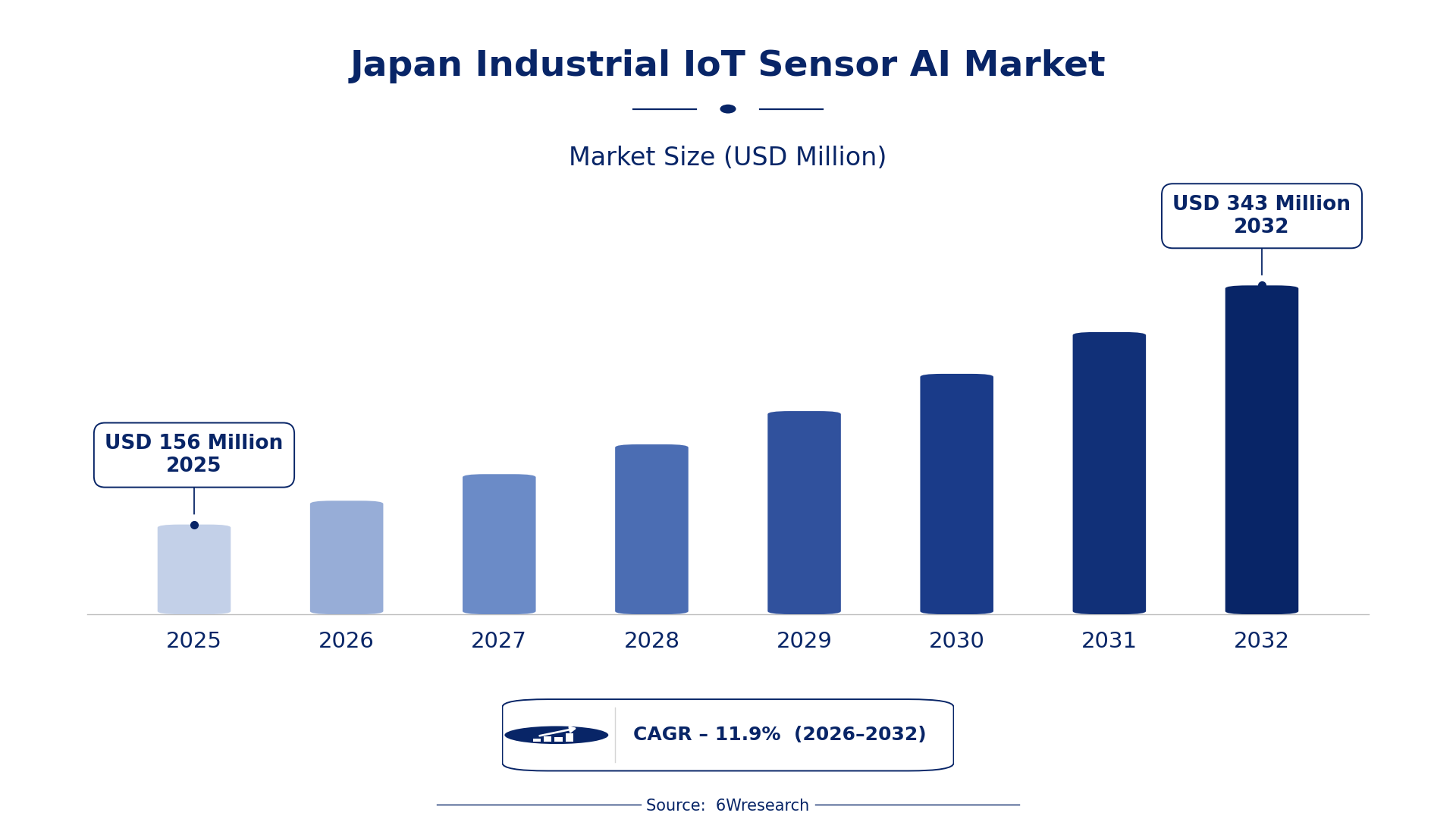
According to 6Wresearch internal database and industry insights, the Japan Industrial IoT Sensor AI Market was valued at USD 156 Million in 2025 and is projected to reach USD 343 Million by 2032, growing at a CAGR of approximately 11.9% during 2026–2032.
Japan Industrial IoT Sensor AI Market Highlights
| Report Metric | Details |
| Report Name | Japan Industrial IoT Sensor AI Market (2026-2032) |
| Market Size 2025 | USD 156 Million |
| Market Size 2032 | USD 343 Million |
| Absolute Growth 2025–2032 | USD 187 Million |
| CAGR 2026–2032 | 11.9% |
| Peak Annual Growth | 13.4% in 2032 |
| Forecast Period | 2026–2032 |
| Historical Data | 2022–2025 |
| Base Year | 2025 |
| Leading Sensor Type, 2025 | Vibration Sensors + AI (47% share) |
| Leading AI Capability, 2025 | Predictive Analysis (44% share) |
| Leading Application Area, 2025 | Motor Monitoring (47% share) |
| Leading End User, 2025 | Smart Factories (45% share) |
| Fastest-Growing Sensor Type | Pressure Sensors + AI (18.5% CAGR) |
| Fastest-Growing AI Capability | Anomaly Detection (16.5% CAGR) |
| Fastest-Growing Application Area | Process Automation (14.9% CAGR) |
| Fastest-Growing End User | Oil Refineries (16.3% CAGR) |
| Growing Sector | manufacturing |
| Key End Users | manufacturers, industrial automation firms, oil refineries, data centers |
Japan Industrial IoT Sensor AI Market Year-wise Growth Rate and Key Drivers (2022–2032)
This graph illustrates the annual growth rates of the market from 2022 to 2032, highlighting a steady upward trajectory and projected market expansion over the forecast period.
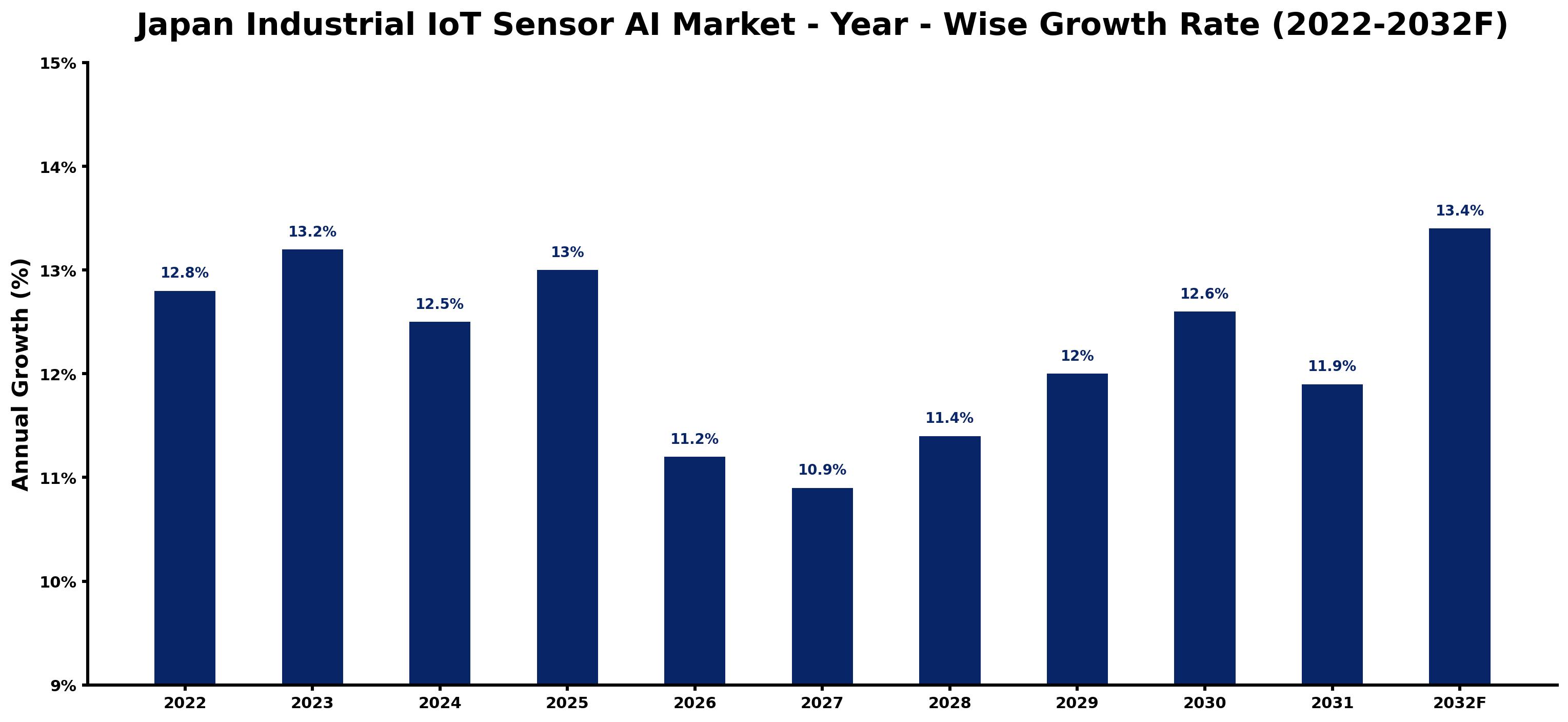
The table below sets out the estimated growth rate for each year and the main factor behind it.
| Year | Estimated Annual Growth (%) | Market Rationale |
| 2022 | 12.8 | The market exhibited strong growth with increasing investments in IoT technologies. |
| 2023 | 13.2 | Growth accelerated as more manufacturers adopted IoT solutions for efficiency. |
| 2024 | 12.5 | Growth slowed slightly, reflecting market adjustments after rapid expansion. |
| 2025 | 13.0 | A rebound in growth occurred as companies focused on digital transformation. |
| 2026 | 11.2 | Growth is expected to decelerate as market saturation begins to influence new investments. |
| 2027 | 10.9 | The trend of slower growth will continue as competition intensifies. |
| 2028 | 11.4 | Growth is projected to pick up again as new technological advancements are introduced. |
| 2029 | 12.0 | The market will experience renewed growth as demand for automation increases. |
| 2030 | 12.6 | Growth will continue as manufacturers seek to improve operational efficiency. |
| 2031 | 11.9 | A slowdown in growth is expected as market maturity sets in. |
| 2032 | 13.4 | Growth will peak as investments in advanced technologies surge. |
Note: Market size estimations and growth projections presented in this report are based on 6Wresearch's proprietary forecasting methodology, utilizing the latest available industry data, government publications, and primary research inputs.
Japan Industrial IoT Sensor AI Market Synopsis
Industrial IoT Sensor AI integrates advanced sensors with artificial intelligence to improve data collection and analysis in industrial environments. These sensors are essential for real-time monitoring and predictive maintenance, optimising operational efficiency and safety in sectors like manufacturing. The Japan Industrial IoT Sensor AI Market is expanding rapidly, driven by over 80% of manufacturers investing in IoT technologies and initiatives like the 'Connected Industries' programme, aiming for a 30% increase in IoT adoption by 2025.
Market Dynamics Impact Analysis (2026–2032)
| Factor | Type | Impact | Primary Segment Affected |
| Growing investments in smart factory initiatives drive demand for advanced sensors. | Driver | High | Vibration Sensors + AI |
| Increased focus on predictive maintenance creates opportunities for sensor integration. | Driver | High | Predictive Analysis |
| Rising demand for automation in manufacturing presents new market opportunities. | Opportunity | High | Smart Factories |
| The need for improved safety standards in industrial settings drives sensor adoption. | Opportunity | Medium | Oil Refineries |
| High initial investment costs can deter smaller manufacturers from adopting IoT solutions. | Restraint | High | Multi-Sensor AI Platforms |
| Limited interoperability between different IoT systems can hinder integration efforts. | Restraint | Medium | Industrial Automation |
| The challenge of ensuring data security can complicate IoT implementation. | Challenge | High | Data Centers |
| A shortage of skilled workforce in AI and IoT technologies can limit growth. | Challenge | Medium | Thermal Sensors + AI |
Evaluation of Drivers in Japan Industrial IoT Sensor AI Market (2026–2032)
These are the developments adding the most demand over the forecast period.
| Drivers | Primary Segment Affected | Why It Matters (Evidence) |
| Increased investment in automation technologies drives demand for sensors. | Vibration Sensors + AI | Over 80% of manufacturers are investing in IoT technologies to improve efficiency. |
| The push for predictive maintenance drives the need for advanced analytics. | Predictive Analysis | The total installed base of industrial sensors in Japan is estimated to be over 10 million units. |
| Growing focus on energy efficiency in manufacturing boosts sensor adoption. | Thermal Sensors + AI | Japan targets a 46% cut in greenhouse-gas emissions by fiscal 2030. |
| Rising safety regulations in industries necessitate advanced monitoring solutions. | Multi-Sensor AI Platforms | The 'Society 5.0' initiative aims to integrate IoT across various sectors. |
| The expansion of smart factories increases demand for integrated sensor solutions. | Motor Monitoring | The Tokyo region is a hub for smart factory initiatives focusing on IoT. |
Volumes grow on the back of substantial investments in automation technologies, with over 80% of manufacturers committing to IoT solutions. The total installed base of industrial sensors in Japan is estimated to exceed 10 million units, driving operational efficiency and predictive maintenance capabilities. Japan's target to cut greenhouse-gas emissions by 46% by 2030 increases demand for energy-efficient thermal sensors.
Evaluation of Restraints in Japan Industrial IoT Sensor AI Market
Several factors work against faster growth; the main ones are summarised below.
| Market Restraint | Primary Segment Affected | Why It Matters (Evidence) |
| High initial investment costs deter smaller manufacturers from adopting IoT solutions. | Multi-Sensor AI Platforms | Many small manufacturers lack the capital to invest in advanced sensor technologies. |
| Limited interoperability between different IoT systems can hinder integration efforts. | Industrial Automation | Incompatibility issues can complicate the deployment of new technologies. |
| Data security concerns complicate the implementation of IoT solutions. | Data Centers | Manufacturers worry about potential breaches and data loss. |
| The complexity of AI technologies can slow down adoption rates. | Thermal Sensors + AI | Many manufacturers lack the expertise to implement AI-driven solutions. |
| Regulatory compliance can increase operational costs for manufacturers. | Vibration Sensors + AI | Meeting safety and environmental standards requires additional investments. |
Japan Industrial IoT Sensor AI Market Challenges
Limited integration of new technology restricts the growth of Industrial IoT Sensor AI in Japan. Many producers rely on outdated systems that cannot accommodate modern sensor capabilities, leading to delayed efficiency improvements and diminished market competitiveness. Compliance with standards like ISO/IEC 30141:2018 diverts essential resources and prolongs project timelines for manufacturers, causing implementation delays. Buyers are facing rising costs as the national minimum wage increased to JPY 1,055 per hour in October 2024, straining pricing strategies for IoT solutions and limiting access for smaller enterprises.
Trends in the Japan Industrial IoT Sensor AI Market
Below are the shifts with the largest effect on the Japan Industrial IoT Sensor AI Market.
- Shift from Traditional Monitoring to Predictive Maintenance: Since 2022, industries have increasingly adopted predictive maintenance strategies, utilising advanced sensors for real-time data analysis. This shift is clear in the automotive sector, where over 80% of manufacturers are investing in IoT technologies, improving operational efficiency.
- Transition from Manual Processes to Automation: The trend towards automation has accelerated, particularly in smart factories. The Tokyo region has seen a surge in smart factory initiatives, with an estimated market size of 1 trillion yen projected by 2025, driving demand for advanced sensor technologies.
- Emergence of Integrated Multi-Sensor Platforms: The integration of multiple sensor types into cohesive platforms is gaining traction. In 2023, the average smart factory deployed approximately 1,000 sensors, enabling effective monitoring and predictive analysis, which improves operational efficiency.
- Prioritisation of Energy Efficiency in Manufacturing: The focus on energy efficiency has intensified, driven by Japan's commitment to reducing greenhouse-gas emissions. The 'Society 5.0' initiative aims to integrate IoT across sectors, promoting energy-efficient technologies in manufacturing.
Investment Opportunities in the Japan Industrial IoT Sensor AI Market
Below are the investment opportunities with the strongest case in the Japan Industrial IoT Sensor AI Market.
- Manufacturers Seeking Automation Solutions: With over 80% of manufacturers investing in IoT technologies, there is a chance to provide advanced sensor solutions. The Tokyo region is a key area for suppliers aiming to enhance automation in smart factories.
- Industrial Facilities Needing Enhanced Safety Measures: As safety regulations become stricter, the demand for advanced monitoring solutions is increasing. The oil refinery sector offers an opportunity for suppliers to invest in safety-focused sensor technologies.
- Growing Demand for Predictive Maintenance Solutions: The need for predictive maintenance is on the rise, with a projected market size of 1 trillion yen by 2025. Suppliers can enter this market by collaborating with manufacturers focused on operational efficiency.
- Investment in Energy-Efficient Technologies: Japan's goal for a 46% reduction in greenhouse gas emissions by 2030 creates a demand for energy-efficient solutions. Suppliers can engage with manufacturers looking to meet these regulations.
Government Initiatives in the Japan Industrial IoT Sensor AI Market
The GX Promotion Act (2023) establishes a legal framework for decarbonisation efforts, building on previous measures like the Semiconductor and Digital Industry Strategy (2021). This act requires companies to adopt sustainable practices, improving the regulatory environment for IoT sensor producers and users.
In 2023, the Japanese government allocated 50 billion yen for digital transformation in manufacturing, overseen by the Ministry of Economy, Trade and Industry (METI). This funding supports initiatives aimed at increasing IoT adoption and improving operational efficiency.
Future Insight of the Japan Industrial IoT Sensor AI Market
Japan's planned investment of JPY 150 trillion in decarbonisation over the next decade will create substantial demand for Industrial IoT Sensor AI. By 2032, the emphasis on smart factories will lead to a 30% increase in IoT adoption within manufacturing, boosting operational efficiency. The Connected Industries initiative will promote collaboration among stakeholders, easing the integration of IoT technologies. As data centres increasingly utilise AI for energy management, the demand for advanced sensors will rise, supporting predictive maintenance and optimising resource use.
Market Segmentation Analysis
Japan Industrial IoT Sensor AI Market report covers a detailed analysis of the following market segments:
By Sensor Type – Vibration Sensors + AI Leads, Pressure Sensors + AI Expected to Grow Fastest
According to Saurav Kr Singh, Senior Research Analyst at 6Wresearch, Vibration Sensors + AI accounted for 47% of the market by sensor type in 2025. Vibration sensors hold the largest share as they are crucial for monitoring machinery health and performance in industrial applications. Their widespread use in automotive manufacturing for predictive maintenance underscores their importance in enhancing operational efficiency. Pressure Sensors + AI is projected to grow fastest, at a CAGR of 18.5% during 2026–2032. Pressure sensors are experiencing rapid growth due to their critical role in process control across various industries. The increasing focus on automation and efficiency within manufacturing processes is significantly propelling this segment forward. Suppliers should focus on enhancing the capabilities of pressure sensors to meet the rising demands of manufacturers.
By AI Capability – Predictive Analysis Leads, Anomaly Detection Expected to Grow Fastest
With 44% of ai capability revenue in 2025, Predictive Analysis was the largest category. Predictive analysis leads the market as it allows for accurate forecasting of equipment failures, which is essential for maintaining operational efficiency. This capability is particularly valued in sectors like manufacturing, where minimising downtime is critical. The quickest growth will come from Anomaly Detection, forecast to expand at a CAGR of 16.5% between 2026 and 2032. Anomaly detection is the fastest-growing segment, propelled by the urgent need to quickly identify unusual patterns in sensor data. As industries increasingly depend on real-time monitoring, the demand for this capability is escalating. Buyers will gain from investing in anomaly detection technologies to improve their operational reliability.
By Application Area – Motor Monitoring Leads, Process Automation Expected to Grow Fastest
Motor Monitoring held 47% of the Japan Industrial IoT Sensor AI Market by application area in 2025. Motor monitoring leads the application area as it ensures optimal performance of electric motors, which are vital in many industrial settings. The demand for effective monitoring solutions is driven by the integral role electric motors play in manufacturing processes. Over 2026–2032, Process Automation is expected to post the fastest growth, at a CAGR of 14.9%. Process automation is the fastest-growing application area, being essential for boosting efficiency in manufacturing. The trend towards smart manufacturing practices is accelerating the adoption of automation technologies. Suppliers should prioritise solutions that improve process automation to take advantage of this growth trend.
By End User – Smart Factories Lead, Oil Refineries Expected to Grow Fastest
The largest end user category in 2025 was Smart Factories, at 45% of revenue. Smart factories dominate the end user segment, central to modern manufacturing strategies that leverage IoT technologies. The significant investment in smart factory initiatives, particularly in regions like Tokyo, highlights the importance of this segment. Oil Refineries are set to record the highest CAGR in this split, 16.3% over 2026–2032. Oil refineries are the fastest-growing end user, utilising sensors to enhance safety and operational efficiency. The ongoing emphasis on improving operational standards in this sector is driving the swift adoption of IoT solutions. Suppliers must tailor their offerings to address the specific needs of oil refineries to seize this emerging market.
Key Attractiveness of the Report
- 10 Years of Market Numbers
- Historical Data Starting from 2022 to 2025
- Base Year 2025
- Forecast Data until 2032
- Key Performance Indicators Impacting the Market
- Major Upcoming Developments and Projects
Key Highlights of the Report:
- Japan Industrial IoT Sensor AI Market Outlook
- Market Size of Japan Industrial IoT Sensor AI Market, 2025
- Forecast of Japan Industrial IoT Sensor AI Market, 2032
- Historical Data and Forecast of Japan Industrial IoT Sensor AI Revenues & Volume for the Period 2022-2032F
- Japan Industrial IoT Sensor AI Market Trend Evolution
- Japan Industrial IoT Sensor AI Market Drivers and Challenges
- Japan Industrial IoT Sensor AI Price Trends
- Japan Industrial IoT Sensor AI Porter's Five Forces
- Japan Industrial IoT Sensor AI Industry Life Cycle
- Historical Data and Forecast of Japan Industrial IoT Sensor AI Market Revenues & Volume By Sensor Type for the Period 2022-2032F
- Historical Data and Forecast of Japan Industrial IoT Sensor AI Market Revenues & Volume By Vibration Sensors + AI for the Period 2022-2032F
- Historical Data and Forecast of Japan Industrial IoT Sensor AI Market Revenues & Volume By Pressure Sensors + AI for the Period 2022-2032F
- Historical Data and Forecast of Japan Industrial IoT Sensor AI Market Revenues & Volume By Thermal Sensors + AI for the Period 2022-2032F
- Historical Data and Forecast of Japan Industrial IoT Sensor AI Market Revenues & Volume By Multi-Sensor AI Platforms for the Period 2022-2032F
- Historical Data and Forecast of Japan Industrial IoT Sensor AI Market Revenues & Volume By AI Capability for the Period 2022-2032F
- Historical Data and Forecast of Japan Industrial IoT Sensor AI Market Revenues & Volume By Predictive Analysis for the Period 2022-2032F
- Historical Data and Forecast of Japan Industrial IoT Sensor AI Market Revenues & Volume By Anomaly Detection for the Period 2022-2032F
- Historical Data and Forecast of Japan Industrial IoT Sensor AI Market Revenues & Volume By Pattern Recognition for the Period 2022-2032F
- Historical Data and Forecast of Japan Industrial IoT Sensor AI Market Revenues & Volume By Sensor Fusion for the Period 2022-2032F
- Historical Data and Forecast of Japan Industrial IoT Sensor AI Market Revenues & Volume By Application Area for the Period 2022-2032F
- Historical Data and Forecast of Japan Industrial IoT Sensor AI Market Revenues & Volume By Motor Monitoring for the Period 2022-2032F
- Historical Data and Forecast of Japan Industrial IoT Sensor AI Market Revenues & Volume By Process Automation for the Period 2022-2032F
- Historical Data and Forecast of Japan Industrial IoT Sensor AI Market Revenues & Volume By Fire Prevention for the Period 2022-2032F
- Historical Data and Forecast of Japan Industrial IoT Sensor AI Market Revenues & Volume By Machine Health for the Period 2022-2032F
- Historical Data and Forecast of Japan Industrial IoT Sensor AI Market Revenues & Volume By End User for the Period 2022-2032F
- Historical Data and Forecast of Japan Industrial IoT Sensor AI Market Revenues & Volume By Smart Factories for the Period 2022-2032F
- Historical Data and Forecast of Japan Industrial IoT Sensor AI Market Revenues & Volume By Oil Refineries for the Period 2022-2032F
- Historical Data and Forecast of Japan Industrial IoT Sensor AI Market Revenues & Volume By Data Centers for the Period 2022-2032F
- Historical Data and Forecast of Japan Industrial IoT Sensor AI Market Revenues & Volume By Industrial Automation for the Period 2022-2032F
- Japan Industrial IoT Sensor AI Import Export Trade Statistics
- Market Opportunity Assessment By Sensor Type
- Market Opportunity Assessment By AI Capability
- Market Opportunity Assessment By Application Area
- Market Opportunity Assessment By End User
- Japan Industrial IoT Sensor AI Top Companies Market Share
- Japan Industrial IoT Sensor AI Competitive Benchmarking By Technical and Operational Parameters
- Japan Industrial IoT Sensor AI Company Profiles
- Japan Industrial IoT Sensor AI Key Strategic Recommendations
Market Covered
This report examines the market across the segments below.
By Sensor Type
- Vibration Sensors + AI
- Pressure Sensors + AI
- Thermal Sensors + AI
- Multi-Sensor AI Platforms
By AI Capability
- Predictive Analysis
- Anomaly Detection
- Pattern Recognition
- Sensor Fusion
By Application Area
- Motor Monitoring
- Process Automation
- Fire Prevention
- Machine Health
By End User
- Smart Factories
- Oil Refineries
- Data Centers
- Industrial Automation































