Japan Industrial IoT Sensor Market Size & Growth Rate
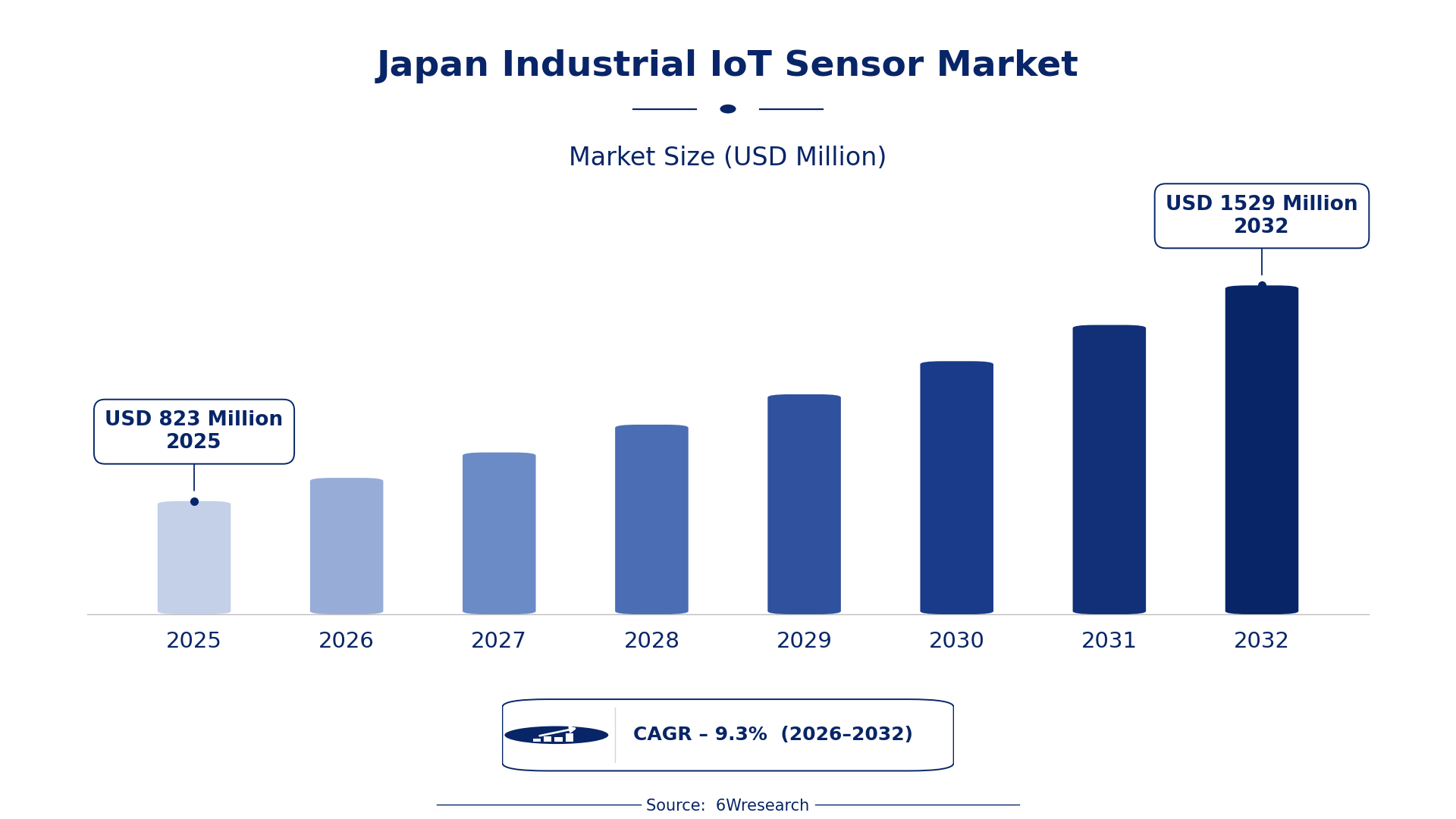
According to 6Wresearch internal database and industry insights, the Japan Industrial IoT Sensor Market was valued at USD 823 Million in 2025 and is projected to reach USD 1,529 Million by 2032, growing at a CAGR of approximately 9.3% during 2026–2032.
Japan Industrial IoT Sensor Market Highlights
| Report Metric | Details |
| Report Name | Japan Industrial IoT Sensor Market (2026-2032) |
| Market Size 2025 | USD 823 Million |
| Market Size 2032 | USD 1,529 Million |
| Absolute Growth 2025–2032 | USD 706 Million |
| CAGR 2026–2032 | 9.3% |
| Peak Annual Growth | 10.4% in 2026 |
| Forecast Period | 2026–2032 |
| Historical Data | 2022–2025 |
| Base Year | 2025 |
| Leading Sensor Type, 2025 | Temperature Sensors (42% share) |
| Leading Signal Output, 2025 | Analog/Digital (41% share) |
| Leading Connectivity, 2025 | Wired/Wireless (42% share) |
| Leading End User, 2025 | Food Processing (36% share) |
| Fastest-Growing Sensor Type | Pressure Sensors (13.4% CAGR) |
| Fastest-Growing Signal Output | Piezoresistive/Capacitive (12.6% CAGR) |
| Fastest-Growing Connectivity | CANbus/Modbus (12.4% CAGR) |
| Fastest-Growing End User | Chemical Plants (12.5% CAGR) |
| Growing Sector | Food Processing |
| Key End Users | Manufacturers, Food Processors, Chemical Plants, HVAC Systems |
Japan Industrial IoT Sensor Market Year-wise Growth Rate and Key Drivers (2022–2032)
This graph illustrates the annual growth rates of the market from 2022 to 2032, highlighting a steady upward trajectory and projected market expansion over the forecast period.
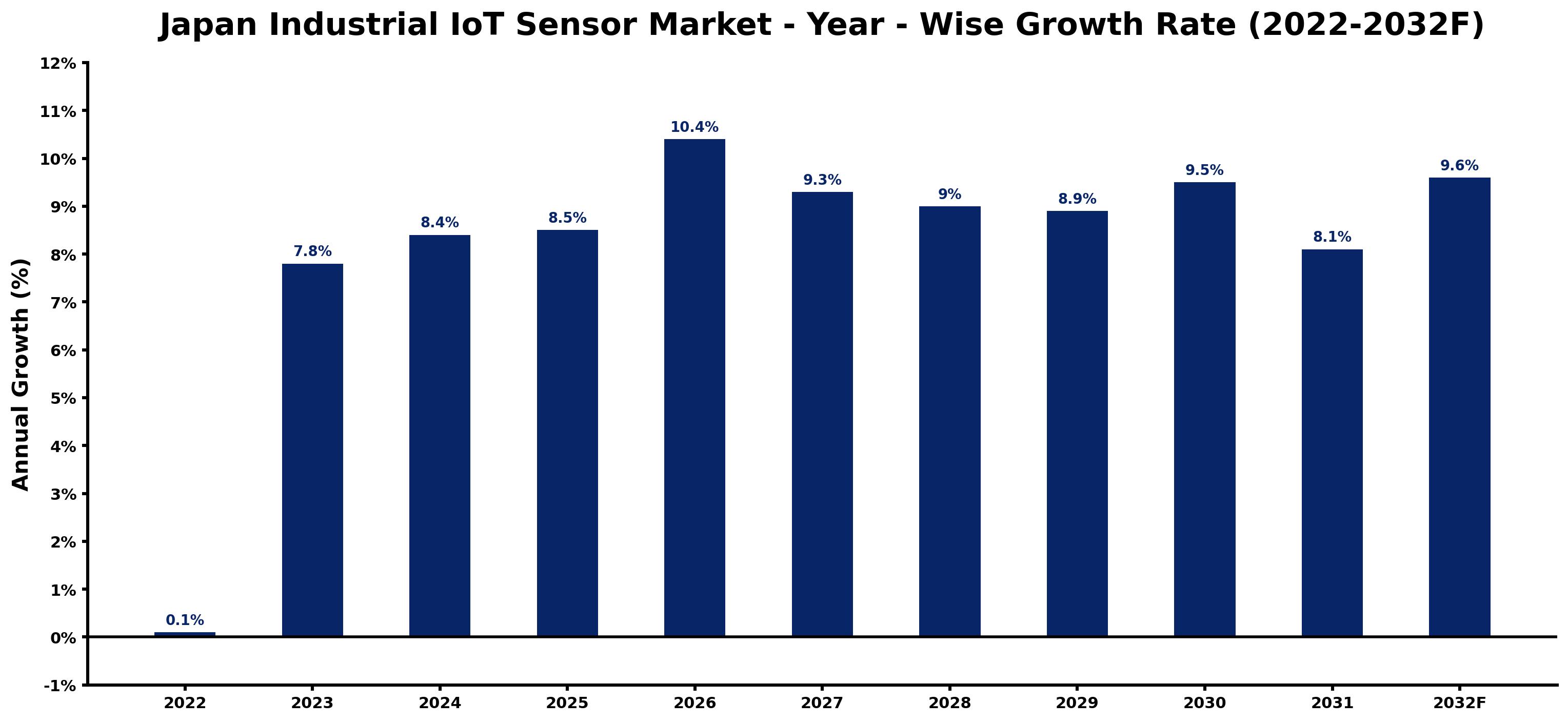
The yearly estimates that follow link every growth rate to its principal driver, so readers can see why the pace changed in each period.
| Year | Estimated Annual Growth (%) | Market Rationale |
| 2022 | 0.1 | The market showed minimal growth as industries began to adopt IoT technologies. |
| 2023 | 7.8 | Growth accelerated as manufacturers increased investments in automation and data collection. |
| 2024 | 8.4 | Demand rose further due to advancements in sensor technologies and integration capabilities. |
| 2025 | 8.5 | The market peaked historically as industries focused on efficiency and process optimization. |
| 2026 | 10.4 | Growth is expected to surge with heightened investments in smart manufacturing and IoT adoption. |
| 2027 | 9.3 | Growth is expected to slow as the market stabilises after rapid expansion in previous years. |
| 2028 | 9.0 | A slight slowdown is projected as industries adjust to new technologies and standards. |
| 2029 | 8.9 | Market growth is expected to remain steady as companies continue to invest in IoT solutions. |
| 2030 | 9.5 | Demand is projected to increase again as sustainability initiatives gain momentum in the industrial sector. |
| 2031 | 8.1 | Growth is expected to slow as the market matures and competition intensifies among providers. |
| 2032 | 9.6 | A resurgence in demand is expected as new technologies are introduced and adopted. |
Note: Market size estimations and growth projections presented in this report are based on 6Wresearch's proprietary forecasting methodology, utilizing the latest available industry data, government publications, and primary research inputs.
Japan Industrial IoT Sensor Market Synopsis
Industrial IoT sensors are essential devices that collect and transmit data from industrial environments, enabling monitoring and optimization in sectors like manufacturing and logistics. The Japan Industrial IoT Sensor Market is driven by increased investments in automation and smart manufacturing technologies. With Japan targeting a 46% cut in greenhouse-gas emissions by 2030, industries are adopting IoT solutions to improve efficiency and sustainability. The Tokyo region, a hub for industrial automation, plays a key role in this expansion, with over 1,500 food processing facilities utilizing these sensors.
Market Dynamics Impact Analysis (2026–2032)
| Factor | Type | Impact | Primary Segment Affected |
| Increased investment in automation technologies | Driver | High | Temperature Sensors |
| Growing focus on energy efficiency and sustainability | Driver | High | Pressure Sensors |
| Rising demand for smart manufacturing solutions | Opportunity | High | Humidity Sensors |
| Expansion of industrial automation in the Tokyo region | Opportunity | High | Proximity Sensors |
| High initial costs of IoT sensor deployment | Restraint | High | Temperature Sensors |
| Limited interoperability with existing systems | Restraint | Medium | Pressure Sensors |
| Shortage of skilled workforce for IoT implementation | Challenge | High | Humidity Sensors |
| Compliance with stringent safety regulations | Challenge | Medium | Proximity Sensors |
Evaluation of Drivers in Japan Industrial IoT Sensor Market (2026–2032)
The following drivers explain most of the expected growth.
| Drivers | Primary Segment Affected | Why It Matters (Evidence) |
| Increased automation in manufacturing processes | Temperature Sensors | Temperature sensors are essential for monitoring environmental conditions, with over 60% of manufacturing plants using them. |
| Focus on energy efficiency | Pressure Sensors | Pressure sensors are critical in over 70% of chemical processing plants, ensuring safety and efficiency. |
| Demand for real-time data analytics | Humidity Sensors | Humidity sensors support optimal conditions in manufacturing, vital for quality control in over 1,500 food processing facilities. |
| Technological advancements in IoT connectivity | Proximity Sensors | Proximity sensors are widely used in automation, driving demand for advanced connectivity solutions. |
| Government initiatives promoting IoT adoption | Analog/Digital | The Ministry of Economy, Trade and Industry promotes IoT through various initiatives, boosting digital transformation. |
Several shifts outside the market lift sales. Increased automation in manufacturing processes drives demand for temperature sensors, which are essential in over 60% of plants. A focus on energy efficiency fuels the need for pressure sensors, critical in 70% of chemical processing facilities. Technological advancements in IoT connectivity expand the use of proximity sensors, widely employed in automation.
Evaluation of Restraints in Japan Industrial IoT Sensor Market
Several factors work against faster growth; the main ones are summarised below.
| Market Restraint | Primary Segment Affected | Why It Matters (Evidence) |
| High initial costs of IoT sensor deployment | Temperature Sensors | The high costs deter smaller manufacturers from adopting temperature sensors, limiting market growth. |
| Limited interoperability with existing systems | Pressure Sensors | Many facilities struggle to integrate pressure sensors with legacy systems, hindering widespread adoption. |
| Shortage of skilled workforce for IoT implementation | Humidity Sensors | A lack of trained personnel affects the effective deployment of humidity sensors in industries. |
| Compliance with stringent safety regulations | Proximity Sensors | Proximity sensors must meet strict safety standards, increasing costs and complexity for manufacturers. |
| Market fragmentation with numerous suppliers | Analog/Digital | Fragmentation leads to price competition, impacting profitability for suppliers in the analog/digital segment. |
Japan Industrial IoT Sensor Market Challenges
In 2023, over 60% of manufacturing plants in Japan depend on temperature sensors, yet supply chain disruptions have delayed sensor deliveries, forcing manufacturers to pause production lines. A shortage of skilled workers in the industrial IoT sector restricts the deployment of advanced technologies, resulting in slower adoption rates for automation among producers. Rising costs of semiconductor materials have increased sensor prices by approximately 15%, affecting budgets for manufacturers and constraining their investment in new technologies. Regulatory changes aimed at enhancing energy efficiency through ISO 50001 standards necessitate substantial adjustments, causing delays in compliance for many facilities.
Trends in the Japan Industrial IoT Sensor Market
Several trends are reshaping the Japan Industrial IoT Sensor Market; the most important are set out below.
- Shift towards Wireless Connectivity: In 2023, over 40% of new installations in Japan opted for wireless connectivity for IoT sensors, improving flexibility and lowering installation costs.
- Transition from Traditional to Smart Manufacturing: The shift commenced in 2023 as Japan initiated a programme to boost smart manufacturing capabilities, targeting a notable increase in IoT sensor adoption across industries.
- Emergence of Advanced Data Analytics: As of 2023, manufacturers are progressively integrating advanced data analytics with IoT sensors, resulting in improved operational efficiency and decision-making.
- Prioritisation of Energy Efficiency: In 2023, Japan's GX Basic Policy highlighted energy efficiency, driving demand for IoT sensors that monitor and optimise energy use in industrial processes.
Investment Opportunities in the Japan Industrial IoT Sensor Market
Where to invest in the Japan Industrial IoT Sensor Market: the main openings are set out below.
- Tokyo Region's Automation Hub: The Tokyo region serves as a major hub for industrial automation, with over 1,500 food processing facilities. Investing in IoT solutions here can address the growing need for efficiency.
- Supply of Energy-Efficient Sensors: With Japan targeting a 46% reduction in greenhouse-gas emissions, supplying energy-efficient sensors can meet the needs of industries focused on sustainability and compliance.
- Growing Demand for Smart Manufacturing Solutions: As industries invest in smart manufacturing, providing advanced IoT sensors can satisfy the increasing demand for automation and data analytics.
- Expansion of Chemical Processing Facilities: The chemical sector, with a projected growth of 12.5% for chemical plants, offers an opportunity to supply pressure sensors that ensure safety and efficiency.
Government Initiatives in the Japan Industrial IoT Sensor Market
The Act on the Rational Use of Energy, enforced since 1979, requires large energy users to improve energy efficiency and report their consumption. This law compels producers to invest in energy management systems and adopt technologies that integrate IoT sensors to monitor energy use effectively. Compliance with these regulations is crucial for maintaining operational standards and reducing energy costs, significantly impacting the industrial sector's sustainability efforts.
The Ministry of Economy, Trade and Industry implements the Semiconductor and Digital Industry Strategy, which aims to secure domestic semiconductor manufacturing by investing JPY 150 trillion over the next decade. This initiative supports the industrial IoT sensor market by ensuring a steady supply of essential components, enabling manufacturers to enhance their automation capabilities and meet growing demand for smart technologies.
Future Insight of the Japan Industrial IoT Sensor Market
Advancements in wireless connectivity will reshape demand for IoT sensors, particularly in the Tokyo region, a centre for industrial automation. The launch of a smart manufacturing programme in 2023 will accelerate adoption across various sectors. Japan's target of JPY 150 trillion in decarbonisation investment will drive the integration of industrial IoT sensors into energy management systems. Consequently, manufacturers will increasingly adopt these devices to improve operational efficiency and reduce greenhouse-gas emissions.
Market Segmentation Analysis
Japan Industrial IoT Sensor Market report covers a detailed analysis of the following market segments:
By Sensor Type – Temperature Sensors Lead, Pressure Sensors Expected to Grow Fastest
According to Saurav Kr Singh, Senior Research Analyst at 6Wresearch, in 2025, Temperature Sensors led the sensor type split with a 42% share. Temperature sensors hold the largest share due to their essential function in monitoring environmental conditions, widely used in over 60% of manufacturing plants across Japan. This extensive application in critical industrial processes ensures their continued importance for operational efficiency. The quickest growth will come from Pressure Sensors, forecast to expand at a CAGR of 13.4% between 2026 and 2032. Pressure sensors are experiencing rapid growth, primarily due to their vital role in over 70% of chemical processing plants, highlighting the increasing need for precise pressure measurements. As industries focus more on process optimisation, this demand is expected to rise further. Suppliers must invest in advanced pressure sensor technologies to meet the escalating demand in this segment.
By Signal Output – Analog/Digital Leads, Piezoresistive/Capacitive Expected to Grow Fastest
Analog/Digital held 41% of the Japan Industrial IoT Sensor Market by signal output in 2025. The analog/digital signal output type dominates the market as it is fundamental for effective data transmission in IoT applications. Its versatility across various sensor types solidifies its position as the preferred choice among users. Piezoresistive/Capacitive is set to record the highest CAGR in this split, 12.6% over 2026–2032. Piezoresistive/capacitive signal outputs are growing quickly due to their specific application in advanced sensor technologies, which are becoming more prevalent in niche markets. This growth indicates a shift towards more specialised sensor solutions. Buyers may need to consider integrating piezoresistive/capacitive technologies to stay competitive in specialised applications.
By Connectivity – Wired/Wireless Leads, CANbus/Modbus Expected to Grow Fastest
Wired/Wireless accounted for 42% of the market by connectivity in 2025. Wired/wireless connectivity leads the market as it is crucial for establishing reliable connections in IoT systems across diverse industrial applications. The integration of both technologies facilitates effective data transmission, catering to various operational needs. CANbus/Modbus is projected to grow fastest, at a CAGR of 12.4% during 2026–2032. CANbus/modbus connectivity is witnessing significant growth, particularly as it gains traction in specific communication protocols within industrial automation. This trend reflects a shift towards standardised communication methods that improve interoperability. Suppliers should prioritise the development of solutions that support CANbus/modbus to meet evolving industry standards and customer needs.
By End User – Food Processing Leads, Chemical Plants Expected to Grow Fastest
The largest end user category in 2025 was Food Processing, at 36% of revenue. The food processing sector is the largest end user, heavily relying on sensors for quality control and safety in over 1,500 facilities across Japan. This substantial demand highlights the critical importance of sensors in maintaining industry standards and operational integrity. Over 2026–2032, Chemical Plants are expected to post the fastest growth, at a CAGR of 12.5%. Chemical plants represent the fastest-growing end user segment, as they require sensors for essential monitoring processes that ensure safety and compliance. This growth reflects an increasing emphasis on operational reliability within the chemical industry. Suppliers should tailor their offerings to meet the specific needs of chemical plants to capitalise on this growth opportunity.
Key Attractiveness of the Report
- 10 Years of Market Numbers
- Historical Data Starting from 2022 to 2025
- Base Year 2025
- Forecast Data until 2032
- Key Performance Indicators Impacting the Market
- Major Upcoming Developments and Projects
Key Highlights of the Report:
- Japan Industrial IoT Sensor Market Outlook
- Market Size of Japan Industrial IoT Sensor Market, 2025
- Forecast of Japan Industrial IoT Sensor Market, 2032
- Historical Data and Forecast of Japan Industrial IoT Sensor Revenues & Volume for the Period 2022-2032F
- Japan Industrial IoT Sensor Market Trend Evolution
- Japan Industrial IoT Sensor Market Drivers and Challenges
- Japan Industrial IoT Sensor Price Trends
- Japan Industrial IoT Sensor Porter's Five Forces
- Japan Industrial IoT Sensor Industry Life Cycle
- Historical Data and Forecast of Japan Industrial IoT Sensor Market Revenues & Volume By Sensor Type for the Period 2022-2032F
- Historical Data and Forecast of Japan Industrial IoT Sensor Market Revenues & Volume By Temperature Sensors for the Period 2022-2032F
- Historical Data and Forecast of Japan Industrial IoT Sensor Market Revenues & Volume By Pressure Sensors for the Period 2022-2032F
- Historical Data and Forecast of Japan Industrial IoT Sensor Market Revenues & Volume By Humidity Sensors for the Period 2022-2032F
- Historical Data and Forecast of Japan Industrial IoT Sensor Market Revenues & Volume By Proximity Sensors for the Period 2022-2032F
- Historical Data and Forecast of Japan Industrial IoT Sensor Market Revenues & Volume By Signal Output for the Period 2022-2032F
- Historical Data and Forecast of Japan Industrial IoT Sensor Market Revenues & Volume By Analog/Digital for the Period 2022-2032F
- Historical Data and Forecast of Japan Industrial IoT Sensor Market Revenues & Volume By Piezoresistive/Capacitive for the Period 2022-2032F
- Historical Data and Forecast of Japan Industrial IoT Sensor Market Revenues & Volume By Resistive/Capacitive for the Period 2022-2032F
- Historical Data and Forecast of Japan Industrial IoT Sensor Market Revenues & Volume By Inductive/Capacitive for the Period 2022-2032F
- Historical Data and Forecast of Japan Industrial IoT Sensor Market Revenues & Volume By Connectivity for the Period 2022-2032F
- Historical Data and Forecast of Japan Industrial IoT Sensor Market Revenues & Volume By Wired/Wireless for the Period 2022-2032F
- Historical Data and Forecast of Japan Industrial IoT Sensor Market Revenues & Volume By CANbus/Modbus for the Period 2022-2032F
- Historical Data and Forecast of Japan Industrial IoT Sensor Market Revenues & Volume By Bluetooth/LoRaWAN for the Period 2022-2032F
- Historical Data and Forecast of Japan Industrial IoT Sensor Market Revenues & Volume By PLC Interface for the Period 2022-2032F
- Historical Data and Forecast of Japan Industrial IoT Sensor Market Revenues & Volume By End User for the Period 2022-2032F
- Historical Data and Forecast of Japan Industrial IoT Sensor Market Revenues & Volume By Food Processing for the Period 2022-2032F
- Historical Data and Forecast of Japan Industrial IoT Sensor Market Revenues & Volume By Chemical Plants for the Period 2022-2032F
- Historical Data and Forecast of Japan Industrial IoT Sensor Market Revenues & Volume By HVAC Systems for the Period 2022-2032F
- Historical Data and Forecast of Japan Industrial IoT Sensor Market Revenues & Volume By Robotics & Conveyor Lines for the Period 2022-2032F
- Japan Industrial IoT Sensor Import Export Trade Statistics
- Market Opportunity Assessment By Sensor Type
- Market Opportunity Assessment By Signal Output
- Market Opportunity Assessment By Connectivity
- Market Opportunity Assessment By End User
- Japan Industrial IoT Sensor Top Companies Market Share
- Japan Industrial IoT Sensor Competitive Benchmarking By Technical and Operational Parameters
- Japan Industrial IoT Sensor Company Profiles
- Japan Industrial IoT Sensor Key Strategic Recommendations
Market Covered
The following segment groups are covered in the report.
By Sensor Type
- Temperature Sensors
- Pressure Sensors
- Humidity Sensors
- Proximity Sensors
By Signal Output
- Analog/Digital
- Piezoresistive/Capacitive
- Resistive/Capacitive
- Inductive/Capacitive
By Connectivity
- Wired/Wireless
- CANbus/Modbus
- Bluetooth/LoRaWAN
- PLC Interface
By End User
- Food Processing
- Chemical Plants
- HVAC Systems
- Robotics & Conveyor Lines































