Japan Industrial IoT Solutions Market Size & Growth Rate
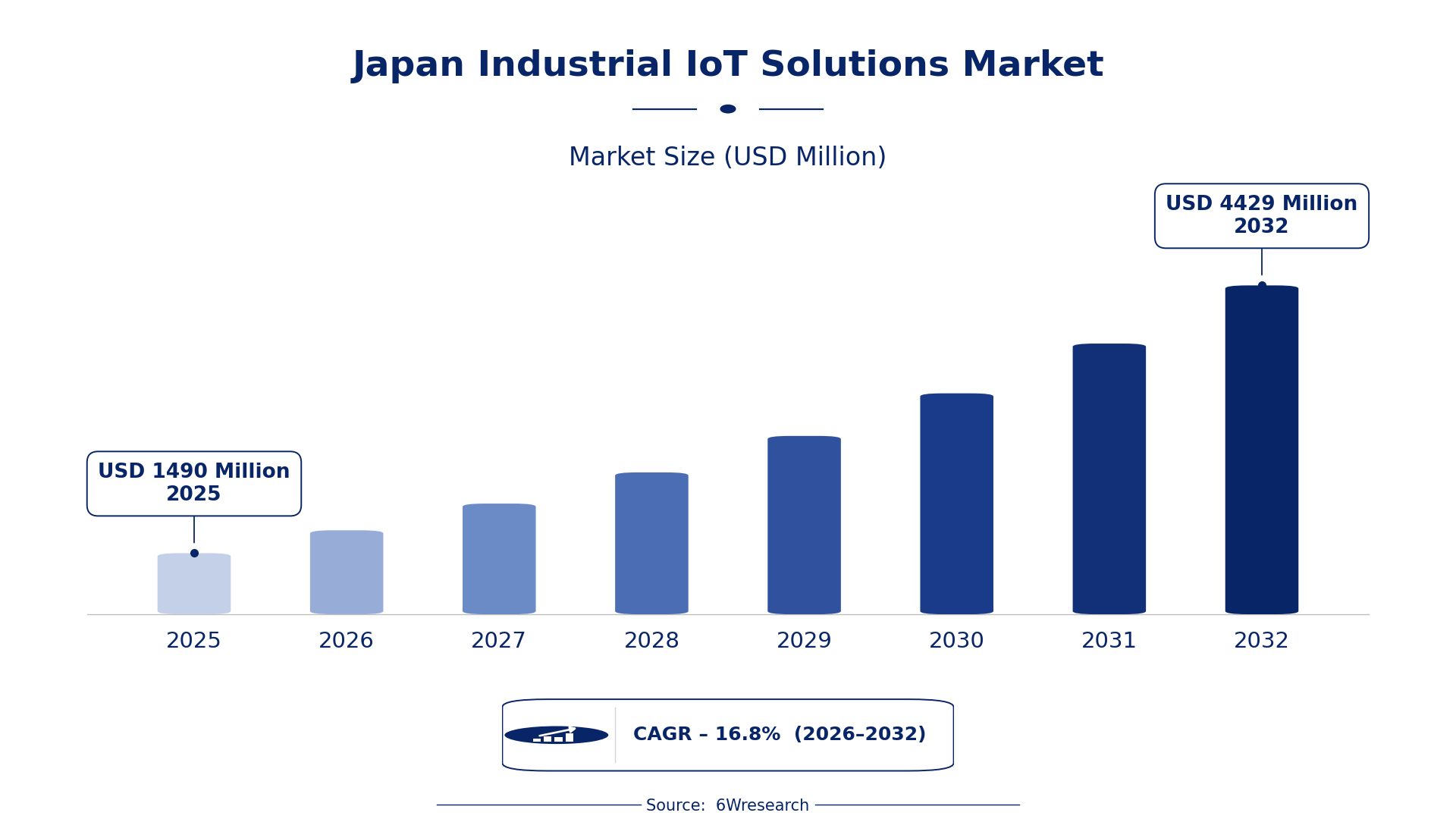
According to 6Wresearch internal database and industry insights, the Japan Industrial IoT Solutions Market was valued at USD 1,490 Million in 2025 and is projected to reach USD 4,429 Million by 2032, growing at a CAGR of approximately 16.8% during 2026–2032.
Japan Industrial IoT Solutions Market Highlights
| Report Metric | Details |
| Report Name | Japan Industrial IoT Solutions Market (2026-2032) |
| Market Size 2025 | USD 1,490 Million |
| Market Size 2032 | USD 4,429 Million |
| Absolute Growth 2025–2032 | USD 2,939 Million |
| CAGR 2026–2032 | 16.8% |
| Peak Annual Growth | 18.0% in 2029 |
| Forecast Period | 2026–2032 |
| Historical Data | 2022–2025 |
| Base Year | 2025 |
| Leading Solution Type, 2025 | Condition Monitoring (38% share) |
| Leading AI Integration, 2025 | Cloud-Based (37% share) |
| Leading Monitoring Type, 2025 | Real-Time (45% share) |
| Leading End User, 2025 | Smart Factories (49% share) |
| Fastest-Growing Solution Type | Smart Asset Tracking (19.6% CAGR) |
| Fastest-Growing AI Integration | Edge AI (22.5% CAGR) |
| Fastest-Growing End User | Logistics & Supply Chain (23.4% CAGR) |
| Growing Sector | manufacturing |
| Key End Users | manufacturers, logistics providers, energy companies, automotive sector |
Japan Industrial IoT Solutions Market Year-wise Growth Rate and Key Drivers (2022–2032)
This graph illustrates the annual growth rates of the market from 2022 to 2032, highlighting a steady upward trajectory and projected market expansion over the forecast period.
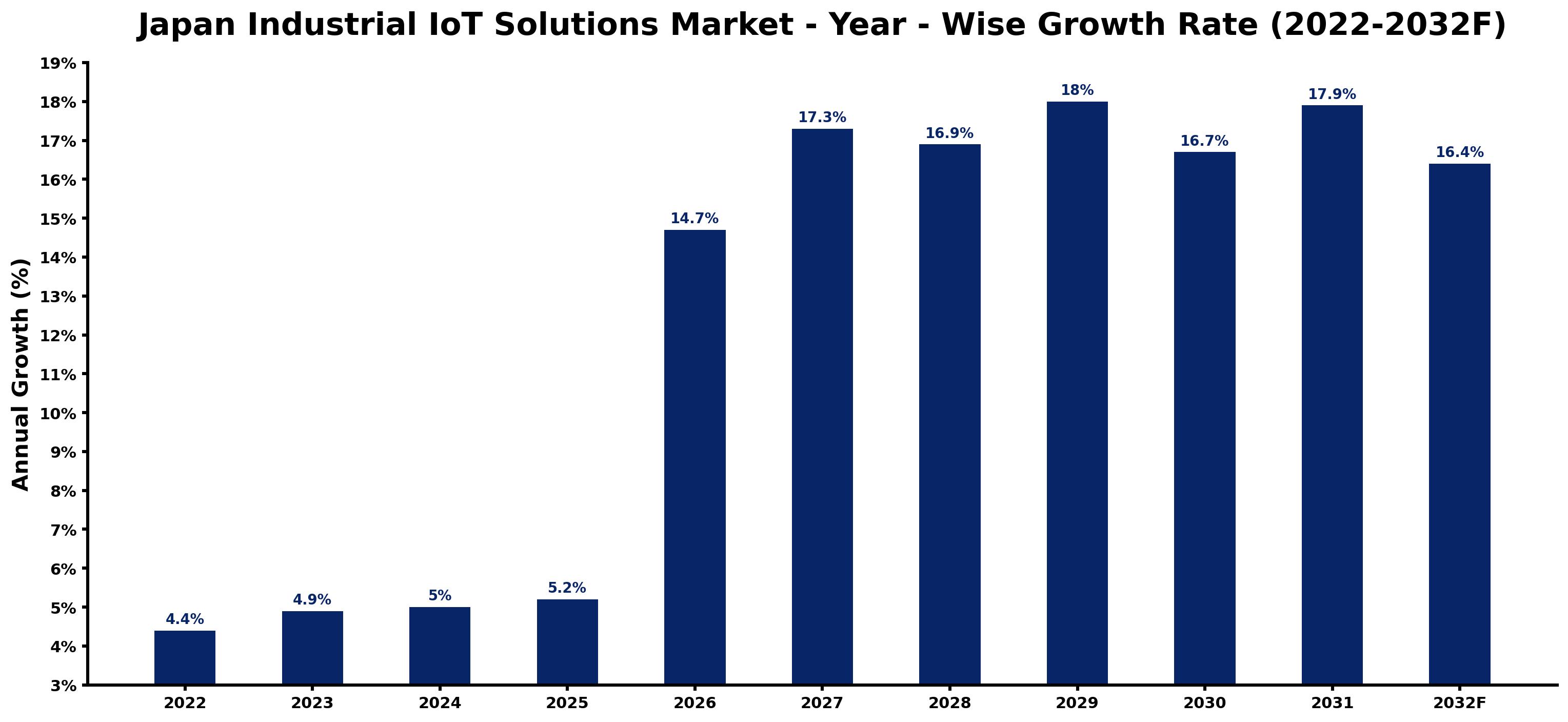
For each year, the table pairs the estimated growth rate with the leading influence on demand, showing how the drivers changed across the period.
| Year | Estimated Annual Growth (%) | Market Rationale |
| 2022 | 4.4 | The market showed steady growth, reflecting ongoing investments in industrial technologies. |
| 2023 | 4.9 | Demand for IoT solutions increased as manufacturers sought efficiency improvements. |
| 2024 | 5.0 | The rise in smart factory initiatives further boosted market expansion. |
| 2025 | 5.2 | Growth continued as companies adopted condition monitoring solutions widely. |
| 2026 | 14.7 | The market is expected to experience a surge due to heightened investment in IoT technologies. |
| 2027 | 17.3 | Demand will rise sharply as smart asset tracking becomes essential in logistics. |
| 2028 | 16.9 | Growth is projected to slow slightly as the market begins to stabilise after rapid expansion. |
| 2029 | 18.0 | The peak growth will be driven by widespread adoption of real-time monitoring. |
| 2030 | 16.7 | A slight slowdown is anticipated as the market adjusts to recent advancements. |
| 2031 | 17.9 | Demand will accelerate again as industries focus on predictive maintenance solutions. |
| 2032 | 16.4 | The market is expected to continue growing, supported by ongoing investments in smart technologies. |
Note: Market size estimations and growth projections presented in this report are based on 6Wresearch's proprietary forecasting methodology, utilizing the latest available industry data, government publications, and primary research inputs.
Japan Industrial IoT Solutions Market Synopsis
Industrial IoT Solutions connect industrial devices to the internet for data collection and analysis, facilitating operational efficiency and predictive maintenance. The Japan Industrial IoT Solutions Market is projected to reach 1 trillion yen by 2025, as manufacturers increasingly adopt smart factories and logistics technologies. The Tokyo region is a major hub for this growth, with domestic manufacturers investing heavily in IoT solutions to optimise processes and improve supply chain management.
Market Dynamics Impact Analysis (2026–2032)
| Factor | Type | Impact | Primary Segment Affected |
| Growing demand for predictive maintenance solutions in manufacturing | Driver | High | Condition Monitoring |
| Increased investments in logistics and supply chain technologies | Driver | High | Smart Asset Tracking |
| Rising investments in smart factory technologies | Opportunity | High | Smart Factories |
| Expansion of remote operations solutions in the oil and gas sector | Opportunity | Medium | Remote Operations Solution |
| High initial investment costs for IoT infrastructure | Restraint | High | Smart Energy Management |
| Concerns regarding data privacy and security in IoT applications | Restraint | Medium | Cloud-Based |
| Limited skilled workforce for IoT implementation | Challenge | High | Edge AI |
| Rapid technological changes leading to obsolescence | Challenge | Medium | IoT + SCADA |
Evaluation of Drivers in Japan Industrial IoT Solutions Market (2026–2032)
Key forces behind demand, with the segment each one moves most, are listed below.
| Drivers | Primary Segment Affected | Why It Matters (Evidence) |
| Increased focus on operational efficiency | Condition Monitoring | The automotive sector widely uses condition monitoring, essential for preventing equipment failures, with a 20% reduction in downtime. |
| Investment in logistics technologies | Smart Asset Tracking | The logistics sector is investing heavily, with projected investments reaching JPY 50 billion by 2025. |
| Growth in smart factory initiatives | Smart Factories | Smart factories are expected to increase by 30% by 2025, boosting IoT adoption. |
| Rising need for remote management solutions | Remote Operations Solution | The oil and gas sector is increasingly implementing these solutions for operational efficiency. |
| Government support for IoT adoption | Cloud-Based | Government initiatives promote cloud solutions, improving data analytics capabilities. |
Orders keep climbing as manufacturers seek to improve operational efficiency through IoT solutions. The automotive sector widely uses condition monitoring, essential for preventing equipment failures, with an estimated 20% reduction in downtime. Logistics companies are investing heavily in smart asset tracking technologies, responding to increased demand for efficiency, with investments projected to reach JPY 50 billion by 2025. The oil and gas sector is increasingly implementing remote operations solutions to optimise resources, driven by a need for enhanced operational oversight.
Evaluation of Restraints in Japan Industrial IoT Solutions Market
The key brakes on demand, and where they bite hardest, are shown below.
| Market Restraint | Primary Segment Affected | Why It Matters (Evidence) |
| High initial costs for IoT infrastructure | Smart Energy Management | The average investment required for smart energy systems can deter smaller manufacturers. |
| Data privacy concerns in IoT applications | Cloud-Based | Compliance with JIS Q 15001 can increase operational costs for businesses. |
| Limited availability of skilled workforce | Edge AI | The current shortage of skilled professionals hampers effective IoT implementation. |
| Rapid technological advancements leading to obsolescence | IoT + SCADA | Frequent updates in technology can result in increased costs for manufacturers. |
| Integration challenges with existing systems | Remote Operations Solution | Many companies face difficulties integrating new IoT solutions with legacy systems. |
Japan Industrial IoT Solutions Market Challenges
In the automotive industry, buyers face rising costs due to advanced condition monitoring solutions, increasing operational expenses by 15%. Suppliers encounter supply chain disruptions, as delays in component deliveries can extend lead times by several weeks, impacting production schedules for manufacturers. Competition intensifies as new entrants adopt advanced IoT technologies, forcing established suppliers to reduce prices by approximately 10% to maintain market share. Technology adoption lags in certain sectors, resulting in inefficiencies that can lead to energy waste of 20% for plants relying on outdated systems.
Trends in the Japan Industrial IoT Solutions Market
The trends below show where the Japan Industrial IoT Solutions Market is heading.
- Shift to Smart Manufacturing: Japan is transitioning towards smart manufacturing solutions as traditional methods become less efficient. By 2025, smart factories are projected to increase by 30%, reflecting a shift in operational strategies.
- Rise in Real-Time Monitoring: Real-time monitoring is becoming vital for compliance with safety regulations in heavy industries. Approximately 10 million connected devices are in use across Japan's industrial applications as of 2023.
- Focus on Predictive Maintenance: Predictive maintenance is gaining traction among manufacturers, focusing on reducing downtime. The automotive industry is leading this trend, utilising condition monitoring extensively, with a projected 15% increase in efficiency.
- Expansion of Remote Operations: Remote operations solutions are increasingly adopted in the oil and gas sector, particularly in Hokkaido. This trend is driven by the need for operational efficiency, with investments exceeding JPY 10 billion.
Investment Opportunities in the Japan Industrial IoT Solutions Market
The opportunities below stand out in the Japan Industrial IoT Solutions Market for new entrants and existing suppliers.
- Growth in Smart Factories: The Tokyo region is a major hub for smart factory investments, with a projected 30% increase by 2025. Companies should partner with local manufacturers to enter this growing market.
- Surge in Smart Asset Tracking: Logistics companies are investing heavily in smart asset tracking technologies, with demand expected to reach JPY 20 billion. Collaborating with local logistics providers can facilitate market entry.
- Increase in Remote Operations: The oil and gas sector is increasingly adopting remote operations solutions, especially in Hokkaido. Suppliers can enter this space by forming joint ventures with local firms.
- Focus on Energy Management Solutions: With average energy savings reaching 20%, there's a strong push for smart energy management systems. Manufacturers should seek certification to meet industry standards and gain market access.
Government Initiatives in the Japan Industrial IoT Solutions Market
The GX Promotion Act (2023) establishes a framework for decarbonisation efforts, mandating substantial investments in IoT solutions for energy efficiency. This policy aims for about JPY 150 trillion in public and private investment over ten years, directly impacting buyers by improving the availability of funding for IoT projects.
The Industrial Safety and Health Act sets requirements for safe operations in industrial settings. The Digital Agency also funds initiatives that promote IoT adoption, ensuring compliance with safety regulations and improving operational standards.
Future Insight of the Japan Industrial IoT Solutions Market
Japan's commitment to a 46% reduction in greenhouse gas emissions by 2030 will drive the adoption of industrial IoT solutions, prompting suppliers to innovate energy management technologies. The 'Society 5.0' initiative aims to integrate IoT across various sectors, improving operational efficiency for buyers. Smart factories are projected to increase by 30% by 2025, creating opportunities for suppliers to offer automation solutions. Investment in industrial IoT is anticipated to reach JPY 150 trillion over the next decade, encouraging advancements in technology.
Market Segmentation Analysis
Japan Industrial IoT Solutions Market report covers a detailed analysis of the following market segments:
By Solution Type – Condition Monitoring Leads, Smart Asset Tracking Expected to Grow Fastest
According to Saurav Kr Singh, Senior Research Analyst at 6Wresearch, the largest solution type category in 2025 was Condition Monitoring, at 38% of revenue. Condition monitoring solutions are vital in Japan's industrial sector, particularly in the automotive industry where they are extensively used for real-time equipment health monitoring. This widespread application is driven by the need for operational efficiency and predictive maintenance across various industrial processes. The quickest growth will come from Smart Asset Tracking, forecast to expand at a CAGR of 19.6% between 2026 and 2032. The logistics sector's significant investments in smart asset tracking technologies are propelling its growth, as these solutions are essential for tracking and optimising supply chain processes. With increasing adoption of these technologies, demand is expected to surge. Suppliers should enhance their smart asset tracking offerings to meet the rising demand in logistics.
By AI Integration – Cloud-Based Leads, Edge AI Expected to Grow Fastest
Cloud-Based accounted for 37% of the market by ai integration in 2025. Cloud-based solutions dominate the market due to their ability to provide essential storage and analytics, which are crucial for manufacturers looking to leverage data effectively. Their integration into various industrial processes is key for achieving operational efficiency and informed decision-making. Over 2026–2032, Edge AI is expected to post the fastest growth, at a CAGR of 22.5%. Edge AI technologies are rapidly gaining traction as they enable data processing at the source, becoming increasingly important for real-time applications. As industries adopt these technologies, their growth rate is expected to accelerate further. Buyers should consider edge AI solutions to improve data processing capabilities at the source.
By Monitoring Type – Real-Time Leads and Records the Fastest Growth
Real-Time took 45% of monitoring type revenue in 2025, more than any other category. Real-time monitoring is critical for immediate data processing and decision-making, establishing it as the leading type in Japan's industrial IoT solutions. Its importance is underscored by the necessity for compliance with safety regulations in heavy industries. Real-Time is also forecast to expand faster than any other category, at a CAGR of 19.0% over 2026–2032. Real-time monitoring will continue to see robust growth due to its essential role in operational efficiency, further solidifying its leadership in the market. The ongoing demand for immediate data processing ensures this segment's rapid expansion. Suppliers must prioritise real-time monitoring solutions to align with industry needs for immediate data insights.
By End User – Smart Factories Lead, Logistics & Supply Chain Expected to Grow Fastest
With 49% of end user revenue in 2025, Smart Factories was the largest category. Smart factories are central to Japan's industrial IoT landscape, significantly driving operational efficiencies and technological advancements. Their widespread adoption within the manufacturing sector reflects substantial investment in advanced industrial technologies. Logistics & Supply Chain is set to record the highest CAGR in this split, 23.4% over 2026–2032. The logistics and supply chain sector is experiencing rapid growth as it becomes increasingly essential for tracking and optimising processes, indicating a rising reliance on IoT solutions. This sector's expansion is anticipated to outpace others due to its direct impact on operational efficiency. Suppliers should tailor their offerings to meet the specific needs of the logistics and supply chain sector.
Key Attractiveness of the Report
- 10 Years of Market Numbers
- Historical Data Starting from 2022 to 2025
- Base Year 2025
- Forecast Data until 2032
- Key Performance Indicators Impacting the Market
- Major Upcoming Developments and Projects
Key Highlights of the Report:
- Japan Industrial IoT Solutions Market Outlook
- Market Size of Japan Industrial IoT Solutions Market, 2025
- Forecast of Japan Industrial IoT Solutions Market, 2032
- Historical Data and Forecast of Japan Industrial IoT Solutions Revenues & Volume for the Period 2022-2032F
- Japan Industrial IoT Solutions Market Trend Evolution
- Japan Industrial IoT Solutions Market Drivers and Challenges
- Japan Industrial IoT Solutions Price Trends
- Japan Industrial IoT Solutions Porter's Five Forces
- Japan Industrial IoT Solutions Industry Life Cycle
- Historical Data and Forecast of Japan Industrial IoT Solutions Market Revenues & Volume By Solution Type for the Period 2022-2032F
- Historical Data and Forecast of Japan Industrial IoT Solutions Market Revenues & Volume By Condition Monitoring for the Period 2022-2032F
- Historical Data and Forecast of Japan Industrial IoT Solutions Market Revenues & Volume By Smart Asset Tracking for the Period 2022-2032F
- Historical Data and Forecast of Japan Industrial IoT Solutions Market Revenues & Volume By Remote Operations Solution for the Period 2022-2032F
- Historical Data and Forecast of Japan Industrial IoT Solutions Market Revenues & Volume By Smart Energy Management for the Period 2022-2032F
- Historical Data and Forecast of Japan Industrial IoT Solutions Market Revenues & Volume By AI Integration for the Period 2022-2032F
- Historical Data and Forecast of Japan Industrial IoT Solutions Market Revenues & Volume By Edge AI for the Period 2022-2032F
- Historical Data and Forecast of Japan Industrial IoT Solutions Market Revenues & Volume By Cloud-Based for the Period 2022-2032F
- Historical Data and Forecast of Japan Industrial IoT Solutions Market Revenues & Volume By IoT + SCADA for the Period 2022-2032F
- Historical Data and Forecast of Japan Industrial IoT Solutions Market Revenues & Volume By Predictive Algorithms for the Period 2022-2032F
- Historical Data and Forecast of Japan Industrial IoT Solutions Market Revenues & Volume By Monitoring Type for the Period 2022-2032F
- Historical Data and Forecast of Japan Industrial IoT Solutions Market Revenues & Volume By Real-Time for the Period 2022-2032F
- Historical Data and Forecast of Japan Industrial IoT Solutions Market Revenues & Volume By Location-Based for the Period 2022-2032F
- Historical Data and Forecast of Japan Industrial IoT Solutions Market Revenues & Volume By Distributed for the Period 2022-2032F
- Historical Data and Forecast of Japan Industrial IoT Solutions Market Revenues & Volume By Load Control for the Period 2022-2032F
- Historical Data and Forecast of Japan Industrial IoT Solutions Market Revenues & Volume By End User for the Period 2022-2032F
- Historical Data and Forecast of Japan Industrial IoT Solutions Market Revenues & Volume By Heavy Equipment for the Period 2022-2032F
- Historical Data and Forecast of Japan Industrial IoT Solutions Market Revenues & Volume By Logistics & Supply Chain for the Period 2022-2032F
- Historical Data and Forecast of Japan Industrial IoT Solutions Market Revenues & Volume By Oil & Gas Sites for the Period 2022-2032F
- Historical Data and Forecast of Japan Industrial IoT Solutions Market Revenues & Volume By Smart Factories for the Period 2022-2032F
- Japan Industrial IoT Solutions Import Export Trade Statistics
- Market Opportunity Assessment By Solution Type
- Market Opportunity Assessment By AI Integration
- Market Opportunity Assessment By Monitoring Type
- Market Opportunity Assessment By End User
- Japan Industrial IoT Solutions Top Companies Market Share
- Japan Industrial IoT Solutions Competitive Benchmarking By Technical and Operational Parameters
- Japan Industrial IoT Solutions Company Profiles
- Japan Industrial IoT Solutions Key Strategic Recommendations
Market Covered
This report examines the market across the segments below.
By Solution Type
- Condition Monitoring
- Smart Asset Tracking
- Remote Operations Solution
- Smart Energy Management
By AI Integration
- Edge AI
- Cloud-Based
- IoT + SCADA
- Predictive Algorithms
By Monitoring Type
- Real-Time
- Location-Based
- Distributed
- Load Control
By End User
- Heavy Equipment
- Logistics & Supply Chain
- Oil & Gas Sites
- Smart Factories































