Japan Industrial Logistics Market Size & Growth Rate
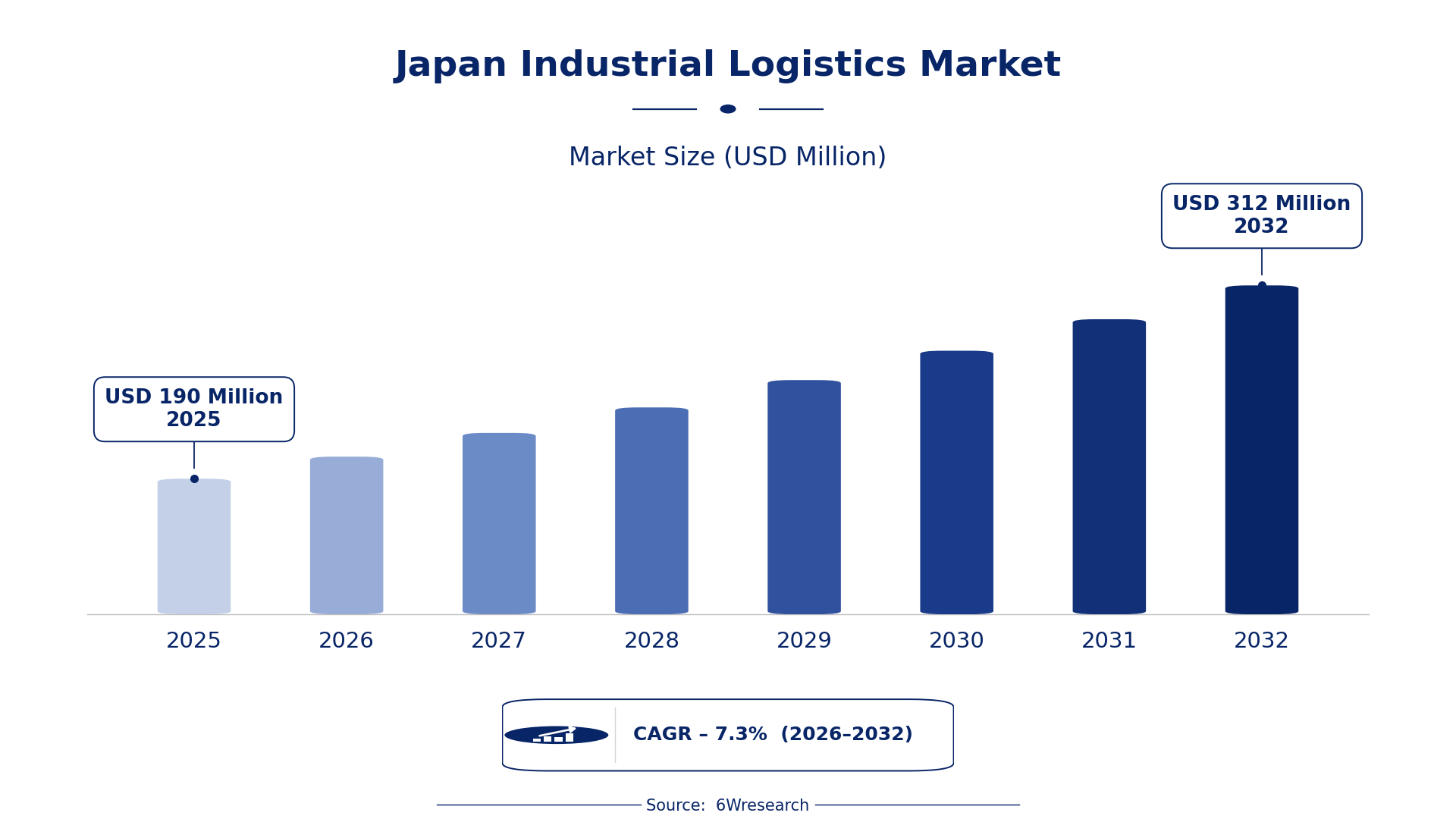
According to 6Wresearch internal database and industry insights, the Japan Industrial Logistics Market was valued at USD 190 Million in 2025 and is projected to reach USD 312 Million by 2032, growing at a CAGR of approximately 7.3% during 2026–2032.
Japan Industrial Logistics Market Highlights
| Report Metric | Details |
| Report Name | Japan Industrial Logistics Market (2026-2032) |
| Market Size 2025 | USD 190 Million |
| Market Size 2032 | USD 312 Million |
| Absolute Growth 2025–2032 | USD 122 Million |
| CAGR 2026–2032 | 7.3% |
| Peak Annual Growth | 9.4% in 2026 |
| Forecast Period | 2026–2032 |
| Historical Data | 2022–2025 |
| Base Year | 2025 |
| Leading Service Type, 2025 | Warehousing (51% share) |
| Leading Delivery Mode, 2025 | Centralized/Decentralized (42% share) |
| Leading Technology Used, 2025 | RFID/Barcode (38% share) |
| Leading End User, 2025 | E-commerce Distribution (37% share) |
| Fastest-Growing Service Type | Freight Transportation (9.3% CAGR) |
| Fastest-Growing Delivery Mode | Road/Rail/Air (9.7% CAGR) |
| Fastest-Growing Technology Used | GPS / Telematics (10.6% CAGR) |
| Fastest-Growing End User | Heavy Equipment Firms (9.2% CAGR) |
| Growing Sector | E-commerce Distribution |
| Key End Users | E-commerce firms, manufacturing companies, food producers, pharmaceuticals |
Japan Industrial Logistics Market Year-wise Growth Rate and Key Drivers (2022–2032)
This graph illustrates the annual growth rates of the market from 2022 to 2032, highlighting a steady upward trajectory and projected market expansion over the forecast period.
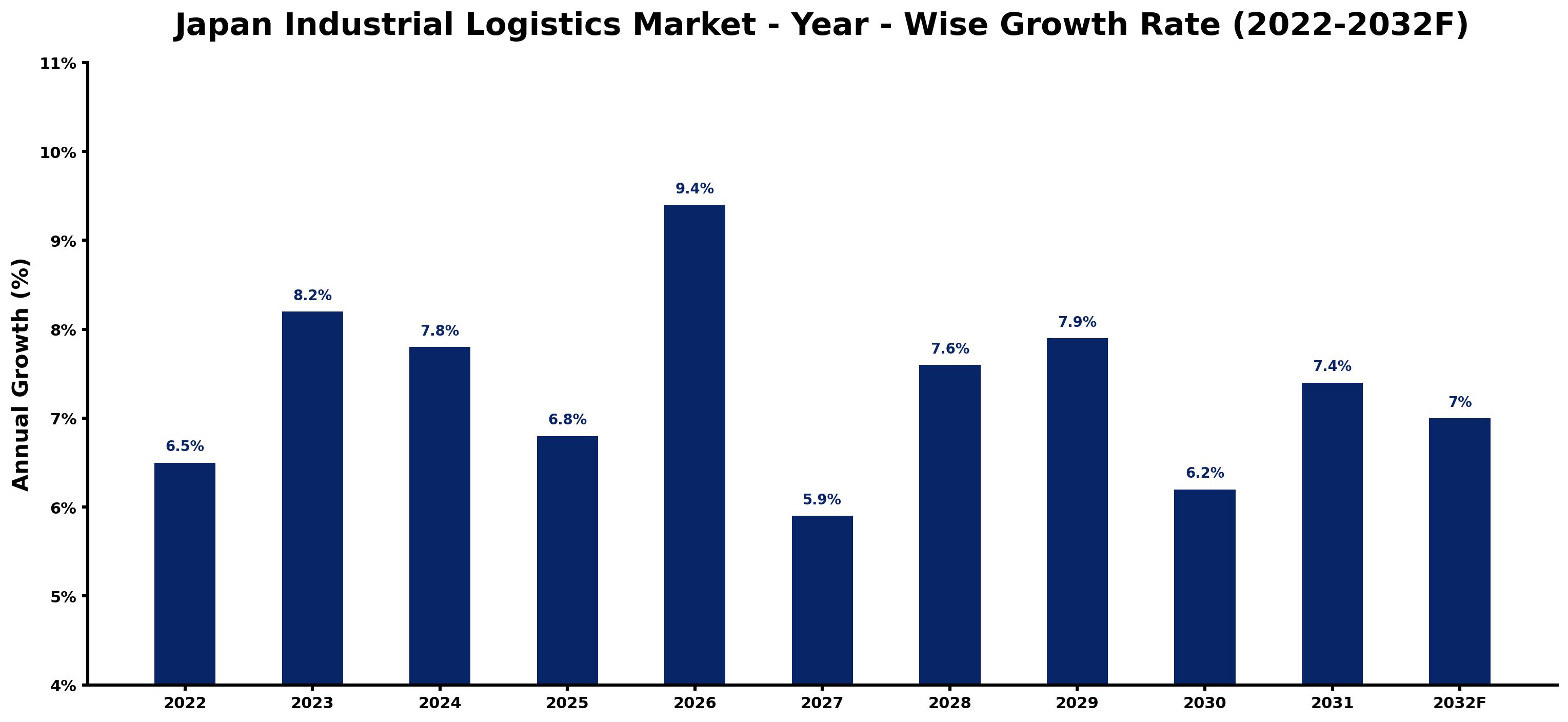
The following figures match every annual growth estimate with the main market development of that year, giving the reasoning behind each rise or slowdown.
| Year | Estimated Annual Growth (%) | Market Rationale |
| 2022 | 6.5 | The logistics market was stable, driven by steady demand from domestic production. |
| 2023 | 8.2 | Growth accelerated due to increased e-commerce sales and logistics innovations. |
| 2024 | 7.8 | Market growth slowed as logistics costs began to rise amid workforce challenges. |
| 2025 | 6.8 | The market continued to grow, but at a slower pace due to rising operational costs. |
| 2026 | 9.4 | Demand is expected to surge as companies invest in advanced logistics technologies and infrastructure. |
| 2027 | 5.9 | Growth is projected to slow as the market adjusts to new operational efficiencies and cost pressures. |
| 2028 | 7.6 | Increased demand for cold chain logistics will boost growth as e-commerce expands. |
| 2029 | 7.9 | The market is expected to experience a slight acceleration, driven by technological advancements in logistics. |
| 2030 | 6.2 | Growth will slow again as companies face challenges in workforce availability and costs. |
| 2031 | 7.4 | The market is projected to rebound with renewed investments in logistics efficiency and technology. |
| 2032 | 7.0 | A slight slowdown is expected as the market stabilises after rapid growth phases. |
Note: Market size estimations and growth projections presented in this report are based on 6Wresearch's proprietary forecasting methodology, utilizing the latest available industry data, government publications, and primary research inputs.
Japan Industrial Logistics Market Synopsis
Industrial logistics involves managing the flow of goods and services, including warehousing and transportation, utilising technologies like RFID and GPS. The Japan Industrial Logistics Market is expanding, driven by a surge in e-commerce sales, which reached ¥20 trillion in 2022, and the GX Promotion Act, which mandates emissions reductions and encourages investments in greener logistics practices. This growth is supported by increasing investments in cold chain logistics, which is growing at 15% annually, reflecting the rising demand for perishable goods transport.
Market Dynamics Impact Analysis (2026–2032)
| Factor | Type | Impact | Primary Segment Affected |
| Rising e-commerce sales drive demand for efficient logistics solutions. | Driver | High | E-commerce Distribution |
| Investment in cold chain logistics to meet growing demand for perishables. | Driver | High | Cold Chain Logistics |
| Expansion of logistics hubs in Tokyo and Osaka creates new opportunities. | Opportunity | High | Warehousing |
| Increasing adoption of IoT solutions enhances logistics efficiency. | Opportunity | Medium | Warehousing |
| Workforce shortages impact logistics operations and service delivery. | Restraint | High | Freight Transportation |
| Rising operational costs challenge profit margins for logistics providers. | Restraint | Medium | Warehousing |
| Technological integration requires significant investment from suppliers. | Challenge | High | Warehousing |
| Regulatory compliance can delay logistics project implementations. | Challenge | Medium | Cold Chain Logistics |
Evaluation of Drivers in Japan Industrial Logistics Market (2026–2032)
The following drivers explain most of the expected growth.
| Drivers | Primary Segment Affected | Why It Matters (Evidence) |
| Increased e-commerce sales | E-commerce Distribution | E-commerce sales reached ¥20 trillion in 2022, prompting logistics providers to improve delivery capabilities. |
| Growth in cold chain logistics | Cold Chain Logistics | Cold chain logistics is growing at 15% annually, driven by demand for perishable goods transport. |
| Investment in logistics technology | Warehousing | The logistics industry is expected to adopt more IoT solutions by 2025, improving operational efficiency. |
| Expansion of logistics hubs | Warehousing | The Tokyo region accounts for 30% of Japan's logistics operations, increasing warehousing demand. |
| Government initiatives to reduce logistics costs | Warehousing | The government aims to reduce logistics costs by 10% by 2025, encouraging efficiency improvements. |
Spending rises because e-commerce sales in Japan reached ¥20 trillion in 2022, driving logistics demand. The logistics workforce, comprising around 1.5 million people, is adapting to new technologies, with an expected increase in IoT solutions by 2025. Cold chain logistics is growing at 15% annually, reflecting the demand for perishable goods transport. Increased investments in warehousing and distribution facilities are evident in the Tokyo region, which accounts for 30% of logistics operations. These developments prompt logistics providers to invest in advanced technologies, improving their service offerings.
Evaluation of Restraints in Japan Industrial Logistics Market
The table below lists the restraints and the evidence behind each.
| Market Restraint | Primary Segment Affected | Why It Matters (Evidence) |
| Workforce shortages impact service delivery. | Freight Transportation | The logistics workforce in Japan is around 1.5 million, but shortages lead to delays in service. |
| Rising operational costs challenge profitability. | Warehousing | Logistics costs increased by 10% in 2023, affecting profit margins for service providers across the sector. |
| Regulatory compliance can delay project timelines. | Cold Chain Logistics | Compliance with strict regulations can slow down the implementation of cold chain solutions. |
| Technological integration requires substantial investment. | Warehousing | Adopting new technologies demands capital, which can deter smaller logistics firms. |
| Market saturation limits growth potential. | Warehousing | With over 1,500 logistics service providers, competition can restrict market expansion opportunities. |
Japan Industrial Logistics Market Challenges
Strict regulations from the Ministry of Land, Infrastructure, Transport and Tourism complicate compliance, delaying operations for suppliers and increasing costs by up to 10%. Skills shortages within the logistics workforce hinder productivity, resulting in longer delivery times for buyers. Supply chain disruptions arise from the reliance on a limited number of logistics service providers, which can lead to delays in product availability for end users. Rising minimum wages, now at JPY 1,055 per hour, inflate operational expenses for logistics firms, ultimately impacting pricing for consumers.
Trends in the Japan Industrial Logistics Market
These developments are changing demand patterns in the Japan Industrial Logistics Market.
- E-commerce Distribution Prioritised over Traditional Retail: E-commerce distribution has become a priority for logistics providers, especially since 2022 when e-commerce sales reached ¥20 trillion. This shift has led to increased investments in logistics infrastructure to support online retail.
- Shift towards IoT-Enabled Logistics: Since 2025, logistics firms have increasingly adopted IoT solutions to improve operational visibility and efficiency. This trend is illustrated by the growing integration of IoT in cold chain logistics, improving tracking capabilities.
- Cold Chain Logistics Gaining Importance: Cold chain logistics has gained prominence as consumer demand for perishable goods rises. With an annual growth rate of 15%, this segment is crucial for maintaining product quality during transport.
- Increased Focus on Sustainability in Logistics: The GX Promotion Act, adopted in 2023, emphasises sustainability, aiming for a 46% cut in greenhouse-gas emissions by 2030. This has prompted logistics providers to adopt greener practices and technologies.
Investment Opportunities in the Japan Industrial Logistics Market
Below are the investment opportunities with the strongest case in the Japan Industrial Logistics Market.
- Invest in Cold Chain Logistics Solutions: Cold chain logistics is growing at 15% annually, creating opportunities for investment in temperature-controlled transport solutions. E-commerce distribution firms are particularly interested in these capabilities.
- Expand Warehousing Facilities in Key Hubs: With Tokyo and Osaka as logistics hubs, there is a pressing need for expanded warehousing facilities. Investing in these areas can cater to the growing demand from e-commerce.
- Adopt IoT Technologies for Efficiency: The increasing adoption of IoT solutions presents an opportunity for logistics providers to improve operational efficiency. Collaborating with technology firms can facilitate this transition.
- Focus on Regulatory Compliance Solutions: As compliance becomes more stringent, offering solutions that help logistics firms meet regulations can be profitable. This is particularly relevant for cold chain logistics providers.
Government Initiatives in the Japan Industrial Logistics Market
The GX Promotion Act (2023) establishes a framework for decarbonisation efforts, impacting logistics providers by mandating emissions reductions. This act aims for about JPY 150 trillion in public-private investment over the next decade, encouraging logistics firms to adopt greener technologies and practices.
The Ministry of Land, Infrastructure, Transport and Tourism regulates logistics operations, ensuring compliance with safety and efficiency standards. The Act on the Rational Use of Energy obliges large energy users to improve energy efficiency, benefiting logistics service providers by reducing operational costs.
Future Insight of the Japan Industrial Logistics Market
E-commerce retailers will benefit from enhanced operational efficiency by 2032, driven by the government's Logistics Innovation Strategy. The integration of IoT solutions will streamline processes, allowing suppliers to reduce logistics costs significantly. Growth in temperature-controlled transport will cater to the increasing need for perishable goods. With a projected JPY 20 trillion in e-commerce sales in 2022, logistics providers will adapt to meet the demands of a digital marketplace.
Market Segmentation Analysis
Japan Industrial Logistics Market report covers a detailed analysis of the following market segments:
By Service Type – Warehousing Leads, Freight Transportation Expected to Grow Fastest
According to Saurav Kr Singh, Senior Research Analyst at 6Wresearch, Warehousing accounted for 51% of the market by service type in 2025. Warehousing holds the largest share in Japan's logistics market due to its essential role in storage and distribution, particularly in urban areas like Tokyo where logistics operations are concentrated. The extensive network of over 1,500 logistics service providers facilitates efficient supply chain management. The quickest growth will come from Freight Transportation, forecast to expand at a CAGR of 9.3% between 2026 and 2032. Freight Transportation is witnessing rapid growth, driven by the surge in e-commerce sales reaching ¥20 trillion in 2022, which necessitates improved goods movement across regions. This growth trajectory suggests that as e-commerce expands, the demand for freight services will continue to rise. Suppliers should focus on enhancing warehousing solutions to meet the increasing logistics demands driven by e-commerce.
By Delivery Mode – Centralized/Decentralized Leads, Road/Rail/Air Expected to Grow Fastest
The largest delivery mode category in 2025 was Centralized/Decentralized, at 42% of revenue. Centralized/Decentralized delivery modes dominate as they align with company strategies, allowing firms to optimise operations based on regional demands. This approach is particularly effective in densely populated areas like Tokyo and Osaka, which are key logistics hubs. Road/Rail/Air is set to record the highest CAGR in this split, 9.7% over 2026–2032. Road/Rail/Air delivery modes are growing rapidly due to their role as primary transport methods for goods, influenced by the increasing logistics activities in urban centres. The expansion of infrastructure in these modes will further drive this growth. Buyers must evaluate their delivery mode strategies to ensure timely and cost-effective logistics solutions.
By Technology Used – RFID/Barcode Leads, GPS / Telematics Expected to Grow Fastest
With 38% of technology used revenue in 2025, RFID/Barcode was the largest category. RFID/Barcode technology commands the largest share as it is vital for maintaining accurate inventory management, enabling businesses to optimise stock levels effectively. Its widespread application across various logistics sectors contributes significantly to operational efficiency. GPS / Telematics are projected to grow fastest, at a CAGR of 10.6% during 2026–2032. GPS / Telematics technology is the fastest-growing segment, largely due to its critical role in real-time shipment tracking, which is essential for logistics companies aiming to enhance service quality. The increasing reliance on these technologies will further improve logistics performance. Suppliers need to invest in advanced tracking technologies to stay competitive in the evolving logistics landscape.
By End User – E-commerce Distribution Leads, Heavy Equipment Firms Expected to Grow Fastest
E-commerce Distribution held 37% of the Japan Industrial Logistics Market by end user in 2025. E-commerce Distribution is the leading end user segment, propelled by the rising demand from online retail which has dramatically increased logistics requirements. The sector's growth is underscored by e-commerce sales reaching ¥20 trillion in 2022, showcasing its significance. Over 2026–2032, Heavy Equipment Firms are expected to post the fastest growth, at a CAGR of 9.2%. Heavy Equipment Firms represent the fastest-growing end user segment, as they necessitate specialised logistics solutions for transporting large and complex items. This demand is anticipated to rise alongside the expansion of the construction and manufacturing sectors. Buyers in the heavy equipment sector should pursue tailored logistics solutions to meet their specific transportation requirements.
Key Attractiveness of the Report
- 10 Years of Market Numbers
- Historical Data Starting from 2022 to 2025
- Base Year 2025
- Forecast Data until 2032
- Key Performance Indicators Impacting the Market
- Major Upcoming Developments and Projects
Key Highlights of the Report:
- Japan Industrial Logistics Market Outlook
- Market Size of Japan Industrial Logistics Market, 2025
- Forecast of Japan Industrial Logistics Market, 2032
- Historical Data and Forecast of Japan Industrial Logistics Revenues & Volume for the Period 2022-2032F
- Japan Industrial Logistics Market Trend Evolution
- Japan Industrial Logistics Market Drivers and Challenges
- Japan Industrial Logistics Price Trends
- Japan Industrial Logistics Porter's Five Forces
- Japan Industrial Logistics Industry Life Cycle
- Historical Data and Forecast of Japan Industrial Logistics Market Revenues & Volume By Service Type for the Period 2022-2032F
- Historical Data and Forecast of Japan Industrial Logistics Market Revenues & Volume By Warehousing for the Period 2022-2032F
- Historical Data and Forecast of Japan Industrial Logistics Market Revenues & Volume By Freight Transportation for the Period 2022-2032F
- Historical Data and Forecast of Japan Industrial Logistics Market Revenues & Volume By Reverse Logistics for the Period 2022-2032F
- Historical Data and Forecast of Japan Industrial Logistics Market Revenues & Volume By Cold Chain Logistics for the Period 2022-2032F
- Historical Data and Forecast of Japan Industrial Logistics Market Revenues & Volume By Delivery Mode for the Period 2022-2032F
- Historical Data and Forecast of Japan Industrial Logistics Market Revenues & Volume By Centralized/Decentralized for the Period 2022-2032F
- Historical Data and Forecast of Japan Industrial Logistics Market Revenues & Volume By Road/Rail/Air for the Period 2022-2032F
- Historical Data and Forecast of Japan Industrial Logistics Market Revenues & Volume By Return & Repair for the Period 2022-2032F
- Historical Data and Forecast of Japan Industrial Logistics Market Revenues & Volume By Temperature Controlled for the Period 2022-2032F
- Historical Data and Forecast of Japan Industrial Logistics Market Revenues & Volume By Technology Used for the Period 2022-2032F
- Historical Data and Forecast of Japan Industrial Logistics Market Revenues & Volume By RFID/Barcode for the Period 2022-2032F
- Historical Data and Forecast of Japan Industrial Logistics Market Revenues & Volume By GPS / Telematics for the Period 2022-2032F
- Historical Data and Forecast of Japan Industrial Logistics Market Revenues & Volume By Cloud Platforms for the Period 2022-2032F
- Historical Data and Forecast of Japan Industrial Logistics Market Revenues & Volume By IoT Monitored for the Period 2022-2032F
- Historical Data and Forecast of Japan Industrial Logistics Market Revenues & Volume By End User for the Period 2022-2032F
- Historical Data and Forecast of Japan Industrial Logistics Market Revenues & Volume By E-commerce Distribution for the Period 2022-2032F
- Historical Data and Forecast of Japan Industrial Logistics Market Revenues & Volume By Heavy Equipment Firms for the Period 2022-2032F
- Historical Data and Forecast of Japan Industrial Logistics Market Revenues & Volume By Electronics Manufacturers for the Period 2022-2032F
- Historical Data and Forecast of Japan Industrial Logistics Market Revenues & Volume By Food & Pharmaceuticals for the Period 2022-2032F
- Japan Industrial Logistics Import Export Trade Statistics
- Market Opportunity Assessment By Service Type
- Market Opportunity Assessment By Delivery Mode
- Market Opportunity Assessment By Technology Used
- Market Opportunity Assessment By End User
- Japan Industrial Logistics Top Companies Market Share
- Japan Industrial Logistics Competitive Benchmarking By Technical and Operational Parameters
- Japan Industrial Logistics Company Profiles
- Japan Industrial Logistics Key Strategic Recommendations
Market Covered
The report covers the following segments.
By Service Type
- Warehousing
- Freight Transportation
- Reverse Logistics
- Cold Chain Logistics
By Delivery Mode
- Centralized/Decentralized
- Road/Rail/Air
- Return & Repair
- Temperature Controlled
By Technology Used
- RFID/Barcode
- GPS / Telematics
- Cloud Platforms
- IoT Monitored
By End User
- E-commerce Distribution
- Heavy Equipment Firms
- Electronics Manufacturers
- Food & Pharmaceuticals































