Japan Industrial Machinery Components Market Size & Growth Rate
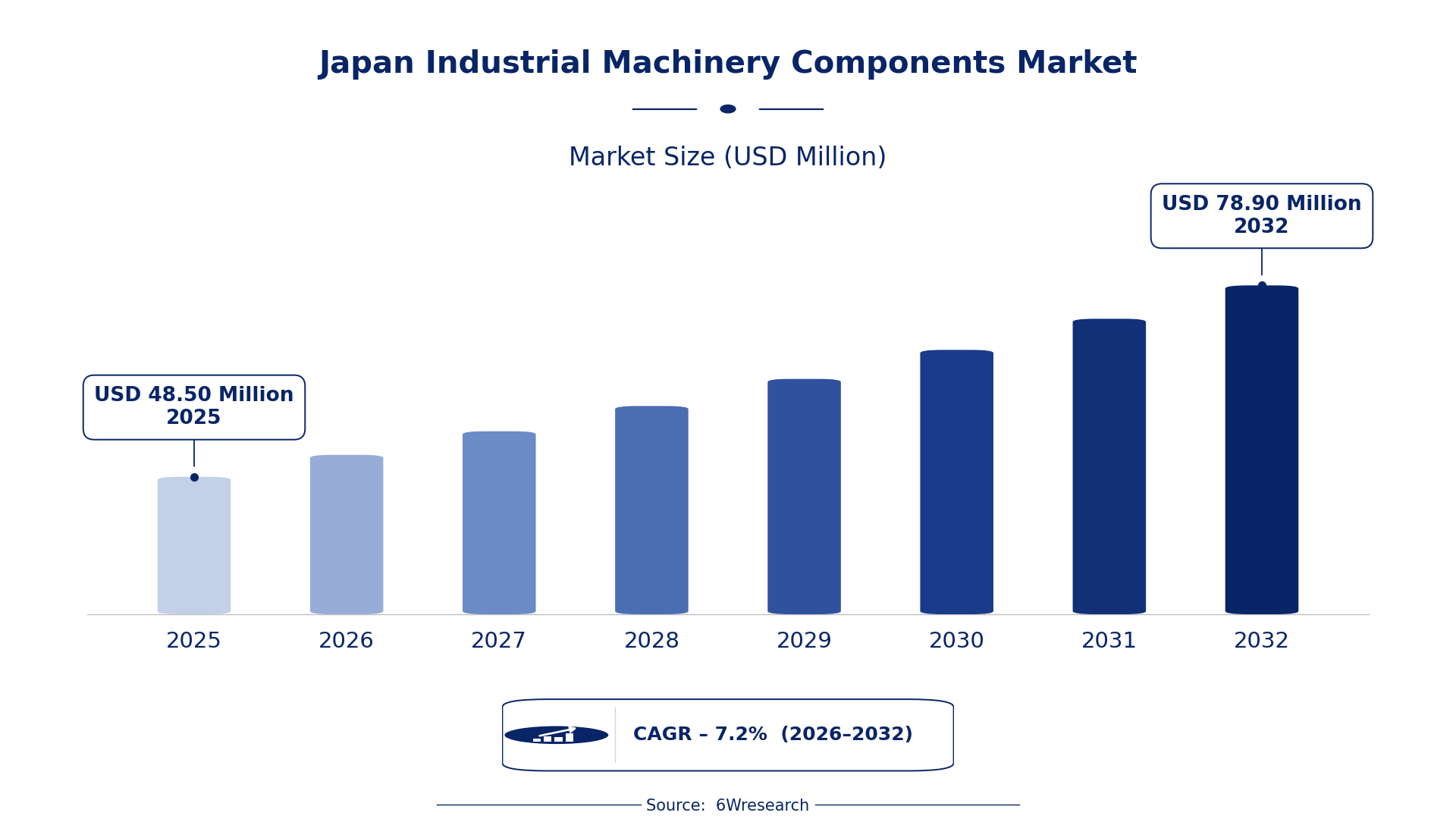
According to 6Wresearch internal database and industry insights, the Japan Industrial Machinery Components Market was valued at USD 48.50 Million in 2025 and is projected to reach USD 78.90 Million by 2032, growing at a CAGR of approximately 7.2% during 2026–2032.
Japan Industrial Machinery Components Market Highlights
| Report Metric | Details |
| Report Name | Japan Industrial Machinery Components Market (2026-2032) |
| Market Size 2025 | USD 48.50 Million |
| Market Size 2032 | USD 78.90 Million |
| Absolute Growth 2025–2032 | USD 30.40 Million |
| CAGR 2026–2032 | 7.2% |
| Peak Annual Growth | 8.0% in 2028 |
| Forecast Period | 2026–2032 |
| Historical Data | 2022–2025 |
| Base Year | 2025 |
| Leading Component Type, 2025 | Gears and Bearings (47% share) |
| Leading Material Type, 2025 | Steel/Alloy (40% share) |
| Leading Use Case, 2025 | Torque Transmission (39% share) |
| Leading End User, 2025 | Power Equipment Builders (42% share) |
| Fastest-Growing Component Type | Shafts & Couplings (10.1% CAGR) |
| Fastest-Growing Material Type | Forged Steel (10.6% CAGR) |
| Fastest-Growing Use Case | Motion Transfer (9.9% CAGR) |
| Fastest-Growing End User | Heavy Machinery OEMs (9.2% CAGR) |
| Growing Sector | heavy machinery |
| Key End Users | power equipment builders, heavy machinery OEMs, construction companies |
Japan Industrial Machinery Components Market Year-wise Growth Rate and Key Drivers (2022–2032)
This graph illustrates the annual growth rates of the market from 2022 to 2032, highlighting a steady upward trajectory and projected market expansion over the forecast period.
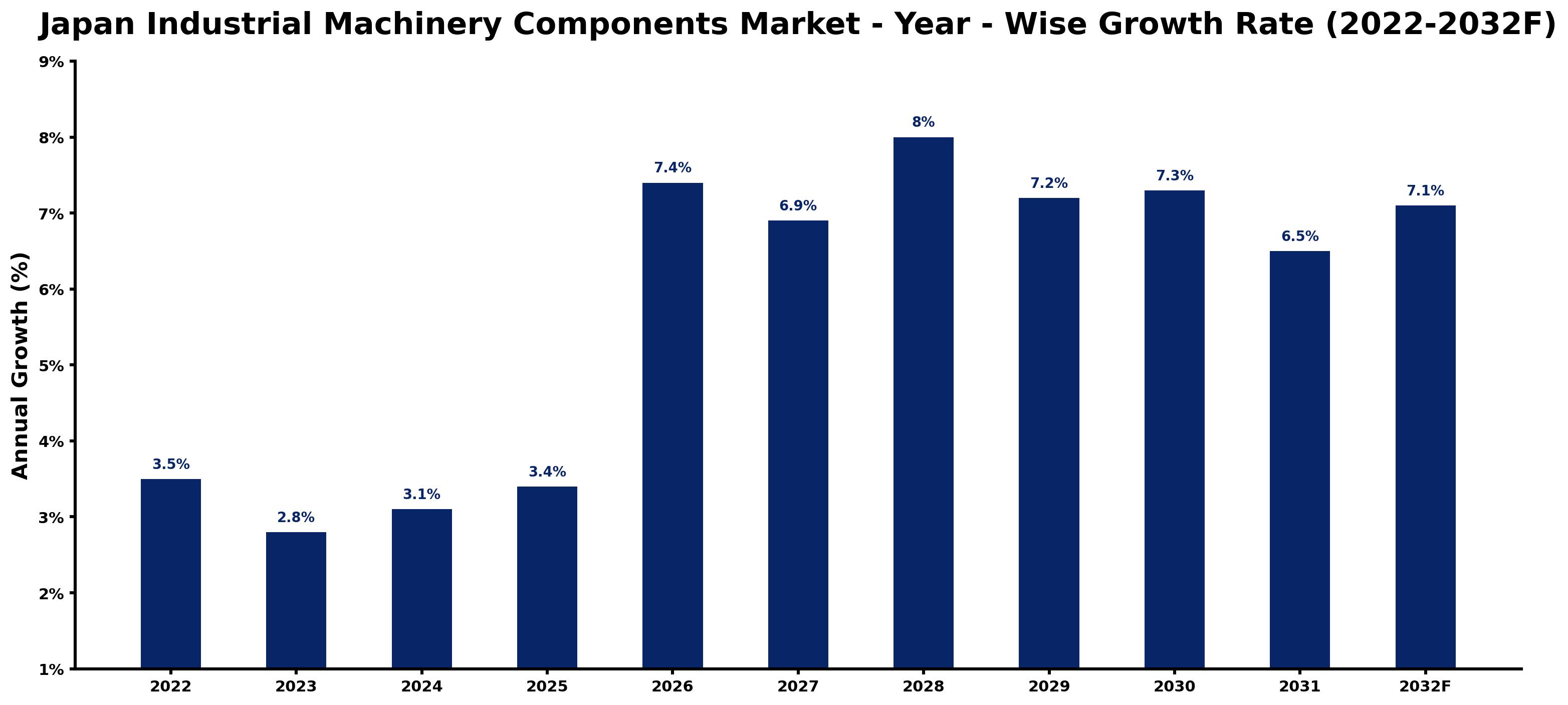
Each row of the following table gives one year's estimated growth and the event or demand shift that explains it.
| Year | Estimated Annual Growth (%) | Market Rationale |
| 2022 | 3.5 | The market experienced stable demand from power equipment builders and heavy machinery manufacturers. |
| 2023 | 2.8 | Growth slowed due to market adjustments following the previous year's high performance. |
| 2024 | 3.1 | A rise in demand for automation components contributed to faster growth this year. |
| 2025 | 3.4 | Increased investments in heavy machinery drove further expansion in the market. |
| 2026 | 7.4 | A surge in decarbonisation initiatives will boost demand for energy-efficient machinery components. |
| 2027 | 6.9 | Growth will slow as the market adjusts to the rapid expansion of the previous year. |
| 2028 | 8.0 | The peak growth will be driven by substantial investments in automation technology. |
| 2029 | 7.2 | A slight slowdown will occur as the market stabilises after peak growth. |
| 2030 | 7.3 | Demand for advanced machinery components will increase due to rising industrial activity. |
| 2031 | 6.5 | Growth will slow as the market begins to normalise following previous high rates. |
| 2032 | 7.1 | A resurgence in heavy machinery investments is expected to drive demand. |
Note: Market size estimations and growth projections presented in this report are based on 6Wresearch's proprietary forecasting methodology, utilizing the latest available industry data, government publications, and primary research inputs.
Japan Industrial Machinery Components Market Synopsis
Industrial machinery components are vital parts used in various applications, primarily made from metals like steel and aluminum. Their primary uses include torque transmission, motion transfer, and automation control in machinery. The Japan Industrial Machinery Components Market is expanding due to rising investments in automation, a focus on energy efficiency, and strong demand from power equipment builders and heavy machinery OEMs. The sector is projected to grow, driven by technological advancements and increasing production capacities, with a size of USD 48.50 Million by 2025.
Market Dynamics Impact Analysis (2026–2032)
| Factor | Type | Impact | Primary Segment Affected |
| Rising investments in automation technology | Driver | High | Control Panels |
| Demand for energy-efficient machinery components | Driver | High | Hydraulic Cylinders |
| Growing need for lightweight components in machinery | Opportunity | Medium | Aluminum/Steel |
| Expansion of heavy machinery production in Aichi | Opportunity | Medium | Excavators/Press Machines |
| High production costs affecting manufacturers | Restraint | High | Gears and Bearings |
| Compliance with stringent safety standards | Restraint | Medium | Shafts & Couplings |
| Limited availability of skilled labour | Challenge | High | Hydraulic Cylinders |
| Rising raw material prices impacting production | Challenge | Medium | Torque Transmission |
Evaluation of Drivers in Japan Industrial Machinery Components Market (2026–2032)
The main growth drivers and the segments they affect most are set out below.
| Drivers | Primary Segment Affected | Why It Matters (Evidence) |
| Increased automation in manufacturing processes | Control Panels | This shift leads to higher demand for advanced control systems, with the Ministry of Economy, Trade and Industry's 2023 program enhancing automation efforts. |
| Growing focus on energy efficiency | Hydraulic Cylinders | As manufacturers seek to reduce energy consumption, the installed base of hydraulic cylinders, exceeding 5 million units, drives demand for efficient components. |
| Expansion of heavy machinery production | Excavators/Press Machines | The heavy machinery sector's projected investment of ¥1 trillion in 2023 is boosting demand for essential components. |
| Rising demand for lightweight materials | Aluminum/Steel | The annual demand for aluminum components, around 300,000 tons, reflects the trend towards lightweight machinery. |
| Technological advancements in component manufacturing | Gears and Bearings | The production of gears and bearings reached 200,000 tons in 2022, indicating a shift towards innovative manufacturing techniques. |
The installed base of hydraulic cylinders exceeds 5 million units, driving demand for energy-efficient components. Heavy machinery production is set to attract ¥1 trillion in investment in 2023, boosting the need for essential components. The annual demand for aluminum components is around 300,000 tons, reflecting a shift towards lightweight machinery. Advances in manufacturing techniques have led to the production of gears and bearings reaching 200,000 tons in 2022, indicating a focus on innovative processes.
Evaluation of Restraints in Japan Industrial Machinery Components Market
These restraints slow adoption and weigh on supplier margins.
| Market Restraint | Primary Segment Affected | Why It Matters (Evidence) |
| High production costs impacting profitability | Gears and Bearings | Manufacturers face rising costs, which can limit their ability to invest in new technologies and production capabilities. |
| Compliance with safety standards increasing operational costs | Shafts & Couplings | Adhering to regulations like the Industrial Safety and Health Act requires investments in safety measures. |
| Limited skilled workforce affecting production capacity | Hydraulic Cylinders | The shortage of skilled labour in the industrial sector hampers production efficiency and capacity. |
| Rising raw material prices impacting component costs | Torque Transmission | Fluctuating prices for steel and aluminum increase production costs, affecting pricing strategies. |
| Regulatory compliance costs for manufacturers | Control Panels | Meeting standards set by the Japan Society of Mechanical Engineers requires ongoing investment in compliance measures. |
Japan Industrial Machinery Components Market Challenges
Buyers in Japan's industrial machinery market encounter issues with outdated technology, as numerous manufacturers continue to depend on legacy systems that diminish efficiency and elevate downtime. Suppliers face escalating production costs following the national minimum wage increase to JPY 1,055 per hour, compelling them to raise prices, which ultimately impacts buyers. Adherence to the JIS B 1501 standard imposes stringent requirements, causing delays in product launches for manufacturers and affecting their competitiveness. Supply chain disruptions may arise, as the heavy machinery sector's projected ¥1 trillion investment in 2023 might not adequately satisfy the growing demand, resulting in delays for producers.
Trends in the Japan Industrial Machinery Components Market
The shifts below are changing how Japan Industrial Machinery Components Market products are bought and supplied.
- Shift from Traditional to Automated Manufacturing: Since 2023, Japan has experienced a transition towards automated manufacturing processes, spurred by a new subsidy programme for energy-efficient machinery. This shift is enhancing productivity and efficiency in factories, particularly in Tokyo and Osaka, where automation is being rapidly embraced.
- Transition from Steel to Lightweight Materials: The movement towards lightweight materials has gained momentum since 2023, with manufacturers increasingly opting for aluminium components. This trend is particularly noticeable in the heavy machinery sector, where annual demand for aluminium components is around 300,000 tons.
- Emergence of Advanced Control Systems: The rollout of advanced control systems commenced in 2023, influencing automation control in machinery. This trend is especially pronounced among power equipment manufacturers, who depend on these systems for improved operational efficiency.
- Growing Adoption of Energy-Efficient Machinery: The uptake of energy-efficient machinery components has been on the rise since 2023, following the GX Promotion Act. This trend is particularly apparent in the hydraulic machinery market, valued at ¥500 billion.
Investment Opportunities in the Japan Industrial Machinery Components Market
Several openings in the Japan Industrial Machinery Components Market merit attention from investors.
- Aichi's Heavy Machinery Sector: Aichi is witnessing a boom in heavy machinery production, with projected investments of ¥1 trillion in 2023. Suppliers can penetrate this market by delivering high-quality components to satisfy the increasing demand.
- Power Equipment Builders' Demand for Automation: Power equipment manufacturers are increasingly pursuing advanced automation solutions, with the sector estimated to comprise around 500 builders. Suppliers can capitalise on this opportunity by providing innovative control panels.
- Gap in Lightweight Component Supply: The demand for lightweight components is on the rise, with annual aluminium demand at 300,000 tons. Suppliers should concentrate on supplying aluminium and steel components to address this market gap.
- Investment in Energy-Efficient Solutions: The market for energy-efficient machinery components is growing, driven by the GX Basic Policy's target of ¥150 trillion in decarbonisation investment. Suppliers can engage with manufacturers prioritising energy-efficient designs.
Government Initiatives in the Japan Industrial Machinery Components Market
The GX Promotion Act, introduced in 2023, builds upon existing environmental regulations by providing a legal framework for decarbonisation initiatives. This act aims to support industries in reducing greenhouse gas emissions, encouraging investments in energy-efficient machinery and technologies, which are important for the industrial machinery components sector.
The New Robot Strategy promotes automation in manufacturing, leading to funding for projects that improve automation capabilities. This strategy benefits manufacturers and buyers of industrial machinery components by improving operational efficiency.
Future Insight of the Japan Industrial Machinery Components Market
Buyers will gain from advanced automation technologies by 2032, as the 2023 government programme seeks to improve manufacturing processes. Suppliers will experience growth from the JPY 150 trillion decarbonisation investment, promoting innovation in energy-efficient machinery. The annual demand for hydraulic cylinders is projected to exceed 5 million units, prompting advancements in production. New standards from the Japan Society of Mechanical Engineers will ensure that products align with future market requirements.
Market Segmentation Analysis
Japan Industrial Machinery Components Market report covers a detailed analysis of the following market segments:
By Component Type – Gears and Bearings Lead, Shafts & Couplings Expected to Grow Fastest
According to Saurav Kr Singh, Senior Research Analyst at 6Wresearch, with 47% of component type revenue in 2025, Gears and Bearings was the largest category. Gears and bearings are integral for torque transmission in machinery, making them indispensable across various industrial applications. Their extensive use in power equipment manufacturing drives a steady demand for these components in Japan. The quickest growth will come from Shafts & Couplings, forecast to expand at a CAGR of 10.1% between 2026 and 2032. Shafts and couplings are experiencing rapid growth due to their essential role in connecting rotating parts, which becomes increasingly critical as machinery complexity advances. The ongoing emphasis on automation in manufacturing is expected to further elevate the demand for these components. Suppliers should focus on enhancing their shafts and couplings offerings to capitalise on the rising market demand.
By Material Type – Steel/Alloy Leads, Forged Steel Expected to Grow Fastest
Steel/Alloy held 40% of the Japan Industrial Machinery Components Market by material type in 2025. Steel and alloy materials are the primary choice for manufacturers due to their durability and strength, which are essential for the longevity of industrial machinery components. The annual production of gears and bearings, reaching 200,000 tons, underscores the reliance on these materials. Over 2026–2032, Forged Steel is expected to post the fastest growth, at a CAGR of 10.6%. Forged steel is gaining traction in high-stress applications, driven by the need for components that can withstand demanding operational conditions. The increasing emphasis on energy-efficient machinery is likely to boost the demand for forged steel components further. Buyers should consider sourcing forged steel components to ensure reliability in high-performance applications.
By Use Case – Torque Transmission Leads, Motion Transfer Expected to Grow Fastest
Torque Transmission accounted for 39% of the market by use case in 2025. Torque transmission is a fundamental use case for industrial machinery components, critical for the effective operation of various machines. This necessity is reflected in the substantial investments made in the heavy machinery sector, projected to reach ¥1 trillion in 2023. Motion Transfer is set to record the highest CAGR in this split, 9.9% over 2026–2032. Motion transfer is becoming increasingly important as machinery designs evolve, necessitating efficient function across various applications. The push for automation in manufacturing is likely to drive further demand for components that facilitate motion transfer. Suppliers must innovate to provide advanced solutions for motion transfer to meet the evolving demands of the market.
By End User – Power Equipment Builders Lead, Heavy Machinery OEMs Expected to Grow Fastest
Power Equipment Builders took 42% of end user revenue in 2025, more than any other category. Power equipment builders are a significant segment, serving as major consumers of industrial machinery components essential for their operations. The existence of around 500 power equipment builders in Japan underscores their pivotal role in shaping market dynamics. Heavy Machinery OEMs are projected to grow fastest, at a CAGR of 9.2% during 2026–2032. Heavy machinery OEMs are witnessing swift growth, driven by a surge in construction and infrastructure projects that necessitate extensive machinery components. The substantial investments in this sector suggest a robust upward trend in demand moving forward. Suppliers need to tailor their products to meet the evolving requirements of heavy machinery OEMs to capture emerging market opportunities.
Key Attractiveness of the Report
- 10 Years of Market Numbers
- Historical Data Starting from 2022 to 2025
- Base Year 2025
- Forecast Data until 2032
- Key Performance Indicators Impacting the Market
- Major Upcoming Developments and Projects
Key Highlights of the Report:
- Japan Industrial Machinery Components Market Outlook
- Market Size of Japan Industrial Machinery Components Market, 2025
- Forecast of Japan Industrial Machinery Components Market, 2032
- Historical Data and Forecast of Japan Industrial Machinery Components Revenues & Volume for the Period 2022-2032F
- Japan Industrial Machinery Components Market Trend Evolution
- Japan Industrial Machinery Components Market Drivers and Challenges
- Japan Industrial Machinery Components Price Trends
- Japan Industrial Machinery Components Porter's Five Forces
- Japan Industrial Machinery Components Industry Life Cycle
- Historical Data and Forecast of Japan Industrial Machinery Components Market Revenues & Volume By Component Type for the Period 2022-2032F
- Historical Data and Forecast of Japan Industrial Machinery Components Market Revenues & Volume By Gears and Bearings for the Period 2022-2032F
- Historical Data and Forecast of Japan Industrial Machinery Components Market Revenues & Volume By Shafts & Couplings for the Period 2022-2032F
- Historical Data and Forecast of Japan Industrial Machinery Components Market Revenues & Volume By Hydraulic Cylinders for the Period 2022-2032F
- Historical Data and Forecast of Japan Industrial Machinery Components Market Revenues & Volume By Control Panels for the Period 2022-2032F
- Historical Data and Forecast of Japan Industrial Machinery Components Market Revenues & Volume By Material Type for the Period 2022-2032F
- Historical Data and Forecast of Japan Industrial Machinery Components Market Revenues & Volume By Steel/Alloy for the Period 2022-2032F
- Historical Data and Forecast of Japan Industrial Machinery Components Market Revenues & Volume By Forged Steel for the Period 2022-2032F
- Historical Data and Forecast of Japan Industrial Machinery Components Market Revenues & Volume By Aluminum/Steel for the Period 2022-2032F
- Historical Data and Forecast of Japan Industrial Machinery Components Market Revenues & Volume By Powder-Coated MS for the Period 2022-2032F
- Historical Data and Forecast of Japan Industrial Machinery Components Market Revenues & Volume By Use Case for the Period 2022-2032F
- Historical Data and Forecast of Japan Industrial Machinery Components Market Revenues & Volume By Torque Transmission for the Period 2022-2032F
- Historical Data and Forecast of Japan Industrial Machinery Components Market Revenues & Volume By Motion Transfer for the Period 2022-2032F
- Historical Data and Forecast of Japan Industrial Machinery Components Market Revenues & Volume By Linear Motion for the Period 2022-2032F
- Historical Data and Forecast of Japan Industrial Machinery Components Market Revenues & Volume By Automation Control for the Period 2022-2032F
- Historical Data and Forecast of Japan Industrial Machinery Components Market Revenues & Volume By End User for the Period 2022-2032F
- Historical Data and Forecast of Japan Industrial Machinery Components Market Revenues & Volume By Power Equipment Builders for the Period 2022-2032F
- Historical Data and Forecast of Japan Industrial Machinery Components Market Revenues & Volume By Heavy Machinery OEMs for the Period 2022-2032F
- Historical Data and Forecast of Japan Industrial Machinery Components Market Revenues & Volume By Excavators/Press Machines for the Period 2022-2032F
- Historical Data and Forecast of Japan Industrial Machinery Components Market Revenues & Volume By Conveyor Systems for the Period 2022-2032F
- Japan Industrial Machinery Components Import Export Trade Statistics
- Market Opportunity Assessment By Component Type
- Market Opportunity Assessment By Material Type
- Market Opportunity Assessment By Use Case
- Market Opportunity Assessment By End User
- Japan Industrial Machinery Components Top Companies Market Share
- Japan Industrial Machinery Components Competitive Benchmarking By Technical and Operational Parameters
- Japan Industrial Machinery Components Company Profiles
- Japan Industrial Machinery Components Key Strategic Recommendations
Market Covered
Coverage by segment is as follows.
By Component Type
- Gears and Bearings
- Shafts & Couplings
- Hydraulic Cylinders
- Control Panels
By Material Type
- Steel/Alloy
- Forged Steel
- Aluminum/Steel
- Powder-Coated MS
By Use Case
- Torque Transmission
- Motion Transfer
- Linear Motion
- Automation Control
By End User
- Power Equipment Builders
- Heavy Machinery OEMs
- Excavators/Press Machines
- Conveyor Systems































