Japan Industrial Maintenance Tools Market Size & Growth Rate
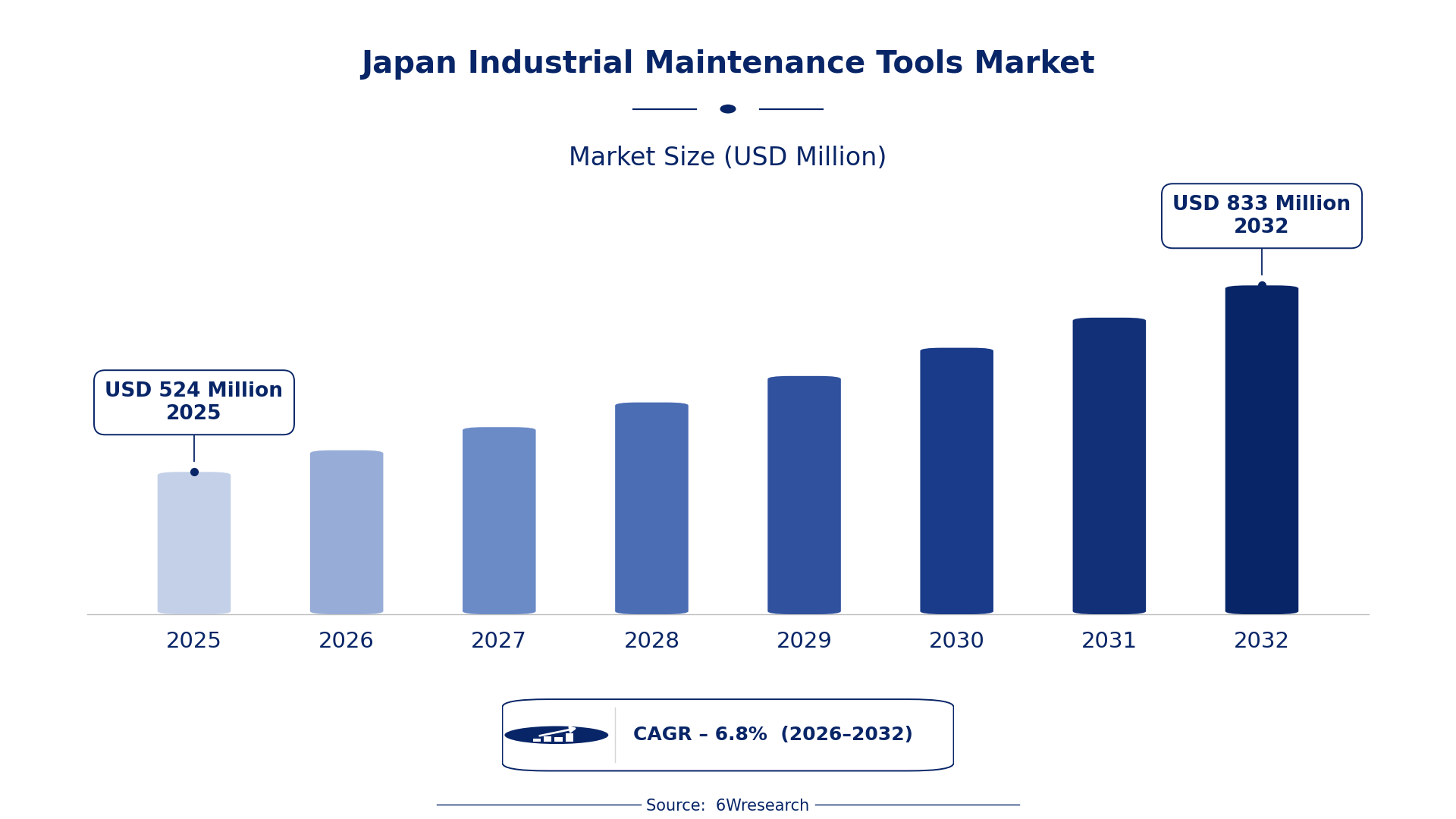
According to 6Wresearch internal database and industry insights, the Japan Industrial Maintenance Tools Market was valued at USD 524 Million in 2025 and is projected to reach USD 833 Million by 2032, growing at a CAGR of approximately 6.8% during 2026–2032.
Japan Industrial Maintenance Tools Market Highlights
| Report Metric | Details |
| Report Name | Japan Industrial Maintenance Tools Market (2026-2032) |
| Market Size 2025 | USD 524 Million |
| Market Size 2032 | USD 833 Million |
| Absolute Growth 2025–2032 | USD 309 Million |
| CAGR 2026–2032 | 6.8% |
| Peak Annual Growth | 7.6% in 2027 |
| Forecast Period | 2026–2032 |
| Historical Data | 2022–2025 |
| Base Year | 2025 |
| Leading Tool Type, 2025 | Torque Wrenches (45% share) |
| Leading Power Source, 2025 | Manual/Electric (52% share) |
| Leading Usage Type, 2025 | Assembly/Repair (47% share) |
| Leading End User, 2025 | Aerospace Maintenance (37% share) |
| Fastest-Growing Tool Type | Bearing Pullers (9.4% CAGR) |
| Fastest-Growing Power Source | Hydraulic/Mechanical (9.9% CAGR) |
| Fastest-Growing Usage Type | Removal Tasks (9.6% CAGR) |
| Fastest-Growing End User | Mechanical Workshops (8.7% CAGR) |
| Growing Sector | Aerospace Maintenance |
| Key End Users | Aerospace firms, mechanical workshops, automotive service centres, manufacturing industries |
Japan Industrial Maintenance Tools Market Year-wise Growth Rate and Key Drivers (2022–2032)
This graph illustrates the annual growth rates of the market from 2022 to 2032, highlighting a steady upward trajectory and projected market expansion over the forecast period.
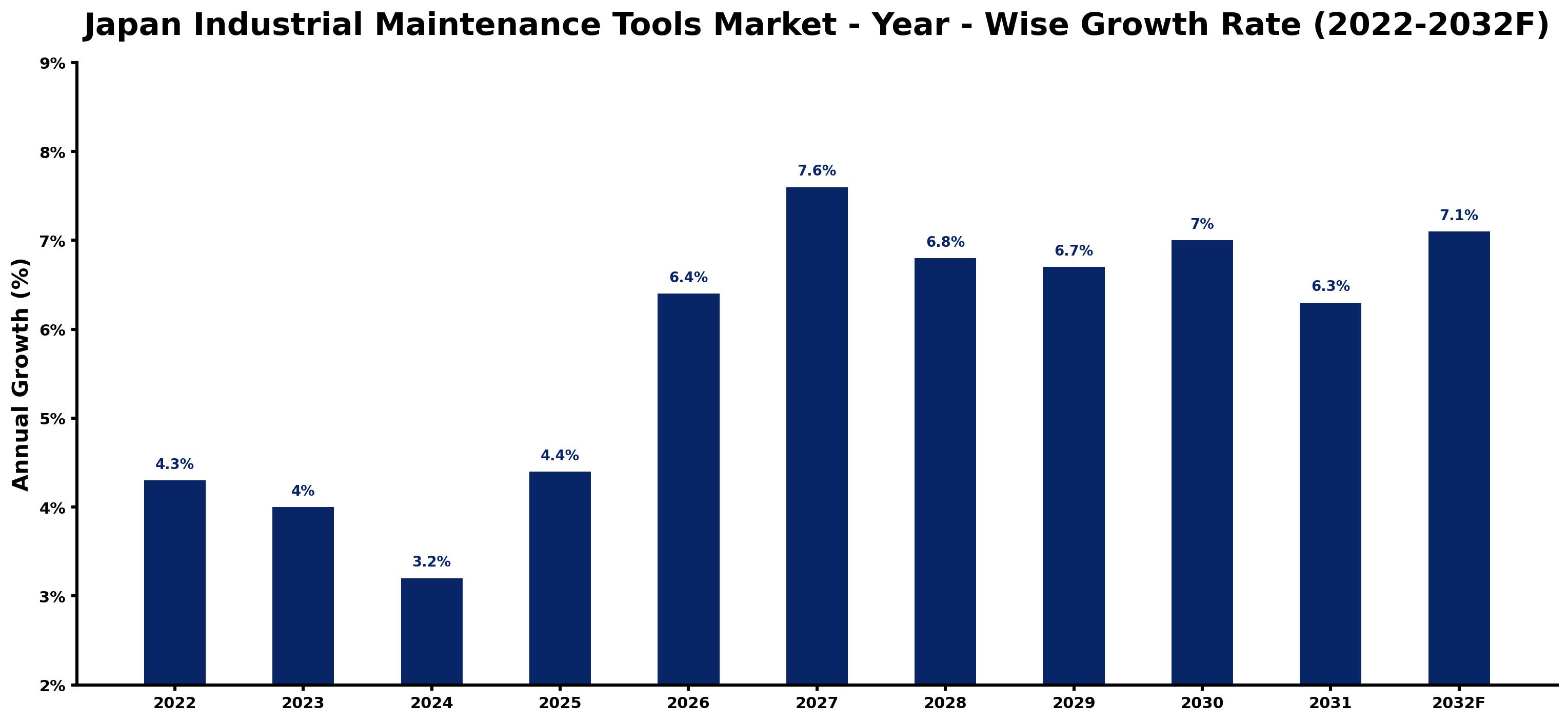
Annual growth estimates for each year appear below with the principal reason behind them, explaining the shifts that set the pace of the market.
| Year | Estimated Annual Growth (%) | Market Rationale |
| 2022 | 4.3 | The market experienced steady growth due to ongoing industrial activities. |
| 2023 | 4.0 | Growth slowed as manufacturers faced supply chain challenges and rising costs. |
| 2024 | 3.2 | The market continued to grow, albeit at a slower pace, due to cautious investments. |
| 2025 | 4.4 | Growth accelerated as modernization efforts in mechanical workshops gained momentum. |
| 2026 | 6.4 | Demand is expected to surge as advanced maintenance technologies are adopted widely. |
| 2027 | 7.6 | The market is projected to peak with substantial investments in aerospace maintenance tools. |
| 2028 | 6.8 | Growth is expected to slow slightly as the market stabilises after peak demand. |
| 2029 | 6.7 | The market will maintain growth, driven by consistent demand from mechanical workshops. |
| 2030 | 7.0 | Demand is projected to increase as new standards for maintenance tools are implemented. |
| 2031 | 6.3 | Growth is expected to slow as the market adjusts to previous high levels of investment. |
| 2032 | 7.1 | The market is projected to grow as new technologies enhance tool efficiency. |
Note: Market size estimations and growth projections presented in this report are based on 6Wresearch's proprietary forecasting methodology, utilizing the latest available industry data, government publications, and primary research inputs.
Japan Industrial Maintenance Tools Market Synopsis
Industrial maintenance tools are vital for machinery upkeep across various sectors, including aerospace and automotive. These tools, made from high-strength materials, are essential for assembly, repair, and maintenance tasks. The Japan Industrial Maintenance Tools Market is expanding due to the thriving aerospace sector, with over 200 firms in the Kanto region driving demand. A government initiative in 2023 promotes advanced maintenance technologies, further boosting investments in this market.
Market Dynamics Impact Analysis (2026–2032)
| Factor | Type | Impact | Primary Segment Affected |
| Growing demand from the aerospace sector drives tool purchases. | Driver | High | Aerospace Maintenance |
| Increased modernization in mechanical workshops enhances tool adoption. | Driver | High | Mechanical Workshops |
| Investment in advanced maintenance technologies presents new opportunities. | Opportunity | High | Diagnostic Scanners |
| Rising demand for precision tools in automotive service centres creates openings. | Opportunity | Medium | Torque Wrenches |
| Supply chain disruptions impact tool availability and pricing. | Restraint | High | Torque Wrenches |
| High competition among manufacturers limits price flexibility. | Restraint | Medium | Torque Wrenches |
| Technological advancements require continuous investment from buyers. | Challenge | High | Torque Wrenches |
| Skilled labour shortages affect tool usage efficiency. | Challenge | Medium | Torque Wrenches |
Evaluation of Drivers in Japan Industrial Maintenance Tools Market (2026–2032)
Below are the drivers that matter most for revenue growth, with supporting evidence.
| Drivers | Primary Segment Affected | Why It Matters (Evidence) |
| Strong demand from the aerospace sector increases tool purchases. | Aerospace Maintenance | With over 200 aerospace firms in the Kanto region, demand for maintenance tools is high. |
| Modernization efforts in mechanical workshops drive tool adoption. | Mechanical Workshops | A 15% increase in tool adoption was reported in Osaka due to these efforts. |
| Investment in advanced maintenance technologies boosts market growth. | Diagnostic Scanners | The Ministry of Economy, Trade and Industry launched a program in 2023 to promote these technologies. |
| The growing automotive sector drives demand for diagnostic tools. | Diagnostic Scanners | Over 500 automotive service centres increasingly use diagnostic scanners for troubleshooting. |
| Rising focus on energy efficiency leads to tool upgrades. | Torque Wrenches | The Act on the Rational Use of Energy obliges large energy users to improve efficiency. |
What keeps demand rising is the strong need for industrial maintenance tools in the aerospace sector, with over 200 firms in the Kanto region driving purchases. Modernisation in mechanical workshops has led to a reported 15% increase in tool adoption in Osaka. The automotive sector's expansion fuels demand for diagnostic tools, as service centres increasingly utilise these for troubleshooting.
Evaluation of Restraints in Japan Industrial Maintenance Tools Market
The following restraints limit how fast demand can grow.
| Market Restraint | Primary Segment Affected | Why It Matters (Evidence) |
| Supply chain disruptions hinder tool availability and increase costs. | Torque Wrenches | Manufacturers face challenges sourcing materials, leading to delays and price hikes. |
| High competition among manufacturers restricts pricing flexibility. | Torque Wrenches | Intense competition forces manufacturers to keep prices low, impacting margins. |
| Technological advancements require continuous investment in tools. | Torque Wrenches | Buyers must frequently upgrade tools to keep pace with new technologies, increasing costs. |
| Skilled labour shortages limit effective tool usage. | Torque Wrenches | A lack of trained maintenance workers affects operational efficiency and tool application. |
| Regulatory compliance increases operational costs for manufacturers. | Torque Wrenches | Compliance with the Industrial Safety and Health Act raises production expenses. |
Japan Industrial Maintenance Tools Market Challenges
Buyers in Japan's industrial maintenance tools market face intense competition, as over 200 aerospace firms in the Kanto region demand high-quality products. Skills shortages hinder producers, with around 1 million industrial maintenance workers limiting the workforce available for tool manufacturing and repair. Rising costs impact buyers, as the average lifespan of manual tools is only 5-10 years, necessitating frequent replacements that inflate expenses. Supply chain disruptions occur due to reliance on imported specialised tools, delaying production timelines for producers and extending project completion by up to 20%.
Trends in the Japan Industrial Maintenance Tools Market
These developments are changing demand patterns in the Japan Industrial Maintenance Tools Market.
- Shift from Manual to Advanced Diagnostic Tools: Since 2023, automotive service centres have increasingly adopted advanced diagnostic scanners. This reflects a shift towards more precise troubleshooting methods, with over 500 centres utilising these tools.
- Transition from Traditional to Modern Maintenance Practices: In 2023, mechanical workshops began modernising their operations, leading to a 15% increase in tool adoption in Osaka. This trend indicates a broader move towards efficiency and effectiveness in maintenance.
- Aerospace Sector Prioritising Precision Tools: The aerospace maintenance sector has seen a rise in demand for precision tools, driven by over 200 firms in the Kanto region. This focus on precision is essential for ensuring safety and compliance.
- Emergence of Energy-Efficient Tools: The introduction of energy-efficient tools has gained traction since 2023, aligning with Japan's decarbonisation goals. The GX Basic Policy targets JPY 150 trillion in investments over ten years.
Investment Opportunities in the Japan Industrial Maintenance Tools Market
The following areas offer the clearest openings for investors and suppliers in the Japan Industrial Maintenance Tools Market.
- Partner with Local Manufacturers for Tool Distribution: With a projected market size of USD 833 million by 2032, collaborating with local manufacturers can facilitate entry into the market. Mechanical workshops are actively seeking modern tools to improve efficiency.
- Supply Advanced Diagnostic Tools to Automotive Centres: The automotive sector's growth presents a notable opportunity, with many service centres needing advanced diagnostic tools. Establishing a joint venture can help meet this demand effectively.
- Invest in Energy-Efficient Tool Technologies: With Japan targeting a 46% reduction in greenhouse gas emissions by 2030, there is a growing demand for energy-efficient tools. This presents an opportunity for suppliers to innovate and meet new standards.
- Improve Training Programs for Maintenance Tool Usage: A government initiative in 2023 aims to enhance training for maintenance tool usage in technical schools. This creates an opportunity to supply training materials and tools to educational institutions.
Government Initiatives in the Japan Industrial Maintenance Tools Market
The Industrial Safety and Health Act mandates that employers ensure safe use of machinery and hazardous substances, impacting producers and buyers of industrial maintenance tools. Compliance with this law requires regular safety assessments and training for workers, ensuring that tools meet safety standards and are used correctly. The Act necessitates that manufacturers provide adequate information on tool safety and usage to end-users, promoting a culture of safety in the workplace.
The GX Promotion Act aims for JPY 150 trillion in decarbonisation investments over ten years, administered by the Ministry of Economy, Trade and Industry. This funding supports projects that improve energy efficiency in industrial maintenance, benefiting tool manufacturers and users.
Future Insight of the Japan Industrial Maintenance Tools Market
A government initiative to promote advanced maintenance technologies will improve operational efficiency in industrial settings by 2032. The JIS B 0011 standard will evolve to ensure tools meet specific performance benchmarks, benefiting both buyers and suppliers. By 2032, the installed base of torque wrenches is expected to grow to 2 million units, reflecting increased adoption rates. Modernisation efforts in mechanical workshops will lead to improved tool usage and refined maintenance practices across various sectors.
Market Segmentation Analysis
Japan Industrial Maintenance Tools Market report covers a detailed analysis of the following market segments:
By Tool Type – Torque Wrenches Lead, Bearing Pullers Expected to Grow Fastest
According to Saurav Kr Singh, Senior Research Analyst at 6Wresearch, Torque Wrenches accounted for 45% of the market by tool type in 2025. Torque wrenches hold the largest market share as they are crucial for ensuring precise torque application during assembly tasks, particularly in the aerospace sector. Their importance is underscored by the installed base of 1.5 million units in Japan, indicating extensive usage in industrial maintenance. Over 2026–2032, Bearing Pullers are expected to post the fastest growth, at a CAGR of 9.4%. Bearing pullers are witnessing rapid growth due to their essential role in efficiently removing bearings during machinery maintenance, especially in modernising mechanical workshops. A reported 15% increase in tool adoption in Osaka's workshops exemplifies this trend. Suppliers should focus on increasing the availability of bearing pullers to meet the rising demand in the maintenance sector.
By Power Source – Manual/Electric Leads, Hydraulic/Mechanical Expected to Grow Fastest
Manual/Electric held 52% of the Japan Industrial Maintenance Tools Market by power source in 2025. The manual/electric power source segment leads the market because of its widespread application across various maintenance tasks, offering both versatility and reliability. This segment's dominance is reinforced by its common use in assembly and repair work across multiple industries. Hydraulic/Mechanical is set to record the highest CAGR in this split, 9.9% over 2026–2032. Hydraulic/mechanical tools are growing rapidly as they are specifically designed for heavy-duty applications that require substantial force, particularly in manufacturing environments. The increasing complexity of machinery necessitates robust maintenance solutions, driving this growth. Buyers may need to invest in hydraulic/mechanical tools to effectively address the demands of modern industrial applications.
By Usage Type – Assembly/Repair Leads, Removal Tasks Expected to Grow Fastest
Assembly/Repair took 47% of usage type revenue in 2025, more than any other category. The assembly/repair usage type dominates the market as it represents the primary function of industrial maintenance tools, which are essential for maintaining operational efficiency. The ongoing need for effective assembly and repair processes across various sectors supports this segment's leading position. The quickest growth will come from Removal Tasks, forecast to expand at a CAGR of 9.6% between 2026 and 2032. Removal tasks are experiencing rapid growth as they are vital for disassembling machinery components, a crucial aspect of maintenance operations. The trend towards machinery modernisation significantly boosts the demand for tools focused on removal tasks. Suppliers should consider expanding their product lines to cater to the increasing focus on removal tasks in maintenance operations.
By End User – Aerospace Maintenance Leads, Mechanical Workshops Expected to Grow Fastest
With 37% of end user revenue in 2025, Aerospace Maintenance was the largest category. Aerospace maintenance is the leading end user due to the critical need for specialised tools to maintain aircraft and aerospace equipment, supported by over 200 aerospace firms in the Kanto region. This sector's stringent requirements for safety and precision ensure a steady demand for maintenance tools. Mechanical Workshops are projected to grow fastest, at a CAGR of 8.7% during 2026–2032. Mechanical workshops are the fastest-growing end user segment as they adapt to modernisation efforts, leading to increased tool adoption for various maintenance tasks. This shift is evidenced by reported increases in tool usage, highlighting the need for efficient maintenance solutions. Suppliers should target mechanical workshops to capitalise on their rapid growth and evolving tool requirements.
Key Attractiveness of the Report
- 10 Years of Market Numbers
- Historical Data Starting from 2022 to 2025
- Base Year 2025
- Forecast Data until 2032
- Key Performance Indicators Impacting the Market
- Major Upcoming Developments and Projects
Key Highlights of the Report:
- Japan Industrial Maintenance Tools Market Outlook
- Market Size of Japan Industrial Maintenance Tools Market, 2025
- Forecast of Japan Industrial Maintenance Tools Market, 2032
- Historical Data and Forecast of Japan Industrial Maintenance Tools Revenues & Volume for the Period 2022-2032F
- Japan Industrial Maintenance Tools Market Trend Evolution
- Japan Industrial Maintenance Tools Market Drivers and Challenges
- Japan Industrial Maintenance Tools Price Trends
- Japan Industrial Maintenance Tools Porter's Five Forces
- Japan Industrial Maintenance Tools Industry Life Cycle
- Historical Data and Forecast of Japan Industrial Maintenance Tools Market Revenues & Volume By Tool Type for the Period 2022-2032F
- Historical Data and Forecast of Japan Industrial Maintenance Tools Market Revenues & Volume By Torque Wrenches for the Period 2022-2032F
- Historical Data and Forecast of Japan Industrial Maintenance Tools Market Revenues & Volume By Bearing Pullers for the Period 2022-2032F
- Historical Data and Forecast of Japan Industrial Maintenance Tools Market Revenues & Volume By Alignment Tools for the Period 2022-2032F
- Historical Data and Forecast of Japan Industrial Maintenance Tools Market Revenues & Volume By Diagnostic Scanners for the Period 2022-2032F
- Historical Data and Forecast of Japan Industrial Maintenance Tools Market Revenues & Volume By Power Source for the Period 2022-2032F
- Historical Data and Forecast of Japan Industrial Maintenance Tools Market Revenues & Volume By Manual/Electric for the Period 2022-2032F
- Historical Data and Forecast of Japan Industrial Maintenance Tools Market Revenues & Volume By Hydraulic/Mechanical for the Period 2022-2032F
- Historical Data and Forecast of Japan Industrial Maintenance Tools Market Revenues & Volume By Laser/Optical for the Period 2022-2032F
- Historical Data and Forecast of Japan Industrial Maintenance Tools Market Revenues & Volume By Battery-Operated for the Period 2022-2032F
- Historical Data and Forecast of Japan Industrial Maintenance Tools Market Revenues & Volume By Usage Type for the Period 2022-2032F
- Historical Data and Forecast of Japan Industrial Maintenance Tools Market Revenues & Volume By Assembly/Repair for the Period 2022-2032F
- Historical Data and Forecast of Japan Industrial Maintenance Tools Market Revenues & Volume By Removal Tasks for the Period 2022-2032F
- Historical Data and Forecast of Japan Industrial Maintenance Tools Market Revenues & Volume By Precision Setup for the Period 2022-2032F
- Historical Data and Forecast of Japan Industrial Maintenance Tools Market Revenues & Volume By Vibration/Thermal for the Period 2022-2032F
- Historical Data and Forecast of Japan Industrial Maintenance Tools Market Revenues & Volume By End User for the Period 2022-2032F
- Historical Data and Forecast of Japan Industrial Maintenance Tools Market Revenues & Volume By Aerospace Maintenance for the Period 2022-2032F
- Historical Data and Forecast of Japan Industrial Maintenance Tools Market Revenues & Volume By Mechanical Workshops for the Period 2022-2032F
- Historical Data and Forecast of Japan Industrial Maintenance Tools Market Revenues & Volume By Rotating Equipment Firms for the Period 2022-2032F
- Historical Data and Forecast of Japan Industrial Maintenance Tools Market Revenues & Volume By Condition Monitoring Teams for the Period 2022-2032F
- Japan Industrial Maintenance Tools Import Export Trade Statistics
- Market Opportunity Assessment By Tool Type
- Market Opportunity Assessment By Power Source
- Market Opportunity Assessment By Usage Type
- Market Opportunity Assessment By End User
- Japan Industrial Maintenance Tools Top Companies Market Share
- Japan Industrial Maintenance Tools Competitive Benchmarking By Technical and Operational Parameters
- Japan Industrial Maintenance Tools Company Profiles
- Japan Industrial Maintenance Tools Key Strategic Recommendations
Market Covered
The report covers the following segments.
By Tool Type
- Torque Wrenches
- Bearing Pullers
- Alignment Tools
- Diagnostic Scanners
By Power Source
- Manual/Electric
- Hydraulic/Mechanical
- Laser/Optical
- Battery-Operated
By Usage Type
- Assembly/Repair
- Removal Tasks
- Precision Setup
- Vibration/Thermal
By End User
- Aerospace Maintenance
- Mechanical Workshops
- Rotating Equipment Firms
- Condition Monitoring Teams































