Japan Industrial Manufacturing Market Size & Growth Rate
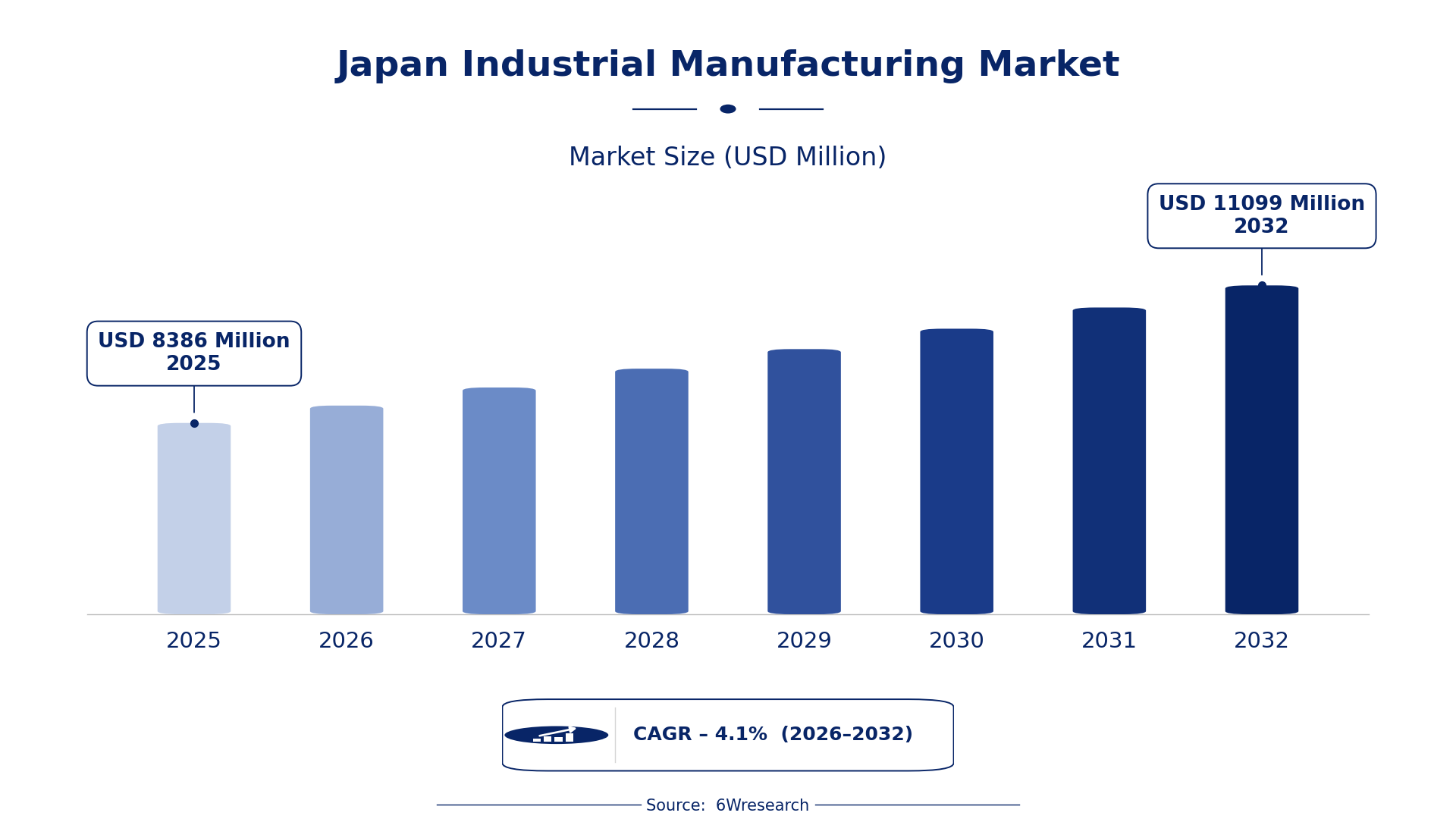
According to 6Wresearch internal database and industry insights, the Japan Industrial Manufacturing Market was valued at USD 8,386 Million in 2025 and is projected to reach USD 11,099 Million by 2032, growing at a CAGR of approximately 4.1% during 2026–2032.
Japan Industrial Manufacturing Market Highlights
| Report Metric | Details |
| Report Name | Japan Industrial Manufacturing Market (2026-2032) |
| Market Size 2025 | USD 8,386 Million |
| Market Size 2032 | USD 11,099 Million |
| Absolute Growth 2025–2032 | USD 2,713 Million |
| CAGR 2026–2032 | 4.1% |
| Peak Annual Growth | 4.7% in 2026 |
| Forecast Period | 2026–2032 |
| Historical Data | 2022–2025 |
| Base Year | 2025 |
| Leading Manufacturing Type, 2025 | Discrete Manufacturing (38% share) |
| Leading Process Category, 2025 | Cutting/Assembly (45% share) |
| Leading Automation Level, 2025 | Semi/Full (52% share) |
| Leading End User, 2025 | Aerospace Components (46% share) |
| Fastest-Growing Manufacturing Type | Process Manufacturing (5.7% CAGR) |
| Fastest-Growing Process Category | Chemical/Batch (6.1% CAGR) |
| Fastest-Growing Automation Level | PLC/SCADA (5.4% CAGR) |
| Fastest-Growing End User | Food & Beverage Plants (5.3% CAGR) |
| Growing Sector | Aerospace Components |
| Key End Users | Aerospace manufacturers, food and beverage producers, electronics manufacturers, R&D facilities |
Japan Industrial Manufacturing Market Year-wise Growth Rate and Key Drivers (2022–2032)
This graph illustrates the annual growth rates of the market from 2022 to 2032, highlighting a steady upward trajectory and projected market expansion over the forecast period.
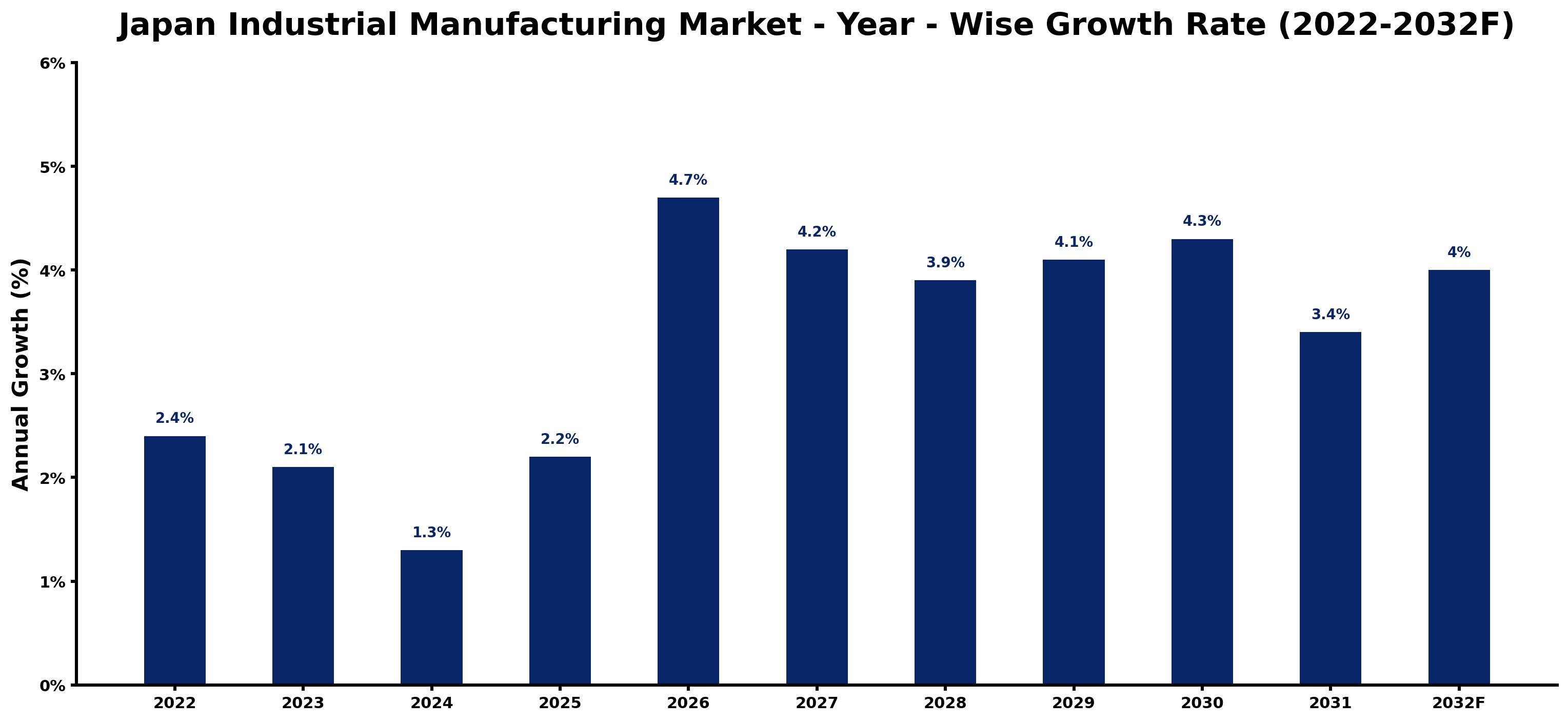
The table below sets out the estimated growth rate for each year and the main factor behind it.
| Year | Estimated Annual Growth (%) | Market Rationale |
| 2022 | 2.4 | Demand remained stable, supported by ongoing industrial activities and investments. |
| 2023 | 2.1 | Growth slowed due to market adjustments and a cautious approach to new investments. |
| 2024 | 1.3 | Continued deceleration reflected challenges in global supply chains affecting production. |
| 2025 | 2.2 | Demand improved as companies increased spending on technology and automation. |
| 2026 | 4.7 | Strong growth is expected to be driven by investments in advanced manufacturing technologies. |
| 2027 | 4.2 | Growth is projected to slow slightly as the market stabilises after a surge in investment. |
| 2028 | 3.9 | Demand is anticipated to continue moderating as companies adjust to new operational efficiencies. |
| 2029 | 4.1 | A rebound in investments is expected to lead to a faster growth rate in manufacturing activities. |
| 2030 | 4.3 | Growth is projected to accelerate further as technological advancements gain traction in the sector. |
| 2031 | 3.4 | The market is expected to experience a slowdown as companies focus on optimising existing processes. |
| 2032 | 4.0 | Demand is expected to rise again as new technologies are adopted widely. |
Note: Market size estimations and growth projections presented in this report are based on 6Wresearch's proprietary forecasting methodology, utilizing the latest available industry data, government publications, and primary research inputs.
Japan Industrial Manufacturing Market Synopsis
Industrial manufacturing in Japan encompasses various processes and technologies for producing goods, including discrete and process manufacturing. Growth in the Japan Industrial Manufacturing Market is fuelled by increased investments in automation and advanced manufacturing technologies. Valued at approximately 20 trillion JPY, key buyers include aerospace components manufacturers and food and beverage producers. The government’s push for decarbonisation and competitiveness improvement further stimulates demand, as illustrated by the JPY 150 trillion investment target set for the next decade.
Market Dynamics Impact Analysis (2026–2032)
| Factor | Type | Impact | Primary Segment Affected |
| Increased automation adoption | Driver | High | Discrete Manufacturing |
| Growing demand for aerospace components | Driver | High | Aerospace Components |
| Investment in decarbonisation initiatives | Opportunity | High | Discrete Manufacturing |
| Expansion of food and beverage production | Opportunity | High | Discrete Manufacturing |
| Aging manufacturing equipment | Restraint | Medium | Discrete Manufacturing |
| High costs of advanced technology implementation | Restraint | Medium | Discrete Manufacturing |
| Shortage of skilled labour in manufacturing | Challenge | High | Discrete Manufacturing |
| Supply chain disruptions affecting production capacity | Challenge | High | Discrete Manufacturing |
Evaluation of Drivers in Japan Industrial Manufacturing Market (2026–2032)
The following drivers explain most of the expected growth.
| Drivers | Primary Segment Affected | Why It Matters (Evidence) |
| Increased investment in automation technologies | Electronics Production | This has led to higher efficiency and productivity, prompting manufacturers to upgrade systems, particularly in electronics production, which employs advanced automation. |
| Rising demand for aerospace components | Aerospace Components | As global air travel rebounds, manufacturers are ramping up production, with the aerospace sector accounting for a large share of the market. |
| Government support for decarbonisation | Discrete Manufacturing | The GX Basic Policy targets JPY 150 trillion in investments in green technologies, encouraging manufacturers to adopt sustainable practices. |
| Growth in food and beverage production | Discrete Manufacturing | The annual production of food and beverage products is around 10 trillion JPY, driving demand for efficient manufacturing processes. |
| Technological advancements in additive manufacturing | Additive Manufacturing | The increased adoption of additive manufacturing in R&D labs improves product development capabilities, prompting more investments. |
Much of the new demand traces back to increased investment in automation technologies, which has risen in the electronics production sector. Approximately 10 million people are involved in manufacturing, resulting in a surge in productivity. The demand for aerospace components has prompted manufacturers to ramp up production, contributing to the market. Growth in food and beverage production, valued at around 10 trillion JPY annually, is pushing demand for efficient manufacturing processes.
Evaluation of Restraints in Japan Industrial Manufacturing Market
The key brakes on demand, and where they bite hardest, are shown below.
| Market Restraint | Primary Segment Affected | Why It Matters (Evidence) |
| Aging manufacturing equipment | Discrete Manufacturing | The average age of manufacturing equipment in Japan exceeds 15 years, causing inefficiencies and higher maintenance costs. |
| High costs of advanced technology implementation | Discrete Manufacturing | Investment in new technologies can be prohibitively expensive, deterring smaller manufacturers from upgrading. |
| Shortage of skilled labour in manufacturing | Discrete Manufacturing | The workforce involved in manufacturing is declining, creating challenges in maintaining production levels. |
| Supply chain disruptions affecting production capacity | Discrete Manufacturing | Global supply chain issues have caused delays in material availability, impacting production schedules. |
| Regulatory compliance costs | Discrete Manufacturing | Compliance with standards such as ISO 9001 incurs additional costs for manufacturers, affecting profitability. |
Japan Industrial Manufacturing Market Challenges
High reliance on imported components creates supply vulnerabilities for producers, resulting in production delays that can extend timelines by up to three months. Rising energy costs, influenced by Japan's energy policies, inflate operational expenses, costing manufacturers around 10% more than competitors in other regions. Buyers encounter difficulties in sourcing materials due to strict regulations, which can prolong project timelines by as much as six months. Compliance with the Japan Industrial Standards can divert resources from innovation, ultimately reducing competitiveness for producers in the market.
Trends in the Japan Industrial Manufacturing Market
Below are the shifts with the largest effect on the Japan Industrial Manufacturing Market.
- Shift towards Automation in Manufacturing: The Japan Machinery Federation has reported a notable increase in automation adoption, with over 500,000 CNC machines installed. This shift is improving production efficiency across various sectors.
- Increased Focus on Sustainable Manufacturing: Aerospace components manufacturers are increasingly adopting eco-friendly practices, aligning with the GX Basic Policy's goals. This trend is projected to drive investments in green technologies.
- Expansion of Additive Manufacturing in R&D: Additive manufacturing has gained traction in R&D labs, with many facilities now adopting these technologies for rapid prototyping. This is changing how products are developed and tested.
- Growth of Food and Beverage Production Facilities: Food and beverage plants are expanding operations, driven by a strong annual production value of around 10 trillion JPY. This growth is stimulating demand for advanced manufacturing processes.
Investment Opportunities in the Japan Industrial Manufacturing Market
The following areas offer the clearest openings for investors and suppliers in the Japan Industrial Manufacturing Market.
- Partnerships for Automation Solutions: Local partners should collaborate with technology providers, as the demand for automation solutions is increasing in manufacturing facilities across Japan, particularly in the electronics sector.
- Investment in Sustainable Technologies: Food and beverage producers are looking to invest in sustainable manufacturing technologies, aligning with government decarbonisation goals and improving their market competitiveness.
- Expansion of Aerospace Manufacturing Facilities: With the aerospace sector growing, there is a need for new manufacturing facilities, particularly in Tokyo and Osaka, providing opportunities for investment and development.
- Approval for Manufacturing Standards: Manufacturers should seek certification under the Japan Industrial Standards (JIS) to improve product quality and marketability, as compliance is increasingly valued by buyers.
Government Initiatives in the Japan Industrial Manufacturing Market
The Industrial Safety and Health Act (1972) mandates employer responsibilities for hazardous substances and machinery, ensuring a safer working environment for manufacturing employees. The GX Promotion Act (2023) establishes a framework for decarbonisation, targeting JPY 150 trillion in investments over the next decade to improve manufacturing competitiveness.
The Ministry of Economy, Trade and Industry oversees the implementation of manufacturing policies and funds initiatives aimed at advancing automation and sustainability. The Japan Machinery Federation supports advancements in manufacturing technologies, ensuring that producers can access the latest innovations.
Future Insight of the Japan Industrial Manufacturing Market
Emerging automation technologies will reshape demand in the manufacturing sector by 2032, streamlining processes and reducing reliance on manual labour. The government's decarbonisation initiative targets substantial investments, prompting suppliers to adopt sustainable manufacturing practices. The annual investment in manufacturing technology, estimated at 2 trillion JPY, is likely to enhance production capabilities. As Japan commits to net zero emissions by 2050, energy-efficient solutions will become crucial, offering long-term benefits for both buyers and suppliers.
Market Segmentation Analysis
Japan Industrial Manufacturing Market report covers a detailed analysis of the following market segments:
By Manufacturing Type – Discrete Manufacturing Leads, Process Manufacturing Expected to Grow Fastest
According to Saurav Kr Singh, Senior Research Analyst at 6Wresearch, in 2025, Discrete Manufacturing led the manufacturing type split with a 38% share. Discrete manufacturing holds the largest share due to its extensive application across various sectors, particularly in electronics and automotive. The installed base of over 500,000 CNC machines in Japan underpins its dominance by facilitating the production of distinct items. The quickest growth will come from Process Manufacturing, forecast to expand at a CAGR of 5.7% between 2026 and 2032. Process manufacturing is experiencing rapid growth as industries increasingly adopt bulk production techniques, especially in the food and beverage sector, which generates around 10 trillion JPY annually. This trend towards efficiency in production will likely widen the gap between discrete and process manufacturing. Suppliers should focus on enhancing their capabilities in process manufacturing to meet the growing demand for bulk production.
By Process Category – Cutting/Assembly Leads, Chemical/Batch Expected to Grow Fastest
Cutting/Assembly held 45% of the Japan Industrial Manufacturing Market by process category in 2025. Cutting and assembly processes are the leading category as they are fundamental to manufacturing operations, especially in sectors like aerospace. Their critical role in ensuring efficient production processes solidifies their position in the market. Over 2026–2032, Chemical/Batch is expected to post the fastest growth, at a CAGR of 6.1%. The chemical and batch process category is growing quickly due to rising demand for chemical products, particularly from the food and beverage industry, which has an annual production value of approximately 10 trillion JPY. This shift indicates a move towards specialised manufacturing techniques that may benefit cutting and assembly. Buyers should invest in advanced chemical processing technologies to capitalise on the market growth.
By Automation Level – Semi/Full Leads, PLC/SCADA Expected to Grow Fastest
With 52% of automation level revenue in 2025, Semi/Full was the largest category. The semi/full automation level leads the market as manufacturers seek to improve efficiency and reduce labour costs, particularly in key industrial regions like Tokyo and Osaka. This trend is reflected in the increasing adoption of automation technologies across various manufacturing sectors. PLC/SCADA is set to record the highest CAGR in this split, 5.4% over 2026–2032. PLC/SCADA systems are rapidly gaining popularity due to their essential role in process control and monitoring, especially in industries that require precision. This growth reflects a broader shift towards smarter manufacturing solutions that may further entrench the lead of semi/full automation. Suppliers of automation technologies should prioritise the development of PLC/SCADA systems to align with market demands.
By End User – Aerospace Components Lead, Food & Beverage Plants Expected to Grow Fastest
The largest end user category in 2025 was Aerospace Components, at 46% of revenue. Aerospace components are a significant application area in manufacturing, bolstered by Japan's strong aerospace industry and its contributions to the overall manufacturing sector. The importance of this segment is underscored by substantial investments in aerospace technologies and infrastructure. Food & Beverage Plants are projected to grow fastest, at a CAGR of 5.3% during 2026–2032. Food and beverage plants represent the fastest-growing end user segment, driven by the industry's employment of over 1 million workers and substantial annual production value. This growth highlights an increasing focus on food safety and quality assurance in manufacturing processes, which may further enhance the aerospace components segment. Suppliers should tailor their solutions to the specific needs of food and beverage plants to seize emerging opportunities.
Key Attractiveness of the Report
- 10 Years of Market Numbers
- Historical Data Starting from 2022 to 2025
- Base Year 2025
- Forecast Data until 2032
- Key Performance Indicators Impacting the Market
- Major Upcoming Developments and Projects
Key Highlights of the Report:
- Japan Industrial Manufacturing Market Outlook
- Market Size of Japan Industrial Manufacturing Market, 2025
- Forecast of Japan Industrial Manufacturing Market, 2032
- Historical Data and Forecast of Japan Industrial Manufacturing Revenues & Volume for the Period 2022-2032F
- Japan Industrial Manufacturing Market Trend Evolution
- Japan Industrial Manufacturing Market Drivers and Challenges
- Japan Industrial Manufacturing Price Trends
- Japan Industrial Manufacturing Porter's Five Forces
- Japan Industrial Manufacturing Industry Life Cycle
- Historical Data and Forecast of Japan Industrial Manufacturing Market Revenues & Volume By Manufacturing Type for the Period 2022-2032F
- Historical Data and Forecast of Japan Industrial Manufacturing Market Revenues & Volume By Discrete Manufacturing for the Period 2022-2032F
- Historical Data and Forecast of Japan Industrial Manufacturing Market Revenues & Volume By Process Manufacturing for the Period 2022-2032F
- Historical Data and Forecast of Japan Industrial Manufacturing Market Revenues & Volume By Additive Manufacturing for the Period 2022-2032F
- Historical Data and Forecast of Japan Industrial Manufacturing Market Revenues & Volume By Continuous Flow Systems for the Period 2022-2032F
- Historical Data and Forecast of Japan Industrial Manufacturing Market Revenues & Volume By Process Category for the Period 2022-2032F
- Historical Data and Forecast of Japan Industrial Manufacturing Market Revenues & Volume By Cutting/Assembly for the Period 2022-2032F
- Historical Data and Forecast of Japan Industrial Manufacturing Market Revenues & Volume By Chemical/Batch for the Period 2022-2032F
- Historical Data and Forecast of Japan Industrial Manufacturing Market Revenues & Volume By 3D Printing/Prototyping for the Period 2022-2032F
- Historical Data and Forecast of Japan Industrial Manufacturing Market Revenues & Volume By Conveyor/Batch Mixing for the Period 2022-2032F
- Historical Data and Forecast of Japan Industrial Manufacturing Market Revenues & Volume By Automation Level for the Period 2022-2032F
- Historical Data and Forecast of Japan Industrial Manufacturing Market Revenues & Volume By Semi/Full for the Period 2022-2032F
- Historical Data and Forecast of Japan Industrial Manufacturing Market Revenues & Volume By PLC/SCADA for the Period 2022-2032F
- Historical Data and Forecast of Japan Industrial Manufacturing Market Revenues & Volume By CNC-Controlled for the Period 2022-2032F
- Historical Data and Forecast of Japan Industrial Manufacturing Market Revenues & Volume By Integrated for the Period 2022-2032F
- Historical Data and Forecast of Japan Industrial Manufacturing Market Revenues & Volume By End User for the Period 2022-2032F
- Historical Data and Forecast of Japan Industrial Manufacturing Market Revenues & Volume By Aerospace Components for the Period 2022-2032F
- Historical Data and Forecast of Japan Industrial Manufacturing Market Revenues & Volume By Food & Beverage Plants for the Period 2022-2032F
- Historical Data and Forecast of Japan Industrial Manufacturing Market Revenues & Volume By R&D Labs for the Period 2022-2032F
- Historical Data and Forecast of Japan Industrial Manufacturing Market Revenues & Volume By Electronics Production for the Period 2022-2032F
- Japan Industrial Manufacturing Import Export Trade Statistics
- Market Opportunity Assessment By Manufacturing Type
- Market Opportunity Assessment By Process Category
- Market Opportunity Assessment By Automation Level
- Market Opportunity Assessment By End User
- Japan Industrial Manufacturing Top Companies Market Share
- Japan Industrial Manufacturing Competitive Benchmarking By Technical and Operational Parameters
- Japan Industrial Manufacturing Company Profiles
- Japan Industrial Manufacturing Key Strategic Recommendations
Market Covered
Segments analysed in this report are listed below.
By Manufacturing Type
- Discrete Manufacturing
- Process Manufacturing
- Additive Manufacturing
- Continuous Flow Systems
By Process Category
- Cutting/Assembly
- Chemical/Batch
- 3D Printing/Prototyping
- Conveyor/Batch Mixing
By Automation Level
- Semi/Full
- PLC/SCADA
- CNC-Controlled
- Integrated
By End User
- Aerospace Components
- Food & Beverage Plants
- R&D Labs
- Electronics Production































