Japan Industrial Mesh Market Size & Growth Rate
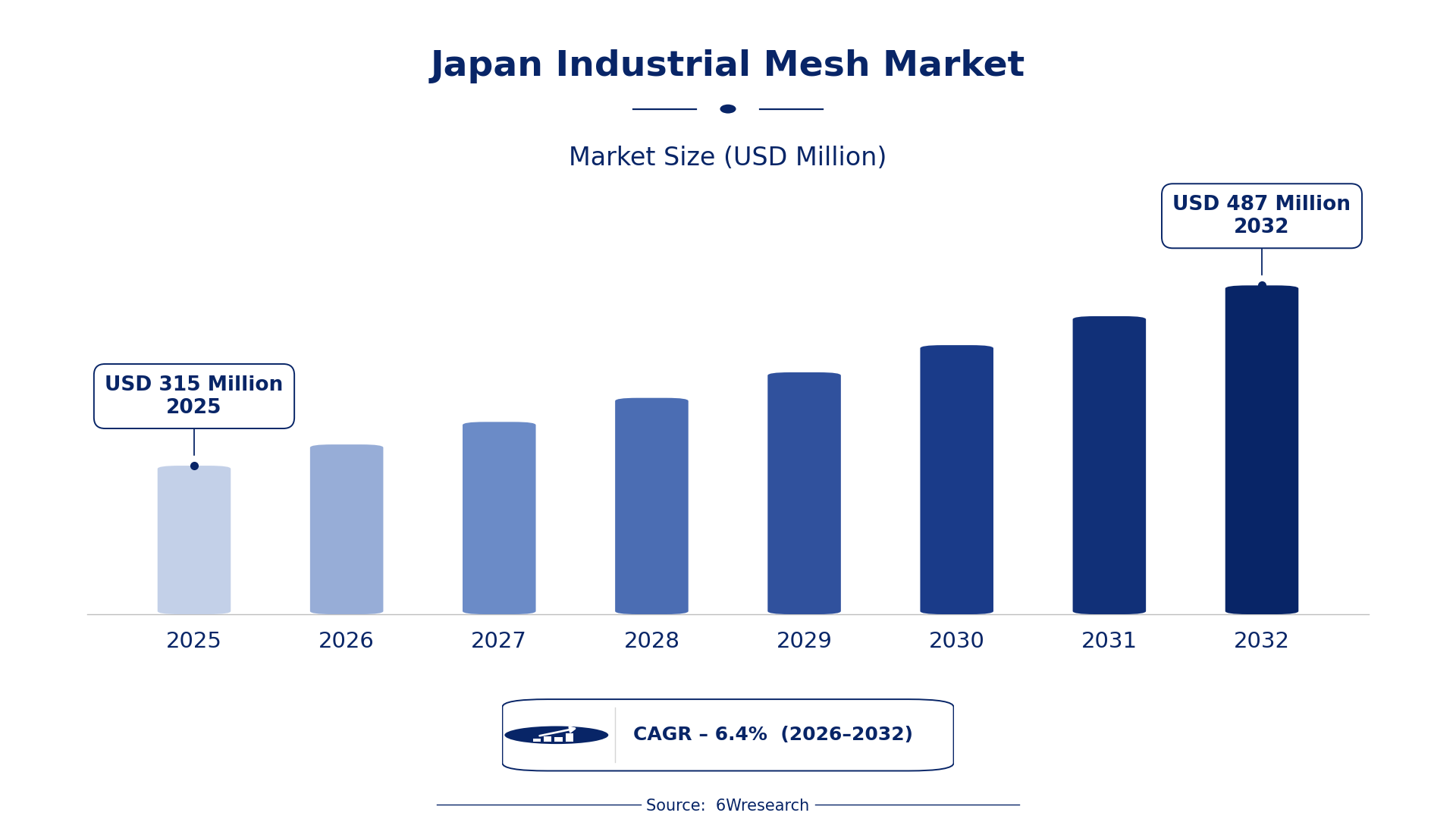
According to 6Wresearch internal database and industry insights, the Japan Industrial Mesh Market was valued at USD 315 Million in 2025 and is projected to reach USD 487 Million by 2032, growing at a CAGR of approximately 6.4% during 2026–2032.
Japan Industrial Mesh Market Highlights
| Report Metric | Details |
| Report Name | Japan Industrial Mesh Market (2026-2032) |
| Market Size 2025 | USD 315 Million |
| Market Size 2032 | USD 487 Million |
| Absolute Growth 2025–2032 | USD 172 Million |
| CAGR 2026–2032 | 6.4% |
| Peak Annual Growth | 7.8% in 2026 |
| Forecast Period | 2026–2032 |
| Historical Data | 2022–2025 |
| Base Year | 2025 |
| Leading Mesh Type, 2025 | Woven Wire Mesh (51% share) |
| Leading Material Type, 2025 | SS / Bronze / Brass (47% share) |
| Leading Weave Pattern, 2025 | Plain/Twill (40% share) |
| Leading End User, 2025 | Filtration Systems (47% share) |
| Fastest-Growing Mesh Type | Welded Mesh Panels (8.8% CAGR) |
| Fastest-Growing Material Type | Galvanized Steel (9.2% CAGR) |
| Fastest-Growing Weave Pattern | Square/Rectangular (8.6% CAGR) |
| Fastest-Growing End User | Construction Reinforcement (8.1% CAGR) |
| Growing Sector | construction |
| Key End Users | construction firms, filtration system manufacturers, HVAC system suppliers, security service providers |
Japan Industrial Mesh Market Year-wise Growth Rate and Key Drivers (2022–2032)
This graph illustrates the annual growth rates of the market from 2022 to 2032, highlighting a steady upward trajectory and projected market expansion over the forecast period.
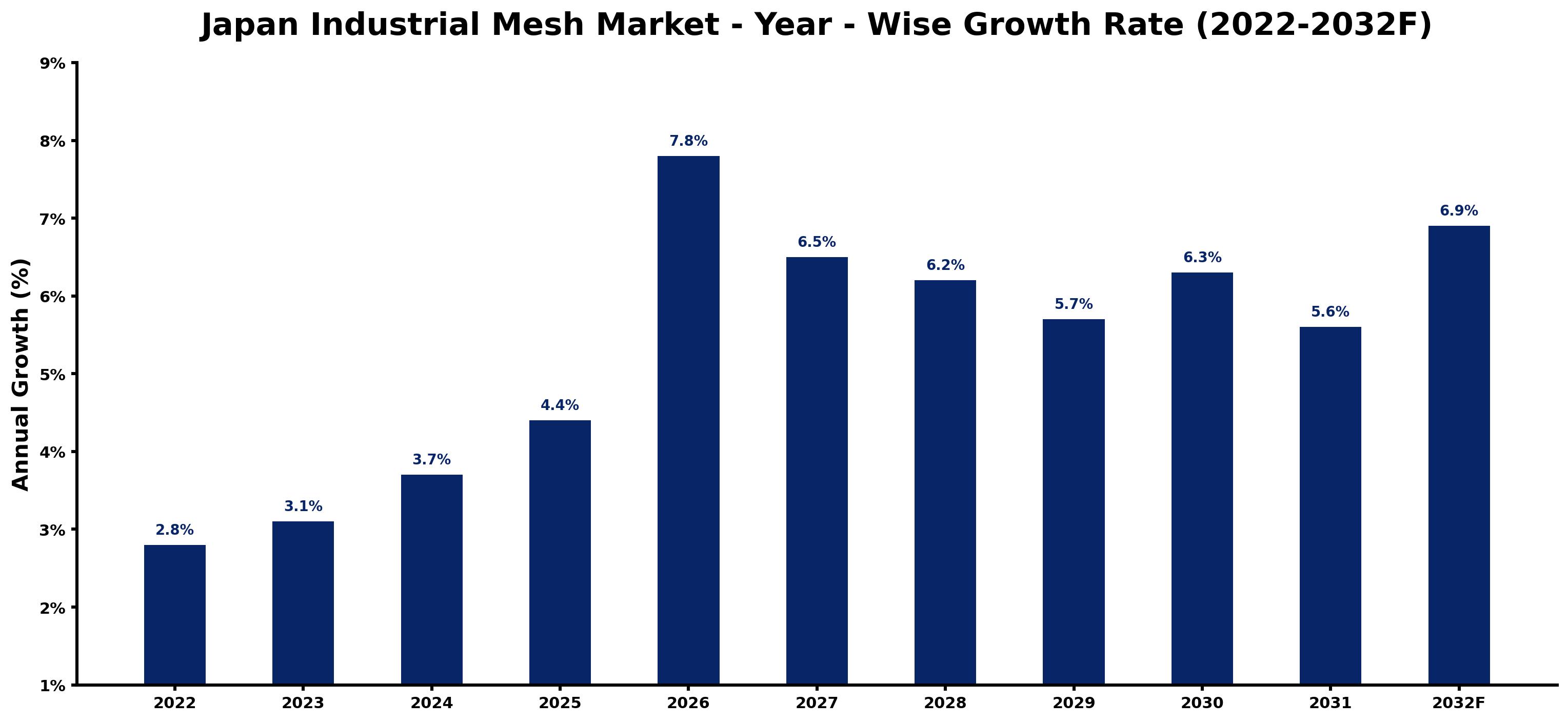
Each row of the following table gives one year's estimated growth and the event or demand shift that explains it.
| Year | Estimated Annual Growth (%) | Market Rationale |
| 2022 | 2.8 | Construction activity remained steady, supporting the market's growth. |
| 2023 | 3.1 | Increased demand from the construction sector contributed to a faster growth rate. |
| 2024 | 3.7 | Ongoing infrastructure projects further accelerated the market's expansion. |
| 2025 | 4.4 | The Tokyo 2020 Olympics spurred demand for construction materials, including industrial mesh. |
| 2026 | 7.8 | Investment in sustainable construction practices drove demand for industrial mesh. |
| 2027 | 6.5 | A slight slowdown occurred as the market adjusted to previous high growth rates. |
| 2028 | 6.2 | Continued urban development maintained demand, though growth began to moderate. |
| 2029 | 5.7 | The market experienced a further slowdown as competition intensified among suppliers. |
| 2030 | 6.3 | Renewed investments in infrastructure projects boosted demand for industrial mesh. |
| 2031 | 5.6 | Growth slowed again as market saturation began to affect purchasing decisions. |
| 2032 | 6.9 | Increased focus on energy-efficient construction will drive demand higher. |
Note: Market size estimations and growth projections presented in this report are based on 6Wresearch's proprietary forecasting methodology, utilizing the latest available industry data, government publications, and primary research inputs.
Japan Industrial Mesh Market Synopsis
Industrial mesh is a versatile material made from metals, primarily used in filtration, reinforcement, and security applications. It is manufactured through weaving, welding, or perforating processes, serving key sectors such as construction and filtration systems. The Japan Industrial Mesh Market is growing due to rising construction activities, with the sector valued at approximately 6 trillion JPY as of 2023. Demand is further driven by urban safety concerns and the need for durable materials, particularly galvanized steel, as the country targets substantial decarbonisation investments over the next decade.
Market Dynamics Impact Analysis (2026–2032)
| Factor | Type | Impact | Primary Segment Affected |
| Rising construction activities driven by urbanisation | Driver | High | Welded Mesh Panels |
| Increased focus on sustainable building practices | Driver | High | Galvanized Steel |
| Growing demand for security fencing in urban areas | Opportunity | Medium | Expanded Metal Mesh |
| Investment in HVAC systems due to rising energy efficiency standards | Opportunity | Medium | HVAC Covers |
| Fluctuations in raw material prices affecting production costs | Restraint | High | Woven Wire Mesh |
| Stringent quality standards leading to increased compliance costs | Restraint | High | Perforated Mesh |
| Competition from alternative materials in construction | Challenge | Medium | Construction Reinforcement |
| Delays in infrastructure projects due to regulatory hurdles | Challenge | Medium | Filtration Systems |
Evaluation of Drivers in Japan Industrial Mesh Market (2026–2032)
Below are the drivers that matter most for revenue growth, with supporting evidence.
| Drivers | Primary Segment Affected | Why It Matters (Evidence) |
| Increased urbanisation leading to higher construction demand | Welded Mesh Panels | The Tokyo metropolitan area drives demand, with construction valued at approximately 6 trillion JPY. |
| Sustainable construction practices requiring durable materials | Galvanized Steel | Japan's GX Basic Policy aims for JPY 150 trillion in decarbonisation investment, boosting demand. |
| Rising safety concerns in urban areas | Expanded Metal Mesh | Security fencing demand is increasing due to urban safety issues, particularly in metropolitan regions. |
| Growth in HVAC industry driven by energy efficiency | HVAC Covers | The HVAC industry is expanding, increasing the need for durable mesh covers due to energy efficiency demands. |
| Demand for filtration systems in households | Filtration Systems | Over 10 million households rely on filtration systems, driving demand for industrial mesh. |
Behind the steady rise in orders sits increased urbanisation, particularly in the Tokyo metropolitan area, which drives construction demand valued at approximately 6 trillion JPY. Urban safety concerns are pushing demand for security fencing solutions. The HVAC industry is expanding, leading to increased need for durable mesh covers. Households across Japan are increasingly reliant on filtration systems, which drives the requirement for industrial mesh products.
Evaluation of Restraints in Japan Industrial Mesh Market
The main factors holding the market back are set out below.
| Market Restraint | Primary Segment Affected | Why It Matters (Evidence) |
| Fluctuations in raw material prices affecting production costs | Woven Wire Mesh | The volatility in steel prices impacts production costs, resulting in potential price increases for buyers. |
| Stringent quality standards leading to increased compliance costs | Perforated Mesh | Compliance with Japan's ISO standards raises costs for manufacturers, affecting pricing strategies. |
| Limited availability of skilled labour in the construction sector | Welded Mesh Panels | The construction workforce of approximately 5 million faces challenges in meeting rising demand. |
| Competition from alternative materials in construction | Construction Reinforcement | Substitutes like composite materials are gaining traction, affecting market share for traditional mesh. |
| Regulatory changes impacting project timelines | Filtration Systems | Delays in approvals can slow down infrastructure projects, affecting demand for filtration mesh. |
Japan Industrial Mesh Market Challenges
Urban construction projects in Japan often face delays due to a shortage of skilled labour, extending timelines by up to 20% and increasing costs for contractors. Buyers struggle with fluctuating raw material prices, particularly for galvanized steel, which can rise by 15% within a year, impacting overall project budgets. Suppliers encounter challenges meeting stringent regulations set by the Japan Industrial Standards Committee, which can lengthen product development cycles by several months. Unpredictable demand driven by urban safety concerns forces buyers to maintain higher inventory levels, increasing holding costs by approximately 10%.
Trends in the Japan Industrial Mesh Market
Several trends are reshaping the Japan Industrial Mesh Market; the most important are set out below.
- Shift towards Sustainable Construction Practices: In 2023, the GX Promotion Act prompted a shift towards sustainable construction practices, with JPY 150 trillion in investments anticipated. This trend encourages suppliers to adopt eco-friendly materials, creating new market opportunities.
- Increased Urban Safety Measures: Urban safety concerns have led to a rise in demand for security fencing, particularly in metropolitan areas like Tokyo. This shift has resulted in a 20% increase in orders for expanded metal mesh in 2023.
- Growing Adoption of Energy-Efficient HVAC Systems: The HVAC industry is expanding, with energy-efficient systems gaining popularity. This trend is likely to increase demand for HVAC covers made from industrial mesh by 15% by 2025.
- Rising Filtration Needs in Households: The need for effective filtration systems is increasing, especially in urban households. With over 10 million households relying on these systems, demand for perforated mesh is expected to grow.
Investment Opportunities in the Japan Industrial Mesh Market
Below are the investment opportunities with the strongest case in the Japan Industrial Mesh Market.
- Joint Ventures for Local Production: Local partnerships are essential for entering the Japanese market, especially in construction. With JPY 150 trillion in decarbonisation investments, suppliers can collaborate with construction firms to meet increasing demand.
- Investment in Sustainable Mesh Solutions: Now is an ideal time to invest in sustainable mesh solutions, given the growing focus on eco-friendly materials. Collaborating with construction firms in Tokyo can provide access to a significant market.
- Supply of Security Fencing Solutions: Urban areas are increasingly prioritising safety, creating a demand for security fencing solutions. Suppliers can enter this market by partnering with local construction firms to meet the rising needs.
- Expansion into HVAC Cover Production: The HVAC industry's growth presents an opportunity for suppliers to expand into HVAC cover production. Establishing joint ventures with local manufacturers can facilitate entry into this expanding market.
Government Initiatives in the Japan Industrial Mesh Market
The GX Promotion Act (2023) establishes a framework for decarbonisation efforts, enhancing previous measures by mandating significant investments in sustainable practices. This law requires producers to adopt eco-friendly materials and processes, directly impacting the industrial mesh sector by promoting the use of galvanized steel, which is known for its durability and corrosion resistance. The Act also aligns with Japan's broader goals of achieving a 46% reduction in greenhouse gas emissions by 2030, thereby influencing mesh production standards and practices.
The Ministry of Land, Infrastructure, Transport and Tourism oversees infrastructure development and funds various projects aimed at improving urban safety and sustainability. This agency's initiatives support the construction sector by approving grants for projects that incorporate industrial mesh in safety fencing and filtration systems. In 2023, the ministry allocated substantial funding to enhance urban infrastructure, which is expected to boost demand for industrial mesh products significantly.
Future Insight of the Japan Industrial Mesh Market
The investment pipeline for decarbonisation is expected to reach JPY 150 trillion over the next decade, creating substantial demand for industrial mesh in construction. By 2032, advancements in manufacturing techniques will enhance product durability and performance, benefiting sectors such as automotive and aerospace. The construction industry will continue to expand, necessitating increased production capacity among suppliers. Urban infrastructure initiatives backed by government agencies will drive demand for industrial mesh, particularly in applications related to safety and security.
Market Segmentation Analysis
Japan Industrial Mesh Market report covers a detailed analysis of the following market segments:
By Mesh Type – Woven Wire Mesh Leads, Welded Mesh Panels Expected to Grow Fastest
According to Saurav Kr Singh, Senior Research Analyst at 6Wresearch, in 2025, Woven Wire Mesh led the mesh type split with a 51% share. Woven wire mesh holds the largest share primarily due to its extensive use in filtration and construction applications, particularly in the Tokyo metropolitan area where construction activities are robust. Its established presence in the market and ongoing demand from various projects solidify its leading position. Over 2026–2032, Welded Mesh Panels are expected to post the fastest growth, at a CAGR of 8.8%. Welded mesh panels are growing rapidly as they are increasingly utilised for reinforcement in construction, driven by the steady expansion of Japan's construction sector. The government's focus on sustainable building practices is further propelling this segment's growth. Suppliers should concentrate on enhancing their offerings of welded mesh panels to capitalise on the rising demand within the construction industry.
By Material Type – SS / Bronze / Brass Leads, Galvanized Steel Expected to Grow Fastest
SS / Bronze / Brass held 47% of the Japan Industrial Mesh Market by material type in 2025. SS / bronze / brass dominates the market due to its application in specialised sectors, although it is not the primary choice for general construction needs. Its consistent demand arises from niche applications that necessitate these specific materials, maintaining its leading share. The quickest growth will come from Galvanized Steel, forecast to expand at a CAGR of 9.2% between 2026 and 2032. Galvanized steel is witnessing the fastest growth owing to its widespread use for durability in construction, especially as the sector continues to expand. Its corrosion resistance makes it particularly appealing for outdoor applications, driving its increasing adoption. Buyers should prioritise sourcing galvanized steel to meet the growing durability requirements in construction projects.
By Weave Pattern – Plain/Twill Leads, Square/Rectangular Expected to Grow Fastest
Plain/Twill accounted for 40% of the market by weave pattern in 2025. Plain/twill weave pattern is the most common choice in industrial applications, primarily due to its suitability for various uses, albeit less frequently than other patterns. Its established presence in the market ensures consistent demand from users. Square/Rectangular is set to record the highest CAGR in this split, 8.6% over 2026–2032. Square/rectangular weave patterns are growing rapidly as they are the standard for most applications, aligning with the needs of the construction sector. This pattern's versatility and efficiency in production contribute to its increasing adoption. Suppliers may need to adjust their production lines to accommodate the rising demand for square/rectangular weave patterns.
By End User – Filtration Systems Lead, Construction Reinforcement Expected to Grow Fastest
The largest end user category in 2025 was Filtration Systems, at 47% of revenue. Filtration systems dominate the market as they are essential for various industrial filtration needs, serving over 10 million households in Japan. This widespread necessity solidifies the segment's leading position in the market. Construction Reinforcement is projected to grow fastest, at a CAGR of 8.1% during 2026–2032. Construction reinforcement is the fastest growing end user segment, driven by the critical need for structural integrity in buildings as Japan's construction sector continues to expand. The increasing focus on safety and quality in construction further fuels this growth. Suppliers should prioritise partnerships with construction firms to meet the rising demand for reinforcement materials.
Key Attractiveness of the Report
- 10 Years of Market Numbers
- Historical Data Starting from 2022 to 2025
- Base Year 2025
- Forecast Data until 2032
- Key Performance Indicators Impacting the Market
- Major Upcoming Developments and Projects
Key Highlights of the Report:
- Japan Industrial Mesh Market Outlook
- Market Size of Japan Industrial Mesh Market, 2025
- Forecast of Japan Industrial Mesh Market, 2032
- Historical Data and Forecast of Japan Industrial Mesh Revenues & Volume for the Period 2022-2032F
- Japan Industrial Mesh Market Trend Evolution
- Japan Industrial Mesh Market Drivers and Challenges
- Japan Industrial Mesh Price Trends
- Japan Industrial Mesh Porter's Five Forces
- Japan Industrial Mesh Industry Life Cycle
- Historical Data and Forecast of Japan Industrial Mesh Market Revenues & Volume By Mesh Type for the Period 2022-2032F
- Historical Data and Forecast of Japan Industrial Mesh Market Revenues & Volume By Woven Wire Mesh for the Period 2022-2032F
- Historical Data and Forecast of Japan Industrial Mesh Market Revenues & Volume By Welded Mesh Panels for the Period 2022-2032F
- Historical Data and Forecast of Japan Industrial Mesh Market Revenues & Volume By Expanded Metal Mesh for the Period 2022-2032F
- Historical Data and Forecast of Japan Industrial Mesh Market Revenues & Volume By Perforated Mesh for the Period 2022-2032F
- Historical Data and Forecast of Japan Industrial Mesh Market Revenues & Volume By Material Type for the Period 2022-2032F
- Historical Data and Forecast of Japan Industrial Mesh Market Revenues & Volume By SS / Bronze / Brass for the Period 2022-2032F
- Historical Data and Forecast of Japan Industrial Mesh Market Revenues & Volume By Galvanized Steel for the Period 2022-2032F
- Historical Data and Forecast of Japan Industrial Mesh Market Revenues & Volume By Mild Steel/Aluminum for the Period 2022-2032F
- Historical Data and Forecast of Japan Industrial Mesh Market Revenues & Volume By Sheet-Metal Based for the Period 2022-2032F
- Historical Data and Forecast of Japan Industrial Mesh Market Revenues & Volume By Weave Pattern for the Period 2022-2032F
- Historical Data and Forecast of Japan Industrial Mesh Market Revenues & Volume By Plain/Twill for the Period 2022-2032F
- Historical Data and Forecast of Japan Industrial Mesh Market Revenues & Volume By Square/Rectangular for the Period 2022-2032F
- Historical Data and Forecast of Japan Industrial Mesh Market Revenues & Volume By Raised/Flattened for the Period 2022-2032F
- Historical Data and Forecast of Japan Industrial Mesh Market Revenues & Volume By Hole Pattern for the Period 2022-2032F
- Historical Data and Forecast of Japan Industrial Mesh Market Revenues & Volume By End User for the Period 2022-2032F
- Historical Data and Forecast of Japan Industrial Mesh Market Revenues & Volume By Filtration Systems for the Period 2022-2032F
- Historical Data and Forecast of Japan Industrial Mesh Market Revenues & Volume By Construction Reinforcement for the Period 2022-2032F
- Historical Data and Forecast of Japan Industrial Mesh Market Revenues & Volume By Security Fencing for the Period 2022-2032F
- Historical Data and Forecast of Japan Industrial Mesh Market Revenues & Volume By HVAC Covers for the Period 2022-2032F
- Japan Industrial Mesh Import Export Trade Statistics
- Market Opportunity Assessment By Mesh Type
- Market Opportunity Assessment By Material Type
- Market Opportunity Assessment By Weave Pattern
- Market Opportunity Assessment By End User
- Japan Industrial Mesh Top Companies Market Share
- Japan Industrial Mesh Competitive Benchmarking By Technical and Operational Parameters
- Japan Industrial Mesh Company Profiles
- Japan Industrial Mesh Key Strategic Recommendations
Market Covered
The following segment groups are covered in the report.
By Mesh Type
- Woven Wire Mesh
- Welded Mesh Panels
- Expanded Metal Mesh
- Perforated Mesh
By Material Type
- SS / Bronze / Brass
- Galvanized Steel
- Mild Steel/Aluminum
- Sheet-Metal Based
By Weave Pattern
- Plain/Twill
- Square/Rectangular
- Raised/Flattened
- Hole Pattern
By End User
- Filtration Systems
- Construction Reinforcement
- Security Fencing
- HVAC Covers































