Japan Industrial Metal Materials Market Size & Growth Rate
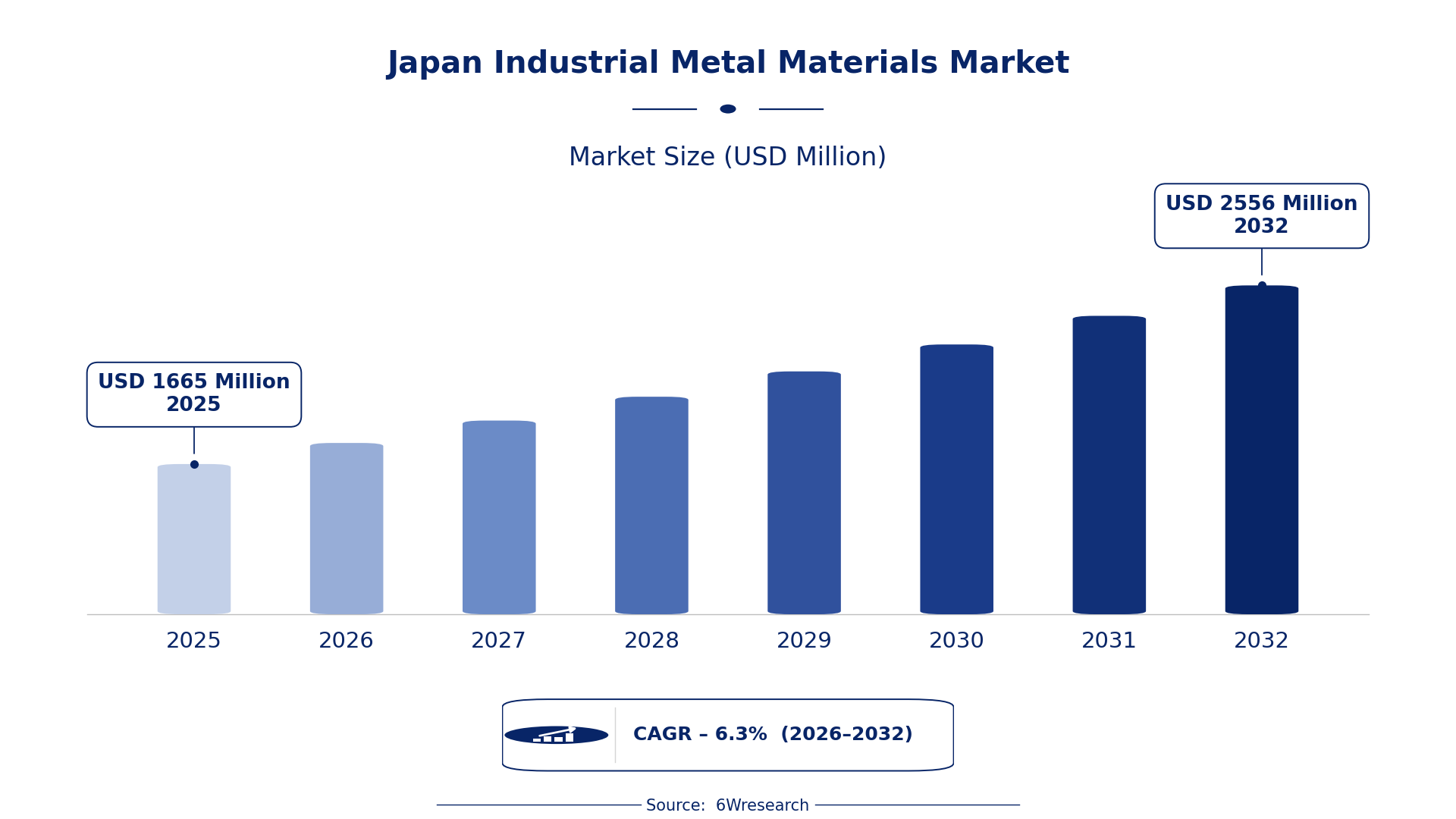
According to 6Wresearch internal database and industry insights, the Japan Industrial Metal Materials Market was valued at USD 1,665 Million in 2025 and is projected to reach USD 2,556 Million by 2032, growing at a CAGR of approximately 6.3% during 2026–2032.
Japan Industrial Metal Materials Market Highlights
| Report Metric | Details |
| Report Name | Japan Industrial Metal Materials Market (2026-2032) |
| Market Size 2025 | USD 1,665 Million |
| Market Size 2032 | USD 2,556 Million |
| Absolute Growth 2025–2032 | USD 891 Million |
| CAGR 2026–2032 | 6.3% |
| Peak Annual Growth | 7.3% in 2030 |
| Forecast Period | 2026–2032 |
| Historical Data | 2022–2025 |
| Base Year | 2025 |
| Leading Material Type, 2025 | Ferrous Metals (42% share) |
| Leading Form Factor, 2025 | Sheets & Rolls (40% share) |
| Leading Application, 2025 | Electronics Manufacturing (53% share) |
| Leading Distribution Channel, 2025 | Direct Sales (38% share) |
| Leading End Use Industry, 2025 | Automotive (45% share) |
| Fastest-Growing Material Type | Non-Ferrous Metals (9.2% CAGR) |
| Fastest-Growing Form Factor | Powder (8.9% CAGR) |
| Fastest-Growing Distribution Channel | Online Platforms (8.4% CAGR) |
| Fastest-Growing End Use Industry | Semiconductor and Electronics (9.1% CAGR) |
| Growing Sector | Aerospace and Defense |
| Key End Users | Automotive, Aerospace, Electronics, Heavy Industry |
Japan Industrial Metal Materials Market Year-wise Growth Rate and Key Drivers (2022–2032)
This graph illustrates the annual growth rates of the market from 2022 to 2032, highlighting a steady upward trajectory and projected market expansion over the forecast period.
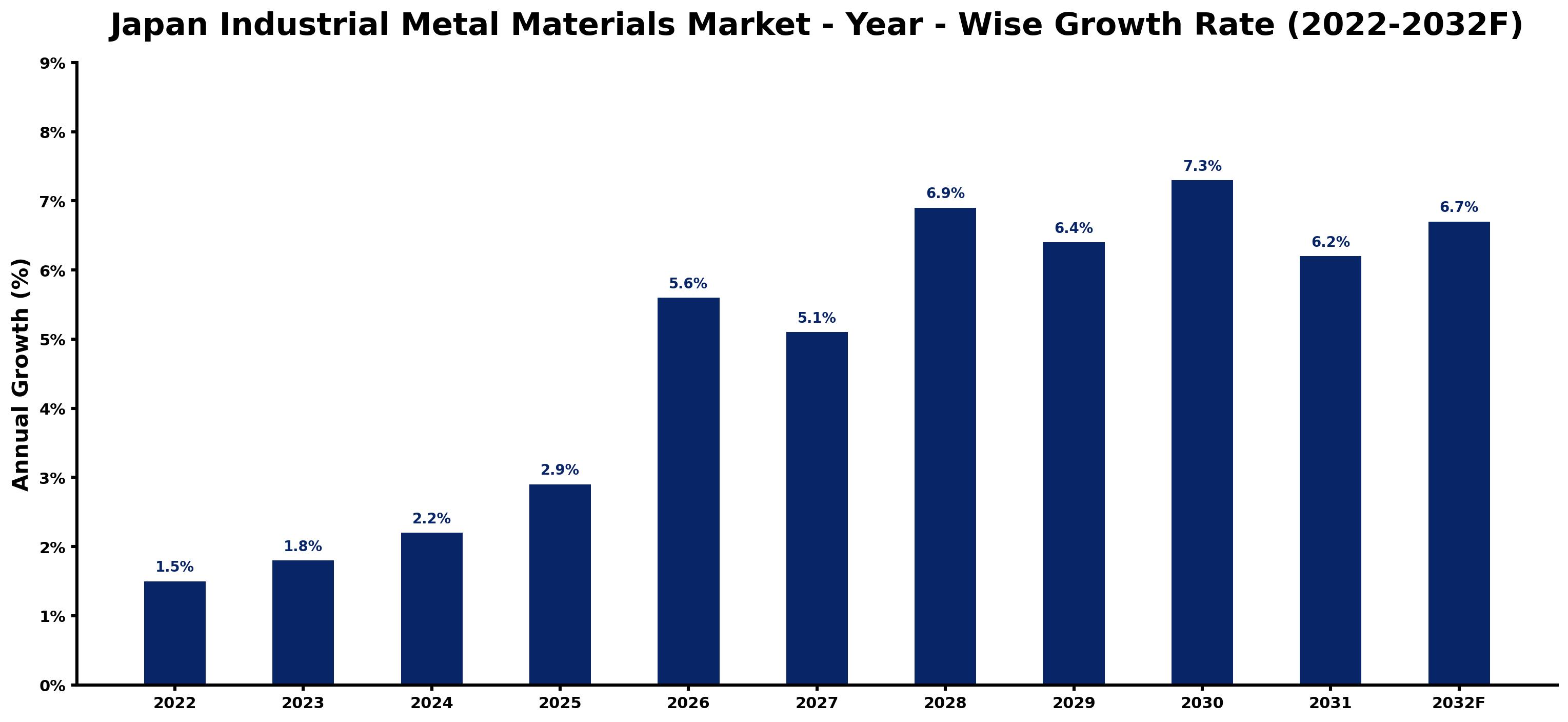
Below, each year's estimated growth is shown next to the factor that most influenced it.
| Year | Estimated Annual Growth (%) | Market Rationale |
| 2022 | 1.5 | The market showed stable demand from domestic users and downstream processing. |
| 2023 | 1.8 | Growth accelerated due to increased production in the automotive sector. |
| 2024 | 2.2 | Demand rose as manufacturers adopted advanced technologies in production. |
| 2025 | 2.9 | The automotive industry expanded, employing over 5 million people. |
| 2026 | 5.6 | Investment in decarbonisation initiatives is expected to boost material demand. |
| 2027 | 5.1 | Growth is projected to slow slightly as the market adjusts to new regulations. |
| 2028 | 6.9 | Rising aerospace sector demand is expected to contribute to a faster growth rate. |
| 2029 | 6.4 | The electronics sector's expansion will lead to a moderate slowdown in growth. |
| 2030 | 7.3 | Peak growth is projected as Japan targets substantial decarbonisation investments. |
| 2031 | 6.2 | Market growth is expected to slow as demand stabilises after peak levels. |
| 2032 | 6.7 | Continued investments in technology will sustain growth. |
Note: Market size estimations and growth projections presented in this report are based on 6Wresearch's proprietary forecasting methodology, utilizing the latest available industry data, government publications, and primary research inputs.
Japan Industrial Metal Materials Market Synopsis
Industrial metal materials encompass ferrous, non-ferrous, precious metals, and specialty alloys, produced through processes like smelting and refining. Demand from the automotive, aerospace, and electronics sectors primarily drives the Japan Industrial Metal Materials Market, with the automotive industry employing over 5 million people. Japan's commitment to a 46% reduction in greenhouse gas emissions by 2030 is spurring investments in decarbonisation, which is increasing demand for these materials. The anticipated JPY 150 trillion investment over the next decade will further stimulate growth across various sectors.
Market Dynamics Impact Analysis (2026–2032)
| Factor | Type | Impact | Primary Segment Affected |
| Growing demand from the automotive sector | Driver | High | Ferrous Metals |
| Increased investment in decarbonisation initiatives | Driver | High | Non-Ferrous Metals |
| Expansion of the aerospace sector | Opportunity | High | Specialty Alloys |
| Rising electronics manufacturing needs | Opportunity | High | Electronics Manufacturing |
| Regulatory compliance costs for producers | Restraint | Medium | Alloy Production |
| Supply chain disruptions affecting material availability | Restraint | Medium | Heavy Industry |
| High production costs due to energy prices | Challenge | High | Ferrous Metals |
| Skilled labour shortages in manufacturing | Challenge | Medium | Non-Ferrous Metals |
Evaluation of Drivers in Japan Industrial Metal Materials Market (2026–2032)
The factors lifting demand, and the evidence behind each, are summarised below.
| Drivers | Primary Segment Affected | Why It Matters (Evidence) |
| Investment in advanced manufacturing technologies | Electronics Manufacturing | This investment is projected to increase efficiency, resulting in higher purchases of metal materials. |
| Growth in automotive production | Ferrous Metals | The automotive sector's expansion is driving demand for steel and other ferrous materials. |
| Rising aerospace sector requirements | Specialty Alloys | Increased production in aerospace is necessitating high-performance alloys, boosting demand. |
| Decarbonisation initiatives driving material innovation | Non-Ferrous Metals | Investment in green technologies is increasing the need for non-ferrous metals in manufacturing. |
| Expansion in electronics manufacturing | Electronics Manufacturing | Growing demand for electronic devices is resulting in higher consumption of metal materials. |
Spending rises because investment in advanced manufacturing technologies is increasing efficiency in the electronics sector, projected to hold a 53% share in 2025. Growth in automotive production drives demand for ferrous metals, with the sector employing over 5 million people. Rising aerospace sector requirements boost the need for specialty alloys, critical for performance in aircraft. Investment in decarbonisation is driving innovation in non-ferrous metals, increasing their application in green technologies. The expansion in electronics manufacturing leads to higher consumption of metal materials, further supporting growth across various regions.
Evaluation of Restraints in Japan Industrial Metal Materials Market
Several factors work against faster growth; the main ones are summarised below.
| Market Restraint | Primary Segment Affected | Why It Matters (Evidence) |
| High compliance costs due to regulatory requirements | Alloy Production | Producers face increased costs for meeting standards, impacting pricing strategies. |
| Supply chain disruptions affecting material availability | Heavy Industry | Disruptions lead to delays in production schedules and increased operational costs. |
| Rising energy prices impacting production costs | Ferrous Metals | Higher energy costs squeeze margins for manufacturers, affecting pricing. |
| Skilled labour shortages in manufacturing | Non-Ferrous Metals | Shortages hinder production capacity, delaying project timelines and increasing costs. |
| Market volatility due to global economic conditions | Electronics Manufacturing | Economic fluctuations create uncertainty, impacting investment decisions and demand. |
Japan Industrial Metal Materials Market Challenges
High production costs have risen by 15% due to energy prices, straining profit margins for producers. Rapid technological advancements in metal processing create a skills gap, delaying innovation and reducing competitiveness for suppliers. A shortage of skilled workers in the industry, particularly in the automotive sector employing over 5 million people, hampers productivity and increases project timelines. Supply chain disruptions from global events have raised lead times for buyers, forcing them to hold excess inventory and incur additional costs, estimated at 10% of their operational budgets.
Trends in the Japan Industrial Metal Materials Market
Four trends stand out in the Japan Industrial Metal Materials Market.
- Shift towards Sustainable Manufacturing Practices: Japan's metal manufacturers are increasingly adopting sustainable practices, with the Green Growth Strategy aiming for a JPY 150 trillion investment in decarbonisation by 2030.
- Increased Automation in Metal Processing: Automation is transforming production efficiency in the electronics manufacturing sector. This trend is particularly visible in Tokyo, where advanced technologies are integrated into metal processing facilities, significantly enhancing output.
- Growing Demand for Recycled Metals: The push for sustainability has led to a rise in recycled metal usage, especially in the automotive sector. In 2023, a new program was launched to improve metal recycling efforts, targeting increased recovery rates.
- Expansion of Online Sales Channels: The distribution of industrial metal materials is shifting towards online platforms, with a projected growth of 8.4% in this channel. This trend is particularly strong in urban areas, allowing suppliers to reach wider markets.
Investment Opportunities in the Japan Industrial Metal Materials Market
Where to invest in the Japan Industrial Metal Materials Market: the main openings are set out below.
- Supply of Specialty Alloys for Aerospace: The aerospace sector is expanding, creating a demand for specialty alloys. Investment in production facilities in Aichi is projected to cater to this need, increasing local supply capabilities.
- Provision of Recycled Metal Solutions: With rising sustainability concerns, there is a growing market for recycled metals. The automotive industry in Tokyo is seeking suppliers who can provide certified recycled materials, improving their green credentials.
- Development of Advanced Metal Processing Technologies: Investment in advanced processing technologies is essential to meet evolving industry standards. Collaborating with local manufacturers in Osaka can facilitate market entry and improve production efficiency.
- Expansion of Online Sales Platforms for Industrial Metals: The shift to online sales channels presents opportunities for suppliers. Establishing partnerships with industrial suppliers in major cities can enhance market reach and improve distribution efficiency.
Government Initiatives in the Japan Industrial Metal Materials Market
The Economic Security Promotion Act of 2022 supports supply-chain resilience for critical products, including industrial metal materials. This law mandates that producers ensure reliable supply chains, stabilising the market. Additionally, the PRTR Law requires businesses to report chemical substance releases, promoting environmental responsibility within the industry. The Chemical Substances Control Law mandates evaluation and control of new chemical substances, ensuring safety and compliance in production processes.
The Ministry of Economy, Trade and Industry oversees regulations affecting industrial metal materials. It funds initiatives aimed at improving supply chain resilience and approving projects that align with sustainability goals, ensuring compliance with environmental standards. In 2023, the ministry approved several projects aimed at improving recycling capabilities in the metal sector.
Future Insight of the Japan Industrial Metal Materials Market
A new recycling programme will improve metal recovery facilities, enhancing efficiency for producers. By 2032, advancements in recycling technologies will boost recovery rates, minimising waste for suppliers. The aerospace sector is expected to expand at 3% annually, driving interest in non-ferrous metals. Public and private investments of JPY 150 trillion will stimulate innovation, creating opportunities for buyers and suppliers alike.
Market Segmentation Analysis
Japan Industrial Metal Materials Market report covers a detailed analysis of the following market segments:
By Material Type – Ferrous Metals Lead, Non-Ferrous Metals Expected to Grow Fastest
According to Saurav Kr Singh, Senior Research Analyst at 6Wresearch, with 42% of material type revenue in 2025, Ferrous Metals was the largest category. Ferrous metals hold a substantial share due to their essential applications in construction and manufacturing, which are foundational to Japan's economy. The heavy industry, accounting for about 20% of Japan's GDP, heavily utilises ferrous materials for various infrastructure projects. Non-Ferrous Metals are set to record the highest CAGR in this split, 9.2% over 2026–2032. The rapid growth of non-ferrous metals is primarily due to their critical role in the electronics and automotive sectors, both of which are experiencing robust expansion. For instance, the electronics sector's increasing reliance on non-ferrous materials is vital for keeping pace with technological advancements. Suppliers should enhance their offerings in non-ferrous metals to meet the rising demand from the electronics and automotive sectors.
By Form Factor – Sheets & Rolls Lead, Powder Expected to Grow Fastest
Sheets & Rolls accounted for 40% of the market by form factor in 2025. Sheets and rolls dominate the market as they are extensively utilised in the automotive and construction industries, which are pivotal to Japan's industrial metal framework. Their versatility makes them a preferred choice for a variety of applications across these sectors. Powder is projected to grow fastest, at a CAGR of 8.9% during 2026–2032. The powder form is witnessing rapid growth due to its application in specialised areas like 3D printing, which is gaining traction in Japan's manufacturing landscape. This trend is expected to continue as industries increasingly adopt advanced production techniques. Buyers may seek suppliers who can provide powder materials to stay competitive in specialised manufacturing applications.
By Application – Electronics Manufacturing Leads and Records the Fastest Growth
Electronics Manufacturing held 53% of the Japan Industrial Metal Materials Market by application in 2025. Electronics manufacturing leads the market as it is crucial for producing electronic components, a sector that plays a vital role in Japan's technological ecosystem. The sustained demand for electronics ensures that this application remains at the forefront of the market. Electronics Manufacturing is also forecast to expand faster than any other category, at a CAGR of 8.6% over 2026–2032. Electronics manufacturing is also the fastest-growing application, benefiting from ongoing technological advancements and increased production of electronic devices. The interplay between demand and innovation in this sector is likely to sustain its growth trajectory. Suppliers must align their strategies to support the needs of the electronics manufacturing sector to remain competitive.
By Distribution Channel – Direct Sales Leads, Online Platforms Expected to Grow Fastest
Direct Sales took 38% of distribution channel revenue in 2025, more than any other category. Direct sales are the predominant distribution method in the industrial metal market, enabling straightforward transactions between manufacturers and end-users. This approach is favoured for its efficiency in managing large orders and building strong buyer-supplier relationships. The quickest growth will come from Online Platforms, forecast to expand at a CAGR of 8.4% between 2026 and 2032. Online platforms are emerging as the fastest-growing channel, driven by the convenience they provide for purchasing materials. The shift towards digital transactions is transforming how buyers interact with suppliers in the industrial sector. Suppliers should invest in online platforms to expand their customer reach and adapt to evolving purchasing behaviours.
By End Use Industry – Automotive Leads, Semiconductor and Electronics Expected to Grow Fastest
The largest end use industry category in 2025 was Automotive, at 45% of revenue. The automotive industry is the largest consumer of industrial metals, employing over 5 million people and generating substantial demand for materials. This significant workforce and the industry's contribution to Japan's economy reinforce its leading position. Semiconductor and Electronics is set to record the highest CAGR in this split, 9.1% over 2026–2032. The semiconductor and electronics sector is the fastest-growing end-use industry, reflecting the increasing demand for advanced electronic devices across various applications. As technology continues to progress, this sector's need for industrial metals is expected to rise. Suppliers should focus on building relationships with the semiconductor and electronics sector to seize emerging opportunities in this rapidly expanding market.
Key Attractiveness of the Report
- 10 Years of Market Numbers
- Historical Data Starting from 2022 to 2025
- Base Year 2025
- Forecast Data until 2032
- Key Performance Indicators Impacting the Market
- Major Upcoming Developments and Projects
Key Highlights of the Report:
- Japan Industrial Metal Materials Market Outlook
- Market Size of Japan Industrial Metal Materials Market, 2025
- Forecast of Japan Industrial Metal Materials Market, 2032
- Historical Data and Forecast of Japan Industrial Metal Materials Revenues & Volume for the Period 2022-2032F
- Japan Industrial Metal Materials Market Trend Evolution
- Japan Industrial Metal Materials Market Drivers and Challenges
- Japan Industrial Metal Materials Price Trends
- Japan Industrial Metal Materials Porter's Five Forces
- Japan Industrial Metal Materials Industry Life Cycle
- Historical Data and Forecast of Japan Industrial Metal Materials Market Revenues & Volume By Material Type for the Period 2022-2032F
- Historical Data and Forecast of Japan Industrial Metal Materials Market Revenues & Volume By Ferrous Metals for the Period 2022-2032F
- Historical Data and Forecast of Japan Industrial Metal Materials Market Revenues & Volume By Non-Ferrous Metals for the Period 2022-2032F
- Historical Data and Forecast of Japan Industrial Metal Materials Market Revenues & Volume By Precious Metals for the Period 2022-2032F
- Historical Data and Forecast of Japan Industrial Metal Materials Market Revenues & Volume By Specialty Alloys for the Period 2022-2032F
- Historical Data and Forecast of Japan Industrial Metal Materials Market Revenues & Volume By Form Factor for the Period 2022-2032F
- Historical Data and Forecast of Japan Industrial Metal Materials Market Revenues & Volume By Powder for the Period 2022-2032F
- Historical Data and Forecast of Japan Industrial Metal Materials Market Revenues & Volume By Slabs for the Period 2022-2032F
- Historical Data and Forecast of Japan Industrial Metal Materials Market Revenues & Volume By Ingots for the Period 2022-2032F
- Historical Data and Forecast of Japan Industrial Metal Materials Market Revenues & Volume By Sheets & Rolls for the Period 2022-2032F
- Historical Data and Forecast of Japan Industrial Metal Materials Market Revenues & Volume By Application for the Period 2022-2032F
- Historical Data and Forecast of Japan Industrial Metal Materials Market Revenues & Volume By Alloy Production for the Period 2022-2032F
- Historical Data and Forecast of Japan Industrial Metal Materials Market Revenues & Volume By Casting & Forging for the Period 2022-2032F
- Historical Data and Forecast of Japan Industrial Metal Materials Market Revenues & Volume By Electronics Manufacturing for the Period 2022-2032F
- Historical Data and Forecast of Japan Industrial Metal Materials Market Revenues & Volume By Structural Fabrication for the Period 2022-2032F
- Historical Data and Forecast of Japan Industrial Metal Materials Market Revenues & Volume By Distribution Channel for the Period 2022-2032F
- Historical Data and Forecast of Japan Industrial Metal Materials Market Revenues & Volume By Direct Sales for the Period 2022-2032F
- Historical Data and Forecast of Japan Industrial Metal Materials Market Revenues & Volume By Distributors for the Period 2022-2032F
- Historical Data and Forecast of Japan Industrial Metal Materials Market Revenues & Volume By Industrial Suppliers for the Period 2022-2032F
- Historical Data and Forecast of Japan Industrial Metal Materials Market Revenues & Volume By Online Platforms for the Period 2022-2032F
- Historical Data and Forecast of Japan Industrial Metal Materials Market Revenues & Volume By End Use Industry for the Period 2022-2032F
- Historical Data and Forecast of Japan Industrial Metal Materials Market Revenues & Volume By Automotive for the Period 2022-2032F
- Historical Data and Forecast of Japan Industrial Metal Materials Market Revenues & Volume By Aerospace and Defense for the Period 2022-2032F
- Historical Data and Forecast of Japan Industrial Metal Materials Market Revenues & Volume By Semiconductor and Electronics for the Period 2022-2032F
- Historical Data and Forecast of Japan Industrial Metal Materials Market Revenues & Volume By Heavy Industry for the Period 2022-2032F
- Japan Industrial Metal Materials Import Export Trade Statistics
- Market Opportunity Assessment By Material Type
- Market Opportunity Assessment By Form Factor
- Market Opportunity Assessment By Application
- Market Opportunity Assessment By Distribution Channel
- Market Opportunity Assessment By End Use Industry
- Japan Industrial Metal Materials Top Companies Market Share
- Japan Industrial Metal Materials Competitive Benchmarking By Technical and Operational Parameters
- Japan Industrial Metal Materials Company Profiles
- Japan Industrial Metal Materials Key Strategic Recommendations
Market Covered
The following segment groups are covered in the report.
By Material Type
- Ferrous Metals
- Non-Ferrous Metals
- Precious Metals
- Specialty Alloys
By Form Factor
- Powder
- Slabs
- Ingots
- Sheets & Rolls
By Application
- Alloy Production
- Casting & Forging
- Electronics Manufacturing
- Structural Fabrication
By Distribution Channel
- Direct Sales
- Distributors
- Industrial Suppliers
- Online Platforms
By End Use Industry
- Automotive
- Aerospace and Defense
- Semiconductor and Electronics
- Heavy Industry































