Japan Industrial Monomers Market Size & Growth Rate
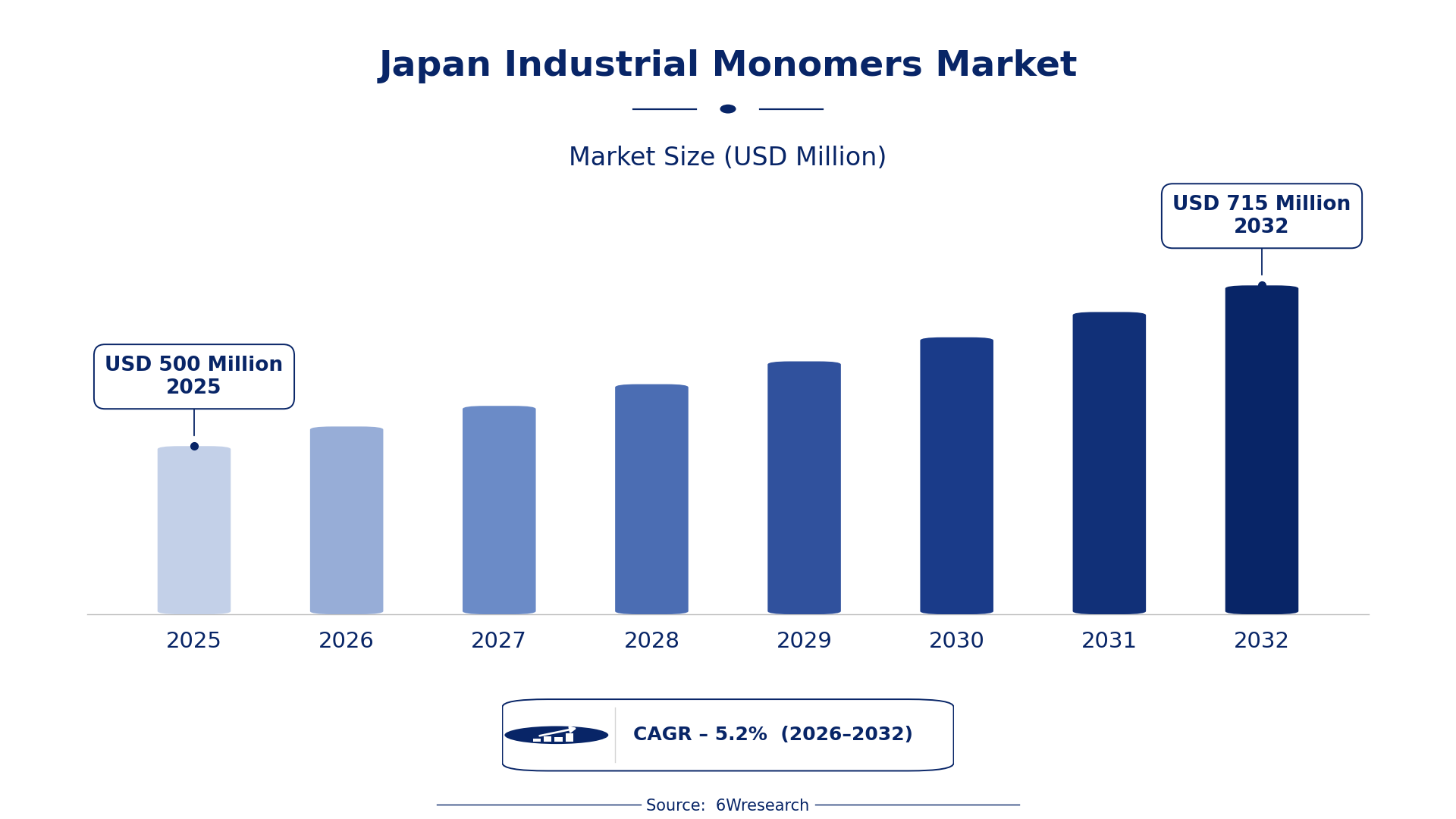
According to 6Wresearch internal database and industry insights, the Japan Industrial Monomers Market was valued at USD 500 Million in 2025 and is projected to reach USD 715 Million by 2032, growing at a CAGR of approximately 5.2% during 2026–2032.
Japan Industrial Monomers Market Highlights
| Report Metric | Details |
| Report Name | Japan Industrial Monomers Market (2026-2032) |
| Market Size 2025 | USD 500 Million |
| Market Size 2032 | USD 715 Million |
| Absolute Growth 2025–2032 | USD 215 Million |
| CAGR 2026–2032 | 5.2% |
| Peak Annual Growth | 6.0% in 2028 |
| Forecast Period | 2026–2032 |
| Historical Data | 2022–2025 |
| Base Year | 2025 |
| Leading Monomer Type, 2025 | Ethylene (41% share) |
| Leading Chemical Class, 2025 | Olefin (45% share) |
| Leading Form, 2025 | Liquid (55% share) |
| Leading Application Area, 2025 | Polymer Manufacturing (44% share) |
| Leading End User Industry, 2025 | Automotive (40% share) |
| Fastest-Growing Monomer Type | Styrene (7.3% CAGR) |
| Fastest-Growing Chemical Class | Aromatic (6.8% CAGR) |
| Fastest-Growing Form | Solid Crystals (7.7% CAGR) |
| Fastest-Growing Application Area | Plastic Production (6.6% CAGR) |
| Fastest-Growing End User Industry | Consumer Staples (7.2% CAGR) |
| Growing Sector | Plastic Production |
| Key End Users | Polymer Manufacturing, Plastic Production, Synthetic Rubber, Paints & Coatings |
Japan Industrial Monomers Market Year-wise Growth Rate and Key Drivers (2022–2032)
This graph illustrates the annual growth rates of the market from 2022 to 2032, highlighting a steady upward trajectory and projected market expansion over the forecast period.
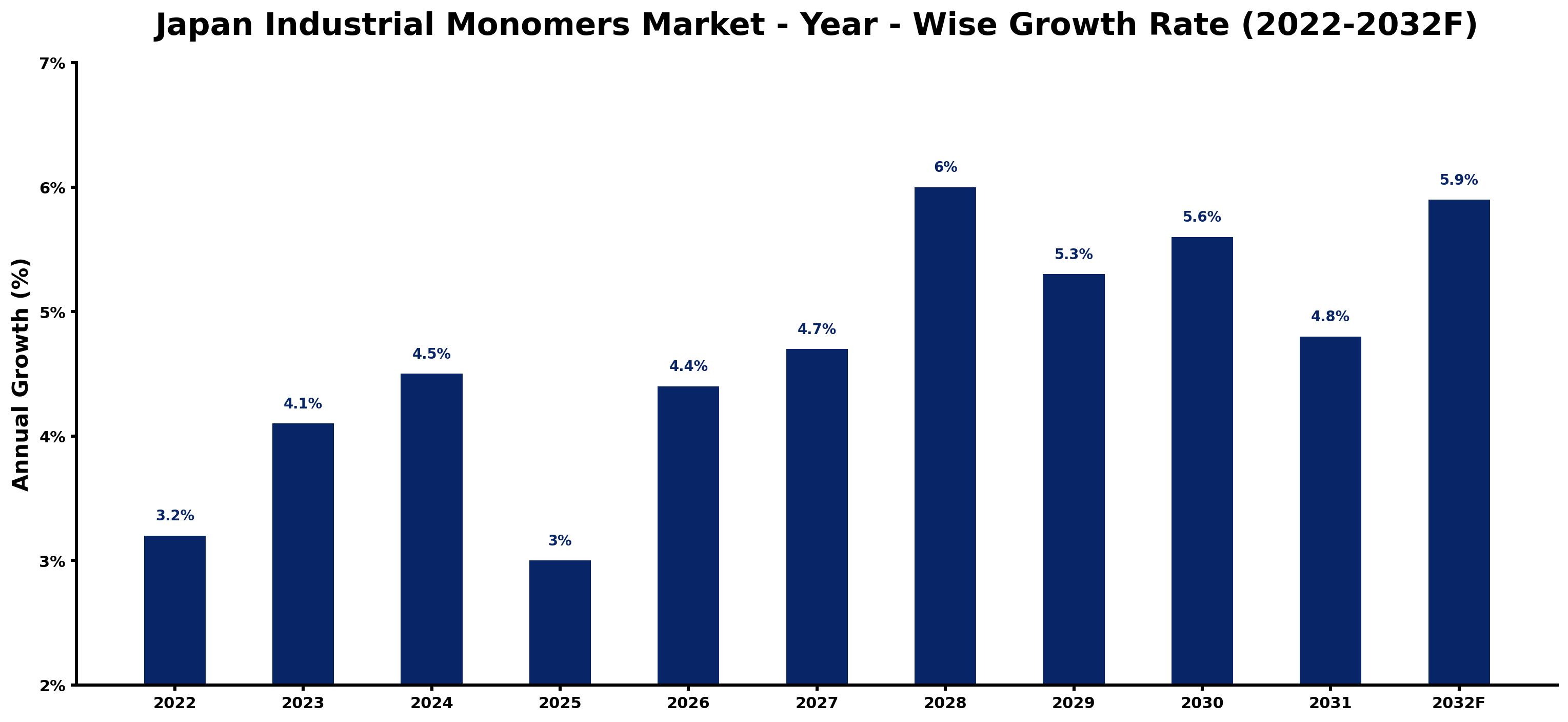
For each year, the table pairs the estimated growth rate with the leading influence on demand, showing how the drivers changed across the period.
| Year | Estimated Annual Growth (%) | Market Rationale |
| 2022 | 3.2 | The automotive sector maintained steady demand for industrial monomers. |
| 2023 | 4.1 | Increased construction activity led to higher consumption of monomers. |
| 2024 | 4.5 | The Tokyo 2020 Olympics generated additional demand for construction materials. |
| 2025 | 3.0 | Demand growth slowed slightly due to market saturation in some areas. |
| 2026 | 4.4 | Investment in sustainable practices is expected to influence monomer production. |
| 2027 | 4.7 | Rising consumer demand for plastics will boost market activity. |
| 2028 | 6.0 | The peak growth rate will be driven by new polymer applications. |
| 2029 | 5.3 | Market growth is projected to slow as competition intensifies among suppliers. |
| 2030 | 5.6 | Consumer trends will shift towards eco-friendly materials, increasing demand. |
| 2031 | 4.8 | Slightly reduced growth will result from regulatory pressures on emissions. |
| 2032 | 5.9 | Technological advancements in production methods are expected to drive growth. |
Note: Market size estimations and growth projections presented in this report are based on 6Wresearch's proprietary forecasting methodology, utilizing the latest available industry data, government publications, and primary research inputs.
Japan Industrial Monomers Market Synopsis
Industrial monomers serve as building blocks for polymers and plastics, produced mainly through petrochemical processes. The Japan Industrial Monomers Market is expanding due to rising investments in decarbonisation, with an estimated JPY 150 trillion allocated for public and private initiatives over the next decade. The automotive sector, which accounted for 25% of total industrial monomer demand, is driving innovation and sustainability in production, indicating a strong growth outlook.
Market Dynamics Impact Analysis (2026–2032)
| Factor | Type | Impact | Primary Segment Affected |
| Increased investment in decarbonisation initiatives | Driver | High | Polymer Manufacturing |
| Growing demand for sustainable materials in construction | Driver | High | Construction Industry |
| Rising consumer interest in eco-friendly products | Opportunity | High | Automotive |
| Expansion of production capacity in the Tokyo region | Opportunity | Medium | Ethylene |
| High production costs due to energy prices | Restraint | High | Synthetic Rubber |
| Regulatory compliance costs impacting production efficiency | Restraint | Medium | Acrylate |
| Intense competition leading to price pressures | Challenge | High | Styrene |
| Supply chain disruptions affecting raw material availability | Challenge | Medium | Ethylene |
Evaluation of Drivers in Japan Industrial Monomers Market (2026–2032)
Below are the drivers that matter most for revenue growth, with supporting evidence.
| Drivers | Primary Segment Affected | Why It Matters (Evidence) |
| Investment in decarbonisation technologies | Polymer Manufacturing | Japan targets a 46% reduction in greenhouse gas emissions by 2030, driving demand for sustainable polymers. |
| Increased infrastructure development | Construction Industry | The construction industry is valued at over 600 billion USD annually, leading to higher monomer consumption. |
| Growing automotive sector | Automotive | The automotive industry accounted for 25% of total industrial monomer demand, boosting purchases of key materials. |
| Rising consumer demand for acrylic products | Plastic Production | Methyl Methacrylate is widely used in transparent acrylic sheets, increasing demand in various applications. |
| Expansion of chemical manufacturing | Acrylate | The Tokyo region's chemical production capacity is set to grow, enhancing supply chain efficiency. |
Purchasing is picking up as investments in decarbonisation technologies rise, with Japan targeting a 46% reduction in greenhouse gas emissions by 2030. The construction industry, valued at over 600 billion USD annually, drives higher monomer consumption. The automotive sector, accounting for 25% of total industrial monomer demand, further boosts purchases. Rising consumer demand for acrylic products increases the need for Methyl Methacrylate in various applications. The growth of chemical manufacturing in the Tokyo region supports overall market expansion.
Evaluation of Restraints in Japan Industrial Monomers Market
The table below lists the restraints and the evidence behind each.
| Market Restraint | Primary Segment Affected | Why It Matters (Evidence) |
| High production costs due to energy prices | Synthetic Rubber | Rising energy prices increase production costs, impacting profitability for synthetic rubber manufacturers. |
| Regulatory compliance costs impacting production efficiency | Acrylate | Compliance with regulations raises operational costs, affecting the efficiency of acrylate production. |
| Limited availability of raw materials | Ethylene | Supply chain disruptions restrict access to essential raw materials, hindering production capabilities. |
| Market saturation in certain applications | Plastic Production | Saturation in specific plastic applications leads to reduced growth potential for producers. |
| Environmental regulations increasing operational complexity | Polymer Manufacturing | Stricter environmental regulations complicate manufacturing processes, increasing compliance costs. |
Japan Industrial Monomers Market Challenges
Producers encounter delays due to reliance on imported raw materials, which can extend lead times by up to three months for monomer manufacturers. Technology gaps in advanced processing techniques result in inefficiencies, raising operational costs by 15% for local producers. Intense competition from international markets pressures local producers to reduce prices, potentially shrinking profit margins by 10% for those unable to innovate. Buyers face increased procurement costs as the construction industry, valued at over 600 billion USD annually, demands higher quality materials, leading to a rise in material expenses.
Trends in the Japan Industrial Monomers Market
The shifts below are changing how Japan Industrial Monomers Market products are bought and supplied.
- Construction Industry Adopting Acrylic Products: The construction industry is increasingly using acrylic products, driven by their durability and aesthetic appeal. In 2022, the sector's demand for industrial monomers rose significantly, highlighting a shift in material preferences.
- Tokyo Region Expanding Chemical Manufacturing: Tokyo is emerging as a major hub for chemical manufacturing, attracting investments for new facilities. The region's production capacity is expected to increase, enhancing supply chain efficiency.
- Growing Focus on Sustainable Practices: There is a rising trend towards sustainable practices in the chemical industry, with more producers adopting eco-friendly materials. This shift is expected to improve market competitiveness and align with consumer preferences.
- Increased Adoption of Quality Standards: Monomer producers are increasingly pursuing ISO 9001 certification to enhance quality management. This trend is anticipated to improve product reliability and operational efficiency across the sector.
Investment Opportunities in the Japan Industrial Monomers Market
Investors looking at the Japan Industrial Monomers Market should consider the following areas.
- Partnerships for Sustainable Production: Now is an ideal time for joint ventures focused on sustainable production methods in the chemical sector. The construction industry is increasingly seeking eco-friendly materials, creating demand for innovative solutions.
- Investment in Advanced Manufacturing Facilities: With Japan's push for decarbonisation, investments in advanced manufacturing facilities are essential. The Tokyo region's chemical hubs are prime locations for such developments.
- Supply Chain Improvements: Investing in supply chain improvements is critical to address raw material shortages. The automotive sector's demand for high-quality materials presents opportunities for suppliers.
- Focus on Eco-Friendly Coatings: The growing demand for eco-friendly coatings in construction offers a lucrative opportunity. Producers can enter this market by developing compliant products that meet sustainability standards.
Government Initiatives in the Japan Industrial Monomers Market
The GX Promotion Act (2023) establishes the legal framework for decarbonisation efforts, requiring producers to adopt sustainable practices. This act aims for a JPY 150 trillion investment in public and private decarbonisation initiatives over the next decade, influencing production methods and materials used in the industry.
The Ministry of Economy, Trade and Industry oversees compliance with the Act on the Rational Use of Energy, which mandates large energy users to enhance efficiency. This regulation impacts monomer producers, compelling them to invest in energy-saving technologies to remain competitive.
Future Insight of the Japan Industrial Monomers Market
Decarbonisation technologies will transform demand for industrial monomers by 2032, driven by Japan's JPY 150 trillion investment in sustainable practices. The introduction of new quality management standards will enhance production efficiency. Environmentally friendly coatings will see greater adoption in the construction sector, aligning with sustainability goals. Production of industrial monomers will remain robust, with 3 million tons of ethylene produced in 2022, ensuring adequate supply for various applications.
Market Segmentation Analysis
Japan Industrial Monomers Market report covers a detailed analysis of the following market segments:
By Monomer Type – Ethylene Leads, Styrene Expected to Grow Fastest
According to Saurav Kr Singh, Senior Research Analyst at 6Wresearch, the largest monomer type category in 2025 was Ethylene, at 41% of revenue. Ethylene holds the largest share in Japan's market as it is crucial for producing polyethylene, a material extensively used in packaging and construction. The automotive sector, which accounts for 25% of industrial monomer demand, heavily relies on polyethylene, reinforcing ethylene's leading position. Over 2026–2032, Styrene is expected to post the fastest growth, at a CAGR of 7.3%. Styrene is experiencing rapid growth due to its increasing use in insulation materials, particularly in the automotive sector. With Japan's focus on energy efficiency, the demand for styrene in vehicle production is projected to rise significantly. Suppliers should prioritise ethylene production while also tapping into the growing styrene market to enhance their competitive edge.
By Chemical Class – Olefin Leads, Aromatic Expected to Grow Fastest
Olefin accounted for 45% of the market by chemical class in 2025. Olefin leads the market because it is integral to various polymer applications, particularly in the automotive and construction industries. Its established supply chain and versatility make it a preferred choice among manufacturers in Japan. Aromatic is set to record the highest CAGR in this split, 6.8% over 2026–2032. Aromatic compounds are growing quickly as they are essential for producing a range of chemicals that are increasingly sought after in advanced manufacturing processes. This growth trend is expected to persist as industries pursue more efficient materials. Suppliers need to optimise olefin production while also investing in aromatic compounds to meet market demands.
By Form – Liquid Leads, Solid Crystals Expected to Grow Fastest
With 55% of form revenue in 2025, Liquid was the largest category. Liquid form holds the largest share as it is the most common state for processing industrial monomers, facilitating easier handling and application in manufacturing. This widespread use in various sectors underlines its importance in Japan's chemical industry. Solid Crystals are projected to grow fastest, at a CAGR of 7.7% during 2026–2032. Solid crystals are gaining traction due to their specific applications in niche markets, where they offer advantages in terms of stability and performance. As industries seek specialised materials, the demand for solid crystals is likely to increase. Manufacturers should ensure efficient liquid production while exploring opportunities in solid crystal applications to meet diverse market demands.
By Application Area – Polymer Manufacturing Leads, Plastic Production Expected to Grow Fastest
In 2025, Polymer Manufacturing led the application area split with a 44% share. Polymer manufacturing is the leading application area, as it serves as the primary use for industrial monomers in creating essential products across multiple sectors. The strong demand for polymers in automotive and construction drives this segment's dominance. The quickest growth will come from Plastic Production, forecast to expand at a CAGR of 6.6% between 2026 and 2032. Plastic production is experiencing rapid growth, driven by the increasing need for lightweight and durable materials in various consumer goods. This trend reflects the broader shift towards sustainable and efficient manufacturing practices. Suppliers should prioritise polymer manufacturing capabilities while adapting to the growing demand for plastics in consumer applications.
By End User Industry – Automotive Leads, Consumer Staples Expected to Grow Fastest
Automotive held 40% of the Japan Industrial Monomers Market by end user industry in 2025. The automotive industry is the largest end user of industrial monomers, accounting for a substantial portion of total demand. Its reliance on high-performance materials for vehicle production underscores the significance of this sector in Japan's market. Over 2026–2032, Consumer Staples are expected to post the fastest growth, at a CAGR of 7.2%. Consumer staples are emerging as the fastest-growing end user industry, primarily due to the rising demand for packaging materials that utilise industrial monomers. This shift indicates a broader trend towards sustainability in consumer goods. Suppliers must align their strategies with the automotive sector's needs while also tapping into the growing consumer staples market for packaging solutions.
Key Attractiveness of the Report
- 10 Years of Market Numbers
- Historical Data Starting from 2022 to 2025
- Base Year 2025
- Forecast Data until 2032
- Key Performance Indicators Impacting the Market
- Major Upcoming Developments and Projects
Key Highlights of the Report:
- Japan Industrial Monomers Market Outlook
- Market Size of Japan Industrial Monomers Market, 2025
- Forecast of Japan Industrial Monomers Market, 2032
- Historical Data and Forecast of Japan Industrial Monomers Revenues & Volume for the Period 2022-2032F
- Japan Industrial Monomers Market Trend Evolution
- Japan Industrial Monomers Market Drivers and Challenges
- Japan Industrial Monomers Price Trends
- Japan Industrial Monomers Porter's Five Forces
- Japan Industrial Monomers Industry Life Cycle
- Historical Data and Forecast of Japan Industrial Monomers Market Revenues & Volume By Monomer Type for the Period 2022-2032F
- Historical Data and Forecast of Japan Industrial Monomers Market Revenues & Volume By Ethylene for the Period 2022-2032F
- Historical Data and Forecast of Japan Industrial Monomers Market Revenues & Volume By Styrene for the Period 2022-2032F
- Historical Data and Forecast of Japan Industrial Monomers Market Revenues & Volume By Butadiene for the Period 2022-2032F
- Historical Data and Forecast of Japan Industrial Monomers Market Revenues & Volume By Methyl Methacrylate for the Period 2022-2032F
- Historical Data and Forecast of Japan Industrial Monomers Market Revenues & Volume By Chemical Class for the Period 2022-2032F
- Historical Data and Forecast of Japan Industrial Monomers Market Revenues & Volume By Olefin for the Period 2022-2032F
- Historical Data and Forecast of Japan Industrial Monomers Market Revenues & Volume By Aromatic for the Period 2022-2032F
- Historical Data and Forecast of Japan Industrial Monomers Market Revenues & Volume By Diene for the Period 2022-2032F
- Historical Data and Forecast of Japan Industrial Monomers Market Revenues & Volume By Acrylate for the Period 2022-2032F
- Historical Data and Forecast of Japan Industrial Monomers Market Revenues & Volume By Form for the Period 2022-2032F
- Historical Data and Forecast of Japan Industrial Monomers Market Revenues & Volume By Liquid for the Period 2022-2032F
- Historical Data and Forecast of Japan Industrial Monomers Market Revenues & Volume By Solid Crystals for the Period 2022-2032F
- Historical Data and Forecast of Japan Industrial Monomers Market Revenues & Volume By Gas for the Period 2022-2032F
- Historical Data and Forecast of Japan Industrial Monomers Market Revenues & Volume By Liquid for the Period 2022-2032F
- Historical Data and Forecast of Japan Industrial Monomers Market Revenues & Volume By Application Area for the Period 2022-2032F
- Historical Data and Forecast of Japan Industrial Monomers Market Revenues & Volume By Polymer Manufacturing for the Period 2022-2032F
- Historical Data and Forecast of Japan Industrial Monomers Market Revenues & Volume By Plastic Production for the Period 2022-2032F
- Historical Data and Forecast of Japan Industrial Monomers Market Revenues & Volume By Synthetic Rubber for the Period 2022-2032F
- Historical Data and Forecast of Japan Industrial Monomers Market Revenues & Volume By Paints & Coatings for the Period 2022-2032F
- Historical Data and Forecast of Japan Industrial Monomers Market Revenues & Volume By End User Industry for the Period 2022-2032F
- Historical Data and Forecast of Japan Industrial Monomers Market Revenues & Volume By Automotive for the Period 2022-2032F
- Historical Data and Forecast of Japan Industrial Monomers Market Revenues & Volume By Consumer Staples for the Period 2022-2032F
- Historical Data and Forecast of Japan Industrial Monomers Market Revenues & Volume By Healthcare for the Period 2022-2032F
- Historical Data and Forecast of Japan Industrial Monomers Market Revenues & Volume By Construction Industry for the Period 2022-2032F
- Japan Industrial Monomers Import Export Trade Statistics
- Market Opportunity Assessment By Monomer Type
- Market Opportunity Assessment By Chemical Class
- Market Opportunity Assessment By Form
- Market Opportunity Assessment By Application Area
- Market Opportunity Assessment By End User Industry
- Japan Industrial Monomers Top Companies Market Share
- Japan Industrial Monomers Competitive Benchmarking By Technical and Operational Parameters
- Japan Industrial Monomers Company Profiles
- Japan Industrial Monomers Key Strategic Recommendations
Market Covered
This report examines the market across the segments below.
By Monomer Type
- Ethylene
- Styrene
- Butadiene
- Methyl Methacrylate
By Chemical Class
- Olefin
- Aromatic
- Diene
- Acrylate
By Form
- Liquid
- Solid Crystals
- Gas
By Application Area
- Polymer Manufacturing
- Plastic Production
- Synthetic Rubber
- Paints & Coatings
By End User Industry
- Automotive
- Consumer Staples
- Healthcare
- Construction Industry































