Japan Industrial Motion Sensor Market Size & Growth Rate
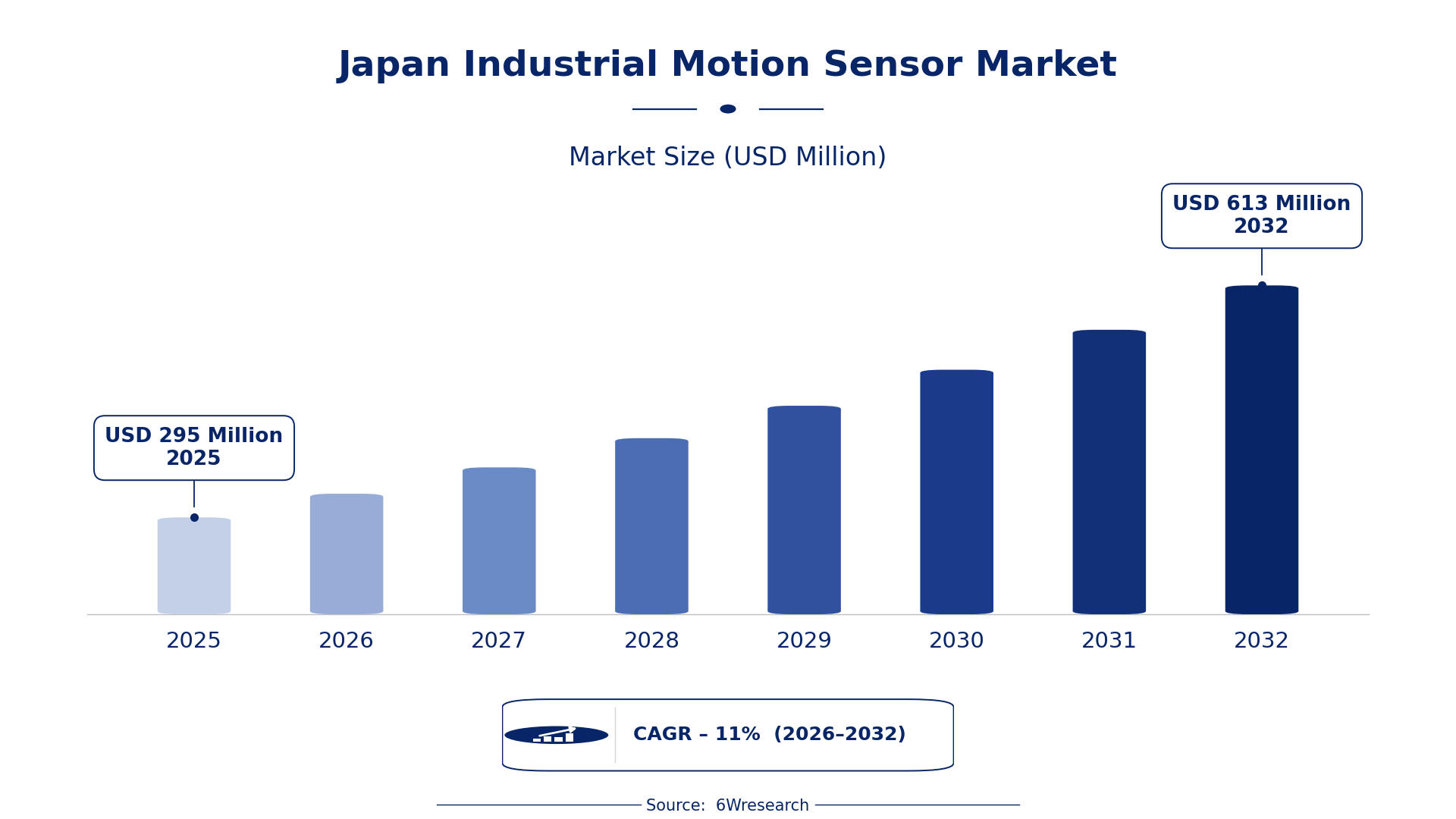
According to 6Wresearch internal database and industry insights, the Japan Industrial Motion Sensor Market was valued at USD 295 Million in 2025 and is projected to reach USD 613 Million by 2032, growing at a CAGR of approximately 11% during 2026–2032.
Japan Industrial Motion Sensor Market Highlights
| Report Metric | Details |
| Report Name | Japan Industrial Motion Sensor Market (2026-2032) |
| Market Size 2025 | USD 295 Million |
| Market Size 2032 | USD 613 Million |
| Absolute Growth 2025–2032 | USD 318 Million |
| CAGR 2026–2032 | 11% |
| Peak Annual Growth | 13.1% in 2026 |
| Forecast Period | 2026–2032 |
| Historical Data | 2022–2025 |
| Base Year | 2025 |
| Leading Sensor Type, 2025 | Accelerometers (39% share) |
| Leading Technology, 2025 | MEMS (43% share) |
| Leading Output Signal, 2025 | Digital (46% share) |
| Leading Application, 2025 | Vibration Monitoring (47% share) |
| Leading End User Industry, 2025 | Automotive (41% share) |
| Fastest-Growing Sensor Type | Gyroscopes (16.1% CAGR) |
| Fastest-Growing Output Signal | Analog (14.1% CAGR) |
| Fastest-Growing Application | Robotics (14.5% CAGR) |
| Fastest-Growing End User Industry | Aerospace and Defense (14.6% CAGR) |
| Growing Sector | Automotive |
| Key End Users | Automotive, Industrial Automation, Aerospace and Defense, Robotics |
Japan Industrial Motion Sensor Market Year-wise Growth Rate and Key Drivers (2022–2032)
This graph illustrates the annual growth rates of the market from 2022 to 2032, highlighting a steady upward trajectory and projected market expansion over the forecast period.
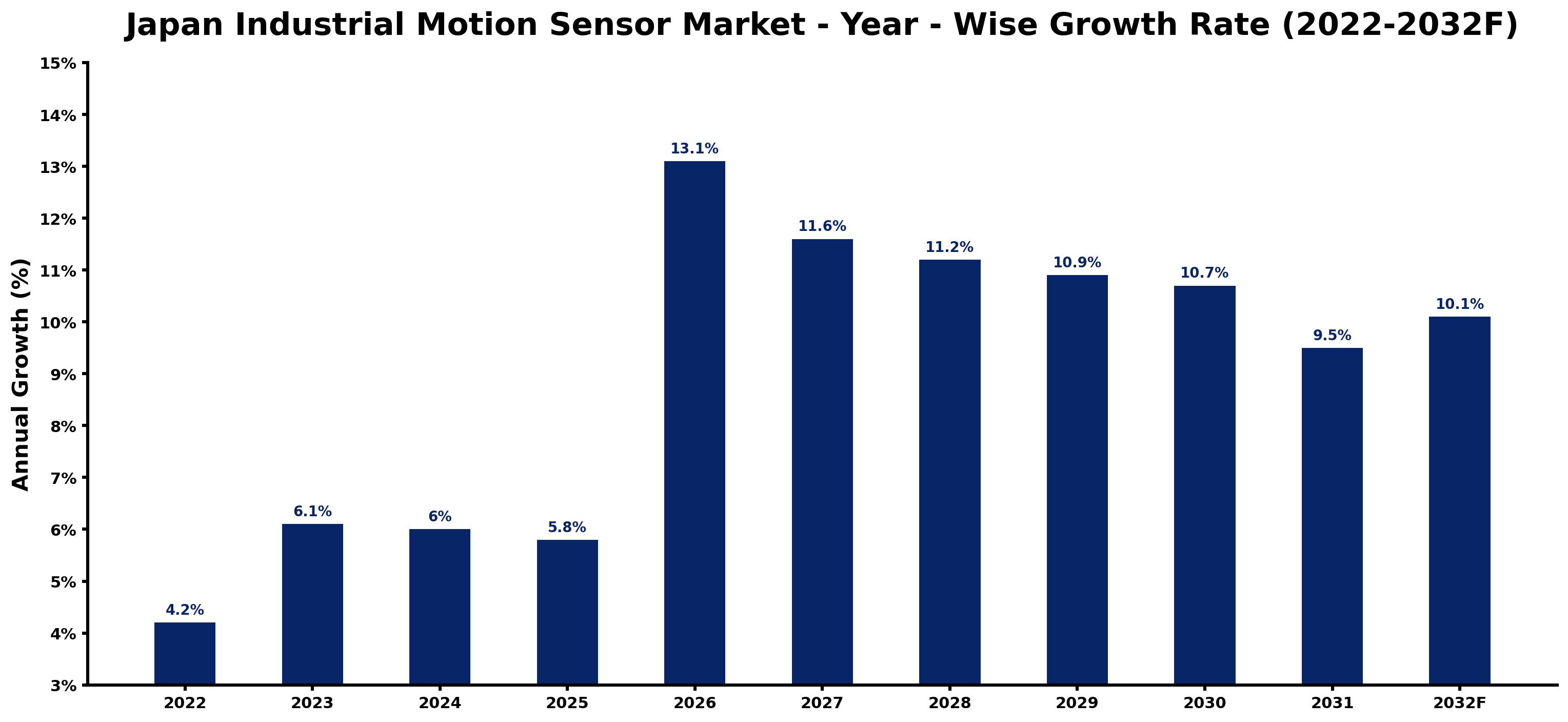
Each row of the following table gives one year's estimated growth and the event or demand shift that explains it.
| Year | Estimated Annual Growth (%) | Market Rationale |
| 2022 | 4.2 | The market experienced steady growth, driven by demand from the automotive sector. |
| 2023 | 6.1 | Growth accelerated due to increased investments in industrial automation technologies. |
| 2024 | 6.0 | A slight slowdown occurred as demand stabilised after previous peaks in investment. |
| 2025 | 5.8 | Continued growth was noted, although at a slower pace compared to the prior year. |
| 2026 | 13.1 | A surge in demand is anticipated, propelled by advancements in MEMS technology. |
| 2027 | 11.6 | Growth is projected to decelerate as the market adjusts to the rapid expansion of the previous year. |
| 2028 | 11.2 | The market is expected to maintain a steady growth rate, supported by ongoing industrial applications. |
| 2029 | 10.9 | A gradual slowdown is anticipated, reflecting a maturing market and stabilised demand. |
| 2030 | 10.7 | The growth rate will continue to slow slightly, indicating market saturation in some sectors. |
| 2031 | 9.5 | A further slowdown is projected as demand stabilises across various applications. |
| 2032 | 10.1 | An uptick in growth is expected, driven by new technological advancements in sensors. |
Note: Market size estimations and growth projections presented in this report are based on 6Wresearch's proprietary forecasting methodology, utilizing the latest available industry data, government publications, and primary research inputs.
Japan Industrial Motion Sensor Market Synopsis
Industrial motion sensors detect and measure motion in various applications, primarily using MEMS and fiber optics technologies. Key applications include vibration monitoring, robotics, and safety systems, particularly in Japan's automotive and industrial automation sectors. The Japan Industrial Motion Sensor Market is expanding due to increased investments in sensor technology and strong demand from the automotive industry, projected to reach USD 613 million by 2032, supported by a focus on decarbonisation and technological advancements.
Market Dynamics Impact Analysis (2026–2032)
| Factor | Type | Impact | Primary Segment Affected |
| Growing demand for safety systems in automotive applications | Driver | High | Safety Systems |
| Advancements in MEMS technology enhancing sensor capabilities | Driver | High | MEMS |
| Rising investment in robotics applications | Opportunity | High | Robotics |
| Increased focus on vibration monitoring in manufacturing | Opportunity | High | Vibration Monitoring |
| Challenges in sourcing advanced materials for sensor production | Restraint | Medium | MEMS |
| Regulatory compliance costs affecting sensor manufacturers | Restraint | Medium | Safety Systems |
| High competition among sensor manufacturers impacting pricing | Challenge | High | Industrial Automation |
| Technological obsolescence requiring constant innovation | Challenge | High | Robotics |
Evaluation of Drivers in Japan Industrial Motion Sensor Market (2026–2032)
These are the developments adding the most demand over the forecast period.
| Drivers | Primary Segment Affected | Why It Matters (Evidence) |
| Increased automotive safety regulations | Safety Systems | This drives demand for advanced sensors, with the automotive industry employing over 5 million people in Japan. |
| Technological advancements in MEMS | MEMS | These advancements enable smaller, more efficient sensors, contributing to a projected growth rate of 12.4% in this segment. |
| Expansion of industrial automation | Industrial Automation | The push for efficiency in manufacturing leads to greater sensor adoption, particularly in the Tokyo region, where operational efficiency is critical. |
| Growing robotics applications | Robotics | Demand for precise motion sensors is increasing, particularly in manufacturing, as robotics applications expand significantly. |
| Rising focus on vibration monitoring | Vibration Monitoring | This application is essential for machinery health, particularly in Japan's heavy machinery sector, leading to increased sensor adoption. |
The expansion of industrial automation drives demand as manufacturers seek greater operational efficiency, particularly in the Tokyo region. The emphasis on vibration monitoring is critical for machinery health in Japan's heavy machinery sector, leading to increased sensor adoption. As robotics applications rise, the need for precise motion sensors for effective control is becoming more pronounced, reflecting a broader shift towards integrating advanced sensor technologies across various industries.
Evaluation of Restraints in Japan Industrial Motion Sensor Market
The main factors holding the market back are set out below.
| Market Restraint | Primary Segment Affected | Why It Matters (Evidence) |
| Sourcing advanced materials for manufacturing | MEMS | The difficulty in obtaining high-quality materials can delay production timelines, impacting overall market supply. |
| Compliance with safety regulations | Safety Systems | Manufacturers face increased costs to meet stringent safety standards, affecting pricing strategies. |
| High competition in the sensor market | Industrial Automation | Intense competition can lead to price wars, reducing profit margins for manufacturers. |
| Technological obsolescence | Robotics | The rapid pace of technology can render existing products outdated, necessitating continuous innovation. |
| Limited awareness of sensor benefits among smaller manufacturers | Vibration Monitoring | Smaller firms may hesitate to invest in advanced sensors, impacting overall market growth. |
Japan Industrial Motion Sensor Market Challenges
In Japan, rising raw material costs have increased input prices for buyers by approximately 15% over the past year, straining budgets across various sectors. Supply chain disruptions have delayed sensor availability, impacting production timelines for manufacturers and causing potential revenue losses of up to JPY 10 billion annually. Stringent safety regulations under the Industrial Safety and Health Act impose additional costs on suppliers, forcing them to invest in advanced technologies to comply. Increased competition from emerging markets pressures local producers, reducing their market share and profitability by around 8%.
Trends in the Japan Industrial Motion Sensor Market
These developments are changing demand patterns in the Japan Industrial Motion Sensor Market.
- Shift from Analog to Digital Sensors: Since 2023, the transition to digital output sensors has accelerated, reflecting their precision and efficiency. This shift is evident in the automotive sector, where digital sensors account for 46% of the market.
- Emergence of MEMS Technology: The MEMS technology segment has gained prominence, particularly in the Tokyo region, where advancements have led to a 12.4% growth rate. This trend reflects the industry's push for miniaturisation and efficiency.
- Increased Focus on Vibration Monitoring: In 2024, the manufacturing sector emphasised vibration monitoring, critical for machinery health. This focus is reflected in the adoption of advanced sensors, particularly in heavy machinery applications.
- Growth in Robotics Applications: Robotics applications have surged since 2025, with a projected CAGR of 14.5%. This trend highlights the increasing integration of motion sensors in automation processes across various industries.
Investment Opportunities in the Japan Industrial Motion Sensor Market
Where to invest in the Japan Industrial Motion Sensor Market: the main openings are set out below.
- Supply of Advanced MEMS Sensors: With Japan targeting JPY 150 trillion in decarbonisation investments, supplying advanced MEMS sensors presents a strong opportunity for manufacturers in the Tokyo region.
- Investment in Vibration Monitoring Technologies: The heavy machinery sector's focus on vibration monitoring creates a demand for specialised sensors, particularly in industrial hubs like Osaka, where operational efficiency is paramount.
- Development of Safety Systems for Automotive Applications: As automotive safety regulations tighten, there is a growing need for effective safety systems, particularly among automotive manufacturers in Aichi Prefecture.
- Expansion of Robotics Sensor Solutions: The robotics sector's projected growth presents an opportunity to supply precise motion sensors, particularly for manufacturers in the Kansai region.
Government Initiatives in the Japan Industrial Motion Sensor Market
The Industrial Safety and Health Act of 1972 mandates employer responsibilities for hazardous substances and machinery, ensuring that producers of industrial motion sensors adhere to safety standards. This law has led to increased demand for advanced safety systems within industrial applications, promoting the integration of motion sensors to improve workplace safety. The Act has resulted in numerous safety audits and compliance checks, benefiting sensor manufacturers by increasing product credibility and market acceptance.
The Semiconductor and Digital Industry Strategy, established by METI in June 2021, aims to secure domestic semiconductor manufacturing. This initiative supports the production of advanced sensors, with funding allocated to improve manufacturing capabilities and foster innovation in sensor technologies. The strategy is expected to attract JPY 100 billion in investments over five years, strengthening the local supply chain for motion sensors.
Future Insight of the Japan Industrial Motion Sensor Market
Advancements in MEMS technology will reshape demand for industrial motion sensors, particularly in applications like automation. The anticipated JPY 150 trillion investment in decarbonisation will drive innovation in sensor technologies, enabling better integration into industrial processes. Support from local governments for smart manufacturing will accelerate the adoption of advanced motion detection solutions. As healthcare increasingly utilises motion sensors for patient monitoring, suppliers must refine their products to meet specific industry needs.
Market Segmentation Analysis
Japan Industrial Motion Sensor Market report covers a detailed analysis of the following market segments:
By Sensor Type – Accelerometers Lead, Gyroscopes Expected to Grow Fastest
According to Saurav Kr Singh, Senior Research Analyst at 6Wresearch, with 39% of sensor type revenue in 2025, Accelerometers was the largest category. Accelerometers lead the market owing to their widespread application in automotive safety systems, which necessitate accurate motion detection. The automotive sector's focus on enhancing safety features has significantly boosted the demand for accelerometers in vehicle manufacturing. The quickest growth will come from Gyroscopes, forecast to expand at a CAGR of 16.1% between 2026 and 2032. Gyroscopes are experiencing rapid growth due to their vital function in robotics and aerospace applications. Increased investments in advanced sensor technologies, particularly in Japan's aerospace sector, are a key factor driving this growth. Suppliers should consider expanding their gyroscope product lines to address the increasing needs in robotics and aerospace.
By Technology – MEMS Leads and Records the Fastest Growth
The largest technology category in 2025 was MEMS, at 43% of revenue. MEMS technology leads the market as it enables the production of compact and efficient motion sensors suitable for various applications. Continuous advancements in MEMS technology reinforce its strong position in the industry. MEMS is also forecast to expand faster than any other category, at a CAGR of 12.4% over 2026–2032. The MEMS segment is also the fastest growing, as ongoing improvements in sensor miniaturisation increase its applicability across diverse fields. This dual role as leader and fastest will likely widen its market lead as demand escalates. Suppliers must invest in MEMS technology to remain competitive and capture the growing market.
By Output Signal – Digital Leads, Analog Expected to Grow Fastest
Digital accounted for 46% of the market by output signal in 2025. Digital output signals are prevalent in modern sensors, providing precise data output that meets the needs of contemporary applications. Their adoption in various industrial applications is a testament to their effectiveness and reliability. Analog is set to record the highest CAGR in this split, 14.1% over 2026–2032. Analog signals, while less common now, are still growing due to their use in legacy systems and specific applications. As industries transition, the demand for analog signals may see a resurgence in certain sectors. Buyers should consider the balance between digital and analog outputs when selecting sensors for their applications.
By Application – Vibration Monitoring Leads, Robotics Expected to Grow Fastest
Vibration Monitoring held 47% of the Japan Industrial Motion Sensor Market by application in 2025. Vibration monitoring is crucial in Japan's manufacturing sector, especially for ensuring the operational safety and reliability of heavy machinery. This essential application has created a strong demand for vibration monitoring sensors across various industrial sectors. Over 2026–2032, Robotics are expected to post the fastest growth, at a CAGR of 14.5%. Robotics applications are witnessing swift expansion, propelled by advancements in automation and control technologies. The rising integration of robotics in diverse industries is significantly driving the demand for accurate motion sensors. Suppliers should focus on developing sensors specifically designed for robotics to take advantage of this growth opportunity.
By End User Industry – Automotive Leads, Aerospace and Defense Expected to Grow Fastest
In 2025, Automotive led the end user industry split with a 41% share. The automotive industry is the primary consumer of industrial motion sensors, with a strong emphasis on safety systems in vehicles. This sector's large workforce and continuous technological advancements drive the demand for motion sensors. The quickest growth will come from Aerospace and Defense, forecast to expand at a CAGR of 14.6% between 2026 and 2032. Aerospace and defense are emerging as the fastest growing sectors for motion sensors, particularly for navigation and control applications. Expected substantial investments in advanced sensor technologies will further accelerate this growth. Suppliers should seek collaborations within the aerospace sector to capitalise on the rising demand for motion sensors.
Key Attractiveness of the Report
- 10 Years of Market Numbers
- Historical Data Starting from 2022 to 2025
- Base Year 2025
- Forecast Data until 2032
- Key Performance Indicators Impacting the Market
- Major Upcoming Developments and Projects
Key Highlights of the Report:
- Japan Industrial Motion Sensor Market Outlook
- Market Size of Japan Industrial Motion Sensor Market, 2025
- Forecast of Japan Industrial Motion Sensor Market, 2032
- Historical Data and Forecast of Japan Industrial Motion Sensor Revenues & Volume for the Period 2022-2032F
- Japan Industrial Motion Sensor Market Trend Evolution
- Japan Industrial Motion Sensor Market Drivers and Challenges
- Japan Industrial Motion Sensor Price Trends
- Japan Industrial Motion Sensor Porter's Five Forces
- Japan Industrial Motion Sensor Industry Life Cycle
- Historical Data and Forecast of Japan Industrial Motion Sensor Market Revenues & Volume By Sensor Type for the Period 2022-2032F
- Historical Data and Forecast of Japan Industrial Motion Sensor Market Revenues & Volume By Accelerometers for the Period 2022-2032F
- Historical Data and Forecast of Japan Industrial Motion Sensor Market Revenues & Volume By Gyroscopes for the Period 2022-2032F
- Historical Data and Forecast of Japan Industrial Motion Sensor Market Revenues & Volume By Ultrasonic Sensors for the Period 2022-2032F
- Historical Data and Forecast of Japan Industrial Motion Sensor Market Revenues & Volume By Infrared Sensors for the Period 2022-2032F
- Historical Data and Forecast of Japan Industrial Motion Sensor Market Revenues & Volume By Technology for the Period 2022-2032F
- Historical Data and Forecast of Japan Industrial Motion Sensor Market Revenues & Volume By MEMS for the Period 2022-2032F
- Historical Data and Forecast of Japan Industrial Motion Sensor Market Revenues & Volume By Fiber Optic for the Period 2022-2032F
- Historical Data and Forecast of Japan Industrial Motion Sensor Market Revenues & Volume By Ultrasonic Waves for the Period 2022-2032F
- Historical Data and Forecast of Japan Industrial Motion Sensor Market Revenues & Volume By Infrared Light for the Period 2022-2032F
- Historical Data and Forecast of Japan Industrial Motion Sensor Market Revenues & Volume By Output Signal for the Period 2022-2032F
- Historical Data and Forecast of Japan Industrial Motion Sensor Market Revenues & Volume By Analog for the Period 2022-2032F
- Historical Data and Forecast of Japan Industrial Motion Sensor Market Revenues & Volume By Digital for the Period 2022-2032F
- Historical Data and Forecast of Japan Industrial Motion Sensor Market Revenues & Volume By PWM for the Period 2022-2032F
- Historical Data and Forecast of Japan Industrial Motion Sensor Market Revenues & Volume By Voltage Signal for the Period 2022-2032F
- Historical Data and Forecast of Japan Industrial Motion Sensor Market Revenues & Volume By Application for the Period 2022-2032F
- Historical Data and Forecast of Japan Industrial Motion Sensor Market Revenues & Volume By Vibration Monitoring for the Period 2022-2032F
- Historical Data and Forecast of Japan Industrial Motion Sensor Market Revenues & Volume By Robotics for the Period 2022-2032F
- Historical Data and Forecast of Japan Industrial Motion Sensor Market Revenues & Volume By Position Tracking for the Period 2022-2032F
- Historical Data and Forecast of Japan Industrial Motion Sensor Market Revenues & Volume By Safety Systems for the Period 2022-2032F
- Historical Data and Forecast of Japan Industrial Motion Sensor Market Revenues & Volume By End User Industry for the Period 2022-2032F
- Historical Data and Forecast of Japan Industrial Motion Sensor Market Revenues & Volume By Automotive for the Period 2022-2032F
- Historical Data and Forecast of Japan Industrial Motion Sensor Market Revenues & Volume By Aerospace and Defense for the Period 2022-2032F
- Historical Data and Forecast of Japan Industrial Motion Sensor Market Revenues & Volume By Consumer Electronics for the Period 2022-2032F
- Historical Data and Forecast of Japan Industrial Motion Sensor Market Revenues & Volume By Industrial Automation for the Period 2022-2032F
- Japan Industrial Motion Sensor Import Export Trade Statistics
- Market Opportunity Assessment By Sensor Type
- Market Opportunity Assessment By Technology
- Market Opportunity Assessment By Output Signal
- Market Opportunity Assessment By Application
- Market Opportunity Assessment By End User Industry
- Japan Industrial Motion Sensor Top Companies Market Share
- Japan Industrial Motion Sensor Competitive Benchmarking By Technical and Operational Parameters
- Japan Industrial Motion Sensor Company Profiles
- Japan Industrial Motion Sensor Key Strategic Recommendations
Market Covered
Segments analysed in this report are listed below.
By Sensor Type
- Accelerometers
- Gyroscopes
- Ultrasonic Sensors
- Infrared Sensors
By Technology
- MEMS
- Fiber Optic
- Ultrasonic Waves
- Infrared Light
By Output Signal
- Analog
- Digital
- PWM
- Voltage Signal
By Application
- Vibration Monitoring
- Robotics
- Position Tracking
- Safety Systems
By End User Industry
- Automotive
- Aerospace and Defense
- Consumer Electronics
- Industrial Automation































