Japan Industrial Safety Market Size & Growth Rate
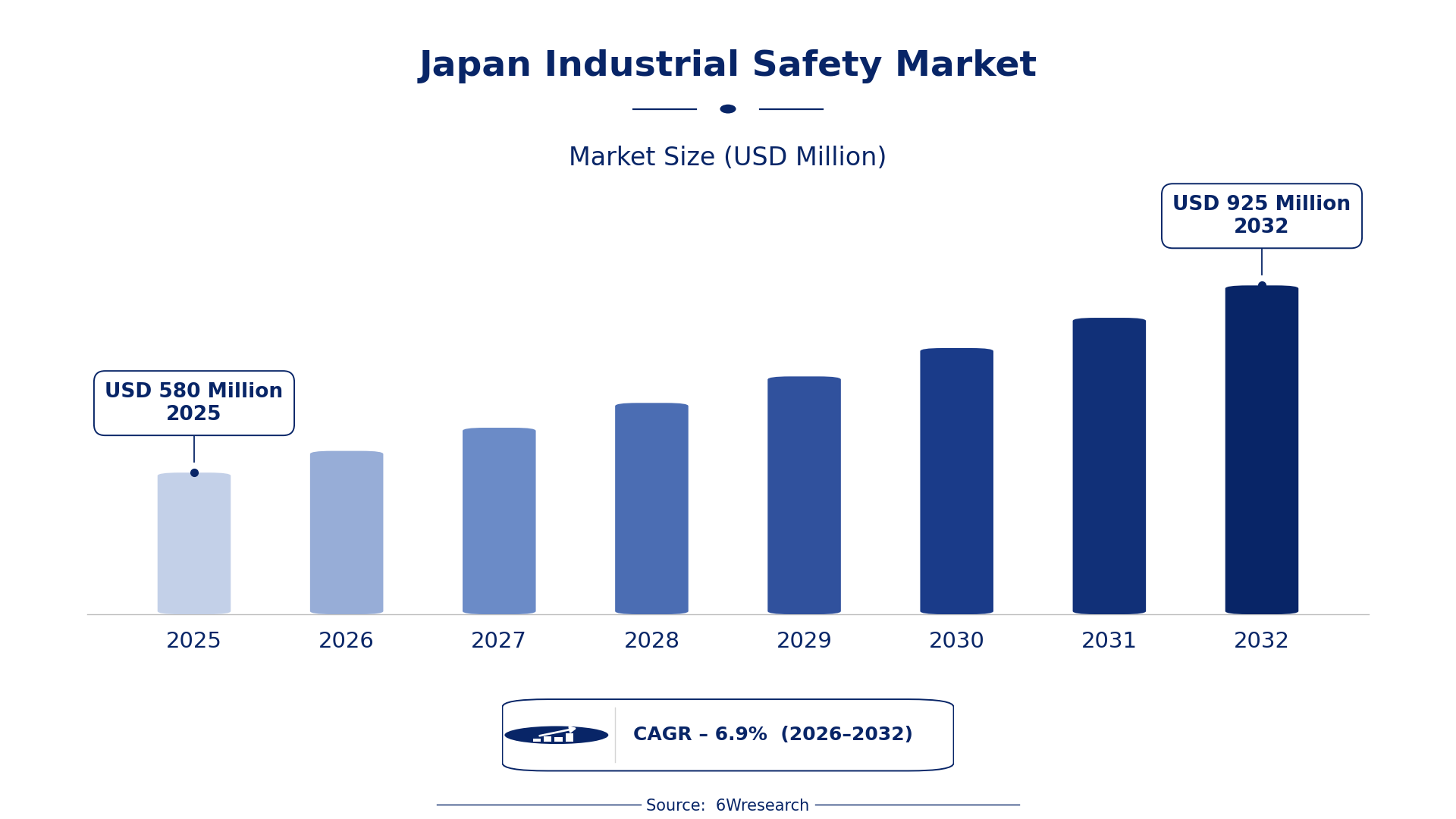
According to 6Wresearch internal database and industry insights, the Japan Industrial Safety Market was valued at USD 580 Million in 2025 and is projected to reach USD 925 Million by 2032, growing at a CAGR of approximately 6.9% during 2026–2032.
Japan Industrial Safety Market Highlights
| Report Metric | Details |
| Report Name | Japan Industrial Safety Market (2026-2032) |
| Market Size 2025 | USD 580 Million |
| Market Size 2032 | USD 925 Million |
| Absolute Growth 2025–2032 | USD 345 Million |
| CAGR 2026–2032 | 6.9% |
| Peak Annual Growth | 7.3% in 2027 |
| Forecast Period | 2026–2032 |
| Historical Data | 2022–2025 |
| Base Year | 2025 |
| Leading Component, 2025 | Presence Sensing Safety Sensors (58% share) |
| Leading Industry, 2025 | Automotive (47% share) |
| Fastest-Growing Component | Programmable Safety Systems (9.6% CAGR) |
| Fastest-Growing Industry | Oil & Gas (8.9% CAGR) |
| Growing Sector | energy sector |
| Key End Users | automotive, energy, oil and gas, manufacturing |
Japan Industrial Safety Market Year-wise Growth Rate and Key Drivers (2022–2032)
This graph illustrates the annual growth rates of the market from 2022 to 2032, highlighting a steady upward trajectory and projected market expansion over the forecast period.
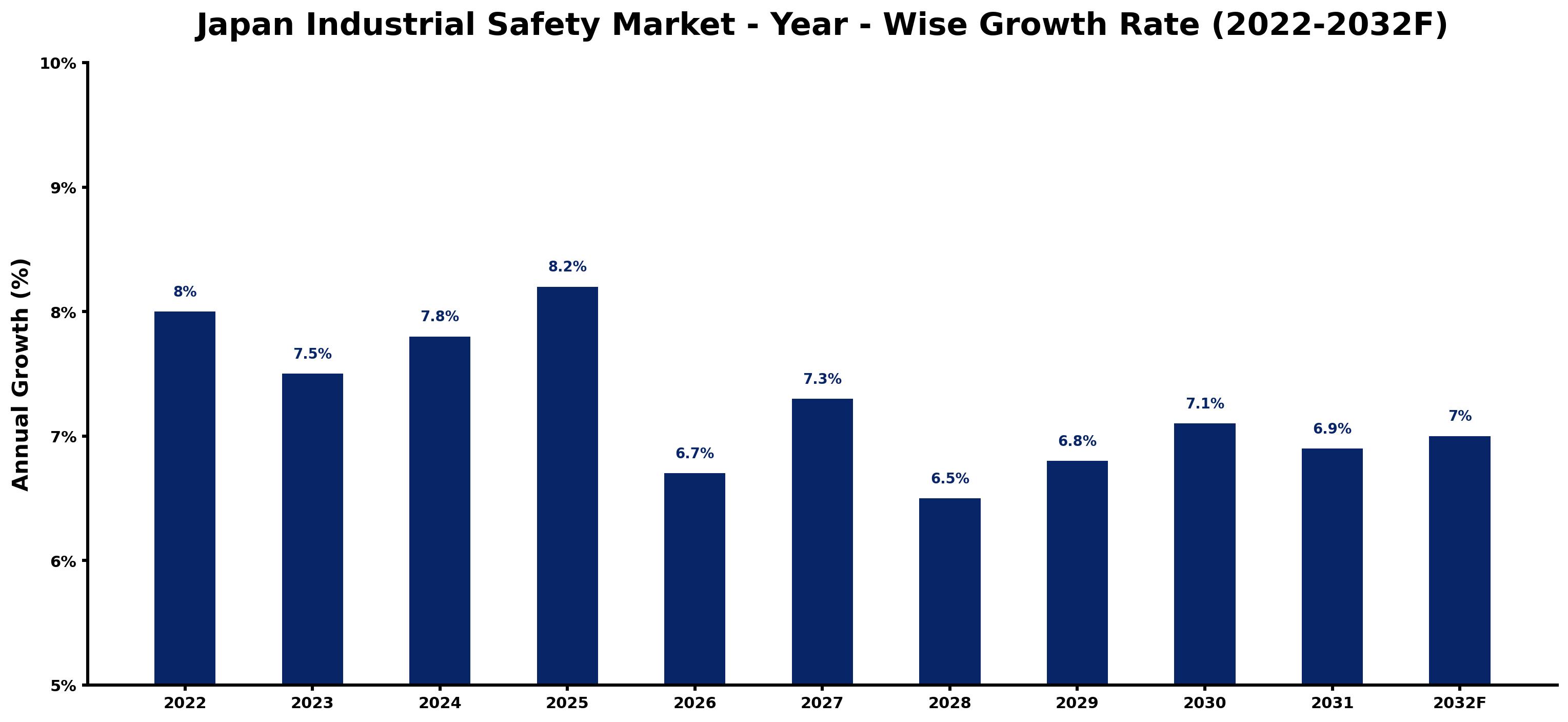
Each row of the following table gives one year's estimated growth and the event or demand shift that explains it.
| Year | Estimated Annual Growth (%) | Market Rationale |
| 2022 | 8.0 | The market experienced strong activity due to rising safety regulations. |
| 2023 | 7.5 | Growth slowed as companies adjusted to new compliance standards. |
| 2024 | 7.8 | Increased investments in safety technology spurred demand. |
| 2025 | 8.2 | The market peaked as major industries ramped up safety measures. |
| 2026 | 6.7 | Growth slowed as market saturation began to set in. |
| 2027 | 7.3 | Demand rose again with new technological advancements. |
| 2028 | 6.5 | Market growth slowed due to increased competition and pricing pressures. |
| 2029 | 6.8 | Demand picked up as industries sought to modernise safety systems. |
| 2030 | 7.1 | Growth continued as companies focused on energy efficiency improvements. |
| 2031 | 6.9 | The market saw a slowdown as some sectors stabilised. |
| 2032 | 7.0 | Demand increased as new regulations incentivised safety investments. |
Note: Market size estimations and growth projections presented in this report are based on 6Wresearch's proprietary forecasting methodology, utilizing the latest available industry data, government publications, and primary research inputs.
Japan Industrial Safety Market Synopsis
Industrial Safety encompasses equipment and systems designed to protect workers from hazards across various environments. The Japan Industrial Safety Market is expanding due to stringent regulations, increased investments in safety technologies, and a growing focus on energy efficiency. Major buyer groups include automotive, energy, and oil and gas sectors. With Japan targeting a 46% cut in greenhouse gas emissions by 2030, the market is projected to grow as industries adopt advanced safety measures to comply with new standards.
Market Dynamics Impact Analysis (2026–2032)
| Factor | Type | Impact | Primary Segment Affected |
| Stringent safety regulations drive compliance investments. | Driver | High | Presence Sensing Safety Sensors |
| Technological advancements in safety systems enhance operational efficiency. | Driver | High | Programmable Safety Systems |
| Growing energy sector demands advanced safety solutions. | Opportunity | High | Safety Controllers |
| Increased focus on decarbonisation creates demand for energy-efficient safety systems. | Opportunity | High | Programmable Safety Systems |
| High initial investment costs can deter smaller companies from upgrading. | Restraint | Medium | Safety Controllers |
| Limited awareness of advanced safety technologies restricts market growth. | Restraint | Medium | Presence Sensing Safety Sensors |
| Supply chain disruptions can delay safety equipment delivery. | Challenge | High | Programmable Safety Systems |
| Rapid technological changes require constant adaptation from manufacturers. | Challenge | Medium | Safety Controllers |
Evaluation of Drivers in Japan Industrial Safety Market (2026–2032)
The following drivers explain most of the expected growth.
| Drivers | Primary Segment Affected | Why It Matters (Evidence) |
| Increased regulatory compliance requirements boost demand for safety solutions. | Presence Sensing Safety Sensors | Japan's Industrial Safety and Health Act mandates employer responsibilities for worker safety. |
| Technological advancements in automation improve safety systems' effectiveness. | Programmable Safety Systems | The adoption of smart technologies in manufacturing increases demand for programmable safety solutions. |
| Growing investments in renewable energy projects require advanced safety measures. | Safety Controllers | The energy sector's expansion necessitates advanced safety systems to mitigate risks. |
| Rising public awareness of workplace safety drives demand for advanced solutions. | Presence Sensing Safety Sensors | Increased media coverage of workplace accidents has heightened demand for safety technologies. |
| Corporate sustainability initiatives are pushing for safer operational practices. | Programmable Safety Systems | Companies are investing in safety systems to align with decarbonisation goals. |
Much of the new demand traces back to the automotive sector, where investments in safety technologies have surged. The energy sector's expansion has prompted a need for advanced safety solutions, with public awareness of workplace safety driving further demand. The adoption of smart technologies in manufacturing is also improving the effectiveness of safety measures.
Evaluation of Restraints in Japan Industrial Safety Market
Below are the constraints most often cited by buyers and suppliers, with the segment each affects.
| Market Restraint | Primary Segment Affected | Why It Matters (Evidence) |
| High costs of safety equipment can limit adoption among smaller firms. | Safety Controllers | Many small companies struggle to afford the latest safety technologies, hindering market growth. |
| Limited knowledge of advanced safety systems restricts market penetration. | Presence Sensing Safety Sensors | A lack of awareness about the benefits of modern safety technologies affects purchasing decisions. |
| Supply chain disruptions can lead to delays in equipment availability. | Programmable Safety Systems | Recent global supply chain issues have impacted the timely delivery of safety equipment. |
| Regulatory changes can create uncertainty for manufacturers and buyers. | Safety Controllers | Frequent updates to safety regulations can complicate compliance efforts and delay purchases. |
| Competition from low-cost alternatives can pressure pricing. | Presence Sensing Safety Sensors | Increased competition from cheaper imports may deter investment in higher-quality safety solutions. |
Japan Industrial Safety Market Challenges
Japan's decarbonisation goals create intense competition among suppliers, leading to price wars that can erode profit margins for producers. Environmental regulations introduce compliance costs that may increase operational expenses by 15% for manufacturers this year, straining their financial resources. Buyers face delays in product availability as suppliers struggle to align with these new standards, potentially causing project setbacks of up to six months. Rapid advancements in safety technologies demand continuous investment, imposing unexpected costs on clinics, which could reach JPY 3 billion annually.
Trends in the Japan Industrial Safety Market
The following changes are redrawing the Japan Industrial Safety Market.
- Shift from Traditional to Smart Safety Systems: Beginning in 2023, industries are increasingly adopting smart safety technologies to improve workplace safety. The integration of IoT devices in safety systems is driving demand for advanced solutions, particularly in manufacturing facilities.
- Transition from Compliance to Proactive Safety Measures: In 2024, companies began prioritising proactive safety measures over mere compliance. This shift is reflected in the automotive sector, which reported a notable increase in investments in safety technologies to prevent accidents before they occur.
- Emergence of Energy-Efficient Safety Solutions: Since 2023, there has been a notable shift towards energy-efficient safety solutions in response to regulatory pressures. The GX Basic Policy aims for a JPY 150 trillion investment in decarbonisation, driving demand for sustainable safety technologies.
- Focus on Integrated Safety Systems: In 2025, the trend towards integrated safety systems gained momentum, particularly in the oil and gas sector. Companies are investing in systems that combine multiple safety functions, leading to a significant increase in system purchases.
Investment Opportunities in the Japan Industrial Safety Market
Investors looking at the Japan Industrial Safety Market should consider the following areas.
- Gap in Advanced Safety Technology Adoption: With a projected 40% of companies still using outdated safety systems, there is an opportunity for suppliers of advanced safety technologies. The automotive sector, which is rapidly modernising, presents a prime target for investment.
- Growing Demand for Energy-Efficient Solutions: As Japan targets a 46% reduction in greenhouse gas emissions, there is a pressing need for energy-efficient safety systems. The energy sector is actively seeking suppliers who can provide compliant technologies.
- Investment in Safety Training Programs: With increasing regulatory requirements, companies are looking to invest in safety training programs. This presents an opportunity for providers of training services and materials to enter the market.
- Need for Customised Safety Solutions: As industries diversify, the demand for customised safety solutions is rising. Companies in the oil and gas sector are seeking tailored safety systems that meet specific operational needs.
Government Initiatives in the Japan Industrial Safety Market
The Industrial Safety and Health Act of 1972 mandates that employers ensure the safety of workers by managing hazardous substances and machinery. This law requires companies to implement safety measures and report on their effectiveness, directly impacting the demand for safety equipment and systems. Additionally, the GX Basic Policy, adopted in 2023, aims for about JPY 150 trillion of public and private decarbonisation investment over the next decade, which will further stimulate the market for energy-efficient safety solutions.
The GX Promotion Act, enacted in 2023, supports the transition to a decarbonised economy by promoting investments in green technologies. The Ministry of the Environment oversees this initiative, which aims to mobilise JPY 150 trillion in public and private investment over the next decade, impacting the demand for energy-efficient safety solutions.
Future Insight of the Japan Industrial Safety Market
Emerging smart safety technologies will reshape demand by 2032, responding to stricter workplace safety regulations. Japan's GX Basic Policy aims for JPY 150 trillion in decarbonisation investment over the next decade, driving innovation in safety equipment. The integration of AI and IoT will enhance safety protocols and compliance efficiency. Suppliers will need to adapt their offerings to align with these evolving regulatory standards and buyer expectations.
Market Segmentation Analysis
Japan Industrial Safety Market report covers a detailed analysis of the following market segments:
By Component – Presence Sensing Safety Sensors Lead, Programmable Safety Systems Expected to Grow Fastest
According to Dhaval Chaurasia, Assistant Manager at 6Wresearch, Presence Sensing Safety Sensors held 58% of the Japan Industrial Safety Market by component in 2025. Presence Sensing Safety Sensors dominate the market as they are crucial for ensuring worker safety in diverse applications, particularly in manufacturing settings. Their role in fulfilling rigorous safety regulations leads to sustained demand across various sectors. The quickest growth will come from Programmable Safety Systems, forecast to expand at a CAGR of 9.6% between 2026 and 2032. Programmable Safety Systems are witnessing rapid growth as industries increasingly adopt automation to enhance safety and operational efficiency. The surge in demand for sophisticated safety solutions, particularly in the automotive sector, is a key factor in this segment's acceleration. Suppliers should concentrate on developing programmable safety technologies to meet the rising automation needs in safety applications.
By Industry – Automotive Leads, Oil & Gas Expected to Grow Fastest
The largest industry category in 2025 was Automotive, at 47% of revenue. The Automotive sector holds the largest share due to its strict safety standards aimed at protecting both employees and consumers. The high volume of vehicle production in Japan necessitates the deployment of comprehensive safety systems to comply with regulatory requirements. Over 2026–2032, Oil & Gas are expected to post the fastest growth, at a CAGR of 8.9%. The Oil & Gas industry is growing at the fastest rate as it ramps up investments in safety measures to mitigate increasing operational risks. This sector's focus on enhancing safety protocols in response to environmental regulations is driving its swift growth. Buyers in the Oil & Gas sector need to prioritise the adoption of advanced safety technologies to effectively manage risks and ensure compliance with regulations.
Key Attractiveness of the Report
- 10 Years of Market Numbers
- Historical Data Starting from 2022 to 2025
- Base Year 2025
- Forecast Data until 2032
- Key Performance Indicators Impacting the Market
- Major Upcoming Developments and Projects
Key Highlights of the Report:
- Japan Industrial Safety Market Outlook
- Market Size of Japan Industrial Safety Market, 2025
- Forecast of Japan Industrial Safety Market, 2032
- Historical Data and Forecast of Japan Industrial Safety Revenues & Volume for the Period 2022-2032
- Japan Industrial Safety Market Trend Evolution
- Japan Industrial Safety Market Drivers and Challenges
- Japan Industrial Safety Price Trends
- Japan Industrial Safety Porter's Five Forces
- Japan Industrial Safety Industry Life Cycle
- Historical Data and Forecast of Japan Industrial Safety Market Revenues & Volume By Component for the Period 2022-2032
- Historical Data and Forecast of Japan Industrial Safety Market Revenues & Volume By Presence Sensing Safety Sensors for the Period 2022-2032
- Historical Data and Forecast of Japan Industrial Safety Market Revenues & Volume By Safety Controllers for the Period 2022-2032
- Historical Data and Forecast of Japan Industrial Safety Market Revenues & Volume By Programmable Safety Systems for the Period 2022-2032
- Historical Data and Forecast of Japan Industrial Safety Market Revenues & Volume By Industry for the Period 2022-2032
- Historical Data and Forecast of Japan Industrial Safety Market Revenues & Volume By Energy & Power for the Period 2022-2032
- Historical Data and Forecast of Japan Industrial Safety Market Revenues & Volume By Automotive for the Period 2022-2032
- Historical Data and Forecast of Japan Industrial Safety Market Revenues & Volume By Oil & Gas for the Period 2022-2032
- Japan Industrial Safety Import Export Trade Statistics
- Market Opportunity Assessment By Component
- Market Opportunity Assessment By Industry
- Japan Industrial Safety Top Companies Market Share
- Japan Industrial Safety Competitive Benchmarking By Technical and Operational Parameters
- Japan Industrial Safety Company Profiles
- Japan Industrial Safety Key Strategic Recommendations
Market Covered
The following segment groups are covered in the report.
By Component
- Presence Sensing Safety Sensors
- Safety Controllers
- Programmable Safety Systems
By Industry
- Energy & Power
- Automotive
- Oil & Gas































