Japan Industrial Skincare Raw Materials Market Size & Growth Rate
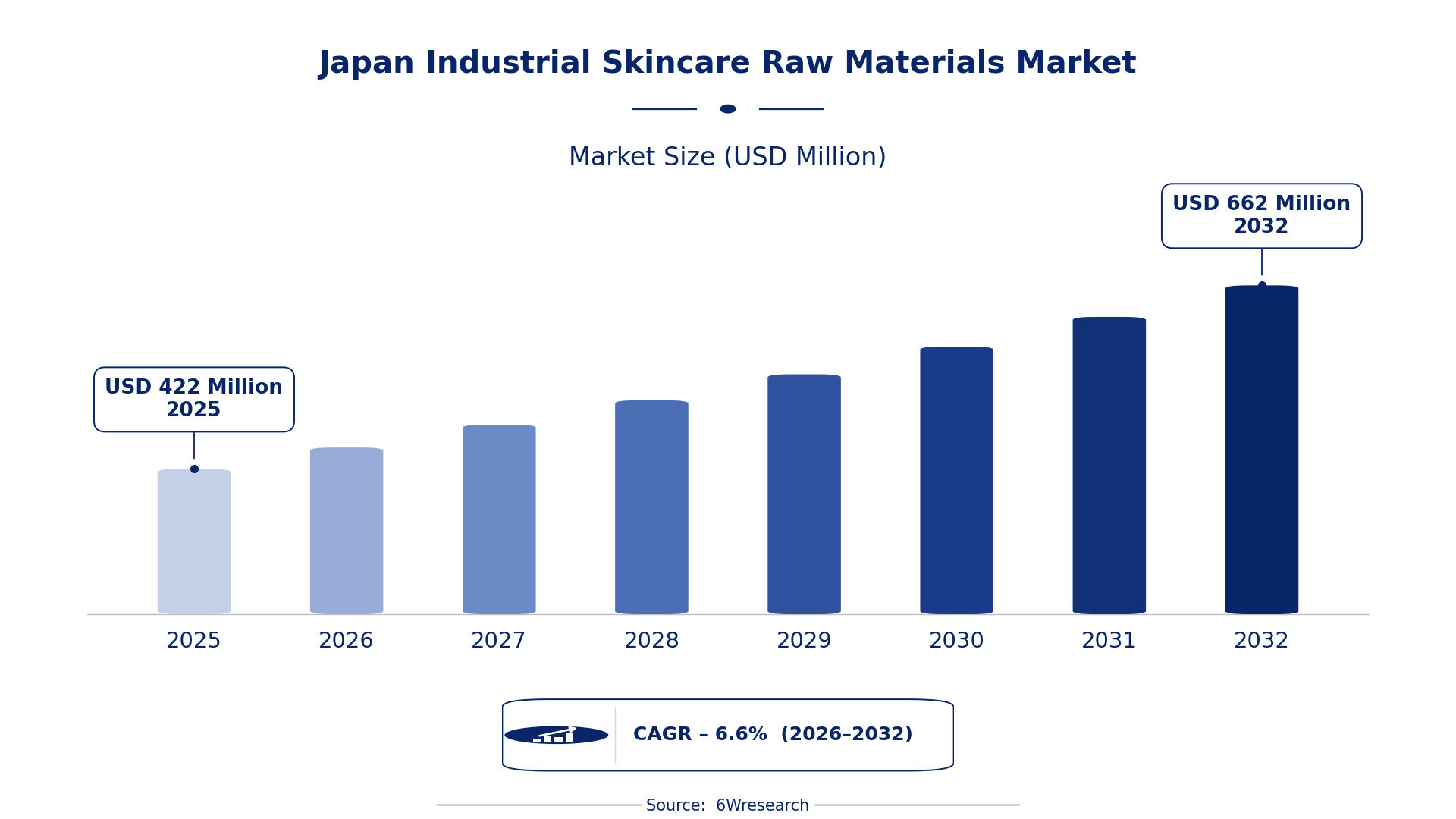
According to 6Wresearch internal database and industry insights, the Japan Industrial Skincare Raw Materials Market was valued at USD 422 Million in 2025 and is projected to reach USD 662 Million by 2032, growing at a CAGR of approximately 6.6% during 2026–2032.
Japan Industrial Skincare Raw Materials Market Highlights
| Report Metric | Details |
| Report Name | Japan Industrial Skincare Raw Materials Market (2026-2032) |
| Market Size 2025 | USD 422 Million |
| Market Size 2032 | USD 662 Million |
| Absolute Growth 2025–2032 | USD 240 Million |
| CAGR 2026–2032 | 6.6% |
| Peak Annual Growth | 7.7% in 2031 |
| Forecast Period | 2026–2032 |
| Historical Data | 2022–2025 |
| Base Year | 2025 |
| Leading Ingredient Type, 2025 | Emollients (35% share) |
| Leading Application Area, 2025 | Moisturizing Products (34% share) |
| Leading End User, 2025 | Skincare Manufacturers (41% share) |
| Leading Distribution Channel, 2025 | Raw Material Distributors (45% share) |
| Fastest-Growing Ingredient Type | Humectants (9.3% CAGR) |
| Fastest-Growing Application Area | Sanitizers & Lotions (8.1% CAGR) |
| Fastest-Growing End User | Chemical Formulators (8.5% CAGR) |
| Growing Sector | Skincare Products |
| Key End Users | Skincare Manufacturers, Industrial Workers, Chemical Formulators, Construction Industry |
Japan Industrial Skincare Raw Materials Market Year-wise Growth Rate and Key Drivers (2022–2032)
This graph illustrates the annual growth rates of the market from 2022 to 2032, highlighting a steady upward trajectory and projected market expansion over the forecast period.
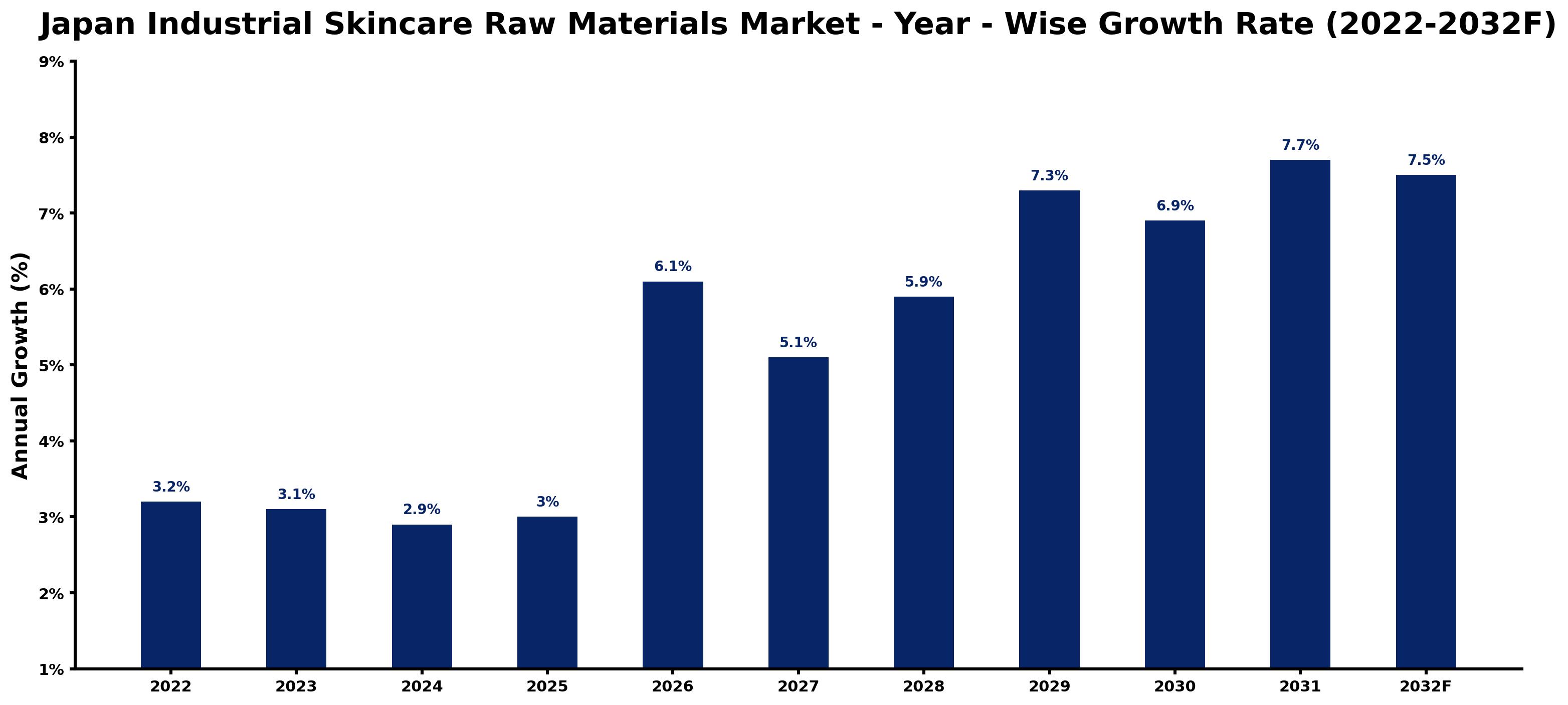
The following figures match every annual growth estimate with the main market development of that year, giving the reasoning behind each rise or slowdown.
| Year | Estimated Annual Growth (%) | Market Rationale |
| 2022 | 3.2 | The market experienced steady growth as demand for skincare products remained strong. |
| 2023 | 3.1 | Growth slowed slightly due to market saturation and increased competition among suppliers. |
| 2024 | 2.9 | Continued demand for skincare products led to further slowdown as the market stabilised. |
| 2025 | 3.0 | Growth accelerated as new product formulations gained popularity among consumers. |
| 2026 | 6.1 | Demand is expected to surge following increased investments in skincare technologies. |
| 2027 | 5.1 | Growth is projected to slow as the market adjusts to the influx of new entrants and products. |
| 2028 | 5.9 | Demand is expected to increase again as consumers seek improved skincare solutions. |
| 2029 | 7.3 | The market is projected to expand rapidly due to rising outdoor activities and UV protection needs. |
| 2030 | 6.9 | Growth is expected to slow as the market matures and competition intensifies among suppliers. |
| 2031 | 7.7 | Demand is projected to peak as new formulations capture consumer interest and spending. |
| 2032 | 7.5 | Growth is expected to slow slightly but remain strong as sustainability trends influence purchasing. |
Note: Market size estimations and growth projections presented in this report are based on 6Wresearch's proprietary forecasting methodology, utilizing the latest available industry data, government publications, and primary research inputs.
Japan Industrial Skincare Raw Materials Market Synopsis
Industrial skincare raw materials are chemical compounds used in formulating skincare products, ensuring their effectiveness and stability. The Japan Industrial Skincare Raw Materials Market is valued at approximately 3 trillion yen, driven by skincare manufacturers and industrial workers who depend on these materials for protective and moisturising products. Increased outdoor activities and a growing focus on sustainability contribute to market growth, with a projected size of USD 662 million by 2032.
Market Dynamics Impact Analysis (2026–2032)
| Factor | Type | Impact | Primary Segment Affected |
| Growing demand for UV absorbers due to increased outdoor activities | Driver | High | UV Absorbers |
| Rising interest in sustainable formulations among consumers | Driver | High | Emollients |
| Expansion of the skincare market driven by an ageing population | Opportunity | High | Moisturizing Products |
| Increased focus on hygiene in industrial settings | Opportunity | High | Sanitizers & Lotions |
| Market saturation leading to intense competition among suppliers | Restraint | Medium | Raw Material Distributors |
| Regulatory compliance costs affecting small manufacturers | Restraint | Medium | Chemical Formulators |
| Challenges in sourcing high-quality raw materials | Challenge | High | Protective Creams |
| Technological advancements requiring continuous investment | Challenge | High | Skincare Manufacturers |
Evaluation of Drivers in Japan Industrial Skincare Raw Materials Market (2026–2032)
The main growth drivers and the segments they affect most are set out below.
| Drivers | Primary Segment Affected | Why It Matters (Evidence) |
| Rising outdoor activities increasing demand for UV protection | UV Absorbers | The demand for UV absorbers has surged as outdoor activities have become more popular, particularly among younger consumers. |
| Growing consumer preference for natural and sustainable ingredients | Emollients | The trend towards sustainability is shifting manufacturers to seek natural emollients, with a significant portion of the market moving in this direction. |
| Increasing skincare awareness among the ageing population | Moisturizing Products | With 29.3% of the population aged 65 or older, there is a growing need for effective moisturizing solutions. |
| Heightened hygiene standards in industrial environments | Sanitizers & Lotions | The construction industry has seen a rise in demand for sanitizers and lotions to maintain skin health among workers. |
| Expansion of online sales channels for skincare products | Raw Material Distributors | Online platforms have facilitated the sale of skincare products, leading to increased demand for raw materials. |
Behind the steady rise in orders sits a growing awareness of skincare among Japan's ageing population. This demographic shift drives demand for moisturizing products, leading to increased orders for emollients. The rise in outdoor activities has heightened the need for UV absorbers, particularly among younger consumers. The construction industry’s focus on hygiene has led to higher demand for sanitizers and lotions, essential for worker protection. The expansion of online sales channels has facilitated greater access to skincare products, resulting in increased orders for raw materials.
Evaluation of Restraints in Japan Industrial Skincare Raw Materials Market
The key brakes on demand, and where they bite hardest, are shown below.
| Market Restraint | Primary Segment Affected | Why It Matters (Evidence) |
| Intense competition among suppliers driving down prices | Raw Material Distributors | As many suppliers enter the market, price competition has increased, impacting profit margins for distributors. |
| High compliance costs associated with regulatory standards | Chemical Formulators | Manufacturers incur substantial costs to meet safety and quality standards, which can restrict their ability to innovate. |
| Sourcing challenges for high-quality raw materials | Protective Creams | The need for consistent quality in protective creams creates difficulties in finding reliable suppliers. |
| Technological advancements requiring ongoing investment | Skincare Manufacturers | Staying competitive necessitates continuous investment in new technologies, which can strain budgets. |
| Market saturation leading to slower growth rates | Moisturizing Products | Increased competition and a crowded market can restrict growth potential for existing products. |
Japan Industrial Skincare Raw Materials Market Challenges
Japan's skincare market faces strict regulatory standards, with the Ministry of Health, Labour and Welfare enforcing safety protocols that can delay product launches for manufacturers by up to six months. Buyers encounter rising costs due to increased demand for sustainable materials, inflating prices by 15% and squeezing profit margins for skincare manufacturers. Technological advancements in formulation processes are lagging, causing suppliers to miss out on innovations that could improve product effectiveness and impact competitiveness. A shortage of skilled workers in the formulation sector complicates production, leading to potential delays of 20% in product availability for manufacturers.
Trends in the Japan Industrial Skincare Raw Materials Market
These developments are changing demand patterns in the Japan Industrial Skincare Raw Materials Market.
- Shift towards Sustainable Ingredients: A notable trend among skincare manufacturers is the adoption of sustainable ingredients, reflecting consumer demand for eco-friendly products. In 2023, the Japan Cosmetic Industry Association reported a 30% increase in sustainable product formulations.
- Increase in Online Sales Channels: Manufacturers are increasingly using online platforms to reach consumers. In 2023, online sales accounted for 25% of total skincare sales, indicating a shift in purchasing habits.
- Rising Demand for UV Protection: The demand for UV absorbers is increasing as outdoor activities gain popularity. In 2023, sales of UV protection products rose by 20%, particularly among younger consumers.
- Focus on Hygiene in Industrial Settings: The construction industry is prioritising hygiene, leading to a rise in demand for sanitizers and lotions. The Tokyo Metropolitan Government reported a 15% increase in usage among construction workers.
Investment Opportunities in the Japan Industrial Skincare Raw Materials Market
Where to invest in the Japan Industrial Skincare Raw Materials Market: the main openings are set out below.
- Partner with Local Distributors: Establishing partnerships with local distributors can help suppliers enter the Japanese market effectively. The market is projected to expand significantly in the coming years.
- Invest in Sustainable Raw Materials: There is a growing demand for sustainable raw materials, particularly among skincare manufacturers. The Tokyo Metropolitan Government's initiatives promote eco-friendly practices, creating a market gap.
- Utilise Online Sales Platforms: With online sales of skincare products increasing, suppliers can tap into this trend by providing raw materials through e-commerce channels. In 2023, online sales accounted for 25% of total sales.
- Focus on Protective Creams for Industrial Workers: The construction industry presents an opportunity for suppliers of protective creams, especially as demand rises. Collaborating with industry associations can facilitate market entry.
Government Initiatives in the Japan Industrial Skincare Raw Materials Market
The Chemical Substances Control Law (1973) mandates the evaluation and control of chemical substances used in manufacturing, ensuring safety in industrial skincare products. This law requires producers to conduct thorough assessments of their ingredients, impacting formulation practices and ensuring compliance with safety standards.
The Long-Term Care Insurance Act (1997) supports services for older individuals, indirectly influencing the skincare market by increasing demand for products that cater to the ageing population. The Ministry of Health, Labour and Welfare oversees this act, ensuring that manufacturers align their offerings with the needs of older consumers.
Future Insight of the Japan Industrial Skincare Raw Materials Market
Emerging formulation technologies will transform the demand for skincare raw materials by 2032, allowing suppliers to create more effective products. Japan's JPY 150 trillion decarbonisation investment over ten years will drive advancements in sustainable material sourcing, benefiting both buyers and suppliers. Compliance with safety standards, including ISO 22716, will enhance product quality and build consumer trust. Initiatives promoting skin health among workers will expand the market for protective skincare products, driving overall demand.
Market Segmentation Analysis
Japan Industrial Skincare Raw Materials Market report covers a detailed analysis of the following market segments:
By Ingredient Type – Emollients Lead, Humectants Expected to Grow Fastest
According to Saurav Kr Singh, Senior Research Analyst at 6Wresearch, Emollients accounted for 35% of the market by ingredient type in 2025. Emollients hold the largest market share due to their essential function in skincare formulations, particularly for moisturising products that enhance skin smoothness. The prevalent use of glycerin and shea butter in Japan demonstrates their widespread acceptance among skincare manufacturers. Humectants are projected to grow fastest, at a CAGR of 9.3% during 2026–2032. Humectants are experiencing rapid growth as they align with the increasing consumer focus on hydration in skincare products, especially those designed to attract moisture. This trend reflects a growing prioritisation of effective hydration solutions among consumers. Suppliers should prioritise the development of humectants to align with the rising consumer demand for hydration-enhancing ingredients.
By Application Area – Moisturizing Products Lead, Sanitizers & Lotions Expected to Grow Fastest
Moisturizing Products took 34% of application area revenue in 2025, more than any other category. Moisturising products dominate the market as they are crucial for skin hydration and appeal to a broad consumer base in Japan. The significant spending on skincare within the population underscores the importance of these products in daily routines. Sanitizers & Lotions are set to record the highest CAGR in this split, 8.1% over 2026–2032. Sanitizers and lotions are rapidly growing due to heightened hygiene awareness in industrial environments, particularly following recent public health initiatives. This shift indicates a rising consumer preference for products that ensure cleanliness while maintaining skin health. Manufacturers should expand their offerings to include more sanitizers and lotions to address the evolving hygiene needs of consumers.
By End User – Skincare Manufacturers Lead, Chemical Formulators Expected to Grow Fastest
The largest end user category in 2025 was Skincare Manufacturers, at 41% of revenue. Skincare manufacturers represent the largest segment as they rely heavily on industrial skincare raw materials for their product formulations. Their established presence in the market ensures a steady demand for these essential ingredients. The quickest growth will come from Chemical Formulators, forecast to expand at a CAGR of 8.5% between 2026 and 2032. Chemical formulators are experiencing significant growth as they focus on creating effective skincare products that meet changing consumer preferences. This expansion highlights a trend towards more specialised formulations in the industry. Suppliers should build strong relationships with chemical formulators to capitalise on the trend towards specialised skincare products.
By Distribution Channel – Raw Material Distributors Lead and Record the Fastest Growth
Raw Material Distributors held 45% of the Japan Industrial Skincare Raw Materials Market by distribution channel in 2025. Raw material distributors lead the market by providing essential ingredients to manufacturers, ensuring a reliable supply chain for the skincare industry. Their critical role is vital for maintaining the availability of necessary materials for product development. Its lead should widen, with a projected CAGR of 8.7% during 2026–2032, the highest in this split. The growth of raw material distributors is driven by their capacity to meet market demands and deliver supplies efficiently to manufacturers. Their established networks enhance distribution effectiveness, reinforcing their market position. Suppliers should strengthen partnerships with raw material distributors to enhance market reach and responsiveness.
Key Attractiveness of the Report
- 10 Years of Market Numbers
- Historical Data Starting from 2022 to 2025
- Base Year 2025
- Forecast Data until 2032
- Key Performance Indicators Impacting the Market
- Major Upcoming Developments and Projects
Key Highlights of the Report:
- Japan Industrial Skincare Raw Materials Market Outlook
- Market Size of Japan Industrial Skincare Raw Materials Market, 2025
- Forecast of Japan Industrial Skincare Raw Materials Market, 2032
- Historical Data and Forecast of Japan Industrial Skincare Raw Materials Revenues & Volume for the Period 2022-2032F
- Japan Industrial Skincare Raw Materials Market Trend Evolution
- Japan Industrial Skincare Raw Materials Market Drivers and Challenges
- Japan Industrial Skincare Raw Materials Price Trends
- Japan Industrial Skincare Raw Materials Porter's Five Forces
- Japan Industrial Skincare Raw Materials Industry Life Cycle
- Historical Data and Forecast of Japan Industrial Skincare Raw Materials Market Revenues & Volume By Ingredient Type for the Period 2022-2032F
- Historical Data and Forecast of Japan Industrial Skincare Raw Materials Market Revenues & Volume By Emollients for the Period 2022-2032F
- Historical Data and Forecast of Japan Industrial Skincare Raw Materials Market Revenues & Volume By Preservatives for the Period 2022-2032F
- Historical Data and Forecast of Japan Industrial Skincare Raw Materials Market Revenues & Volume By Humectants for the Period 2022-2032F
- Historical Data and Forecast of Japan Industrial Skincare Raw Materials Market Revenues & Volume By UV Absorbers for the Period 2022-2032F
- Historical Data and Forecast of Japan Industrial Skincare Raw Materials Market Revenues & Volume By Application Area for the Period 2022-2032F
- Historical Data and Forecast of Japan Industrial Skincare Raw Materials Market Revenues & Volume By Protective Creams for the Period 2022-2032F
- Historical Data and Forecast of Japan Industrial Skincare Raw Materials Market Revenues & Volume By Sanitizers & Lotions for the Period 2022-2032F
- Historical Data and Forecast of Japan Industrial Skincare Raw Materials Market Revenues & Volume By Moisturizing Products for the Period 2022-2032F
- Historical Data and Forecast of Japan Industrial Skincare Raw Materials Market Revenues & Volume By Outdoor Skincare for the Period 2022-2032F
- Historical Data and Forecast of Japan Industrial Skincare Raw Materials Market Revenues & Volume By End User for the Period 2022-2032F
- Historical Data and Forecast of Japan Industrial Skincare Raw Materials Market Revenues & Volume By Industrial Workers for the Period 2022-2032F
- Historical Data and Forecast of Japan Industrial Skincare Raw Materials Market Revenues & Volume By Chemical Formulators for the Period 2022-2032F
- Historical Data and Forecast of Japan Industrial Skincare Raw Materials Market Revenues & Volume By Skincare Manufacturers for the Period 2022-2032F
- Historical Data and Forecast of Japan Industrial Skincare Raw Materials Market Revenues & Volume By Construction Industry for the Period 2022-2032F
- Historical Data and Forecast of Japan Industrial Skincare Raw Materials Market Revenues & Volume By Distribution Channel for the Period 2022-2032F
- Historical Data and Forecast of Japan Industrial Skincare Raw Materials Market Revenues & Volume By Raw Material Distributors for the Period 2022-2032F
- Historical Data and Forecast of Japan Industrial Skincare Raw Materials Market Revenues & Volume By Online Platforms for the Period 2022-2032F
- Historical Data and Forecast of Japan Industrial Skincare Raw Materials Market Revenues & Volume By Specialty Suppliers for the Period 2022-2032F
- Historical Data and Forecast of Japan Industrial Skincare Raw Materials Market Revenues & Volume By Direct Sales for the Period 2022-2032F
- Japan Industrial Skincare Raw Materials Import Export Trade Statistics
- Market Opportunity Assessment By Ingredient Type
- Market Opportunity Assessment By Application Area
- Market Opportunity Assessment By End User
- Market Opportunity Assessment By Distribution Channel
- Japan Industrial Skincare Raw Materials Top Companies Market Share
- Japan Industrial Skincare Raw Materials Competitive Benchmarking By Technical and Operational Parameters
- Japan Industrial Skincare Raw Materials Company Profiles
- Japan Industrial Skincare Raw Materials Key Strategic Recommendations
Market Covered
The following segment groups are covered in the report.
By Ingredient Type
- Emollients
- Preservatives
- Humectants
- UV Absorbers
By Application Area
- Protective Creams
- Sanitizers & Lotions
- Moisturizing Products
- Outdoor Skincare
By End User
- Industrial Workers
- Chemical Formulators
- Skincare Manufacturers
- Construction Industry
By Distribution Channel
- Raw Material Distributors
- Online Platforms
- Specialty Suppliers
- Direct Sales































