Japan Infrared Imaging Market Size, Share & Growth Rate
The Japan Infrared Imaging Market was estimated at USD 221 Million in 2025 and is projected to reach USD 237 Million by 2032, growing at a CAGR of 1.0% from 2026 to 2032. This growth trajectory is primarily fueled by the increasing demand for non-invasive medical diagnostics, advanced surveillance systems, and automotive applications. Furthermore, ongoing technological innovations, particularly in high-resolution imaging and sensor technology, are enhancing the operational capabilities of infrared imaging devices.
Japan Infrared Imaging Market Year-wise Growth Rate and Key Drivers
This graph highlights how the Japan Infrared Imaging Market has steadily grown over the years, supported by major growth factors.
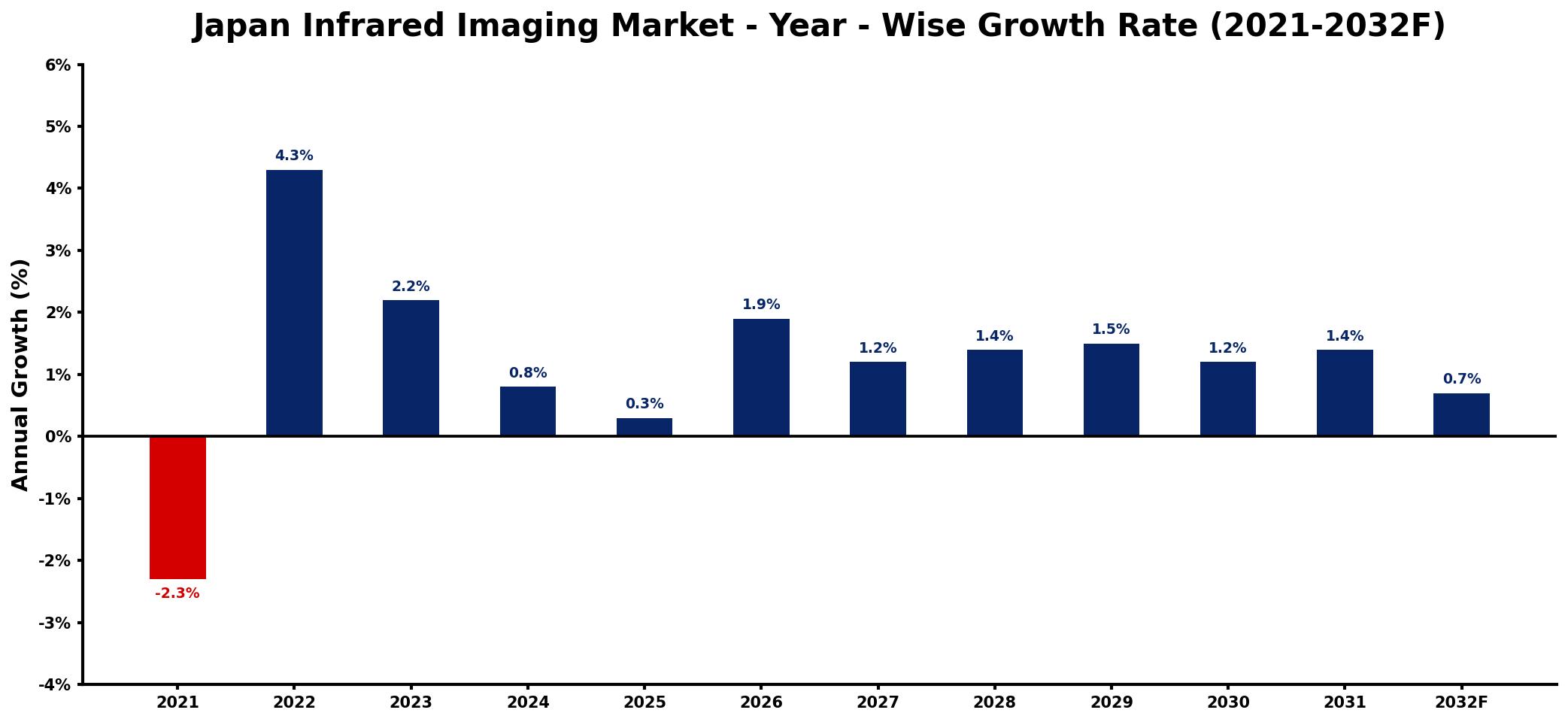
The table below presents the year‑wise growth rates along with the key drivers influencing the market
| Year | Growth Rate | Major Drivers |
| 2021 | -2.3% | decreased investments in healthcare technologies |
| 2022 | 4.3% | increased demand from industrial sectors |
| 2023 | 2.2% | growing adoption in security applications |
| 2024 | 0.8% | expansion of renewable energy projects |
| 2025 | 0.3% | rising interest in automation technologies |
| 2026 | 1.9% | enhanced funding for research initiatives |
| 2027 | 1.2% | growing awareness of energy efficiency |
| 2028 | 1.4% | increased utilization in agricultural practices |
| 2029 | 1.5% | strengthening international trade flows |
| 2030 | 1.2% | growing integration with IoT devices |
| 2031 | 1.4% | rising investments in defense technologies |
| 2032 | 0.7% | increased focus on environmental monitoring |
Note: Market size estimations and growth projections presented in this report are based on 6Wresearch's proprietary forecasting methodology, utilizing the latest available industry data, government publications, and primary research inputs.
Japan Infrared Imaging Market Synopsis
The Japan Infrared Imaging Market is experiencing a notable shift as industries recognize the vital role of thermal imaging in security and medical applications. As stakeholders seek more effective surveillance solutions and precise diagnostic tools, the market continues to expand in both scope and sophistication.
Recent advancements in infrared technology, such as smaller and more affordable sensors, are democratizing access to these systems. With the integration of artificial intelligence and machine learning, infrared imaging capabilities are evolving, providing enhanced analytical power and automation across various sectors.
Japan Infrared Imaging Market Key Takeaways
- Significant growth in the market driven by demand in healthcare, automotive, and defense sectors.
- Technological advancements are making infrared imaging systems more effective and accessible.
- Integration with AI and machine learning is enhancing the capabilities of thermal imaging solutions.
- Government initiatives are supporting research and development in infrared technology.
- High initial costs and skilled labor shortages present challenges in market growth.
Evaluation of Restraints in Japan Infrared Imaging Market
Despite the promising outlook, the Japan Infrared Imaging Market faces several limitations that may hinder its growth. One primary concern is the high initial investment required for quality infrared imaging equipment, which may deter smaller enterprises from adopting this technology. Additionally, there is a noted scarcity of professionals skilled in operating and maintaining such sophisticated systems. This skills gap not only hampers effective utilization but also places operational pressure on existing personnel. Furthermore, regulatory constraints in sectors like healthcare and defense impose stringent guidelines that complicate market entry and expansion.
Japan Infrared Imaging Market Trends
A notable trend in the Japan Infrared Imaging Market is the increasing resolution and sensitivity of infrared cameras, which are crucial for applications in night vision and security monitoring. The demand for improved thermal imaging technology is also evident as industries seek to enhance operational efficiency and data accuracy. Moreover, the growing emphasis on integrating infrared imaging with cutting-edge technologies, such as AI and machine learning, reflects a push towards automation and smarter analytics. This convergence is expected to redefine the capabilities of infrared imaging in real-time applications.
Japan Infrared Imaging Market Opportunities
The expansion of the Japan Infrared Imaging Market presents numerous investment opportunities, particularly for entities engaged in developing advanced imaging solutions. Companies specializing in creating innovative infrared sensors and thermal imaging systems are well-positioned to capitalize on the growing demand across various sectors, including aerospace, automotive, and security. Furthermore, investment in research and development aimed at improving the efficiency and functionality of infrared imaging technology could yield substantial returns as market demand continues to rise.
Government Initiatives in the Japan Infrared Imaging Market
The Japanese government has enacted various policies designed to foster the growth of the infrared imaging sector. These initiatives are focused on enhancing national security through advanced surveillance technologies and supporting research and development to encourage innovation within the industry. The government also plays a pivotal role in establishing regulatory frameworks that ensure the safety and reliability of infrared imaging applications in critical sectors, such as healthcare and defense. Such support is vital for maintaining high standards while promoting technological advancements.
Future Insights of the Japan Infrared Imaging Market
Looking ahead to 2026-2032, the Japan Infrared Imaging Market is poised for continuous growth. The increasing adoption of thermal imaging in medical diagnostics, coupled with rising security needs, is expected to drive demand further. As companies invest in R&D, we can anticipate more advanced imaging technologies entering the market. The ongoing convergence of infrared imaging with AI and machine learning will likely enhance operational efficiencies, enabling users to extract greater value from their imaging investments.
Japan Infrared Imaging Market Latest Developments (2025 - 2026)
Recent developments in the Japan Infrared Imaging Market highlight a trend towards more compact and efficient thermal imaging solutions. Industry players are increasingly focusing on innovative product launches that feature enhanced resolution and integration capabilities with other technological systems. Additionally, there have been significant collaborations between private enterprises and governmental bodies aimed at pushing the boundaries of infrared technology research. These movements signal a commitment to leveraging infrared imaging for broader applications across various industries.
Japan Infrared Imaging Market - Key Attractiveness of the Report
- 10 Years of Market Numbers
- Historical Data Starting from 2022 to 2025
- Base Year: 2025
- Forecast Data until 2032
- Key Performance Indicators Impacting the Market
- Major Upcoming Developments and Projects
Key Highlights of the Report:
- Japan Infrared Imaging Market Outlook
- Market Size of Japan Infrared Imaging Market, 2025
- Forecast of Japan Infrared Imaging Market, 2032
- Historical Data and Forecast of Japan Infrared Imaging Revenues & Volume for the Period 2022-2032F
- Japan Infrared Imaging Market Trend Evolution
- Japan Infrared Imaging Market Drivers and Challenges
- Japan Infrared Imaging Price Trends
- Japan Infrared Imaging Porter's Five Forces
- Japan Infrared Imaging Industry Life Cycle
- Historical Data and Forecast of Japan Infrared Imaging Market Revenues & Volume By Technology for the Period 2022-2032F
- Historical Data and Forecast of Japan Infrared Imaging Market Revenues & Volume By Cooled Infrared Imaging for the Period 2022-2032F
- Historical Data and Forecast of Japan Infrared Imaging Market Revenues & Volume By Uncooled Infrared Imaging for the Period 2022-2032F
- Historical Data and Forecast of Japan Infrared Imaging Market Revenues & Volume By Wavelength for the Period 2022-2032F
- Historical Data and Forecast of Japan Infrared Imaging Market Revenues & Volume By Near Infrared for the Period 2022-2032F
- Historical Data and Forecast of Japan Infrared Imaging Market Revenues & Volume By Shortwave Infrared for the Period 2022-2032F
- Historical Data and Forecast of Japan Infrared Imaging Market Revenues & Volume By Mid-wave Infrared for the Period 2022-2032F
- Historical Data and Forecast of Japan Infrared Imaging Market Revenues & Volume By Long-wave Infrared for the Period 2022-2032F
- Historical Data and Forecast of Japan Infrared Imaging Market Revenues & Volume By Application for the Period 2022-2032F
- Historical Data and Forecast of Japan Infrared Imaging Market Revenues & Volume By Security & Surveillance for the Period 2022-2032F
- Historical Data and Forecast of Japan Infrared Imaging Market Revenues & Volume By Monitoring & Inspection for the Period 2022-2032F
- Historical Data and Forecast of Japan Infrared Imaging Market Revenues & Volume By Detection for the Period 2022-2032F
- Historical Data and Forecast of Japan Infrared Imaging Market Revenues & Volume By Vertical for the Period 2022-2032F
- Historical Data and Forecast of Japan Infrared Imaging Market Revenues & Volume By Industrial for the Period 2022-2032F
- Historical Data and Forecast of Japan Infrared Imaging Market Revenues & Volume By Nonindustrial for the Period 2022-2032F
- Japan Infrared Imaging Import Export Trade Statistics
- Market Opportunity Assessment By Technology
- Market Opportunity Assessment By Wavelength
- Market Opportunity Assessment By Application
- Market Opportunity Assessment By Vertical
- Japan Infrared Imaging Top Companies Market Share
- Japan Infrared Imaging Competitive Benchmarking By Technical and Operational Parameters
- Japan Infrared Imaging Company Profiles
- Japan Infrared Imaging Key Strategic Recommendations






































