Japan Internet Security Market Size & Growth Rate
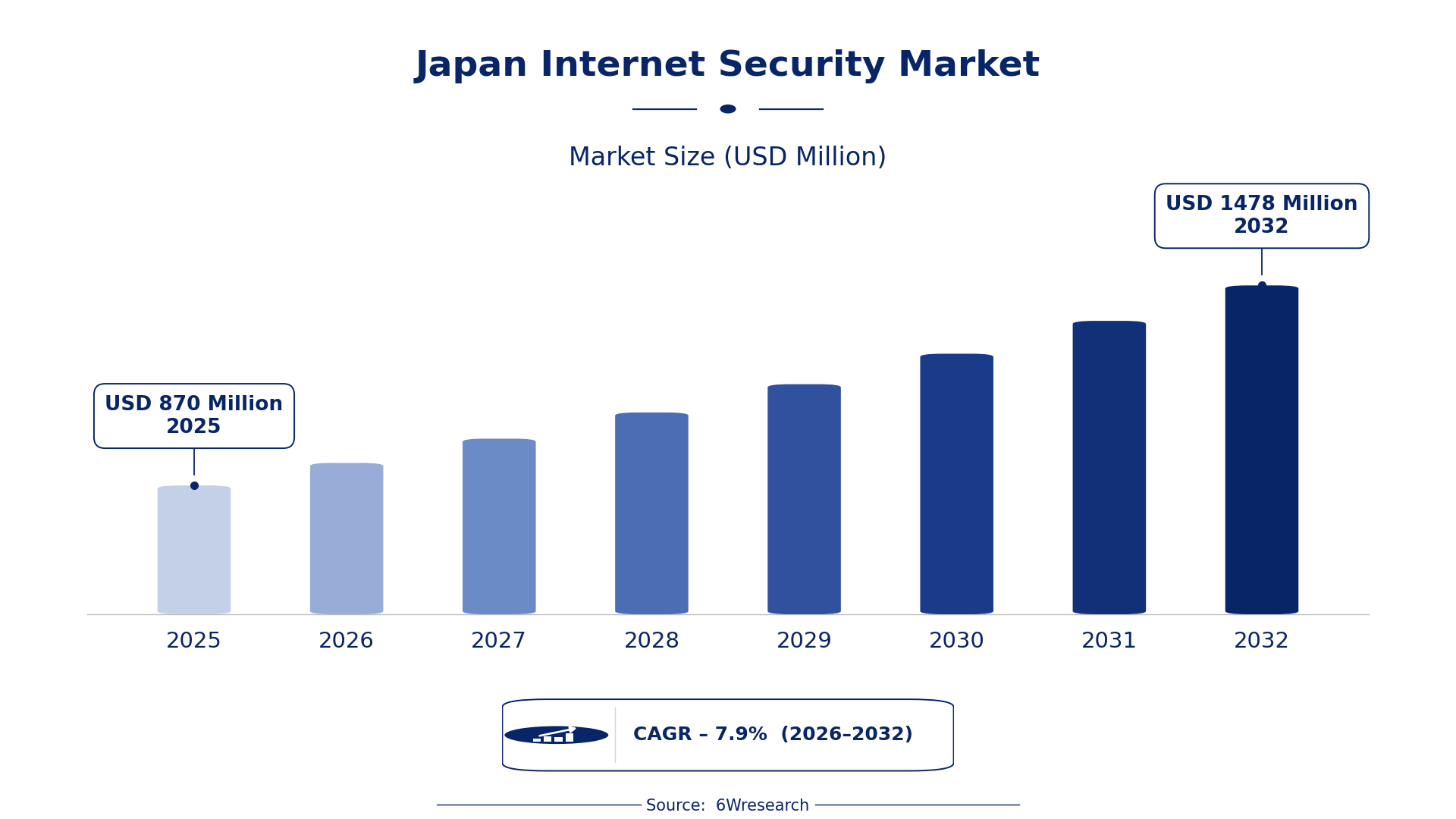
According to 6Wresearch internal database and industry insights, the Japan Internet Security Market was valued at USD 870 Million in 2025 and is projected to reach USD 1,478 Million by 2032, growing at a CAGR of approximately 7.9% during 2026–2032.
Japan Internet Security Market Highlights
| Report Metric | Details |
| Report Name | Japan Internet Security Market (2026-2032) |
| Market Size 2025 | USD 870 Million |
| Market Size 2032 | USD 1,478 Million |
| Absolute Growth 2025–2032 | USD 608 Million |
| CAGR 2026–2032 | 7.9% |
| Peak Annual Growth | 9.4% in 2032 |
| Forecast Period | 2026–2032 |
| Historical Data | 2022–2025 |
| Base Year | 2025 |
| Leading Type, 2025 | Network Layer Security (31% share) |
| Leading Application, 2025 | Government (32% share) |
| Fastest-Growing Type | Internet Protocol Security (11.5% CAGR) |
| Fastest-Growing Application | Banking (11.4% CAGR) |
| Growing Sector | Healthcare |
| Key End Users | Government, Banking, Financial Services and Insurance (BFSI) |
Japan Internet Security Market Year-wise Growth Rate and Key Drivers (2022–2032)
This graph illustrates the annual growth rates of the market from 2022 to 2032, highlighting a steady upward trajectory and projected market expansion over the forecast period.
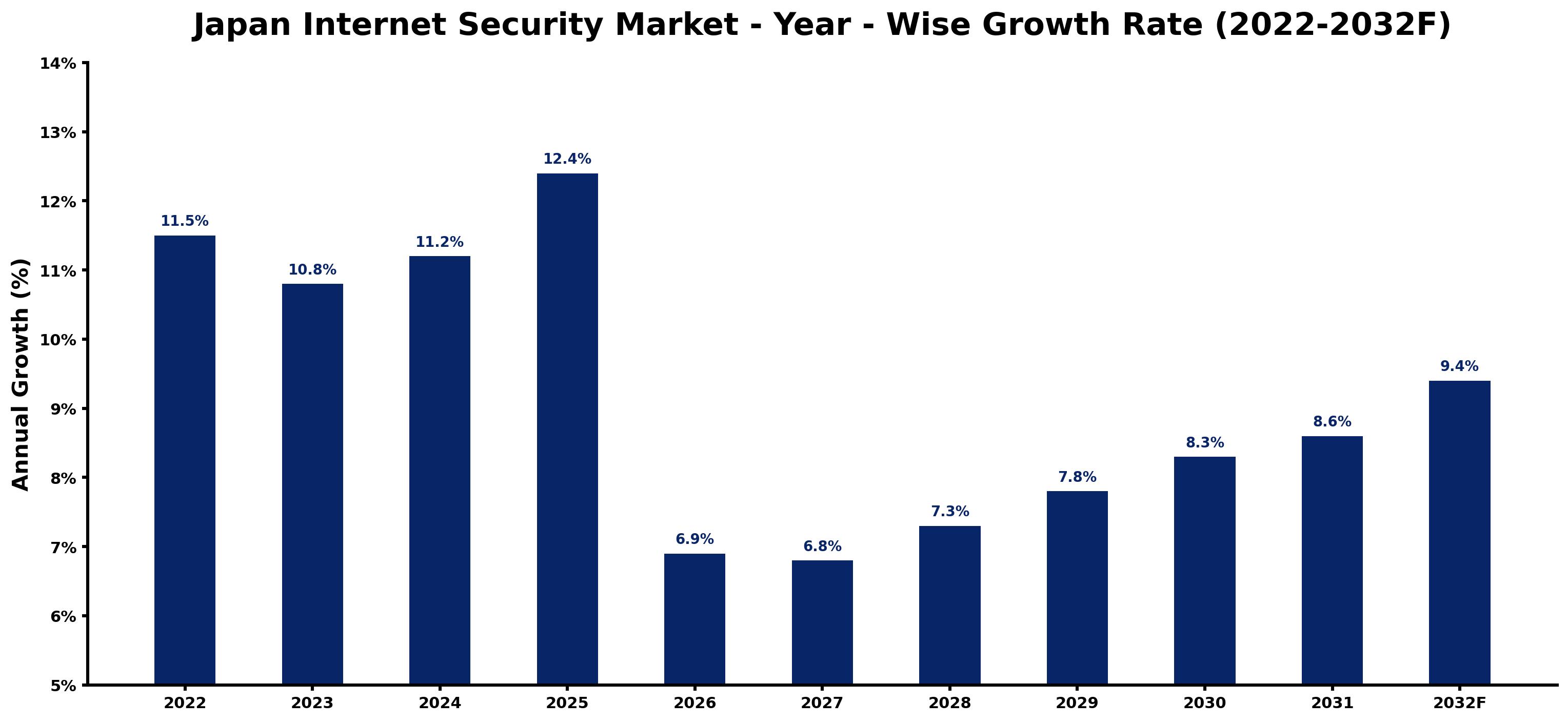
The table below sets out the estimated growth rate for each year and the main factor behind it.
| Year | Estimated Annual Growth (%) | Market Rationale |
| 2022 | 11.5 | The market demonstrated strong activity, driven by increasing cyber threats. |
| 2023 | 10.8 | Growth slowed slightly as businesses adjusted to new cybersecurity measures. |
| 2024 | 11.2 | Demand rose again as companies improved their security protocols. |
| 2025 | 12.4 | A surge in cyber incidents propelled the market to its historical peak. |
| 2026 | 6.9 | Growth is expected to moderate as the market stabilises after rapid expansion. |
| 2027 | 6.8 | Continued investment in security infrastructure will maintain positive growth. |
| 2028 | 7.3 | Demand is projected to increase as more sectors adopt advanced security technologies. |
| 2029 | 7.8 | Cybersecurity investments will rise further, particularly in the banking sector. |
| 2030 | 8.3 | Growth will continue as awareness of digital security risks expands. |
| 2031 | 8.6 | The market will see sustained growth as businesses prioritise cybersecurity. |
| 2032 | 9.4 | A peak in growth is expected, driven by regulatory compliance demands. |
Note: Market size estimations and growth projections presented in this report are based on 6Wresearch's proprietary forecasting methodology, utilizing the latest available industry data, government publications, and primary research inputs.
Japan Internet Security Market Synopsis
Internet security encompasses technologies and practices designed to protect networks, devices, and data from unauthorized access or attacks. The Japan Internet Security Market is growing due to rising cyber threats, with the Tokyo region accounting for 40% of demand. Key growth drivers include increased investments in cybersecurity across sectors like banking and healthcare, alongside the implementation of national strategies to improve security. The adoption of standards such as ISO/IEC 27001 further supports market expansion, ensuring consistent management practices.
Market Dynamics Impact Analysis (2026–2032)
| Factor | Type | Impact | Primary Segment Affected |
| Increasing cyber incidents drive demand for enhanced security measures. | Driver | High | Network Layer Security |
| Adoption of Multi-Factor Authentication boosts security across sectors. | Driver | High | Multi-Factor Authentication |
| Growing investments in cybersecurity offer opportunities for technology providers. | Opportunity | High | Healthcare |
| Rising regulatory compliance demands create a need for security solutions. | Opportunity | High | Banking |
| Limited availability of skilled cybersecurity professionals constrains growth. | Restraint | Medium | Information Communication and Technology (ICT) |
| High costs associated with implementing advanced security measures can deter investments. | Restraint | Medium | Retail |
| Competition among service providers can lead to price wars, affecting profitability. | Challenge | High | Financial Services and Insurance (BFSI) |
| Rapid technological changes require continuous adaptation by providers. | Challenge | Medium | Government |
Evaluation of Drivers in Japan Internet Security Market (2026–2032)
The table below links each growth driver to the segment it affects and the evidence for it.
| Drivers | Primary Segment Affected | Why It Matters (Evidence) |
| Rising number of cyber incidents increases demand for security solutions. | Network Layer Security | Japan reported 10,000 cyber incidents in 2022, prompting businesses to invest in security. |
| Adoption of Multi-Factor Authentication improves transaction security. | Multi-Factor Authentication | With 85% adoption in banking as of 2023, financial institutions are securing transactions. |
| Healthcare sector investments in cybersecurity are expanding rapidly. | Healthcare | Over 100 billion JPY was invested in cybersecurity measures in 2023 to protect patient data. |
| Government initiatives promote cybersecurity awareness and compliance. | Information Communication and Technology (ICT) | The Semiconductor and Digital Industry Strategy implemented in 2021 encourages businesses to adopt effective security measures. |
| ISO/IEC 27001 standard adoption improves information security management. | Information Communication and Technology (ICT) | This widely adopted standard supports companies in establishing effective security protocols. |
Much of the new demand traces back to the increasing number of cyber incidents reported in Japan, which reached 10,000 in 2022. This surge has prompted businesses to invest more in network layer security to protect sensitive data. The healthcare sector, for instance, has invested over 100 billion JPY in cybersecurity measures in 2023, driven by the need to secure patient information. The adoption of multi-factor authentication in banking has reached 85%, improving transaction security and encouraging further investments in cybersecurity solutions. The Semiconductor and Digital Industry Strategy has also played a role in promoting awareness and compliance among businesses, leading to increased demand for security technologies.
Evaluation of Restraints in Japan Internet Security Market
The table below lists the restraints and the evidence behind each.
| Market Restraint | Primary Segment Affected | Why It Matters (Evidence) |
| Shortage of skilled cybersecurity professionals limits service capacity. | Information Communication and Technology (ICT) | With over 300,000 professionals estimated, the demand still outstrips supply, affecting service delivery. |
| High implementation costs deter smaller businesses from investing in security. | Retail | Many retailers face budget constraints, limiting their ability to adopt advanced security measures. |
| Rapid technological changes require constant updates to security systems. | Government | Frequent updates can strain budgets and resources, complicating compliance efforts. |
| Regulatory compliance can be complex and time-consuming for businesses. | Financial Services and Insurance (BFSI) | Navigating regulations set by the Financial Services Agency can delay security upgrades. |
| Market competition may lead to price wars, impacting profitability. | Banking | Intense competition among security providers can drive down prices, affecting margins. |
Japan Internet Security Market Challenges
Producers in Japan's internet security market face rising costs due to over 10,000 reported cyber incidents in 2022, compelling them to invest in urgent protective measures. Competition intensifies as the Tokyo region, responsible for 40% of demand, struggles to differentiate offerings, resulting in procurement delays for buyers. Technology adoption lags in some sectors, leaving sensitive data vulnerable to breaches and increasing risk for firms. Skills shortages persist, with over 300,000 cybersecurity professionals available, yet many lack expertise in critical areas, limiting effective security implementations for organizations.
Trends in the Japan Internet Security Market
Below are the shifts with the largest effect on the Japan Internet Security Market.
- Shift from Traditional to Cloud-Based Security Solutions: Since 2022, there has been a transition to cloud-based security solutions, reflecting a growing trend in the market. The Tokyo Metropolitan Government has initiated programs to support local businesses in adopting these technologies, showcasing the shift towards flexibility and scalability.
- Increased Focus on Multi-Factor Authentication: The adoption of multi-factor authentication has surged, particularly in the banking sector, where it reached 85% in 2023. This change highlights the need for improved security measures to protect sensitive financial transactions.
- Growing Investment in Cybersecurity by Healthcare Sector: The healthcare sector has seen a notable increase in cybersecurity investments, with over 100 billion JPY allocated in 2023. This trend underscores the sector's commitment to safeguarding patient data amidst rising cyber threats.
- Emergence of Cybersecurity Awareness Programs: Since 2020, awareness programs have proliferated across various sectors. The Information Technology Promotion Agency has been instrumental in providing resources for these initiatives, improving overall cybersecurity posture.
Investment Opportunities in the Japan Internet Security Market
The openings below show where demand in the Japan Internet Security Market is visible and how suppliers can enter.
- Investment in Cybersecurity Technologies: With the healthcare sector investing over 100 billion JPY in 2023, there is an opportunity for technology providers to supply advanced security solutions. Collaborating with healthcare institutions can facilitate market entry.
- Supply of Multi-Factor Authentication Solutions: The banking sector's 85% adoption of multi-factor authentication indicates a growing market for security technologies. Providers can partner with financial institutions to improve security measures.
- Development of Cloud-Based Security Solutions: The shift towards cloud-based security solutions presents an opportunity for tech firms. The Tokyo region's demand for flexible security systems can be met through partnerships with local businesses.
- Expansion of Cybersecurity Awareness Programs: With increased focus on cybersecurity awareness, there is a gap for educational services. Collaborating with the Information Technology Promotion Agency can help in reaching a wider audience.
Government Initiatives in the Japan Internet Security Market
The Semiconductor and Digital Industry Strategy, implemented in 2021, strengthens existing laws by mandating stricter compliance measures for businesses. This strategy requires organizations to adopt effective security protocols and report cyber incidents, fostering a culture of security awareness across sectors. The strategy also aims to reduce the number of cyber incidents reported annually, targeting a 20% reduction by 2025.
The Information Technology Promotion Agency oversees the implementation of cybersecurity regulations, ensuring that all financial institutions comply with mandated security measures. This agency also provides resources for training and awareness programs, helping businesses to improve their cybersecurity posture.
Future Insight of the Japan Internet Security Market
By 2032, buyers in Japan's internet security market will experience notable changes as the government enforces stricter compliance measures, enhancing security protocols. Increased funding for cybersecurity innovation from the Ministry of Economy, Trade and Industry will drive technological advancements across various sectors. The adoption of advanced security measures will expand, with the healthcare sector investing over 100 billion JPY in cybersecurity in 2023, setting a precedent for other industries. As investments rise, a more secure digital environment will emerge, benefiting all stakeholders.
Market Segmentation Analysis
Japan Internet Security Market report covers a detailed analysis of the following market segments:
By Type – Network Layer Security Leads, Internet Protocol Security Expected to Grow Fastest
According to Shubham Deep, Research Manager at 6Wresearch, with 31% of type revenue in 2025, Network Layer Security was the largest category. Network Layer Security commands the largest share in Japan as it is crucial for safeguarding data in transit, particularly within government operations where secure communication is vital. The increasing frequency of cyber incidents has made this technology a top priority for many organisations, ensuring its dominant position. Over 2026–2032, Internet Protocol Security is expected to post the fastest growth, at a CAGR of 11.5%. Internet Protocol Security is experiencing rapid growth due to the heightened demand for secure communications across networks, especially as reported cyber incidents rise. This technology's critical role in ensuring operational integrity is propelling its adoption at an accelerated rate, further widening the lead of Network Layer Security. Suppliers should focus on enhancing Internet Protocol Security solutions to meet the escalating demand across various sectors.
By Application – Government Leads, Banking Expected to Grow Fastest
The largest application category in 2025 was Government, at 32% of revenue. The Government sector leads the market as it necessitates strong security measures to protect national infrastructure and sensitive data. The establishment of the Cybersecurity Strategy has reinforced the government's dedication to improving security protocols throughout its operations. The quickest growth will come from Banking, forecast to expand at a CAGR of 11.4% between 2026 and 2032. The Banking sector is growing the fastest as there is an urgent need for advanced security measures to protect financial transactions from increasing cyber threats. The rise in cyber incidents has compelled financial institutions to make substantial investments in cybersecurity solutions, driving rapid growth in this area. Buyers in the banking sector must prioritise acquiring advanced security solutions to effectively protect their operations from escalating cyber threats.
Key Attractiveness of the Report
- 10 Years of Market Numbers
- Historical Data Starting from 2022 to 2025
- Base Year 2025
- Forecast Data until 2032
- Key Performance Indicators Impacting the Market
- Major Upcoming Developments and Projects
Key Highlights of the Report:
- Japan Internet Security Market Outlook
- Market Size of Japan Internet Security Market, 2025
- Forecast of Japan Internet Security Market, 2032
- Historical Data and Forecast of Japan Internet Security Revenues & Volume for the Period 2022-2032
- Japan Internet Security Market Trend Evolution
- Japan Internet Security Market Drivers and Challenges
- Japan Internet Security Price Trends
- Japan Internet Security Porter's Five Forces
- Japan Internet Security Industry Life Cycle
- Historical Data and Forecast of Japan Internet Security Market Revenues & Volume By Type for the Period 2022-2032
- Historical Data and Forecast of Japan Internet Security Market Revenues & Volume By Network Layer Security for the Period 2022-2032
- Historical Data and Forecast of Japan Internet Security Market Revenues & Volume By Internet Protocol Security for the Period 2022-2032
- Historical Data and Forecast of Japan Internet Security Market Revenues & Volume By Multi-Factor Authentication for the Period 2022-2032
- Historical Data and Forecast of Japan Internet Security Market Revenues & Volume By Security Token for the Period 2022-2032
- Historical Data and Forecast of Japan Internet Security Market Revenues & Volume By Electronic Mail Security for the Period 2022-2032
- Historical Data and Forecast of Japan Internet Security Market Revenues & Volume By Firewalls for the Period 2022-2032
- Historical Data and Forecast of Japan Internet Security Market Revenues & Volume By Application for the Period 2022-2032
- Historical Data and Forecast of Japan Internet Security Market Revenues & Volume By Government for the Period 2022-2032
- Historical Data and Forecast of Japan Internet Security Market Revenues & Volume By Banking for the Period 2022-2032
- Historical Data and Forecast of Japan Internet Security Market Revenues & Volume By Financial Services and Insurance (BFSI) for the Period 2022-2032
- Historical Data and Forecast of Japan Internet Security Market Revenues & Volume By Manufacturing for the Period 2022-2032
- Historical Data and Forecast of Japan Internet Security Market Revenues & Volume By Information Communication and Technology (ICT) for the Period 2022-2032
- Historical Data and Forecast of Japan Internet Security Market Revenues & Volume By Retail for the Period 2022-2032
- Historical Data and Forecast of Japan Internet Security Market Revenues & Volume By Healthcare for the Period 2022-2032
- Japan Internet Security Import Export Trade Statistics
- Market Opportunity Assessment By Type
- Market Opportunity Assessment By Application
- Japan Internet Security Top Companies Market Share
- Japan Internet Security Competitive Benchmarking By Technical and Operational Parameters
- Japan Internet Security Company Profiles
- Japan Internet Security Key Strategic Recommendations
Market Covered
The report covers the following segments.
By Type
- Network Layer Security
- Internet Protocol Security
- Multi-Factor Authentication
- Security Token
- Electronic Mail Security
- Firewalls
By Application
- Government
- Banking
- Financial Services and Insurance (BFSI)
- Manufacturing
- Information Communication and Technology (ICT)
- Retail
- Healthcare































