Japan IoT based Asset Tracking and Monitoring Market Size & Growth Rate
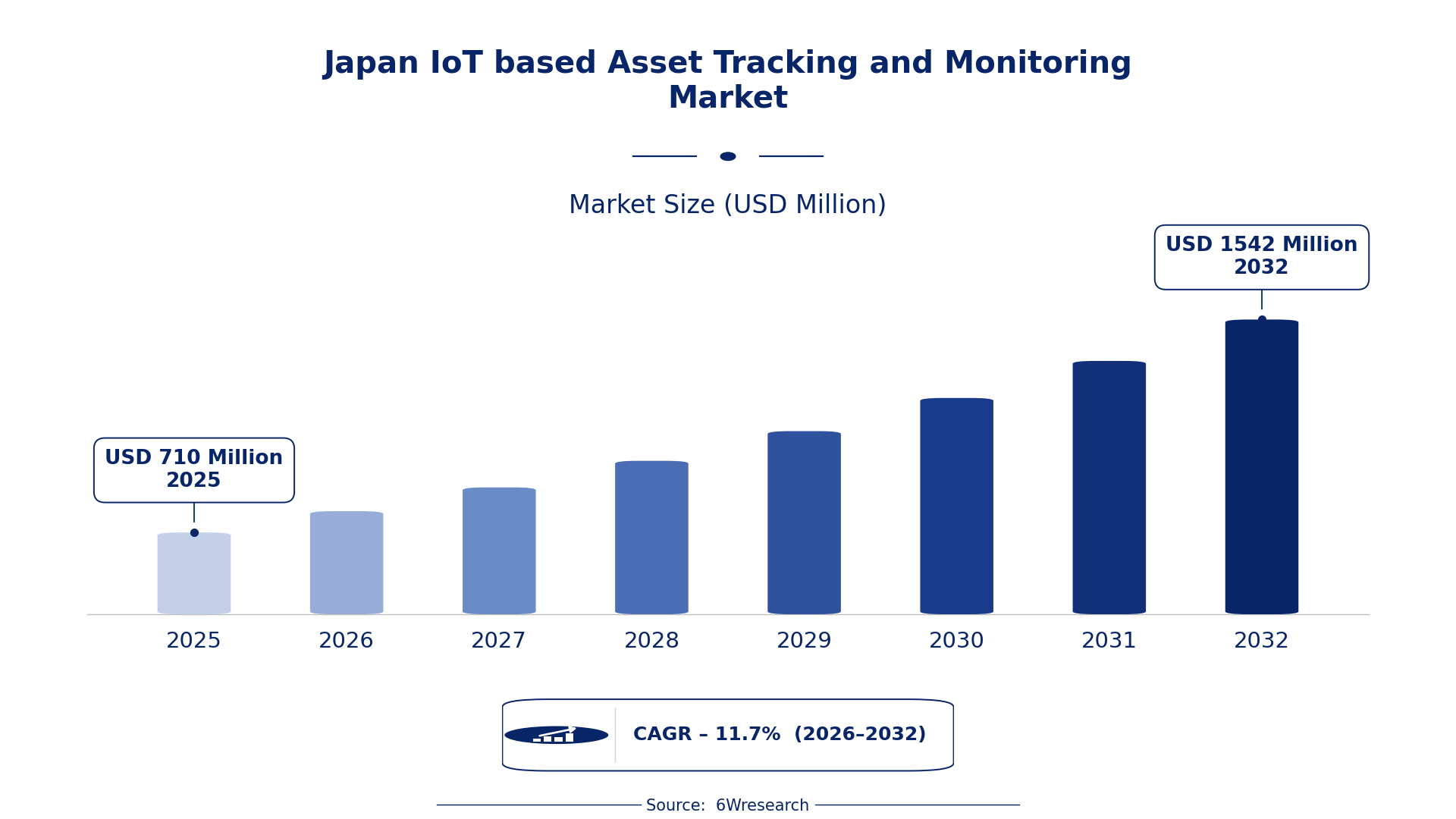
According to 6Wresearch internal database and industry insights, the Japan IoT based Asset Tracking and Monitoring Market was valued at USD 710 Million in 2025 and is projected to reach USD 1,542 Million by 2032, growing at a CAGR of approximately 11.7% during 2026–2032.
Japan IoT based Asset Tracking and Monitoring Market Highlights
| Report Metric | Details |
| Report Name | Japan IoT based Asset Tracking and Monitoring Market (2026-2032) |
| Market Size 2025 | USD 710 Million |
| Market Size 2032 | USD 1,542 Million |
| Absolute Growth 2025–2032 | USD 832 Million |
| CAGR 2026–2032 | 11.7% |
| Peak Annual Growth | 13.1% in 2027 |
| Forecast Period | 2026–2032 |
| Historical Data | 2022–2025 |
| Base Year | 2025 |
| Leading Connectivity Type, 2025 | Cellular (38% share) |
| Leading Application, 2025 | Manufacturing (37% share) |
| Fastest-Growing Connectivity Type | NB-IoT (17.2% CAGR) |
| Fastest-Growing Application | Cold Chain Monitoring (15.9% CAGR) |
| Growing Sector | Logistics |
| Key End Users | Manufacturers, logistics companies, agricultural producers |
Japan IoT based Asset Tracking and Monitoring Market Year-wise Growth Rate and Key Drivers (2022–2032)
This graph illustrates the annual growth rates of the market from 2022 to 2032, highlighting a steady upward trajectory and projected market expansion over the forecast period.
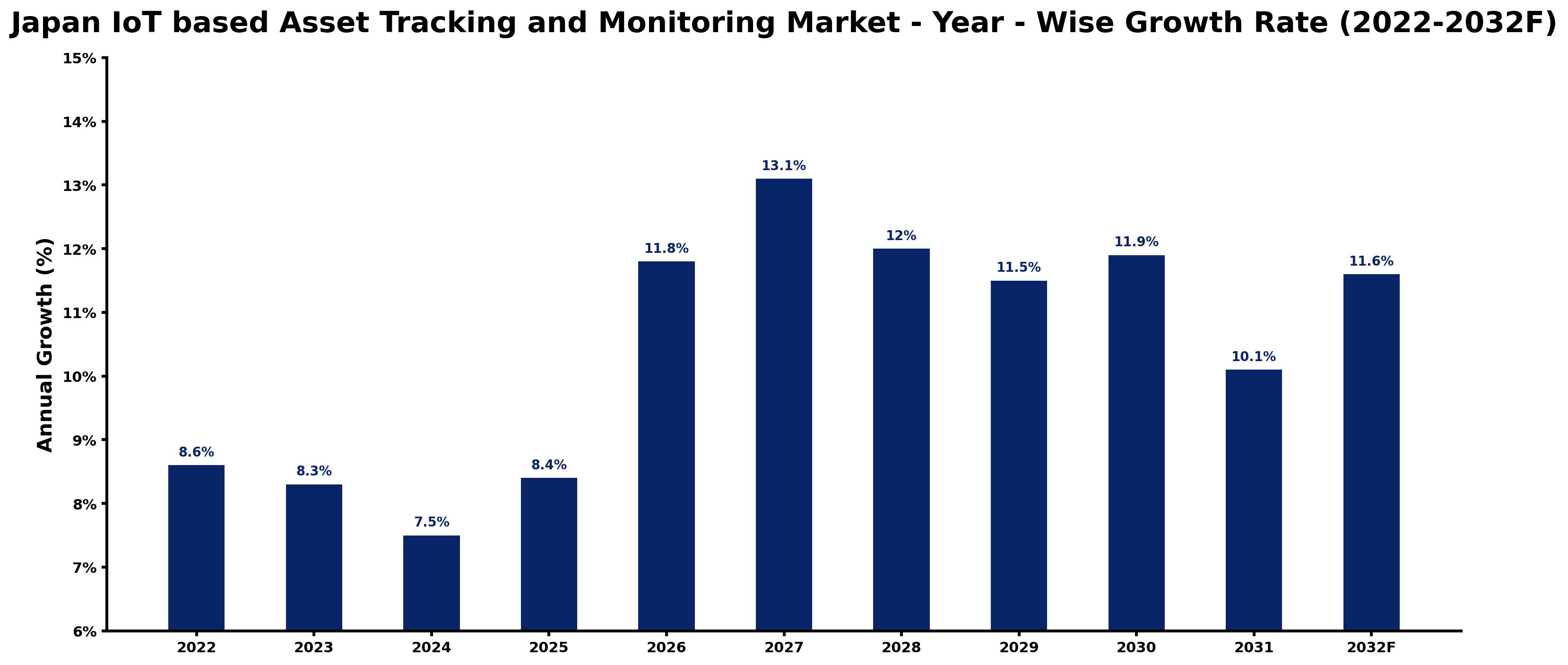
Year by year, the estimates below pair each growth rate with the development that shaped it.
| Year | Estimated Annual Growth (%) | Market Rationale |
| 2022 | 8.6 | The market exhibited stable growth, driven by increased IoT device adoption. |
| 2023 | 8.3 | Growth slowed slightly as logistics companies adjusted their strategies to integrate IoT solutions. |
| 2024 | 7.5 | The market continued to slow as companies focused on optimising existing IoT systems. |
| 2025 | 8.4 | Growth accelerated as manufacturers invested in new IoT technologies to improve productivity. |
| 2026 | 11.8 | Demand surged as logistics companies expanded their IoT capabilities for real-time monitoring. |
| 2027 | 13.1 | The market peaked with significant investments in IoT solutions across various sectors. |
| 2028 | 12.0 | Growth slowed as market saturation began to impact new IoT adoption rates. |
| 2029 | 11.5 | The market continued to experience a slowdown as companies refined their IoT strategies. |
| 2030 | 11.9 | Growth picked up again as new applications for IoT in logistics emerged. |
| 2031 | 10.1 | The market saw a slowdown as competition intensified among IoT solution providers. |
| 2032 | 11.6 | Growth accelerated again as the demand for efficient asset tracking solutions increased. |
Note: Market size estimations and growth projections presented in this report are based on 6Wresearch's proprietary forecasting methodology, utilizing the latest available industry data, government publications, and primary research inputs.
Japan IoT based Asset Tracking and Monitoring Market Synopsis
IoT based Asset Tracking and Monitoring utilises Internet of Things technology to monitor assets in real-time, employing various sensors and connectivity devices. This technology is essential for logistics, inventory management, and monitoring high-value assets. The Japan IoT based Asset Tracking and Monitoring Market is expanding due to over 100 million active IoT devices and strong demand from the logistics sector, which is projected to invest heavily in IoT solutions in the coming years.
Market Dynamics Impact Analysis (2026–2032)
| Factor | Type | Impact | Primary Segment Affected |
| Growing demand for real-time asset visibility in logistics | Driver | High | Cellular |
| Increasing investment in IoT solutions by manufacturers | Driver | High | Manufacturing |
| Rising food safety regulations boosting Cold Chain Monitoring | Opportunity | High | Cold Chain Monitoring |
| Government initiatives promoting IoT adoption in agriculture | Opportunity | Medium | Cellular |
| High initial investment costs for IoT implementation | Restraint | High | Cellular |
| Limited interoperability between different IoT systems | Restraint | Medium | Manufacturing |
| Challenges in data security and privacy concerns | Challenge | High | Cellular |
| Shortage of skilled workforce for IoT deployment | Challenge | Medium | Manufacturing |
Evaluation of Drivers in Japan IoT based Asset Tracking and Monitoring Market (2026–2032)
Key forces behind demand, with the segment each one moves most, are listed below.
| Drivers | Primary Segment Affected | Why It Matters (Evidence) |
| High demand for real-time tracking solutions | Cellular | The logistics industry in Japan is projected to invest heavily in IoT solutions, with over 100 million active IoT devices supporting this trend. |
| Increased automation in manufacturing processes | Manufacturing | Manufacturers accounted for 20% of IoT asset tracking applications in 2022, driving demand for efficient inventory management. |
| Regulatory pressures for food safety | Cold Chain Monitoring | The Cold Chain Monitoring segment is anticipated to grow due to rising food safety regulations. |
| Growth in urban areas necessitating efficient tracking | Bluetooth | The adoption of Bluetooth technology in asset tracking is increasing in urban areas, improving short-range tracking capabilities. |
| Expansion of IoT in transportation | Cellular | The government allocated ¥10 billion for IoT innovation in transportation, boosting investment in tracking solutions. |
A wider customer base explains much of the growth, as logistics companies increasingly demand real-time asset visibility to improve operational efficiency. In 2022, the logistics industry accounted for a large portion of the market, supported by over 100 million active IoT devices. The manufacturing sector also contributes significantly, representing 20% of applications, as companies invest in IoT solutions to optimise inventory management. Urban areas are experiencing a rise in Bluetooth adoption for short-range asset tracking, further expanding market opportunities.
Evaluation of Restraints in Japan IoT based Asset Tracking and Monitoring Market
These restraints slow adoption and weigh on supplier margins.
| Market Restraint | Primary Segment Affected | Why It Matters (Evidence) |
| High initial investment costs for IoT implementation | Cellular | Logistics companies face high costs in deploying IoT systems, which can delay adoption and limit market growth. |
| Limited interoperability between different IoT systems | Manufacturing | Manufacturers struggle with integrating various IoT solutions, hindering overall system efficiency and effectiveness. |
| Concerns over data security and privacy | Cellular | Data security issues can deter companies from fully implementing IoT solutions, affecting market penetration. |
| Shortage of skilled workforce for IoT deployment | Manufacturing | The lack of skilled professionals in IoT technology can slow down implementation and innovation in the sector. |
| Complex regulatory environment for IoT applications | Cellular | Navigating regulatory requirements can complicate IoT deployments, leading to delays and increased costs. |
Japan IoT based Asset Tracking and Monitoring Market Challenges
A critical obstacle in the IoT based asset tracking market is the slow integration of technology. Outdated infrastructure in logistics companies hampers the adoption of new IoT solutions, delaying real-time asset monitoring for buyers. Implementation costs can reach ¥10 million per project, deterring smaller firms from investing and limiting their operational efficiency. A lack of skilled professionals in IoT expertise constrains suppliers' ability to develop effective solutions, resulting in unmet demand for advanced tracking technologies. These issues hinder the growth of the market for all stakeholders involved.
Trends in the Japan IoT based Asset Tracking and Monitoring Market
These developments are changing demand patterns in the Japan IoT based Asset Tracking and Monitoring Market.
- Smart Logistics Initiative Accelerating IoT Adoption: The government aims for 50% adoption of IoT technologies among logistics companies by 2025, enhancing tracking capabilities and operational efficiency. This initiative is expected to drive substantial investments in IoT infrastructure.
- Rise of Cold Chain Monitoring Technologies: Cold Chain Monitoring is gaining traction due to stringent food safety regulations, with the segment projected to grow rapidly. The Ministry of Health, Labour and Welfare supports this trend through enhanced regulatory frameworks.
- Increased Use of GNSS for Outdoor Tracking: The use of GNSS for asset tracking is regulated under the Ministry of Land, Infrastructure, Transport and Tourism, ensuring compliance and reliability in outdoor applications. This regulation supports the growth of outdoor asset tracking solutions.
- Expansion of NB-IoT in Urban Areas: NB-IoT technology is emerging as a preferred solution for low-power, wide-area asset tracking in urban settings. Its adoption is projected to grow by 17.2% CAGR, driven by rising demand for efficient tracking solutions.
Investment Opportunities in the Japan IoT based Asset Tracking and Monitoring Market
The opportunities below stand out in the Japan IoT based Asset Tracking and Monitoring Market for new entrants and existing suppliers.
- Timing for Investment in Cold Chain Monitoring: With rising food safety regulations, now is the time to invest in Cold Chain Monitoring solutions. The logistics industry is actively seeking advanced tracking technologies to comply with these regulations.
- Agricultural Sector's Need for IoT Solutions: The agriculture sector is increasingly adopting IoT technologies, supported by the government's push for IoT utilisation. This presents an opportunity for suppliers to enter the market through partnerships or certifications.
- Tokyo Bay Area as a Logistics Hub: The Tokyo Bay area is a key logistics hub for IoT applications, with significant investments expected. Suppliers can enter this market by collaborating with local logistics companies.
- Entry into Transportation Sector: The recent government allocation of ¥10 billion for IoT innovation in transportation creates opportunities for new entrants. Collaborating with local agencies can facilitate market entry.
Government Initiatives in the Japan IoT based Asset Tracking and Monitoring Market
The GX Promotion Act, adopted in 2023, establishes a legal framework for promoting green technology, including IoT applications. This act complements earlier regulations by providing clearer guidelines for IoT deployment in various sectors, encouraging innovation and investment. It specifically impacts IoT based Asset Tracking and Monitoring by streamlining the approval process for new technologies.
The Ministry of Internal Affairs and Communications funds initiatives to boost IoT adoption, particularly in logistics and agriculture. They approve projects aimed at improving IoT infrastructure, ensuring that companies can access necessary resources for effective implementation. This support is crucial for buyers looking to enhance their asset tracking capabilities.
Future Insight of the Japan IoT based Asset Tracking and Monitoring Market
The logistics sector will undergo notable transformations as 50% of companies embrace IoT solutions by 2025, driven by the Smart Logistics initiative. Government funding of ¥10 billion for IoT innovation will enhance transportation efficiency and promote technology integration. Stricter food safety regulations will stimulate growth in asset monitoring applications, presenting new opportunities for suppliers. Increased collaboration among stakeholders in the IoT sector will facilitate advancements in tracking capabilities, benefiting both buyers and suppliers.
Market Segmentation Analysis
Japan IoT based Asset Tracking and Monitoring Market report covers a detailed analysis of the following market segments:
By Connectivity Type – Cellular Leads, NB-IoT Expected to Grow Fastest
According to Ravi Bhandari, Research Head at 6Wresearch, Cellular held 38% of the Japan IoT based Asset Tracking and Monitoring Market by connectivity type in 2025. Cellular technology commands the largest share because it offers extensive coverage and reliability, making it suitable for tracking assets over long distances. For example, the high number of over 100 million active IoT devices in Japan largely relies on cellular connectivity for effective asset management. The quickest growth will come from NB-IoT, forecast to expand at a CAGR of 17.2% between 2026 and 2032. The growth of NB-IoT is propelled by its effectiveness for low-power, wide-area asset tracking, which is increasingly necessary in urban settings. The government's initiatives to promote IoT adoption in logistics further fuel this segment's rapid expansion. Suppliers should prioritise the development of NB-IoT solutions to cater to the rising demand for efficient tracking in urban logistics.
By Application – Manufacturing Leads, Cold Chain Monitoring Expected to Grow Fastest
The largest application category in 2025 was Manufacturing, at 37% of revenue. The manufacturing sector holds the largest share in the market, accounting for 20% of IoT asset tracking applications in 2022, as it requires effective monitoring of machinery and inventory. This sector's established infrastructure and substantial investments in IoT technologies solidify its dominant position. Cold Chain Monitoring is set to record the highest CAGR in this split, 15.9% over 2026–2032. Cold Chain Monitoring is experiencing rapid growth due to stringent food safety regulations that necessitate precise tracking of temperature-sensitive goods. The government's initiatives to promote IoT adoption in agriculture further accelerate this segment's expansion. Suppliers should prioritise developing solutions tailored for Cold Chain Monitoring to meet the rising demand for compliance and efficiency in the food industry.
Key Attractiveness of the Report
- 10 Years of Market Numbers
- Historical Data Starting from 2022 to 2025
- Base Year 2025
- Forecast Data until 2032
- Key Performance Indicators Impacting the Market
- Major Upcoming Developments and Projects
Key Highlights of the Report:
- Japan IoT based Asset Tracking and Monitoring Market Outlook
- Market Size of Japan IoT based Asset Tracking and Monitoring Market, 2025
- Forecast of Japan IoT based Asset Tracking and Monitoring Market, 2032
- Historical Data and Forecast of Japan IoT based Asset Tracking and Monitoring Revenues & Volume for the Period 2022-2032
- Japan IoT based Asset Tracking and Monitoring Market Trend Evolution
- Japan IoT based Asset Tracking and Monitoring Market Drivers and Challenges
- Japan IoT based Asset Tracking and Monitoring Price Trends
- Japan IoT based Asset Tracking and Monitoring Porter's Five Forces
- Japan IoT based Asset Tracking and Monitoring Industry Life Cycle
- Historical Data and Forecast of Japan IoT based Asset Tracking and Monitoring Market Revenues & Volume By Connectivity Type for the Period 2022-2032
- Historical Data and Forecast of Japan IoT based Asset Tracking and Monitoring Market Revenues & Volume By Wi-Fi for the Period 2022-2032
- Historical Data and Forecast of Japan IoT based Asset Tracking and Monitoring Market Revenues & Volume By Bluetooth for the Period 2022-2032
- Historical Data and Forecast of Japan IoT based Asset Tracking and Monitoring Market Revenues & Volume By Cellular for the Period 2022-2032
- Historical Data and Forecast of Japan IoT based Asset Tracking and Monitoring Market Revenues & Volume By NB-IoT for the Period 2022-2032
- Historical Data and Forecast of Japan IoT based Asset Tracking and Monitoring Market Revenues & Volume By LoRa for the Period 2022-2032
- Historical Data and Forecast of Japan IoT based Asset Tracking and Monitoring Market Revenues & Volume By SigFox for the Period 2022-2032
- Historical Data and Forecast of Japan IoT based Asset Tracking and Monitoring Market Revenues & Volume By UWB for the Period 2022-2032
- Historical Data and Forecast of Japan Wi-Fi IoT based Asset Tracking and Monitoring Market Revenues & Volume By GNSS for the Period 2022-2032
- Historical Data and Forecast of Japan IoT based Asset Tracking and Monitoring Market Revenues & Volume By Application for the Period 2022-2032
- Historical Data and Forecast of Japan IoT based Asset Tracking and Monitoring Market Revenues & Volume By Livestock Monitoring for the Period 2022-2032
- Historical Data and Forecast of Japan IoT based Asset Tracking and Monitoring Market Revenues & Volume By Automotive for the Period 2022-2032
- Historical Data and Forecast of Japan IoT based Asset Tracking and Monitoring Market Revenues & Volume By Railways for the Period 2022-2032
- Historical Data and Forecast of Japan IoT based Asset Tracking and Monitoring Market Revenues & Volume By Aviation for the Period 2022-2032
- Historical Data and Forecast of Japan IoT based Asset Tracking and Monitoring Market Revenues & Volume By Manufacturing for the Period 2022-2032
- Historical Data and Forecast of Japan IoT based Asset Tracking and Monitoring Market Revenues & Volume By Cold Chain Monitoring for the Period 2022-2032
- Historical Data and Forecast of Japan IoT based Asset Tracking and Monitoring Market Revenues & Volume By Others for the Period 2022-2032
- Japan IoT based Asset Tracking and Monitoring Import Export Trade Statistics
- Market Opportunity Assessment By Connectivity Type
- Market Opportunity Assessment By Application
- Japan IoT based Asset Tracking and Monitoring Top Companies Market Share
- Japan IoT based Asset Tracking and Monitoring Competitive Benchmarking By Technical and Operational Parameters
- Japan IoT based Asset Tracking and Monitoring Company Profiles
- Japan IoT based Asset Tracking and Monitoring Key Strategic Recommendations
Market Covered
The study includes the following segmentation.
By Connectivity Type
- Wi-Fi
- Bluetooth
- Cellular
- NB-IoT
- LoRa
- SigFox
- UWB
- GNSS
By Application
- Livestock Monitoring
- Automotive
- Railways
- Aviation
- Manufacturing
- Cold Chain Monitoring
- Others































