Japan IoT Technology Market Size & Growth Rate
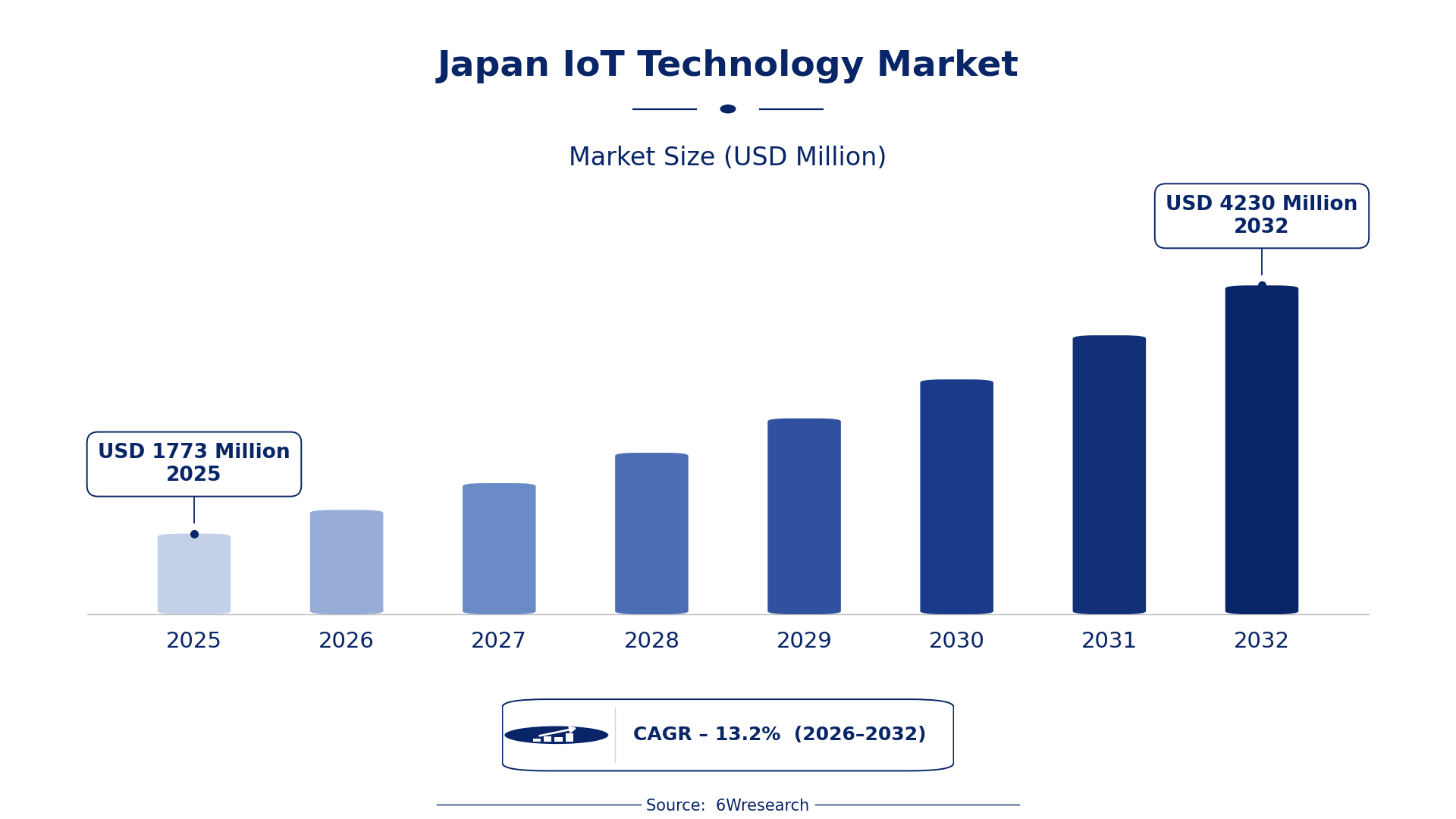
According to 6Wresearch internal database and industry insights, the Japan IoT Technology Market was valued at USD 1,773 Million in 2025 and is projected to reach USD 4,230 Million by 2032, growing at a CAGR of approximately 13.2% during 2026–2032.
Japan IoT Technology Market Highlights
| Report Metric | Details |
| Report Name | Japan IoT Technology Market (2026-2032) |
| Market Size 2025 | USD 1,773 Million |
| Market Size 2032 | USD 4,230 Million |
| Absolute Growth 2025–2032 | USD 2,457 Million |
| CAGR 2026–2032 | 13.2% |
| Peak Annual Growth | 14.9% in 2027 |
| Forecast Period | 2026–2032 |
| Historical Data | 2022–2025 |
| Base Year | 2025 |
| Leading Node Component, 2025 | Processor (33% share) |
| Leading Software Solution, 2025 | Data Management (35% share) |
| Leading Platform, 2025 | Device Management (50% share) |
| Leading Service, 2025 | Professional Services (62% share) |
| Leading End Use, 2025 | Healthcare (31% share) |
| Fastest-Growing Node Component | Connectivity IC (19.0% CAGR) |
| Fastest-Growing Software Solution | Real-Time Streaming Analytics (17.1% CAGR) |
| Fastest-Growing Platform | Application Management (17.7% CAGR) |
| Fastest-Growing Service | Managed Services (16.6% CAGR) |
| Fastest-Growing End Use | Automotive & Transportation (17.9% CAGR) |
| Growing Sector | Healthcare |
| Key End Users | Healthcare providers, automotive manufacturers, agricultural businesses, retail sector |
Japan IoT Technology Market Year-wise Growth Rate and Key Drivers (2022–2032)
This graph illustrates the annual growth rates of the market from 2022 to 2032, highlighting a steady upward trajectory and projected market expansion over the forecast period.
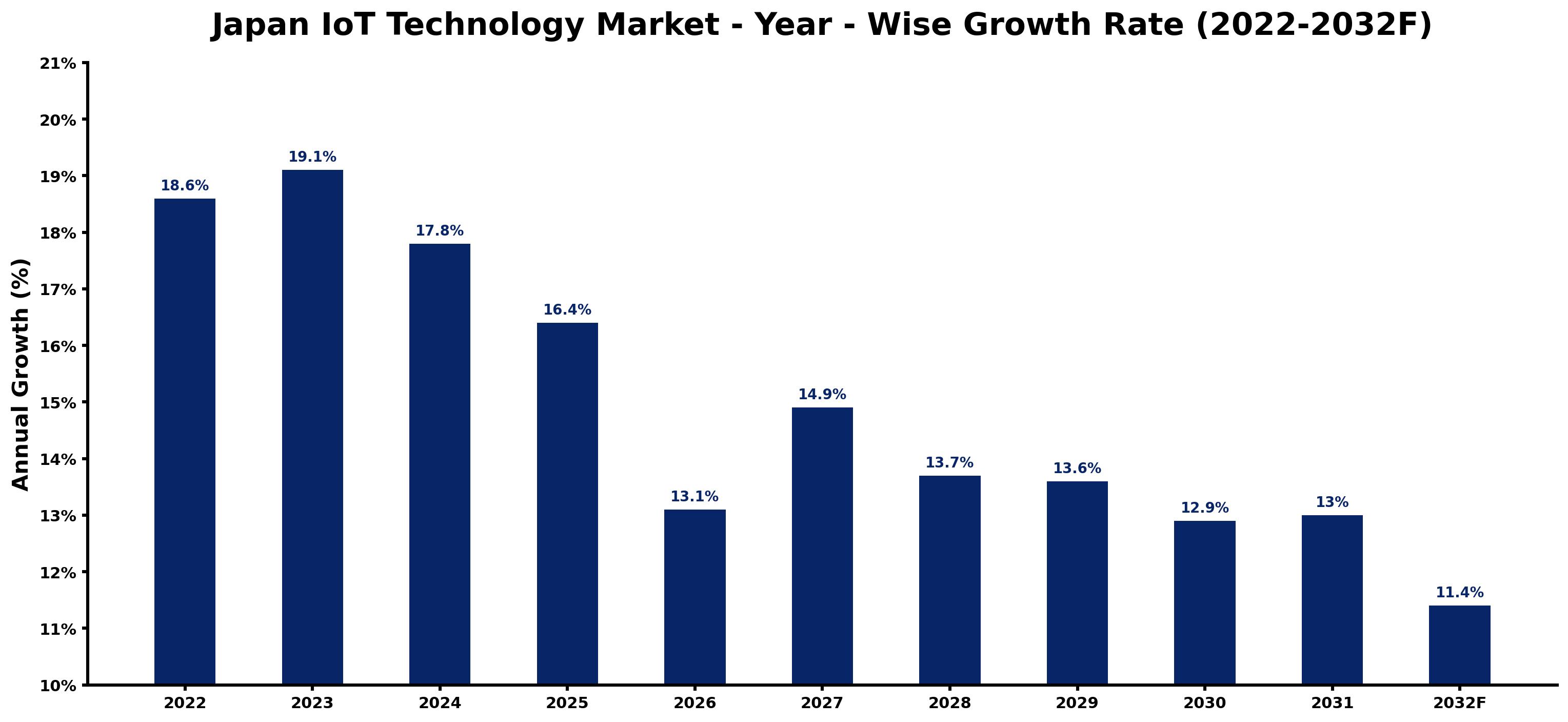
Below, each year's estimated growth is shown next to the factor that most influenced it.
| Year | Estimated Annual Growth (%) | Market Rationale |
| 2022 | 18.6 | The market experienced strong growth due to increased adoption of IoT technologies. |
| 2023 | 19.1 | Demand surged with over 10 million devices used in healthcare monitoring. |
| 2024 | 17.8 | Growth slowed as the market adjusted to previous high rates of expansion. |
| 2025 | 16.4 | The market continued to grow, driven by ongoing investments in smart city initiatives. |
| 2026 | 13.1 | Growth is expected to slow further as the market stabilises after rapid expansion. |
| 2027 | 14.9 | Demand is projected to accelerate again, supported by the automotive sector's adoption of IoT. |
| 2028 | 13.7 | The growth rate will decrease as the market matures and competition intensifies. |
| 2029 | 13.6 | A slight slowdown is expected as the market reaches a saturation point in some areas. |
| 2030 | 12.9 | The market will continue to grow, driven by emerging applications in agriculture. |
| 2031 | 13.0 | Growth is expected to rebound as new IoT solutions gain traction in various sectors. |
| 2032 | 11.4 | The market is projected to grow steadily, driven by ongoing technological advancements. |
Note: Market size estimations and growth projections presented in this report are based on 6Wresearch's proprietary forecasting methodology, utilizing the latest available industry data, government publications, and primary research inputs.
Japan IoT Technology Market Synopsis
IoT Technology encompasses interconnected devices and systems that communicate over the internet, integrating hardware, software, and protocols. The healthcare sector leads demand, utilising over 10 million devices for remote monitoring.
Market Dynamics Impact Analysis (2026–2032)
| Factor | Type | Impact | Primary Segment Affected |
| Increased adoption of IoT in healthcare | Driver | High | Healthcare |
| Growing investments in smart city initiatives | Driver | High | Building Automation |
| Rising demand for smart home applications | Opportunity | High | Retail |
| Expansion of IoT in the automotive sector | Opportunity | High | Automotive & Transportation |
| High costs of IoT implementation | Restraint | Medium | Processor |
| Limited interoperability between devices | Restraint | Medium | Processor |
| Shortage of skilled professionals in IoT | Challenge | High | Processor |
| Compliance with evolving security standards | Challenge | High | Processor |
Evaluation of Drivers in Japan IoT Technology Market (2026–2032)
The factors lifting demand, and the evidence behind each, are summarised below.
| Drivers | Primary Segment Affected | Why It Matters (Evidence) |
| Growing healthcare applications | Healthcare | Over 10 million devices are used for remote patient monitoring, increasing demand for IoT solutions. |
| Investment in smart city projects | Building Automation | Tokyo's initiatives have led to widespread adoption of IoT technologies for urban management. |
| Adoption of connected vehicles | Automotive & Transportation | Over 5 million connected vehicles are expected by 2025, driving demand for IoT technologies. |
| Increased efficiency in agriculture | Agriculture | IoT is projected to improve efficiency by 30%, leading to higher investments in precision farming. |
| Real-time analytics in manufacturing | Manufacturing | 40% of factories are implementing real-time analytics solutions, boosting demand for IoT technologies. |
Volumes grow on the back of over 10 million IoT devices used in healthcare for remote monitoring, prompting hospitals to invest in advanced solutions. Smart city projects in Tokyo drive the adoption of IoT technologies for urban management. The automotive sector anticipates over 5 million connected vehicles by 2025, increasing demand for IoT devices. Agriculture is projected to achieve a 30% increase in efficiency with IoT, encouraging investment in precision farming technologies. Additionally, 40% of factories are implementing real-time analytics solutions, which boosts productivity and drives further purchases.
Evaluation of Restraints in Japan IoT Technology Market
The table below lists the restraints and the evidence behind each.
| Market Restraint | Primary Segment Affected | Why It Matters (Evidence) |
| High implementation costs for IoT solutions | Processor | Many businesses face substantial upfront costs, limiting their ability to adopt IoT technologies. |
| Interoperability issues among devices | Processor | Limited compatibility between different IoT devices hampers integration and usage. |
| Lack of qualified personnel in IoT fields | Processor | The shortage of skilled professionals restricts growth and innovation opportunities. |
| Compliance with strict security standards | Processor | Evolving regulations require constant updates, increasing operational costs for companies. |
| Market saturation in certain sectors | Processor | As IoT adoption matures, growth rates are slowing due to increased competition. |
Japan IoT Technology Market Challenges
Remote patient monitoring in healthcare faces supply chain delays due to a reliance on imported components, disrupting hospitals that depend on timely device availability. Competition among tech startups in Tokyo intensifies, leading to increased operational costs for producers who must invest heavily in R&D to differentiate themselves. Buyers encounter rising prices as demand for IoT solutions escalates, with 70% of retail stores projected to adopt these technologies by 2025, straining budgets for small businesses. Compliance with JIS Q 15001:2017 complicates processes for suppliers, raising costs and potentially delaying product launches.
Trends in the Japan IoT Technology Market
The following changes are redrawing the Japan IoT Technology Market.
- Shift towards Smart Home Technologies: Japan's population is increasingly adopting smart home technologies, with projections indicating that 70% of retail stores will implement IoT solutions by 2025. This trend reflects a growing consumer preference for connected devices.
- Expansion of IoT in Agriculture: The agriculture industry is adopting IoT for precision farming, with a projected increase in efficiency of 30%. This shift is evidenced by rising investments in smart farming technologies across Japan.
- Growth of Real-Time Analytics in Manufacturing: Real-time analytics solutions are being increasingly adopted in manufacturing, with 40% of factories implementing these technologies by 2025. This trend highlights the need for immediate data processing capabilities.
- Development of Smart City Initiatives: The Smart City initiative in Yokohama integrates IoT for urban management and sustainability, showcasing the city's commitment to technology for improved living standards.
Investment Opportunities in the Japan IoT Technology Market
Investors looking at the Japan IoT Technology Market should consider the following areas.
- Healthcare Sector Expansion: Healthcare providers are increasingly adopting IoT for patient monitoring, with over 10 million devices in use. This presents an opportunity for suppliers to offer tailored solutions.
- Automotive Sector Growth: With over 5 million connected vehicles expected by 2025, the automotive sector presents a strong opportunity for IoT technology providers to improve vehicle connectivity.
- Smart Home Market Potential: As Japan's population embraces smart home technologies, suppliers can invest in IoT devices and solutions tailored for residential applications, capitalising on this growing market.
- Investment in Smart City Projects: Tokyo's initiatives in smart city development create opportunities for partnerships in IoT solutions, allowing companies to enter the market through local collaborations.
Government Initiatives in the Japan IoT Technology Market
The Semiconductor and Digital Industry Strategy, introduced in June 2021, builds on previous laws to secure supply chains for semiconductor manufacturing. This strategy aims to strengthen Japan's position in the global semiconductor market, essential for IoT technology and its applications.
In 2023, the government allocated 50 billion JPY for IoT research and development, administered by the Ministry of Economy, Trade and Industry (METI). This funding supports various IoT initiatives, promoting innovation and growth in the sector.
Future Insight of the Japan IoT Technology Market
The Yokohama Smart City initiative will implement IoT technologies for urban management, increasing the demand for interconnected devices. IoT-enabled devices are expected to reach 1.5 billion units in Japan by 2025, transforming consumer interactions. The government's allocation of 50 billion JPY for IoT R&D in 2023 will drive advancements and encourage new applications. Real-time analytics solutions are anticipated to be adopted in 40% of factories by 2025, streamlining production processes and improving operational efficiency.
Market Segmentation Analysis
Japan IoT Technology Market report covers a detailed analysis of the following market segments:
By Node Component – Processor Leads, Connectivity IC Expected to Grow Fastest
According to Sumit Sagar, AM at 6Wresearch, in 2025, Processor led the node component split with a 33% share. Processors are essential for the functionality of IoT devices, ensuring reliable performance across various applications. Their critical role is highlighted by the expected deployment of 1.5 billion units in Japan by 2025, underscoring their dominance in the market. Connectivity IC is projected to grow fastest, at a CAGR of 19.0% during 2026–2032. The rising number of interconnected devices is significantly boosting the demand for connectivity ICs, which are crucial for facilitating communication. As the IoT ecosystem continues to expand, the need for these components will only intensify, reinforcing their growth trajectory. Suppliers should prioritise the development of advanced connectivity solutions to meet the escalating demand for interconnected IoT devices.
By Software Solution – Data Management Leads, Real-Time Streaming Analytics Expected to Grow Fastest
Data Management took 35% of software solution revenue in 2025, more than any other category. Data management solutions are crucial for processing the vast volumes of information generated by IoT devices, making them indispensable for operational efficiency. Their importance in managing data effectively secures their leading position in the market. Over 2026–2032, Real-Time Streaming Analytics is expected to post the fastest growth, at a CAGR of 17.1%. The demand for immediate data processing is driving the rapid growth of real-time streaming analytics, which are vital for timely decision-making. This necessity for instant insights will continue to propel the expansion of this software segment. Buyers should consider investing in real-time analytics to improve responsiveness and operational agility.
By Platform – Device Management Leads, Application Management Expected to Grow Fastest
Device Management held 50% of the Japan IoT Technology Market by platform in 2025. Device management platforms play a central role in the seamless operation of IoT systems, ensuring effective integration and functionality of devices. Their importance in managing device lifecycles solidifies their leading market share. The quickest growth will come from Application Management, forecast to expand at a CAGR of 17.7% between 2026 and 2032. Application management is experiencing rapid growth as businesses seek efficient software deployment across multiple devices. This trend reflects the increasing complexity of IoT applications and the need for streamlined management solutions. Suppliers should focus on enhancing application management capabilities to support the expanding IoT ecosystem.
By Service – Professional Services Lead, Managed Services Expected to Grow Fastest
With 62% of service revenue in 2025, Professional Services was the largest category. Professional services provide the necessary expertise for the successful implementation of IoT solutions, making them indispensable for businesses. Their ability to guide organisations through complex deployments ensures they hold the largest share in the market. Managed Services are set to record the highest CAGR in this split, 16.6% over 2026–2032. Managed services are rapidly growing as companies look to outsource their IoT management, allowing them to focus on core operations. This shift towards outsourcing is indicative of the increasing complexity of IoT systems. Providers should consider expanding managed service offerings to cater to the growing demand for outsourced IoT solutions.
By End Use – Healthcare Leads, Automotive & Transportation Expected to Grow Fastest
Healthcare accounted for 31% of the market by end use in 2025. The healthcare sector utilises IoT for remote patient monitoring, with over 10 million devices currently deployed, significantly enhancing patient care. This extensive installed base reinforces its leadership position in the market. Automotive & Transportation is projected to grow fastest, at a CAGR of 17.9% during 2026–2032. The automotive and transportation sector is swiftly adopting IoT technologies to improve vehicle connectivity, with over 5 million connected vehicles expected by 2025. This transition indicates a strong shift towards smarter transportation solutions. Investments in IoT for automotive applications are likely to yield substantial returns as connectivity becomes increasingly essential for future vehicles.
Key Attractiveness of the Report
- 10 Years of Market Numbers
- Historical Data Starting from 2022 to 2025
- Base Year 2025
- Forecast Data until 2032
- Key Performance Indicators Impacting the Market
- Major Upcoming Developments and Projects
Key Highlights of the Report:
- Japan IoT Technology Market Outlook
- Market Size of Japan IoT Technology Market, 2025
- Forecast of Japan IoT Technology Market, 2032
- Historical Data and Forecast of Japan IoT Technology Revenues & Volume for the Period 2022-2032
- Japan IoT Technology Market Trend Evolution
- Japan IoT Technology Market Drivers and Challenges
- Japan IoT Technology Price Trends
- Japan IoT Technology Porter's Five Forces
- Japan IoT Technology Industry Life Cycle
- Historical Data and Forecast of Japan IoT Technology Market Revenues & Volume By Node Component for the Period 2022-2032
- Historical Data and Forecast of Japan IoT Technology Market Revenues & Volume By Processor for the Period 2022-2032
- Historical Data and Forecast of Japan IoT Technology Market Revenues & Volume By Connectivity IC for the Period 2022-2032
- Historical Data and Forecast of Japan IoT Technology Market Revenues & Volume By Memory Device for the Period 2022-2032
- Historical Data and Forecast of Japan IoT Technology Market Revenues & Volume By Sensor for the Period 2022-2032
- Historical Data and Forecast of Japan IoT Technology Market Revenues & Volume By Logic Device for the Period 2022-2032
- Historical Data and Forecast of Japan IoT Technology Market Revenues & Volume By Software Solution for the Period 2022-2032
- Historical Data and Forecast of Japan IoT Technology Market Revenues & Volume By Data Management for the Period 2022-2032
- Historical Data and Forecast of Japan IoT Technology Market Revenues & Volume By Real-Time Streaming Analytics for the Period 2022-2032
- Historical Data and Forecast of Japan IoT Technology Market Revenues & Volume By Network Bandwidth Management for the Period 2022-2032
- Historical Data and Forecast of Japan IoT Technology Market Revenues & Volume By Remote Monitoring for the Period 2022-2032
- Historical Data and Forecast of Japan IoT Technology Market Revenues & Volume By Security Solution for the Period 2022-2032
- Historical Data and Forecast of Japan IoT Technology Market Revenues & Volume By Platform for the Period 2022-2032
- Historical Data and Forecast of Japan IoT Technology Market Revenues & Volume By Device Management for the Period 2022-2032
- Historical Data and Forecast of Japan IoT Technology Market Revenues & Volume By Application Management for the Period 2022-2032
- Historical Data and Forecast of Japan IoT Technology Market Revenues & Volume By Network Management for the Period 2022-2032
- Historical Data and Forecast of Japan IoT Technology Market Revenues & Volume By Service for the Period 2022-2032
- Historical Data and Forecast of Japan IoT Technology Market Revenues & Volume By Professional Services for the Period 2022-2032
- Historical Data and Forecast of Japan IoT Technology Market Revenues & Volume By Managed Services for the Period 2022-2032
- Historical Data and Forecast of Japan IoT Technology Market Revenues & Volume By End Use for the Period 2022-2032
- Historical Data and Forecast of Japan IoT Technology Market Revenues & Volume By Healthcare for the Period 2022-2032
- Historical Data and Forecast of Japan IoT Technology Market Revenues & Volume By Automotive & Transportation for the Period 2022-2032
- Historical Data and Forecast of Japan IoT Technology Market Revenues & Volume By Building Automation for the Period 2022-2032
- Historical Data and Forecast of Japan IoT Technology Market Revenues & Volume By Manufacturing for the Period 2022-2032
- Historical Data and Forecast of Japan IoT Technology Market Revenues & Volume By Retail for the Period 2022-2032
- Historical Data and Forecast of Japan IoT Technology Market Revenues & Volume By BFSI for the Period 2022-2032
- Historical Data and Forecast of Japan IoT Technology Market Revenues & Volume By Oil & Gas for the Period 2022-2032
- Historical Data and Forecast of Japan IoT Technology Market Revenues & Volume By Agriculture for the Period 2022-2032
- Japan IoT Technology Import Export Trade Statistics
- Market Opportunity Assessment By Node Component
- Market Opportunity Assessment By Software Solution
- Market Opportunity Assessment By Platform
- Market Opportunity Assessment By Service
- Market Opportunity Assessment By End Use
- Japan IoT Technology Top Companies Market Share
- Japan IoT Technology Competitive Benchmarking By Technical and Operational Parameters
- Japan IoT Technology Company Profiles
- Japan IoT Technology Key Strategic Recommendations
Market Covered
The report covers the following segments.
By Node Component
- Processor
- Connectivity IC
- Memory Device
- Sensor
- Logic Device
By Software Solution
- Data Management
- Real-Time Streaming Analytics
- Network Bandwidth Management
- Remote Monitoring
- Security Solution
By Platform
- Device Management
- Application Management
- Network Management
By Service
- Professional Services
- Managed Services
By End Use
- Healthcare
- Automotive & Transportation
- Building Automation
- Manufacturing
- Retail
- BFSI
- Oil & Gas
- Agriculture































