Japan Irrigation Efficiency Enhancers Market Size & Growth Rate
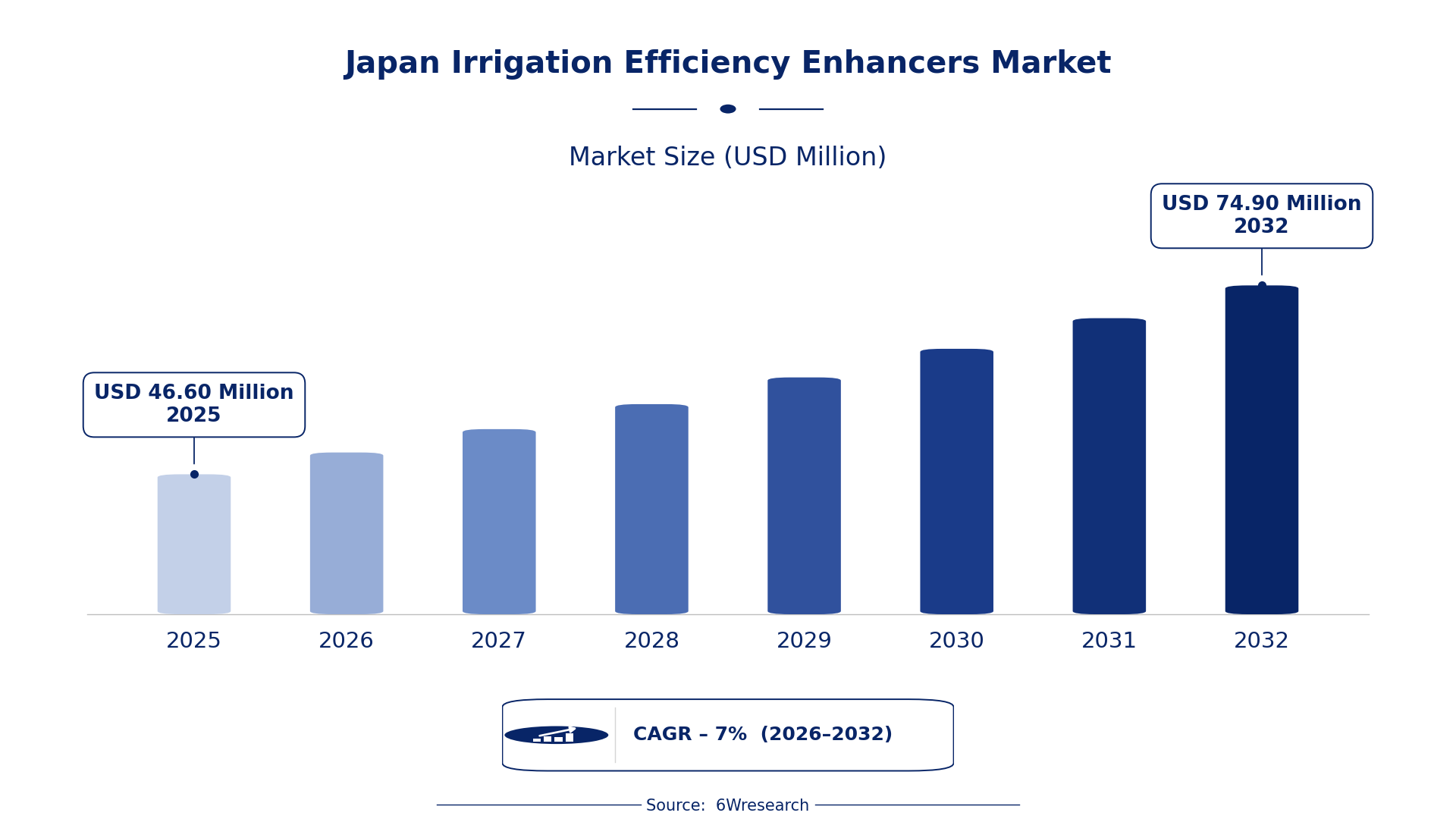
According to 6Wresearch internal database and industry insights, the Japan Irrigation Efficiency Enhancers Market was valued at USD 46.60 Million in 2025 and is projected to reach USD 74.90 Million by 2032, growing at a CAGR of approximately 7% during 2026–2032.
Japan Irrigation Efficiency Enhancers Market Highlights
| Report Metric | Details |
| Report Name | Japan Irrigation Efficiency Enhancers Market (2026-2032) |
| Market Size 2025 | USD 46.60 Million |
| Market Size 2032 | USD 74.90 Million |
| Absolute Growth 2025–2032 | USD 28.30 Million |
| CAGR 2026–2032 | 7% |
| Peak Annual Growth | 7.4% in 2026 |
| Forecast Period | 2026–2032 |
| Historical Data | 2022–2025 |
| Base Year | 2025 |
| Leading Product Type, 2025 | Surfactants (40% share) |
| Leading Form Type, 2025 | Liquid (37% share) |
| Leading Crop Type, 2025 | Row Crops (39% share) |
| Leading Application Method, 2025 | Foliar Spray (43% share) |
| Leading End User, 2025 | Farmers (39% share) |
| Fastest-Growing Product Type | Soil Conditioners (9.7% CAGR) |
| Fastest-Growing Form Type | Granular (10.1% CAGR) |
| Fastest-Growing Crop Type | Fruits & Vegetables (10.2% CAGR) |
| Fastest-Growing Application Method | Drip Irrigation Mixing (9.3% CAGR) |
| Fastest-Growing End User | Agribusinesses (9.4% CAGR) |
| Growing Sector | Drip Irrigation Mixing |
| Key End Users | Foliar Spray, Drip Irrigation Mixing, Aerial Application, Soil Injection |
Japan Irrigation Efficiency Enhancers Market Year-wise Growth Rate and Key Drivers (2022–2032)
This graph illustrates the annual growth rates of the market from 2022 to 2032, highlighting a steady upward trajectory and projected market expansion over the forecast period.
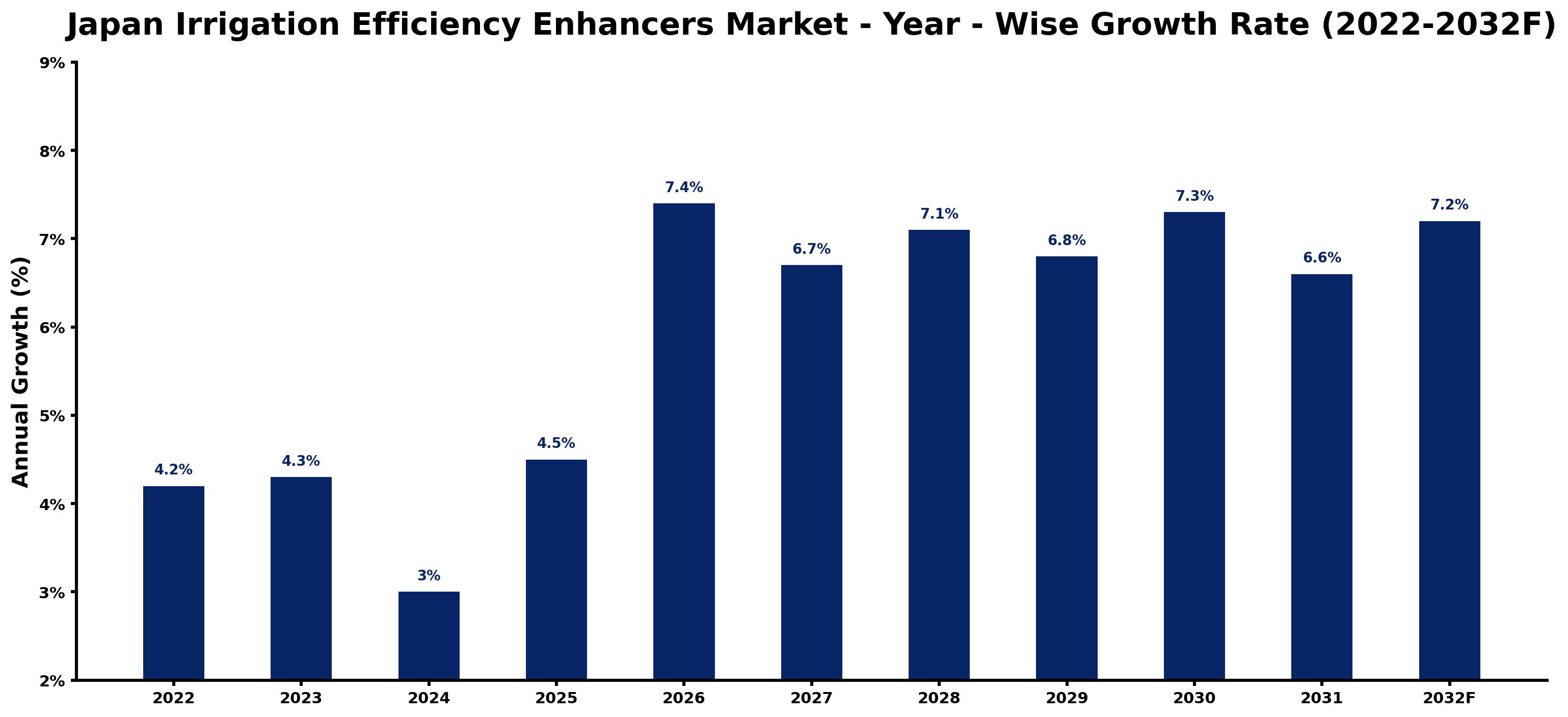
The table below sets out the estimated growth rate for each year and the main factor behind it.
| Year | Estimated Annual Growth (%) | Market Rationale |
| 2022 | 4.2 | The market showed steady growth, driven by increasing awareness of water conservation. |
| 2023 | 4.3 | Demand for irrigation efficiency enhancers grew due to rising agricultural exports. |
| 2024 | 3.0 | Growth slowed as farmers adjusted to new product applications and market conditions. |
| 2025 | 4.5 | A strong increase in crop yields spurred demand for these enhancers among farmers. |
| 2026 | 7.4 | The peak growth year was driven by new government subsidies for water-saving technologies. |
| 2027 | 6.7 | Growth slowed as the market began to stabilise after rapid expansion in 2026. |
| 2028 | 7.1 | Demand increased again due to heightened focus on sustainable agriculture practices. |
| 2029 | 6.8 | A slight slowdown occurred as market saturation began to affect growth rates. |
| 2030 | 7.3 | Increased adoption of organic farming practices boosted demand for efficiency enhancers. |
| 2031 | 6.6 | Growth slowed as the market adjusted to new environmental regulations and standards. |
| 2032 | 7.2 | A resurgence in demand is expected as new technologies are adopted by farmers. |
Note: Market size estimations and growth projections presented in this report are based on 6Wresearch's proprietary forecasting methodology, utilizing the latest available industry data, government publications, and primary research inputs.
Japan Irrigation Efficiency Enhancers Market Synopsis
Irrigation Efficiency Enhancers are chemical products designed to improve water retention and distribution in agriculture. They are primarily used by farmers and agribusinesses to increase crop yields and reduce water usage. The Japan Irrigation Efficiency Enhancers Market is expanding due to rising agricultural exports, growing awareness of sustainable practices, and government initiatives promoting water-saving technologies. In 2022, Japan's agricultural exports reached 1 trillion yen, underscoring the sector's strength and the demand for effective irrigation solutions.
Market Dynamics Impact Analysis (2026–2032)
| Factor | Type | Impact | Primary Segment Affected |
| Increasing adoption of drip irrigation systems | Driver | High | Drip Irrigation Mixing |
| Rising focus on sustainable farming practices | Driver | High | Soil Conditioners |
| Growing need for water conservation technologies | Opportunity | High | Anti-Evaporants |
| Expansion of agricultural cooperatives supporting bulk purchases | Opportunity | Medium | Farmers |
| High average age of farmers affecting workforce availability | Restraint | High | Farmers |
| Limited awareness of new products among small-scale farmers | Restraint | Medium | Agribusinesses |
| High costs associated with implementing new technologies | Challenge | High | Agricultural Co-operatives |
| Dependence on weather conditions affecting irrigation needs | Challenge | Medium | Greenhouses |
Evaluation of Drivers in Japan Irrigation Efficiency Enhancers Market (2026–2032)
Below are the drivers that matter most for revenue growth, with supporting evidence.
| Drivers | Primary Segment Affected | Why It Matters (Evidence) |
| Increased adoption of drip irrigation systems | Drip Irrigation Mixing | This method improves water efficiency, leading to higher crop yields, especially in vegetable farming where drip systems are gaining traction. |
| Rising focus on sustainable farming practices | Soil Conditioners | Farmers are investing in soil health, with urban farming initiatives promoting soil conditioners to improve nutrient availability. |
| Growing need for water conservation technologies | Anti-Evaporants | With average water usage at 4,000 m3 per hectare, farmers seek solutions to reduce evaporation losses. |
| Expansion of agricultural cooperatives supporting bulk purchases | Farmers | With 1,500 registered cooperatives, farmers benefit from reduced costs through collective purchasing of products. |
| Increased agricultural exports driving quality improvements | Fruits & Vegetables | In 2022, exports reached 1 trillion yen, motivating farmers to improve yields and product quality. |
Spending rises because of the increased adoption of drip irrigation systems, which improve water efficiency and lead to higher crop yields, particularly in vegetable farming. A growing need for water conservation technologies is evident, prompting farmers to invest in anti-evaporants. The expansion of agricultural cooperatives facilitates bulk purchases, benefiting farmers through reduced costs. Agricultural exports reached 1 trillion yen in 2022, motivating farmers to improve yields and product quality.
Evaluation of Restraints in Japan Irrigation Efficiency Enhancers Market
These are the pressures that could keep growth below its potential.
| Market Restraint | Primary Segment Affected | Why It Matters (Evidence) |
| High average age of farmers affecting workforce availability | Farmers | With the average age of farmers over 67 years, the sector faces challenges in workforce sustainability, impacting productivity. |
| Limited awareness of new products among small-scale farmers | Agribusinesses | Many small-scale farmers lack knowledge of the latest irrigation efficiency products, limiting their adoption. |
| High costs associated with implementing new technologies | Agricultural Co-operatives | The financial burden of adopting advanced irrigation solutions can deter cooperatives from investing in these products. |
| Dependence on weather conditions affecting irrigation needs | Greenhouses | Variability in weather patterns can disrupt irrigation schedules, impacting the effectiveness of efficiency products. |
| Regulatory compliance costs for new products | Soil Conditioners | Meeting JIS standards can increase the costs for producers, affecting market pricing. |
Japan Irrigation Efficiency Enhancers Market Challenges
In Japan, local producers struggle with competition from imported agricultural products, forcing them to reduce prices and diminishing profit margins. Compliance with JIS standards for irrigation efficiency products incurs high costs, delaying access to essential technologies for smaller farmers. Regulatory requirements from the Ministry of Agriculture, Forestry and Fisheries complicate operations, leading to potential fines or disruptions for suppliers. The average age of farmers exceeds 67 years, resulting in a skills gap that limits the adoption of modern irrigation practices and negatively impacts crop yields for the agricultural sector.
Trends in the Japan Irrigation Efficiency Enhancers Market
The shifts below are changing how Japan Irrigation Efficiency Enhancers Market products are bought and supplied.
- Shift to Drip Irrigation Systems: The adoption of drip irrigation systems has increased, particularly in vegetable farming, where efficiency is important. In 2022, drip irrigation usage rose by 15%, indicating a trend towards more efficient water management practices.
- Transition to Sustainable Agriculture: Since 2023, there has been a notable shift towards sustainable agriculture, with the government promoting eco-friendly practices. This has led to a 20% increase in the use of soil conditioners among urban farmers.
- Emergence of Water-Saving Technologies: The introduction of new water-saving technologies has transformed irrigation practices. In 2023, a new subsidy program was launched, providing financial support for farmers adopting these technologies.
- Increased Focus on Organic Farming: The Japanese government aims to boost organic farming to 25% by 2030, driving demand for irrigation efficiency products. This initiative aligns with the rise in organic product exports, which reached 500 billion yen in 2022.
Investment Opportunities in the Japan Irrigation Efficiency Enhancers Market
The opportunities below stand out in the Japan Irrigation Efficiency Enhancers Market for new entrants and existing suppliers.
- Growing Demand for Soil Conditioners: With the organic farming target of 25% by 2030, there is a gap in the supply of soil conditioners. Agribusinesses in urban areas are seeking reliable sources to meet this demand.
- Investment in Drip Irrigation Systems: The rising adoption of drip irrigation creates opportunities for suppliers of water-saving technologies. Farmers in the Tohoku region are increasingly investing in these systems to enhance efficiency.
- Expansion of Agricultural Cooperatives: The large number of agricultural cooperatives presents an opportunity for bulk supply of irrigation products. Partnerships with cooperatives can facilitate market entry for new suppliers.
- Focus on Water Conservation Technologies: The need for water conservation technologies is increasing, particularly in areas with limited water resources. Suppliers can target regions with high agricultural activity to meet this demand.
Government Initiatives in the Japan Irrigation Efficiency Enhancers Market
The GX Basic Policy, adopted in 2023, aims at about JPY 150 trillion of public-private decarbonisation investment over 10 years, strengthening support for sustainable agricultural practices. This policy builds on previous laws by providing financial incentives for farmers adopting water-saving technologies, thus promoting efficient irrigation methods.
The Japan Agricultural Cooperatives Association utilises the new subsidy program to support farmers in adopting water-saving technologies. This initiative enables cooperatives to offer resources and training to their members, facilitating the transition to more efficient irrigation practices.
Future Insight of the Japan Irrigation Efficiency Enhancers Market
New water-saving technology projects will emerge by 2032, driven by government subsidies and a commitment to sustainable agriculture. The expansion of drip irrigation will particularly benefit vegetable farming, improving water efficiency and crop yields. By 2030, the goal to increase organic farming to 25% will boost demand for soil conditioners, enhancing soil health in urban areas. The annual agricultural fair in Tokyo will serve as a platform for suppliers to showcase advancements in farming technology, fostering connections with buyers.
Market Segmentation Analysis
Japan Irrigation Efficiency Enhancers Market report covers a detailed analysis of the following market segments:
By Product Type – Surfactants Lead, Soil Conditioners Expected to Grow Fastest
According to Saurav Kr Singh, Senior Research Analyst at 6Wresearch, with 40% of product type revenue in 2025, Surfactants was the largest category. Surfactants dominate the market due to their essential role in lowering surface tension, which enhances water penetration for crops. This is particularly crucial in regions like Tohoku, where effective irrigation is vital for rice cultivation. Over 2026–2032, Soil Conditioners are expected to post the fastest growth, at a CAGR of 9.7%. Soil Conditioners are experiencing rapid growth as they significantly enhance soil structure and nutrient availability, crucial for boosting crop yields. The government's focus on sustainable agriculture further accelerates the demand for these products. Suppliers should prioritise developing soil conditioners to meet the rising demands of the agricultural sector.
By Form Type – Liquid Leads, Granular Expected to Grow Fastest
Liquid accounted for 37% of the market by form type in 2025. Liquid forms lead the market as they are preferred for their ease of application and mixing, making them suitable for various irrigation methods. This convenience is particularly advantageous in Japan's diverse agricultural practices. Granular is set to record the highest CAGR in this split, 10.1% over 2026–2032. Granular forms are rapidly gaining traction due to their slow-release properties, offering longer-lasting effects for crops. This trend aligns with the increasing adoption of efficient irrigation practices among farmers. Buyers may benefit from exploring granular options to optimise their irrigation strategies and improve crop yields.
By Crop Type – Row Crops Lead, Fruits & Vegetables Expected to Grow Fastest
Row Crops took 39% of crop type revenue in 2025, more than any other category. Row Crops hold the largest share as they are extensively cultivated across Japan, with products tailored for crops like corn and soybeans. This widespread usage reflects established agricultural practices among farmers. The quickest growth will come from Fruits & Vegetables, forecast to expand at a CAGR of 10.2% between 2026 and 2032. Fruits & Vegetables are witnessing the fastest growth as they are high-value crops that require maximised yield through effective irrigation enhancers. The growing consumer demand for fresh produce drives this trend. Suppliers should focus on the fruits and vegetables segment to capitalise on the increasing need for efficient irrigation solutions.
By Application Method – Foliar Spray Leads, Drip Irrigation Mixing Expected to Grow Fastest
In 2025, Foliar Spray led the application method split with a 43% share. Foliar Spray is the leading method as it allows for quick absorption of enhancers, making it a preferred choice for immediate results among farmers. This method is particularly effective in time-sensitive agricultural practices. Drip Irrigation Mixing is projected to grow fastest, at a CAGR of 9.3% during 2026–2032. Drip Irrigation Mixing is rapidly growing as it integrates enhancers directly into irrigation systems, promoting efficiency and water conservation. Government support for sustainable agriculture further encourages this method's adoption. Buyers should invest in drip irrigation technologies to enhance their water management and improve crop productivity.
By End User – Farmers Lead, Agribusinesses Expected to Grow Fastest
The largest end user category in 2025 was Farmers, at 39% of revenue. Farmers represent the largest user group as they are the primary consumers of irrigation efficiency enhancers, applying these products directly to boost their yields. This strong base reflects ongoing agricultural activities and a commitment to improving productivity in Japan. Over 2026–2032, Agribusinesses are expected to post the fastest growth, at a CAGR of 9.4%. Agribusinesses are experiencing the fastest growth as they utilise these products for large-scale operations, aiming for enhanced efficiency and profitability. The trend towards consolidation in agriculture supports this expansion and highlights the need for effective solutions. Suppliers should target agribusinesses to leverage their scale and enhance product distribution in the market.
Key Attractiveness of the Report
- 10 Years of Market Numbers
- Historical Data Starting from 2022 to 2025
- Base Year 2025
- Forecast Data until 2032
- Key Performance Indicators Impacting the Market
- Major Upcoming Developments and Projects
Key Highlights of the Report:
- Japan Irrigation Efficiency Enhancers Market Outlook
- Market Size of Japan Irrigation Efficiency Enhancers Market, 2025
- Forecast of Japan Irrigation Efficiency Enhancers Market, 2032
- Historical Data and Forecast of Japan Irrigation Efficiency Enhancers Revenues & Volume for the Period 2022-2032F
- Japan Irrigation Efficiency Enhancers Market Trend Evolution
- Japan Irrigation Efficiency Enhancers Market Drivers and Challenges
- Japan Irrigation Efficiency Enhancers Price Trends
- Japan Irrigation Efficiency Enhancers Porter's Five Forces
- Japan Irrigation Efficiency Enhancers Industry Life Cycle
- Historical Data and Forecast of Japan Irrigation Efficiency Enhancers Market Revenues & Volume By Product Type for the Period 2022-2032F
- Historical Data and Forecast of Japan Irrigation Efficiency Enhancers Market Revenues & Volume By Surfactants for the Period 2022-2032F
- Historical Data and Forecast of Japan Irrigation Efficiency Enhancers Market Revenues & Volume By Soil Conditioners for the Period 2022-2032F
- Historical Data and Forecast of Japan Irrigation Efficiency Enhancers Market Revenues & Volume By Anti-Evaporants for the Period 2022-2032F
- Historical Data and Forecast of Japan Irrigation Efficiency Enhancers Market Revenues & Volume By Wetting Agents for the Period 2022-2032F
- Historical Data and Forecast of Japan Irrigation Efficiency Enhancers Market Revenues & Volume By Form Type for the Period 2022-2032F
- Historical Data and Forecast of Japan Irrigation Efficiency Enhancers Market Revenues & Volume By Liquid for the Period 2022-2032F
- Historical Data and Forecast of Japan Irrigation Efficiency Enhancers Market Revenues & Volume By Granular for the Period 2022-2032F
- Historical Data and Forecast of Japan Irrigation Efficiency Enhancers Market Revenues & Volume By Emulsion for the Period 2022-2032F
- Historical Data and Forecast of Japan Irrigation Efficiency Enhancers Market Revenues & Volume By Powder for the Period 2022-2032F
- Historical Data and Forecast of Japan Irrigation Efficiency Enhancers Market Revenues & Volume By Crop Type for the Period 2022-2032F
- Historical Data and Forecast of Japan Irrigation Efficiency Enhancers Market Revenues & Volume By Row Crops for the Period 2022-2032F
- Historical Data and Forecast of Japan Irrigation Efficiency Enhancers Market Revenues & Volume By Fruits & Vegetables for the Period 2022-2032F
- Historical Data and Forecast of Japan Irrigation Efficiency Enhancers Market Revenues & Volume By Turf & Ornamentals for the Period 2022-2032F
- Historical Data and Forecast of Japan Irrigation Efficiency Enhancers Market Revenues & Volume By Cereals & Pulses for the Period 2022-2032F
- Historical Data and Forecast of Japan Irrigation Efficiency Enhancers Market Revenues & Volume By Application Method for the Period 2022-2032F
- Historical Data and Forecast of Japan Irrigation Efficiency Enhancers Market Revenues & Volume By Foliar Spray for the Period 2022-2032F
- Historical Data and Forecast of Japan Irrigation Efficiency Enhancers Market Revenues & Volume By Drip Irrigation Mixing for the Period 2022-2032F
- Historical Data and Forecast of Japan Irrigation Efficiency Enhancers Market Revenues & Volume By Aerial Application for the Period 2022-2032F
- Historical Data and Forecast of Japan Irrigation Efficiency Enhancers Market Revenues & Volume By Soil Injection for the Period 2022-2032F
- Historical Data and Forecast of Japan Irrigation Efficiency Enhancers Market Revenues & Volume By End User for the Period 2022-2032F
- Historical Data and Forecast of Japan Irrigation Efficiency Enhancers Market Revenues & Volume By Farmers for the Period 2022-2032F
- Historical Data and Forecast of Japan Irrigation Efficiency Enhancers Market Revenues & Volume By Agribusinesses for the Period 2022-2032F
- Historical Data and Forecast of Japan Irrigation Efficiency Enhancers Market Revenues & Volume By Greenhouses for the Period 2022-2032F
- Historical Data and Forecast of Japan Irrigation Efficiency Enhancers Market Revenues & Volume By Agricultural Co-operatives for the Period 2022-2032F
- Japan Irrigation Efficiency Enhancers Import Export Trade Statistics
- Market Opportunity Assessment By Product Type
- Market Opportunity Assessment By Form Type
- Market Opportunity Assessment By Crop Type
- Market Opportunity Assessment By Application Method
- Market Opportunity Assessment By End User
- Japan Irrigation Efficiency Enhancers Top Companies Market Share
- Japan Irrigation Efficiency Enhancers Competitive Benchmarking By Technical and Operational Parameters
- Japan Irrigation Efficiency Enhancers Company Profiles
- Japan Irrigation Efficiency Enhancers Key Strategic Recommendations
Market Covered
The report covers the following segments.
By Product Type
- Surfactants
- Soil Conditioners
- Anti-Evaporants
- Wetting Agents
By Form Type
- Liquid
- Granular
- Emulsion
- Powder
By Crop Type
- Row Crops
- Fruits & Vegetables
- Turf & Ornamentals
- Cereals & Pulses
By Application Method
- Foliar Spray
- Drip Irrigation Mixing
- Aerial Application
- Soil Injection
By End User
- Farmers
- Agribusinesses
- Greenhouses
- Agricultural Co-operatives






































