Japan Isosafrole Market Size & Growth Rate
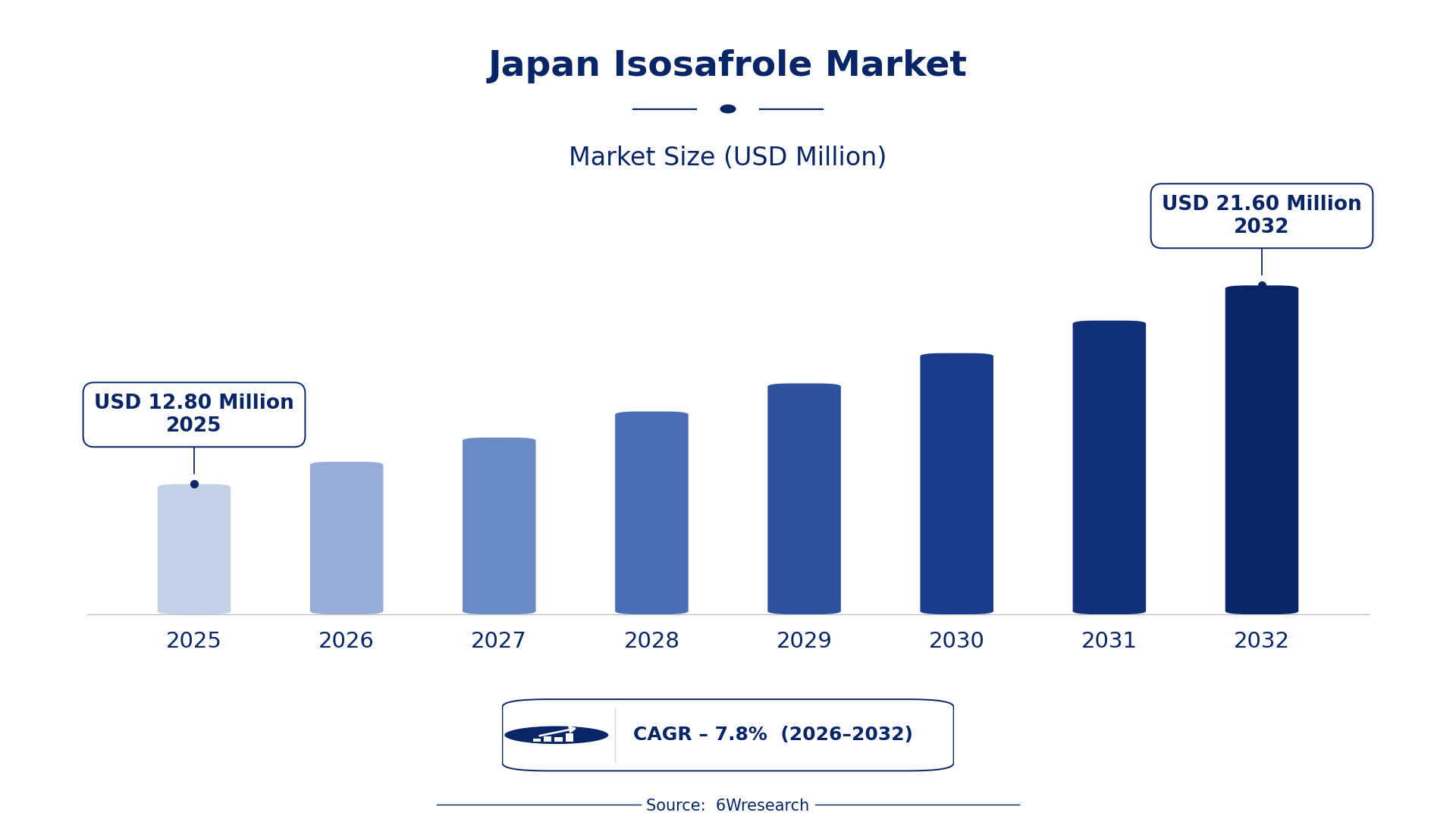
According to 6Wresearch internal database and industry insights, the Japan Isosafrole Market was valued at USD 12.80 Million in 2025 and is projected to reach USD 21.60 Million by 2032, growing at a CAGR of approximately 7.8% during 2026–2032.
Japan Isosafrole Market Highlights
| Report Metric | Details |
| Report Name | Japan Isosafrole Market (2026-2032) |
| Market Size 2025 | USD 12.80 Million |
| Market Size 2032 | USD 21.60 Million |
| Absolute Growth 2025–2032 | USD 8.80 Million |
| CAGR 2026–2032 | 7.8% |
| Peak Annual Growth | 10.2% in 2029 |
| Forecast Period | 2026–2032 |
| Historical Data | 2022–2025 |
| Base Year | 2025 |
| Leading Product Type, 2025 | Trans-Isosafrole (63% share) |
| Leading End Users / Applications, 2025 | Soft Drinks Industry (60% share) |
| Fastest-Growing Product Type | Cis-Isosafrole (10.7% CAGR) |
| Fastest-Growing End Users / Applications | Soap and Perfumes Industry (10.0% CAGR) |
| Growing Sector | Soap and Perfumes Industry |
| Key End Users | Soap manufacturers, beverage producers, personal care brands |
Japan Isosafrole Market Year-wise Growth Rate and Key Drivers (2022–2032)
This graph illustrates the annual growth rates of the market from 2022 to 2032, highlighting a steady upward trajectory and projected market expansion over the forecast period.
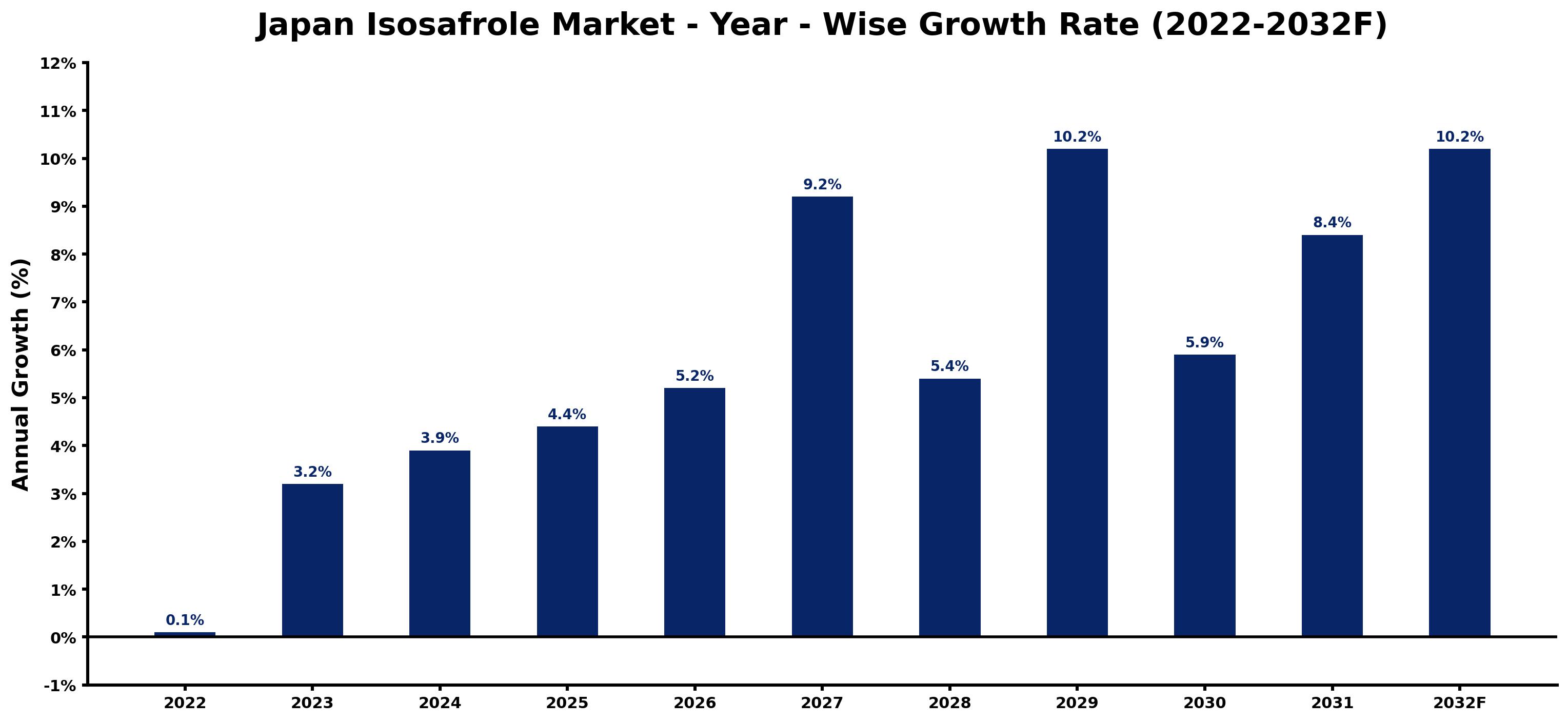
The yearly estimates that follow link every growth rate to its principal driver, so readers can see why the pace changed in each period.
| Year | Estimated Annual Growth (%) | Market Rationale |
| 2022 | 0.1 | Demand for isosafrole was stable, reflecting consistent use in the soap industry. |
| 2023 | 3.2 | Growth accelerated due to increased flavoring ingredient usage in the soft drinks sector. |
| 2024 | 3.9 | The soap and perfumes industry continued to expand, driving higher isosafrole demand. |
| 2025 | 4.4 | Demand peaked as the soap and perfumes industry reached a valuation of approximately 1 trillion JPY. |
| 2026 | 5.2 | The market is set to grow more rapidly, driven by rising consumer interest in fragrances. |
| 2027 | 9.2 | Demand is projected to surge as the soft drinks market reports a steady increase in flavoring usage. |
| 2028 | 5.4 | Growth is anticipated to slow slightly as the market adjusts to previous high demand levels. |
| 2029 | 10.2 | A notable rise in demand is expected, driven by new product launches in the fragrance sector. |
| 2030 | 5.9 | The market will experience a moderate slowdown, yet demand is expected to remain strong overall. |
| 2031 | 8.4 | Demand is projected to increase again, spurred by ongoing trends in personal care and beverage industries. |
| 2032 | 10.2 | The market is expected to maintain strong growth, supported by continued consumer interest. |
Note: Market size estimations and growth projections presented in this report are based on 6Wresearch's proprietary forecasting methodology, utilizing the latest available industry data, government publications, and primary research inputs.
Japan Isosafrole Market Synopsis
Isosafrole is an organic compound derived from sassafras essential oil, primarily used as a fragrance and flavouring agent. The Japan Isosafrole Market is driven by the soap and perfumes industry, valued at approximately 1 trillion JPY in 2022, and the soft drinks industry, which reached 2.5 trillion JPY. The promotion of sustainable fragrance ingredients and rising consumer interest in unique scents are creating new demand for isosafrole, presenting opportunities for suppliers.
Market Dynamics Impact Analysis (2026–2032)
| Factor | Type | Impact | Primary Segment Affected |
| Growing demand for fragrance ingredients in personal care products | Driver | High | Soap and Perfumes Industry |
| Increasing flavoring ingredient usage in beverages | Driver | High | Soft Drinks Industry |
| Expansion of the soap industry in the Tokyo region | Opportunity | High | Soap and Perfumes Industry |
| Rising consumer interest in sustainable fragrance ingredients | Opportunity | High | Soft Drinks Industry |
| Regulatory compliance costs for fragrance ingredients | Restraint | Medium | Soap and Perfumes Industry |
| Limited applications of Cis-Isosafrole in the market | Restraint | Medium | Cis-Isosafrole |
| High production costs affecting profitability | Challenge | High | Trans-Isosafrole |
| Competition from synthetic alternatives in flavoring | Challenge | Medium | Soft Drinks Industry |
Evaluation of Drivers in Japan Isosafrole Market (2026–2032)
The following drivers explain most of the expected growth.
| Drivers | Primary Segment Affected | Why It Matters (Evidence) |
| Increased consumer spending on personal care products | Soap and Perfumes Industry | The soap and perfumes industry in Japan was valued at approximately 1 trillion JPY in 2022, driving demand for isosafrole. |
| Growing soft drinks market | Soft Drinks Industry | The soft drinks market in Japan reached 2.5 trillion JPY in 2022, increasing the need for flavoring agents. |
| Support for sustainable ingredients | Soap and Perfumes Industry | A program launched in 2023 promotes sustainable fragrance ingredients, encouraging industry investment. |
| Rising demand for unique scents among consumers | Soap and Perfumes Industry | Japan's population of about 125 million influences the demand for diverse fragrance options. |
| Adoption of ISO 22716 for good manufacturing practices | Soap and Perfumes Industry | The standard ensures quality and safety in fragrance production, building market confidence. |
The strongest pull on demand comes from increased consumer spending on personal care products, with the soap and perfumes industry valued at approximately 1 trillion JPY in 2022. The growing soft drinks market, reaching 2.5 trillion JPY in 2022, has also increased the need for flavouring agents like isosafrole. Japan's population of about 125 million drives demand for diverse fragrance options, while the adoption of quality standards ensures safety in production, building market confidence.
Evaluation of Restraints in Japan Isosafrole Market
Several factors work against faster growth; the main ones are summarised below.
| Market Restraint | Primary Segment Affected | Why It Matters (Evidence) |
| Compliance costs associated with the Industrial Standardization Act | Soap and Perfumes Industry | Producers must adhere to strict regulations, increasing operational costs and affecting pricing. |
| Limited applications of Cis-Isosafrole compared to Trans-Isosafrole | Cis-Isosafrole | The minor use of Cis-Isosafrole restricts its market potential and revenue generation. |
| High production costs for isosafrole | Trans-Isosafrole | Production expenses can limit profitability for manufacturers in the competitive fragrance market. |
| Competition from synthetic flavoring agents | Soft Drinks Industry | Synthetic alternatives often provide lower-cost options, impacting isosafrole's market share. |
| Regulatory hurdles for new fragrance ingredients | Soap and Perfumes Industry | Producers face lengthy approval processes, delaying product launches and market entry. |
Japan Isosafrole Market Challenges
Producers in the soap industry face supply chain disruptions due to reliance on specific raw materials, which can delay production timelines by up to six weeks, impacting delivery schedules for retailers. Regulatory measures complicate operations, as isosafrole must meet stringent guidelines set by the Japan Cosmetic Industry Association, leading to compliance costs that can reach 10% of production expenses for manufacturers. Buyers encounter price volatility, with fluctuations causing costs to rise by approximately 15% annually, complicating budgeting for fragrance products. Competition from alternative fragrance ingredients increases, as new entrants can offer lower-priced substitutes, threatening market share for established suppliers.
Trends in the Japan Isosafrole Market
The trends below show where the Japan Isosafrole Market is heading.
- Shift towards Sustainable Fragrance Ingredients: In 2023, Japan initiated a program promoting sustainable fragrance ingredients, encouraging the soap and perfumes industry to adopt eco-friendly practices. This shift is expected to influence purchasing decisions, as consumers increasingly prefer products with sustainable credentials.
- Increase in Flavoring Usage in Soft Drinks: The soft drinks industry in Japan reported a steady increase in flavouring ingredient usage, reaching 2.5 trillion JPY in 2022. This trend indicates a growing market for unique flavours, prompting suppliers to innovate and diversify their offerings.
- Rising Demand for Unique Scents: With Japan's population of about 125 million, there is an increasing consumer preference for unique and diverse fragrance options. This trend is reshaping the soap and perfumes industry, driving demand for isosafrole as a key ingredient.
- Adoption of ISO 22716 Standards: The implementation of ISO 22716 standards for good manufacturing practices in cosmetics has become essential since its introduction. This standard ensures quality and safety, influencing purchasing decisions in the soap and perfumes industry.
Investment Opportunities in the Japan Isosafrole Market
The opportunities below stand out in the Japan Isosafrole Market for new entrants and existing suppliers.
- Soap and Perfumes Industry Expansion: The soap and perfumes industry in the Tokyo region is expanding, creating opportunities for suppliers of isosafrole. With a market value of approximately 1 trillion JPY, there is potential for growth.
- Soft Drinks Industry Flavoring Demand: The soft drinks industry is increasingly seeking unique flavouring agents, creating opportunities for isosafrole suppliers. With the market reaching 2.5 trillion JPY, suppliers can enter through partnerships with local manufacturers.
- Sustainable Fragrance Ingredient Supply: There is a growing need for sustainable fragrance ingredients in personal care products. Suppliers can invest in eco-friendly isosafrole production to meet the demand from environmentally conscious consumers.
- Regulatory Compliance Services: As producers navigate complex regulations, there is an opportunity for consulting firms to offer compliance services. This support can help manufacturers adhere to the Industrial Standardization Act.
Government Initiatives in the Japan Isosafrole Market
The recent GX Basic Policy, adopted in 2023, aims for approximately JPY 150 trillion in public-private decarbonisation investment over the next decade, affecting producers of isosafrole by encouraging the use of sustainable fragrance ingredients. This policy builds on the Industrial Standardization Act, which governs product standards, ensuring that fragrance ingredients meet safety and quality requirements. Such regulations are crucial for maintaining consumer trust and ensuring that manufacturers adhere to best practices in production.
The Ministry of Health, Labour and Welfare oversees the approval of flavouring agents in food products, ensuring that isosafrole meets safety guidelines for use in the soft drinks industry. This agency also funds research into sustainable practices, promoting the development of eco-friendly alternatives. By supporting initiatives that enhance ingredient transparency, the ministry helps buyers make informed choices, thereby fostering a more responsible market environment.
Future Insight of the Japan Isosafrole Market
A policy-driven shift towards sustainable fragrance ingredients will reshape sourcing practices, prompting suppliers to adopt eco-friendly alternatives. By 2032, the implementation of ISO 22716 standards will ensure better manufacturing practices, improving product quality and safety for buyers. Increased consumer awareness will drive demand for transparency in ingredient sourcing. The annual demand for isosafrole in the soap industry, estimated at 500 tons, will likely influence suppliers to innovate and diversify their offerings.
Market Segmentation Analysis
Japan Isosafrole Market report covers a detailed analysis of the following market segments:
By Product Type – Trans-Isosafrole Leads, Cis-Isosafrole Expected to Grow Fastest
According to Ravi Bhandari, Research Head at 6Wresearch, in 2025, Trans-Isosafrole led the product type split with a 63% share. Trans-Isosafrole holds the largest share in Japan due to its extensive use as a fragrance component in various products, particularly in the soap and perfumes industry, which was valued at approximately 1 trillion JPY in 2022. The high annual demand for isosafrole in this sector, estimated at 500 tons, underscores its significance in the market. Over 2026–2032, Cis-Isosafrole is expected to post the fastest growth, at a CAGR of 10.7%. Cis-Isosafrole is experiencing the fastest growth as the industry seeks to diversify fragrance offerings, despite its limited applications compared to trans-isomer. The recent government program promoting sustainable fragrance ingredients may further drive interest in this compound. Suppliers should focus on expanding their product lines to include both isomers to meet the evolving preferences of the fragrance market.
By End Users / Applications – Soft Drinks Industry Leads, Soap and Perfumes Industry Expected to Grow Fastest
Soft Drinks Industry accounted for 60% of the market by end users / applications in 2025. The soft drinks industry holds the largest share in the isosafrole market as it is essential for flavouring beverages, with a market value of 2.5 trillion JPY in 2022. This extensive market is indicative of the high consumption of soft drinks among Japan's population of approximately 125 million. The quickest growth will come from Soap and Perfumes Industry, forecast to expand at a CAGR of 10.0% between 2026 and 2032. The soap and perfumes industry is experiencing rapid growth due to rising consumer interest in personal care products that incorporate isosafrole for its fragrance. Additionally, the Japanese government's recent programme promoting sustainable fragrance ingredients is likely to further accelerate this segment's expansion. Suppliers should focus on meeting the increasing demand for isosafrole in personal care products to capitalise on growth opportunities.
Key Attractiveness of the Report
- 10 Years of Market Numbers
- Historical Data Starting from 2022 to 2025
- Base Year 2025
- Forecast Data until 2032
- Key Performance Indicators Impacting the Market
- Major Upcoming Developments and Projects
Key Highlights of the Report:
- Japan Isosafrole Market Outlook
- Market Size of Japan Isosafrole Market, 2025
- Forecast of Japan Isosafrole Market, 2032
- Historical Data and Forecast of Japan Isosafrole Revenues & Volume for the Period 2022-2032
- Japan Isosafrole Market Trend Evolution
- Japan Isosafrole Market Drivers and Challenges
- Japan Isosafrole Price Trends
- Japan Isosafrole Porter's Five Forces
- Japan Isosafrole Industry Life Cycle
- Historical Data and Forecast of Japan Isosafrole Market Revenues & Volume By Product Type for the Period 2022-2032
- Historical Data and Forecast of Japan Isosafrole Market Revenues & Volume By Trans-Isosafrole for the Period 2022-2032
- Historical Data and Forecast of Japan Isosafrole Market Revenues & Volume By Cis-Isosafrole for the Period 2022-2032
- Historical Data and Forecast of Japan Isosafrole Market Revenues & Volume By End Users / Applications for the Period 2022-2032
- Historical Data and Forecast of Japan Isosafrole Market Revenues & Volume By Soft Drinks Industry for the Period 2022-2032
- Historical Data and Forecast of Japan Isosafrole Market Revenues & Volume By Soap and Perfumes Industry for the Period 2022-2032
- Japan Isosafrole Import Export Trade Statistics
- Market Opportunity Assessment By Product Type
- Market Opportunity Assessment By End Users / Applications
- Japan Isosafrole Top Companies Market Share
- Japan Isosafrole Competitive Benchmarking By Technical and Operational Parameters
- Japan Isosafrole Company Profiles
- Japan Isosafrole Key Strategic Recommendations
Market Covered
This report examines the market across the segments below.
By Product Type
- Trans-Isosafrole
- Cis-Isosafrole
By End Users / Applications
- Soft Drinks Industry
- Soap and Perfumes Industry






































