Japan Jam Jelly and Preserve Market Size & Growth Rate
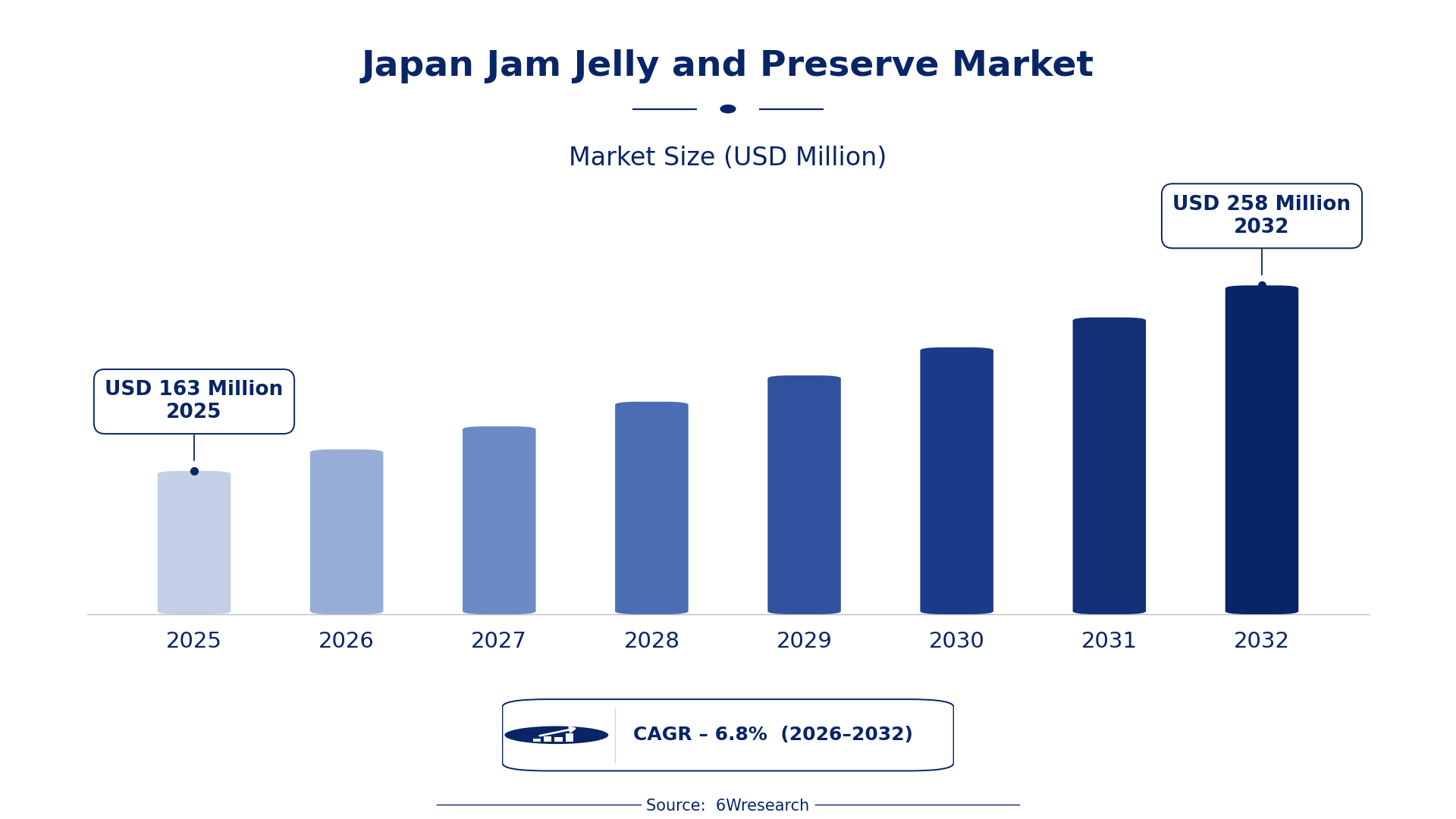
According to 6Wresearch internal database and industry insights, the Japan Jam Jelly and Preserve Market was valued at USD 163 Million in 2025 and is projected to reach USD 258 Million by 2032, growing at a CAGR of approximately 6.8% during 2026–2032.
Japan Jam Jelly and Preserve Market Highlights
| Report Metric | Details |
| Report Name | Japan Jam Jelly and Preserve Market (2026-2032) |
| Market Size 2025 | USD 163 Million |
| Market Size 2032 | USD 258 Million |
| Absolute Growth 2025–2032 | USD 95 Million |
| CAGR 2026–2032 | 6.8% |
| Peak Annual Growth | 8.2% in 2032 |
| Forecast Period | 2026–2032 |
| Historical Data | 2022–2025 |
| Base Year | 2025 |
| Leading Product Type, 2025 | Jam (52% share) |
| Leading Ingredient Type, 2025 | Fruit-Based (57% share) |
| Leading Distribution Channel, 2025 | Supermarkets (50% share) |
| Leading Packaging Type, 2025 | Glass Jar (56% share) |
| Fastest-Growing Product Type | Jelly (9.5% CAGR) |
| Fastest-Growing Ingredient Type | Organic (9.9% CAGR) |
| Fastest-Growing Distribution Channel | Online Stores (9.0% CAGR) |
| Fastest-Growing Packaging Type | Plastic Container (9.6% CAGR) |
| Growing Sector | Organic Jam |
| Key End Users | Consumers, Specialty Stores, Supermarkets, Online Retailers |
Japan Jam Jelly and Preserve Market Year-wise Growth Rate and Key Drivers (2022–2032)
This graph illustrates the annual growth rates of the market from 2022 to 2032, highlighting a steady upward trajectory and projected market expansion over the forecast period.
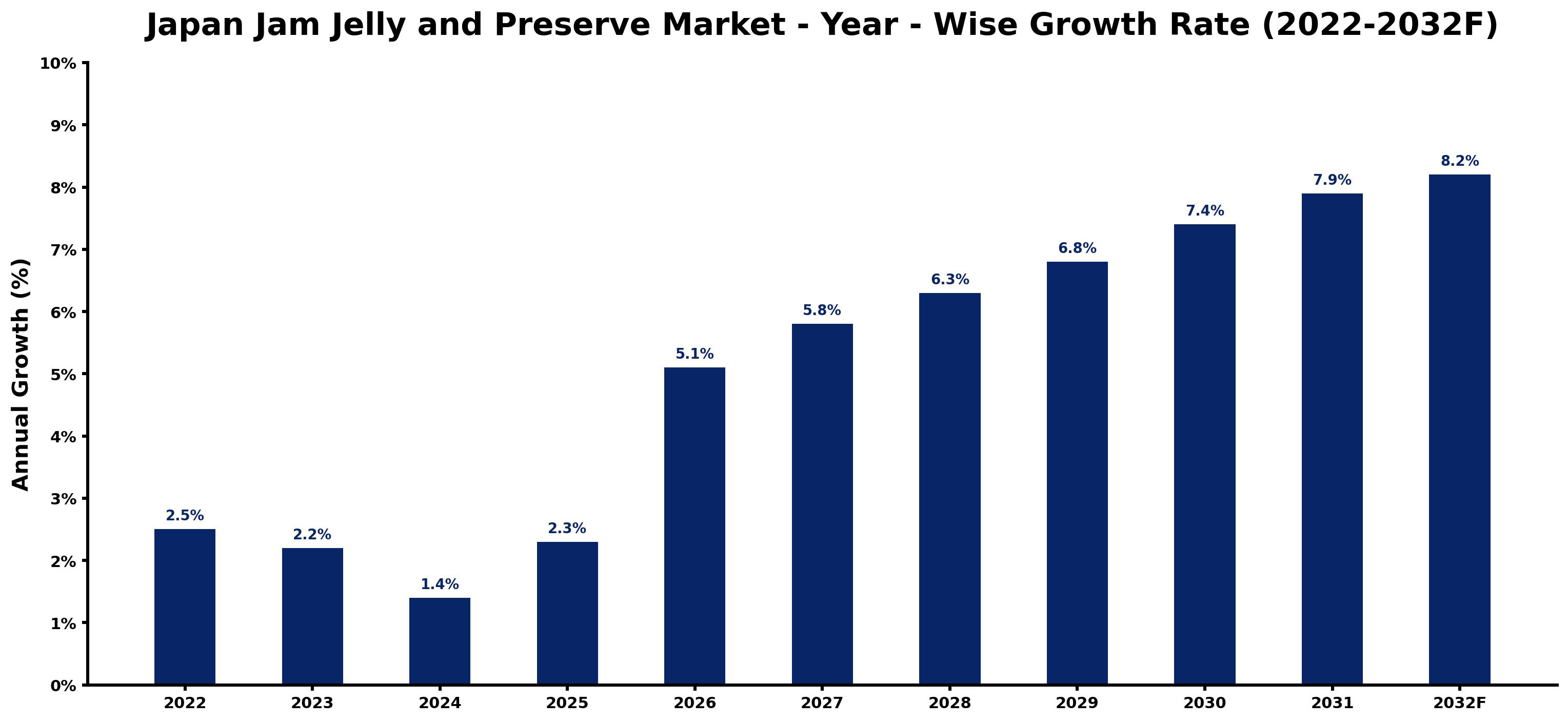
The table below sets out the estimated growth rate for each year and the main factor behind it.
| Year | Estimated Annual Growth (%) | Market Rationale |
| 2022 | 2.5 | The market experienced steady consumption levels, reflecting established preferences among consumers. |
| 2023 | 2.2 | Growth slowed due to market saturation and evolving consumer tastes towards healthier options. |
| 2024 | 1.4 | Demand continued to grow, albeit at a slower pace as health trends gained traction. |
| 2025 | 2.3 | Growth accelerated as consumers sought diverse and quality products in urban areas. |
| 2026 | 5.1 | Demand is expected to surge as health-conscious consumers increasingly prefer organic selections. |
| 2027 | 5.8 | The market will expand further with rising interest in unique fruit flavours and gourmet options. |
| 2028 | 6.3 | Growth is projected to continue as online channels gain traction for specialty products. |
| 2029 | 6.8 | Demand will increase with the popularity of gourmet jams among urban consumers seeking quality. |
| 2030 | 7.4 | The market is expected to see further growth driven by new product offerings and innovations. |
| 2031 | 7.9 | Consumer preferences will shift towards premium and artisanal products, enhancing market dynamics. |
| 2032 | 8.2 | The market is projected to peak as health trends and quality demands reach new heights. |
Note: Market size estimations and growth projections presented in this report are based on 6Wresearch's proprietary forecasting methodology, utilizing the latest available industry data, government publications, and primary research inputs.
Japan Jam Jelly and Preserve Market Synopsis
Jam, jelly, and preserves are fruit-based products made by cooking fruit with sugar and pectin, primarily used as spreads and ingredients in desserts. In 2022, consumption reached approximately 30,000 tons, driven by urban centres like Tokyo and Osaka. The Japan Jam Jelly and Preserve Market is expanding due to rising interest in organic products, which hold a 15% market share, and increasing demand for quality and unique flavours that cater to local tastes.
Market Dynamics Impact Analysis (2026–2032)
| Factor | Type | Impact | Primary Segment Affected |
| Increasing health consciousness among consumers drives demand for organic and sugar-free options. | Driver | High | Organic |
| The annual Jam Festival promotes local producers and showcases unique products. | Opportunity | High | Specialty Stores |
| Market saturation limits growth potential for traditional jam varieties. | Restraint | High | Jam |
| Rising competition from imported products pressures local producers. | Restraint | Medium | Jelly |
| The growing trend of online shopping enhances accessibility for consumers. | Driver | Medium | Online Stores |
| The shift towards premium products opens new market segments for suppliers. | Opportunity | Medium | Preserves |
| Supply chain disruptions can affect product availability and pricing. | Challenge | High | Jelly |
| Fluctuating fruit prices impact production costs for local manufacturers. | Challenge | Medium | Jam |
Evaluation of Drivers in Japan Jam Jelly and Preserve Market (2026–2032)
The factors lifting demand, and the evidence behind each, are summarised below.
| Drivers | Primary Segment Affected | Why It Matters (Evidence) |
| Rising demand for organic products boosts sales of organic jams. | Organic | The organic jam segment captures around 15% of the market, attracting health-conscious consumers seeking quality. |
| Health-conscious consumers are increasingly opting for sugar-free options. | Sugar-Free | Health trends are influencing demand, with consumers seeking healthier alternatives to traditional jams. |
| Urban centres like Tokyo and Osaka are key markets for jam consumption. | Jam | These cities account for a large portion of total consumption, approximately 30,000 tons in 2022, driving sales. |
| The annual Jam Festival showcases local products and drives consumer interest. | Specialty Stores | This event promotes local producers and unique offerings, increasing visibility and consumer engagement in urban areas. |
| Increasing online shopping trends expand market reach for specialty jams. | Online Stores | More consumers are turning to online platforms for unique and artisanal products, enhancing market access. |
Behind the steady rise in orders sits a growing interest in unique flavours and health-conscious choices. The organic segment is expanding, capturing a notable share of the market as consumers opt for healthier options. Urban centres are significant, with a large portion of total consumption driven by diverse product offerings. The trend towards online shopping is reshaping purchasing patterns, as more consumers seek specialty jams through digital platforms. Events like the annual Jam Festival promote local producers, increasing visibility and consumer interest in unique offerings.
Evaluation of Restraints in Japan Jam Jelly and Preserve Market
The table below lists the restraints and the evidence behind each.
| Market Restraint | Primary Segment Affected | Why It Matters (Evidence) |
| Market saturation limits growth potential for traditional jam varieties. | Jam | With over 100 varieties available, consumers have many options, resulting in slower growth rates. |
| Rising competition from imported products pressures local producers. | Jelly | Imported jams and jellies often offer lower prices, affecting local sales and market share. |
| Supply chain disruptions can affect product availability and pricing. | Preserves | Recent global supply chain issues have caused inconsistent fruit supplies, impacting production and availability. |
| Fluctuating fruit prices impact production costs for local manufacturers. | Jam | Price volatility in fruit markets can strain profit margins for local producers, affecting pricing strategies. |
| Changing consumer preferences towards gourmet and artisanal products. | Jelly | The shift in consumer tastes diverts demand from traditional jelly products to premium options. |
Japan Jam Jelly and Preserve Market Challenges
In 2023, rising sugar prices have increased production costs for local producers, forcing them to raise prices by 10%, which impacts buyers seeking affordable options. Supply chain disruptions have delayed deliveries of essential ingredients, causing a 15% increase in lead times for manufacturers, which frustrates retailers. Compliance with ISO 22000 standards requires additional investments in food safety management, costing producers up to 5% of their annual revenue, which can burden smaller firms. Skills shortages in food processing limit innovation, making it difficult for suppliers to respond to evolving consumer preferences.
Trends in the Japan Jam Jelly and Preserve Market
These developments are changing demand patterns in the Japan Jam Jelly and Preserve Market.
- Urban Consumers Seeking Unique Flavours: Urban centres are increasingly favouring unique and gourmet jams, reflecting changing tastes. Specialty stores account for approximately 20% of the market, showcasing the demand for artisanal products and local flavours.
- Growth of Online Shopping for Specialty Products: Consumers are turning to online platforms for specialty jams, increasing accessibility. Online sales are projected to grow at a CAGR of 9.0%, driven by convenience and the variety of products available.
- Annual Jam Festival Showcasing Local Products: The annual Jam Festival in Japan highlights local producers and their unique products, attracting consumer interest. This event has contributed to increased visibility for local brands in urban areas, enhancing consumer engagement.
- Rising Interest in Organic Options: Health-conscious consumers are increasingly choosing organic jams, reflecting a growing trend in Japan. The organic jam segment holds a market share of around 15%, indicating a strong consumer preference for healthier options.
Investment Opportunities in the Japan Jam Jelly and Preserve Market
Where to invest in the Japan Jam Jelly and Preserve Market: the main openings are set out below.
- Key Markets in Urban Areas: Tokyo and Osaka present opportunities for jam producers, with urban demand driving growth. Investing in unique flavours can attract local consumers and strengthen market presence, especially in these key areas.
- Collaborations with Specialty Stores: Partnering with specialty stores can increase market presence for premium products. Urban areas are ideal for such collaborations, given their consumer base's interest in quality and artisanal offerings.
- Expanding Online Sales Channels: The trend of online shopping offers a gap for suppliers to fill. Establishing partnerships with e-commerce platforms can help reach health-conscious consumers effectively, enhancing market access.
- Investment in Unique Flavours: With the organic segment growing, there is a clear opportunity for product development. Targeting health-conscious consumers can drive sales in this niche, particularly in urban markets.
Government Initiatives in the Japan Jam Jelly and Preserve Market
The Food Sanitation Act amendment (2018) established a system for ensuring safety and quality in food packaging, requiring producers to comply with strict standards. This measure builds consumer trust and ensures that products meet safety requirements, benefiting both producers and buyers in the jam market.
The Digital Agency, established in September 2021, supports initiatives that improve traceability and transparency in food production. This agency oversees projects that benefit producers and consumers, ensuring higher standards in food safety and quality assurance.
Future Insight of the Japan Jam Jelly and Preserve Market
Advancements in food technology will drive demand for healthier options, particularly as consumers seek low-sugar alternatives. By 2032, the organic jam segment is expected to grow to 15% of the market, reflecting increased consumer interest in natural products. The government's support program for local fruit farmers will strengthen supply chain stability, benefiting both producers and buyers. The annual Jam Festival will continue to showcase local flavours and innovations, building a stronger connection between consumers and domestic producers.
Market Segmentation Analysis
Japan Jam Jelly and Preserve Market report covers a detailed analysis of the following market segments:
By Product Type – Jam Leads, Jelly Expected to Grow Fastest
According to Sachin Kumar Rai, Senior Research Analyst at 6Wresearch, in 2025, Jam led the product type split with a 52% share. Jam holds the largest share due to its widespread use as a spread and ingredient in various dishes, appealing to diverse consumer preferences. This is evident as it accounts for 70% of total jam consumption in Japan. The quickest growth will come from Jelly, forecast to expand at a CAGR of 9.5% between 2026 and 2032. Jelly is experiencing rapid growth as it becomes increasingly popular in desserts and breakfast items, aligning with consumer trends towards versatile spreads. This popularity will likely continue to propel the segment's expansion. Suppliers should focus on improving their jelly offerings to meet the rising consumer demand.
By Ingredient Type – Fruit-Based Leads, Organic Expected to Grow Fastest
Fruit-Based accounted for 57% of the market by ingredient type in 2025. Fruit-based products lead the market as they are essential for all types of jams, jellies, and preserves, fulfilling consumer demand for traditional flavours. The extensive variety of over 100 fruit-based products available in Japan underscores this segment's strong foundation. Organic is set to record the highest CAGR in this split, 9.9% over 2026–2032. The organic segment is expanding as consumers increasingly seek healthier options, currently holding a market share of around 15%. This shift towards organic ingredients is likely to attract more health-conscious buyers. Buyers are increasingly seeking organic options, prompting suppliers to expand their organic product lines.
By Distribution Channel – Supermarkets Lead, Online Stores Expected to Grow Fastest
The largest distribution channel category in 2025 was Supermarkets, at 50% of revenue. Supermarkets are the primary distribution channel for mass-market products, making them the preferred choice for consumers seeking convenience. This channel plays a crucial role in jam sales, particularly in major urban centres like Tokyo and Osaka. Over 2026–2032, Online Stores are expected to post the fastest growth, at a CAGR of 9.0%. Online stores are quickly gaining traction as a distribution channel, especially for specialty and organic products, reflecting a shift in consumer shopping habits. The convenience offered by online shopping is appealing to a broader audience, driving its growth. Suppliers should strengthen their online presence to cater to the increasing number of consumers opting for digital shopping.
By Packaging Type – Glass Jar Leads, Plastic Container Expected to Grow Fastest
With 56% of packaging type revenue in 2025, Glass Jar was the largest category. Glass jars are the predominant packaging choice, effectively preserving the freshness and quality of products, which is vital for maintaining consumer trust. This type of packaging is widely recognised and preferred for its aesthetic appeal and functionality. Plastic Container is projected to grow fastest, at a CAGR of 9.6% during 2026–2032. Plastic containers are increasingly favoured due to their convenience, making them attractive for on-the-go consumers. This trend indicates a growing demand for accessible packaging solutions that cater to modern lifestyles. Suppliers must consider diversifying their packaging options to cater to both traditional and convenience-focused consumers.
Key Attractiveness of the Report
- 10 Years of Market Numbers
- Historical Data Starting from 2022 to 2025
- Base Year 2025
- Forecast Data until 2032
- Key Performance Indicators Impacting the Market
- Major Upcoming Developments and Projects
Key Highlights of the Report:
- Japan Jam Jelly and Preserve Market Outlook
- Market Size of Japan Jam Jelly and Preserve Market,2025
- Forecast of Japan Jam Jelly and Preserve Market, 2032
- Historical Data and Forecast of Japan Jam Jelly and Preserve Revenues & Volume for the Period 2022-2032
- Japan Jam Jelly and Preserve Market Trend Evolution
- Japan Jam Jelly and Preserve Market Drivers and Challenges
- Japan Jam Jelly and Preserve Price Trends
- Japan Jam Jelly and Preserve Porter's Five Forces
- Japan Jam Jelly and Preserve Industry Life Cycle
- Historical Data and Forecast of Japan Jam Jelly and Preserve Market Revenues & Volume By Product Type for the Period 2022-2032
- Historical Data and Forecast of Japan Jam Jelly and Preserve Market Revenues & Volume By Jam for the Period 2022-2032
- Historical Data and Forecast of Japan Jam Jelly and Preserve Market Revenues & Volume By Jelly for the Period 2022-2032
- Historical Data and Forecast of Japan Jam Jelly and Preserve Market Revenues & Volume By Preserves for the Period 2022-2032
- Historical Data and Forecast of Japan Jam Jelly and Preserve Market Revenues & Volume By Ingredient Type for the Period 2022-2032
- Historical Data and Forecast of Japan Jam Jelly and Preserve Market Revenues & Volume By Fruit-Based for the Period 2022-2032
- Historical Data and Forecast of Japan Jam Jelly and Preserve Market Revenues & Volume By Sugar-Free for the Period 2022-2032
- Historical Data and Forecast of Japan Jam Jelly and Preserve Market Revenues & Volume By Organic for the Period 2022-2032
- Historical Data and Forecast of Japan Jam Jelly and Preserve Market Revenues & Volume By Distribution Channel for the Period 2022-2032
- Historical Data and Forecast of Japan Jam Jelly and Preserve Market Revenues & Volume By Supermarkets for the Period 2022-2032
- Historical Data and Forecast of Japan Jam Jelly and Preserve Market Revenues & Volume By Online Stores for the Period 2022-2032
- Historical Data and Forecast of Japan Jam Jelly and Preserve Market Revenues & Volume By Specialty Stores for the Period 2022-2032
- Historical Data and Forecast of Japan Jam Jelly and Preserve Market Revenues & Volume By Packaging Type for the Period 2022-2032
- Historical Data and Forecast of Japan Jam Jelly and Preserve Market Revenues & Volume By Glass Jar for the Period 2022-2032
- Historical Data and Forecast of Japan Jam Jelly and Preserve Market Revenues & Volume By Plastic Container for the Period 2022-2032
- Historical Data and Forecast of Japan Jam Jelly and Preserve Market Revenues & Volume By Squeeze Bottle for the Period 2022-2032
- Japan Jam Jelly and Preserve Import Export Trade Statistics
- Market Opportunity Assessment By Product Type
- Market Opportunity Assessment By Ingredient Type
- Market Opportunity Assessment By Distribution Channel
- Market Opportunity Assessment By Packaging Type
- Japan Jam Jelly and Preserve Top Companies Market Share
- Japan Jam Jelly and Preserve Competitive Benchmarking By Technical and Operational Parameters
- Japan Jam Jelly and Preserve Company Profiles
- Japan Jam Jelly and Preserve Key Strategic Recommendations
Market Covered
The study includes the following segmentation.
By Product Type
- Jam
- Jelly
- Preserves
By Ingredient Type
- Fruit-Based
- Sugar-Free
- Organic
By Distribution Channel
- Supermarkets
- Online Stores
- Specialty Stores
By Packaging Type
- Glass Jar
- Plastic Container
- Squeeze Bottle































