Japan Kairomones Market Size & Growth Rate
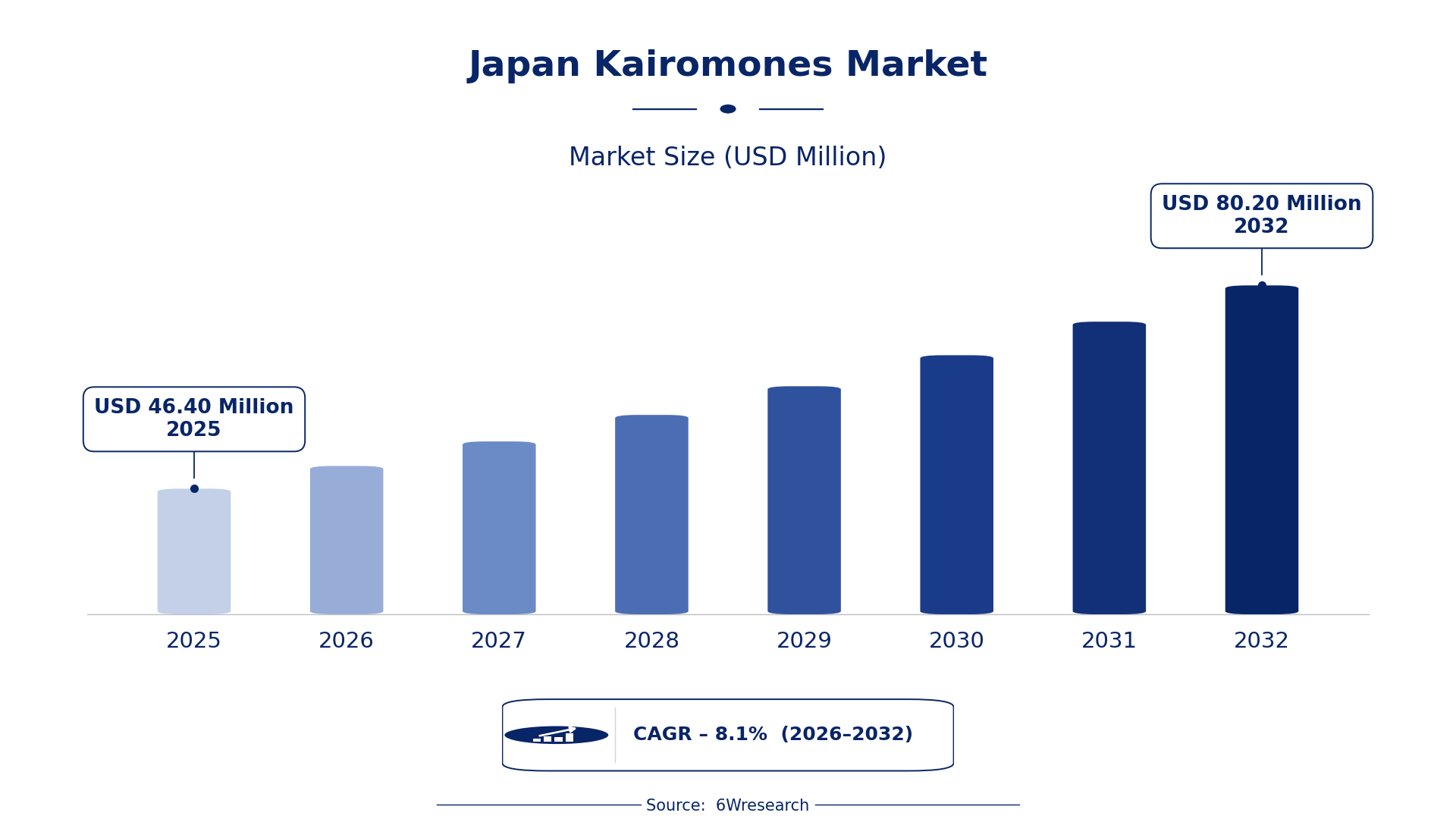
According to 6Wresearch internal database and industry insights, the Japan Kairomones Market was valued at USD 46.40 Million in 2025 and is projected to reach USD 80.20 Million by 2032, growing at a CAGR of approximately 8.1% during 2026–2032.
Japan Kairomones Market Highlights
| Report Metric | Details |
| Report Name | Japan Kairomones Market (2026-2032) |
| Market Size 2025 | USD 46.40 Million |
| Market Size 2032 | USD 80.20 Million |
| Absolute Growth 2025–2032 | USD 33.80 Million |
| CAGR 2026–2032 | 8.1% |
| Peak Annual Growth | 9.0% in 2030 |
| Forecast Period | 2026–2032 |
| Historical Data | 2022–2025 |
| Base Year | 2025 |
| Leading Product Type, 2025 | Insect Kairomones (43% share) |
| Leading Chemical Type, 2025 | Semiochemicals (45% share) |
| Leading Application Area, 2025 | Pest Monitoring (45% share) |
| Leading Distribution Channel, 2025 | Agri Distributors (44% share) |
| Leading End User, 2025 | Farmers (46% share) |
| Fastest-Growing Product Type | Synthetic Kairomones (11.6% CAGR) |
| Fastest-Growing Chemical Type | Chemical Analogues (11.2% CAGR) |
| Fastest-Growing Application Area | Crop Protection (9.6% CAGR) |
| Fastest-Growing Distribution Channel | Specialty Suppliers (10.5% CAGR) |
| Fastest-Growing End User | Agrochemical Firms (10.3% CAGR) |
| Growing Sector | Agriculture |
| Key End Users | Farmers, Agrochemical Firms, Research Institutes |
Japan Kairomones Market Year-wise Growth Rate and Key Drivers (2022–2032)
This graph illustrates the annual growth rates of the market from 2022 to 2032, highlighting a steady upward trajectory and projected market expansion over the forecast period.
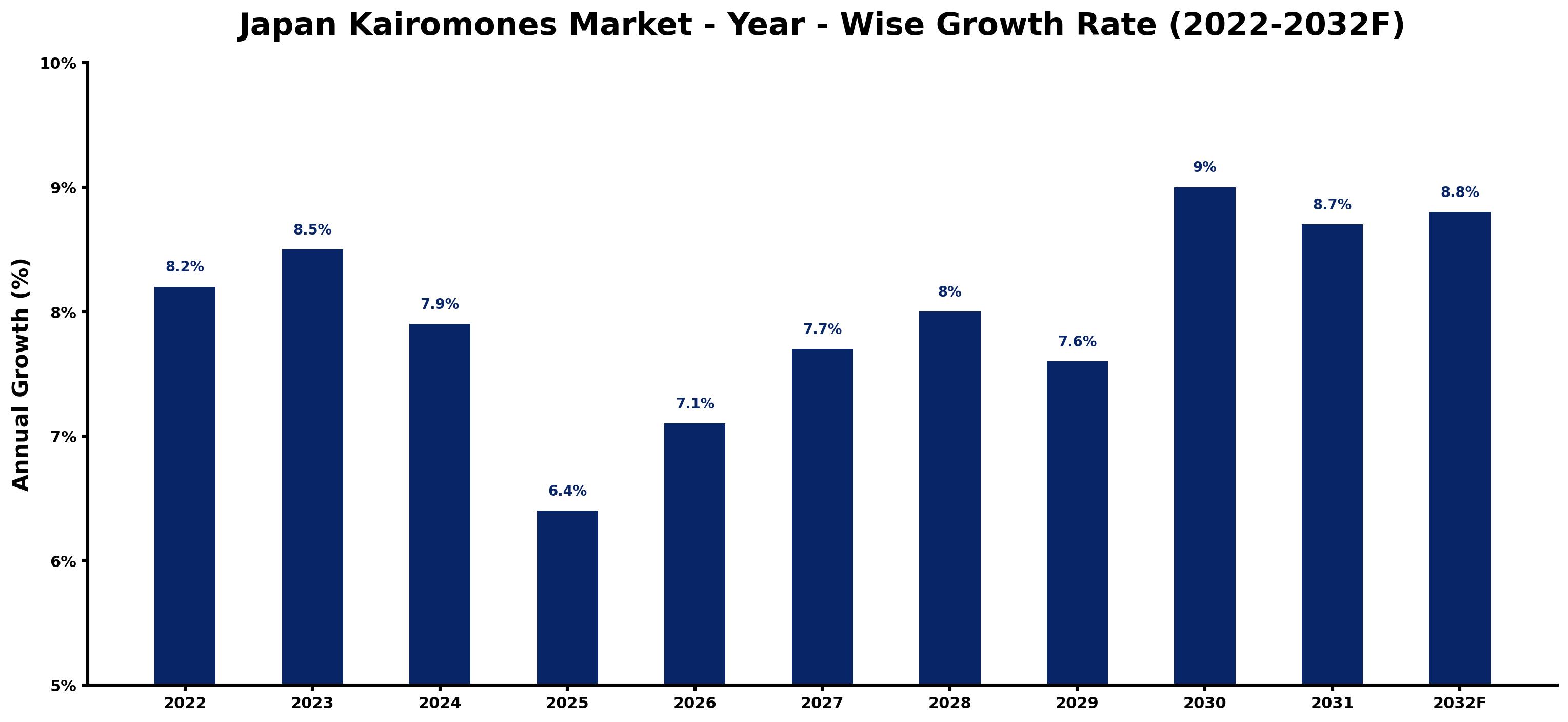
Below, each year's estimated growth is shown next to the factor that most influenced it.
| Year | Estimated Annual Growth (%) | Market Rationale |
| 2022 | 8.2 | The market showed steady growth with increasing awareness of pest management solutions. |
| 2023 | 8.5 | Growth accelerated as farmers sought effective pest control methods amid rising agricultural demands. |
| 2024 | 7.9 | The market experienced a slowdown as farmers adjusted to new pest management strategies. |
| 2025 | 6.4 | Growth continued to slow as farmers faced challenges in adopting new pest control solutions. |
| 2026 | 7.1 | The market is expected to recover as new technologies in pest management gain traction. |
| 2027 | 7.7 | Growth is projected to rise as farmers increasingly adopt sustainable pest management practices. |
| 2028 | 8.0 | The market is anticipated to grow further with advancements in kairomone applications. |
| 2029 | 7.6 | Growth is expected to slow as market saturation begins to set in. |
| 2030 | 9.0 | The market is projected to peak as demand for effective pest control reaches new heights. |
| 2031 | 8.7 | Growth is expected to moderate as the market stabilises following peak demand. |
| 2032 | 8.8 | The market is anticipated to grow steadily as ongoing developments in pest management continue. |
Note: Market size estimations and growth projections presented in this report are based on 6Wresearch's proprietary forecasting methodology, utilizing the latest available industry data, government publications, and primary research inputs.
Japan Kairomones Market Synopsis
Kairomones are chemical signals that insects use for communication, primarily derived from natural sources or synthesized in laboratories. The Japan Kairomones Market is growing due to increasing demand from farmers and agrochemical firms for effective pest management solutions. In 2023, Japan's agricultural sector produced around 8 million tons of rice, which drives the need for new pest control methods and the adoption of Integrated Pest Management practices.
Market Dynamics Impact Analysis (2026–2032)
| Factor | Type | Impact | Primary Segment Affected |
| Increasing adoption of Integrated Pest Management practices | Driver | High | Pest Monitoring |
| Growing demand for sustainable agricultural solutions | Driver | High | Crop Protection |
| Emerging technologies in pest management | Opportunity | High | Synthetic Kairomones |
| Expansion of agricultural research initiatives | Opportunity | Medium | Agri Distributors |
| Aging farmer population requiring modern solutions | Restraint | High | Farmers |
| Limited awareness of kairomone benefits among new farmers | Restraint | Medium | Agrochemical Firms |
| High initial investment for new pest control technologies | Challenge | High | Research Institutes |
| Competition from alternative pest management solutions | Challenge | Medium | Specialty Suppliers |
Evaluation of Drivers in Japan Kairomones Market (2026–2032)
The following drivers explain most of the expected growth.
| Drivers | Primary Segment Affected | Why It Matters (Evidence) |
| Rising agricultural output in Japan | Pest Monitoring | In 2023, Japan produced approximately 8 million tons of rice, increasing the need for effective pest management. |
| Growing focus on sustainable practices | Crop Protection | With over 66% of farmers aged 66 and above, there is a demand for sustainable pest control solutions. |
| Technological advancements in pest control | Synthetic Kairomones | Research Institutes are developing new methods using kairomones, improving pest management effectiveness. |
| Increased funding for agricultural innovation | Agri Distributors | The annual budget for agricultural innovation programs is around 500 million yen, supporting new pest management technologies. |
| Expansion of Integrated Pest Management programs | Integrated Pest Management | The Japanese government promotes Integrated Pest Management, encouraging farmers to adopt effective pest control strategies. |
Much of the new demand originates from Japan's agricultural sector, which produced around 8 million tons of rice in 2023, creating a need for effective pest management. The average age of farmers, exceeding 66 years, underscores the urgency for sustainable pest control solutions. An annual budget of approximately 500 million yen for agricultural innovation supports new methodologies. Research Institutes are actively developing applications for kairomones, leading to increased purchases among farmers seeking effective solutions.
Evaluation of Restraints in Japan Kairomones Market
The table below lists the restraints and the evidence behind each.
| Market Restraint | Primary Segment Affected | Why It Matters (Evidence) |
| Aging farmer population limits adoption of new technologies | Farmers | With an average age over 66, many farmers are hesitant to invest in new pest management solutions. |
| Limited awareness of kairomone benefits among new farmers | Agrochemical Firms | Many new farmers lack knowledge about the advantages of using kairomones for pest control. |
| High initial costs of advanced pest control technologies | Research Institutes | The investment required for new pest management solutions can deter adoption among smaller farms. |
| Competition from alternative pest management solutions | Specialty Suppliers | The presence of various pest control methods can overshadow kairomones, affecting their market share. |
| Regulatory hurdles for new chemical substances | Synthetic Kairomones | Compliance with the Chemical Substances Control Law can delay the introduction of new products. |
Japan Kairomones Market Challenges
Intense competition among suppliers results in price wars, forcing producers to compromise on quality and affecting profitability. Rising production costs stem from the need for sophisticated pest management solutions, straining farmers who already allocate over 20% of their budgets to pest control. Regulatory challenges from the Ministry of Agriculture, Forestry and Fisheries create delays in product approvals, preventing agrochemical firms from launching timely solutions during critical planting periods. Insufficient technological advancements in kairomone applications hinder suppliers, leaving farmers with outdated pest management practices that can ultimately reduce crop yields.
Trends in the Japan Kairomones Market
The trends below show where the Japan Kairomones Market is heading.
- Shift from Traditional to Integrated Pest Management: Since 2020, Japan has seen a shift towards Integrated Pest Management, driven by the government’s Green Growth Strategy. This approach promotes sustainable practices, with approximately 30% of agricultural land now used for fruit and vegetable production, encouraging farmers to adopt more holistic pest management solutions.
- Emergence of Synthetic Kairomones: The market for synthetic kairomones is expanding rapidly, with a projected CAGR of 11.6% from 2026 to 2032. Research Institutes are increasingly developing these products, which mimic natural signals, improving pest control efficiency in various crops.
- Increased Focus on Sustainable Agriculture: The Japanese government’s Green Growth Strategy has led to a heightened focus on sustainable agriculture practices. With an annual budget of around 500 million yen for agricultural innovation, farmers are encouraged to adopt environmentally friendly pest control methods.
- Growth in Pest Monitoring Technologies: In recent years, pest monitoring technologies have gained traction, particularly in the Tokyo region, where agricultural research is concentrated. This trend is supported by the increasing need for effective pest tracking solutions among farmers.
Investment Opportunities in the Japan Kairomones Market
The following areas offer the clearest openings for investors and suppliers in the Japan Kairomones Market.
- Investment in Synthetic Kairomones: With a projected CAGR of 11.6%, now is the time to invest in synthetic kairomones. Agrochemical firms are looking for solutions to improve pest control effectiveness, creating opportunities for suppliers.
- Expansion of Integrated Pest Management Practices: The ongoing promotion of Integrated Pest Management offers a significant opportunity for investment. Farmers in regions with high agricultural output are seeking sustainable solutions, making this an ideal market for new entrants.
- Development of Pest Monitoring Technologies: The demand for advanced pest monitoring technologies is rising, especially in the Tokyo region. Suppliers can enter this market by partnering with local research institutes to develop effective solutions.
- Supply of Sustainable Pest Control Solutions: With increasing awareness of sustainability, there is a growing need for eco-friendly pest control products. Farmers are actively seeking solutions, presenting a prime opportunity for investment.
Government Initiatives in the Japan Kairomones Market
The Chemical Substances Control Law (1973) and the PRTR Law (1999) establish a regulatory framework for chemical substances in Japan. These laws require businesses to report and evaluate chemical releases, ensuring that producers of kairomones adhere to safety and environmental standards. Compliance with these regulations is essential for maintaining market access and consumer trust.
An annual budget of approximately 500 million yen is allocated for agricultural innovation programs, overseen by the Ministry of Agriculture, Forestry and Fisheries. These programs support the development and approval of new pest management technologies, enabling producers to meet evolving market demands while ensuring compliance with safety regulations.
Future Insight of the Japan Kairomones Market
By 2032, policy-driven initiatives will encourage suppliers to adopt innovative pest management strategies, responding to the government's push for sustainability. The integration of advanced technologies will lead to more effective kairomone applications, improving crop protection. With an annual agricultural budget of around 500 million yen for innovation, buyers can expect improved solutions that align with modern agricultural practices. The focus on environmentally friendly methods will reshape the market, ensuring that pest control measures meet both regulatory standards and farmer needs.
Market Segmentation Analysis
Japan Kairomones Market report covers a detailed analysis of the following market segments:
By Product Type – Insect Kairomones Lead, Synthetic Kairomones Expected to Grow Fastest
According to Vasu Joshi, Associate Consultant at 6Wresearch, Insect Kairomones took 43% of product type revenue in 2025, more than any other category. Insect Kairomones hold the largest market share due to their effectiveness in attracting or repelling specific insect species, which is vital for pest management. Their prevalent use among farmers in regions like Tokyo, known for agricultural research, reinforces their dominant position. Synthetic Kairomones are projected to grow fastest, at a CAGR of 11.6% during 2026–2032. The rapid growth of Synthetic Kairomones is attributed to their ability to replicate natural kairomones, offering targeted pest control solutions. As the agricultural sector seeks more efficient alternatives, the uptake of these synthetic products is expected to accelerate. Suppliers should prioritise the development of synthetic kairomones to cater to the increasing demand from the agricultural sector.
By Chemical Type – Semiochemicals Lead, Chemical Analogues Expected to Grow Fastest
With 45% of chemical type revenue in 2025, Semiochemicals was the largest category. Semiochemicals hold the largest share as they serve as vital communication signals for pest management, widely used by farmers across Japan. Their established role in pest control strategies ensures consistent demand from the agricultural sector. Chemical Analogues are set to record the highest CAGR in this split, 11.2% over 2026–2032. Chemical Analogues are experiencing rapid growth due to their application in specialized pest control scenarios, appealing to niche markets within agriculture. As farmers look for tailored solutions, this segment is likely to expand further. Suppliers may need to diversify their product lines to include more chemical analogues to cater to specific agricultural needs.
By Application Area – Pest Monitoring Leads, Crop Protection Expected to Grow Fastest
The largest application area category in 2025 was Pest Monitoring, at 45% of revenue. Pest Monitoring holds a substantial share as it is vital for tracking pest populations, which is crucial for maintaining crop health in Japan's agricultural sector. This is particularly evident in rice production, where effective monitoring is essential to ensure high yields. Over 2026–2032, Crop Protection is expected to post the fastest growth, at a CAGR of 9.6%. Crop Protection is growing rapidly as farmers increasingly prioritise the safeguarding of their crops from pest damage. The rise in fruit and vegetable production necessitates robust protection strategies, driving this segment's growth. Suppliers must focus on developing advanced crop protection solutions to align with the increasing demand from farmers.
By Distribution Channel – Agri Distributors Lead, Specialty Suppliers Expected to Grow Fastest
Agri Distributors accounted for 44% of the market by distribution channel in 2025. Agri Distributors are the primary channel for distributing kairomones, ensuring that farmers have access to essential pest management tools. Their established networks facilitate efficient supply to the agricultural sector, particularly in rural areas. The quickest growth will come from Specialty Suppliers, forecast to expand at a CAGR of 10.5% between 2026 and 2032. Specialty Suppliers are growing rapidly as they provide niche products tailored to specific agricultural needs, appealing to farmers looking for targeted solutions. This trend indicates a shift towards more specialised distribution methods in the market. Suppliers might consider partnerships with specialty suppliers to reach more targeted customer segments effectively.
By End User – Farmers Lead, Agrochemical Firms Expected to Grow Fastest
In 2025, Farmers led the end user split with a 46% share. Farmers represent the largest end user group, as they are the primary users of kairomones for pest control in their agricultural practices. With around 2 million registered farmers in Japan, their needs significantly influence market dynamics. Agrochemical Firms are projected to grow fastest, at a CAGR of 10.3% during 2026–2032. Agrochemical Firms are experiencing the fastest growth as they incorporate kairomones into their pest management products more frequently. This trend reflects a broader shift towards sustainable pest management solutions within the industry. Suppliers should consider forming strategic alliances with agrochemical firms to leverage the expanding market for sustainable pest control.
Key Attractiveness of the Report
- 10 Years of Market Numbers
- Historical Data Starting from 2022 to 2025
- Base Year 2025
- Forecast Data until 2032
- Key Performance Indicators Impacting the Market
- Major Upcoming Developments and Projects
Key Highlights of the Report:
- Japan Kairomones Market Outlook
- Market Size of Japan Kairomones Market, 2025
- Forecast of Japan Kairomones Market, 2032
- Historical Data and Forecast of Japan Kairomones Market Revenues & Volume for the Period 2022-2032F
- Japan Kairomones Market Trend Evolution
- Japan Kairomones Market Drivers and Challenges
- Japan Kairomones Market Price Trends
- Japan Kairomones Market Porter's Five Forces
- Japan Kairomones Market Industry Life Cycle
- Historical Data and Forecast of Japan Kairomones Market Revenues & Volume By Product Type for the Period 2022-2032F
- Historical Data and Forecast of Japan Kairomones Market Revenues & Volume By Insect Kairomones for the Period 2022-2032F
- Historical Data and Forecast of Japan Kairomones Market Revenues & Volume By Synthetic Kairomones for the Period 2022-2032F
- Historical Data and Forecast of Japan Kairomones Market Revenues & Volume By Blended Kairomones for the Period 2022-2032F
- Historical Data and Forecast of Japan Kairomones Market Revenues & Volume By Chemical Type for the Period 2022-2032F
- Historical Data and Forecast of Japan Kairomones Market Revenues & Volume By Semiochemicals for the Period 2022-2032F
- Historical Data and Forecast of Japan Kairomones Market Revenues & Volume By Chemical Analogues for the Period 2022-2032F
- Historical Data and Forecast of Japan Kairomones Market Revenues & Volume By Multi-Species for the Period 2022-2032F
- Historical Data and Forecast of Japan Kairomones Market Revenues & Volume By Application Area for the Period 2022-2032F
- Historical Data and Forecast of Japan Kairomones Market Revenues & Volume By Pest Monitoring for the Period 2022-2032F
- Historical Data and Forecast of Japan Kairomones Market Revenues & Volume By Crop Protection for the Period 2022-2032F
- Historical Data and Forecast of Japan Kairomones Market Revenues & Volume By Integrated Pest Management for the Period 2022-2032F
- Historical Data and Forecast of Japan Kairomones Market Revenues & Volume By Distribution Channel for the Period 2022-2032F
- Historical Data and Forecast of Japan Kairomones Market Revenues & Volume By Agri Distributors for the Period 2022-2032F
- Historical Data and Forecast of Japan Kairomones Market Revenues & Volume By Specialty Suppliers for the Period 2022-2032F
- Historical Data and Forecast of Japan Kairomones Market Revenues & Volume By Direct Sales for the Period 2022-2032F
- Historical Data and Forecast of Japan Kairomones Market Revenues & Volume By End User for the Period 2022-2032F
- Historical Data and Forecast of Japan Kairomones Market Revenues & Volume By Farmers for the Period 2022-2032F
- Historical Data and Forecast of Japan Kairomones Market Revenues & Volume By Agrochemical Firms for the Period 2022-2032F
- Historical Data and Forecast of Japan Kairomones Market Revenues & Volume By Research Institutes for the Period 2022-2032F
- Japan Kairomones Market Import Export Trade Statistics
- Market Opportunity Assessment By Product Type
- Market Opportunity Assessment By Chemical Type
- Market Opportunity Assessment By Application Area
- Market Opportunity Assessment By Distribution Channel
- Market Opportunity Assessment By End User
- Japan Kairomones Market Top Companies Market Share
- Japan Kairomones Market Competitive Benchmarking By Technical and Operational Parameters
- Japan Kairomones Market Company Profiles
- Japan Kairomones Market Key Strategic Recommendations
Market Covered
The study includes the following segmentation.
By Product Type
- Insect Kairomones
- Synthetic Kairomones
- Blended Kairomones
By Chemical Type
- Semiochemicals
- Chemical Analogues
- Multi-Species
By Application Area
- Pest Monitoring
- Crop Protection
- Integrated Pest Management
By Distribution Channel
- Agri Distributors
- Specialty Suppliers
- Direct Sales
By End User
- Farmers
- Agrochemical Firms
- Research Institutes






































