Japan Kitchen and cleaning cloth Market (2024-2030) | Industry, Growth, Value, Size, Forecast, Outlook, Share, Analysis, Revenue, Trends & Companies
Market Forecast By Product Type (Sourcing Pads, Scrubbers, and Sponges, Mops and Brooms, Cleaning Brushes, Wipes, Gloves, Others), By End-users (Commercial, Residential), By Distribution Channel (Supermarkets and Hypermarkets, Convenience Stores, Specialty Stores, Online Stores, Others) And Competitive Landscape
| Product Code: ETC028722 | Publication Date: Jun 2023 | Updated Date: Oct 2025 | Product Type: Report | |
| Publisher: 6Wresearch | Author: Ravi Bhandari | No. of Pages: 70 | No. of Figures: 35 | No. of Tables: 5 |
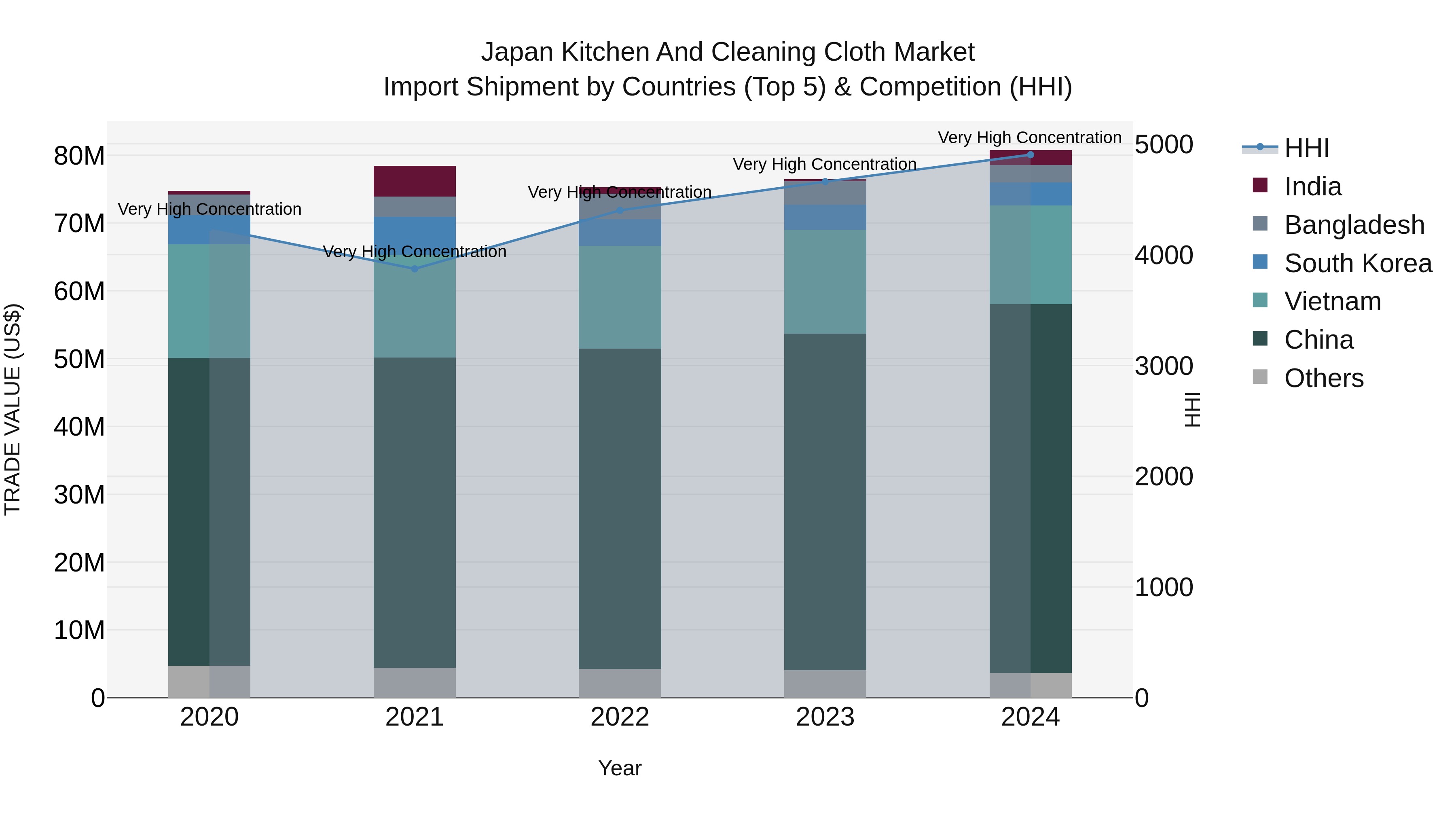
Japan Kitchen And Cleaning Cloth Market Import Shipment by Countries (Top 5) & Competition (HHI)
The Japan kitchen and cleaning cloth import market continues to thrive in 2024, with top exporting countries being China, Vietnam, South Korea, Bangladesh, and India. The high Herfindahl-Hirschman Index (HHI) concentration indicates a competitive market. With a compound annual growth rate (CAGR) of 1.94% from 2020 to 2024 and a notable growth rate of 5.58% in 2023-24, the industry shows promising developments and opportunities for further expansion in the coming years.
Japan Kitchen and Cleaning Cloth Market Highlights
| Report Name | Japan Kitchen and Cleaning Cloth Market |
| Forecast Period | 2024-2030 |
| Market Size | USD 48Billion – USD 57Billion |
| CAGR | 6.7% |
| Growing Sector | e-Commerce |
Topics Covered in the Japan Kitchen and Cleaning Cloth Market Report
The Japan Kitchen and Cleaning Cloth market report thoroughly covers the market by product type, by end-user and distribution channel. The report provides an unbiased and detailed analysis of the on-going market trends, opportunities/high growth areas, and market drivers which would help the stakeholders to devise and align their market strategies according to the current and future market dynamics.
Japan Kitchen and Cleaning Cloth Market Size & Analysis
In 2024, the Japan Kitchen and Cleaning Cloth market is valued at approximately $ 48billion, with a projected compound annual growth rate (CAGR) of 6.7% over the next five years. Additionally, by 2030, the market is expected to reach around $ 57billion. Thee-commerce sector holds significant position in the overall market.
Japan Kitchen and Cleaning Cloth Market Synopsis
The Japan kitchen and cleaning cloth market is shaped by rising consumer awareness of hygiene, sustainability, and convenience. Products like microfiber cloths, known for their durability and high cleaning efficiency, dominate the market, alongside eco-friendly options made from organic and biodegradable materials. The market benefits from a strong focus on innovation, with antimicrobial coatings and enhanced absorbency being key selling points. Urbanization and smaller living spaces drive demand for compact and multipurpose cleaning solutions, while e-commerce growth expands accessibility and variety for consumers. This sector is expected to grow steadily, supported by trends in sustainability, premium product offerings, and evolving consumer lifestyles.
According to 6Wresearch, Japan Kitchen and Cleaning Cloth market size is projected to grow at a CAGR of 6.7% during 2024-2030. The growth of the Japan kitchen and cleaning cloth market is fueled by increasing consumer awareness of hygiene, urbanization, and a rising preference for eco-friendly products. Technological advancements, such as the development of antimicrobial fabrics and highly absorbent microfiber cloths, further enhance market appeal. The growing emphasis on sustainability, driven by both consumer demand and government regulations, has accelerated the adoption of biodegradable and reusable materials. However, the Japan Kitchen and Cleaning Cloth industryfaces challenges such as intense competition among domestic manufacturers, the high cost of innovative materials, and the need to meet stringent environmental regulations can hinder growth. Additionally, economic fluctuations and shifting consumer spending patterns may impact market expansion in the short term.
Japan Kitchen and Cleaning Cloth Market Trends
Growth Eco-Friendly Innovations - Increasing demand for reusable and biodegradable cleaning cloths as consumers and businesses focus on sustainability
Technological Advancements - Introduction of antimicrobial coatings and high-performance microfiber cloths for superior hygiene and cleaning efficiency
Compact and Multipurpose Products - Urban living drives demand for space-saving and multifunctional cleaning solutions
E-Commerce Growth - Rising popularity of online platforms provides consumers easy access to a wider range of products, fueling market expansion
Investment Opportunities in the Japan Kitchen and Cleaning Cloth Market
Expansion Eco-Friendly Products - Development and production of biodegradable, reusable, and sustainable cleaning cloths to meet growing consumer demand
Innovative Materials - Investment in high-performance materials like antimicrobial fabrics and advanced microfiber technologies
E-Commerce Expansion - Leveraging online platforms to expand reach and tap into the growing preference for digital shopping
Commercial Applications - Targeting industries such as healthcare, hospitality, and food service with specialized, high-quality cleaning cloths
Urban and Compact Solutions - Designing space-efficient, multifunctional products tailored to urban consumers with limited storage
Key Players in the Japan Kitchen and Cleaning Cloth Market
The Japan kitchen and cleaning cloth market is led by prominent domestic and international companies, with Kao Corporation holding a significant market share due to its high-quality cleaning solutions and sustainable initiatives. Other notable players include Unicharm Corporation, known for its innovative microfiber and disposable cleaning cloths, and P&G Japan, which focuses on premium and multifunctional cleaning products. Smaller domestic brands and niche eco-friendly startups are also gaining traction, emphasizing biodegradable materials and sustainable practices. Additionally, some of these players hold majority of the Japan Kitchen and Cleaning Cloth market share. Moreover, this competitive and fragmented market fosters innovation, catering to diverse consumer preferences and regulatory demands
Government Regulationsin the Japan Kitchen and Cleaning Cloth Market
The Japan government enforces stringent environmental and consumer safety regulations that impact the kitchen and cleaning cloth market. Key frameworks include the Act on the Promotion of Resource Circulation for Plastics, which encourages manufacturers to reduce plastic use in products and packaging, fostering a shift towards biodegradable and eco-friendly materials. The Chemical Substances Control Law regulates the use of chemicals in antimicrobial and treated cloths to ensure safety. Further, these initiatives have further boosted the Japan Kitchen and Cleaning Cloth market revenues. Furthermore, the government promotes sustainability initiatives, offering subsidies and incentives for companies investing in green technologies and materials. These policies not only shape product innovation but also influence market dynamics by prioritizing environmentally responsible practices
Future Insights of the Japan Kitchen and Cleaning Cloth Market
The future of the Japan kitchen and cleaning cloth market is poised for growth, driven by increasing consumer demand for sustainable and innovative products. The adoption of biodegradable and antimicrobial materials is expected to surge, aligning with environmental regulations and hygiene priorities. Digital transformation through e-commerce will expand market accessibility, particularly among younger, tech-savvy consumers. Additionally, rising demand from commercial sectors like healthcare and hospitality will drive the development of specialized cleaning solutions. As urbanization continues, compact, multifunctional designs will gain traction, while government incentives for green manufacturing will further propel innovation and investment in the sector.
Mops and Brooms Typeto Dominate the Market - By Product Type
According to Ravi Bhandari, Research Head, 6Wresearch, the mops and brooms segment within Japan's cleaning products market is experiencing steady growth, driven by increasing household and commercial demand for effective cleaning solutions. Consumers are showing a preference for lightweight, durable, and ergonomic designs, with advanced materials like microfiber enhancing cleaning efficiency. The commercial sector, including hospitals, hotels, and offices, is a significant contributor, requiring high-performance and specialized tools. Sustainability trends are encouraging the development of reusable and eco-friendly products; such as mops with replaceable or washable heads.
Commercial Categoryto Dominate the Market – By End User
The commercial end-user segment in Japan's kitchen and cleaning cloth market is witnessing robust growth, primarily fueled by rising hygiene standards in sectors such as healthcare, hospitality, and food services. Businesses in these industries demand high-quality, durable, and specialized cleaning cloths to meet strict cleanliness and safety regulations. The shift towards reusable and eco-friendly products also aligns with sustainability goals, making such products increasingly attractive to commercial buyers. Additionally, advancements in antimicrobial technologies and the introduction of cost-efficient bulk procurement options are further driving adoption in this segment.
Key Attractiveness of the Report
- 10 Years Market Numbers.
- Historical Data Starting from 2020to 2023.
- Base Year 2023.
- Forecast Data until 2030.
- Key Performance Indicators Impacting the Market.
- Major Upcoming Developments and Projects.
Key Highlights of the Report:
- Japan Kitchen and Cleaning Cloth Market Overview
- Japan Kitchen and Cleaning Cloth Market Outlook
- Market Size of Japan Kitchen and cleaning cloth Market, 2023
- Forecast of Japan Kitchen and cleaning cloth Market, 2030
- Historical Data and Forecast of Japan Kitchen and Cleaning Cloth Revenues & Volume for the Period 2020-2030
- Japan Kitchen and Cleaning Cloth Market Trend Evolution
- Japan Kitchen and Cleaning Cloth Market Drivers and Challenges
- Japan Kitchen and Cleaning ClothMarket - Price Trends
- Japan Kitchen and Cleaning ClothMarket - Porter's Five Forces
- Japan Kitchen and Cleaning Cloth Industry Life Cycle
- Historical Data and Forecast of Japan Kitchen and Cleaning Cloth Market Revenues & Volume, By Product Type for the Period 2020-2030
- Historical Data and Forecast of Japan Kitchen and Cleaning Cloth Market Revenues & Volume, By Sourcing Pads, Scrubbers, and Sponges for the Period 2020-2030
- Historical Data and Forecast of Japan Kitchen and Cleaning Cloth Market Revenues & Volume, By Mops and Brooms for the Period 2020-2030
- Historical Data and Forecast of Japan Kitchen and Cleaning Cloth Market Revenues & Volume, By Cleaning Brushes for the Period 2020-2030
- Historical Data and Forecast of Japan Kitchen and Cleaning Cloth Market Revenues & Volume, By Wipes for the Period 2020-2030
- Historical Data and Forecast of Japan Kitchen and Cleaning Cloth Market Revenues & Volume, By Gloves for the Period 2020-2030
- Historical Data and Forecast of Japan Kitchen and Cleaning Cloth Market Revenues & Volume, By Others for the Period 2020-2030
- Historical Data and Forecast of Japan Kitchen and Cleaning Cloth Market Revenues & Volume, By End-users for the Period 2020-2030
- Historical Data and Forecast of Japan Kitchen and Cleaning Cloth Market Revenues & Volume, By Commercial for the Period 2020-2030
- Historical Data and Forecast of Japan Kitchen and Cleaning Cloth Market Revenues & Volume By Residential for the Period 2020-2030
- Historical Data and Forecast of Japan Kitchen and Cleaning Cloth Market Revenues & Volume, By Distribution Channel for the Period 2020-2030
- Historical Data and Forecast of Japan Kitchen and Cleaning Cloth Market Revenues & Volume By Supermarkets and Hypermarkets for the Period 2020-2030
- Historical Data and Forecast of Japan Kitchen and Cleaning Cloth Market Revenues & Volume, By Convenience Stores for the Period 2020-2030
- Historical Data and Forecast of Japan Kitchen and Cleaning Cloth Market Revenues & Volume, By Specialty Stores for the Period 2020-2030
- Historical Data and Forecast of Japan Kitchen and Cleaning Cloth Market Revenues & Volume, By Online Stores for the Period 2020-2030
- Historical Data and Forecast of Japan Kitchen and Cleaning Cloth Market Revenues & Volume, By Others for the Period 2020-2030
- Japan Kitchen and Cleaning ClothMarket - Import Export Trade Statistics
- Market Opportunity Assessment, By Product Type
- Market Opportunity Assessment, By End-users
- Market Opportunity Assessment, By Distribution Channel
- Japan Kitchen and Cleaning ClothMarket - Top Companies Market Share
- Japan Kitchen and Cleaning ClothMarket - Competitive Benchmarking, By Technical and Operational Parameters
- Japan Kitchen and Cleaning ClothMarket - Company Profiles
- Japan Kitchen and Cleaning ClothMarket - Key Strategic Recommendations
Markets Covered
The Japan Kitchen and Cleaning Cloth market report provides a detailed analysis of the following market segments
By Product Type
- Sourcing Pads
- Scrubbers and Sponges
- Mops and Brooms
- Cleaning Brushes
- Wipes
- Gloves
- Others
By End User
- Commercial
- Residential
By Distribution Channel
- Supermarkets and Hypermarkets
- Convenience Stores
- Specialty Stores
- Online Stores
- Others
Japan Kitchen and cleaning cloth Market (2024-2030): FAQs
The market growth is driven byincreasing demand for hygiene and cleanliness across both residential and commercial sectors.
The mops and brooms categoryis expected to register massive growth over the years.
The commercial end userholds the highest market share.
Scotch Brite, Zwipes, Norwex, CMA, Atlas Graham and Torayare some of the prominent players in the Japan Kitchen and Cleaning Cloth market.
6Wresearch actively monitors the Japan Kitchen and cleaning cloth Market and publishes its comprehensive annual report, highlighting emerging trends, growth drivers, revenue analysis, and forecast outlook. Our insights help businesses to make data-backed strategic decisions with ongoing market dynamics. Our analysts track relevent industries related to the Japan Kitchen and cleaning cloth Market, allowing our clients with actionable intelligence and reliable forecasts tailored to emerging regional needs.
Yes, we provide customisation as per your requirements. To learn more, feel free to contact us on sales@6wresearch.com
| 1 Executive Summary |
| 2 Introduction |
| 2.1 Key Highlights of the Report |
| 2.2 Report Description |
| 2.3 Market Scope & Segmentation |
| 2.4 Research Methodology |
| 2.5 Assumptions |
| 3 Japan Kitchen and cleaning cloth Market Overview |
| 3.1 Japan Country Macro Economic Indicators |
| 3.2 Japan Kitchen and cleaning cloth Market Revenues & Volume, 2020 & 2030F |
| 3.3 Japan Kitchen and cleaning cloth Market - Industry Life Cycle |
| 3.4 Japan Kitchen and cleaning cloth Market - Porter's Five Forces |
| 3.5 Japan Kitchen and cleaning cloth Market Revenues & Volume Share, By Product Type, 2020 & 2030F |
| 3.6 Japan Kitchen and cleaning cloth Market Revenues & Volume Share, By End-users, 2020 & 2030F |
| 3.7 Japan Kitchen and cleaning cloth Market Revenues & Volume Share, By Distribution Channel, 2020 & 2030F |
| 4 Japan Kitchen and cleaning cloth Market Dynamics |
| 4.1 Impact Analysis |
| 4.2 Market Drivers |
| 4.2.1 Increasing focus on hygiene and cleanliness in households |
| 4.2.2 Rising demand for eco-friendly and sustainable cleaning products |
| 4.2.3 Growth in the number of households with dual-income earners, leading to higher spending on convenience products like kitchen and cleaning cloths |
| 4.3 Market Restraints |
| 4.3.1 Competition from alternative cleaning products such as disposable wipes |
| 4.3.2 Fluctuating raw material prices impacting production costs |
| 4.3.3 Slow adoption of innovative cleaning cloth technologies in the market |
| 5 Japan Kitchen and cleaning cloth Market Trends |
| 6 Japan Kitchen and cleaning cloth Market, By Types |
| 6.1 Japan Kitchen and cleaning cloth Market, By Product Type |
| 6.1.1 Overview and Analysis |
| 6.1.2 Japan Kitchen and cleaning cloth Market Revenues & Volume, By Product Type, 2020 - 2030F |
| 6.1.3 Japan Kitchen and cleaning cloth Market Revenues & Volume, By Sourcing Pads, Scrubbers, and Sponges, 2020 - 2030F |
| 6.1.4 Japan Kitchen and cleaning cloth Market Revenues & Volume, By Mops and Brooms, 2020 - 2030F |
| 6.1.5 Japan Kitchen and cleaning cloth Market Revenues & Volume, By Cleaning Brushes, 2020 - 2030F |
| 6.1.6 Japan Kitchen and cleaning cloth Market Revenues & Volume, By Wipes, 2020 - 2030F |
| 6.1.7 Japan Kitchen and cleaning cloth Market Revenues & Volume, By Gloves, 2020 - 2030F |
| 6.1.8 Japan Kitchen and cleaning cloth Market Revenues & Volume, By Others, 2020 - 2030F |
| 6.2 Japan Kitchen and cleaning cloth Market, By End-users |
| 6.2.1 Overview and Analysis |
| 6.2.2 Japan Kitchen and cleaning cloth Market Revenues & Volume, By Commercial, 2020 - 2030F |
| 6.2.3 Japan Kitchen and cleaning cloth Market Revenues & Volume, By Residential, 2020 - 2030F |
| 6.3 Japan Kitchen and cleaning cloth Market, By Distribution Channel |
| 6.3.1 Overview and Analysis |
| 6.3.2 Japan Kitchen and cleaning cloth Market Revenues & Volume, By Supermarkets and Hypermarkets, 2020 - 2030F |
| 6.3.3 Japan Kitchen and cleaning cloth Market Revenues & Volume, By Convenience Stores, 2020 - 2030F |
| 6.3.4 Japan Kitchen and cleaning cloth Market Revenues & Volume, By Specialty Stores, 2020 - 2030F |
| 6.3.5 Japan Kitchen and cleaning cloth Market Revenues & Volume, By Online Stores, 2020 - 2030F |
| 6.3.6 Japan Kitchen and cleaning cloth Market Revenues & Volume, By Others, 2020 - 2030F |
| 7 Japan Kitchen and cleaning cloth Market Import-Export Trade Statistics |
| 7.1 Japan Kitchen and cleaning cloth Market Export to Major Countries |
| 7.2 Japan Kitchen and cleaning cloth Market Imports from Major Countries |
| 8 Japan Kitchen and cleaning cloth Market Key Performance Indicators |
| 8.1 Consumer satisfaction and repeat purchase rate |
| 8.2 Adoption rate of eco-friendly cleaning cloths |
| 8.3 Average time spent on household cleaning tasks |
| 8.4 Customer reviews and ratings on product effectiveness |
| 8.5 Market penetration in different regions of Japan |
| 9 Japan Kitchen and cleaning cloth Market - Opportunity Assessment |
| 9.1 Japan Kitchen and cleaning cloth Market Opportunity Assessment, By Product Type, 2020 & 2030F |
| 9.2 Japan Kitchen and cleaning cloth Market Opportunity Assessment, By End-users, 2020 & 2030F |
| 9.3 Japan Kitchen and cleaning cloth Market Opportunity Assessment, By Distribution Channel, 2020 & 2030F |
| 10 Japan Kitchen and cleaning cloth Market - Competitive Landscape |
| 10.1 Japan Kitchen and cleaning cloth Market Revenue Share, By Companies, 2023 |
| 10.2 Japan Kitchen and cleaning cloth Market Competitive Benchmarking, By Operating and Technical Parameters |
| 11 Company Profiles |
| 12 Recommendations |
| 13 Disclaimer |
Global Go To Market Strategy - 2030
Export potential enables firms to identify high-growth global markets with greater confidence by combining advanced trade intelligence with a structured quantitative methodology. The framework analyzes emerging demand trends and country-level import patterns while integrating macroeconomic and trade datasets such as GDP and population forecasts, bilateral import–export flows, tariff structures, elasticity differentials between developed and developing economies, geographic distance, and import demand projections. Using weighted trade values from 2020–2024 as the base period to project country-to-country export potential for 2030, these inputs are operationalized through calculated drivers such as gravity model parameters, tariff impact factors, and projected GDP per-capita growth. Through an analysis of hidden potentials, demand hotspots, and market conditions that are most favorable to success, this method enables firms to focus on target countries, maximize returns, and global expansion with data, backed by accuracy.
By factoring in the projected importer demand gap that is currently unmet and could be potential opportunity, it identifies the potential for the Exporter (Country) among 190 countries, against the general trade analysis, which identifies the biggest importer or exporter.
To discover high-growth global markets and optimize your business strategy:
Click Here
Pricing
- Single User License$ 1,995
- Department License$ 2,400
- Site License$ 3,120
- Global License$ 3,795

Leadership Perspectives from Industry Events
Search
Thought Leadership and Analyst Meet





Our Clients








6WResearch In News
- India Air Conditioner Market Set for Strong Rebound in 2026 After Weather-Led Correction and GST-Driven Recovery: 6Wresearch
- ADAS in India: How Automatic Emergency Braking, Blind Spot Detection & Driver Monitoring are Transforming Road Safety
- Doha a strategic location for EV manufacturing hub: IPA Qatar
- Demand for luxury TVs surging in the GCC, says Samsung
- Empowering Growth: The Thriving Journey of Bangladesh’s Cable Industry
- Demand for luxury TVs surging in the GCC, says Samsung
Latest Reports
- Nicaragua RPG Gaming Market (2026-2032)
- New Zealand RPG Gaming Market (2026-2032)
- Netherlands RPG Gaming Market (2026-2032)
- Nauru RPG Gaming Market (2026-2032)
- Namibia RPG Gaming Market (2026-2032)
- Mozambique RPG Gaming Market (2026-2032)
- Montenegro RPG Gaming Market (2026-2032)
- Mongolia RPG Gaming Market (2026-2032)
- Monaco RPG Gaming Market (2026-2032)
- Micronesia RPG Gaming Market (2026-2032)
Industry Events and Analyst Meet

EV India Expo 2026

HIMTEX 2026

India Refining Summit 2026

India EV Show 2026

EV tech India Expo 2026
Whitepaper
- Middle East & Africa Commercial Security Market Click here to view more.
- Middle East & Africa Fire Safety Systems & Equipment Market Click here to view more.
- GCC Drone Market Click here to view more.
- Middle East Lighting Fixture Market Click here to view more.
- GCC Physical & Perimeter Security Market Click here to view more.


