Japan Lactic Acid Feed Market Size & Growth Rate
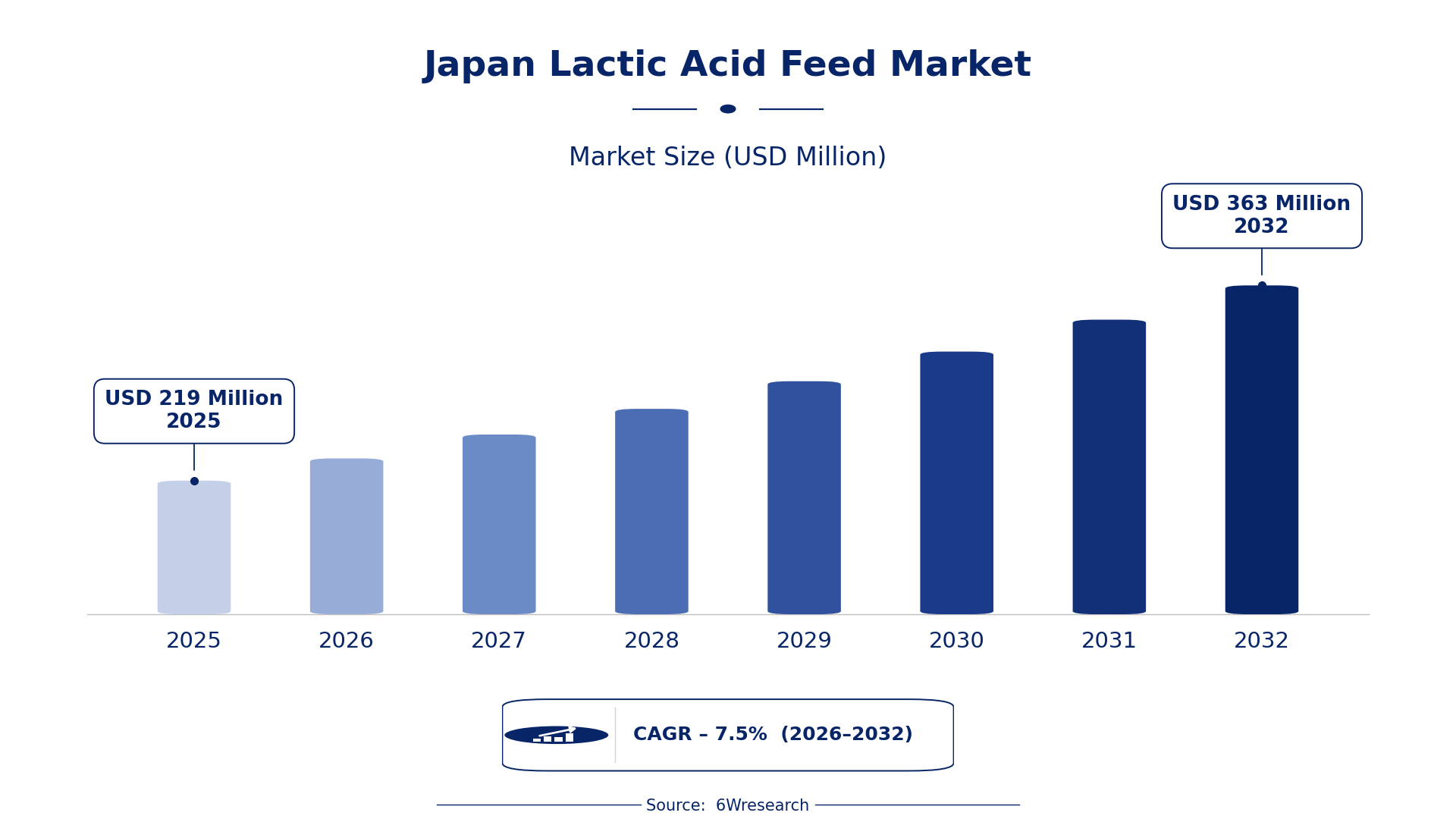
According to 6Wresearch internal database and industry insights, the Japan Lactic Acid Feed Market was valued at USD 219 Million in 2025 and is projected to reach USD 363 Million by 2032, growing at a CAGR of approximately 7.5% during 2026–2032.
Japan Lactic Acid Feed Market Highlights
| Report Metric | Details |
| Report Name | Japan Lactic Acid Feed Market (2026-2032) |
| Market Size 2025 | USD 219 Million |
| Market Size 2032 | USD 363 Million |
| Absolute Growth 2025–2032 | USD 144 Million |
| CAGR 2026–2032 | 7.5% |
| Peak Annual Growth | 8.7% in 2026 |
| Forecast Period | 2026–2032 |
| Historical Data | 2022–2025 |
| Base Year | 2025 |
| Leading Product Type, 2025 | Fermented Lactic Acid (48% share) |
| Leading Source Type, 2025 | Plant-Based (38% share) |
| Leading Distribution Channel, 2025 | Direct Sales (42% share) |
| Leading End User, 2025 | Poultry Farms (46% share) |
| Fastest-Growing Product Type | Synthetic Lactic Acid (10.6% CAGR) |
| Fastest-Growing Source Type | Petrochemical (10.5% CAGR) |
| Fastest-Growing Distribution Channel | Online Platforms (9.8% CAGR) |
| Fastest-Growing End User | Livestock Feed Manufacturers (9.5% CAGR) |
| Growing Sector | Livestock Feed |
| Key End Users | Poultry Farms, Livestock Feed Manufacturers, Animal Feed Distributors |
Japan Lactic Acid Feed Market Year-wise Growth Rate and Key Drivers (2022–2032)
This graph illustrates the annual growth rates of the market from 2022 to 2032, highlighting a steady upward trajectory and projected market expansion over the forecast period.
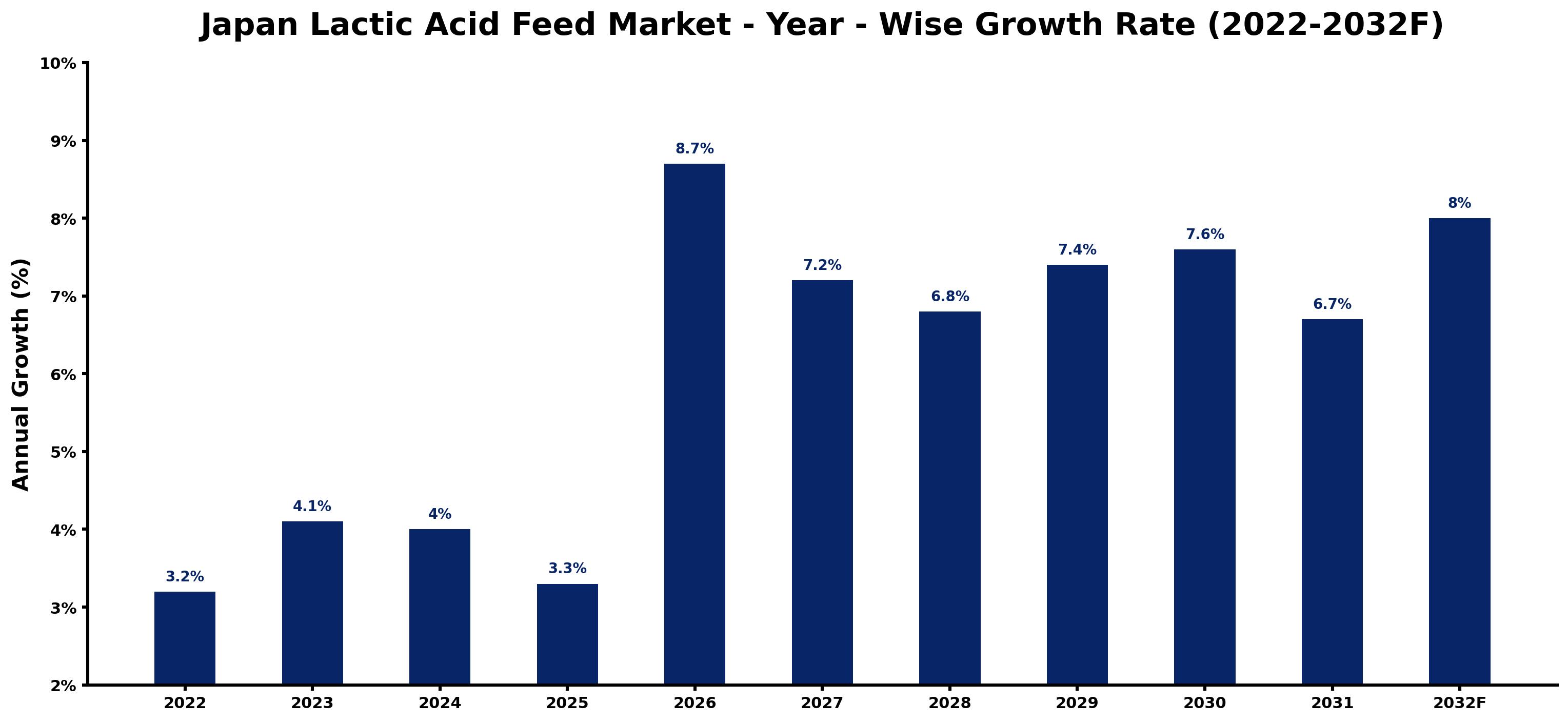
The yearly estimates that follow link every growth rate to its principal driver, so readers can see why the pace changed in each period.
| Year | Estimated Annual Growth (%) | Market Rationale |
| 2022 | 3.2 | The market experienced steady growth as demand from poultry farms remained stable. |
| 2023 | 4.1 | Growth accelerated due to increased awareness of feed quality among livestock feed manufacturers. |
| 2024 | 4.0 | Growth slowed slightly as market conditions normalised after the previous year's surge. |
| 2025 | 3.3 | A further slowdown occurred as the market adjusted to changing feed preferences. |
| 2026 | 8.7 | Demand surged as the introduction of new sustainable feed initiatives gained traction. |
| 2027 | 7.2 | Growth decelerated as the market stabilised after the peak demand in 2026. |
| 2028 | 6.8 | The market continued to slow, reflecting adjustments in feed formulations and preferences. |
| 2029 | 7.4 | A renewed interest in quality feed led to faster growth as producers adapted. |
| 2030 | 7.6 | Demand rose again as investments in feed efficiency technologies expanded. |
| 2031 | 6.7 | Growth moderated as the market began to stabilise after several years of rapid changes. |
| 2032 | 8.0 | A resurgence in demand is anticipated as new feed standards are implemented. |
Note: Market size estimations and growth projections presented in this report are based on 6Wresearch's proprietary forecasting methodology, utilizing the latest available industry data, government publications, and primary research inputs.
Japan Lactic Acid Feed Market Synopsis
Lactic Acid Feed is derived from lactic acid, produced through fermentation or chemical synthesis, and is primarily used in animal nutrition to improve feed quality and digestibility. Sustainable feed initiatives and demand from poultry farms further support this growth.
Market Dynamics Impact Analysis (2026–2032)
| Factor | Type | Impact | Primary Segment Affected |
| Rising demand for quality feed among poultry farms | Driver | High | Fermented Lactic Acid |
| Increased production capacity in regions like Hokkaido | Driver | High | Liquid Lactic Acid Feed |
| Growing online sales channels for animal feed | Opportunity | High | Powdered Lactic Acid Feed |
| Expansion of livestock feed manufacturers in Japan | Opportunity | High | Synthetic Lactic Acid |
| Compliance with stringent feed quality standards | Restraint | High | Plant-Based |
| Limited awareness of synthetic feed alternatives | Restraint | Medium | Synthetic Lactic Acid |
| High production costs for quality feed ingredients | Challenge | High | Liquid Lactic Acid Feed |
| Capacity constraints in feed production facilities | Challenge | Medium | Fermented Lactic Acid |
Evaluation of Drivers in Japan Lactic Acid Feed Market (2026–2032)
Demand rests on the following drivers, each shown with the segment it touches most.
| Drivers | Primary Segment Affected | Why It Matters (Evidence) |
| Increased focus on feed efficiency improvements | Powdered Lactic Acid Feed | Lactic acid feed contributes to improved feed efficiency in poultry by up to 10%, driving demand from poultry farms. |
| Growing livestock population in Japan | Fermented Lactic Acid | With approximately 4 million livestock, the need for quality feed is rising, boosting production. |
| Sustainable feed initiatives supported by the Ministry of Agriculture | Liquid Lactic Acid Feed | The 2023 programme promotes fermented feeds, leading to higher adoption rates among feed manufacturers. |
| Rising online sales of animal feed | Synthetic Lactic Acid | Online sales increased by 15% last year, encouraging manufacturers to diversify distribution channels. |
| High demand from livestock feed manufacturers | Plant-Based | The Dairy Industry, valued over 1 trillion JPY, influences the demand for quality feed ingredients. |
Orders keep climbing as the focus on feed efficiency rises, with lactic acid feed improving poultry feed efficiency by up to 10%. The livestock population in Japan, approximately 4 million, drives demand for quality feed, particularly from poultry farms. Online sales of animal feed have surged by 15%, prompting manufacturers to adjust distribution strategies. The Dairy Industry, valued at over 1 trillion JPY, further fuels the need for quality feed ingredients, driving demand for lactic acid feed products.
Evaluation of Restraints in Japan Lactic Acid Feed Market
The following restraints limit how fast demand can grow.
| Market Restraint | Primary Segment Affected | Why It Matters (Evidence) |
| High production costs for quality feed ingredients | Liquid Lactic Acid Feed | Production costs rise due to the need for high-quality raw materials, affecting profitability for manufacturers. |
| Limited awareness of synthetic feed alternatives | Synthetic Lactic Acid | Many producers still prefer traditional feed sources, hindering the growth of synthetic options. |
| Compliance with stringent feed quality standards | Plant-Based | Producers must invest in testing and certification to meet JIS Z 1701 standards, increasing operational costs. |
| Capacity constraints in feed production facilities | Fermented Lactic Acid | Limited production capacity restricts supply, impacting the ability to meet growing demand. |
| Market competition from alternative feed sources | Powdered Lactic Acid Feed | Competition from cheaper feed alternatives challenges the market share of lactic acid feed. |
Japan Lactic Acid Feed Market Challenges
A major obstacle in the lactic acid feed market is the stringent regulations set by JIS Z 1701, which require extensive testing and certification, delaying product availability and increasing costs by approximately 20% for manufacturers. Supply chain challenges arise from reliance on specific agricultural regions like Hokkaido and Kumamoto, leading to inconsistent supply and compelling buyers to maintain higher inventory levels. A shortage of skilled workers in fermentation technology hampers production efficiency, resulting in a 15% drop in output for some producers. Rising prices of corn-based ingredients, which account for about 30% of total feed usage, further pressure profit margins for livestock feed manufacturers.
Trends in the Japan Lactic Acid Feed Market
Buyers and suppliers in the Japan Lactic Acid Feed Market are adjusting to the following trends.
- Shift towards Sustainable Feed Practices: In 2023, Japan launched a programme promoting the use of fermented feeds in livestock, reflecting a growing trend towards sustainability. This initiative is expected to improve feed quality and efficiency, influencing purchasing decisions among livestock feed manufacturers.
- Rising Online Sales Channels: Since 2022, online platforms for animal feed have gained traction, with sales increasing by 15% last year. This shift enables easier access for poultry farms, allowing them to source quality feed more conveniently.
- Transition from Traditional to Fermented Feed: The trend towards fermented feed began gaining momentum in 2023, driven by its benefits in improving growth rates in poultry. This shift is supported by the Ministry of Agriculture's initiatives, encouraging feed manufacturers to adapt.
- Emergence of Synthetic Lactic Acid: Synthetic Lactic Acid is becoming more prominent, with a projected CAGR of 10.6% from 2026 to 2032. This growth is driven by increased awareness of its benefits among livestock feed manufacturers.
Investment Opportunities in the Japan Lactic Acid Feed Market
Several openings in the Japan Lactic Acid Feed Market merit attention from investors.
- Growing Demand for Quality Feed: With the livestock population at approximately 4 million, there is a pressing need for quality feed solutions. Poultry farms are increasingly seeking lactic acid feed to improve growth rates, creating investment opportunities for suppliers.
- Expansion of Online Distribution Channels: As online sales of animal feed have surged by 15%, there is a significant opportunity for suppliers to invest in e-commerce platforms. Collaborating with online distributors can facilitate market entry for new products.
- Investment in Fermented Feed Production: Now is the time to invest in facilities producing fermented feeds, as the 2023 programme supports sustainable practices. Livestock feed manufacturers are prime targets for partnerships in this area.
- Development of Synthetic Feed Alternatives: With a projected CAGR of 10.6% for synthetic lactic acid, investing in R&D for synthetic feed products is timely. Livestock feed manufacturers are looking for solutions to meet evolving standards.
Government Initiatives in the Japan Lactic Acid Feed Market
The 2023 programme promoting fermented feeds adds to existing laws like the Industrial Standardization Act (1949), which governs feed quality standards. This new initiative encourages producers to adopt sustainable practices, improving the overall quality of animal feed in Japan.
Buyers, particularly livestock feed manufacturers, benefit from the Ministry of Agriculture's support for sustainable feed initiatives. The programme facilitates access to quality feed ingredients, promoting compliance with established standards and improving overall feed efficiency.
Future Insight of the Japan Lactic Acid Feed Market
A programme promoting the use of fermented feeds in livestock will launch by 2032, enhancing the quality of animal nutrition. Advanced production technologies will emerge, improving feed efficiency and digestibility for livestock. Online sales platforms will evolve, providing streamlined access for buyers and facilitating procurement. Stricter quality standards from the Animal Feed Association will enhance product reliability, benefiting both suppliers and livestock farms.
Market Segmentation Analysis
Japan Lactic Acid Feed Market report covers a detailed analysis of the following market segments:
By Product Type – Fermented Lactic Acid Leads, Synthetic Lactic Acid Expected to Grow Fastest
According to Saurav Kr Singh, Senior Research Analyst at 6Wresearch, Fermented Lactic Acid accounted for 48% of the market by product type in 2025. Fermented Lactic Acid holds the largest share due to its critical function in enhancing growth rates in poultry feed. This is particularly relevant in Japan's poultry sector, where it is a key ingredient in feed formulations, meeting the demands of livestock producers. Synthetic Lactic Acid is set to record the highest CAGR in this split, 10.6% over 2026–2032. The growth of Synthetic Lactic Acid is propelled by manufacturers exploring alternatives to traditional sources, particularly following a recent initiative promoting fermented feeds. This may lead to increased interest in synthetic options, further expanding its market presence. Suppliers should consider expanding their offerings to include synthetic lactic acid to meet emerging market demands.
By Source Type – Plant-Based Leads, Petrochemical Expected to Grow Fastest
The largest source type category in 2025 was Plant-Based, at 38% of revenue. Plant-Based sources lead the market due to their natural composition, which is preferred for producing high-quality feed. This trend is particularly strong among livestock feed manufacturers who prioritise natural ingredients for their formulations. The quickest growth will come from Petrochemical, forecast to expand at a CAGR of 10.5% between 2026 and 2032. Petrochemical sources are growing in popularity as manufacturers look for cost-effective alternatives, which appeal to those aiming to lower production costs. This interest is likely to increase as feed prices fluctuate, driving further adoption of petrochemical options. Buyers may find value in exploring a wider range of feed options, including those derived from petrochemical sources.
By Distribution Channel – Direct Sales Leads, Online Platforms Expected to Grow Fastest
Direct Sales held 42% of the Japan Lactic Acid Feed Market by distribution channel in 2025. Direct Sales is the leading distribution channel, ensuring efficient delivery of feed products directly to farms, which is essential for maintaining product quality. This channel is particularly important for poultry farms that require timely access to their feed supplies to optimise operations. Online Platforms are projected to grow fastest, at a CAGR of 9.8% during 2026–2032. Online Platforms are experiencing rapid growth, as indicated by a 15% rise in online sales over the past year, reflecting a shift in purchasing habits among feed buyers. This trend underscores a growing preference for the convenience and accessibility of online transactions. Suppliers should enhance their online sales capabilities to effectively reach the increasing number of buyers choosing digital purchasing options.
By End User – Poultry Farms Lead, Livestock Feed Manufacturers Expected to Grow Fastest
Poultry Farms took 46% of end user revenue in 2025, more than any other category. Poultry Farms are the largest end-users of lactic acid feed, driven by the need for improved feed efficiency and growth rates in poultry production. The substantial livestock population in Japan further supports this demand. Over 2026–2032, Livestock Feed Manufacturers are expected to post the fastest growth, at a CAGR of 9.5%. Livestock Feed Manufacturers are experiencing the fastest growth as they adapt to meet the increasing demand for high-quality feed products. Their role as primary producers positions them to capitalise on market trends effectively. Suppliers must align their strategies with the needs of livestock feed manufacturers to ensure sustained growth.
Key Attractiveness of the Report
- 10 Years of Market Numbers
- Historical Data Starting from 2022 to 2025
- Base Year 2025
- Forecast Data until 2032
- Key Performance Indicators Impacting the Market
- Major Upcoming Developments and Projects
Key Highlights of the Report:
- Japan Lactic Acid Feed Market Outlook
- Market Size of Japan Lactic Acid Feed Market, 2025
- Forecast of Japan Lactic Acid Feed Market, 2032
- Historical Data and Forecast of Japan Lactic Acid Feed Revenues & Volume for the Period 2022-2032F
- Japan Lactic Acid Feed Market Trend Evolution
- Japan Lactic Acid Feed Market Drivers and Challenges
- Japan Lactic Acid Feed Price Trends
- Japan Lactic Acid Feed Porter's Five Forces
- Japan Lactic Acid Feed Industry Life Cycle
- Historical Data and Forecast of Japan Lactic Acid Feed Market Revenues & Volume By Product Type for the Period 2022-2032F
- Historical Data and Forecast of Japan Lactic Acid Feed Market Revenues & Volume By Fermented Lactic Acid for the Period 2022-2032F
- Historical Data and Forecast of Japan Lactic Acid Feed Market Revenues & Volume By Synthetic Lactic Acid for the Period 2022-2032F
- Historical Data and Forecast of Japan Lactic Acid Feed Market Revenues & Volume By Liquid Lactic Acid Feed for the Period 2022-2032F
- Historical Data and Forecast of Japan Lactic Acid Feed Market Revenues & Volume By Powdered Lactic Acid Feed for the Period 2022-2032F
- Historical Data and Forecast of Japan Lactic Acid Feed Market Revenues & Volume By Source Type for the Period 2022-2032F
- Historical Data and Forecast of Japan Lactic Acid Feed Market Revenues & Volume By Plant-Based for the Period 2022-2032F
- Historical Data and Forecast of Japan Lactic Acid Feed Market Revenues & Volume By Petrochemical for the Period 2022-2032F
- Historical Data and Forecast of Japan Lactic Acid Feed Market Revenues & Volume By Molasses Base for the Period 2022-2032F
- Historical Data and Forecast of Japan Lactic Acid Feed Market Revenues & Volume By Corn-Based for the Period 2022-2032F
- Historical Data and Forecast of Japan Lactic Acid Feed Market Revenues & Volume By Distribution Channel for the Period 2022-2032F
- Historical Data and Forecast of Japan Lactic Acid Feed Market Revenues & Volume By Direct Sales for the Period 2022-2032F
- Historical Data and Forecast of Japan Lactic Acid Feed Market Revenues & Volume By Online Platforms for the Period 2022-2032F
- Historical Data and Forecast of Japan Lactic Acid Feed Market Revenues & Volume By Industrial Suppliers for the Period 2022-2032F
- Historical Data and Forecast of Japan Lactic Acid Feed Market Revenues & Volume By Specialty Stores for the Period 2022-2032F
- Historical Data and Forecast of Japan Lactic Acid Feed Market Revenues & Volume By End User for the Period 2022-2032F
- Historical Data and Forecast of Japan Lactic Acid Feed Market Revenues & Volume By Poultry Farms for the Period 2022-2032F
- Historical Data and Forecast of Japan Lactic Acid Feed Market Revenues & Volume By Livestock Feed Manufacturers for the Period 2022-2032F
- Historical Data and Forecast of Japan Lactic Acid Feed Market Revenues & Volume By Dairy Industry for the Period 2022-2032F
- Historical Data and Forecast of Japan Lactic Acid Feed Market Revenues & Volume By Animal Feed Distributors for the Period 2022-2032F
- Japan Lactic Acid Feed Import Export Trade Statistics
- Market Opportunity Assessment By Product Type
- Market Opportunity Assessment By Source Type
- Market Opportunity Assessment By Distribution Channel
- Market Opportunity Assessment By End User
- Japan Lactic Acid Feed Top Companies Market Share
- Japan Lactic Acid Feed Competitive Benchmarking By Technical and Operational Parameters
- Japan Lactic Acid Feed Company Profiles
- Japan Lactic Acid Feed Key Strategic Recommendations
Market Covered
Coverage by segment is as follows.
By Product Type
- Fermented Lactic Acid
- Synthetic Lactic Acid
- Liquid Lactic Acid Feed
- Powdered Lactic Acid Feed
By Source Type
- Plant-Based
- Petrochemical
- Molasses Base
- Corn-Based
By Distribution Channel
- Direct Sales
- Online Platforms
- Industrial Suppliers
- Specialty Stores
By End User
- Poultry Farms
- Livestock Feed Manufacturers
- Dairy Industry
- Animal Feed Distributors






































